Thin Layer Chromatography (TLC)
Under the supervision of Assistant
Professor – Mrs. Ritu Rani Yadav
Modern Pharmaceutical Analytical Techniques (MPH 101T)
-Abhni Gupta
-M-Pharm 1st
Year (Pharmaceutics)
PSIT- Pranveer Singh Institute of
Technology (Pharmacy),Kanpur
Chromatography
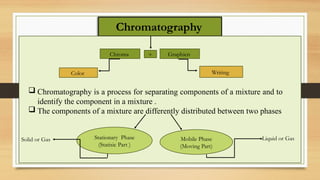
 Chromatography is a process for separating components of a mixture and to
identify the component in a mixture .
 The components of a mixture are differently distributed between two phases
Stationary Phase
(Statisic Part )
Mobile Phase
(Moving Part)
Solid or Gas Liquid or Gas
Chroma + Graphien
Color Writing
Introduction of Thin Layer Chromtaography
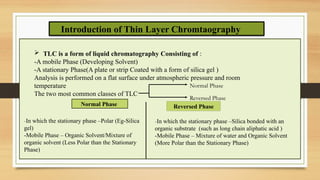
 TLC is a form of liquid chromatography Consisting of :
-A mobile Phase (Developing Solvent)
-A stationary Phase(A plate or strip Coated with a form of silica gel )
Analysis is performed on a flat surface under atmospheric pressure and room
temperature
The two most common classes of TLC
Normal Phase
Reversed Phase
Normal Phase Reversed Phase
-In which the stationary phase –Polar (Eg-Silica
gel)
-Mobile Phase – Organic Solvent/Mixture of
organic solvent (Less Polar than the Stationary
Phase)
-In which the stationary phase –Silica bonded with an
organic substrate (such as long chain aliphatic acid )
-Mobile Phase – Mixture of water and Organic Solvent
(More Polar than the Stationary Phase)
Principal of TLC
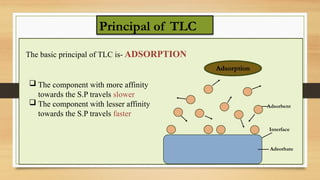
The basic principal of TLC is- ADSORPTION
 The component with more affinity
towards the S.P travels slower
 The component with lesser affinity
towards the S.P travels faster
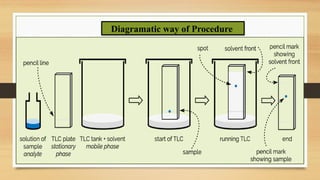
Diagramatic way of Procedure
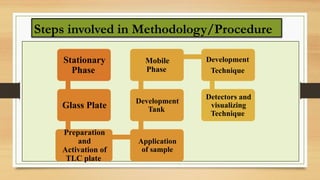
Steps involved in Methodology/Procedure
Stationary
Phase
Glass Plate
Preparation
and
Activation of
TLC plate
Application
of sample
Development
Tank
Mobile
Phase
Development
Technique
Detectors and
visualizing
Technique
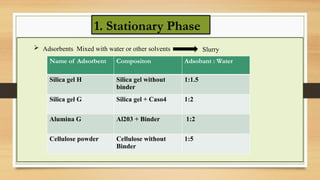
1. Stationary Phase
 Adsorbents Mixed with water or other solvents Slurry
Name of Adsorbent Compositon Adsobant : Water
Silica gel H Silica gel without
binder
1:1.5
Silica gel G Silica gel + Caso4 1:2
Alumina G Al203 + Binder 1:2
Cellulose powder Cellulose without
Binder
1:5
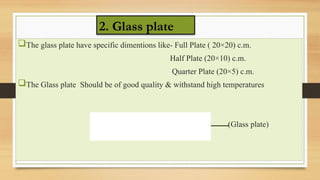
The glass plate have specific dimentions like- Full Plate ( 20×20) c.m.
Half Plate (20×10) c.m.
Quarter Plate (20×5) c.m.
The Glass plate Should be of good quality & withstand high temperatures
(Glass plate)
2. Glass plate
3. Preparation and activation of TLC plate
Slurry ,Whuch is a mixture of stationary phase and water is prepared by using ratio
mentioned earlier
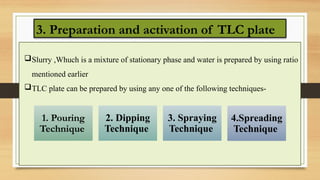
TLC plate can be prepared by using any one of the following techniques-
1. Pouring
Technique
2. Dipping
Technique
3. Spraying
Technique
4.Spreading
Technique
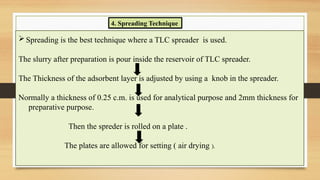
4. Spreading Technique
Spreading is the best technique where a TLC spreader is used.
The slurry after preparation is pour inside the reservoir of TLC spreader.
The Thickness of the adsorbent layer is adjusted by using a knob in the spreader.
Normally a thickness of 0.25 c.m. is used for analytical purpose and 2mm thickness for
preparative purpose.
Then the spreder is rolled on a plate .
The plates are allowed for setting ( air drying ).
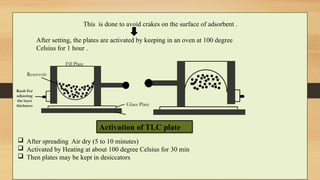
This is done to avoid crakes on the surface of adsorbent .
After setting, the plates are activated by keeping in an oven at 100 degree
Celsius for 1 hour .
Activation of TLC plate
 After spreading Air dry (5 to 10 minutes)
 Activated by Heating at about 100 degree Celsius for 30 min
 Then plates may be kept in desiccators
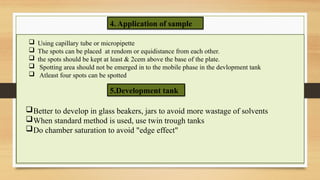
4. Application of sample
 Using capillary tube or micropipette
 The spots can be placed at rendom or equidistance from each other.
 the spots should be kept at least & 2cem above the base of the plate.
 Spotting area should not be emerged in to the mobile phase in the devlopment tank
 Atleast four spots can be spotted
5.Development tank
Better to develop in glass beakers, jars to avoid more wastage of solvents
When standard method is used, use twin trough tanks
Do chamber saturation to avoid "edge effect"
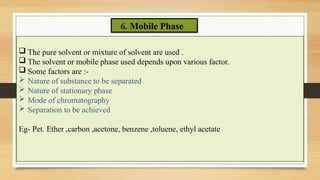
6. Mobile Phase
 The pure solvent or mixture of solvent are used .
 The solvent or mobile phase used depends upon various factor.
 Some factors are :-
 Nature of substance to be separated
 Nature of stationary phase
 Mode of chromatography
 Separation to be achieved
Eg- Pet. Ether ,carbon ,acetone, benzene ,toluene, ethyl acetate
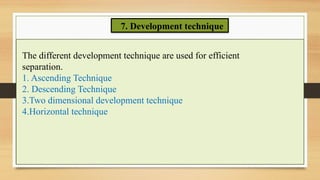
7. Development technique
The different development technique are used for efficient
separation.
1. Ascending Technique
2. Descending Technique
3.Two dimensional development technique
4.Horizontal technique
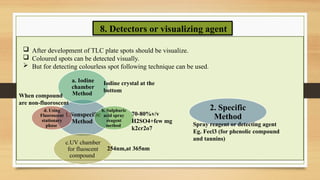
8. Detectors or visualizing agent
 After development of TLC plate spots should be visualize.
 Coloured spots can be detected visually.
 But for detecting colourless spot following technique can be used.
1.Nonspecific
Method
a. Iodine
chamber
Method
b. Sulphuric
acid spray
reagent
method
c.UV chamber
for fluoscent
compound
d. Using
Fluoroscent
stationary
phase
Iodine crystal at the
bottom
70-80%v/v
H2SO4+few mg
k2cr2o7
254nm,at 365nm
When compound
are non-fluoroscent
2. Specific
Method
Spray reagent or detecting agent
Eg. Fecl3 (for phenolic compound
and tannins)
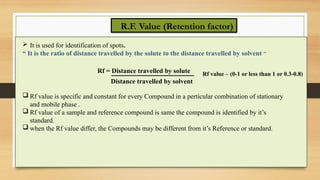
R.F. Value (Retention factor)
 It is used for identification of spots.
“ It is the ratio of distance travelled by the solute to the distance travelled by solvent “
Rf = Distance travelled by solute
Distance travelled by solvent
Rf value – (0-1 or less than 1 or 0.3-0.8)
 Rf value is specific and constant for every Compound in a perticular combination of stationary
and mobile phase .
 Rf value of a sample and reference compound is same the compound is identified by it’s
standard.
 when the Rf value differ, the Compounds may be different from it’s Reference or standard.
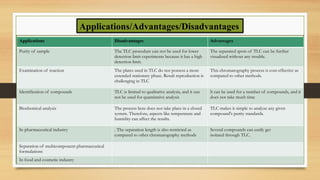
Applications/Advantages/Disadvantages
Applications Disadvantages Advantages
Purity of sample The TLC procedure can not be used for lower
detection limit experiments because it has a high
detection limit.
The separated spots of TLC can be further
visualized without any trouble.
Examination of reaction The plates used in TLC do not possess a more
extended stationary phase. Result reproduction is
challenging in TLC
This chromatography process is cost-effective as
compared to other methods.
Identification of compounds TLC is limited to qualitative analysis, and it can
not be used for quantitative analysis
lt can be used for a number of compounds, and it
does not take much time
Biochemical analysis The process here does not take place in a closed
system. Therefore, aspects like temperature and
humidity can affect the results.
TLC makes it simple to analyze any given
compound's purity standards.
In pharmaceutical industry . The separation length is also restricted as
compared to other chromatography methods
Several compounds can easily get
isolated through TLC.
Separation of multicomponent pharmaceutical
formulations
In food and cosmetic industry
Thin layer chromatography.(Abhni Gupta)pptx

Thin layer chromatography.(Abhni Gupta)pptx

  • 1.
    Thin Layer Chromatography(TLC) Under the supervision of Assistant Professor – Mrs. Ritu Rani Yadav Modern Pharmaceutical Analytical Techniques (MPH 101T) -Abhni Gupta -M-Pharm 1st Year (Pharmaceutics) PSIT- Pranveer Singh Institute of Technology (Pharmacy),Kanpur
  • 2.
    Chromatography  Chromatography isa process for separating components of a mixture and to identify the component in a mixture .  The components of a mixture are differently distributed between two phases Stationary Phase (Statisic Part ) Mobile Phase (Moving Part) Solid or Gas Liquid or Gas Chroma + Graphien Color Writing
  • 3.
    Introduction of ThinLayer Chromtaography  TLC is a form of liquid chromatography Consisting of : -A mobile Phase (Developing Solvent) -A stationary Phase(A plate or strip Coated with a form of silica gel ) Analysis is performed on a flat surface under atmospheric pressure and room temperature The two most common classes of TLC Normal Phase Reversed Phase Normal Phase Reversed Phase -In which the stationary phase –Polar (Eg-Silica gel) -Mobile Phase – Organic Solvent/Mixture of organic solvent (Less Polar than the Stationary Phase) -In which the stationary phase –Silica bonded with an organic substrate (such as long chain aliphatic acid ) -Mobile Phase – Mixture of water and Organic Solvent (More Polar than the Stationary Phase)
  • 4.
    Principal of TLC Thebasic principal of TLC is- ADSORPTION  The component with more affinity towards the S.P travels slower  The component with lesser affinity towards the S.P travels faster
  • 5.
  • 6.
    Steps involved inMethodology/Procedure Stationary Phase Glass Plate Preparation and Activation of TLC plate Application of sample Development Tank Mobile Phase Development Technique Detectors and visualizing Technique
  • 7.
    1. Stationary Phase Adsorbents Mixed with water or other solvents Slurry Name of Adsorbent Compositon Adsobant : Water Silica gel H Silica gel without binder 1:1.5 Silica gel G Silica gel + Caso4 1:2 Alumina G Al203 + Binder 1:2 Cellulose powder Cellulose without Binder 1:5
  • 8.
    The glass platehave specific dimentions like- Full Plate ( 20×20) c.m. Half Plate (20×10) c.m. Quarter Plate (20×5) c.m. The Glass plate Should be of good quality & withstand high temperatures (Glass plate) 2. Glass plate
  • 9.
    3. Preparation andactivation of TLC plate Slurry ,Whuch is a mixture of stationary phase and water is prepared by using ratio mentioned earlier TLC plate can be prepared by using any one of the following techniques- 1. Pouring Technique 2. Dipping Technique 3. Spraying Technique 4.Spreading Technique
  • 10.
    4. Spreading Technique Spreadingis the best technique where a TLC spreader is used. The slurry after preparation is pour inside the reservoir of TLC spreader. The Thickness of the adsorbent layer is adjusted by using a knob in the spreader. Normally a thickness of 0.25 c.m. is used for analytical purpose and 2mm thickness for preparative purpose. Then the spreder is rolled on a plate . The plates are allowed for setting ( air drying ).
  • 11.
    This is doneto avoid crakes on the surface of adsorbent . After setting, the plates are activated by keeping in an oven at 100 degree Celsius for 1 hour . Activation of TLC plate  After spreading Air dry (5 to 10 minutes)  Activated by Heating at about 100 degree Celsius for 30 min  Then plates may be kept in desiccators
  • 12.
    4. Application ofsample  Using capillary tube or micropipette  The spots can be placed at rendom or equidistance from each other.  the spots should be kept at least & 2cem above the base of the plate.  Spotting area should not be emerged in to the mobile phase in the devlopment tank  Atleast four spots can be spotted 5.Development tank Better to develop in glass beakers, jars to avoid more wastage of solvents When standard method is used, use twin trough tanks Do chamber saturation to avoid "edge effect"
  • 13.
    6. Mobile Phase The pure solvent or mixture of solvent are used .  The solvent or mobile phase used depends upon various factor.  Some factors are :-  Nature of substance to be separated  Nature of stationary phase  Mode of chromatography  Separation to be achieved Eg- Pet. Ether ,carbon ,acetone, benzene ,toluene, ethyl acetate
  • 14.
    7. Development technique Thedifferent development technique are used for efficient separation. 1. Ascending Technique 2. Descending Technique 3.Two dimensional development technique 4.Horizontal technique
  • 15.
    8. Detectors orvisualizing agent  After development of TLC plate spots should be visualize.  Coloured spots can be detected visually.  But for detecting colourless spot following technique can be used. 1.Nonspecific Method a. Iodine chamber Method b. Sulphuric acid spray reagent method c.UV chamber for fluoscent compound d. Using Fluoroscent stationary phase Iodine crystal at the bottom 70-80%v/v H2SO4+few mg k2cr2o7 254nm,at 365nm When compound are non-fluoroscent 2. Specific Method Spray reagent or detecting agent Eg. Fecl3 (for phenolic compound and tannins)
  • 16.
    R.F. Value (Retentionfactor)  It is used for identification of spots. “ It is the ratio of distance travelled by the solute to the distance travelled by solvent “ Rf = Distance travelled by solute Distance travelled by solvent Rf value – (0-1 or less than 1 or 0.3-0.8)  Rf value is specific and constant for every Compound in a perticular combination of stationary and mobile phase .  Rf value of a sample and reference compound is same the compound is identified by it’s standard.  when the Rf value differ, the Compounds may be different from it’s Reference or standard.
  • 17.
    Applications/Advantages/Disadvantages Applications Disadvantages Advantages Purityof sample The TLC procedure can not be used for lower detection limit experiments because it has a high detection limit. The separated spots of TLC can be further visualized without any trouble. Examination of reaction The plates used in TLC do not possess a more extended stationary phase. Result reproduction is challenging in TLC This chromatography process is cost-effective as compared to other methods. Identification of compounds TLC is limited to qualitative analysis, and it can not be used for quantitative analysis lt can be used for a number of compounds, and it does not take much time Biochemical analysis The process here does not take place in a closed system. Therefore, aspects like temperature and humidity can affect the results. TLC makes it simple to analyze any given compound's purity standards. In pharmaceutical industry . The separation length is also restricted as compared to other chromatography methods Several compounds can easily get isolated through TLC. Separation of multicomponent pharmaceutical formulations In food and cosmetic industry