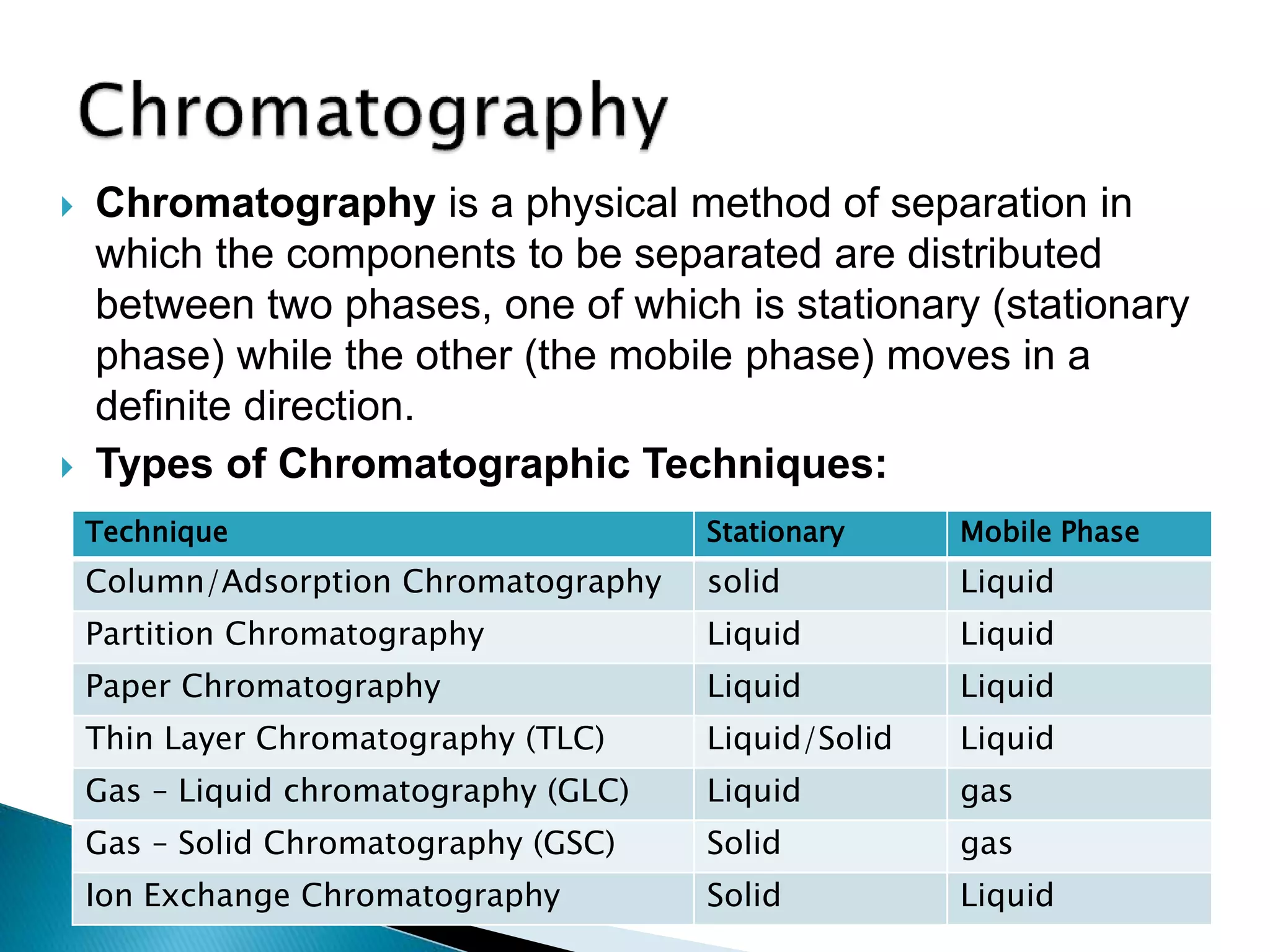
 Chromatography is a physical method of separation in
which the components to be separated are distributed
between two phases, one of which is stationary (stationary
phase) while the other (the mobile phase) moves in a
definite direction.
 Types of Chromatographic Techniques:
Technique Stationary Mobile Phase
Column/Adsorption Chromatography solid Liquid
Partition Chromatography Liquid Liquid
Paper Chromatography Liquid Liquid
Thin Layer Chromatography (TLC) Liquid/Solid Liquid
Gas – Liquid chromatography (GLC) Liquid gas
Gas – Solid Chromatography (GSC) Solid gas
Ion Exchange Chromatography Solid Liquid
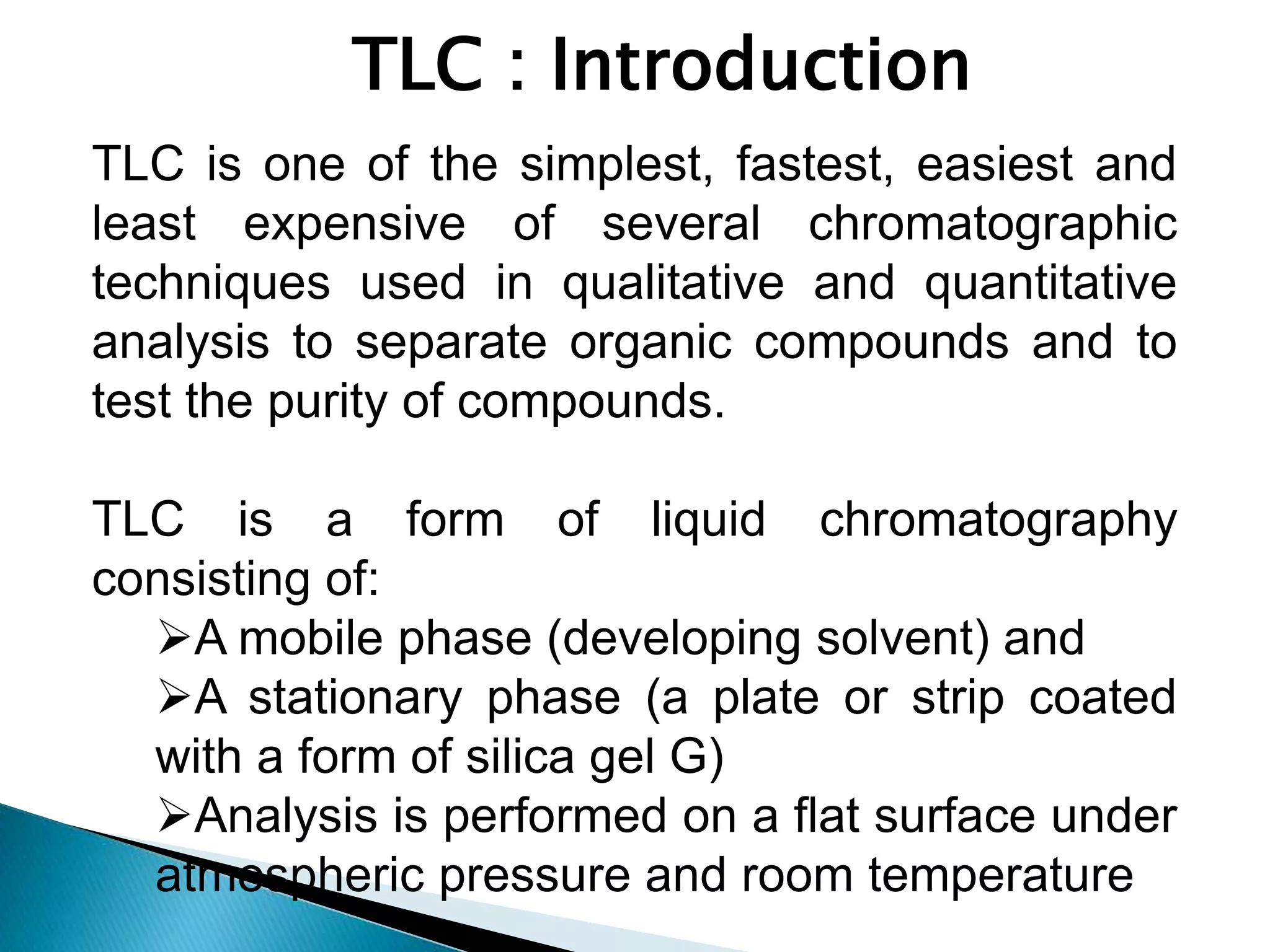
TLC : Introduction
TLC is one of the simplest, fastest, easiest and
least expensive of several chromatographic
techniques used in qualitative and quantitative
analysis to separate organic compounds and to
test the purity of compounds.
TLC is a form of liquid chromatography
consisting of:
A mobile phase (developing solvent) and
A stationary phase (a plate or strip coated
with a form of silica gel G)
Analysis is performed on a flat surface under
atmospheric pressure and room temperature
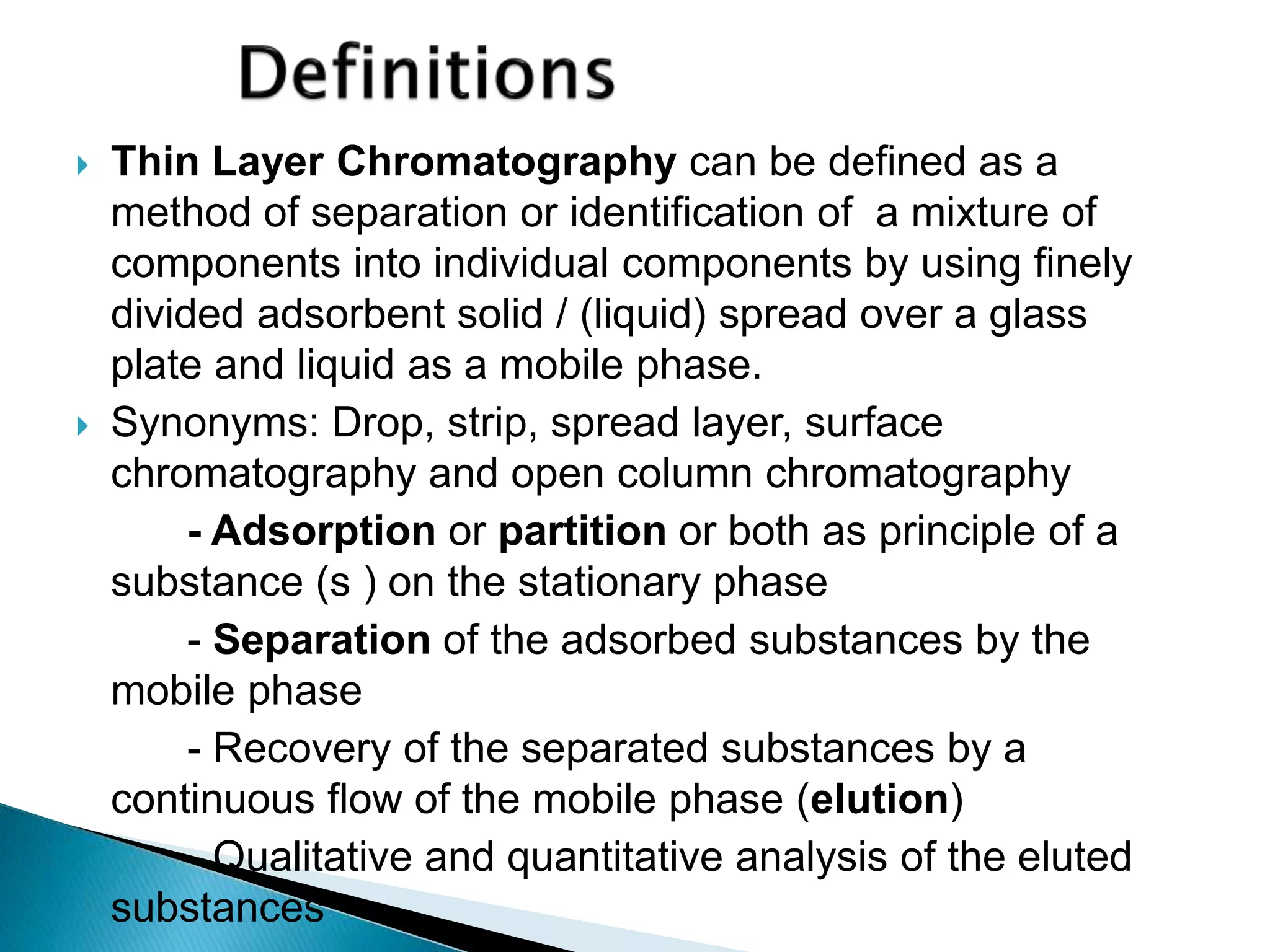
 Thin Layer Chromatography can be defined as a
method of separation or identification of a mixture of
components into individual components by using finely
divided adsorbent solid / (liquid) spread over a glass
plate and liquid as a mobile phase.
 Synonyms: Drop, strip, spread layer, surface
chromatography and open column chromatography
- Adsorption or partition or both as principle of a
substance (s ) on the stationary phase
- Separation of the adsorbed substances by the
mobile phase
- Recovery of the separated substances by a
continuous flow of the mobile phase (elution)
- Qualitative and quantitative analysis of the eluted
substances
 Substances are nonvolatile or of low volatility
 The subs are strongly polar, of medium polarity,
nonpolar or ionic.
 Large no. of samples must be analyzed
simultaneously. cost effectively and within short
duration of time.
 Components of a mixture of subs after separation
have to be detected individually or have to be
subjected to various detection methods.
 Material can not be detected by the method of LC or
GC.
Principle of TLC
It is based on the principle of adsorption
chromatography or partition chromatography or
combination of both, depending on adsorbent, its
treatment and nature of solvents employed
•The components with more affinity towards stationary
phase travels slower.
•Components with less affinity towards stationary phase
travels faster
•In TLC, a solid phase, the adsorbent, is coated onto a
solid support (thin sheet of glass, plastic, and aluminum )
as a thin layer (about 0.25 mm thick). In many cases, a
small amount of a binder such as plaster of Paris is mixed
with the absorbent to facilitate the coating.
 The mixture (A + B) to be separated is dissolved in a solvent
and the resulting solution is spotted onto the thin layer plate
near the bottom. A solvent, or mixture of solvents, called the
eluent, is allowed to flow up the plate by capillary action.
 Separation of mixtures in microgram quantities by movement
of a solvent across a flat surface; components migrate at
different rates due to differences in solubility, adsorption, size
or charge; elution is halted when or before the solvent front
reaches the opposite side of the surface and the components
examined in situ or removed for further analysis.
Separations in TLC involve distributing a mixture
of two or more substances between a stationary
phase and a mobile phase
1.The stationary phase:
is a thin layer of adsorbent (usually silica gel or
alumina) coated on a plate.
2.The mobile phase:
is a developing liquid which travels up the
stationary phase, carrying the samples with it.
Components of the samples will separate on the
stationary phase according to:
how much they adsorb on the stationary
phase versus how much they rise in the
mobile phase
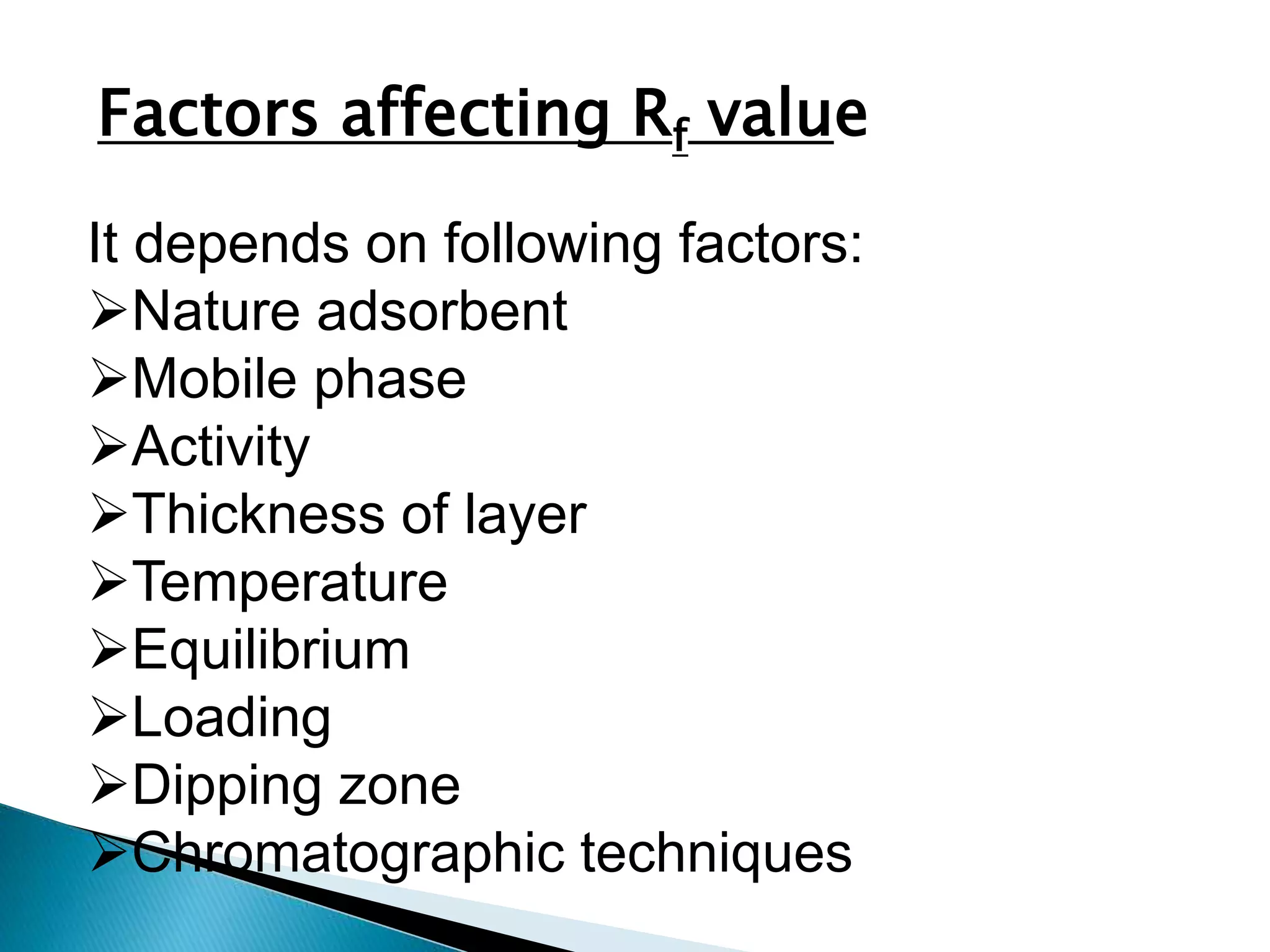
Factors affecting Rf value
It depends on following factors:
Nature adsorbent
Mobile phase
Activity
Thickness of layer
Temperature
Equilibrium
Loading
Dipping zone
Chromatographic techniques
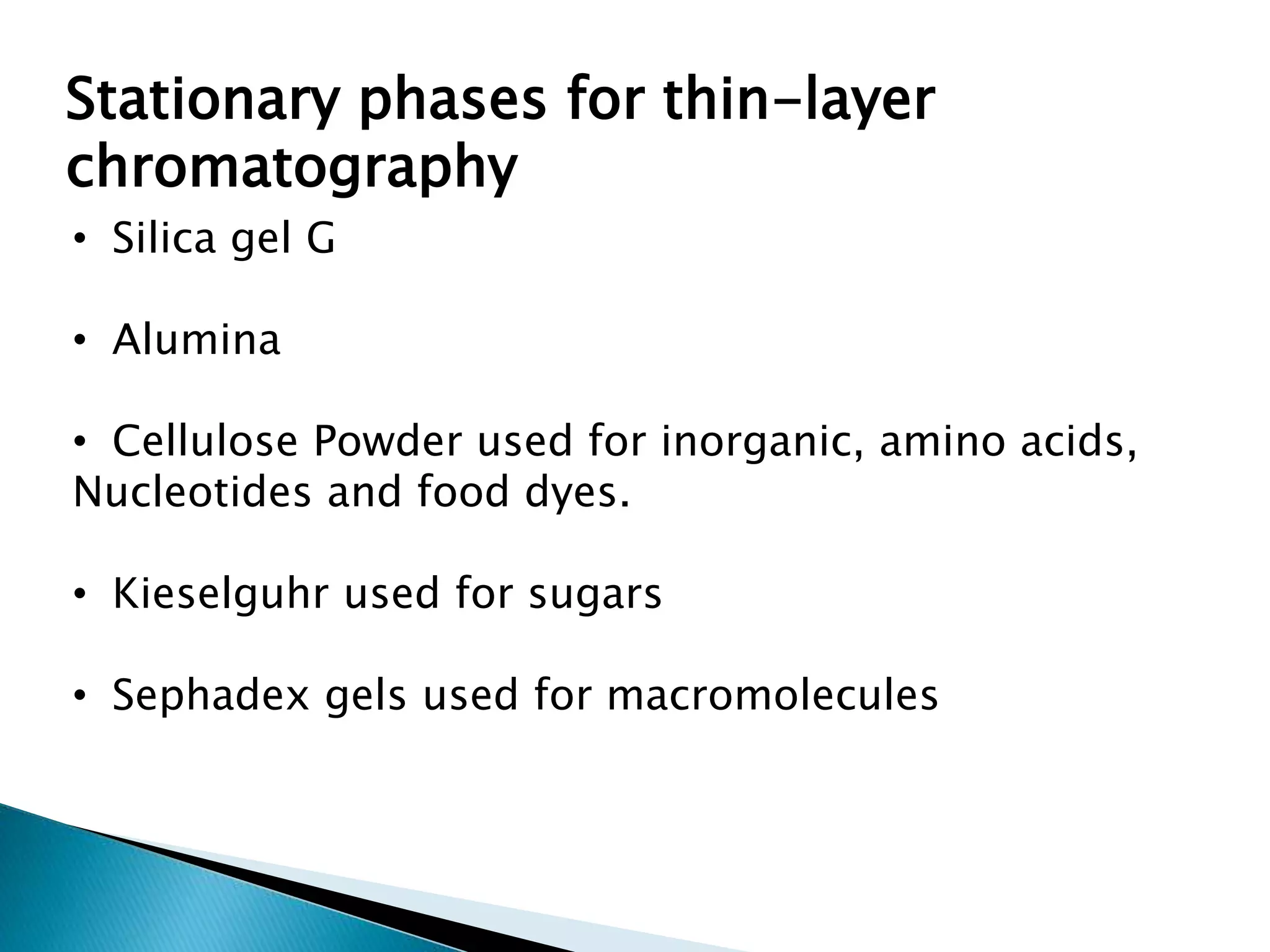
Stationary phases for thin-layer
chromatography
• Silica gel G
• Alumina
• Cellulose Powder used for inorganic, amino acids,
Nucleotides and food dyes.
• Kieselguhr used for sugars
• Sephadex gels used for macromolecules
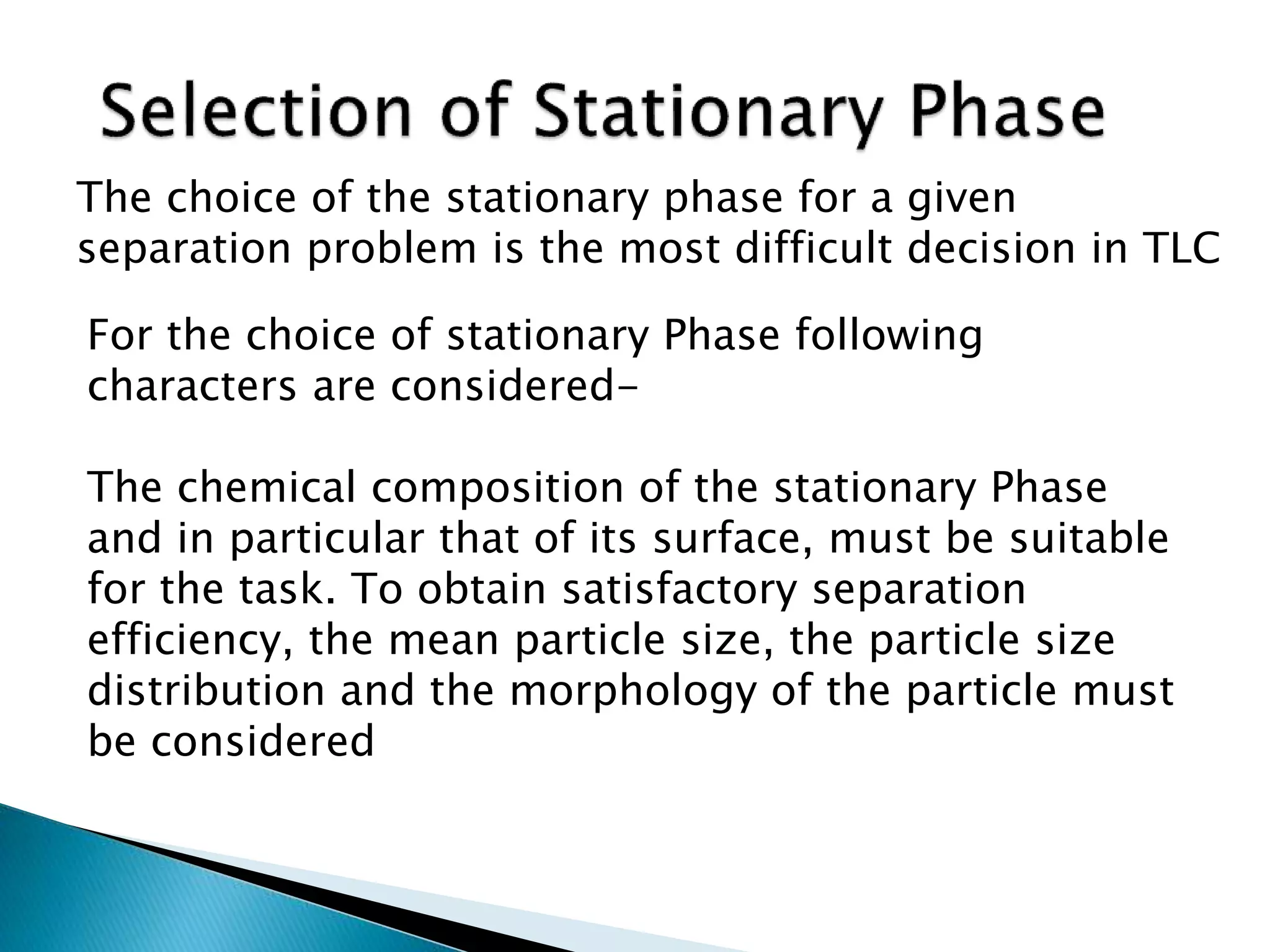
The choice of the stationary phase for a given
separation problem is the most difficult decision in TLC
For the choice of stationary Phase following
characters are considered-
The chemical composition of the stationary Phase
and in particular that of its surface, must be suitable
for the task. To obtain satisfactory separation
efficiency, the mean particle size, the particle size
distribution and the morphology of the particle must
be considered
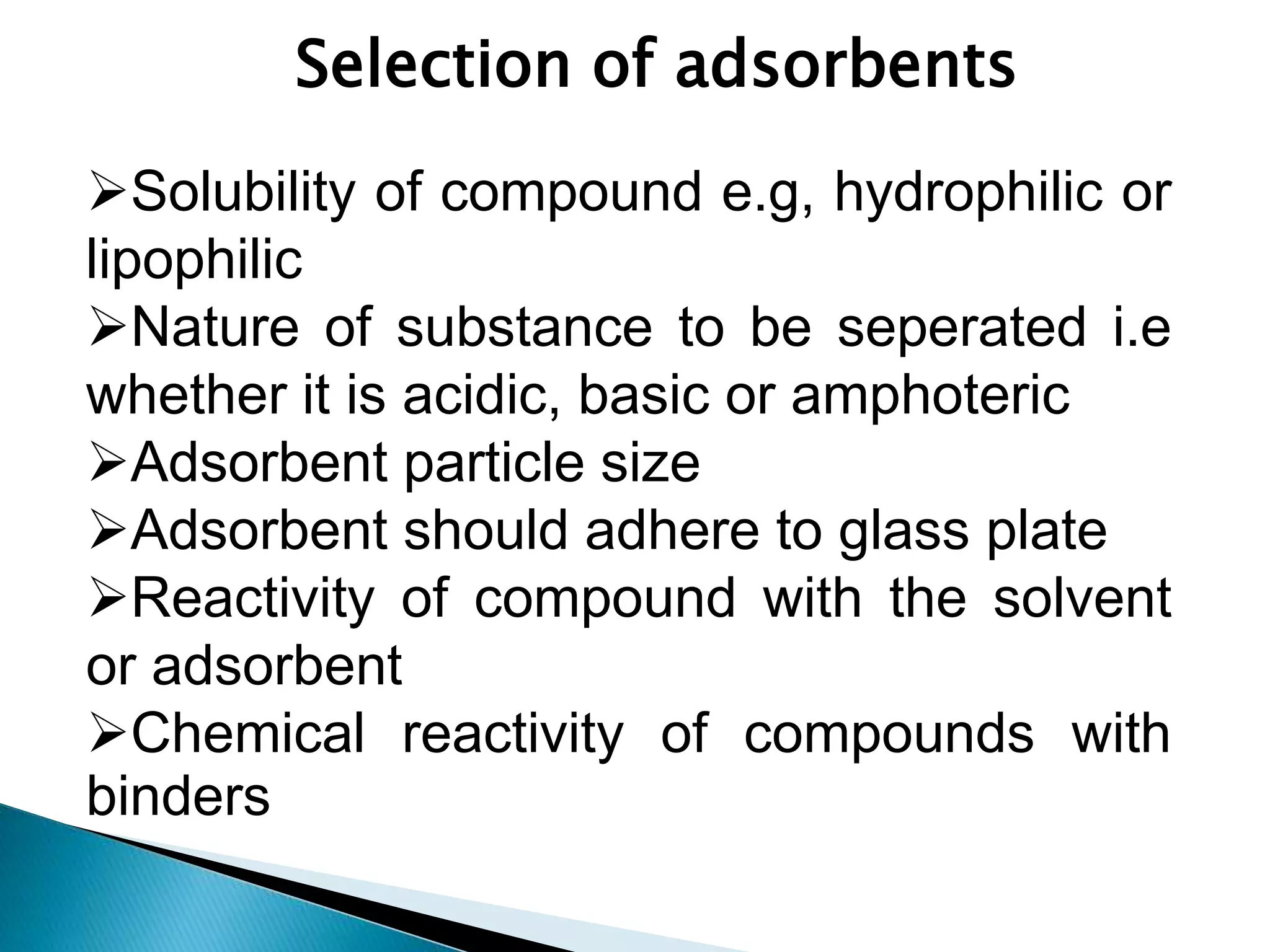
Selection of adsorbents
Solubility of compound e.g, hydrophilic or
lipophilic
Nature of substance to be seperated i.e
whether it is acidic, basic or amphoteric
Adsorbent particle size
Adsorbent should adhere to glass plate
Reactivity of compound with the solvent
or adsorbent
Chemical reactivity of compounds with
binders
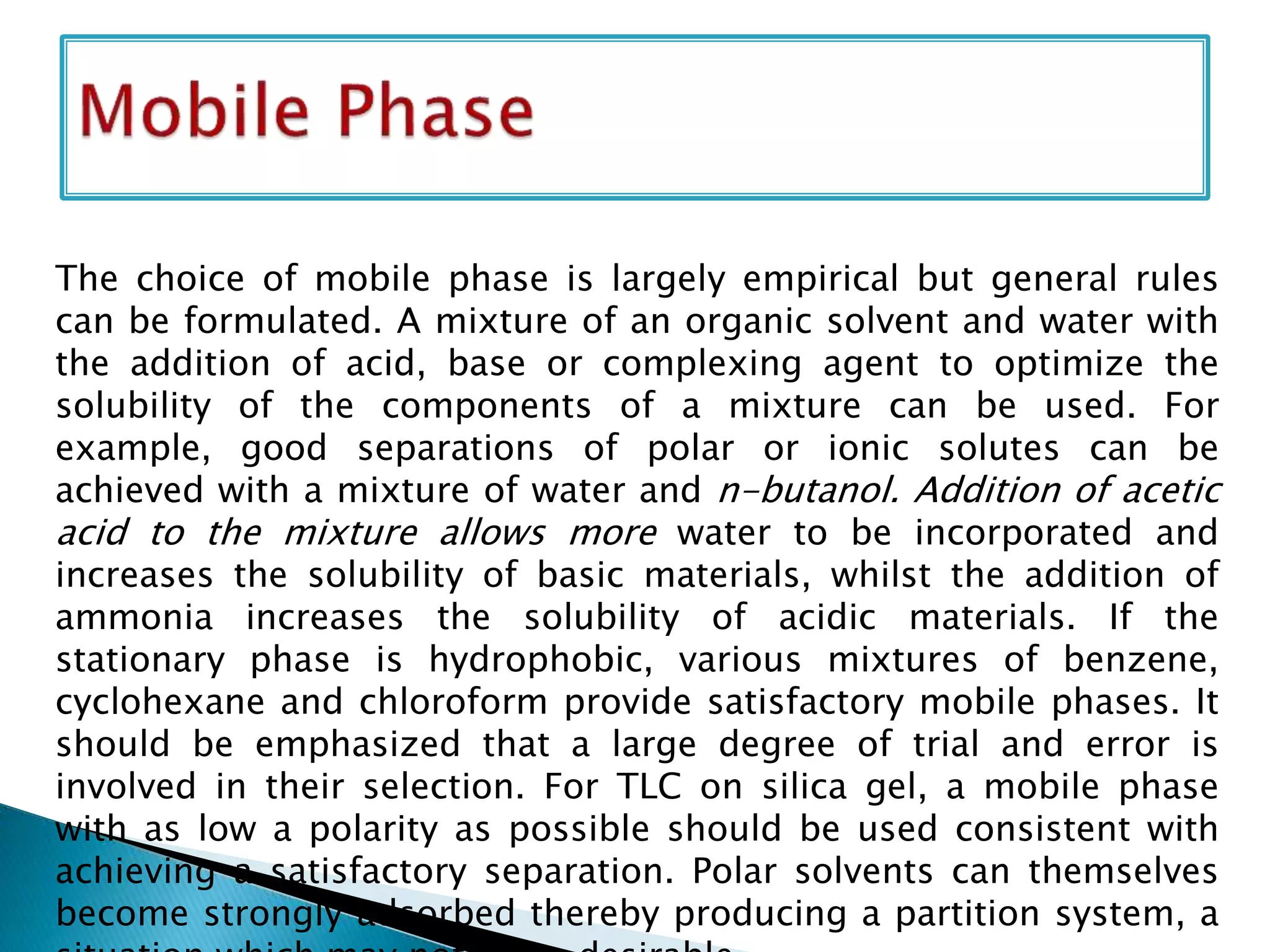
The choice of mobile phase is largely empirical but general rules
can be formulated. A mixture of an organic solvent and water with
the addition of acid, base or complexing agent to optimize the
solubility of the components of a mixture can be used. For
example, good separations of polar or ionic solutes can be
achieved with a mixture of water and n-butanol. Addition of acetic
acid to the mixture allows more water to be incorporated and
increases the solubility of basic materials, whilst the addition of
ammonia increases the solubility of acidic materials. If the
stationary phase is hydrophobic, various mixtures of benzene,
cyclohexane and chloroform provide satisfactory mobile phases. It
should be emphasized that a large degree of trial and error is
involved in their selection. For TLC on silica gel, a mobile phase
with as low a polarity as possible should be used consistent with
achieving a satisfactory separation. Polar solvents can themselves
become strongly adsorbed thereby producing a partition system, a
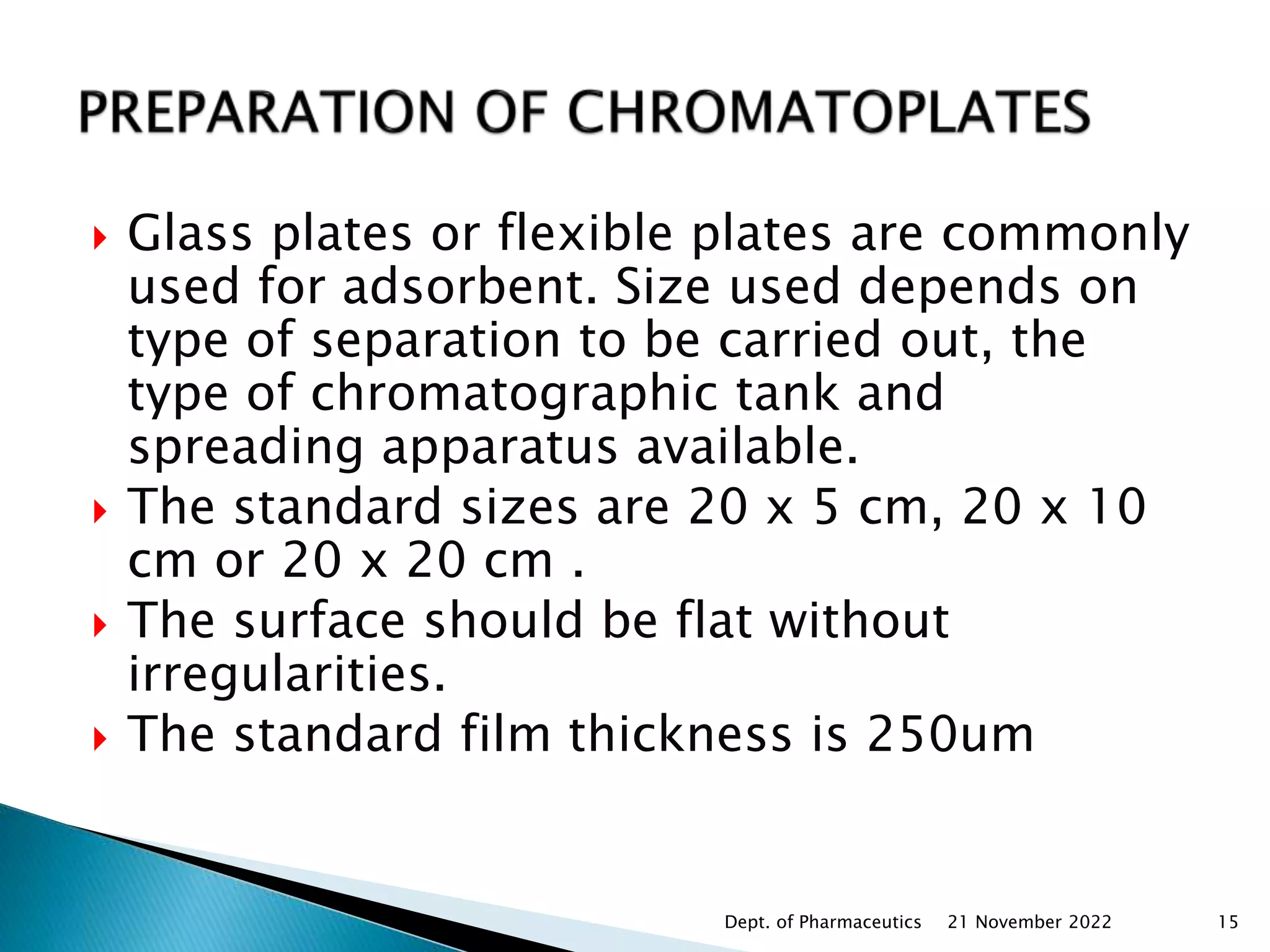
 Glass plates or flexible plates are commonly
used for adsorbent. Size used depends on
type of separation to be carried out, the
type of chromatographic tank and
spreading apparatus available.
 The standard sizes are 20 x 5 cm, 20 x 10
cm or 20 x 20 cm .
 The surface should be flat without
irregularities.
 The standard film thickness is 250um
21 November 2022
Dept. of Pharmaceutics 15
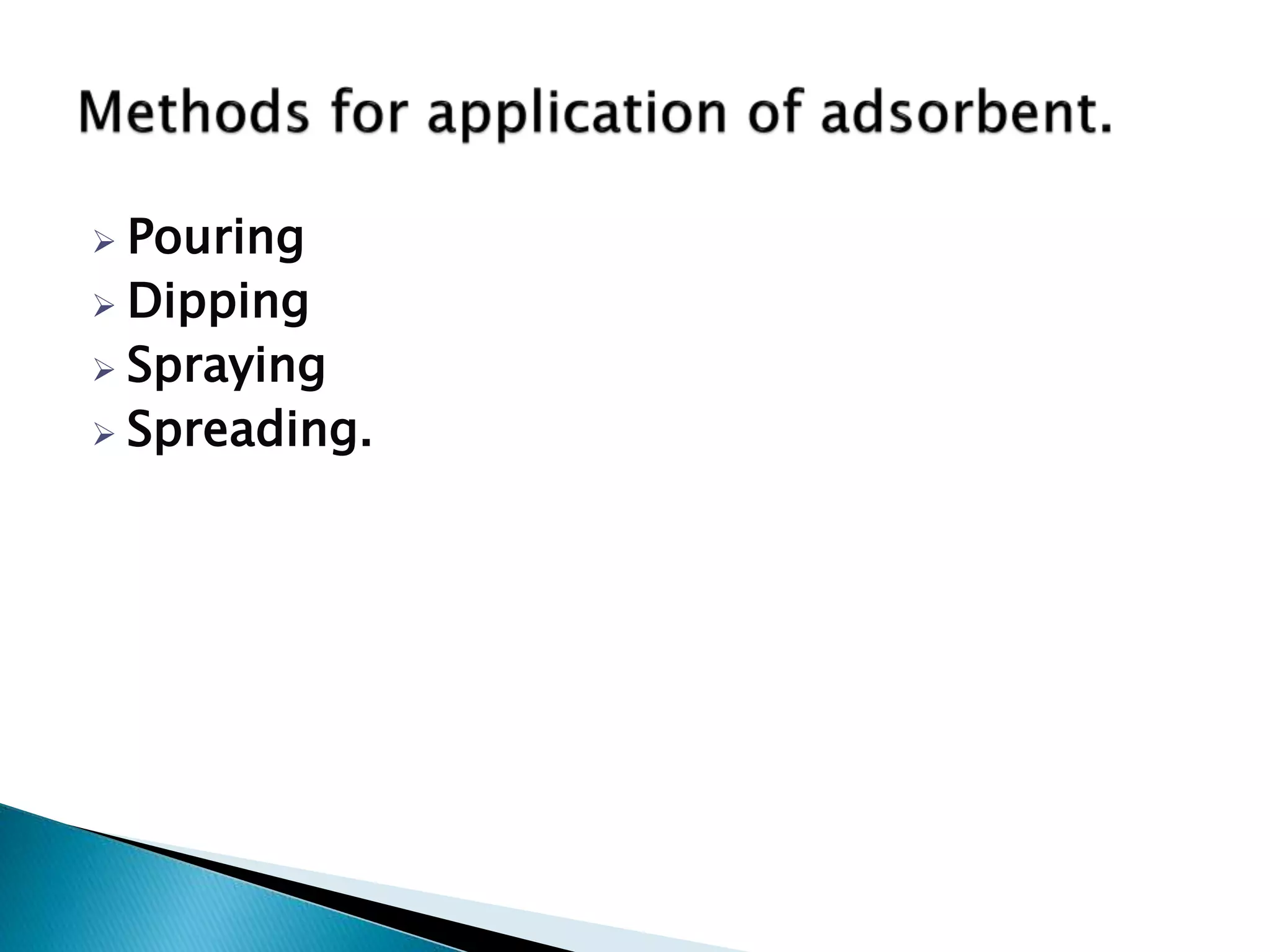
 Pouring
 Dipping
 Spraying
 Spreading.
 Pouring: The adsorbent of finely divided and
homogeneous particle size is made into
slurry and is poured on a plate and allowed to
flow over it so that it is evenly covered.
 Dipping : This technique is used for small
plates by dipping the two plates at a time,
back to back in a slurry of adsorbent in
chloroform or other volatile solvents. Exact
thickness of layer is not known and evenness
of layer may not be good.
 Spraying : Slurry is diluted further for the
operation of sprayer. But this technique is not
used now a days as it is difficult to get
uniform layer.
 Spreading : All the above methods fail to give
thin and uniform layers. Modern methods
utilize the spreading devices for preparation
of uniform thin layers on glass plates.
Commercial spreaders are of two types (a)
Moving spreader, (b) Moving plate type.
It gives layer thickness from 0.2 to 2.0 mm.
 After spreading plates are allowed to dry in
air and further dried and activated by heating
at about 100
0
c for 30 mins.
 By removing the liquids associated with layer
completely, the adsorbent layer is activated.
The solvent system performs the following main tasks:
 To dissolve the mixture of substances,
 To transport the substances to be separated across
the sorbent layer,
 To give Rf values in the medium range, or as near to
this as possible,
 To provide adequate selectivity for the substance
mixture to be separated.
They should also fulfill the following requirements:
 Adequate purity, Adequate stability,
 Low viscosity,
 Linear partition isotherm,
 A Vapor pressure that is neither very low nor very
high,
 Toxicity that is as low as possible
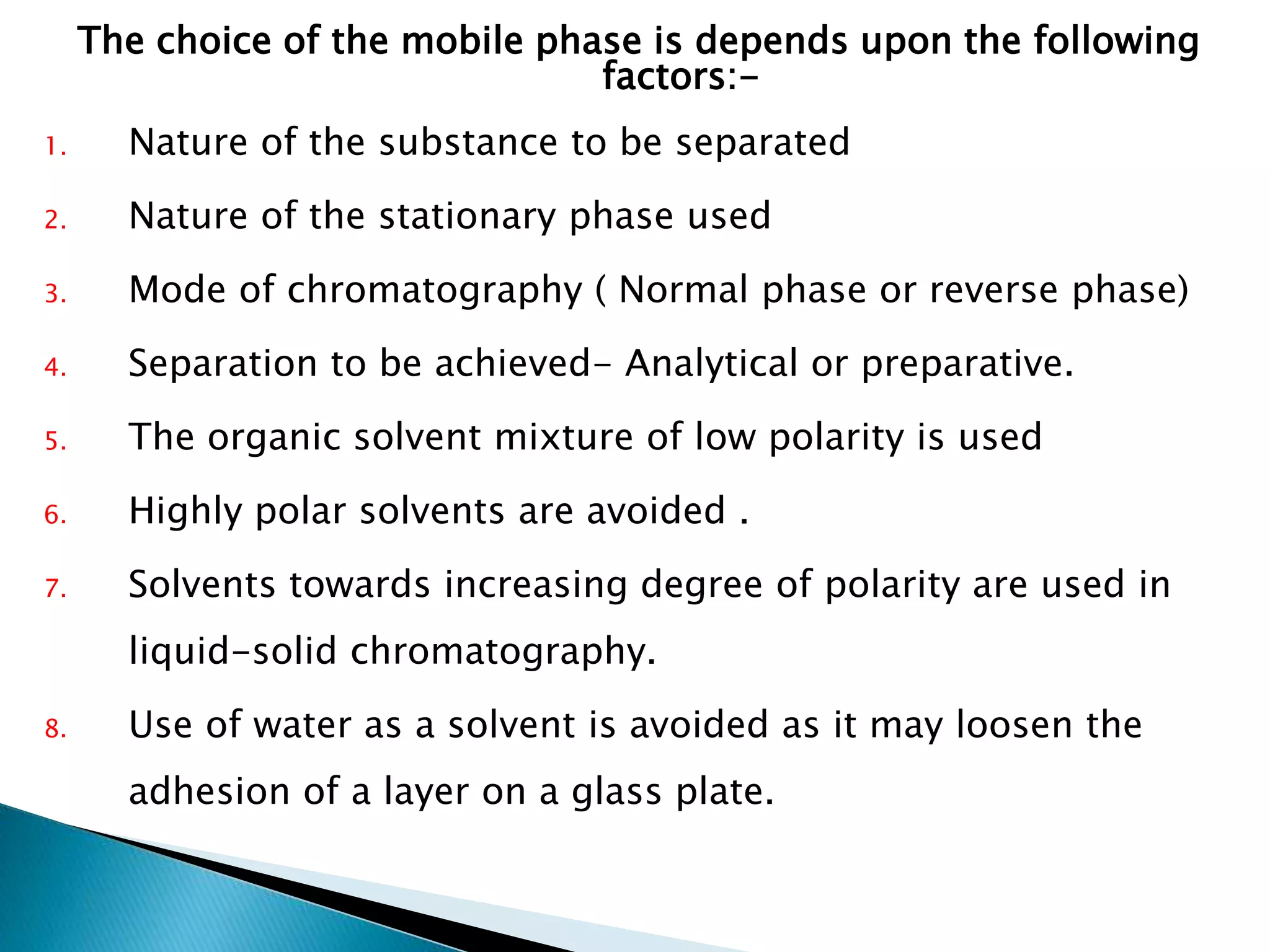
The choice of the mobile phase is depends upon the following
factors:-
1. Nature of the substance to be separated
2. Nature of the stationary phase used
3. Mode of chromatography ( Normal phase or reverse phase)
4. Separation to be achieved- Analytical or preparative.
5. The organic solvent mixture of low polarity is used
6. Highly polar solvents are avoided .
7. Solvents towards increasing degree of polarity are used in
liquid-solid chromatography.
8. Use of water as a solvent is avoided as it may loosen the
adhesion of a layer on a glass plate.
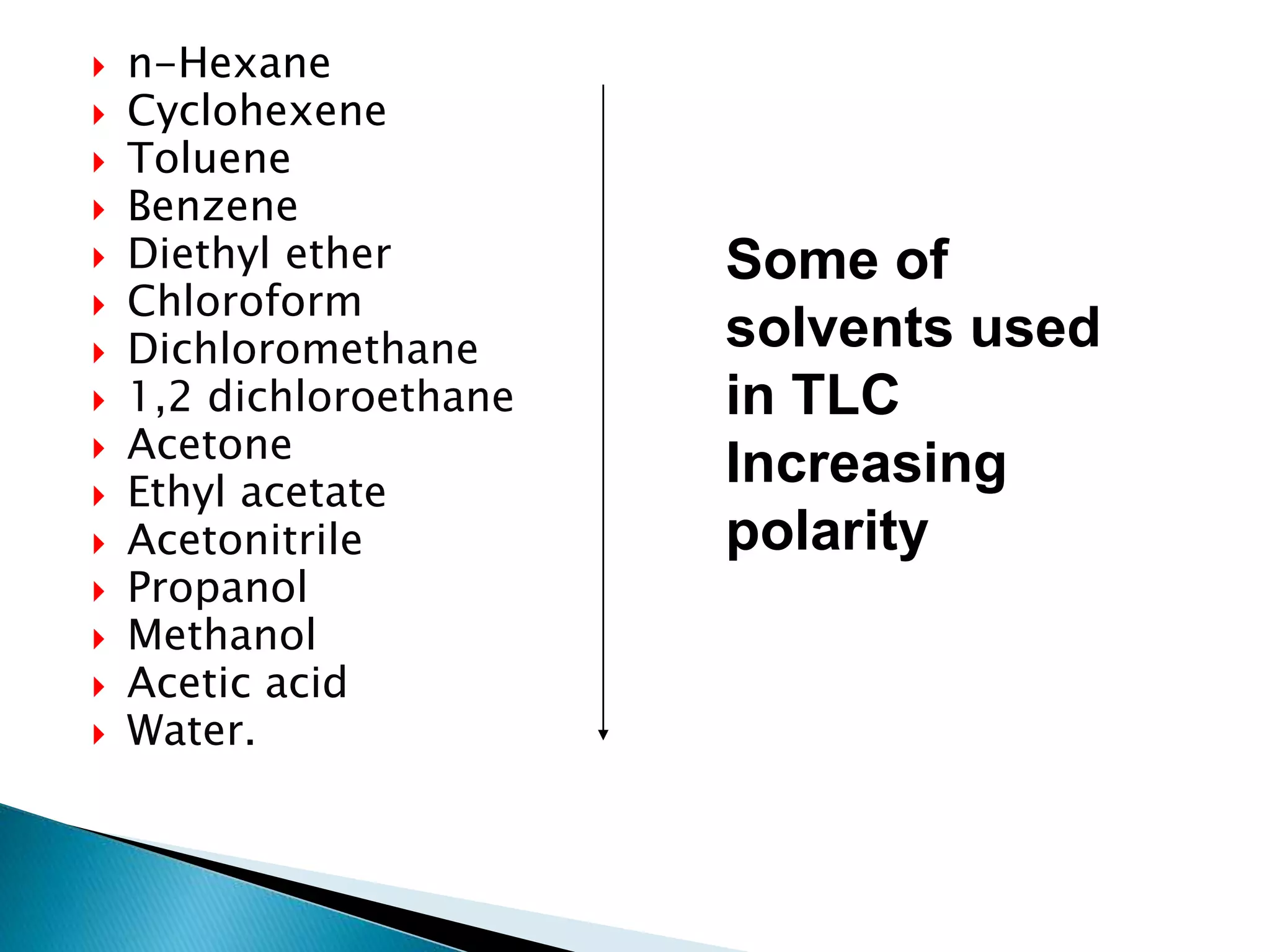
 n-Hexane
 Cyclohexene
 Toluene
 Benzene
 Diethyl ether
 Chloroform
 Dichloromethane
 1,2 dichloroethane
 Acetone
 Ethyl acetate
 Acetonitrile
 Propanol
 Methanol
 Acetic acid
 Water.
Some of
solvents used
in TLC
Increasing
polarity
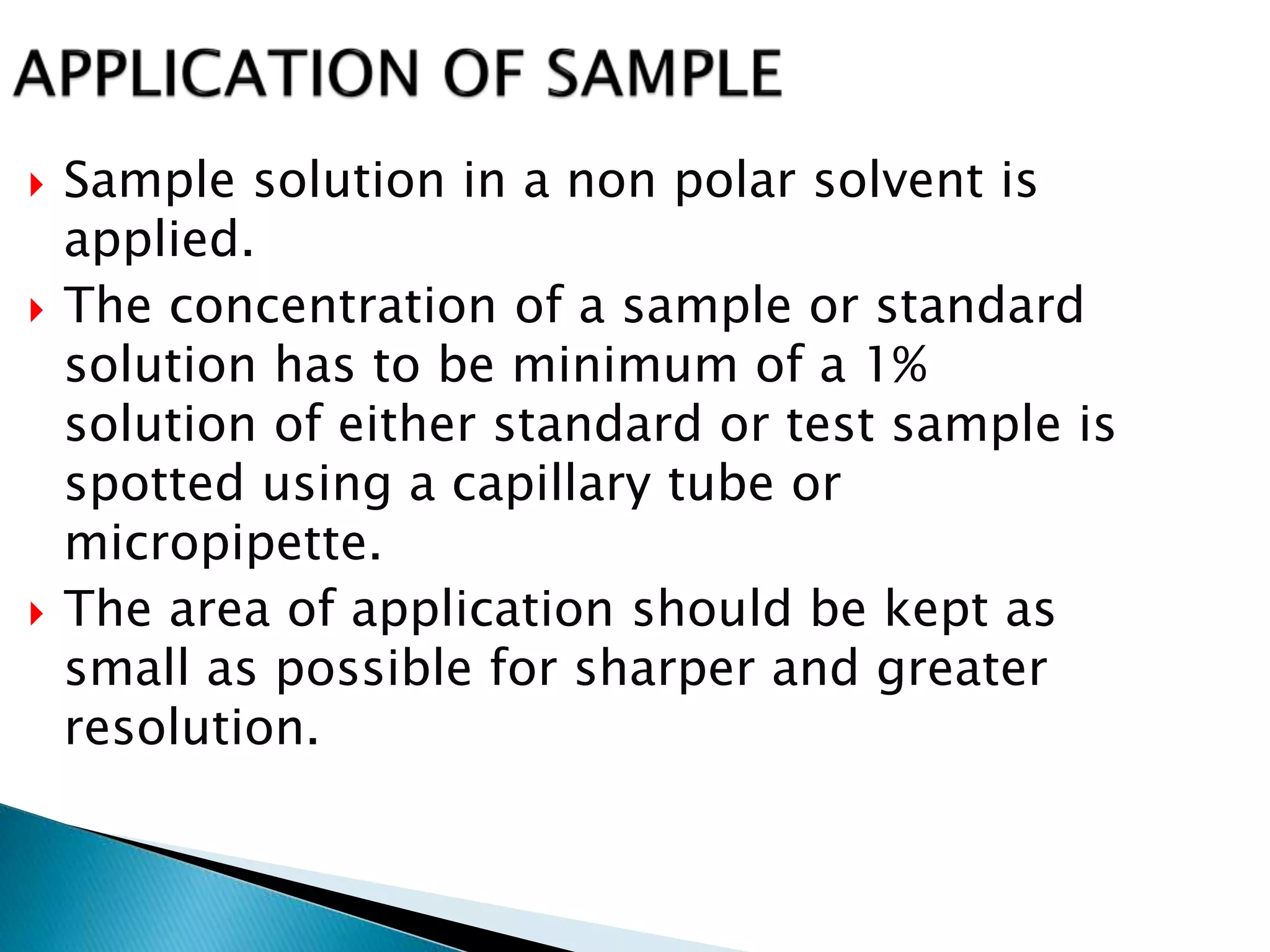
 Sample solution in a non polar solvent is
applied.
 The concentration of a sample or standard
solution has to be minimum of a 1%
solution of either standard or test sample is
spotted using a capillary tube or
micropipette.
 The area of application should be kept as
small as possible for sharper and greater
resolution.
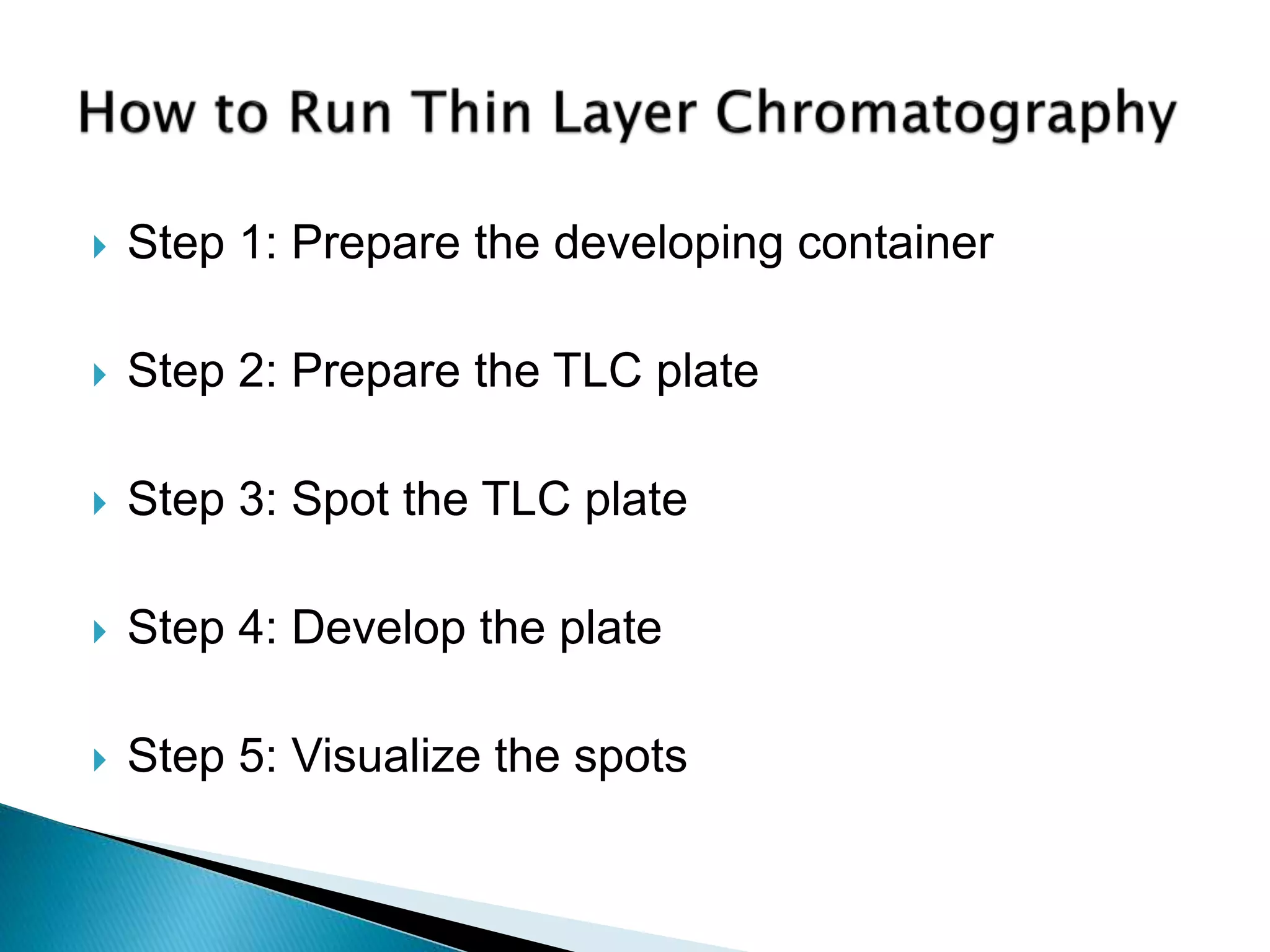
 Step 1: Prepare the developing container
 Step 2: Prepare the TLC plate
 Step 3: Spot the TLC plate
 Step 4: Develop the plate
 Step 5: Visualize the spots
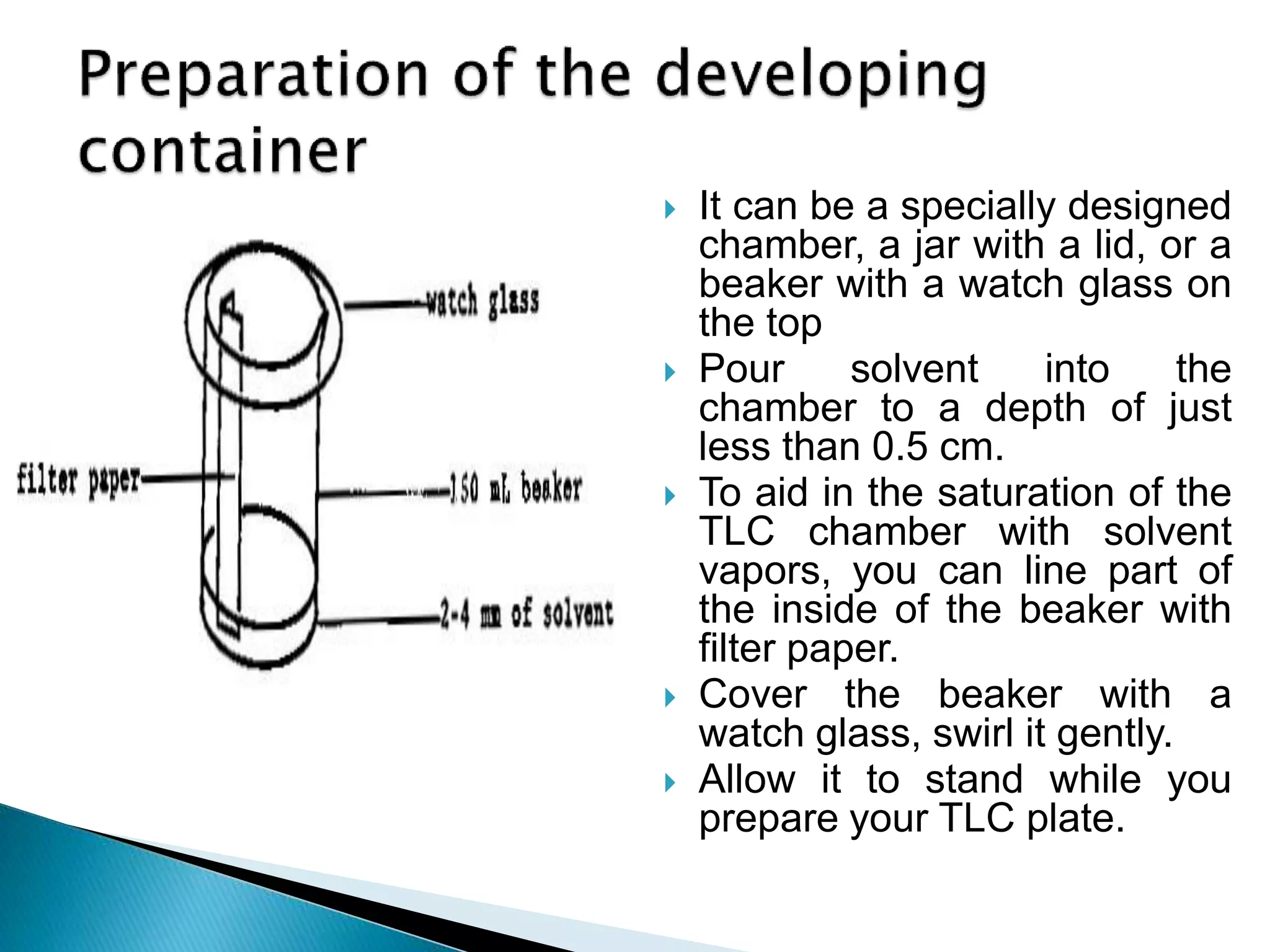
 It can be a specially designed
chamber, a jar with a lid, or a
beaker with a watch glass on
the top
 Pour solvent into the
chamber to a depth of just
less than 0.5 cm.
 To aid in the saturation of the
TLC chamber with solvent
vapors, you can line part of
the inside of the beaker with
filter paper.
 Cover the beaker with a
watch glass, swirl it gently.
 Allow it to stand while you
prepare your TLC plate.
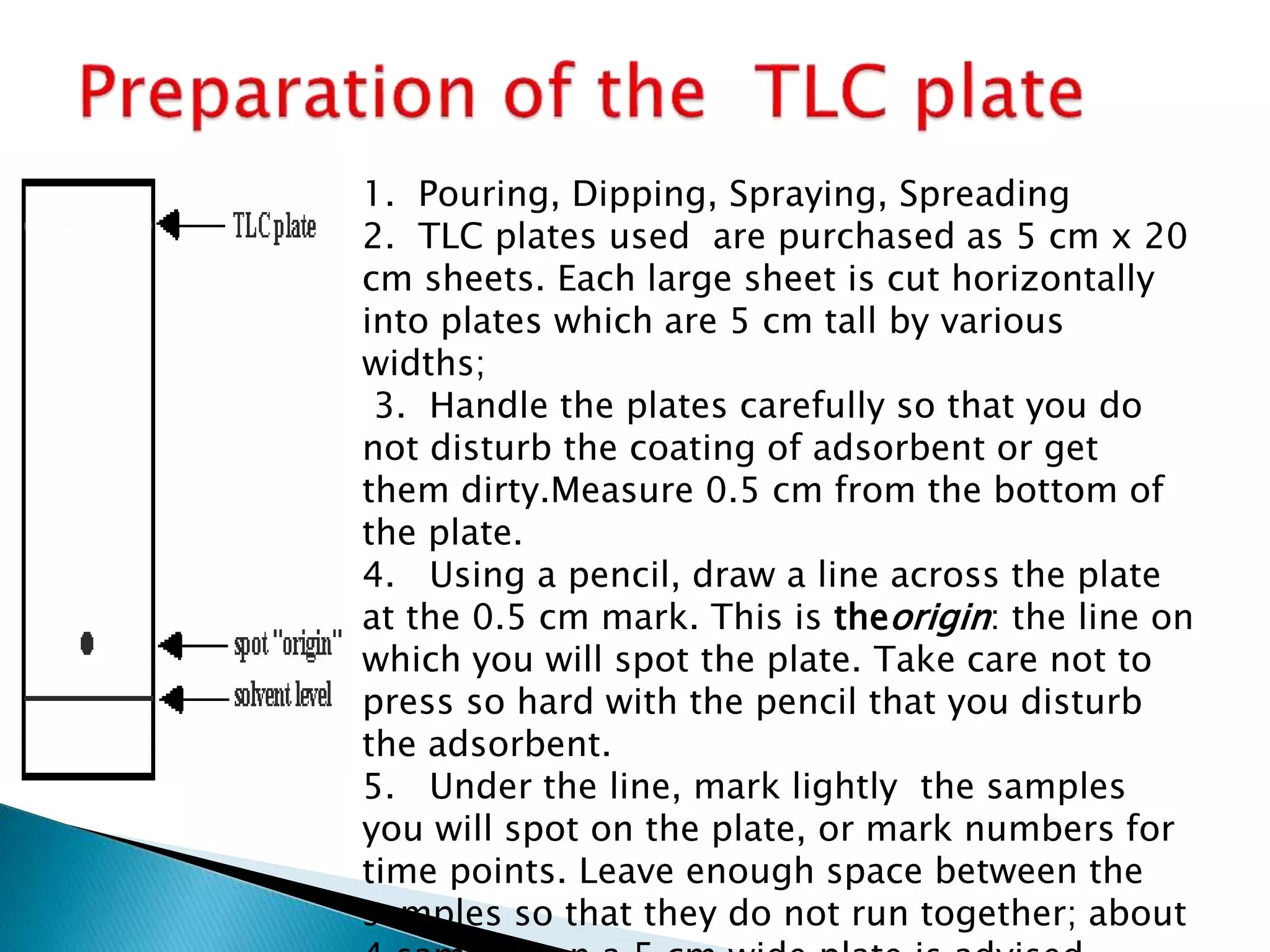
1. Pouring, Dipping, Spraying, Spreading
2. TLC plates used are purchased as 5 cm x 20
cm sheets. Each large sheet is cut horizontally
into plates which are 5 cm tall by various
widths;
3. Handle the plates carefully so that you do
not disturb the coating of adsorbent or get
them dirty.Measure 0.5 cm from the bottom of
the plate.
4. Using a pencil, draw a line across the plate
at the 0.5 cm mark. This is theorigin: the line on
which you will spot the plate. Take care not to
press so hard with the pencil that you disturb
the adsorbent.
5. Under the line, mark lightly the samples
you will spot on the plate, or mark numbers for
time points. Leave enough space between the
samples so that they do not run together; about
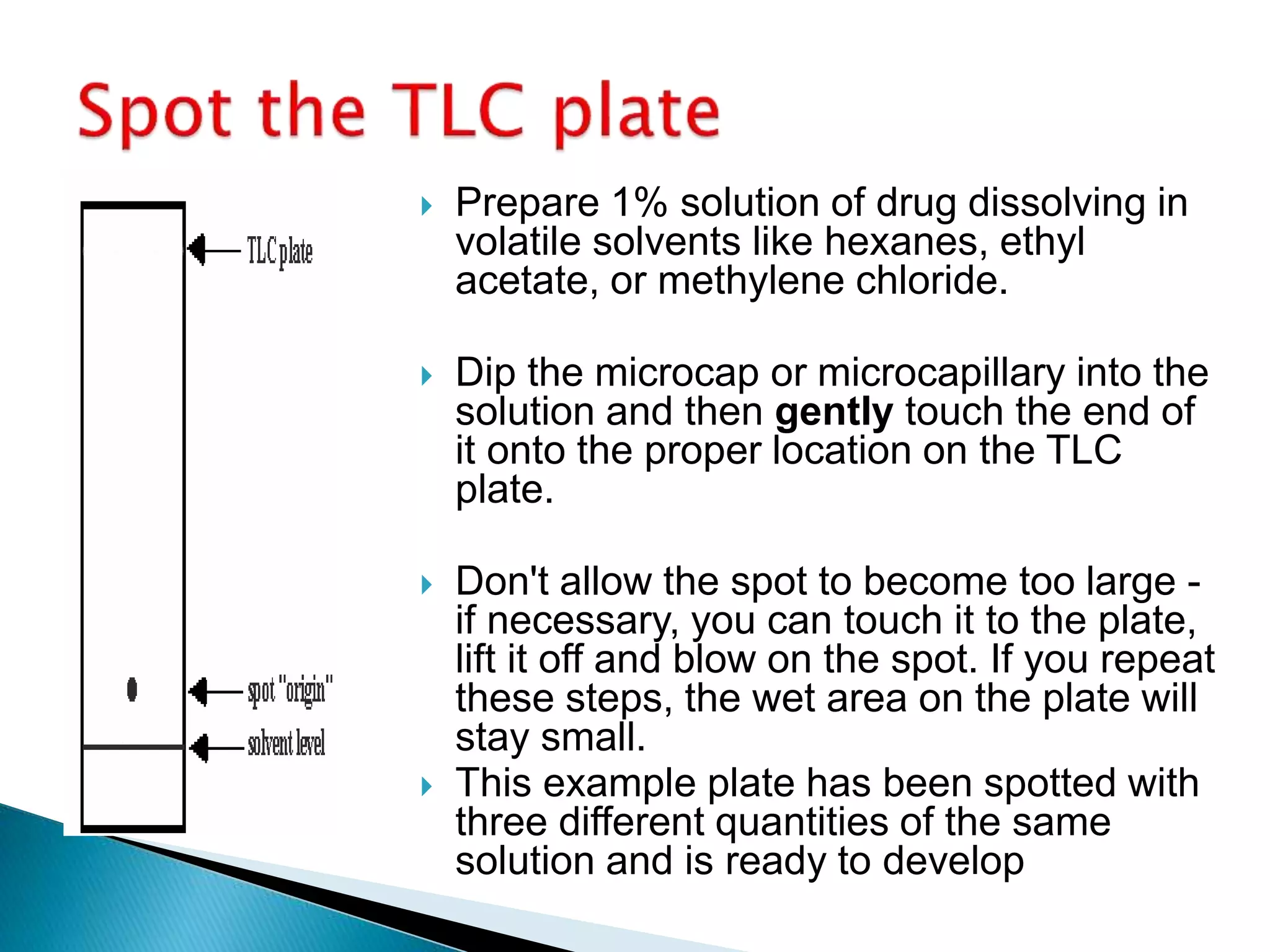
 Prepare 1% solution of drug dissolving in
volatile solvents like hexanes, ethyl
acetate, or methylene chloride.
 Dip the microcap or microcapillary into the
solution and then gently touch the end of
it onto the proper location on the TLC
plate.
 Don't allow the spot to become too large -
if necessary, you can touch it to the plate,
lift it off and blow on the spot. If you repeat
these steps, the wet area on the plate will
stay small.
 This example plate has been spotted with
three different quantities of the same
solution and is ready to develop
 Place the prepared TLC plate in the developing beaker,
cover the beaker with the watch glass, and leave it
undisturbed on your bench top.
 The solvent will rise up the TLC plate by capillary action.
Make sure the solvent does not cover the spot.
 Allow the plate to develop until the solvent is about half a
centimeter below the top of the plate.
 Remove the plate from the beaker and immediately mark
the solvent front with a pencil
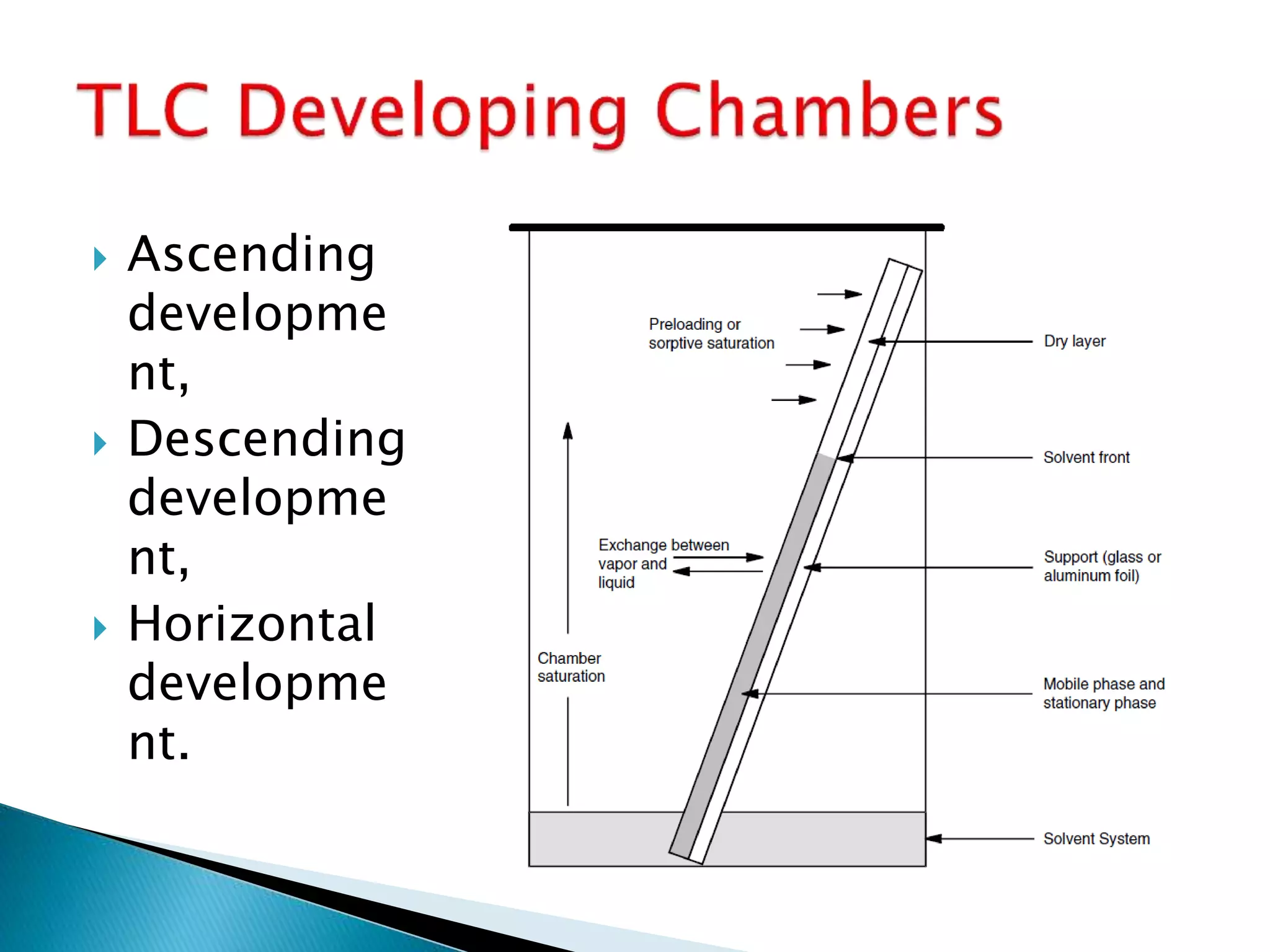
 Ascending
developme
nt,
 Descending
developme
nt,
 Horizontal
developme
nt.
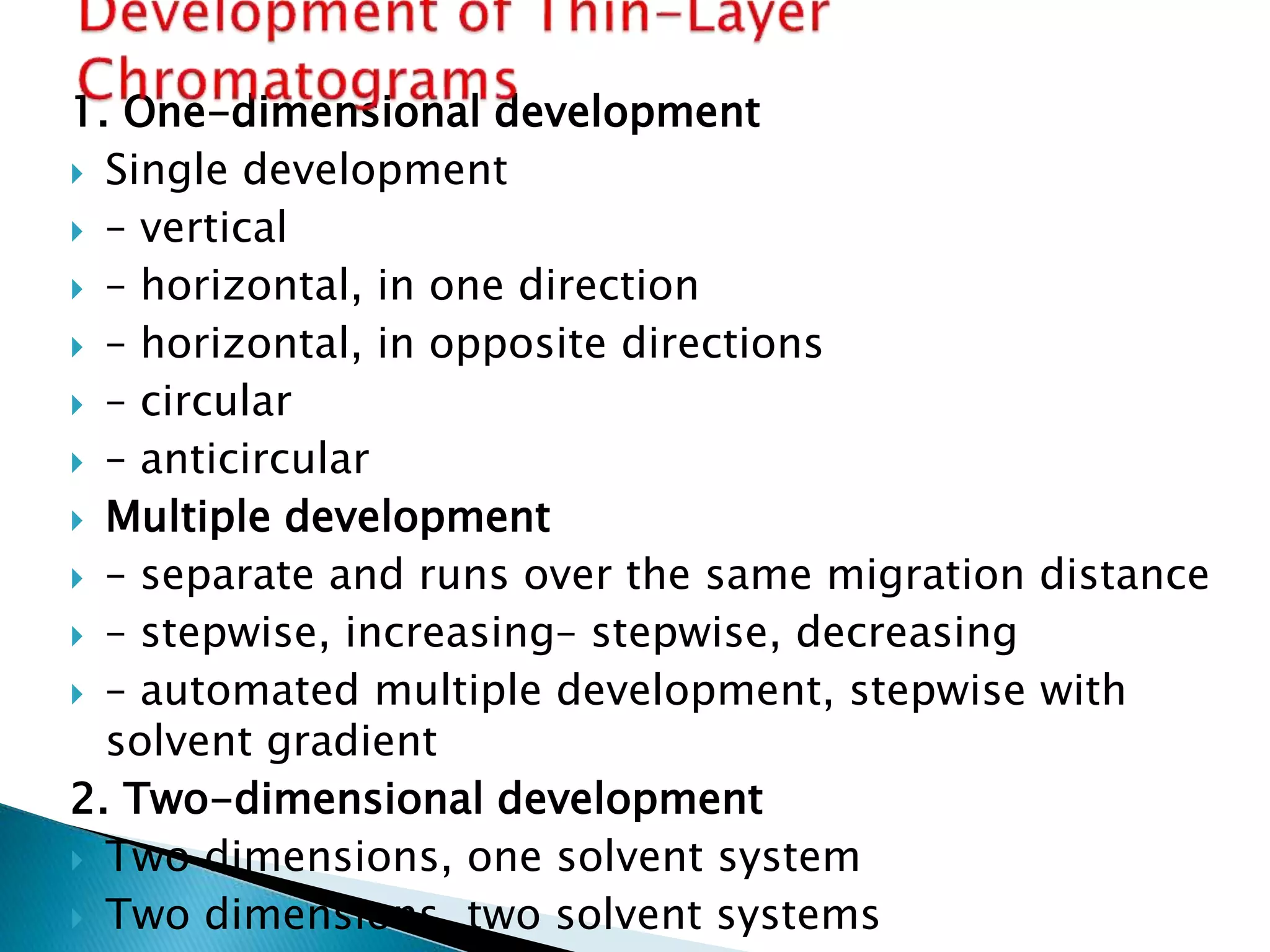
1. One-dimensional development
 Single development
 – vertical
 – horizontal, in one direction
 – horizontal, in opposite directions
 – circular
 – anticircular
 Multiple development
 – separate and runs over the same migration distance
 – stepwise, increasing– stepwise, decreasing
 – automated multiple development, stepwise with
solvent gradient
2. Two-dimensional development
 Two dimensions, one solvent system
 Two dimensions, two solvent systems
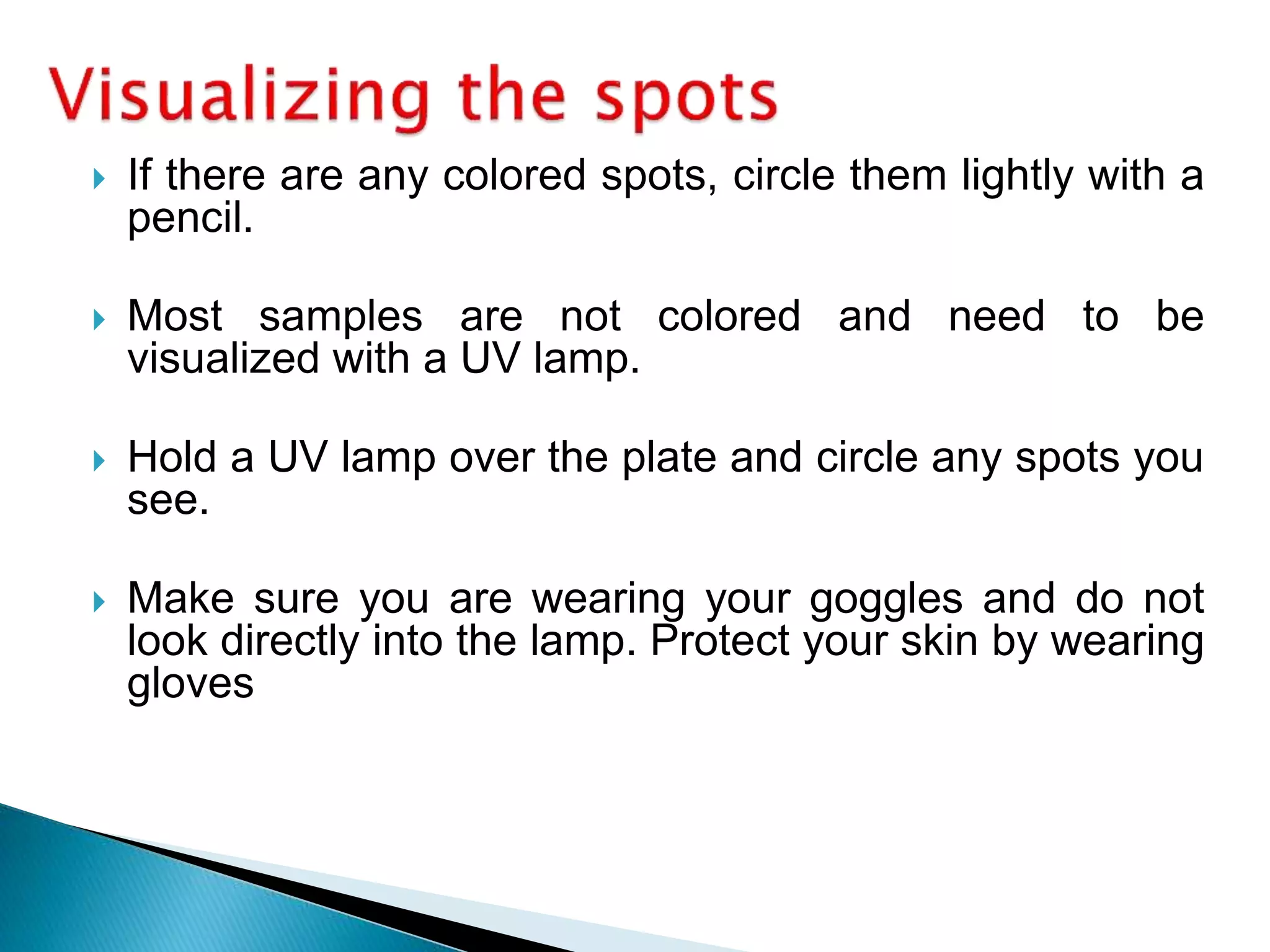
 If there are any colored spots, circle them lightly with a
pencil.
 Most samples are not colored and need to be
visualized with a UV lamp.
 Hold a UV lamp over the plate and circle any spots you
see.
 Make sure you are wearing your goggles and do not
look directly into the lamp. Protect your skin by wearing
gloves
 It is used for separation of all classes of natural
products and macromolecules like amino acids,
proteins and peptides, and antibiotics
 For checking the purity of samples- as a
purification process
 Examination of Progress of reaction
 For identifying organic compounds
 For separation of Inorganic Ions
 Separation of Amino Acids and Vitamins – vitamin
E, Vitamin D3, vitamin A
 Application of TLC in quantitative analysis

Thin Layer Chromatography.ppt

  • 2.
     Chromatography isa physical method of separation in which the components to be separated are distributed between two phases, one of which is stationary (stationary phase) while the other (the mobile phase) moves in a definite direction.  Types of Chromatographic Techniques: Technique Stationary Mobile Phase Column/Adsorption Chromatography solid Liquid Partition Chromatography Liquid Liquid Paper Chromatography Liquid Liquid Thin Layer Chromatography (TLC) Liquid/Solid Liquid Gas – Liquid chromatography (GLC) Liquid gas Gas – Solid Chromatography (GSC) Solid gas Ion Exchange Chromatography Solid Liquid
  • 3.
    TLC : Introduction TLCis one of the simplest, fastest, easiest and least expensive of several chromatographic techniques used in qualitative and quantitative analysis to separate organic compounds and to test the purity of compounds. TLC is a form of liquid chromatography consisting of: A mobile phase (developing solvent) and A stationary phase (a plate or strip coated with a form of silica gel G) Analysis is performed on a flat surface under atmospheric pressure and room temperature
  • 4.
     Thin LayerChromatography can be defined as a method of separation or identification of a mixture of components into individual components by using finely divided adsorbent solid / (liquid) spread over a glass plate and liquid as a mobile phase.  Synonyms: Drop, strip, spread layer, surface chromatography and open column chromatography - Adsorption or partition or both as principle of a substance (s ) on the stationary phase - Separation of the adsorbed substances by the mobile phase - Recovery of the separated substances by a continuous flow of the mobile phase (elution) - Qualitative and quantitative analysis of the eluted substances
  • 5.
     Substances arenonvolatile or of low volatility  The subs are strongly polar, of medium polarity, nonpolar or ionic.  Large no. of samples must be analyzed simultaneously. cost effectively and within short duration of time.  Components of a mixture of subs after separation have to be detected individually or have to be subjected to various detection methods.  Material can not be detected by the method of LC or GC.
  • 6.
    Principle of TLC Itis based on the principle of adsorption chromatography or partition chromatography or combination of both, depending on adsorbent, its treatment and nature of solvents employed •The components with more affinity towards stationary phase travels slower. •Components with less affinity towards stationary phase travels faster •In TLC, a solid phase, the adsorbent, is coated onto a solid support (thin sheet of glass, plastic, and aluminum ) as a thin layer (about 0.25 mm thick). In many cases, a small amount of a binder such as plaster of Paris is mixed with the absorbent to facilitate the coating.
  • 7.
     The mixture(A + B) to be separated is dissolved in a solvent and the resulting solution is spotted onto the thin layer plate near the bottom. A solvent, or mixture of solvents, called the eluent, is allowed to flow up the plate by capillary action.  Separation of mixtures in microgram quantities by movement of a solvent across a flat surface; components migrate at different rates due to differences in solubility, adsorption, size or charge; elution is halted when or before the solvent front reaches the opposite side of the surface and the components examined in situ or removed for further analysis.
  • 8.
    Separations in TLCinvolve distributing a mixture of two or more substances between a stationary phase and a mobile phase 1.The stationary phase: is a thin layer of adsorbent (usually silica gel or alumina) coated on a plate. 2.The mobile phase: is a developing liquid which travels up the stationary phase, carrying the samples with it. Components of the samples will separate on the stationary phase according to: how much they adsorb on the stationary phase versus how much they rise in the mobile phase
  • 9.
    Factors affecting Rfvalue It depends on following factors: Nature adsorbent Mobile phase Activity Thickness of layer Temperature Equilibrium Loading Dipping zone Chromatographic techniques
  • 10.
    Stationary phases forthin-layer chromatography • Silica gel G • Alumina • Cellulose Powder used for inorganic, amino acids, Nucleotides and food dyes. • Kieselguhr used for sugars • Sephadex gels used for macromolecules
  • 11.
    The choice ofthe stationary phase for a given separation problem is the most difficult decision in TLC For the choice of stationary Phase following characters are considered- The chemical composition of the stationary Phase and in particular that of its surface, must be suitable for the task. To obtain satisfactory separation efficiency, the mean particle size, the particle size distribution and the morphology of the particle must be considered
  • 12.
    Selection of adsorbents Solubilityof compound e.g, hydrophilic or lipophilic Nature of substance to be seperated i.e whether it is acidic, basic or amphoteric Adsorbent particle size Adsorbent should adhere to glass plate Reactivity of compound with the solvent or adsorbent Chemical reactivity of compounds with binders
  • 13.
    The choice ofmobile phase is largely empirical but general rules can be formulated. A mixture of an organic solvent and water with the addition of acid, base or complexing agent to optimize the solubility of the components of a mixture can be used. For example, good separations of polar or ionic solutes can be achieved with a mixture of water and n-butanol. Addition of acetic acid to the mixture allows more water to be incorporated and increases the solubility of basic materials, whilst the addition of ammonia increases the solubility of acidic materials. If the stationary phase is hydrophobic, various mixtures of benzene, cyclohexane and chloroform provide satisfactory mobile phases. It should be emphasized that a large degree of trial and error is involved in their selection. For TLC on silica gel, a mobile phase with as low a polarity as possible should be used consistent with achieving a satisfactory separation. Polar solvents can themselves become strongly adsorbed thereby producing a partition system, a
  • 15.
     Glass platesor flexible plates are commonly used for adsorbent. Size used depends on type of separation to be carried out, the type of chromatographic tank and spreading apparatus available.  The standard sizes are 20 x 5 cm, 20 x 10 cm or 20 x 20 cm .  The surface should be flat without irregularities.  The standard film thickness is 250um 21 November 2022 Dept. of Pharmaceutics 15
  • 16.
     Pouring  Dipping Spraying  Spreading.
  • 17.
     Pouring: Theadsorbent of finely divided and homogeneous particle size is made into slurry and is poured on a plate and allowed to flow over it so that it is evenly covered.  Dipping : This technique is used for small plates by dipping the two plates at a time, back to back in a slurry of adsorbent in chloroform or other volatile solvents. Exact thickness of layer is not known and evenness of layer may not be good.
  • 18.
     Spraying :Slurry is diluted further for the operation of sprayer. But this technique is not used now a days as it is difficult to get uniform layer.  Spreading : All the above methods fail to give thin and uniform layers. Modern methods utilize the spreading devices for preparation of uniform thin layers on glass plates. Commercial spreaders are of two types (a) Moving spreader, (b) Moving plate type. It gives layer thickness from 0.2 to 2.0 mm.
  • 19.
     After spreadingplates are allowed to dry in air and further dried and activated by heating at about 100 0 c for 30 mins.  By removing the liquids associated with layer completely, the adsorbent layer is activated.
  • 20.
    The solvent systemperforms the following main tasks:  To dissolve the mixture of substances,  To transport the substances to be separated across the sorbent layer,  To give Rf values in the medium range, or as near to this as possible,  To provide adequate selectivity for the substance mixture to be separated. They should also fulfill the following requirements:  Adequate purity, Adequate stability,  Low viscosity,  Linear partition isotherm,  A Vapor pressure that is neither very low nor very high,  Toxicity that is as low as possible
  • 21.
    The choice ofthe mobile phase is depends upon the following factors:- 1. Nature of the substance to be separated 2. Nature of the stationary phase used 3. Mode of chromatography ( Normal phase or reverse phase) 4. Separation to be achieved- Analytical or preparative. 5. The organic solvent mixture of low polarity is used 6. Highly polar solvents are avoided . 7. Solvents towards increasing degree of polarity are used in liquid-solid chromatography. 8. Use of water as a solvent is avoided as it may loosen the adhesion of a layer on a glass plate.
  • 22.
     n-Hexane  Cyclohexene Toluene  Benzene  Diethyl ether  Chloroform  Dichloromethane  1,2 dichloroethane  Acetone  Ethyl acetate  Acetonitrile  Propanol  Methanol  Acetic acid  Water. Some of solvents used in TLC Increasing polarity
  • 23.
     Sample solutionin a non polar solvent is applied.  The concentration of a sample or standard solution has to be minimum of a 1% solution of either standard or test sample is spotted using a capillary tube or micropipette.  The area of application should be kept as small as possible for sharper and greater resolution.
  • 24.
     Step 1:Prepare the developing container  Step 2: Prepare the TLC plate  Step 3: Spot the TLC plate  Step 4: Develop the plate  Step 5: Visualize the spots
  • 25.
     It canbe a specially designed chamber, a jar with a lid, or a beaker with a watch glass on the top  Pour solvent into the chamber to a depth of just less than 0.5 cm.  To aid in the saturation of the TLC chamber with solvent vapors, you can line part of the inside of the beaker with filter paper.  Cover the beaker with a watch glass, swirl it gently.  Allow it to stand while you prepare your TLC plate.
  • 26.
    1. Pouring, Dipping,Spraying, Spreading 2. TLC plates used are purchased as 5 cm x 20 cm sheets. Each large sheet is cut horizontally into plates which are 5 cm tall by various widths; 3. Handle the plates carefully so that you do not disturb the coating of adsorbent or get them dirty.Measure 0.5 cm from the bottom of the plate. 4. Using a pencil, draw a line across the plate at the 0.5 cm mark. This is theorigin: the line on which you will spot the plate. Take care not to press so hard with the pencil that you disturb the adsorbent. 5. Under the line, mark lightly the samples you will spot on the plate, or mark numbers for time points. Leave enough space between the samples so that they do not run together; about
  • 27.
     Prepare 1%solution of drug dissolving in volatile solvents like hexanes, ethyl acetate, or methylene chloride.  Dip the microcap or microcapillary into the solution and then gently touch the end of it onto the proper location on the TLC plate.  Don't allow the spot to become too large - if necessary, you can touch it to the plate, lift it off and blow on the spot. If you repeat these steps, the wet area on the plate will stay small.  This example plate has been spotted with three different quantities of the same solution and is ready to develop
  • 28.
     Place theprepared TLC plate in the developing beaker, cover the beaker with the watch glass, and leave it undisturbed on your bench top.  The solvent will rise up the TLC plate by capillary action. Make sure the solvent does not cover the spot.  Allow the plate to develop until the solvent is about half a centimeter below the top of the plate.  Remove the plate from the beaker and immediately mark the solvent front with a pencil
  • 29.
  • 30.
    1. One-dimensional development Single development  – vertical  – horizontal, in one direction  – horizontal, in opposite directions  – circular  – anticircular  Multiple development  – separate and runs over the same migration distance  – stepwise, increasing– stepwise, decreasing  – automated multiple development, stepwise with solvent gradient 2. Two-dimensional development  Two dimensions, one solvent system  Two dimensions, two solvent systems
  • 31.
     If thereare any colored spots, circle them lightly with a pencil.  Most samples are not colored and need to be visualized with a UV lamp.  Hold a UV lamp over the plate and circle any spots you see.  Make sure you are wearing your goggles and do not look directly into the lamp. Protect your skin by wearing gloves
  • 33.
     It isused for separation of all classes of natural products and macromolecules like amino acids, proteins and peptides, and antibiotics  For checking the purity of samples- as a purification process  Examination of Progress of reaction  For identifying organic compounds  For separation of Inorganic Ions  Separation of Amino Acids and Vitamins – vitamin E, Vitamin D3, vitamin A  Application of TLC in quantitative analysis