MUSCLE CONTRACTION Sliding Filament
Theory
SARCOMERE
•Muscle is a specialized contractile tissue that is a
distinguishing characteristic of animals.
•Changes in muscle length support an exquisite array of animal movements.
•The contraction process has several key steps, which have been conserved
during evolution across most animals.
•When muscle cells are viewed under the microscope, one can see that they
contain a striped pattern (striations).
•This pattern is formed by a series of basic units called sarcomeres arranged
in a stacked pattern throughout muscle tissue. There can be thousands of
sarcomeres within a single muscle cell.
•Sarcomeres are repeated throughout muscle cells, and the proteins within
them can change in length, which causes the overall size of a muscle to
change.
•An individual sarcomere contains many parallel actins (thin)
and myosin (thick) filaments.
CONTD….
•The structure of the sarcomere is traditionally described
with dark and light bands visible under the microscope.
•This banding pattern in sarcomeres is due mainly to the arrangement of thick
and thin myofilaments in each unit.
•These markings include:
A band (or anisotropic band) – dark band that contains whole thick filaments
(myosin).
I bands (or isotropic bands) - light bands that contain only the thin filaments
(actin) and are located between the two thick filaments.
Z disc - is an area that traverses the I bands and marks the point of the
connection between the two neighboring actin filaments. That said, the
sarcomere can also be described as the structure between the two Z discs.
M line - marks the middle of the sarcomere and contains the protein called
myomesin.
H zone - the central part of the thick filament, not overlapped by the thin
filament, is called the H zone. The H zone contains only myosin.
Figure. A gastrocnemius muscle (calf)
with a striped pattern of sarcomeres
The sarcomeres are artificially colored
green and appear as stacked horizontal
stripes of similar lengths. (White scale
bar = 25 microns.)
THE SLIDING FILAMENT THEORY
•Using high-resolution microscopy, A. F. Huxley and R. Niedergerke (1954)
and H. E. Huxley and J. Hanson (1954) observed changes in the sarcomeres as
muscle tissue shortened.
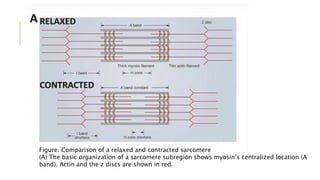
•They observed that one zone of the repeated sarcomere arrangement, the "A
band," remained relatively constant in length during contraction.
•The A band contains thick filaments of myosin, which suggests that the
myosin filaments remained central and constant in length while other regions
of the sarcomere shortened.
•The investigators noted that the "I band," rich in thinner filaments made of
actin, changed its length along with the sarcomere.
•These observations led them to propose the sliding filament theory, which
states that the sliding of actin past myosin generates muscle tension.
•Because actin is tethered to structures located at the lateral ends of each
sarcomere called z discs or “z bands,” any shortening of the actin filament
length would result in a shortening of the sarcomere and, thus, the muscle.
Figure. Comparison of a relaxed and contracted sarcomere
(A) The basic organization of a sarcomere subregion shows myosin’s centralized location (A
band). Actin and the z discs are shown in red.
AN ANALOGY FOR SLIDING FILAMENTS IN A
SARCOMERE SHORTENING EVENT
•Imagine that you are standing between two large bookcases loaded with books.
•These large bookcases are several meters apart and positioned on rails so they can be
easily moved.
•You are tasked with bringing the two bookcases together, but you are limited to using
only your arms and two ropes.
•Standing centered between the bookcases, you pull on the two ropes — one per arm
— which are tied securely to each bookcase.
•Repetitively, you pull each rope toward you, regrasp it, and then pull again.
•Eventually, as you progress through the length of the rope, the bookcases move
together and approach you.
•In this example, your arms are similar to the myosin molecules, the ropes are the
actin filaments, and the bookcases are the z discs to which the actin is secured, which
make up the lateral ends of a sarcomere.
•Like you would remain centered between the bookcases, the myosin filaments remain
centered during normal muscle contraction.
(B) A conceptual diagram
representing the connectivity
of molecules within a
sarcomere.
A person standing between
two bookcases (z bands)
pulls them in via ropes
(actin).
Myosin (M) is analogous to
the person and the pulling
arms.
(z bands are also called z
discs.)
CROSS BRIDGES
•One important refinement of the sliding filament theory involved the particular
way in which myosin can pull upon actin to shorten the sarcomere.
•Scientists have demonstrated that the globular end of each
myosin protein that is nearest actin, called the S1 region, has multiple hinged
segments, which can bend and facilitate contraction.
•The bending of the myosin S1 region helps explain how myosin moves or
"walks" along actin.
•The slimmer and typically longer "tail" region of myosin (S2) also exhibits
flexibility and rotates in concert with the S1 contraction.
•The movements of myosin appear to be a kind of molecular dance.
•The myosin reaches forward, binds to actin, contracts, releases actin, and then
reaches forward again to bind actin in a new cycle. This process is known as
myosin-actin cycling.
•As the myosin S1 segment binds and releases actin, it forms what is called
cross bridges, which extend from the thick myosin filaments to the thin actin
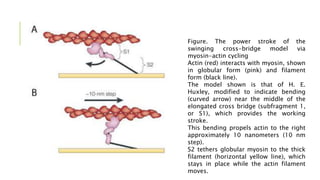
Figure. The power stroke of the
swinging cross-bridge model via
myosin-actin cycling
Actin (red) interacts with myosin, shown
in globular form (pink) and filament
form (black line).
The model shown is that of H. E.
Huxley, modified to indicate bending
(curved arrow) near the middle of the
elongated cross bridge (subfragment 1,
or S1), which provides the working
stroke.
This bending propels actin to the right
approximately 10 nanometers (10 nm
step).
S2 tethers globular myosin to the thick
filament (horizontal yellow line), which
stays in place while the actin filament
moves.
CONTD….
•The power stroke requires the hydrolysis of ATP, which breaks a high-energy
phosphate bond to release energy.
•Specifically, this ATP hydrolysis provides the energy for myosin to go through
this cycling: to release actin, change its conformation, contract, and repeat the
process again.
•Myosin would remain bound to actin indefinitely — causing the stiffness of
rigor mortis — if new ATP molecules were unavailable.
•Two key aspects of myosin-actin cycling use the energy made available by the
hydrolysis of ATP.
•First, the action of reaching the myosin S1 head uses the energy released after
the ATP molecule is broken into ADP and phosphate.
•Myosin binds actin in this extended conformation. Second, the release of the
phosphate empowers the contraction of the myosin S1 region.
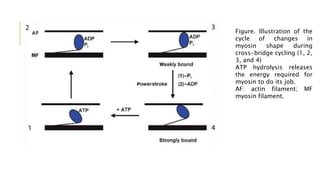
Figure. Illustration of the
cycle of changes in
myosin shape during
cross-bridge cycling (1, 2,
3, and 4)
ATP hydrolysis releases
the energy required for
myosin to do its job.
AF: actin filament; MF
myosin filament.
WHAT REGULATES SARCOMERE
SHORTENING?
•Calcium and ATP are cofactors (nonprotein components of enzymes) required for the
contraction of muscle cells.
•ATP supplies the energy, as described above.
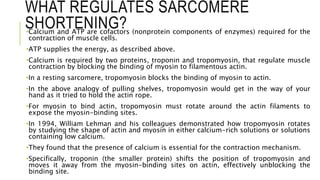
•Calcium is required by two proteins, troponin and tropomyosin, that regulate muscle
contraction by blocking the binding of myosin to filamentous actin.
•In a resting sarcomere, tropomyosin blocks the binding of myosin to actin.
•In the above analogy of pulling shelves, tropomyosin would get in the way of your
hand as it tried to hold the actin rope.
•For myosin to bind actin, tropomyosin must rotate around the actin filaments to
expose the myosin-binding sites.
•In 1994, William Lehman and his colleagues demonstrated how tropomyosin rotates
by studying the shape of actin and myosin in either calcium-rich solutions or solutions
containing low calcium.
•They found that the presence of calcium is essential for the contraction mechanism.
•Specifically, troponin (the smaller protein) shifts the position of tropomyosin and
moves it away from the myosin-binding sites on actin, effectively unblocking the
binding site.
CONTD….
•Once the myosin-binding sites are exposed, and sufficient ATP is present,
myosin binds to actin to begin cross-bridge cycling.
•Then the sarcomere shortens, and the muscle contracts.
•In the absence of calcium, this binding does not occur, so the presence of free
calcium is an important regulator of muscle contraction.
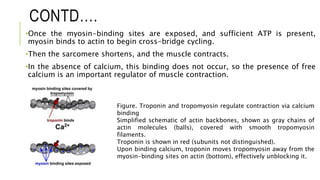
Figure. Troponin and tropomyosin regulate contraction via calcium
binding
Simplified schematic of actin backbones, shown as gray chains of
actin molecules (balls), covered with smooth tropomyosin
filaments.
Troponin is shown in red (subunits not distinguished).
Upon binding calcium, troponin moves tropomyosin away from the
myosin-binding sites on actin (bottom), effectively unblocking it.

Muscle contraction.pptx

  • 1.
  • 2.
    SARCOMERE •Muscle is aspecialized contractile tissue that is a distinguishing characteristic of animals. •Changes in muscle length support an exquisite array of animal movements. •The contraction process has several key steps, which have been conserved during evolution across most animals. •When muscle cells are viewed under the microscope, one can see that they contain a striped pattern (striations). •This pattern is formed by a series of basic units called sarcomeres arranged in a stacked pattern throughout muscle tissue. There can be thousands of sarcomeres within a single muscle cell. •Sarcomeres are repeated throughout muscle cells, and the proteins within them can change in length, which causes the overall size of a muscle to change. •An individual sarcomere contains many parallel actins (thin) and myosin (thick) filaments.
  • 3.
    CONTD…. •The structure ofthe sarcomere is traditionally described with dark and light bands visible under the microscope. •This banding pattern in sarcomeres is due mainly to the arrangement of thick and thin myofilaments in each unit. •These markings include: A band (or anisotropic band) – dark band that contains whole thick filaments (myosin). I bands (or isotropic bands) - light bands that contain only the thin filaments (actin) and are located between the two thick filaments. Z disc - is an area that traverses the I bands and marks the point of the connection between the two neighboring actin filaments. That said, the sarcomere can also be described as the structure between the two Z discs. M line - marks the middle of the sarcomere and contains the protein called myomesin. H zone - the central part of the thick filament, not overlapped by the thin filament, is called the H zone. The H zone contains only myosin.
  • 5.
    Figure. A gastrocnemiusmuscle (calf) with a striped pattern of sarcomeres The sarcomeres are artificially colored green and appear as stacked horizontal stripes of similar lengths. (White scale bar = 25 microns.)
  • 6.
    THE SLIDING FILAMENTTHEORY •Using high-resolution microscopy, A. F. Huxley and R. Niedergerke (1954) and H. E. Huxley and J. Hanson (1954) observed changes in the sarcomeres as muscle tissue shortened. •They observed that one zone of the repeated sarcomere arrangement, the "A band," remained relatively constant in length during contraction. •The A band contains thick filaments of myosin, which suggests that the myosin filaments remained central and constant in length while other regions of the sarcomere shortened. •The investigators noted that the "I band," rich in thinner filaments made of actin, changed its length along with the sarcomere. •These observations led them to propose the sliding filament theory, which states that the sliding of actin past myosin generates muscle tension. •Because actin is tethered to structures located at the lateral ends of each sarcomere called z discs or “z bands,” any shortening of the actin filament length would result in a shortening of the sarcomere and, thus, the muscle.
  • 7.
    Figure. Comparison ofa relaxed and contracted sarcomere (A) The basic organization of a sarcomere subregion shows myosin’s centralized location (A band). Actin and the z discs are shown in red.
  • 8.
    AN ANALOGY FORSLIDING FILAMENTS IN A SARCOMERE SHORTENING EVENT •Imagine that you are standing between two large bookcases loaded with books. •These large bookcases are several meters apart and positioned on rails so they can be easily moved. •You are tasked with bringing the two bookcases together, but you are limited to using only your arms and two ropes. •Standing centered between the bookcases, you pull on the two ropes — one per arm — which are tied securely to each bookcase. •Repetitively, you pull each rope toward you, regrasp it, and then pull again. •Eventually, as you progress through the length of the rope, the bookcases move together and approach you. •In this example, your arms are similar to the myosin molecules, the ropes are the actin filaments, and the bookcases are the z discs to which the actin is secured, which make up the lateral ends of a sarcomere. •Like you would remain centered between the bookcases, the myosin filaments remain centered during normal muscle contraction.
  • 9.
    (B) A conceptualdiagram representing the connectivity of molecules within a sarcomere. A person standing between two bookcases (z bands) pulls them in via ropes (actin). Myosin (M) is analogous to the person and the pulling arms. (z bands are also called z discs.)
  • 10.
    CROSS BRIDGES •One importantrefinement of the sliding filament theory involved the particular way in which myosin can pull upon actin to shorten the sarcomere. •Scientists have demonstrated that the globular end of each myosin protein that is nearest actin, called the S1 region, has multiple hinged segments, which can bend and facilitate contraction. •The bending of the myosin S1 region helps explain how myosin moves or "walks" along actin. •The slimmer and typically longer "tail" region of myosin (S2) also exhibits flexibility and rotates in concert with the S1 contraction. •The movements of myosin appear to be a kind of molecular dance. •The myosin reaches forward, binds to actin, contracts, releases actin, and then reaches forward again to bind actin in a new cycle. This process is known as myosin-actin cycling. •As the myosin S1 segment binds and releases actin, it forms what is called cross bridges, which extend from the thick myosin filaments to the thin actin
  • 11.
    Figure. The powerstroke of the swinging cross-bridge model via myosin-actin cycling Actin (red) interacts with myosin, shown in globular form (pink) and filament form (black line). The model shown is that of H. E. Huxley, modified to indicate bending (curved arrow) near the middle of the elongated cross bridge (subfragment 1, or S1), which provides the working stroke. This bending propels actin to the right approximately 10 nanometers (10 nm step). S2 tethers globular myosin to the thick filament (horizontal yellow line), which stays in place while the actin filament moves.
  • 12.
    CONTD…. •The power strokerequires the hydrolysis of ATP, which breaks a high-energy phosphate bond to release energy. •Specifically, this ATP hydrolysis provides the energy for myosin to go through this cycling: to release actin, change its conformation, contract, and repeat the process again. •Myosin would remain bound to actin indefinitely — causing the stiffness of rigor mortis — if new ATP molecules were unavailable. •Two key aspects of myosin-actin cycling use the energy made available by the hydrolysis of ATP. •First, the action of reaching the myosin S1 head uses the energy released after the ATP molecule is broken into ADP and phosphate. •Myosin binds actin in this extended conformation. Second, the release of the phosphate empowers the contraction of the myosin S1 region.
  • 13.
    Figure. Illustration ofthe cycle of changes in myosin shape during cross-bridge cycling (1, 2, 3, and 4) ATP hydrolysis releases the energy required for myosin to do its job. AF: actin filament; MF myosin filament.
  • 14.
    WHAT REGULATES SARCOMERE SHORTENING? •Calciumand ATP are cofactors (nonprotein components of enzymes) required for the contraction of muscle cells. •ATP supplies the energy, as described above. •Calcium is required by two proteins, troponin and tropomyosin, that regulate muscle contraction by blocking the binding of myosin to filamentous actin. •In a resting sarcomere, tropomyosin blocks the binding of myosin to actin. •In the above analogy of pulling shelves, tropomyosin would get in the way of your hand as it tried to hold the actin rope. •For myosin to bind actin, tropomyosin must rotate around the actin filaments to expose the myosin-binding sites. •In 1994, William Lehman and his colleagues demonstrated how tropomyosin rotates by studying the shape of actin and myosin in either calcium-rich solutions or solutions containing low calcium. •They found that the presence of calcium is essential for the contraction mechanism. •Specifically, troponin (the smaller protein) shifts the position of tropomyosin and moves it away from the myosin-binding sites on actin, effectively unblocking the binding site.
  • 15.
    CONTD…. •Once the myosin-bindingsites are exposed, and sufficient ATP is present, myosin binds to actin to begin cross-bridge cycling. •Then the sarcomere shortens, and the muscle contracts. •In the absence of calcium, this binding does not occur, so the presence of free calcium is an important regulator of muscle contraction. Figure. Troponin and tropomyosin regulate contraction via calcium binding Simplified schematic of actin backbones, shown as gray chains of actin molecules (balls), covered with smooth tropomyosin filaments. Troponin is shown in red (subunits not distinguished). Upon binding calcium, troponin moves tropomyosin away from the myosin-binding sites on actin (bottom), effectively unblocking it.