SUPAC
(SCALE UP AND POST APPROVAL CHANGES)
GUIDELINES
Submitted By
Atul Chaudhary
M Pharm(Student)
1st Year(Pharmaceutics)
1
SUPAC
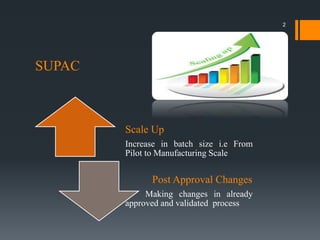
Scale Up
Increase in batch size i.e From
Pilot to Manufacturing Scale
Post Approval Changes
Making changes in already
approved and validated process
2
What is SUPAC
SUPAC was established by the Centre for Drug Evaluation
and Research (CDER), Chemistry, Manufacturing and
Controls Coordinating Committee to develop guidance on
scale up and other post approval changes.
It refers to the FDA recommended testing and filing actions
to be taken by a pharmaceutical firm when it changes the
manufacturing process of a drug product that has been
approved via a New Drug Application (NDA), Abbreviated
New Drug Application (ANDA) or Abbreviated Antibiotic
Drug Application (AADA).
3
FDA has issued various guidance for SUPAC
changes designated as
SUPAC-IR(For Immediate release solid dosage form)-
Focus on changes in the amount of excipients in the drug
product.
SUPAC-MR(For Modified release solid oral dosage form)-
Focus on excipients critical or non critical to the drug
release.
SUPAC-SS(For Non Sterile Semisolid Dosage Form
including creams ,ointments , gels and lotions)-Focus on
changes in preservatives.
4
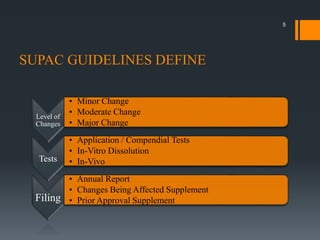
SUPAC GUIDELINES DEFINE
Level of
Changes
• Minor Change
• Moderate Change
• Major Change
Tests
• Application / Compendial Tests
• In-Vitro Dissolution
• In-Vivo
Filing
• Annual Report
• Changes Being Affected Supplement
• Prior Approval Supplement
5
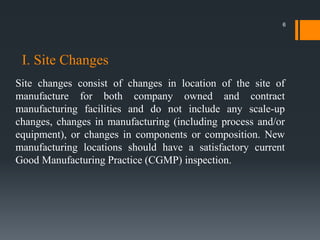
I. Site Changes
Site changes consist of changes in location of the site of
manufacture for both company owned and contract
manufacturing facilities and do not include any scale-up
changes, changes in manufacturing (including process and/or
equipment), or changes in components or composition. New
manufacturing locations should have a satisfactory current
Good Manufacturing Practice (CGMP) inspection.
6
A. Level 1 Changes
Definition: Level 1 changes consist of site changes within a
single facility where the same equipment, standard operating
procedures (SOP's), environmental conditions (e.g temperature
and humidity) and controls, and personnel common to both
manufacturing sites are used, and where no changes are made
to the manufacturing batch records, except for administrative
information and the location of the facility.
Test Documentation
A. Chemistry Documentation: None beyond application/
compendial release requirements.
B. Dissolution Documentation: None beyond application/
compendial release requirements.
C. In Vivo Bioequivalence Documentation- None
Filing Documentation- Annual Report.
7
B. Level 2 Changes
 Definition: Level 2 changes consist of site changes within a contiguous
campus, or between facilities in adjacent city blocks, where the same
equipment, SOP's, environmental conditions (e.g., temperature and
humidity) and controls, and personnel common to both manufacturing
sites are used, and where no changes are made to the manufacturing batch
records, except for administrative information and the location of the
facility.
 Test Documentation
A. Chemistry Documentation Location of new site and updated batch
records. None beyond application/ compendial release requirements.One
batch on long-term stability data reported in annual report.
B. Dissolution Documentation None beyond application /compendial
release requirements.
C. In Vivo Bioequivalence Documentation-None.
Filing Documentation- Changes being effected supplement; annual report
(long term stability test data).
8
C. Level 3 Changes
Definition: Level 3 changes consist of a change in
manufacturing site to a different campus. A different campus is
defined as one that is not on the same original contiguous site or
where the
facilities are not in adjacent city blocks. To qualify as a Level 3
change, the same equipment, SOP's, environmental conditions,
and controls should be used in the manufacturing process at the
new site, and no changes may be made to the manufacturing
batch records except for administrative information, location
and language translation where needed.
9
Test Documentation
 Chemistry Documentation Location of new site and updated batch records.
Application/compendial release requirements.
 Stability: Significant body of data available: One batch with three months
accelerated stability data reported in supplement; one batch on long-term
stability data reported in annual report. Significant body of data not available:
Up to three batches with three months accelerated stability data reported in
supplement; up to three batches on long term stability data reported in annual
report.
 Dissolution Documentation Case B: Multipoint dissolution profile should be
performed in the application/compendia medium at 15, 30, 45, 60 and 120
minutes or until an asymptote is reached. The dissolution profile of the drug
product at the current and proposed site should be similar.
 In Vivo Bioequivalence Documentation- None
 Filing Documentation- Changes being effected supplement; annual report
(long-term stability data).
10
11
A. Level 1 Changes
Definition of Level: Change in batch size, up to and
including a factor of 10 times the size of the Pilot/ Bio batch,
where:
 The equipment used to produce the test batch is of the same
design and operating principles;
 The batch is manufactured in full compliance with CGMP's;
 The same standard operating procedures(SOP's) and controls,
as well as the same formulation and manufacturing
procedures, are used on the test batch and on the full-scale
production batch.
12
Test Documentation
Chemistry Documentation Application/compendial release
requirements. Notification of change and submission of
updated batch records in annual report. One batch on long-
term stability reported in annual report.
 Dissolution Documentation None beyond application/
compendial release requirements.
 In Vivo Bioequivalence-None.
Filing Documentation-Annual report (long term stability
data).
13
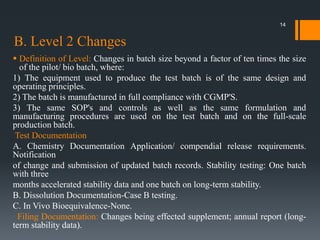
B. Level 2 Changes
 Definition of Level: Changes in batch size beyond a factor of ten times the size
of the pilot/ bio batch, where:
1) The equipment used to produce the test batch is of the same design and
operating principles.
2) The batch is manufactured in full compliance with CGMP'S.
3) The same SOP's and controls as well as the same formulation and
manufacturing procedures are used on the test batch and on the full-scale
production batch.
Test Documentation
A. Chemistry Documentation Application/ compendial release requirements.
Notification
of change and submission of updated batch records. Stability testing: One batch
with three
months accelerated stability data and one batch on long-term stability.
B. Dissolution Documentation-Case B testing.
C. In Vivo Bioequivalence-None.
Filing Documentation: Changes being effected supplement; annual report (long-
term stability data).
14
III. Manufacturing
 Manufacturing changes may affect both equipment used in the manufacturing
process and the process itself.
 A. Equipment 1. Level 1 Changes
 Definition of Change This category consists of:
1) Change from non-automated or non mechanical equipment to automated or
mechanical equipment to move ingredients.
2) Change to alternative equipment of the same design and operating principles of
the same or of a different capacity.
 Test Documentation: Chemistry documentation application/compendial release
requirements. Notification of change and submission of updated batch records.
Stability testing: One batch on long term stability.
ii. Dissolution Documentation None beyond application/ compendial release
requirements.
iii. In Vivo Bioequivalence Documentation-None
 Filing Documentation-Annual report (long term stability data).
15
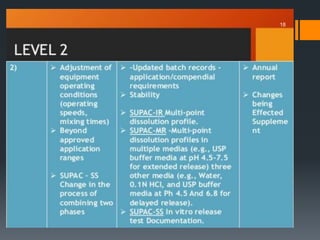
Level 2 Changes
 Definition of Level- Change in equipment to a different design and
different operating principles.
 Test Documentation- Chemistry Documentation application/compendial
release requirements. Notification of change and submission of updated
batch records. Stability testing: Significant body of data available: One
batch with three months accelerated stability data reported in supplement;
one batch on long-term stability data reported in annual report. Significant
body of data not available: Up to three batches with three months
accelerated stability data reported in supplement; up to three batches on
long-term stability data reported in annual report.
 Dissolution Documentation- Case C dissolution profile.
 In Vivo Bioequivalence Documentation- None.
 Filing Documentation- Prior approval supplement with justification for
change; annual report (long-term stability data).
16
17
18
19
Limitations of SUPAC
SUPAC has not been updated since 1995/1997 for main
guidelines.
Does not cover modified equipment.
Does not discuss multiple changes.
20
Advantages
Reducing operating overhead & maintenance expenses.
 More rapid implementation of process and equipment
changes.
 Improved yield & reduce failure investigations.
More rapid implementation of batch size increases.
Production of fewer unmarketable stability batches.
Reduce stability testing/costs.
21
Reference
 https://www.researchgate.net/publication/316021703_SCALE_UP_A
ND_POSTAPPROVAL_CHANGES_SUPAC_GUIDANCE_FOR_IN
DUSTRY_A_REGULATORY_NOTE.
 https://www.slideshare.net/sayedasalma/supac-87129226
 http://m.authorstream.com/presentation/jeevithakanapart-1905484-
supac/
22
23

Supac

  • 1.
    SUPAC (SCALE UP ANDPOST APPROVAL CHANGES) GUIDELINES Submitted By Atul Chaudhary M Pharm(Student) 1st Year(Pharmaceutics) 1
  • 2.
    SUPAC Scale Up Increase inbatch size i.e From Pilot to Manufacturing Scale Post Approval Changes Making changes in already approved and validated process 2
  • 3.
    What is SUPAC SUPACwas established by the Centre for Drug Evaluation and Research (CDER), Chemistry, Manufacturing and Controls Coordinating Committee to develop guidance on scale up and other post approval changes. It refers to the FDA recommended testing and filing actions to be taken by a pharmaceutical firm when it changes the manufacturing process of a drug product that has been approved via a New Drug Application (NDA), Abbreviated New Drug Application (ANDA) or Abbreviated Antibiotic Drug Application (AADA). 3
  • 4.
    FDA has issuedvarious guidance for SUPAC changes designated as SUPAC-IR(For Immediate release solid dosage form)- Focus on changes in the amount of excipients in the drug product. SUPAC-MR(For Modified release solid oral dosage form)- Focus on excipients critical or non critical to the drug release. SUPAC-SS(For Non Sterile Semisolid Dosage Form including creams ,ointments , gels and lotions)-Focus on changes in preservatives. 4
  • 5.
    SUPAC GUIDELINES DEFINE Levelof Changes • Minor Change • Moderate Change • Major Change Tests • Application / Compendial Tests • In-Vitro Dissolution • In-Vivo Filing • Annual Report • Changes Being Affected Supplement • Prior Approval Supplement 5
  • 6.
    I. Site Changes Sitechanges consist of changes in location of the site of manufacture for both company owned and contract manufacturing facilities and do not include any scale-up changes, changes in manufacturing (including process and/or equipment), or changes in components or composition. New manufacturing locations should have a satisfactory current Good Manufacturing Practice (CGMP) inspection. 6
  • 7.
    A. Level 1Changes Definition: Level 1 changes consist of site changes within a single facility where the same equipment, standard operating procedures (SOP's), environmental conditions (e.g temperature and humidity) and controls, and personnel common to both manufacturing sites are used, and where no changes are made to the manufacturing batch records, except for administrative information and the location of the facility. Test Documentation A. Chemistry Documentation: None beyond application/ compendial release requirements. B. Dissolution Documentation: None beyond application/ compendial release requirements. C. In Vivo Bioequivalence Documentation- None Filing Documentation- Annual Report. 7
  • 8.
    B. Level 2Changes  Definition: Level 2 changes consist of site changes within a contiguous campus, or between facilities in adjacent city blocks, where the same equipment, SOP's, environmental conditions (e.g., temperature and humidity) and controls, and personnel common to both manufacturing sites are used, and where no changes are made to the manufacturing batch records, except for administrative information and the location of the facility.  Test Documentation A. Chemistry Documentation Location of new site and updated batch records. None beyond application/ compendial release requirements.One batch on long-term stability data reported in annual report. B. Dissolution Documentation None beyond application /compendial release requirements. C. In Vivo Bioequivalence Documentation-None. Filing Documentation- Changes being effected supplement; annual report (long term stability test data). 8
  • 9.
    C. Level 3Changes Definition: Level 3 changes consist of a change in manufacturing site to a different campus. A different campus is defined as one that is not on the same original contiguous site or where the facilities are not in adjacent city blocks. To qualify as a Level 3 change, the same equipment, SOP's, environmental conditions, and controls should be used in the manufacturing process at the new site, and no changes may be made to the manufacturing batch records except for administrative information, location and language translation where needed. 9
  • 10.
    Test Documentation  ChemistryDocumentation Location of new site and updated batch records. Application/compendial release requirements.  Stability: Significant body of data available: One batch with three months accelerated stability data reported in supplement; one batch on long-term stability data reported in annual report. Significant body of data not available: Up to three batches with three months accelerated stability data reported in supplement; up to three batches on long term stability data reported in annual report.  Dissolution Documentation Case B: Multipoint dissolution profile should be performed in the application/compendia medium at 15, 30, 45, 60 and 120 minutes or until an asymptote is reached. The dissolution profile of the drug product at the current and proposed site should be similar.  In Vivo Bioequivalence Documentation- None  Filing Documentation- Changes being effected supplement; annual report (long-term stability data). 10
  • 11.
  • 12.
    A. Level 1Changes Definition of Level: Change in batch size, up to and including a factor of 10 times the size of the Pilot/ Bio batch, where:  The equipment used to produce the test batch is of the same design and operating principles;  The batch is manufactured in full compliance with CGMP's;  The same standard operating procedures(SOP's) and controls, as well as the same formulation and manufacturing procedures, are used on the test batch and on the full-scale production batch. 12
  • 13.
    Test Documentation Chemistry DocumentationApplication/compendial release requirements. Notification of change and submission of updated batch records in annual report. One batch on long- term stability reported in annual report.  Dissolution Documentation None beyond application/ compendial release requirements.  In Vivo Bioequivalence-None. Filing Documentation-Annual report (long term stability data). 13
  • 14.
    B. Level 2Changes  Definition of Level: Changes in batch size beyond a factor of ten times the size of the pilot/ bio batch, where: 1) The equipment used to produce the test batch is of the same design and operating principles. 2) The batch is manufactured in full compliance with CGMP'S. 3) The same SOP's and controls as well as the same formulation and manufacturing procedures are used on the test batch and on the full-scale production batch. Test Documentation A. Chemistry Documentation Application/ compendial release requirements. Notification of change and submission of updated batch records. Stability testing: One batch with three months accelerated stability data and one batch on long-term stability. B. Dissolution Documentation-Case B testing. C. In Vivo Bioequivalence-None. Filing Documentation: Changes being effected supplement; annual report (long- term stability data). 14
  • 15.
    III. Manufacturing  Manufacturingchanges may affect both equipment used in the manufacturing process and the process itself.  A. Equipment 1. Level 1 Changes  Definition of Change This category consists of: 1) Change from non-automated or non mechanical equipment to automated or mechanical equipment to move ingredients. 2) Change to alternative equipment of the same design and operating principles of the same or of a different capacity.  Test Documentation: Chemistry documentation application/compendial release requirements. Notification of change and submission of updated batch records. Stability testing: One batch on long term stability. ii. Dissolution Documentation None beyond application/ compendial release requirements. iii. In Vivo Bioequivalence Documentation-None  Filing Documentation-Annual report (long term stability data). 15
  • 16.
    Level 2 Changes Definition of Level- Change in equipment to a different design and different operating principles.  Test Documentation- Chemistry Documentation application/compendial release requirements. Notification of change and submission of updated batch records. Stability testing: Significant body of data available: One batch with three months accelerated stability data reported in supplement; one batch on long-term stability data reported in annual report. Significant body of data not available: Up to three batches with three months accelerated stability data reported in supplement; up to three batches on long-term stability data reported in annual report.  Dissolution Documentation- Case C dissolution profile.  In Vivo Bioequivalence Documentation- None.  Filing Documentation- Prior approval supplement with justification for change; annual report (long-term stability data). 16
  • 17.
  • 18.
  • 19.
  • 20.
    Limitations of SUPAC SUPAChas not been updated since 1995/1997 for main guidelines. Does not cover modified equipment. Does not discuss multiple changes. 20
  • 21.
    Advantages Reducing operating overhead& maintenance expenses.  More rapid implementation of process and equipment changes.  Improved yield & reduce failure investigations. More rapid implementation of batch size increases. Production of fewer unmarketable stability batches. Reduce stability testing/costs. 21
  • 22.
  • 23.