OTITIS MEDIA - Therapeutics
Dr. S P Srinivas Nayak,
Assistant Professor, SUCP
Hyderabad, Telangana
6/4/2021 Dr. S P NAYAK MED EASY LECTURES
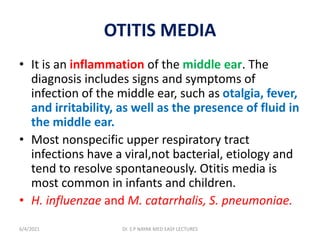
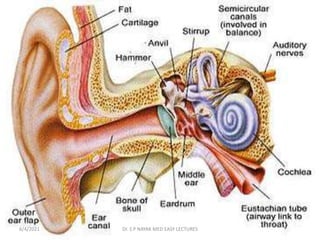
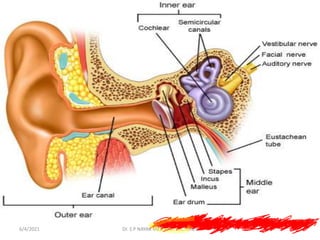
OTITIS MEDIA
• It is an inflammation of the middle ear. The
diagnosis includes signs and symptoms of
infection of the middle ear, such as otalgia, fever,
and irritability, as well as the presence of fluid in
the middle ear.
• Most nonspecific upper respiratory tract
infections have a viral,not bacterial, etiology and
tend to resolve spontaneously. Otitis media is
most common in infants and children.
• H. influenzae and M. catarrhalis, S. pneumoniae.
6/4/2021 Dr. S P NAYAK MED EASY LECTURES
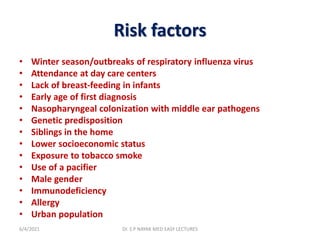
Risk factors
• Winter season/outbreaks of respiratory influenza virus
• Attendance at day care centers
• Lack of breast-feeding in infants
• Early age of first diagnosis
• Nasopharyngeal colonization with middle ear pathogens
• Genetic predisposition
• Siblings in the home
• Lower socioeconomic status
• Exposure to tobacco smoke
• Use of a pacifier
• Male gender
• Immunodeficiency
• Allergy
• Urban population
6/4/2021 Dr. S P NAYAK MED EASY LECTURES
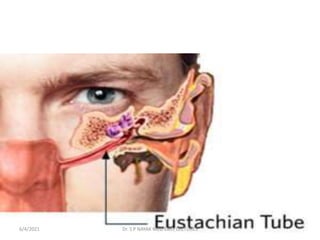
PATHOPHYSIOLOGY
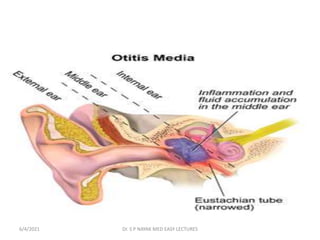
• Acute bacterial otitis media usually follows a viral
upper respiratory tract infection that causes
eustachian tube dysfunction and mucosal swelling in
the middle ear.
• Bacteria that colonize the nasopharynx thus enter the
middle ear and are not cleared properly by the
mucociliary system. In the presence of effusion, the
bacteria proliferate and cause infection.
• Children tend to be more susceptible to otitis media
than adults because the anatomy of their eustachian
tube is shorter and more horizontal, facilitating
bacterial entry into the middle ear.
6/4/2021 Dr. S P NAYAK MED EASY LECTURES
CLINICAL PRESENTATIONS
• General
The acute onset of signs and symptoms has cold symptoms of
runny nose, nasal congestion, or cough
• Signs and symptoms
Pain that can be severe (more than 75% of patients), Children
may be irritable, tug on the involved ear, and have
difficulty sleeping, Fever is present in less than 25% of
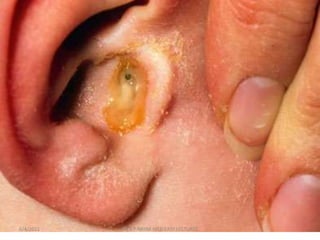
patients , Examination shows a discolored (gray),
thickened, bulging eardrum
Draining middle ear fluid occurs (less than 3% of patients)
that usually reveals a bacterial etiology
• Laboratory tests
Gram stain, culture, and sensitivities of draining fluid or
aspirated fluid if tympanocentesis is performed
6/4/2021 Dr. S P NAYAK MED EASY LECTURES
Treatment
• Acetaminophen or a nonsteroidal
antiinflammatory drug (NSAID) such as
ibuprofen should be offered early to relieve
pain and malaise in acute otitis media
regardless of the use of antibiotics
First Line
• Amoxicillin high dose alone or combined with
clavulonic acid.
• 50–90 mg/kg/day divided twice daily
6/4/2021 Dr. S P NAYAK MED EASY LECTURES
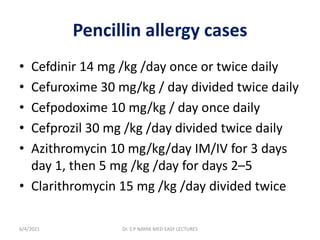
Pencillin allergy cases
• Cefdinir 14 mg /kg /day once or twice daily
• Cefuroxime 30 mg/kg / day divided twice daily
• Cefpodoxime 10 mg/kg / day once daily
• Cefprozil 30 mg /kg /day divided twice daily
• Azithromycin 10 mg/kg/day IM/IV for 3 days
day 1, then 5 mg /kg /day for days 2–5
• Clarithromycin 15 mg /kg /day divided twice
6/4/2021 Dr. S P NAYAK MED EASY LECTURES
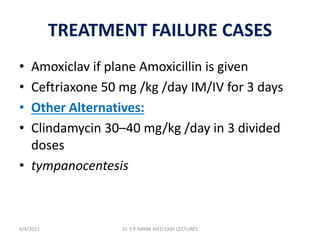
TREATMENT FAILURE CASES
• Amoxiclav if plane Amoxicillin is given
• Ceftriaxone 50 mg /kg /day IM/IV for 3 days
• Other Alternatives:
• Clindamycin 30–40 mg/kg /day in 3 divided
doses
• tympanocentesis
6/4/2021 Dr. S P NAYAK MED EASY LECTURES
Thank you
6/4/2021 Dr. S P NAYAK MED EASY LECTURES

Otitis media basic concepts

  • 1.
    OTITIS MEDIA -Therapeutics Dr. S P Srinivas Nayak, Assistant Professor, SUCP Hyderabad, Telangana 6/4/2021 Dr. S P NAYAK MED EASY LECTURES
  • 2.
    OTITIS MEDIA • Itis an inflammation of the middle ear. The diagnosis includes signs and symptoms of infection of the middle ear, such as otalgia, fever, and irritability, as well as the presence of fluid in the middle ear. • Most nonspecific upper respiratory tract infections have a viral,not bacterial, etiology and tend to resolve spontaneously. Otitis media is most common in infants and children. • H. influenzae and M. catarrhalis, S. pneumoniae. 6/4/2021 Dr. S P NAYAK MED EASY LECTURES
  • 3.
    Risk factors • Winterseason/outbreaks of respiratory influenza virus • Attendance at day care centers • Lack of breast-feeding in infants • Early age of first diagnosis • Nasopharyngeal colonization with middle ear pathogens • Genetic predisposition • Siblings in the home • Lower socioeconomic status • Exposure to tobacco smoke • Use of a pacifier • Male gender • Immunodeficiency • Allergy • Urban population 6/4/2021 Dr. S P NAYAK MED EASY LECTURES
  • 4.
    6/4/2021 Dr. SP NAYAK MED EASY LECTURES
  • 5.
    6/4/2021 Dr. SP NAYAK MED EASY LECTURES
  • 6.
    6/4/2021 Dr. SP NAYAK MED EASY LECTURES
  • 7.
    PATHOPHYSIOLOGY • Acute bacterialotitis media usually follows a viral upper respiratory tract infection that causes eustachian tube dysfunction and mucosal swelling in the middle ear. • Bacteria that colonize the nasopharynx thus enter the middle ear and are not cleared properly by the mucociliary system. In the presence of effusion, the bacteria proliferate and cause infection. • Children tend to be more susceptible to otitis media than adults because the anatomy of their eustachian tube is shorter and more horizontal, facilitating bacterial entry into the middle ear. 6/4/2021 Dr. S P NAYAK MED EASY LECTURES
  • 8.
    6/4/2021 Dr. SP NAYAK MED EASY LECTURES
  • 9.
    CLINICAL PRESENTATIONS • General Theacute onset of signs and symptoms has cold symptoms of runny nose, nasal congestion, or cough • Signs and symptoms Pain that can be severe (more than 75% of patients), Children may be irritable, tug on the involved ear, and have difficulty sleeping, Fever is present in less than 25% of patients , Examination shows a discolored (gray), thickened, bulging eardrum Draining middle ear fluid occurs (less than 3% of patients) that usually reveals a bacterial etiology • Laboratory tests Gram stain, culture, and sensitivities of draining fluid or aspirated fluid if tympanocentesis is performed 6/4/2021 Dr. S P NAYAK MED EASY LECTURES
  • 10.
    6/4/2021 Dr. SP NAYAK MED EASY LECTURES
  • 11.
    Treatment • Acetaminophen ora nonsteroidal antiinflammatory drug (NSAID) such as ibuprofen should be offered early to relieve pain and malaise in acute otitis media regardless of the use of antibiotics First Line • Amoxicillin high dose alone or combined with clavulonic acid. • 50–90 mg/kg/day divided twice daily 6/4/2021 Dr. S P NAYAK MED EASY LECTURES
  • 12.
    Pencillin allergy cases •Cefdinir 14 mg /kg /day once or twice daily • Cefuroxime 30 mg/kg / day divided twice daily • Cefpodoxime 10 mg/kg / day once daily • Cefprozil 30 mg /kg /day divided twice daily • Azithromycin 10 mg/kg/day IM/IV for 3 days day 1, then 5 mg /kg /day for days 2–5 • Clarithromycin 15 mg /kg /day divided twice 6/4/2021 Dr. S P NAYAK MED EASY LECTURES
  • 13.
    TREATMENT FAILURE CASES •Amoxiclav if plane Amoxicillin is given • Ceftriaxone 50 mg /kg /day IM/IV for 3 days • Other Alternatives: • Clindamycin 30–40 mg/kg /day in 3 divided doses • tympanocentesis 6/4/2021 Dr. S P NAYAK MED EASY LECTURES
  • 14.
    Thank you 6/4/2021 Dr.S P NAYAK MED EASY LECTURES