



Dr. S P Srinivas Nayak,
PharmD., MSc., PGDND., (PhD)
Assistant Professor, PIPR, PU
POPULATION PHARMACOKINETICS
Lecture Objectives
After completion of this lecture, student will be able to:
• Explain origin and development of population pharmacokinetics
• Discuss introduction to Bayesian theory
• Discuss introduction to analysis of population pharmacokinetic data
Population pharmacokinetics
• Population pharmacokinetics is the study of the sources and correlates of
variability in drug concentrations among individuals who are the target patient
population receiving clinically relevant doses of a drug of interest
• Certain patient demographical, pathophysiological, and therapeutic features,
such as body weight, excretory and metabolic functions, and the presence of
other therapies, can regularly alter dose-concentration relationships
• The study participants recruited are usually healthy volunteers or are
selected very cautiously.
Population Pharmacokinetics
• For example, steady-state concentrations of drugs eliminated mostly by the
kidney are usually greater in patients suffering from renal failure than they
are in patients with normal renal function who receive the same drug dosage
• Population pharmacokinetics seeks to identify the measurable
pathophysiological factors that cause changes in the dose-concentration
relationship and extent of these changes so that, if such changes are
associated with clinically significant shifts in the therapeutic index, dosage
can be appropriately modified.
Origins and development of population pharmacokinetics
• The subjects of traditional pharmacokinetic studies are usually healthy
volunteers or highly selected patients, and the average behavior of a group
(i.e., the mean plasma concentration-time profile) has been the main focus of
interest
• Traditional pharmacokinetic studies also usually involve multiple samples
taken at fixed intervals from healthy volunteers
Origins and development of population
pharmacokinetics
• In contrast, population pharmacokinetic data are obtained from patients being
treated with a drug
In contrast to traditional pharmacokinetic evaluation, the population PK
approach encompasses some or all of the following features:
o The collection of relevant pharmacokinetic information in patients who are
representative of the target population to be treated with the drug
Origins and development of population pharmacokinetics
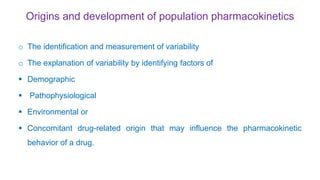
o The identification and measurement of variability
o The explanation of variability by identifying factors of
 Demographic
 Pathophysiological
 Environmental or
 Concomitant drug-related origin that may influence the pharmacokinetic
behavior of a drug.
Population pharmacokinetics
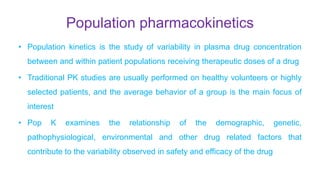
• Population kinetics is the study of variability in plasma drug concentration
between and within patient populations receiving therapeutic doses of a drug
• Traditional PK studies are usually performed on healthy volunteers or highly
selected patients, and the average behavior of a group is the main focus of
interest
• Pop K examines the relationship of the demographic, genetic,
pathophysiological, environmental and other drug related factors that
contribute to the variability observed in safety and efficacy of the drug
Population pharmacokinetics
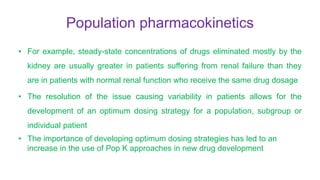
• For example, steady-state concentrations of drugs eliminated mostly by the
kidney are usually greater in patients suffering from renal failure than they
are in patients with normal renal function who receive the same drug dosage
• The resolution of the issue causing variability in patients allows for the
development of an optimum dosing strategy for a population, subgroup or
individual patient
• The importance of developing optimum dosing strategies has led to an
increase in the use of Pop K approaches in new drug development
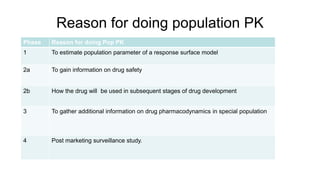
Reason for doing population PK
Phase Reason for doing Pop PK
1 To estimate population parameter of a response surface model
2a To gain information on drug safety
2b How the drug will be used in subsequent stages of drug development
3 To gather additional information on drug pharmacodynamics in special population
4 Post marketing surveillance study.
• The magnitude of the unexplained (random) variability
is important because the efficacy and safety of a drug
may decrease as unexplainable variability increases
• In addition to inter-individual variability, the degree to
which steady-state drug concentrations in individuals
typically vary about their long-term average is also
important
Objectives of pop k
1. Provides estimates of pop pk parameters fixed effects
(Fixed effects: Parameters in the pharmacokinetic model
that do not vary across subject)
2. Provides estimates of variability random effects
(Random effects: Effects varying in a random way
between subjects, between occasions, or within subject)
a. Intersubject variability: variability between subjects; measures
the magnitude of random individual variability in relation to fixed
effects. Also referred to as inter-individual variability
b. Interoccasion variability: Random variability in individual
pharmacokinetic parameters between study occasions (day to day
variability)
c. Residual intrasubject variability: The remaining unexplained
variability in response occurring within subjects after all structural
and covariate effects have been incorporated into a model.
Pop pk determines significant factors
effecting inter-subject variability…
• Demographics
• Genetics
• Environmental
• Physiological
• Concomitant therapy
• Other factors
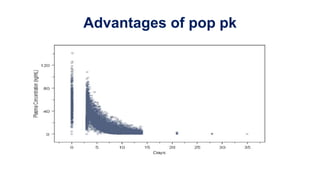
Advantages of pop pk
• Provides a better understanding of dose-response relationship
among the target patient population
• The sample population mimics the real target population at
large
• Evaluates entire population
• Can be used for predictions and simulations
Advantages of pop pk
• Computationally intensive
• Intensive and sparse sampling
• Analysis time is longer
• PK/PD modeling (relationship between drug levels and
drug effects)
Advantages of pop pk
• Multiple factors may be studied in one pop pk study
• Data can be used to support labeling claims, drug-conc
relationship and also to see regulatory approval of a new
use of a drug
• Data on studies of different designs, dosing regimens,
dosage and formulations can be pooled
Advantages of pop pk
• Provides structural model for PK/PD
• Linear and Nonlinear PK supported
• Can determine
– Clearance
– Volume of distribution
– Effect of covariates (e.g. age, weight, sex, kidney function)
Advantages of pop pk
Disadvantages
• Less rapid
• Less user-friendly software
• More expertise required for analysis, complex
methodology
• Analysis limited by imagination
• Usually patients are not homogenous
Disadvantages
• relatively large numbers of patients are required (typically
>40)
• complex pharmacostatistical analyses
• requires collection, compilation and verification of large
amounts of data
• model building may be tedious, labour intensive and
time-consuming
Disadvantages
• • model diagnostics are often complex and time-
consuming
• difficulties with handling missing data (e.g. all covariates
in all patients)
Recent studies
• A recent survey of 206 new drug applications and supplements
reviewed by the Office of Clinical Pharmacology and
Biopharmaceutics of the FDA in fiscal years 1995 and 1996
showed that almost one-quarter (i.e., 47) of the submissions
contained population PK and/or pharmacodynamic reports
• Because of early integration of population PK studies with clinical
studies, the population PK approach provided useful safety,
efficacy, and dosage optimization information for the drug label in
83 percent of the 47 submissions.
Clinical outcomes
 Population pharmacokinetic methods are an emerging and important part of drug
development including preclinical studies, clinical trials and postmarketing
surveillance.
 There are excellent reviews from the pharmaceutical industry and regulatory
perspectives, and web-based guidelines from regulatory agencies.
 Studies have involved research and clinical applications in a wide variety of patients
and conditions including diabetes, clotting disorders, malignancy, serious infection,
apnoea of prematurity, pregnancy, organ transplantation, self-poisoning and arthritis.
 Clinically, it has the potential to help the selection of the optimum dose for an
individual patient.
Clinical outcomes
 Like all mathematical models, a population pharmacokinetic model only provides
estimates of the true (but unknown) pharmacokinetic parameter values.
 Fitting a model to the data results in some uncertainty in the true value of the
estimated parameter, therefore plasma concentrations predicted by a model also have
a degree of uncertainty attached to them.
• There is an oft-quoted adage that ‘all models are wrong, but some are useful’.
Population analyses have numerous useful clinical applications, especially in patients
who otherwise may be difficult to recruit for a traditional pharmacokinetic study, for
example young children or patients in intensive care.
INTRODUCTION TO BAYESIAN THEORY
• Bayesian theory was originally developed to improve forecast accuracy by
combining subjective prediction with improvement from newly collected data
• In the diagnosis of disease, the physician may make a preliminary diagnosis
based on symptoms and physical examination
• Later, the results of laboratory tests are received. The clinician then makes a
new diagnostic forecast based on both sets of information
• Bayesian theory provides a method to weigh the prior information (eg, physical
diagnosis) and new information (eg, results from laboratory tests) to estimate a
new probability for predicting the disease
• The advantage of the Bayesian approach is the improvement in estimating the
patient's pharmacokinetic parameters based on Bayesian probability versus an
ordinary least-squares-based program
• Because of inter- and intra-subject variability, the pharmacokinetic
parameters of an individual patient must be estimated from limited data in the
presence of
 Unknown random error (assays, etc)
 Known covariates and
 Variables such as clearance, weight, and disease factor, etc, and possible
structural (kinetic model) error
• From knowledge of mean population pharmacokinetic parameters and their
variability, Bayesian methods often employ a special approach and allow
improved estimation of patient pharmacokinetic parameters when there is a
lot of variation in data
Bayesian probability theory :
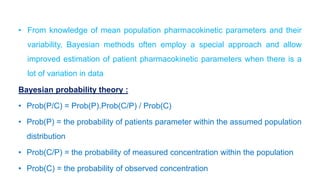
• Prob(P/C) = Prob(P).Prob(C/P) / Prob(C)
• Prob(P) = the probability of patients parameter within the assumed population
distribution
• Prob(C/P) = the probability of measured concentration within the population
• Prob(C) = the probability of observed concentration
Adaptive method
• In dosing drugs with narrow therapeutic ratios, an initial dose is calculated based
on mean population pharmacokinetic parameters
• After dosing, plasma drug concentrations are obtained from the patient
• As more blood samples are drawn from the patient, the calculated individualized
patient pharmacokinetic parameters become increasingly more reliable
Adaptive method
• This type of approach has been referred to as adaptive, or Bayesian adaptive
method with feedback
• Many ordinary least-squares computer software packages are available to
clinical practice for parameter and dosage calculation
Adaptive method
• An adaptive-type algorithm is used to estimate pharmacokinetic parameters
• The average population clearance and volume of distribution of drugs are
used for initial estimates and the program computes patient-
specific Cl and V D as serum drug concentrations are entered
Adaptive method
• Many least-squares (LS) and weighted-least-squares (WLS) algorithms are
available for estimating patient pharmacokinetic parameters
• Their common objective involves estimating the parameters with minimum
bias and good prediction, often as evaluated by mean predictive error
Adaptive method
• For example, a drug is administered by intravenous infusion at a rate, R, to a
patient. The drug is infused over t hours (t may be 0.5 to 2 hours for a typical
infusion)
• The patient's clearance, Cl T, may be estimated from plasma drug concentration
taken at a known time according to a one-compartment-model equation
Analysis of population PK Data
• The nonlinear mixed effect model (or NONMEM) is so called because the
model uses both fixed and random factors to describe data
• Fixed factors such as patient weight, age, gender are assumed to have no
error, whereas random factors include inter- and intra individual differences
• NONMEM is a statistical program written in Fortran that allows Bayesian
pharmacokinetic parameters to be estimated using an efficient algorithm
called the first-order (FO) method
• The parameters may now be estimated also with a first-order conditional
estimate (FOCE) algorithm
• NONMEM fits plasma drug concentration data for all subjects in the groups
simultaneously and estimates the population parameter and its variance. The
parameter may be clearance and/or V D
• The model may also test for other fixed effects on the drug due to factors
such as age, weight, and creatinine concentration
• There are generally two reliable and practical approaches to population
pharmacokinetic data analysis
• One approach is the standard two-stage (STS) method, which estimates
parameters from the plasma drug concentration data for an individual subject
during the first stage
• The estimates from all subjects are then combined to obtain an estimate of the
parameters for the population
• A second approach, the first-order (FO) method, is also used but is perhaps
less well understood
• The estimation procedure is based on minimization of an extended least-
squares criterion which utilizes a Newton-Raphson-like algorithm
Summary
• Bayesian theory was originally developed to improve forecast accuracy by
combining subjective prediction with improvement from newly collected data
• Bayesian theory provides a method to weigh the prior information (eg,
physical diagnosis) and new information (eg, results from laboratory tests) to
estimate a new probability for predicting the disease
• The nonlinear mixed effect model (or NONMEM) is so called because the
model uses both fixed and random factors to describe data
• Population pharmacokinetics
• Origins and development of population pharmacokinetics
• Introduction to Bayesian theory
• Adaptive method
• Analysis of population PK data
THANK YOU

6. population pharmacokinetics

  • 1.
    Dr. S PSrinivas Nayak, PharmD., MSc., PGDND., (PhD) Assistant Professor, PIPR, PU POPULATION PHARMACOKINETICS
  • 2.
    Lecture Objectives After completionof this lecture, student will be able to: • Explain origin and development of population pharmacokinetics • Discuss introduction to Bayesian theory • Discuss introduction to analysis of population pharmacokinetic data
  • 3.
    Population pharmacokinetics • Populationpharmacokinetics is the study of the sources and correlates of variability in drug concentrations among individuals who are the target patient population receiving clinically relevant doses of a drug of interest • Certain patient demographical, pathophysiological, and therapeutic features, such as body weight, excretory and metabolic functions, and the presence of other therapies, can regularly alter dose-concentration relationships • The study participants recruited are usually healthy volunteers or are selected very cautiously.
  • 4.
    Population Pharmacokinetics • Forexample, steady-state concentrations of drugs eliminated mostly by the kidney are usually greater in patients suffering from renal failure than they are in patients with normal renal function who receive the same drug dosage • Population pharmacokinetics seeks to identify the measurable pathophysiological factors that cause changes in the dose-concentration relationship and extent of these changes so that, if such changes are associated with clinically significant shifts in the therapeutic index, dosage can be appropriately modified.
  • 5.
    Origins and developmentof population pharmacokinetics • The subjects of traditional pharmacokinetic studies are usually healthy volunteers or highly selected patients, and the average behavior of a group (i.e., the mean plasma concentration-time profile) has been the main focus of interest • Traditional pharmacokinetic studies also usually involve multiple samples taken at fixed intervals from healthy volunteers
  • 6.
    Origins and developmentof population pharmacokinetics • In contrast, population pharmacokinetic data are obtained from patients being treated with a drug In contrast to traditional pharmacokinetic evaluation, the population PK approach encompasses some or all of the following features: o The collection of relevant pharmacokinetic information in patients who are representative of the target population to be treated with the drug
  • 7.
    Origins and developmentof population pharmacokinetics o The identification and measurement of variability o The explanation of variability by identifying factors of  Demographic  Pathophysiological  Environmental or  Concomitant drug-related origin that may influence the pharmacokinetic behavior of a drug.
  • 8.
    Population pharmacokinetics • Populationkinetics is the study of variability in plasma drug concentration between and within patient populations receiving therapeutic doses of a drug • Traditional PK studies are usually performed on healthy volunteers or highly selected patients, and the average behavior of a group is the main focus of interest • Pop K examines the relationship of the demographic, genetic, pathophysiological, environmental and other drug related factors that contribute to the variability observed in safety and efficacy of the drug
  • 9.
    Population pharmacokinetics • Forexample, steady-state concentrations of drugs eliminated mostly by the kidney are usually greater in patients suffering from renal failure than they are in patients with normal renal function who receive the same drug dosage • The resolution of the issue causing variability in patients allows for the development of an optimum dosing strategy for a population, subgroup or individual patient • The importance of developing optimum dosing strategies has led to an increase in the use of Pop K approaches in new drug development
  • 10.
    Reason for doingpopulation PK Phase Reason for doing Pop PK 1 To estimate population parameter of a response surface model 2a To gain information on drug safety 2b How the drug will be used in subsequent stages of drug development 3 To gather additional information on drug pharmacodynamics in special population 4 Post marketing surveillance study.
  • 11.
    • The magnitudeof the unexplained (random) variability is important because the efficacy and safety of a drug may decrease as unexplainable variability increases • In addition to inter-individual variability, the degree to which steady-state drug concentrations in individuals typically vary about their long-term average is also important
  • 12.
    Objectives of popk 1. Provides estimates of pop pk parameters fixed effects (Fixed effects: Parameters in the pharmacokinetic model that do not vary across subject) 2. Provides estimates of variability random effects (Random effects: Effects varying in a random way between subjects, between occasions, or within subject)
  • 13.
    a. Intersubject variability:variability between subjects; measures the magnitude of random individual variability in relation to fixed effects. Also referred to as inter-individual variability b. Interoccasion variability: Random variability in individual pharmacokinetic parameters between study occasions (day to day variability) c. Residual intrasubject variability: The remaining unexplained variability in response occurring within subjects after all structural and covariate effects have been incorporated into a model.
  • 14.
    Pop pk determinessignificant factors effecting inter-subject variability… • Demographics • Genetics • Environmental • Physiological • Concomitant therapy • Other factors
  • 15.
    Advantages of poppk • Provides a better understanding of dose-response relationship among the target patient population • The sample population mimics the real target population at large • Evaluates entire population • Can be used for predictions and simulations
  • 16.
    Advantages of poppk • Computationally intensive • Intensive and sparse sampling • Analysis time is longer • PK/PD modeling (relationship between drug levels and drug effects)
  • 17.
    Advantages of poppk • Multiple factors may be studied in one pop pk study • Data can be used to support labeling claims, drug-conc relationship and also to see regulatory approval of a new use of a drug • Data on studies of different designs, dosing regimens, dosage and formulations can be pooled
  • 18.
    Advantages of poppk • Provides structural model for PK/PD • Linear and Nonlinear PK supported • Can determine – Clearance – Volume of distribution – Effect of covariates (e.g. age, weight, sex, kidney function)
  • 19.
  • 20.
    Disadvantages • Less rapid •Less user-friendly software • More expertise required for analysis, complex methodology • Analysis limited by imagination • Usually patients are not homogenous
  • 21.
    Disadvantages • relatively largenumbers of patients are required (typically >40) • complex pharmacostatistical analyses • requires collection, compilation and verification of large amounts of data • model building may be tedious, labour intensive and time-consuming
  • 22.
    Disadvantages • • modeldiagnostics are often complex and time- consuming • difficulties with handling missing data (e.g. all covariates in all patients)
  • 23.
    Recent studies • Arecent survey of 206 new drug applications and supplements reviewed by the Office of Clinical Pharmacology and Biopharmaceutics of the FDA in fiscal years 1995 and 1996 showed that almost one-quarter (i.e., 47) of the submissions contained population PK and/or pharmacodynamic reports • Because of early integration of population PK studies with clinical studies, the population PK approach provided useful safety, efficacy, and dosage optimization information for the drug label in 83 percent of the 47 submissions.
  • 24.
    Clinical outcomes  Populationpharmacokinetic methods are an emerging and important part of drug development including preclinical studies, clinical trials and postmarketing surveillance.  There are excellent reviews from the pharmaceutical industry and regulatory perspectives, and web-based guidelines from regulatory agencies.  Studies have involved research and clinical applications in a wide variety of patients and conditions including diabetes, clotting disorders, malignancy, serious infection, apnoea of prematurity, pregnancy, organ transplantation, self-poisoning and arthritis.  Clinically, it has the potential to help the selection of the optimum dose for an individual patient.
  • 25.
    Clinical outcomes  Likeall mathematical models, a population pharmacokinetic model only provides estimates of the true (but unknown) pharmacokinetic parameter values.  Fitting a model to the data results in some uncertainty in the true value of the estimated parameter, therefore plasma concentrations predicted by a model also have a degree of uncertainty attached to them. • There is an oft-quoted adage that ‘all models are wrong, but some are useful’. Population analyses have numerous useful clinical applications, especially in patients who otherwise may be difficult to recruit for a traditional pharmacokinetic study, for example young children or patients in intensive care.
  • 26.
    INTRODUCTION TO BAYESIANTHEORY • Bayesian theory was originally developed to improve forecast accuracy by combining subjective prediction with improvement from newly collected data • In the diagnosis of disease, the physician may make a preliminary diagnosis based on symptoms and physical examination • Later, the results of laboratory tests are received. The clinician then makes a new diagnostic forecast based on both sets of information
  • 27.
    • Bayesian theoryprovides a method to weigh the prior information (eg, physical diagnosis) and new information (eg, results from laboratory tests) to estimate a new probability for predicting the disease • The advantage of the Bayesian approach is the improvement in estimating the patient's pharmacokinetic parameters based on Bayesian probability versus an ordinary least-squares-based program
  • 28.
    • Because ofinter- and intra-subject variability, the pharmacokinetic parameters of an individual patient must be estimated from limited data in the presence of  Unknown random error (assays, etc)  Known covariates and  Variables such as clearance, weight, and disease factor, etc, and possible structural (kinetic model) error
  • 29.
    • From knowledgeof mean population pharmacokinetic parameters and their variability, Bayesian methods often employ a special approach and allow improved estimation of patient pharmacokinetic parameters when there is a lot of variation in data Bayesian probability theory : • Prob(P/C) = Prob(P).Prob(C/P) / Prob(C) • Prob(P) = the probability of patients parameter within the assumed population distribution • Prob(C/P) = the probability of measured concentration within the population • Prob(C) = the probability of observed concentration
  • 30.
    Adaptive method • Indosing drugs with narrow therapeutic ratios, an initial dose is calculated based on mean population pharmacokinetic parameters • After dosing, plasma drug concentrations are obtained from the patient • As more blood samples are drawn from the patient, the calculated individualized patient pharmacokinetic parameters become increasingly more reliable
  • 31.
    Adaptive method • Thistype of approach has been referred to as adaptive, or Bayesian adaptive method with feedback • Many ordinary least-squares computer software packages are available to clinical practice for parameter and dosage calculation
  • 32.
    Adaptive method • Anadaptive-type algorithm is used to estimate pharmacokinetic parameters • The average population clearance and volume of distribution of drugs are used for initial estimates and the program computes patient- specific Cl and V D as serum drug concentrations are entered
  • 33.
    Adaptive method • Manyleast-squares (LS) and weighted-least-squares (WLS) algorithms are available for estimating patient pharmacokinetic parameters • Their common objective involves estimating the parameters with minimum bias and good prediction, often as evaluated by mean predictive error
  • 34.
    Adaptive method • Forexample, a drug is administered by intravenous infusion at a rate, R, to a patient. The drug is infused over t hours (t may be 0.5 to 2 hours for a typical infusion) • The patient's clearance, Cl T, may be estimated from plasma drug concentration taken at a known time according to a one-compartment-model equation
  • 35.
    Analysis of populationPK Data Analysis of population PK Data • The nonlinear mixed effect model (or NONMEM) is so called because the model uses both fixed and random factors to describe data • Fixed factors such as patient weight, age, gender are assumed to have no error, whereas random factors include inter- and intra individual differences
  • 36.
    • NONMEM isa statistical program written in Fortran that allows Bayesian pharmacokinetic parameters to be estimated using an efficient algorithm called the first-order (FO) method • The parameters may now be estimated also with a first-order conditional estimate (FOCE) algorithm
  • 37.
    • NONMEM fitsplasma drug concentration data for all subjects in the groups simultaneously and estimates the population parameter and its variance. The parameter may be clearance and/or V D • The model may also test for other fixed effects on the drug due to factors such as age, weight, and creatinine concentration
  • 38.
    • There aregenerally two reliable and practical approaches to population pharmacokinetic data analysis • One approach is the standard two-stage (STS) method, which estimates parameters from the plasma drug concentration data for an individual subject during the first stage • The estimates from all subjects are then combined to obtain an estimate of the parameters for the population
  • 39.
    • A secondapproach, the first-order (FO) method, is also used but is perhaps less well understood • The estimation procedure is based on minimization of an extended least- squares criterion which utilizes a Newton-Raphson-like algorithm
  • 40.
    Summary • Bayesian theorywas originally developed to improve forecast accuracy by combining subjective prediction with improvement from newly collected data • Bayesian theory provides a method to weigh the prior information (eg, physical diagnosis) and new information (eg, results from laboratory tests) to estimate a new probability for predicting the disease • The nonlinear mixed effect model (or NONMEM) is so called because the model uses both fixed and random factors to describe data
  • 41.
    • Population pharmacokinetics •Origins and development of population pharmacokinetics • Introduction to Bayesian theory • Adaptive method • Analysis of population PK data
  • 42.