Otitis Media
PRESENTATION BY :-
MISS. TAMANNA
PEDIATRICS (CHILD HEALTH
NURSING)
Introduction
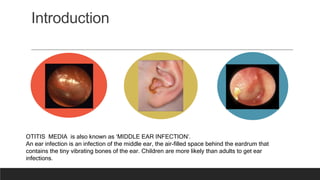
OTITIS MEDIA is also known as ‘MIDDLE EAR INFECTION’.
An ear infection is an infection of the middle ear, the air-filled space behind the eardrum that
contains the tiny vibrating bones of the ear. Children are more likely than adults to get ear
infections.
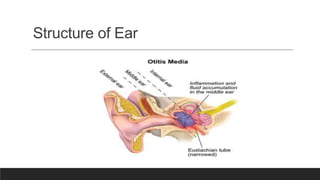
Structure of Ear
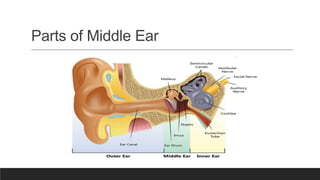
Parts of Middle Ear
Definition
Otitis Media can be defined as inflammation of the middle ear.
 Most often it occurs in infant and young children but can occur at any age.
It may involves inflammation of mastoid, petrous apex and peripheral labyrinthine air
cells.
. Basically it is an accumulation of the fluid in the middle ear, the space between
tympanic membrane and inner ear. The middle ear is usually filled with air but
sometimes get filled with mucus and fluid. Sometime this mucus get infarcted with
pathogens called an ear infection. It is most common pediatric problem
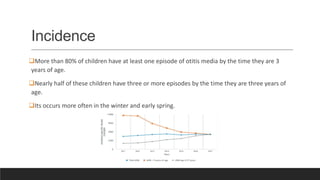
Incidence
More than 80% of children have at least one episode of otitis media by the time they are 3
years of age.
Nearly half of these children have three or more episodes by the time they are three years of
age.
Its occurs more often in the winter and early spring.
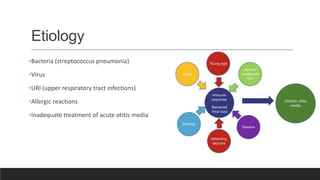
Etiology
•Bacteria (streptococcus pneumonia)
•Virus
•URI (upper respiratory tract infections)
•Allergic reactions
•Inadequate treatment of acute otitis media
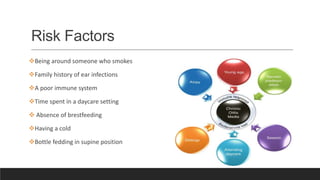
Risk Factors
Being around someone who smokes
Family history of ear infections
A poor immune system
Time spent in a daycare setting
 Absence of brestfeeding
Having a cold
Bottle fedding in supine position
Types of Otitis Media
ACUTE OTITIS MEDIA (AOM) :- The middle ear infection occurs abruptly causing swelling
and redness. Fluid and mucous become trapped inside the ear, causing the child to have
fever, ear pain and hearing loss.
OTITIS MEDIA WITH EFFUSION (OME) :- Fluid (effusion) and mucous continue to
accumulate in the middle ear after an initial infection subsides. The child may experience
a feeling of fullness in the ear and hearing loss.
Clinical Manifestations
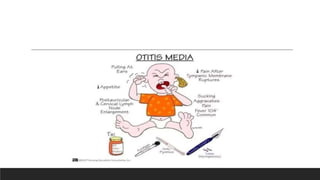
:The following are the most common symptoms of otitis media. However, each child may
experience symptoms differently. Symptoms may include
Unusual irritability
Difficulty sleeping or staying asleep
Tugging or pulling at one or both ears
Fever
Fluid draining from ear(s)
Loss of balance
 Hearing difficulties
Ear pain
Nausea and vomiting
Diarrhea
Decreased appetite
Congestion
The symptoms of otitis media may resemble other conditions or medical problems.
Diagnostic Evaluation
History collection and physical examination
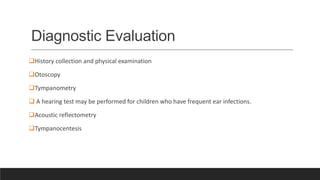
Otoscopy
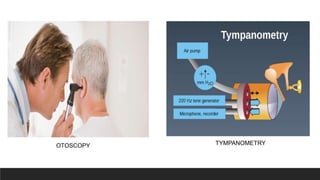
Tympanometry
 A hearing test may be performed for children who have frequent ear infections.
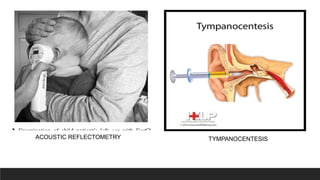
Acoustic reflectometry
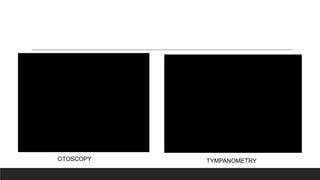
Tympanocentesis
OTOSCOPY TYMPANOMETRY
ACOUSTIC REFLECTOMETRY TYMPANOCENTESIS
OTOSCOPY TYMPANOMETRY
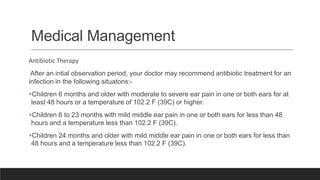
Medical Management
Antibiotic Therapy
After an intial observation period, your doctor may recommend antibiotic treatment for an
infection in the following situatons:-
Children 6 months and older with moderate to severe ear pain in one or both ears for at
least 48 hours or a temperature of 102.2 F (39C) or higher.
Children 6 to 23 months with mild middle ear pain in one or both ears for less than 48
hours and a temperature less than 102.2 F (39C).
Children 24 months and older with mild middle ear pain in one or both ears for less than
48 hours and a temperature less than 102.2 F (39C).
Antibiotic medication by mouth or ear drops.
Analgesics (for pain)
Broad spectrum antibiotic therapy (penicillin)
NSAIDs Drug
Surgical Management
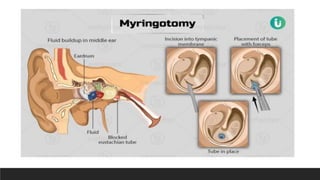
Myringotomy:- incision through eardrum to create an artificial opening either to allow
infected fluid to drain from the middle ear in acute otitis media.
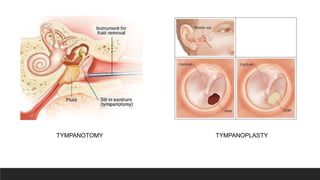
Tympanotomy:- A surgical operation to expose the middle ear and allow access to the
ossicles. It is usually performed by using around the ear drum and turning it forwards.
Tympanoplasty:- Surgical repair of tympanic membrane (eardrum) or surgical repair of
a perforated eardrum by grafting.
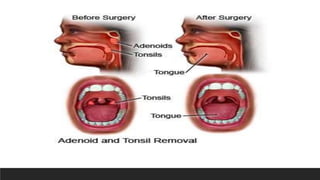
Removal of adenoids – adenoid is a lymph tissue located in the space above the soft
roof of the mouth, also called as nasopharynx. Removal of adenoids has shown to help
some children with otitis media.
MYRINGOTOMY
TYMPANOTOMY TYMPANOPLASTY
TYMPANOPLASTY
Nursing Management
Assessment
Collect the health history includes a complete description of the ear problem.
Collect the data about the duration and intensity of the problem, its causes, and previous
treatments.
Obtain information about other health problems and medications.
Physical assessment includes observation for erythema, edema, otorrhea, lesions, and
characteristics such as odor and color of discharge.
Nursing Diagnosis
Acute pain (otalgia) related to disease condition as evidenced by patient verbalization.
Altered auditory sensation perception related to fluid accumulation in middle ear as evidenced
by patient unable to respond.
Knowledge deficit related to disease process and treatment as evidenced by patient is having
many doubts.
Risk for infection related to decreased immune response.
Complications
Untreated otitis media can result in any/all of the following:
Infection in other parts of the head
Permanent hearing loss
Problem with speech and language development
Tearing of ear drum
Preventions
•Prevent common colds and other illnesses.
•Avoid secondhand smoke
•Breastfeed baby
•While bottle-feeding, hold baby in an upright position
Conclusion
Otitis Media, which is also known as “middle ear infection” , its already specifies in its
name that otitis media is inflammation or infection of middle ear which usually occurs
due to accumulation of fluid in middle ear behind the ear drum.
More often it occurs in infants and children but it can occur at any age.
Many risk factors and causes give rise to condition of otitis media which leads to a no. of
sign and symptoms in the patient.
The treatment to this disease condition can be done by medication or by using surgical
procedures.
Summary
In this presentation, we have covered the following topics concerning about otitis media:-
Introduction
Definition
Incidence
Etiology
Risk Factors
Types of otitis media
Clinical Manifestations
Diagnostic Evaluations
Medical Management
Surgical Management
Nursing Management
Complications
Preventions
Bibliographhy
• Sharma Rimple, “Essentials of Pediatrics Nursing”, 3rd Edition, pg no. 374-375
•https://www.slideshare.net/AshokBishnoi1/otitis-media-32721967
Otitis Media.pptx

Otitis Media.pptx

  • 1.
    Otitis Media PRESENTATION BY:- MISS. TAMANNA PEDIATRICS (CHILD HEALTH NURSING)
  • 2.
    Introduction OTITIS MEDIA isalso known as ‘MIDDLE EAR INFECTION’. An ear infection is an infection of the middle ear, the air-filled space behind the eardrum that contains the tiny vibrating bones of the ear. Children are more likely than adults to get ear infections.
  • 3.
  • 4.
  • 5.
    Definition Otitis Media canbe defined as inflammation of the middle ear.  Most often it occurs in infant and young children but can occur at any age. It may involves inflammation of mastoid, petrous apex and peripheral labyrinthine air cells. . Basically it is an accumulation of the fluid in the middle ear, the space between tympanic membrane and inner ear. The middle ear is usually filled with air but sometimes get filled with mucus and fluid. Sometime this mucus get infarcted with pathogens called an ear infection. It is most common pediatric problem
  • 6.
    Incidence More than 80%of children have at least one episode of otitis media by the time they are 3 years of age. Nearly half of these children have three or more episodes by the time they are three years of age. Its occurs more often in the winter and early spring.
  • 7.
    Etiology •Bacteria (streptococcus pneumonia) •Virus •URI(upper respiratory tract infections) •Allergic reactions •Inadequate treatment of acute otitis media
  • 8.
    Risk Factors Being aroundsomeone who smokes Family history of ear infections A poor immune system Time spent in a daycare setting  Absence of brestfeeding Having a cold Bottle fedding in supine position
  • 9.
    Types of OtitisMedia ACUTE OTITIS MEDIA (AOM) :- The middle ear infection occurs abruptly causing swelling and redness. Fluid and mucous become trapped inside the ear, causing the child to have fever, ear pain and hearing loss. OTITIS MEDIA WITH EFFUSION (OME) :- Fluid (effusion) and mucous continue to accumulate in the middle ear after an initial infection subsides. The child may experience a feeling of fullness in the ear and hearing loss.
  • 10.
    Clinical Manifestations :The followingare the most common symptoms of otitis media. However, each child may experience symptoms differently. Symptoms may include Unusual irritability Difficulty sleeping or staying asleep Tugging or pulling at one or both ears Fever Fluid draining from ear(s) Loss of balance
  • 11.
     Hearing difficulties Earpain Nausea and vomiting Diarrhea Decreased appetite Congestion The symptoms of otitis media may resemble other conditions or medical problems.
  • 13.
    Diagnostic Evaluation History collectionand physical examination Otoscopy Tympanometry  A hearing test may be performed for children who have frequent ear infections. Acoustic reflectometry Tympanocentesis
  • 14.
  • 15.
  • 16.
  • 17.
    Medical Management Antibiotic Therapy Afteran intial observation period, your doctor may recommend antibiotic treatment for an infection in the following situatons:- Children 6 months and older with moderate to severe ear pain in one or both ears for at least 48 hours or a temperature of 102.2 F (39C) or higher. Children 6 to 23 months with mild middle ear pain in one or both ears for less than 48 hours and a temperature less than 102.2 F (39C). Children 24 months and older with mild middle ear pain in one or both ears for less than 48 hours and a temperature less than 102.2 F (39C).
  • 18.
    Antibiotic medication bymouth or ear drops. Analgesics (for pain) Broad spectrum antibiotic therapy (penicillin) NSAIDs Drug
  • 19.
    Surgical Management Myringotomy:- incisionthrough eardrum to create an artificial opening either to allow infected fluid to drain from the middle ear in acute otitis media. Tympanotomy:- A surgical operation to expose the middle ear and allow access to the ossicles. It is usually performed by using around the ear drum and turning it forwards. Tympanoplasty:- Surgical repair of tympanic membrane (eardrum) or surgical repair of a perforated eardrum by grafting. Removal of adenoids – adenoid is a lymph tissue located in the space above the soft roof of the mouth, also called as nasopharynx. Removal of adenoids has shown to help some children with otitis media.
  • 21.
  • 22.
  • 23.
  • 25.
    Nursing Management Assessment Collect thehealth history includes a complete description of the ear problem. Collect the data about the duration and intensity of the problem, its causes, and previous treatments. Obtain information about other health problems and medications. Physical assessment includes observation for erythema, edema, otorrhea, lesions, and characteristics such as odor and color of discharge.
  • 26.
    Nursing Diagnosis Acute pain(otalgia) related to disease condition as evidenced by patient verbalization. Altered auditory sensation perception related to fluid accumulation in middle ear as evidenced by patient unable to respond. Knowledge deficit related to disease process and treatment as evidenced by patient is having many doubts. Risk for infection related to decreased immune response.
  • 27.
    Complications Untreated otitis mediacan result in any/all of the following: Infection in other parts of the head Permanent hearing loss Problem with speech and language development Tearing of ear drum
  • 28.
    Preventions •Prevent common coldsand other illnesses. •Avoid secondhand smoke •Breastfeed baby •While bottle-feeding, hold baby in an upright position
  • 29.
    Conclusion Otitis Media, whichis also known as “middle ear infection” , its already specifies in its name that otitis media is inflammation or infection of middle ear which usually occurs due to accumulation of fluid in middle ear behind the ear drum. More often it occurs in infants and children but it can occur at any age. Many risk factors and causes give rise to condition of otitis media which leads to a no. of sign and symptoms in the patient. The treatment to this disease condition can be done by medication or by using surgical procedures.
  • 30.
    Summary In this presentation,we have covered the following topics concerning about otitis media:- Introduction Definition Incidence Etiology Risk Factors Types of otitis media
  • 31.
    Clinical Manifestations Diagnostic Evaluations MedicalManagement Surgical Management Nursing Management Complications Preventions
  • 32.
    Bibliographhy • Sharma Rimple,“Essentials of Pediatrics Nursing”, 3rd Edition, pg no. 374-375 •https://www.slideshare.net/AshokBishnoi1/otitis-media-32721967