Presentation by:
Mrs.sarasajani.s
Asst professor
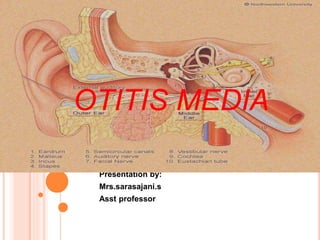
OTITIS MEDIA
TERMINOLOGY
 Otology:- The study of disease of the ear.
 Otalgia :- Pain in the ear due to some
disease of jaw joint, neck, throat or teeth.
 Tinnitus:- The sensation of sound in the ear.
 Vertigo:- Spinning of the head .
 Otorrhea :- Any discharge from the ear.
 Otorrhagia :- Bleeding from the ear.
 Otomycosis:- A fungus infection of the ear
causing irritation & inflammation.
 Deafness:- Loss of hearing.
 Otoplasty :-Surgical Repair & Reconstruction of
the ear.
 Otorhinolaryngology:- Study of ear, nose &
throat disease.
 Audiometry:- An apparatus for measuring
hearing.
 Tympanoplasty:- It is repairment of tympanic
membrane.
 Myringotomy:- Incision in tympanic membrane. The
fluid is section out of middle ear, cavity.
 Osteitis:- Inflammation in bone.
 Mastoiditis:- Inflammation of the mastoid antrum
and cell.
INTRODUCTION
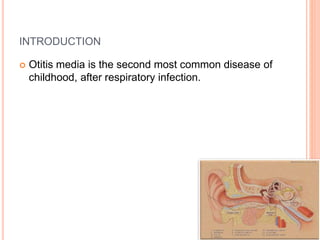
 Otitis media is the second most common disease of
childhood, after respiratory infection.
DEFINITION:-
 “It is an inflammation of the middle ear that is the
area between the tympanic membrane and the
inner ear.
INCIDENCE
 Occurs more frequently in the winter months
 Peak incidence in the first two years of life (esp. 6-
24 months.
 Boys more affected girls 50% of children 1 yr of age
will have at least 1 episode.
 1/3 of children will have 3 or more infections by
age 3
 90% of children will have at least one infection by
age 6.
CLASSIFICATION
 Otitis media:
Presence of a middle ear infection or inflammation.
 Acute Otitis Media:
occurrence of bacterial infection within the middle
ear cavity.
 Otitis Media with Effusion:
presence of non purulent fluid(with out
symptoms) within the middle ear cavity (viral).
CAUSES
1. 3 most common bacteria causing acute otitis
media are-
 Streptococcus pneumoniae
 Haemophilus influenzae(non-typeable)
 Moraxella catarrhalis
2. The two viruses most likely to precipitate otitis
media are -
 Respiratory syncytia virus
 influenza.
CON..........
 This infection often results from another illness – cold,
flue or allergy. That causes congestion and swelling of
the nasal passages, throat and Eustachian tubes.
RISK FACTORS
Some factors that increase a child's risk for middle ear infections include:
 Age:Children between the ages of 6 months and 2 years are more
susceptible to ear infections because of the size and shape of their
eustachian tubes and because their immune systems are still
developing.
 crowded living conditions
 attending daycare
 exposure to second-hand smoke
 respiratory illnesses such as the common cold
 close contact with siblings who have colds
 having a cleft palate
 allergies that cause congestion on a chronic basis
 not being breast-fed
 bottle-feeding while lying down
 Barometric trauma is another risk factor for a middle ear infection.
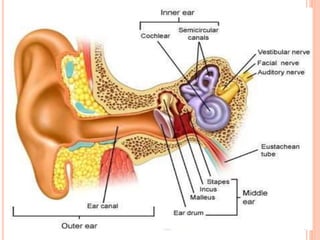
ROLE OF EUSTACHIAN TUBES
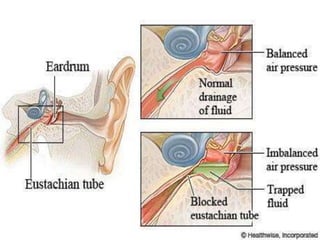
The eustachian tubes are a pair of narrow tubes that run from
each middle ear to high in the back of the throat, behind the
nasal passages.
The eustachian tubes have 3 functions relative to the middle ear:
 Equalize the air pressure between the middle ear and
nasopharynx.
 Ventilation and drainage of the middle ear.
 Protects the middle ear from the nasopharyngeal secretions and
loud sounds.
PATHOPHYSIOLOGY
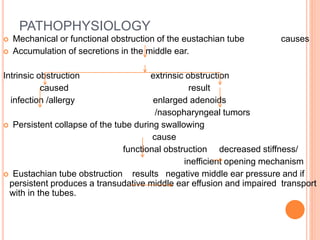
 Mechanical or functional obstruction of the eustachian tube causes
 Accumulation of secretions in the middle ear.
Intrinsic obstruction extrinsic obstruction
caused result
infection /allergy enlarged adenoids
/nasopharyngeal tumors
 Persistent collapse of the tube during swallowing
cause
functional obstruction decreased stiffness/
inefficient opening mechanism
 Eustachian tube obstruction results negative middle ear pressure and if
persistent produces a transudative middle ear effusion and impaired transport
with in the tubes.
SIGNS & SYMPTOMS
 Acute otitis media:
 follow an upper respiratory tract infection
 Otorrhea(purulent discharge)
 Otalgia(ear ache)
 Fever may or may not present.
 Infant or very young child:
 Crying, fussiness, restlessness, irritability,
 tendency to rub, hold, or pull affected ear
 Rolling head from side to side
 Difficulty comforting child, loss of appetite.
 Older child:
 Crying or verbalizing feeling of discomfort,irritability,lethargy,loss of appetite.
 Chronic otitis media:
 Hearing loss,difficulty communicating, feeling of fullness, tinnitus or vertigo
may be present
CON..........
 Other non specific symptoms are:
 Rhinitis
 Cough
 Diarrhea are often present.
COMPLICATIONS
 Ear infections that happen again and again can lead to serious
complications:
 Impaired hearing. Mild hearing loss that comes and goes is fairly
common with an ear infection, but it usually gets better after the
infection clears. Ear infections that happen again and again, or fluid in
the middle ear, may lead to more-significant hearing loss. If there is
some permanent damage to the eardrum or other middle ear
structures, permanent hearing loss may occur.
 Speech or developmental delays. If hearing is temporarily or
permanently impaired in infants and toddlers, they may experience
delays in speech, social and developmental skills.
 Spread of infection. Untreated infections or infections that don't
respond well to treatment can spread to nearby tissues. Infection of
the mastoid, the bony protrusion behind the ear, is called mastoiditis.
This infection can result in damage to the bone and the formation of
pus-filled cysts. Rarely, serious middle ear infections spread to other
tissues in the skull, including the brain or the membranes surrounding
the brain (meningitis).
 Tearing of the eardrum. Most eardrum tears heal within 72 hours. In
some cases, surgical repair is needed.
DIAGNOSTIC EVALUATION
 • History
 • Physical examination
 • Otoscopic examination
 • Culture
 • Audiometry ( testing of the hearing sense) &
Tympanometry (evaluation of the mobility and
patency of the eardrum)
MANAGEMENT MEDICAL MANAGEMENT- •
 Administration of antibiotic (Ampicillin or
Amoxicillin).
 • Anti-inflammatory (analgesic & antipyretic).
MANAGEMENT SURGICAL MANAGEMENT
 Myringotomy or tympanotomy (incision in the
tympanic membrane) a procedure in which a doctor
creates a small hole in the eardrum so fluids such
as water, blood, or pus can drain out.
NURSING CARE
 • Apply hot water bag over the ear with the child lying on the
affected side may reduce the discomfort (applied during the
attack of pain).
 • Put ice bag over the affected ear may also be beneficial to
reduce edema (between pain attacks).
 • For drained ear; the external canal may be frequently cleaned
using sterile cotton swabs (dry or soaked in hydrogen peroxide).
 Excoriation of the outer ear should be prevented by frequent
cleansing & application of zinc oxide to the area of oxidate.
 • Give special attention to th tympanostomy tube i.e., avoid
water entering the middle ear and introducing bacteria.
 • Educate family about care of child, & keep them aware with
the complications of acute otitis media e.g.,hearing loss.
 Provide emotional support to the child & his family.

Otitis media

  • 1.
  • 3.
    TERMINOLOGY  Otology:- Thestudy of disease of the ear.  Otalgia :- Pain in the ear due to some disease of jaw joint, neck, throat or teeth.  Tinnitus:- The sensation of sound in the ear.  Vertigo:- Spinning of the head .  Otorrhea :- Any discharge from the ear.  Otorrhagia :- Bleeding from the ear.
  • 4.
     Otomycosis:- Afungus infection of the ear causing irritation & inflammation.  Deafness:- Loss of hearing.  Otoplasty :-Surgical Repair & Reconstruction of the ear.  Otorhinolaryngology:- Study of ear, nose & throat disease.  Audiometry:- An apparatus for measuring hearing.
  • 5.
     Tympanoplasty:- Itis repairment of tympanic membrane.  Myringotomy:- Incision in tympanic membrane. The fluid is section out of middle ear, cavity.  Osteitis:- Inflammation in bone.  Mastoiditis:- Inflammation of the mastoid antrum and cell.
  • 6.
    INTRODUCTION  Otitis mediais the second most common disease of childhood, after respiratory infection.
  • 7.
    DEFINITION:-  “It isan inflammation of the middle ear that is the area between the tympanic membrane and the inner ear.
  • 8.
    INCIDENCE  Occurs morefrequently in the winter months  Peak incidence in the first two years of life (esp. 6- 24 months.  Boys more affected girls 50% of children 1 yr of age will have at least 1 episode.  1/3 of children will have 3 or more infections by age 3  90% of children will have at least one infection by age 6.
  • 9.
    CLASSIFICATION  Otitis media: Presenceof a middle ear infection or inflammation.  Acute Otitis Media: occurrence of bacterial infection within the middle ear cavity.  Otitis Media with Effusion: presence of non purulent fluid(with out symptoms) within the middle ear cavity (viral).
  • 10.
    CAUSES 1. 3 mostcommon bacteria causing acute otitis media are-  Streptococcus pneumoniae  Haemophilus influenzae(non-typeable)  Moraxella catarrhalis 2. The two viruses most likely to precipitate otitis media are -  Respiratory syncytia virus  influenza.
  • 11.
    CON..........  This infectionoften results from another illness – cold, flue or allergy. That causes congestion and swelling of the nasal passages, throat and Eustachian tubes.
  • 12.
    RISK FACTORS Some factorsthat increase a child's risk for middle ear infections include:  Age:Children between the ages of 6 months and 2 years are more susceptible to ear infections because of the size and shape of their eustachian tubes and because their immune systems are still developing.  crowded living conditions  attending daycare  exposure to second-hand smoke  respiratory illnesses such as the common cold  close contact with siblings who have colds  having a cleft palate  allergies that cause congestion on a chronic basis  not being breast-fed  bottle-feeding while lying down  Barometric trauma is another risk factor for a middle ear infection.
  • 13.
    ROLE OF EUSTACHIANTUBES The eustachian tubes are a pair of narrow tubes that run from each middle ear to high in the back of the throat, behind the nasal passages. The eustachian tubes have 3 functions relative to the middle ear:  Equalize the air pressure between the middle ear and nasopharynx.  Ventilation and drainage of the middle ear.  Protects the middle ear from the nasopharyngeal secretions and loud sounds.
  • 15.
    PATHOPHYSIOLOGY  Mechanical orfunctional obstruction of the eustachian tube causes  Accumulation of secretions in the middle ear. Intrinsic obstruction extrinsic obstruction caused result infection /allergy enlarged adenoids /nasopharyngeal tumors  Persistent collapse of the tube during swallowing cause functional obstruction decreased stiffness/ inefficient opening mechanism  Eustachian tube obstruction results negative middle ear pressure and if persistent produces a transudative middle ear effusion and impaired transport with in the tubes.
  • 16.
    SIGNS & SYMPTOMS Acute otitis media:  follow an upper respiratory tract infection  Otorrhea(purulent discharge)  Otalgia(ear ache)  Fever may or may not present.  Infant or very young child:  Crying, fussiness, restlessness, irritability,  tendency to rub, hold, or pull affected ear  Rolling head from side to side  Difficulty comforting child, loss of appetite.  Older child:  Crying or verbalizing feeling of discomfort,irritability,lethargy,loss of appetite.  Chronic otitis media:  Hearing loss,difficulty communicating, feeling of fullness, tinnitus or vertigo may be present
  • 17.
    CON..........  Other nonspecific symptoms are:  Rhinitis  Cough  Diarrhea are often present.
  • 18.
    COMPLICATIONS  Ear infectionsthat happen again and again can lead to serious complications:  Impaired hearing. Mild hearing loss that comes and goes is fairly common with an ear infection, but it usually gets better after the infection clears. Ear infections that happen again and again, or fluid in the middle ear, may lead to more-significant hearing loss. If there is some permanent damage to the eardrum or other middle ear structures, permanent hearing loss may occur.  Speech or developmental delays. If hearing is temporarily or permanently impaired in infants and toddlers, they may experience delays in speech, social and developmental skills.  Spread of infection. Untreated infections or infections that don't respond well to treatment can spread to nearby tissues. Infection of the mastoid, the bony protrusion behind the ear, is called mastoiditis. This infection can result in damage to the bone and the formation of pus-filled cysts. Rarely, serious middle ear infections spread to other tissues in the skull, including the brain or the membranes surrounding the brain (meningitis).  Tearing of the eardrum. Most eardrum tears heal within 72 hours. In some cases, surgical repair is needed.
  • 19.
    DIAGNOSTIC EVALUATION  •History  • Physical examination  • Otoscopic examination  • Culture  • Audiometry ( testing of the hearing sense) & Tympanometry (evaluation of the mobility and patency of the eardrum)
  • 20.
    MANAGEMENT MEDICAL MANAGEMENT-•  Administration of antibiotic (Ampicillin or Amoxicillin).  • Anti-inflammatory (analgesic & antipyretic).
  • 21.
    MANAGEMENT SURGICAL MANAGEMENT Myringotomy or tympanotomy (incision in the tympanic membrane) a procedure in which a doctor creates a small hole in the eardrum so fluids such as water, blood, or pus can drain out.
  • 22.
    NURSING CARE  •Apply hot water bag over the ear with the child lying on the affected side may reduce the discomfort (applied during the attack of pain).  • Put ice bag over the affected ear may also be beneficial to reduce edema (between pain attacks).  • For drained ear; the external canal may be frequently cleaned using sterile cotton swabs (dry or soaked in hydrogen peroxide).  Excoriation of the outer ear should be prevented by frequent cleansing & application of zinc oxide to the area of oxidate.  • Give special attention to th tympanostomy tube i.e., avoid water entering the middle ear and introducing bacteria.  • Educate family about care of child, & keep them aware with the complications of acute otitis media e.g.,hearing loss.  Provide emotional support to the child & his family.