ACUTE OTITIS MEDIA
Dr Tembo Paul. M.D
BSc.Hb, MBChB (UNZA)
DEFINITION
Acute inflammation of the middle ear cavity
TYPES:
a) Acute suppurative otitis media
b) Acute necrotizing otitis media
c) Otitis media with effusions
d) Recurrent otitis media
e) Aero-otitis media(otitic barotrauma)
Acute Suppurative Otitis
Media(A.S.O.M)
• An acute inflammation of the middle ear
caused by pyogenic organisms
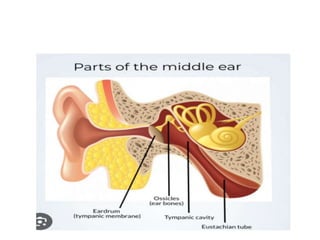
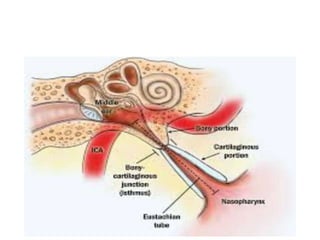
• Middle ear ( in this case means middle ear
cleft = eustachian tube, middle ear, additus,
antrum and mastoid air cells)
….
CAUSES OF A.S.O.M
• Usually ascending viral infections of the upper
respiratory tract
• .Bacteria; strep.pneumoniae (30᷁%), B-
lactamase producing organisms( H.Influenza,
M.Catarrhalis), others like strep pyogenes,
staph. Aureus, pseudomonas aureginosa.
…
ROUTES OF INFECTION
1. Eustachian tube
2. Via lumen of tube ie along subepithelial
peritubal or surrounding lymphatics
3. Via external ear-direct trauma exposes
middle ear
4. Blood borne- uncommon route
…
PREDISPOSING/RISK FACTORS
• Recurrent attacks of common cold, U.R.T
infections and exanthematous fevers
• Infections of tonsils and adenoids
• Chronic rhinitis and sinusitis
• Nasal allergy
• Tumours of nasopharynx, packing nose or
nasopharynx in epistaxis
…
• Cleft palate (effect on tensor velli palatini)
• Low socioeconomic groups
• More common in infants and young children
because eustachean tube is more horizontal,
shorter and wider than in adults
N/B: anything altering normal functioning of
eustachian tube is a predisposing factor
…
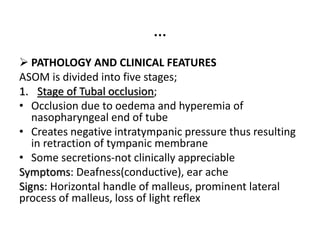
 PATHOLOGY AND CLINICAL FEATURES
ASOM is divided into five stages;
1. Stage of Tubal occlusion;
• Occlusion due to oedema and hyperemia of
nasopharyngeal end of tube
• Creates negative intratympanic pressure thus resulting
in retraction of tympanic membrane
• Some secretions-not clinically appreciable
Symptoms: Deafness(conductive), ear ache
Signs: Horizontal handle of malleus, prominent lateral
process of malleus, loss of light reflex
…
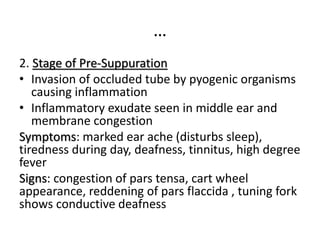
2. Stage of Pre-Suppuration
• Invasion of occluded tube by pyogenic organisms
causing inflammation
• Inflammatory exudate seen in middle ear and
membrane congestion
Symptoms: marked ear ache (disturbs sleep),
tiredness during day, deafness, tinnitus, high degree
fever
Signs: congestion of pars tensa, cart wheel
appearance, reddening of pars flaccida , tuning fork
shows conductive deafness
…
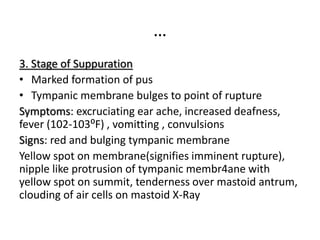
3. Stage of Suppuration
• Marked formation of pus
• Tympanic membrane bulges to point of rupture
Symptoms: excruciating ear ache, increased deafness,
fever (102-103⁰F) , vomitting , convulsions
Signs: red and bulging tympanic membrane
Yellow spot on membrane(signifies imminent rupture),
nipple like protrusion of tympanic membr4ane with
yellow spot on summit, tenderness over mastoid antrum,
clouding of air cells on mastoid X-Ray
…
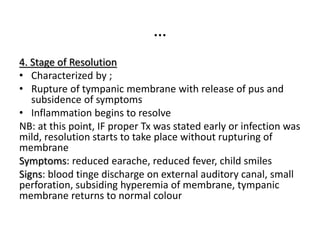
4. Stage of Resolution
• Characterized by ;
• Rupture of tympanic membrane with release of pus and
subsidence of symptoms
• Inflammation begins to resolve
NB: at this point, IF proper Tx was stated early or infection was
mild, resolution starts to take place without rupturing of
membrane
Symptoms: reduced earache, reduced fever, child smiles
Signs: blood tinge discharge on external auditory canal, small
perforation, subsiding hyperemia of membrane, tympanic
membrane returns to normal colour
…
5. Stage of Complication
Features depend on virulence
Spread of infection leads to;
• Acute mastoiditis
• Subperiosteal abcess
• Facial paralysis
• Labyrinthitis
• Periostitis
• Extradural abcess
• Meningitis
• Brain abcess/ lateral sinus thrombophlebitis
…
TREATMENT
Principles of Mx
A. Relief of symptoms
B. Drain pus
C. Prevent recurrence of infection
…
A. Relief of Symptoms
AIM: relieve eustachean tube of oedema and promote ventilation of
middle ear
i) Decongestant- nasal drops( ephedrine 0.1% adults, 0.05%
children) can cause rebound congestion if overused,
oxymetazoline(not used in children <6 years,
xylometazoline(otrivion)
ii) Oral nasal decongestant
• Pseudoephedrine(30mg BD)+/- antihistamine(easy administration
than nasal drops which require meticulous positioning) side effects:
sympathomimetic effect therefore not preffered
iii) analgesia and antipyretic ( paracetamol)
iv) Dry local heat relieves pain
…
B. Drainage of Pus
i. Ear Toilet- involves dry mopping with sterile cotton buds and wick
moistened with a/biotic
ii. Myringotomy
C. Prevent Recurrence of Infection
• A/biotic therapy: ampicillin(50mg/kg/day in 4 divided doses) and
amoxicillin(40mg/kg/day)-covers s.pnemoniae and H.influenza
NB: if pts allergic to drugs give ceflacor, cotrimoxazole, erythromycin
NB: if B-Lactamase producing organisms use Amoxicillin, Clavulanate,
augment with cefuroxime , axetil or cefixime.
NB: whatever the cause the antibiotic should be continued for a
minimum of 10 days until tympanic membrane regains normal
appearance and hearing returns to normal
Acute Necrotizing Otitis Media
• Seen often in children suffering from measles,
scarlet fever or influenza
AETIOLOGY:
• B-Haemolytic Streptococcus
Pathology: rapid destruction of whole of
whole of tympanic membrane with its
annulus, mucosa of promontory, ossicular
chain and mastoid air cells.
…
• Clinical Features: profuse ottorhea, scars,
secondary cholesteatoma
MANAGEMENT
• Medical Mx: Early institution of A/biotics for
at least 7-10 days
• Surgical Mx: cortical mastoidectomy
OTITIS MEDIA WITH EFFUSIONS
(Synonyms: Serous otitis media,
secretory otitis media, mucoid otitis
media or “Glue Ear”)
• Insidious condition characterized by
accumulation of non purulent effusion in the
middle ear cleft
• Effusion thick serous and it is sterile
• Commonly seen in school going children
…
 PATHOGENESIS
• Two mechanisms responsible:
I. Malfunctioning eustachian tube
II. Increased secretory activity of middle ear mucosa
 AETIOLOGY
1. Malfunctioning eustachian tube:
• caused by ;
a) Adenoid hyperplasia
b) Chronic Rhinitis and Sinusitis
c) Chronic Tonsilitis
…
d. Benign and malignant tumors of nasopharynx
e. Palatal defects e.g cleft palate, palatal
paralysis
2. Allergy
3. Unresolved Otitis Media
4. Viral Infections
…
 CLINICAL FEATURES
• Symptoms(5-8year olds affected): Hearing loss, Delayed and
defective speech, mild ear aches
• Signs: otoscopic findings; Dull and opaque tympanic membrane,
appears yellow grey or bluish in color, blood vessels seen on handle
of malleus, or Blood vessels at periphery of tympanic membrane,
membrane retraction, full bulging tympanic membrane, fluid level
or air bubbles , mobility of tympanic membrane
• Hearing test findings: Tunning Fork test= conductive deafness,
Audiometry: conductive deafness between 20-40DB , +/-
sensorineural deafness
• Impedence Audiometry
• X Ray Mastoids: clouding of air cells due to fluid
…
TREATMENT
1. Medical:
a) Decongestants
b) Anti allergic measure
• Steroids/antihistamine use
• Find out allergy of person involved
c) A/biotics
d) Middle ear aeration
…
2. Surgical:
Indicated when fluid is thick and medical treatment
alone does not help, surgical removal must be done
a) Myringotomy and aspiration of fluid
b) Grommet insertion
c) Tympanotomy/cortical mastoidectomy
d) Sx treatment of causative factor e.g
Adenoidectomy, Tonsilectomy and/or wash out
of maxillary antra(done during myringotomy)
Recurrent Otitis Media
• Recurrent episodes 4-5 times per year of acute otitis media
affecting 6month-6year old children
• Occurs after URTI and child is symptom free between
episodes
 AETIOLOGY
• Recurrent sinusitis
• Velopharyngeal insufficiency
• Hypertrophy of adenoids
• Infected tonsils
• Allergy
• Immune Deficiency
• Feeding baby in supine without head support
…
MANAGEMENT
1. Finding cause and eliminating it
2. Antimicrobiual Prophylaxis
3. Myringotomy and insertion of tympanostomy
tube
4. Adenoidectomy +/- tonsilectomy
5. Management of inhalant or food allergy
Aero-Otitis Media (Otitic Barotrauma)
• It is a non suppurative condition resulting from
failure of eustachian tube to maintain middle ear
pressure at ambient atmospheric pressure
• AETIOLOGY
• Rapid descent during air flight, underwater diving
or compression in pressure chamber
• MECHANISM
reversal of normal functioning of eustachean tube
where it allows easy and passive egress of air from
the middle ear to pharynx if middle ear pressure is
high.
…
CLINICAL FEATURES
Symptoms: Severe earache, hearing loss and
tinnitus, vertigo(uncommon)
Signs: tympanic membrane retraction
,congestion and rupture
Middle ear shows air bubbles of hemorhagic
effusions
Hearing loss = conductive but sensorineural
type of loss may be seen
…
TREATMENT
• Aim is : Restore middle ear aeration
PREVENTION
1. Avoid air travel in presence of URTI or allergy
2. Swallow repeatedly during descent
3. No sleep during descent of plane(fx of swallowing is
decreased during sleep)
4. Autoinflation of tube by valsalva during descent helps
5. Use vasoconstrictor nasal spray and antihistamine and
systemic decongestant 30minutes before descent of
plane

Otitis Media 3.pptx

  • 1.
    ACUTE OTITIS MEDIA DrTembo Paul. M.D BSc.Hb, MBChB (UNZA)
  • 2.
    DEFINITION Acute inflammation ofthe middle ear cavity TYPES: a) Acute suppurative otitis media b) Acute necrotizing otitis media c) Otitis media with effusions d) Recurrent otitis media e) Aero-otitis media(otitic barotrauma)
  • 3.
    Acute Suppurative Otitis Media(A.S.O.M) •An acute inflammation of the middle ear caused by pyogenic organisms • Middle ear ( in this case means middle ear cleft = eustachian tube, middle ear, additus, antrum and mastoid air cells)
  • 4.
    …. CAUSES OF A.S.O.M •Usually ascending viral infections of the upper respiratory tract • .Bacteria; strep.pneumoniae (30᷁%), B- lactamase producing organisms( H.Influenza, M.Catarrhalis), others like strep pyogenes, staph. Aureus, pseudomonas aureginosa.
  • 5.
    … ROUTES OF INFECTION 1.Eustachian tube 2. Via lumen of tube ie along subepithelial peritubal or surrounding lymphatics 3. Via external ear-direct trauma exposes middle ear 4. Blood borne- uncommon route
  • 8.
    … PREDISPOSING/RISK FACTORS • Recurrentattacks of common cold, U.R.T infections and exanthematous fevers • Infections of tonsils and adenoids • Chronic rhinitis and sinusitis • Nasal allergy • Tumours of nasopharynx, packing nose or nasopharynx in epistaxis
  • 9.
    … • Cleft palate(effect on tensor velli palatini) • Low socioeconomic groups • More common in infants and young children because eustachean tube is more horizontal, shorter and wider than in adults N/B: anything altering normal functioning of eustachian tube is a predisposing factor
  • 10.
    …  PATHOLOGY ANDCLINICAL FEATURES ASOM is divided into five stages; 1. Stage of Tubal occlusion; • Occlusion due to oedema and hyperemia of nasopharyngeal end of tube • Creates negative intratympanic pressure thus resulting in retraction of tympanic membrane • Some secretions-not clinically appreciable Symptoms: Deafness(conductive), ear ache Signs: Horizontal handle of malleus, prominent lateral process of malleus, loss of light reflex
  • 11.
    … 2. Stage ofPre-Suppuration • Invasion of occluded tube by pyogenic organisms causing inflammation • Inflammatory exudate seen in middle ear and membrane congestion Symptoms: marked ear ache (disturbs sleep), tiredness during day, deafness, tinnitus, high degree fever Signs: congestion of pars tensa, cart wheel appearance, reddening of pars flaccida , tuning fork shows conductive deafness
  • 12.
    … 3. Stage ofSuppuration • Marked formation of pus • Tympanic membrane bulges to point of rupture Symptoms: excruciating ear ache, increased deafness, fever (102-103⁰F) , vomitting , convulsions Signs: red and bulging tympanic membrane Yellow spot on membrane(signifies imminent rupture), nipple like protrusion of tympanic membr4ane with yellow spot on summit, tenderness over mastoid antrum, clouding of air cells on mastoid X-Ray
  • 13.
    … 4. Stage ofResolution • Characterized by ; • Rupture of tympanic membrane with release of pus and subsidence of symptoms • Inflammation begins to resolve NB: at this point, IF proper Tx was stated early or infection was mild, resolution starts to take place without rupturing of membrane Symptoms: reduced earache, reduced fever, child smiles Signs: blood tinge discharge on external auditory canal, small perforation, subsiding hyperemia of membrane, tympanic membrane returns to normal colour
  • 14.
    … 5. Stage ofComplication Features depend on virulence Spread of infection leads to; • Acute mastoiditis • Subperiosteal abcess • Facial paralysis • Labyrinthitis • Periostitis • Extradural abcess • Meningitis • Brain abcess/ lateral sinus thrombophlebitis
  • 15.
    … TREATMENT Principles of Mx A.Relief of symptoms B. Drain pus C. Prevent recurrence of infection
  • 16.
    … A. Relief ofSymptoms AIM: relieve eustachean tube of oedema and promote ventilation of middle ear i) Decongestant- nasal drops( ephedrine 0.1% adults, 0.05% children) can cause rebound congestion if overused, oxymetazoline(not used in children <6 years, xylometazoline(otrivion) ii) Oral nasal decongestant • Pseudoephedrine(30mg BD)+/- antihistamine(easy administration than nasal drops which require meticulous positioning) side effects: sympathomimetic effect therefore not preffered iii) analgesia and antipyretic ( paracetamol) iv) Dry local heat relieves pain
  • 17.
    … B. Drainage ofPus i. Ear Toilet- involves dry mopping with sterile cotton buds and wick moistened with a/biotic ii. Myringotomy C. Prevent Recurrence of Infection • A/biotic therapy: ampicillin(50mg/kg/day in 4 divided doses) and amoxicillin(40mg/kg/day)-covers s.pnemoniae and H.influenza NB: if pts allergic to drugs give ceflacor, cotrimoxazole, erythromycin NB: if B-Lactamase producing organisms use Amoxicillin, Clavulanate, augment with cefuroxime , axetil or cefixime. NB: whatever the cause the antibiotic should be continued for a minimum of 10 days until tympanic membrane regains normal appearance and hearing returns to normal
  • 18.
    Acute Necrotizing OtitisMedia • Seen often in children suffering from measles, scarlet fever or influenza AETIOLOGY: • B-Haemolytic Streptococcus Pathology: rapid destruction of whole of whole of tympanic membrane with its annulus, mucosa of promontory, ossicular chain and mastoid air cells.
  • 19.
    … • Clinical Features:profuse ottorhea, scars, secondary cholesteatoma MANAGEMENT • Medical Mx: Early institution of A/biotics for at least 7-10 days • Surgical Mx: cortical mastoidectomy
  • 20.
    OTITIS MEDIA WITHEFFUSIONS (Synonyms: Serous otitis media, secretory otitis media, mucoid otitis media or “Glue Ear”) • Insidious condition characterized by accumulation of non purulent effusion in the middle ear cleft • Effusion thick serous and it is sterile • Commonly seen in school going children
  • 21.
    …  PATHOGENESIS • Twomechanisms responsible: I. Malfunctioning eustachian tube II. Increased secretory activity of middle ear mucosa  AETIOLOGY 1. Malfunctioning eustachian tube: • caused by ; a) Adenoid hyperplasia b) Chronic Rhinitis and Sinusitis c) Chronic Tonsilitis
  • 22.
    … d. Benign andmalignant tumors of nasopharynx e. Palatal defects e.g cleft palate, palatal paralysis 2. Allergy 3. Unresolved Otitis Media 4. Viral Infections
  • 23.
    …  CLINICAL FEATURES •Symptoms(5-8year olds affected): Hearing loss, Delayed and defective speech, mild ear aches • Signs: otoscopic findings; Dull and opaque tympanic membrane, appears yellow grey or bluish in color, blood vessels seen on handle of malleus, or Blood vessels at periphery of tympanic membrane, membrane retraction, full bulging tympanic membrane, fluid level or air bubbles , mobility of tympanic membrane • Hearing test findings: Tunning Fork test= conductive deafness, Audiometry: conductive deafness between 20-40DB , +/- sensorineural deafness • Impedence Audiometry • X Ray Mastoids: clouding of air cells due to fluid
  • 24.
    … TREATMENT 1. Medical: a) Decongestants b)Anti allergic measure • Steroids/antihistamine use • Find out allergy of person involved c) A/biotics d) Middle ear aeration
  • 25.
    … 2. Surgical: Indicated whenfluid is thick and medical treatment alone does not help, surgical removal must be done a) Myringotomy and aspiration of fluid b) Grommet insertion c) Tympanotomy/cortical mastoidectomy d) Sx treatment of causative factor e.g Adenoidectomy, Tonsilectomy and/or wash out of maxillary antra(done during myringotomy)
  • 26.
    Recurrent Otitis Media •Recurrent episodes 4-5 times per year of acute otitis media affecting 6month-6year old children • Occurs after URTI and child is symptom free between episodes  AETIOLOGY • Recurrent sinusitis • Velopharyngeal insufficiency • Hypertrophy of adenoids • Infected tonsils • Allergy • Immune Deficiency • Feeding baby in supine without head support
  • 27.
    … MANAGEMENT 1. Finding causeand eliminating it 2. Antimicrobiual Prophylaxis 3. Myringotomy and insertion of tympanostomy tube 4. Adenoidectomy +/- tonsilectomy 5. Management of inhalant or food allergy
  • 28.
    Aero-Otitis Media (OtiticBarotrauma) • It is a non suppurative condition resulting from failure of eustachian tube to maintain middle ear pressure at ambient atmospheric pressure • AETIOLOGY • Rapid descent during air flight, underwater diving or compression in pressure chamber • MECHANISM reversal of normal functioning of eustachean tube where it allows easy and passive egress of air from the middle ear to pharynx if middle ear pressure is high.
  • 29.
    … CLINICAL FEATURES Symptoms: Severeearache, hearing loss and tinnitus, vertigo(uncommon) Signs: tympanic membrane retraction ,congestion and rupture Middle ear shows air bubbles of hemorhagic effusions Hearing loss = conductive but sensorineural type of loss may be seen
  • 30.
    … TREATMENT • Aim is: Restore middle ear aeration PREVENTION 1. Avoid air travel in presence of URTI or allergy 2. Swallow repeatedly during descent 3. No sleep during descent of plane(fx of swallowing is decreased during sleep) 4. Autoinflation of tube by valsalva during descent helps 5. Use vasoconstrictor nasal spray and antihistamine and systemic decongestant 30minutes before descent of plane