PROSTATE DISEASE
CASE DISCUSSION SESSION-5
Dr. S P Srinivas Nayak
Assistant Professor
Dept. of Pharmacy Practice
Parul University
CASE.1
A 64-year-old man presents with complaints of poor urinary flow and
having to visit the toilet at least twice during the night to pass urine.
There is no family history of DM, HTN & Prostate disease and he is
taking no medication., Patient has no symptoms of pedal edema., RBS
found was in Normal range, BP: 130/80 mm/Hg
On questioning, he also describes symptoms of urinary frequency,
urgency and urge incontinence, but fever is absent.
Question:
What investigations are appropriate to diagnose the case and how
should he be managed?
PROSTATE DISEASE
1. Benign prostatic hyperplasia
2. Prostatitis
3. Prostate cancer
BENIGN PROSTATIC
HYPERPLASIA (BPH)
most common, presence of BPH in 50% of males aged 51–60
years
The prostate gland:
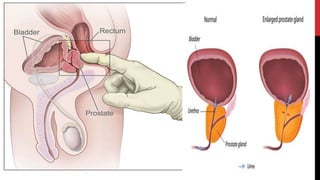
The prostate is a part glandular, part fibromuscular structure about
the size of a walnut that surrounds the first part of the male
urethra at the base of the bladder
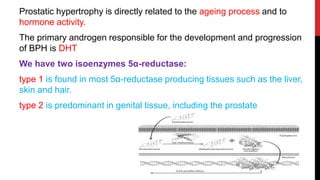
Prostatic hypertrophy is directly related to the ageing process and to
hormone activity.
The primary androgen responsible for the development and progression
of BPH is DHT
We have two isoenzymes 5α-reductase:
type 1 is found in most 5α-reductase producing tissues such as the liver,
skin and hair.
type 2 is predominant in genital tissue, including the prostate
As the prostate enlarges, it can compress the urethra and this,
can lead to bladder outflow obstruction (BOO) and lower
urinary tract symptoms (LUTSs).
Therefore, the term BPH includes benign prostatic enlargement
(BPE), the clinical features associated with urinary obstruction
and LUTSs.
SYMPTOMS
Men with BPH can develop bothersome LUTSs
LUTSs can be divided into 2 symptoms
1. symptoms of failure of urine storage (irritative) and
2. those caused by failure to empty the bladder (obstructive or
voiding).
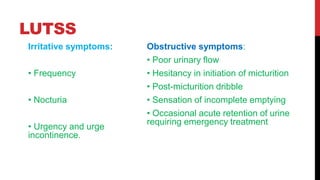
LUTSS
Irritative symptoms:
• Frequency
• Nocturia
• Urgency and urge
incontinence.
Obstructive symptoms:
• Poor urinary flow
• Hesitancy in initiation of micturition
• Post-micturition dribble
• Sensation of incomplete emptying
• Occasional acute retention of urine
requiring emergency treatment
EXAMINATION AND INVESTIGATIONS
Physical examination:
1. a digital rectal examination (DRE)
examiner palpating the prostate with
a finger through the rectum wall.
2. transrectal ultrasonography (TRUS)
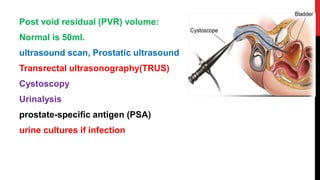
Post void residual (PVR) volume:
Normal is 50ml.
ultrasound scan, Prostatic ultrasound
Transrectal ultrasonography(TRUS)
Cystoscopy
Urinalysis
prostate-specific antigen (PSA)
urine cultures if infection
TREATMENT
1. Watchful waiting
2. Pharmacotherapy
3. surgical treatments:
A. Transurethral resection of the prostate (TURP)
B. Open prostatectomy.
C. transurethral microwave heat treatment (TUMT),
ADVICE IN MODERATE CONDITION
Advice for the management of lower urinary tract symptoms Limit
fluid consumption before going out and before going to bed (to
reduce urinary frequency and nocturia)
Reduce alcohol and caffeine intake Schedule toilet visits Manage
constipation
Review medication (including diuretics and other medicines that can
affect the urinary system)
Bladder training (encourage patient to go longer between voiding and
increase the volume voided)
Use distraction techniques (practice breathing exercises and penile
squeezing to control symptoms of irritation)
PHARMACOTHERAPY
three subtypes of α1 receptors exist (α1A, α1B and α1D). The
α1A is thought to be the dominant receptor in the prostate
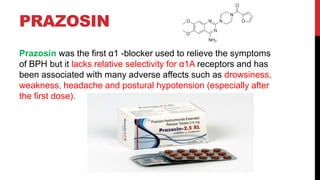
PRAZOSIN
Prazosin was the first α1 -blocker used to relieve the symptoms
of BPH but it lacks relative selectivity for α1A receptors and has
been associated with many adverse affects such as drowsiness,
weakness, headache and postural hypotension (especially after
the first dose).
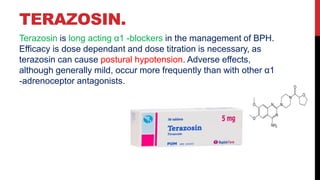
TERAZOSIN.
Terazosin is long acting α1 -blockers in the management of BPH.
Efficacy is dose dependant and dose titration is necessary, as
terazosin can cause postural hypotension. Adverse effects,
although generally mild, occur more frequently than with other α1
-adrenoceptor antagonists.
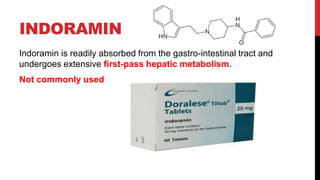
INDORAMIN
Indoramin is readily absorbed from the gastro-intestinal tract and
undergoes extensive first-pass hepatic metabolism.
Not commonly used
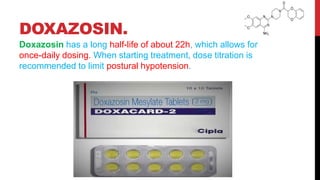
DOXAZOSIN.
Doxazosin has a long half-life of about 22h, which allows for
once-daily dosing. When starting treatment, dose titration is
recommended to limit postural hypotension.
TAMSULOSIN
Tamsulosin is a selective inhibitor of the α1A and α1B-
adrenoceptor. It has an elimination half-life of about 13h and
is available as a prolonged release formulation that allows
once-daily dosing, well tolerated.
Intraoperative floppy iris syndrome (IFIS) in cataract surgery,
stopped 1-2 weeks before surgery
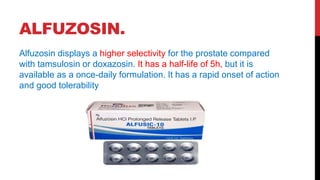
ALFUZOSIN.
Alfuzosin displays a higher selectivity for the prostate compared
with tamsulosin or doxazosin. It has a half-life of 5h, but it is
available as a once-daily formulation. It has a rapid onset of action
and good tolerability
5Α-REDUCTASE
INHIBITORS
The primary androgen responsible for the development and
progression of BPH is DHT
finasteride and dutasteride are two agents currently available
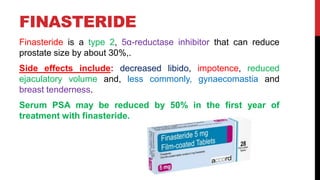
FINASTERIDE
Finasteride is a type 2, 5α-reductase inhibitor that can reduce
prostate size by about 30%,.
Side effects include: decreased libido, impotence, reduced
ejaculatory volume and, less commonly, gynaecomastia and
breast tenderness.
Serum PSA may be reduced by 50% in the first year of
treatment with finasteride.
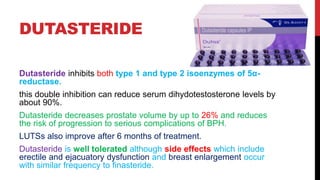
DUTASTERIDE
Dutasteride inhibits both type 1 and type 2 isoenzymes of 5α-
reductase.
this double inhibition can reduce serum dihydotestosterone levels by
about 90%.
Dutasteride decreases prostate volume by up to 26% and reduces
the risk of progression to serious complications of BPH.
LUTSs also improve after 6 months of treatment.
Dutasteride is well tolerated although side effects which include
erectile and ejacuatory dysfunction and breast enlargement occur
with similar frequency to finasteride.
COMBINATION THERAPY
THANK YOU

prostate disease CASE DISCUSSION

  • 1.
    PROSTATE DISEASE CASE DISCUSSIONSESSION-5 Dr. S P Srinivas Nayak Assistant Professor Dept. of Pharmacy Practice Parul University
  • 2.
    CASE.1 A 64-year-old manpresents with complaints of poor urinary flow and having to visit the toilet at least twice during the night to pass urine. There is no family history of DM, HTN & Prostate disease and he is taking no medication., Patient has no symptoms of pedal edema., RBS found was in Normal range, BP: 130/80 mm/Hg On questioning, he also describes symptoms of urinary frequency, urgency and urge incontinence, but fever is absent. Question: What investigations are appropriate to diagnose the case and how should he be managed?
  • 3.
    PROSTATE DISEASE 1. Benignprostatic hyperplasia 2. Prostatitis 3. Prostate cancer
  • 4.
    BENIGN PROSTATIC HYPERPLASIA (BPH) mostcommon, presence of BPH in 50% of males aged 51–60 years The prostate gland: The prostate is a part glandular, part fibromuscular structure about the size of a walnut that surrounds the first part of the male urethra at the base of the bladder
  • 7.
    Prostatic hypertrophy isdirectly related to the ageing process and to hormone activity. The primary androgen responsible for the development and progression of BPH is DHT We have two isoenzymes 5α-reductase: type 1 is found in most 5α-reductase producing tissues such as the liver, skin and hair. type 2 is predominant in genital tissue, including the prostate
  • 9.
    As the prostateenlarges, it can compress the urethra and this, can lead to bladder outflow obstruction (BOO) and lower urinary tract symptoms (LUTSs). Therefore, the term BPH includes benign prostatic enlargement (BPE), the clinical features associated with urinary obstruction and LUTSs.
  • 10.
    SYMPTOMS Men with BPHcan develop bothersome LUTSs LUTSs can be divided into 2 symptoms 1. symptoms of failure of urine storage (irritative) and 2. those caused by failure to empty the bladder (obstructive or voiding).
  • 11.
    LUTSS Irritative symptoms: • Frequency •Nocturia • Urgency and urge incontinence. Obstructive symptoms: • Poor urinary flow • Hesitancy in initiation of micturition • Post-micturition dribble • Sensation of incomplete emptying • Occasional acute retention of urine requiring emergency treatment
  • 13.
    EXAMINATION AND INVESTIGATIONS Physicalexamination: 1. a digital rectal examination (DRE) examiner palpating the prostate with a finger through the rectum wall. 2. transrectal ultrasonography (TRUS)
  • 14.
    Post void residual(PVR) volume: Normal is 50ml. ultrasound scan, Prostatic ultrasound Transrectal ultrasonography(TRUS) Cystoscopy Urinalysis prostate-specific antigen (PSA) urine cultures if infection
  • 15.
    TREATMENT 1. Watchful waiting 2.Pharmacotherapy 3. surgical treatments: A. Transurethral resection of the prostate (TURP) B. Open prostatectomy. C. transurethral microwave heat treatment (TUMT),
  • 16.
    ADVICE IN MODERATECONDITION Advice for the management of lower urinary tract symptoms Limit fluid consumption before going out and before going to bed (to reduce urinary frequency and nocturia) Reduce alcohol and caffeine intake Schedule toilet visits Manage constipation Review medication (including diuretics and other medicines that can affect the urinary system) Bladder training (encourage patient to go longer between voiding and increase the volume voided) Use distraction techniques (practice breathing exercises and penile squeezing to control symptoms of irritation)
  • 17.
    PHARMACOTHERAPY three subtypes ofα1 receptors exist (α1A, α1B and α1D). The α1A is thought to be the dominant receptor in the prostate
  • 18.
    PRAZOSIN Prazosin was thefirst α1 -blocker used to relieve the symptoms of BPH but it lacks relative selectivity for α1A receptors and has been associated with many adverse affects such as drowsiness, weakness, headache and postural hypotension (especially after the first dose).
  • 19.
    TERAZOSIN. Terazosin is longacting α1 -blockers in the management of BPH. Efficacy is dose dependant and dose titration is necessary, as terazosin can cause postural hypotension. Adverse effects, although generally mild, occur more frequently than with other α1 -adrenoceptor antagonists.
  • 20.
    INDORAMIN Indoramin is readilyabsorbed from the gastro-intestinal tract and undergoes extensive first-pass hepatic metabolism. Not commonly used
  • 21.
    DOXAZOSIN. Doxazosin has along half-life of about 22h, which allows for once-daily dosing. When starting treatment, dose titration is recommended to limit postural hypotension.
  • 22.
    TAMSULOSIN Tamsulosin is aselective inhibitor of the α1A and α1B- adrenoceptor. It has an elimination half-life of about 13h and is available as a prolonged release formulation that allows once-daily dosing, well tolerated. Intraoperative floppy iris syndrome (IFIS) in cataract surgery, stopped 1-2 weeks before surgery
  • 23.
    ALFUZOSIN. Alfuzosin displays ahigher selectivity for the prostate compared with tamsulosin or doxazosin. It has a half-life of 5h, but it is available as a once-daily formulation. It has a rapid onset of action and good tolerability
  • 24.
    5Α-REDUCTASE INHIBITORS The primary androgenresponsible for the development and progression of BPH is DHT finasteride and dutasteride are two agents currently available
  • 25.
    FINASTERIDE Finasteride is atype 2, 5α-reductase inhibitor that can reduce prostate size by about 30%,. Side effects include: decreased libido, impotence, reduced ejaculatory volume and, less commonly, gynaecomastia and breast tenderness. Serum PSA may be reduced by 50% in the first year of treatment with finasteride.
  • 26.
    DUTASTERIDE Dutasteride inhibits bothtype 1 and type 2 isoenzymes of 5α- reductase. this double inhibition can reduce serum dihydotestosterone levels by about 90%. Dutasteride decreases prostate volume by up to 26% and reduces the risk of progression to serious complications of BPH. LUTSs also improve after 6 months of treatment. Dutasteride is well tolerated although side effects which include erectile and ejacuatory dysfunction and breast enlargement occur with similar frequency to finasteride.
  • 27.
  • 28.