UNIT:1
INTRODUCTION TO CLINICAL
PHARMACOKINETICS
LECTURE SPEAKER
Dr. S P Srinivas Nayak.,
PharmD.,RPh.,MSc.,(PhD)
LECTURE OBJECTIVES
After completion of this lecture, student will be able to:
• Explain clinical pharmacokinetics
• Discuss linear and non linear pharmacokinetics
• Describe steady state concentration
INTRODUCTION
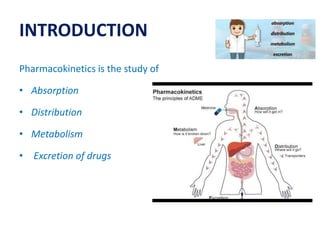
Pharmacokinetics is the study of
• Absorption
• Distribution
• Metabolism
• Excretion of drugs
Introduction
• When drugs are given extravascularly (e.g., orally,
intramuscularly, applied to the skin via a transdermal patch,
etc.), absorption must take place for the drug molecules to
reach the systemic circulation
Introduction
• In order to be absorbed, the drug molecules must pass
through several physiological barriers before reaching the
vascular system
• For example, when a medication is given orally, the drug
dosage form must release drug molecules via dissolution
• These molecules must pass through the various layers of the
gastrointestinal tract where they enter capillaries
Introduction
• Distribution occurs when drug molecules that have entered
the vascular system pass from the bloodstream into various
tissues and organs such as the muscle or heart
• Metabolism is the chemical conversion of the drug molecule,
usually by an enzymatically mediated reaction, into another
chemical entity referred to as a metabolite
• The metabolite may have the same, or different,
pharmacological effect as the parent drug, or even cause toxic
side effects
• Excretion is the irreversible removal of drug from the body
and commonly occurs via the kidney or biliary tract
Definition
• “Clinical pharmacokinetics is the discipline that applies
pharmacokinetic concepts and principles in humans in order
to design individualized dosage regimens which optimize the
therapeutic response of a medication while minimizing the
chance of an adverse drug reaction”
• Pharmacodynamics is the relationship between drug
concentration and pharmacological response
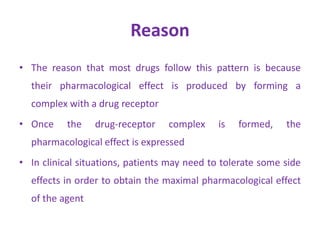
• It is extremely important for us to realize that the change in
drug effect is usually not proportional to the change in drug
dose or concentration
Example
• For example, the increase in pharmacological effect is greater
when the initial concentration is low compared to the change
in drug effect observed when the initial concentration is high
Reason
• The reason that most drugs follow this pattern is because
their pharmacological effect is produced by forming a
complex with a drug receptor
• Once the drug-receptor complex is formed, the
pharmacological effect is expressed
• In clinical situations, patients may need to tolerate some side
effects in order to obtain the maximal pharmacological effect
of the agent
Linear Versus Nonlinear
Pharmacokinetics
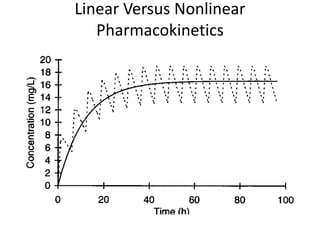
• When medications are given on a continuous basis, serum
concentrations increase until the rate of drug administration
equals the elimination rate
• For the intravenous infusion, serum concentrations increase
in a smooth pattern until steady state is achieved
Linear Versus Nonlinear
Pharmacokinetics
• During oral dosing, the serum concentrations oscillate around
the intravenous profile
• This increases during drug absorption and decreases after
absorption is complete and elimination takes place
• This equilibrium condition is known as steady state and is
extremely important in clinical pharmacokinetics because
usually steady-state serum or blood concentrations are used to
assess patient response and compute new dosage regimens
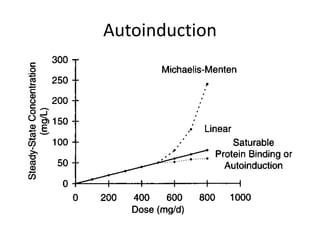
• If a plot of steady state concentration versus dose yields a
straight line, the drug is said to follow linear pharmacokinetics
• In this situation, steady-state serum concentrations increase or
decrease proportionally with dose
• Therefore, if a patient has a steady-state drug concentration of
10 μg/mL at a dosage rate of 100 mg/h, the steady-state
serum concentration will increase to 15 μg/mL if the dosage
rate is increased to 150 mg/h
Non-linear Pharmacokinetics
• When steady-state concentrations change in a disproportionate
fashion after the dose is altered, a plot of steady-state
concentration versus dose is not a straight line and the drug is
said to follow nonlinear pharmacokinetics
• When steady-state concentrations increase more than expected
after a dosage increase, the most likely explanation is that the
processes removing the drug from the body have become
saturated
Saturable or Michaelis-Menten
Pharmacokinetics
• This phenomenon is known as saturable or Michaelis-Menten
pharmacokinetics
• Both phenytoin and salicylic acid follow Michaelis-Menten
pharmacokinetics
• When steady-state concentrations increase less than expected
after a dosage increase, there are two typical explanations
Saturable or Michaelis-Menten
Pharmacokinetics
• Some drugs, such as valproic acid and disopyramide, saturate
plasma protein binding sites so that as the dosage is increased
steady-state serum concentrations increase less than
expected
• Other drugs, such as carbamazepine, increase their own rate
of metabolism from the body
Autoinduction
• This process is known as autoinduction of drug metabolism
• In either case, the relationship between steady-state
concentration and dose for drugs that follow nonlinear
pharmacokinetics
• Drugs that exhibit nonlinear pharmacokinetics are oftentimes
very difficult to dose correctly
Autoinduction
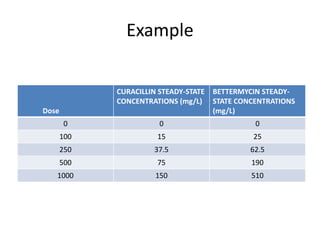
Example
Dose
CURACILLIN STEADY-STATE
CONCENTRATIONS (mg/L)
BETTERMYCIN STEADY-
STATE CONCENTRATIONS
(mg/L)
0 0 0
100 15 25
250 37.5 62.5
500 75 190
1000 150 510
Summary
• Clinical pharmacokinetics is application of pharmacokinetic
concepts and principles in humans in order to design
individualized dosage regimens
• If a plot of steady state concentration versus dose yields a
straight line, the drug is said to follow linear pharmacokinetics
• If a plot of steady-state concentration versus dose is not a
straight line and the drug is said to follow nonlinear
pharmacokinetics
Thank you… all the best

CP and TDM unit.1 5TH YEAR NOTES

  • 1.
    UNIT:1 INTRODUCTION TO CLINICAL PHARMACOKINETICS LECTURESPEAKER Dr. S P Srinivas Nayak., PharmD.,RPh.,MSc.,(PhD)
  • 2.
    LECTURE OBJECTIVES After completionof this lecture, student will be able to: • Explain clinical pharmacokinetics • Discuss linear and non linear pharmacokinetics • Describe steady state concentration
  • 3.
    INTRODUCTION Pharmacokinetics is thestudy of • Absorption • Distribution • Metabolism • Excretion of drugs
  • 4.
    Introduction • When drugsare given extravascularly (e.g., orally, intramuscularly, applied to the skin via a transdermal patch, etc.), absorption must take place for the drug molecules to reach the systemic circulation
  • 5.
    Introduction • In orderto be absorbed, the drug molecules must pass through several physiological barriers before reaching the vascular system • For example, when a medication is given orally, the drug dosage form must release drug molecules via dissolution • These molecules must pass through the various layers of the gastrointestinal tract where they enter capillaries
  • 6.
    Introduction • Distribution occurswhen drug molecules that have entered the vascular system pass from the bloodstream into various tissues and organs such as the muscle or heart • Metabolism is the chemical conversion of the drug molecule, usually by an enzymatically mediated reaction, into another chemical entity referred to as a metabolite
  • 7.
    • The metabolitemay have the same, or different, pharmacological effect as the parent drug, or even cause toxic side effects • Excretion is the irreversible removal of drug from the body and commonly occurs via the kidney or biliary tract
  • 8.
    Definition • “Clinical pharmacokineticsis the discipline that applies pharmacokinetic concepts and principles in humans in order to design individualized dosage regimens which optimize the therapeutic response of a medication while minimizing the chance of an adverse drug reaction”
  • 9.
    • Pharmacodynamics isthe relationship between drug concentration and pharmacological response • It is extremely important for us to realize that the change in drug effect is usually not proportional to the change in drug dose or concentration
  • 10.
    Example • For example,the increase in pharmacological effect is greater when the initial concentration is low compared to the change in drug effect observed when the initial concentration is high
  • 11.
    Reason • The reasonthat most drugs follow this pattern is because their pharmacological effect is produced by forming a complex with a drug receptor • Once the drug-receptor complex is formed, the pharmacological effect is expressed • In clinical situations, patients may need to tolerate some side effects in order to obtain the maximal pharmacological effect of the agent
  • 12.
    Linear Versus Nonlinear Pharmacokinetics •When medications are given on a continuous basis, serum concentrations increase until the rate of drug administration equals the elimination rate • For the intravenous infusion, serum concentrations increase in a smooth pattern until steady state is achieved
  • 13.
  • 14.
    • During oraldosing, the serum concentrations oscillate around the intravenous profile • This increases during drug absorption and decreases after absorption is complete and elimination takes place • This equilibrium condition is known as steady state and is extremely important in clinical pharmacokinetics because usually steady-state serum or blood concentrations are used to assess patient response and compute new dosage regimens
  • 15.
    • If aplot of steady state concentration versus dose yields a straight line, the drug is said to follow linear pharmacokinetics • In this situation, steady-state serum concentrations increase or decrease proportionally with dose • Therefore, if a patient has a steady-state drug concentration of 10 μg/mL at a dosage rate of 100 mg/h, the steady-state serum concentration will increase to 15 μg/mL if the dosage rate is increased to 150 mg/h
  • 16.
    Non-linear Pharmacokinetics • Whensteady-state concentrations change in a disproportionate fashion after the dose is altered, a plot of steady-state concentration versus dose is not a straight line and the drug is said to follow nonlinear pharmacokinetics • When steady-state concentrations increase more than expected after a dosage increase, the most likely explanation is that the processes removing the drug from the body have become saturated
  • 17.
    Saturable or Michaelis-Menten Pharmacokinetics •This phenomenon is known as saturable or Michaelis-Menten pharmacokinetics • Both phenytoin and salicylic acid follow Michaelis-Menten pharmacokinetics • When steady-state concentrations increase less than expected after a dosage increase, there are two typical explanations
  • 18.
    Saturable or Michaelis-Menten Pharmacokinetics •Some drugs, such as valproic acid and disopyramide, saturate plasma protein binding sites so that as the dosage is increased steady-state serum concentrations increase less than expected • Other drugs, such as carbamazepine, increase their own rate of metabolism from the body
  • 19.
    Autoinduction • This processis known as autoinduction of drug metabolism • In either case, the relationship between steady-state concentration and dose for drugs that follow nonlinear pharmacokinetics • Drugs that exhibit nonlinear pharmacokinetics are oftentimes very difficult to dose correctly
  • 20.
  • 21.
    Example Dose CURACILLIN STEADY-STATE CONCENTRATIONS (mg/L) BETTERMYCINSTEADY- STATE CONCENTRATIONS (mg/L) 0 0 0 100 15 25 250 37.5 62.5 500 75 190 1000 150 510
  • 22.
    Summary • Clinical pharmacokineticsis application of pharmacokinetic concepts and principles in humans in order to design individualized dosage regimens • If a plot of steady state concentration versus dose yields a straight line, the drug is said to follow linear pharmacokinetics • If a plot of steady-state concentration versus dose is not a straight line and the drug is said to follow nonlinear pharmacokinetics
  • 23.