Presented by:
o Jeevan kishore
o Group: 16
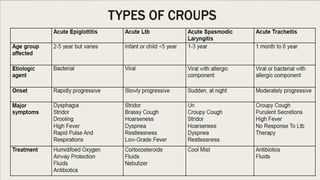
CROUPoCroup is a respiratory illness characterized by inspiratory
stridor, cough, and hoarseness.
oThese symptoms result from inflammation in the larynx and
subglottic airway
o A barking cough is the hallmark of croup among infants and
young children, whereas hoarseness predominates in older
children and adults.
o Although croup usually is a mild and self-limited illness,
significant upper airway obstruction, respiratory distress,
and rarely death, can occur.
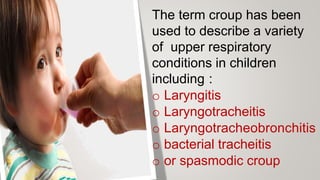
The term croup has been
used to describe a variety
of upper respiratory
conditions in children
including :
o Laryngitis
o Laryngotracheitis
o Laryngotracheobronchitis
o bacterial tracheitis
o or spasmodic croup
Laryngitis:refers to inflammation limited to the larynx and manifests
itself as hoarseness . It usually occurs in older children and
adults
Laryngotracheitis:
refers to inflammation of the larynx and trachea .Although
lower airway signs are absent, the typical barking cough
will be present.
LARYNGOTRACHEO
BRONCHITIS (LTB):o occurs when inflammation extends into the bronchi,
resulting in lower airway signs
o Further extension of inflammation into the lower
airways results in laryngotracheobronchopneumonitis,
which sometimes can be complicated by bacterial
superinfection.
o Bacterial superinfection can be manifest as
pneumonia, bronchopneumonia, or bacterial tracheitis
Bacterial tracheitis:
o Bacterial tracheitis (also called bacterial croup) describes
bacterial infection of the subglottic trachea, resulting in a
thick, purulent exudate, which causes symptoms of upper
airway obstruction
o Bacterial tracheitis may occur as a complication of viral
respiratory infections (usually those which manifest
themselves as LTB or (laryngotracheobronchopneumonitis)
or as a primary bacterial infection.
SPASMODIC CROUP:
o Spasmodic croup is characterized by the sudden onset of
inspiratory stridor at night, short duration (several hours),
and sudden cessation.
o This is often in the setting of a mild upper respiratory
infection, but without fever or inflammation.
o A striking feature of spasmodic croup is its recurrent nature,
hence the alternate descriptive term, "frequently recurrent
croup". Because of some clinical overlap with atopic
diseases, it is sometimes referred to as "allergic croup".
ETIOLOGY
Croup is usually caused by viruses. Bacterial infection
may occur secondarily.
o para influenza virus type 1,2 & 3
o Respiratory syncytial virus (RSV) and adenoviruses
o Human coronavirus NL63 (HCoV-NL63)
o Measles
o Influenza virus
o Rhinoviruses, enteroviruses (especially Coxsackie types
A9, B4,and B5, and echovirus types 4, 11, and 21),
o Herpes simplex virus
o Metapneumo viruses
Croup also may be caused by bacteria.
The most common secondary bacterial pathogens include
o Staphylococcus aureus
o Streptococcus pyogenes
o Streptococcus Pneumoniae
secondary bacterial infection may occur in children
with laryngotracheitis, laryngotracheobronchitis, or
laryngotracheobronchopneumonitis.
Bacterial infection:
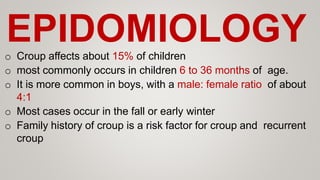
EPIDOMIOLOGYo Croup affects about 15% of children
o most commonly occurs in children 6 to 36 months of age.
o It is more common in boys, with a male: female ratio of about
4:1
o Most cases occur in the fall or early winter
o Family history of croup is a risk factor for croup and recurrent
croup
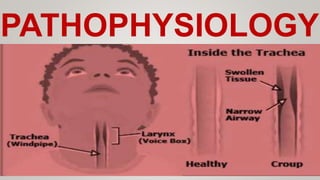
PATHOPHYSIOLOGY
o The viral pathogen is inhaled and infects the cells of the respiratory
epithelium. Consequently leading to localized inflammatory response
including
o Inflammation of the subglottic area
o Mucosal edema
o Increased mucous production
o Swelling of the involved airway particularly involving the lateral walls
of the trachea just below the vocal cords
o The combination of swelling, edema and excess mucous production
leads to narrowing of the internal airway lumen- this is aggravated by
inspiration where further inflammation can results from walls of the
subglottic space are drawn in during inspiration
Clinical presentation
o Over the next 12 to 48 hours, a progressively worsening "barky"
cough, hoarseness and inspiratory stridor are noted, secondary to
some degree of upper airway obstruction and laryngeal
inflammation.
o Croup symptoms appear to subside during the day (possibly
because of positioning), only to recur the following night.
o The onset is often rapid and typically in the early morning hours (e.g.,
2:00 am).
o Thus, a child with significant stridor presenting during
daylight, may be more seriously affected.
Most children with mild symptoms have no more than a croupy
cough and hoarse cry and some may have stridor only upon
activity or agitation.
Children with more severe cases have:
oinspiratory and expiratory stridor at rest.
ovisible suprasternal, intercostal, subcostal retractions.
oAir entry may be poor.
olethargy and agitation
ohypoxemia and increasing hypercarbia
orespiratory arrest may occur suddenly during an episode of
severe coughing
WARNING SIGNS:
o tachypnea, tachycardia out of
proportion to fever.
o hypotonia.
o unable to maintain adequate oral
intake.
o cyanosis.
DIAGNOSISo Laboratory studies add little to the diagnosis of croup if
bacterial infection is not suspected.
o White blood cell counts may be
elevated above 10,000 with a
predominance of polymorphonuclear
cells.
o White blood cell counts greater than
20,000 may suggest bacterial
superinfection
IMAGING:
o Lateral neck radiographs are often obtained, not as
much to confirm the diagnosis of croup, but to rule
out other causes of stridor such as soft tissue
densities in the trachea, a retropharyngeal abscess
and epiglottitis.
o Chest radiographs may show subglottic narrowing
(in 50% of children with croup), but this can also
be seen in normal patients.
PULSE OXIMETRYTo determine the percentage
of oxyhemoglobin in blood
pulsating through a network of
capillaries. A low reading of
oxygen saturation on pulse
oximetry indicates significant
respiratory impairment.
Direct or indirect laryngoscopy is not
usually required and is indicated if
there is a concern for an anatomical
malformation of the upper airway,
possible aspiration of a foreign object,
or should the child rapidly deteriorate
or not respond to routine therapy in
the anticipated manner.
Laryngoscopy
SEVERITY ASSESSMENT:
Total score 0-17Westley score
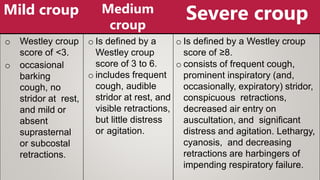
o Westley croup
score of <3.
o occasional
barking
cough, no
stridor at rest,
and mild or
absent
suprasternal
or subcostal
retractions.
o Is defined by a
Westley croup
score of 3 to 6.
o includes frequent
cough, audible
stridor at rest, and
visible retractions,
but little distress
or agitation.
o Is defined by a Westley croup
score of ≥8.
o consists of frequent cough,
prominent inspiratory (and,
occasionally, expiratory) stridor,
conspicuous retractions,
decreased air entry on
auscultation, and significant
distress and agitation. Lethargy,
cyanosis, and decreasing
retractions are harbingers of
impending respiratory failure.
Mild croup Medium
croup
Severe croup
DIFFERENTIAL DIAGNOSIS
o Acute epiglottitis
o Peritonsillar and
retropharyngeal
abscesses
o Foreign body
aspiration or Ingestion
o Allergic reaction
o Acute angioneurotic
Edema
o Upper airway injury
o Congenital
anomalies of the
upper airway
o Laryngeal
diphtheria
TREATMENT
oKeep child calm
oCool mist or night air
oSteam(vaporizer of from shower)
oAntipyretics
oEncouragement of fluid intake
oHumidified air
oSingle dose of oral dexamethasone(0.6 mg/kg)
MILD CROUP
MODERATE TO SEVERE CROUP
Supportive care
o Humidified air or humidified oxygen
o Monitoring
o Fluids
o Intubation
PHARMACOTHERAPY
oCorticosteroids provide benefit for children with
viral croup by reducing the severity and shortening
the course of the symptoms
o Dexamethasone is the most commonly used, with
the dose being 0.6 mg/kg (maximum 10 mg) by mouth
or intramuscularly
o Clinical improvement from corticosteroids is usually
not apparent until 6 hours after treatment.
NEBULIZED EPINEPHRINE
o Is thought to stimulate alpha-adrenergic receptors
with subsequent constriction of arterioles and
decreased laryngeal edema.
o Nebulized epinephrine may have marked effect to
decrease inspiratory stridor and the work of breathing.
o The effects of this medication last less than two hours
and children need to be monitored serially for the
return of symptoms.
RACEMIC EPINEPHRINE
L-epinephrine
o Is administered as 0.5 mL/kg per dose (maximum of 5 mL)
of a 1:1000 dilution. It is given via nebulizer over 15
minutes.
o Racemic epinephrine and L-epinephrine appear to be
equally effective.
o Is administered as 0.05 mL/kg per dose (maximum of 0.5
mL)of a 2.25 percent solution diluted to 3 mL total volume with
normal saline.
o It is given via nebulizer over 15 minutes.
Antibiotics should be used only to treat
specific bacterial complications of croup.
Hospitalization if :
o Progressive stridor
o Stridor at rest
o Respiratory distress
o Cyanosis
o Depressed mental status
o Viral croup is usually a self-limited disease
o The prognosis for croup is excellent, and recovery is
almost always complete.
o Symptoms usually improve within three days, but may
last for up to seven days
o Less than 5 percent of children with croup require
hospital admission, and among those, 1 to 6 percent
require intubation Mortality is rare, occurring in <0.5
percent of intubated children
PROGNOSIS
COMPLICATIONS
o hypoxemia (oxygen saturation
<92 percent in room air) and
respiratory failure.
o pulmonary edema
o pneumothorax, and
pneumomediastinum
complications in croup are rare.
o Lymphadenitis
o otitis media
o Secondary bacterial
infections
o Bacterial tracheitis
o bronchopneumonia,
and pneumonia
o cardiac arrest and
death
REFERENCES:o Nelson textbook of pediatrics 19th edition
o http://www.uptodate.com
o http://www.medescape.com
o http://www.hawaii.edu/medicine/pediatrics
o https://www.slideshare.net/najah_abbas/croup-laryngotracheobronchitis-
2015?qid=8e93eeb1-531b-4638-93de-
e00cf0f49367&v=&b=&from_search=6
o https://www.slideshare.net/mrmodaq/croup-55390752
o https://www.webmd.com/children/understanding-croup-basic-information
o http://www.mayoclinic.org/diseases-conditions/croup/symptoms-
causes/syc-20350348
Croup

Croup

  • 1.
    Presented by: o Jeevankishore o Group: 16
  • 2.
    CROUPoCroup is arespiratory illness characterized by inspiratory stridor, cough, and hoarseness. oThese symptoms result from inflammation in the larynx and subglottic airway o A barking cough is the hallmark of croup among infants and young children, whereas hoarseness predominates in older children and adults. o Although croup usually is a mild and self-limited illness, significant upper airway obstruction, respiratory distress, and rarely death, can occur.
  • 3.
    The term crouphas been used to describe a variety of upper respiratory conditions in children including : o Laryngitis o Laryngotracheitis o Laryngotracheobronchitis o bacterial tracheitis o or spasmodic croup
  • 4.
    Laryngitis:refers to inflammationlimited to the larynx and manifests itself as hoarseness . It usually occurs in older children and adults Laryngotracheitis: refers to inflammation of the larynx and trachea .Although lower airway signs are absent, the typical barking cough will be present.
  • 5.
    LARYNGOTRACHEO BRONCHITIS (LTB):o occurswhen inflammation extends into the bronchi, resulting in lower airway signs o Further extension of inflammation into the lower airways results in laryngotracheobronchopneumonitis, which sometimes can be complicated by bacterial superinfection. o Bacterial superinfection can be manifest as pneumonia, bronchopneumonia, or bacterial tracheitis
  • 6.
    Bacterial tracheitis: o Bacterialtracheitis (also called bacterial croup) describes bacterial infection of the subglottic trachea, resulting in a thick, purulent exudate, which causes symptoms of upper airway obstruction o Bacterial tracheitis may occur as a complication of viral respiratory infections (usually those which manifest themselves as LTB or (laryngotracheobronchopneumonitis) or as a primary bacterial infection.
  • 7.
    SPASMODIC CROUP: o Spasmodiccroup is characterized by the sudden onset of inspiratory stridor at night, short duration (several hours), and sudden cessation. o This is often in the setting of a mild upper respiratory infection, but without fever or inflammation. o A striking feature of spasmodic croup is its recurrent nature, hence the alternate descriptive term, "frequently recurrent croup". Because of some clinical overlap with atopic diseases, it is sometimes referred to as "allergic croup".
  • 9.
  • 10.
    Croup is usuallycaused by viruses. Bacterial infection may occur secondarily. o para influenza virus type 1,2 & 3 o Respiratory syncytial virus (RSV) and adenoviruses o Human coronavirus NL63 (HCoV-NL63) o Measles o Influenza virus o Rhinoviruses, enteroviruses (especially Coxsackie types A9, B4,and B5, and echovirus types 4, 11, and 21), o Herpes simplex virus o Metapneumo viruses
  • 11.
    Croup also maybe caused by bacteria. The most common secondary bacterial pathogens include o Staphylococcus aureus o Streptococcus pyogenes o Streptococcus Pneumoniae secondary bacterial infection may occur in children with laryngotracheitis, laryngotracheobronchitis, or laryngotracheobronchopneumonitis. Bacterial infection:
  • 12.
    EPIDOMIOLOGYo Croup affectsabout 15% of children o most commonly occurs in children 6 to 36 months of age. o It is more common in boys, with a male: female ratio of about 4:1 o Most cases occur in the fall or early winter o Family history of croup is a risk factor for croup and recurrent croup
  • 13.
  • 14.
    o The viralpathogen is inhaled and infects the cells of the respiratory epithelium. Consequently leading to localized inflammatory response including o Inflammation of the subglottic area o Mucosal edema o Increased mucous production o Swelling of the involved airway particularly involving the lateral walls of the trachea just below the vocal cords o The combination of swelling, edema and excess mucous production leads to narrowing of the internal airway lumen- this is aggravated by inspiration where further inflammation can results from walls of the subglottic space are drawn in during inspiration
  • 15.
  • 16.
  • 17.
    o Over thenext 12 to 48 hours, a progressively worsening "barky" cough, hoarseness and inspiratory stridor are noted, secondary to some degree of upper airway obstruction and laryngeal inflammation. o Croup symptoms appear to subside during the day (possibly because of positioning), only to recur the following night. o The onset is often rapid and typically in the early morning hours (e.g., 2:00 am). o Thus, a child with significant stridor presenting during daylight, may be more seriously affected.
  • 18.
    Most children withmild symptoms have no more than a croupy cough and hoarse cry and some may have stridor only upon activity or agitation. Children with more severe cases have: oinspiratory and expiratory stridor at rest. ovisible suprasternal, intercostal, subcostal retractions. oAir entry may be poor. olethargy and agitation ohypoxemia and increasing hypercarbia orespiratory arrest may occur suddenly during an episode of severe coughing
  • 19.
    WARNING SIGNS: o tachypnea,tachycardia out of proportion to fever. o hypotonia. o unable to maintain adequate oral intake. o cyanosis.
  • 20.
    DIAGNOSISo Laboratory studiesadd little to the diagnosis of croup if bacterial infection is not suspected. o White blood cell counts may be elevated above 10,000 with a predominance of polymorphonuclear cells. o White blood cell counts greater than 20,000 may suggest bacterial superinfection
  • 21.
    IMAGING: o Lateral neckradiographs are often obtained, not as much to confirm the diagnosis of croup, but to rule out other causes of stridor such as soft tissue densities in the trachea, a retropharyngeal abscess and epiglottitis. o Chest radiographs may show subglottic narrowing (in 50% of children with croup), but this can also be seen in normal patients.
  • 22.
    PULSE OXIMETRYTo determinethe percentage of oxyhemoglobin in blood pulsating through a network of capillaries. A low reading of oxygen saturation on pulse oximetry indicates significant respiratory impairment.
  • 23.
    Direct or indirectlaryngoscopy is not usually required and is indicated if there is a concern for an anatomical malformation of the upper airway, possible aspiration of a foreign object, or should the child rapidly deteriorate or not respond to routine therapy in the anticipated manner. Laryngoscopy
  • 24.
  • 25.
    o Westley croup scoreof <3. o occasional barking cough, no stridor at rest, and mild or absent suprasternal or subcostal retractions. o Is defined by a Westley croup score of 3 to 6. o includes frequent cough, audible stridor at rest, and visible retractions, but little distress or agitation. o Is defined by a Westley croup score of ≥8. o consists of frequent cough, prominent inspiratory (and, occasionally, expiratory) stridor, conspicuous retractions, decreased air entry on auscultation, and significant distress and agitation. Lethargy, cyanosis, and decreasing retractions are harbingers of impending respiratory failure. Mild croup Medium croup Severe croup
  • 26.
    DIFFERENTIAL DIAGNOSIS o Acuteepiglottitis o Peritonsillar and retropharyngeal abscesses o Foreign body aspiration or Ingestion o Allergic reaction o Acute angioneurotic Edema o Upper airway injury o Congenital anomalies of the upper airway o Laryngeal diphtheria
  • 27.
    TREATMENT oKeep child calm oCoolmist or night air oSteam(vaporizer of from shower) oAntipyretics oEncouragement of fluid intake oHumidified air oSingle dose of oral dexamethasone(0.6 mg/kg) MILD CROUP
  • 28.
    MODERATE TO SEVERECROUP Supportive care o Humidified air or humidified oxygen o Monitoring o Fluids o Intubation
  • 29.
    PHARMACOTHERAPY oCorticosteroids provide benefitfor children with viral croup by reducing the severity and shortening the course of the symptoms o Dexamethasone is the most commonly used, with the dose being 0.6 mg/kg (maximum 10 mg) by mouth or intramuscularly o Clinical improvement from corticosteroids is usually not apparent until 6 hours after treatment.
  • 30.
    NEBULIZED EPINEPHRINE o Isthought to stimulate alpha-adrenergic receptors with subsequent constriction of arterioles and decreased laryngeal edema. o Nebulized epinephrine may have marked effect to decrease inspiratory stridor and the work of breathing. o The effects of this medication last less than two hours and children need to be monitored serially for the return of symptoms.
  • 31.
    RACEMIC EPINEPHRINE L-epinephrine o Isadministered as 0.5 mL/kg per dose (maximum of 5 mL) of a 1:1000 dilution. It is given via nebulizer over 15 minutes. o Racemic epinephrine and L-epinephrine appear to be equally effective. o Is administered as 0.05 mL/kg per dose (maximum of 0.5 mL)of a 2.25 percent solution diluted to 3 mL total volume with normal saline. o It is given via nebulizer over 15 minutes.
  • 32.
    Antibiotics should beused only to treat specific bacterial complications of croup. Hospitalization if : o Progressive stridor o Stridor at rest o Respiratory distress o Cyanosis o Depressed mental status
  • 33.
    o Viral croupis usually a self-limited disease o The prognosis for croup is excellent, and recovery is almost always complete. o Symptoms usually improve within three days, but may last for up to seven days o Less than 5 percent of children with croup require hospital admission, and among those, 1 to 6 percent require intubation Mortality is rare, occurring in <0.5 percent of intubated children PROGNOSIS
  • 34.
    COMPLICATIONS o hypoxemia (oxygensaturation <92 percent in room air) and respiratory failure. o pulmonary edema o pneumothorax, and pneumomediastinum complications in croup are rare. o Lymphadenitis o otitis media o Secondary bacterial infections o Bacterial tracheitis o bronchopneumonia, and pneumonia o cardiac arrest and death
  • 35.
    REFERENCES:o Nelson textbookof pediatrics 19th edition o http://www.uptodate.com o http://www.medescape.com o http://www.hawaii.edu/medicine/pediatrics o https://www.slideshare.net/najah_abbas/croup-laryngotracheobronchitis- 2015?qid=8e93eeb1-531b-4638-93de- e00cf0f49367&v=&b=&from_search=6 o https://www.slideshare.net/mrmodaq/croup-55390752 o https://www.webmd.com/children/understanding-croup-basic-information o http://www.mayoclinic.org/diseases-conditions/croup/symptoms- causes/syc-20350348