This document discusses humidification devices used in anesthesia and critical care including humidifiers, nebulizers, atomizers, and mucolytics. It describes passive humidifiers like heat and moisture exchangers that conserve humidity from exhaled gases. Active heated humidifiers add water to gases and include temperature monitoring. Nebulizers produce aerosolized medications or water for humidification. Mucolytics are drugs that liquify thick mucus in critically ill patients. Precise control of humidity is important to avoid complications like dehydration or overhydration of the lungs.
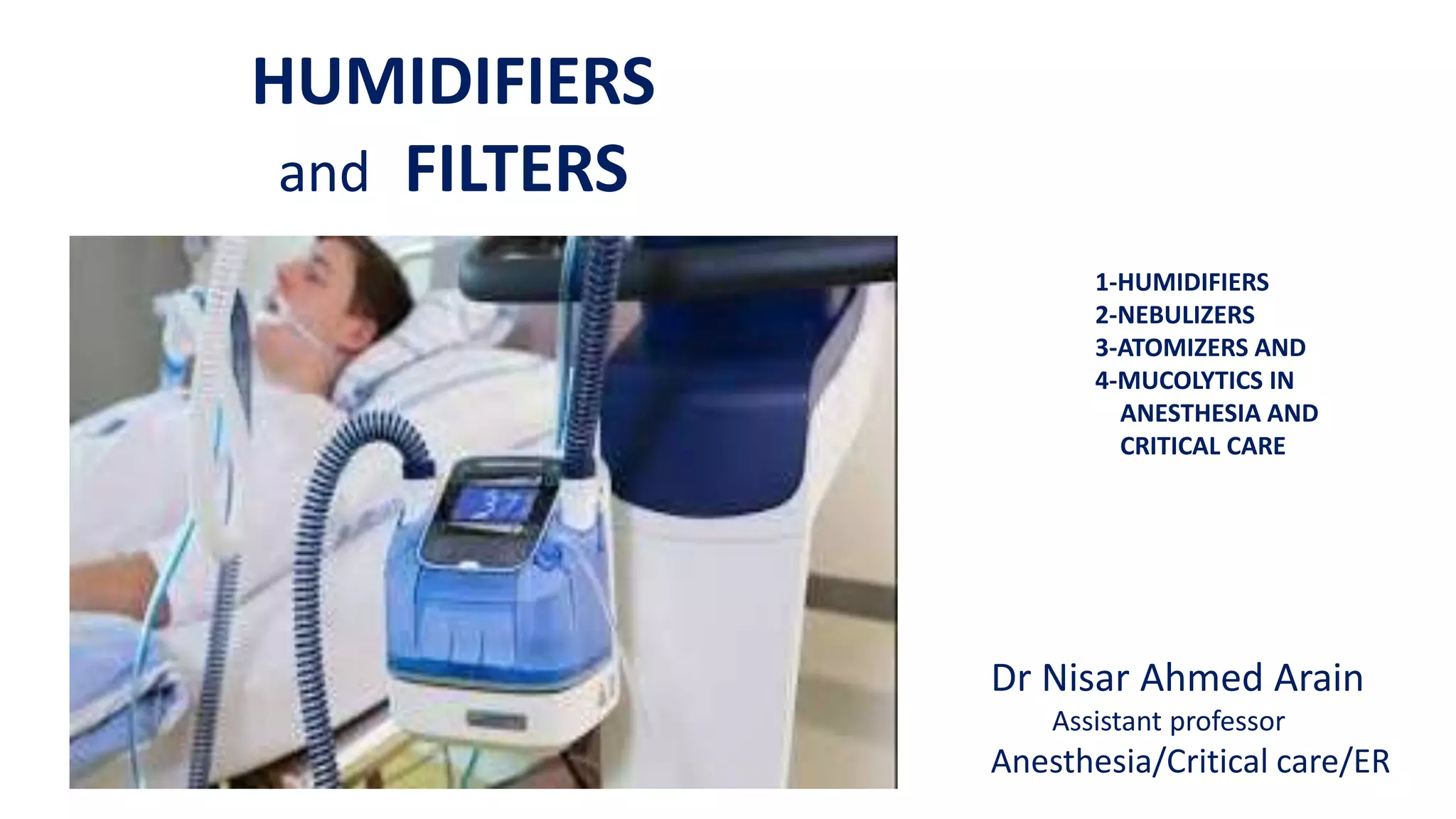
Overview of humidifiers, their types, and effects of humidity in anesthesia, including complications from inadequate humidification.
Discussion of sources of humidity in anesthesia, including CO2 absorbents, moisture conservation techniques, and system designs for humidity.
Description of passive humidifiers, including Heat and Moisture Exchangers (HMEs), their benefits, filters, and classifications into hydrophobic and hygroscopic types.
Indications for use, operational details such as tidal volume considerations, effectiveness, limitations, compatibility with other devices, and types of passive humidifiers. Overview of active humidifiers, including mechanisms for adding humidity, unheated vs heated types, and associated advantages and disadvantages.
Introduction to nebulizers, their mechanism of action, types, and the advantages, disadvantages, and potential hazards of using nebulizers in clinical practice.
Focus on mucolytics, their classification, effects on mucus properties, and examples of specific agents like NAC and their clinical uses.
Detailed information on specific mucolytic agents including Sodium Bicarbonate and Dornase Alpha, their mechanisms of action, and clinical applications.
-HUMIDIFICATION
-INTRODUCTION
--HUMIDITY -It iss general term used to
describe amount of water vapour in gas or air
--Water is intentionally removed from Medical gases
so that gases delivered from Anesthesia Machine
are dry and at room Temperature
--Gases must therefore be warmed to body
temperature and saturated with water by upper
respiratory tract
--Tracheal intubation and high fresh gas flows bypass
this normal Humidification by upper airways and
expose lower airways to dry (< 10 mg H2O / L)
room temperature gases
3.
--
HUMIDIFICATIO
N
-INTRODUCTION (
contd)
--Prolonged humidificationof gases by lower
respiratory tract leads to
a-dehydration of mucosa
b-Altered ciliary function
c-Impairment of Surfactant activity
d-Loss of body heat (heat of vaporization for
water)
--If excessively prolonged, it could potentially lead
to inspissation of secretions, airway and
tracheal tube obstruction, atelectasis, and even
ventilation and perfusion mismatching
particularly in patients with underlying lung
disease
4.
-HUMIDIFICATION
-INTRODUCTION (contd.)
--Artificial humidificationis of greatest benefit in
paediatric patients at increased risk for
developing pulmonary complications, older
patients with severe underlying lung pathology
e.g.
a-Cystic fibrosis and
b-Long procedures
--Excessive humidity (increased water load) may cause
a-ciliary degeneration and paralysis
b-pulmonary edema
c-altered alveolar – arterial oxygen gradient
d-Decreased vital capacity and compliance and
e-Decrease in Hematocrit and serum sodium
5.
--SOURCES OF
HUMIDITY
--CO2 absorbent:-Reaction of CO2 with absorbent
releases water
--Exhaled gases:-Rebreathing in tracheal tube,
supraglottic airway device, and connections to
breathing system
a-Almost half of humidity in expired gases is preserved
in this manner
--Moistening (Rinsing)breathing tubes and
reservoir bag before use
6.
-SOURCES OF
HUMIDITY (contd.)
--LOWFRESH GAS FLOWS:- conserve moisture
--COAXIAL BREATHING CIRCUITS:-They
increase humidity more quickly then a system
with two separate limbs, when combined with
low flows
a-They are not very efficient, Bain system
(coaxial version of Mapleson D)does not meet
optimal humidification requirements because
of high fresh gas flow required
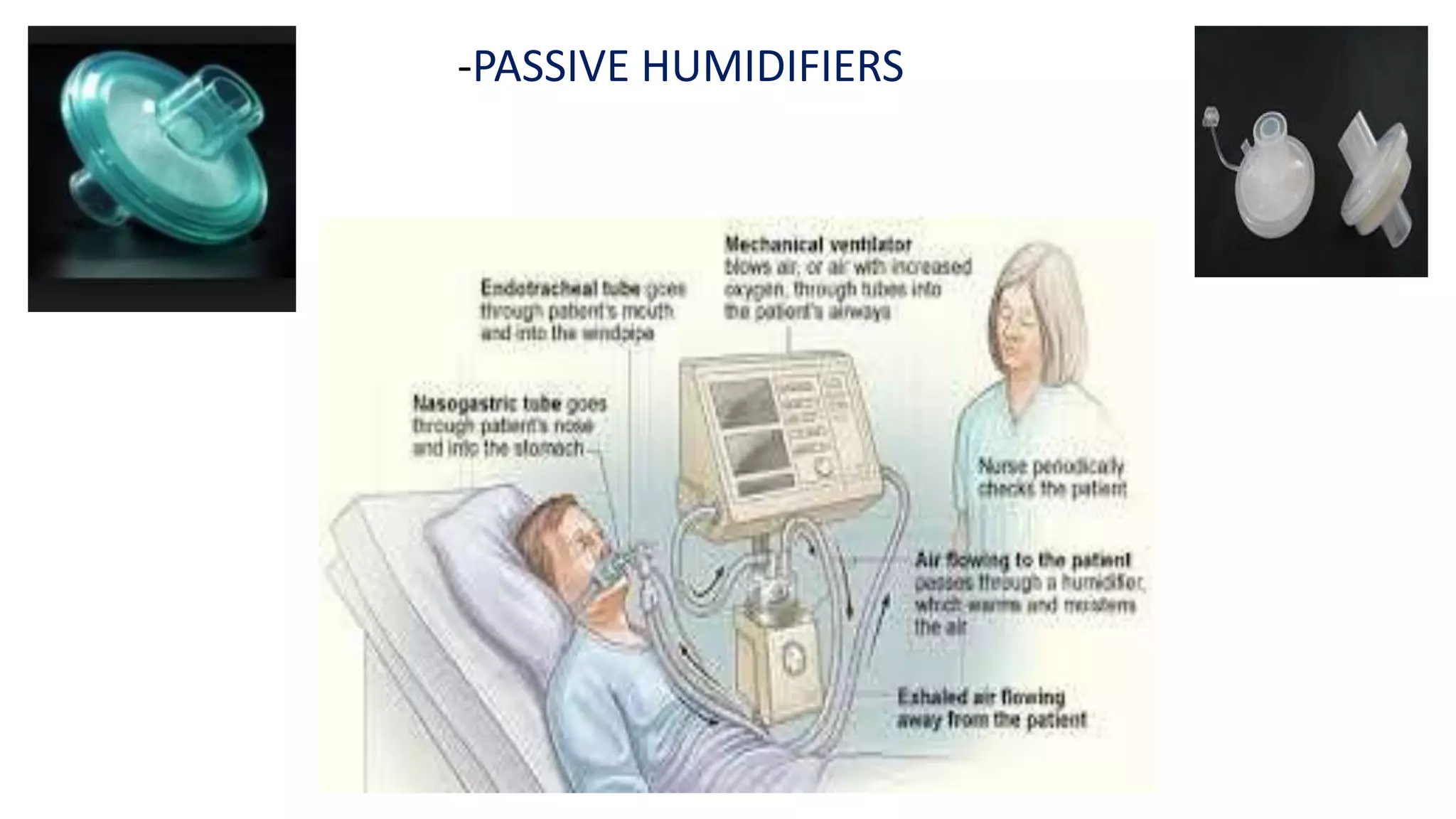
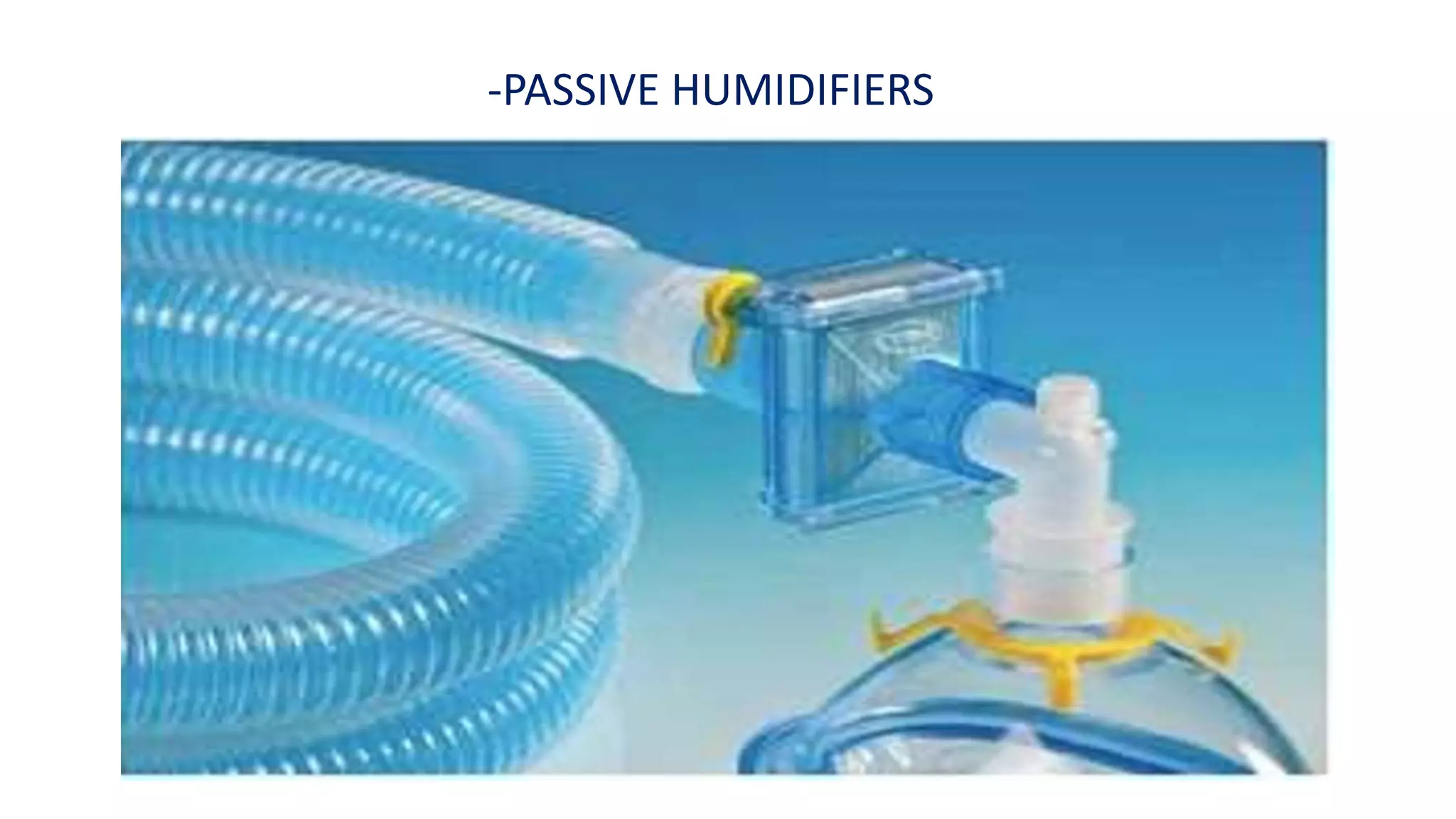
-PASSIVE HUMIDIFIERS
--Simplest designsare Heat and moisture Exchangers (HMEs)
--Also called as
a-Condenser Humidifier
b-Artificial Nose
c-Swedish Nose
d-Nose Humidifier
e-Regenerative Humidifier OR
f-Vapour Condenser
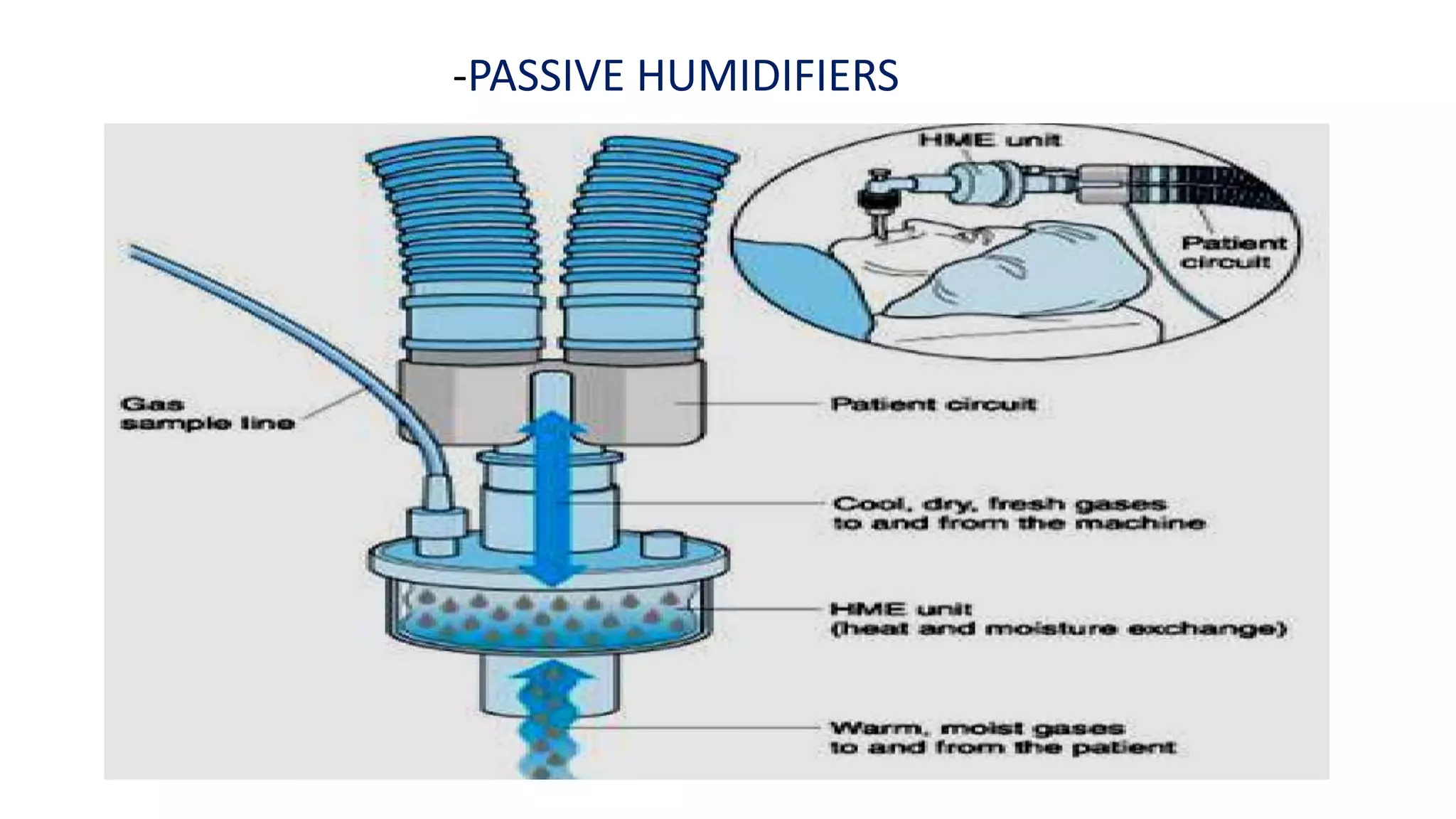
--Disposable devices that trap some exhaled water and heat,
and deliver them to patient on subsequent inhalation
(This minimizes heat and water loss)
--When combined with a filter for Bacteria and viruses
Heat and Moisture Exchanging Filter (HMEF) particularly
important when ventilating patients with respiratory
infections or compromised immune system
9.
-PASSIVE HUMIDIFIERS contd:-
--Exchangingmedium enclosed in plastic
housing
--Vary in size
--shape
--dead space
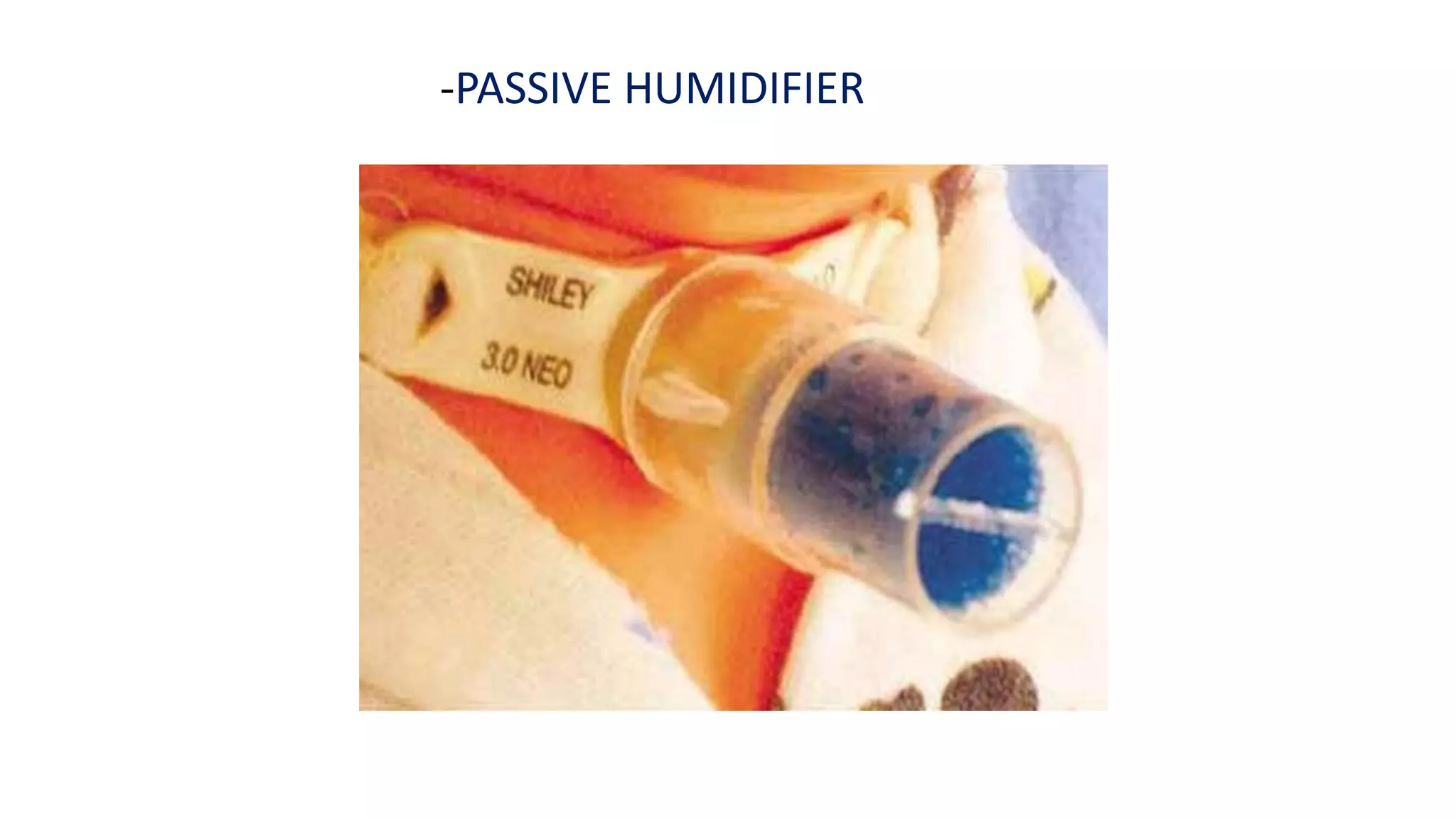
--pediatric and neonatal HEMs with low
dead space available
--May have a port to attach gas sampling line
for respiratory gas monitor
--Placed between ET tube and breathing circuit
-PASSIVE HUMIDIFIERS contd:-
-HYDROPHOBICHMEs
--1-Hydrophobic membrane with small pores,
pleated to increase surface area
--2-Allow passage of water vapour but not liquid,
and water at usual ventilator pressures
--3-Efficient Bacterial and Viral filters
--4-Performance may be impaired by high Ambient
temperature
15.
-PASSIVE HUMIDIFIERS contd:-
-HYGROSCOPICHMEs
--1-Wool, Foam, or paper like material coated with moisture
retaining chemicals
--2-Medium may be impregnated with a bactericide
--3-Composite Hygroscopic HMEs
--Hygroscopic layer + layer of thin, nonwoven fiber
membrane subjected to electric field to increase polarity
(Improves filtration efficiency and Hydrophobicity) more
efficient at moisture and temperature conservation than
Hydrophobic HMEs
16.
-PASSIVE HUMIDIFIERS contd:-
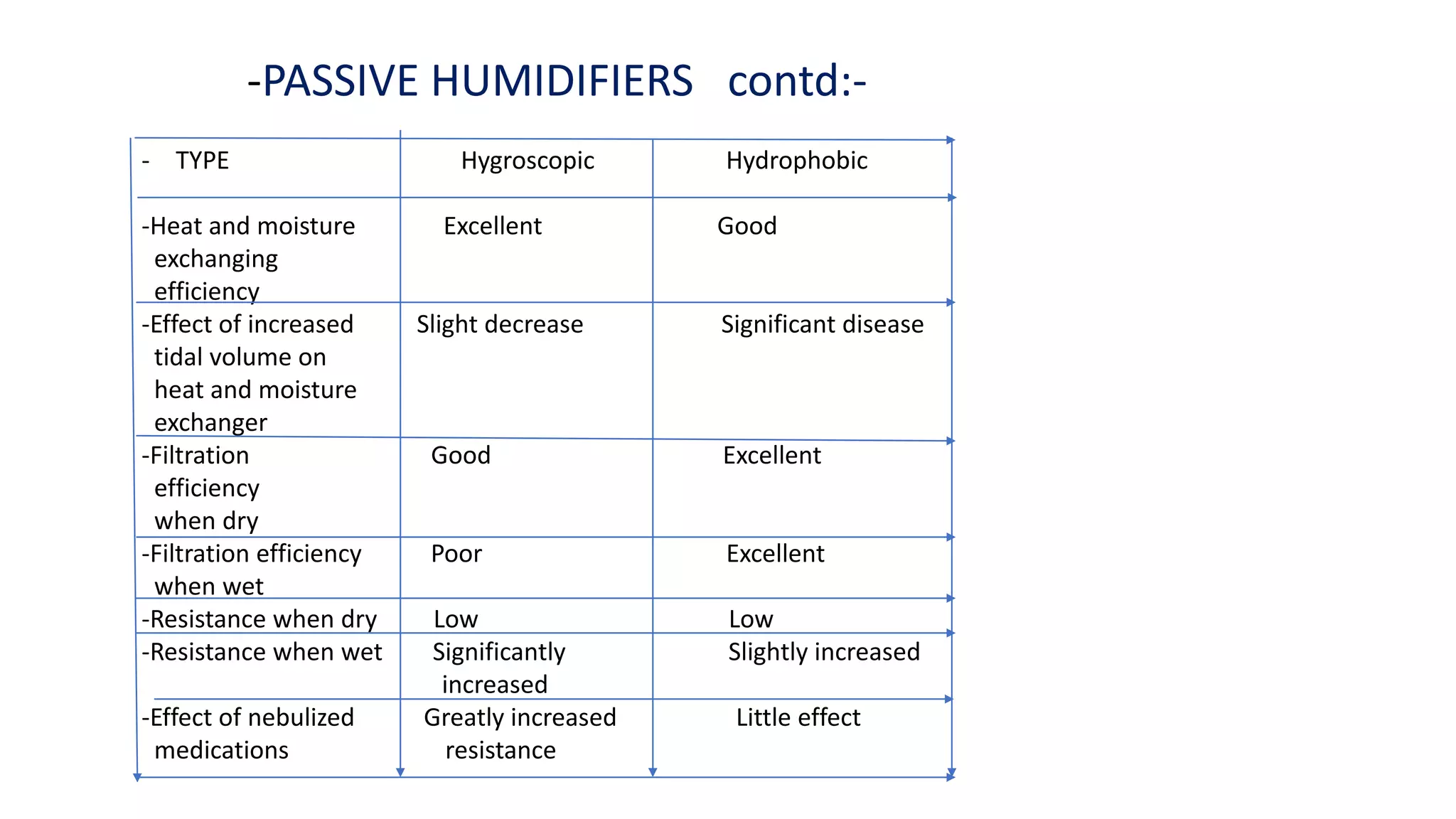
-TYPE Hygroscopic Hydrophobic
-Heat and moisture Excellent Good
exchanging
efficiency
-Effect of increased Slight decrease Significant disease
tidal volume on
heat and moisture
exchanger
-Filtration Good Excellent
efficiency
when dry
-Filtration efficiency Poor Excellent
when wet
-Resistance when dry Low Low
-Resistance when wet Significantly Slightly increased
increased
-Effect of nebulized Greatly increased Little effect
medications resistance
17.
-PASSIVE HUMIDIFIERS contd:-
-INDICATIONS
--1-Toincrease inspired heat and humidity during
both short and long term ventilation
--2-Especially useful when transporting intubated
patients – transport ventilators frequently
have no means for humidifying inspired
gases
--3-To supply supplemental oxygen to intubated
patient / patient with a supraglottic airway –
by connecting oxygen tubing to gas sampling
port
18.
-PASSIVE HUMIDIFIERS contd:-
--Shouldbe of appropriate size for patients tidal
volume
--Connecting more then one in series will
improve performance but care should be
taken that increase in dead space is not
excessive for particular patient
(Especially small patient)
--Should be visible and accessible at all times in
order to detect contamination or
disconnection
19.
-PASSIVE HUMIDIFIERS contd:-
--Maybe used for tracheostomized patients
--May be combined with another source like
unheated Humidifier, but should not be used
with heated Humidifier
--Nebulizer or metered dose inhaler if used should
be inserted between HME and patient, or HME
removed from circuit during aerosol treatment
--Should be replaced if contaminated with
secretions
-PASSIVE HUMIDIFIERS contd:-
-ADVANTAGES
--1-Inexpensive
--2-Easyto use
--3-Small, light weight, simple in design
--4-Silent in operation
--5-Do not require water / External energy
source / Temperature monitor / alarms
--6-No danger of overhydration / Hyperthermia
/ Burns / electrical shock
22.
-PASSIVE HUMIDIFIERS contd:-
--DISADVANTAGES
--1-Candeliver only limited Humidity
--2-Insignificant contribution to temperature
preservation
--3-Less effective than active humidifiers,
specially after intubation lasting for
several days
--4-Increased dead space
a-It may necessitate increase in Tidal
Volume
b-It may increase work of breathing
23.
-ACTIVE HUMIDIFIERS
--Add waterto gas by passing the gas over a
water chamber (Pass over Humidifier) or
through a saturated vick(Vick Humidifier,
bubbling it through water(bubble-through
Humidifier, or mixing it through vaporized
water (vapour-Phase Humidifier)
--Unlike passive Humidifiers, they do not filter
respiratory gases
--These are of two types
a-Unheated
b-Heated
24.
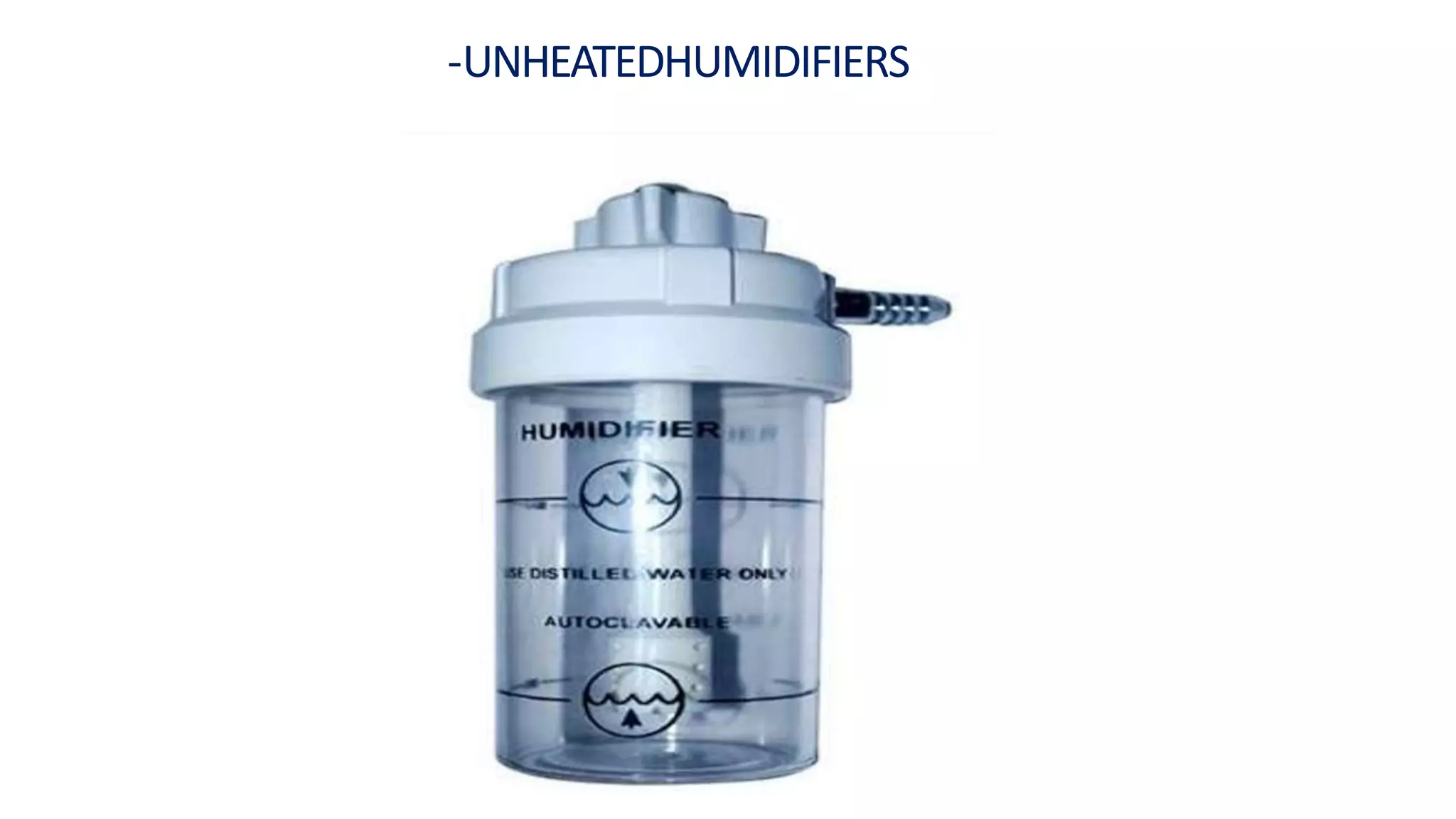
-UNHEATED HUMIDIFIERS
--Disposable, bubble-throughdevices used to
increase Humidity in oxygen supplied to
patients via face mask or nasal canula
--Simple containers containing distilled water
through Which oxygen ia passed and it gets
humidified
--Maximum Humidity that can be achieved is
9 mg H2O / L
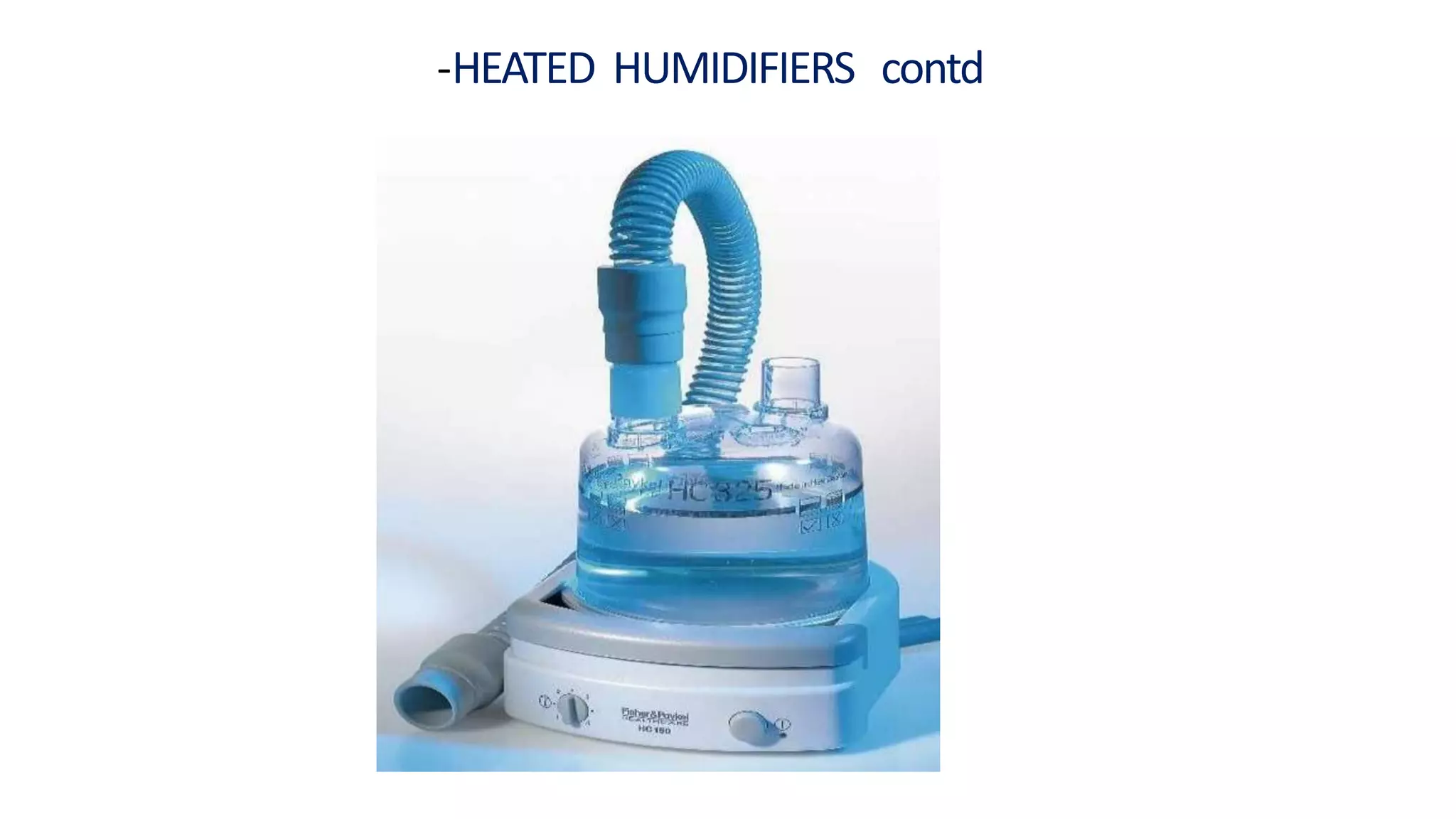
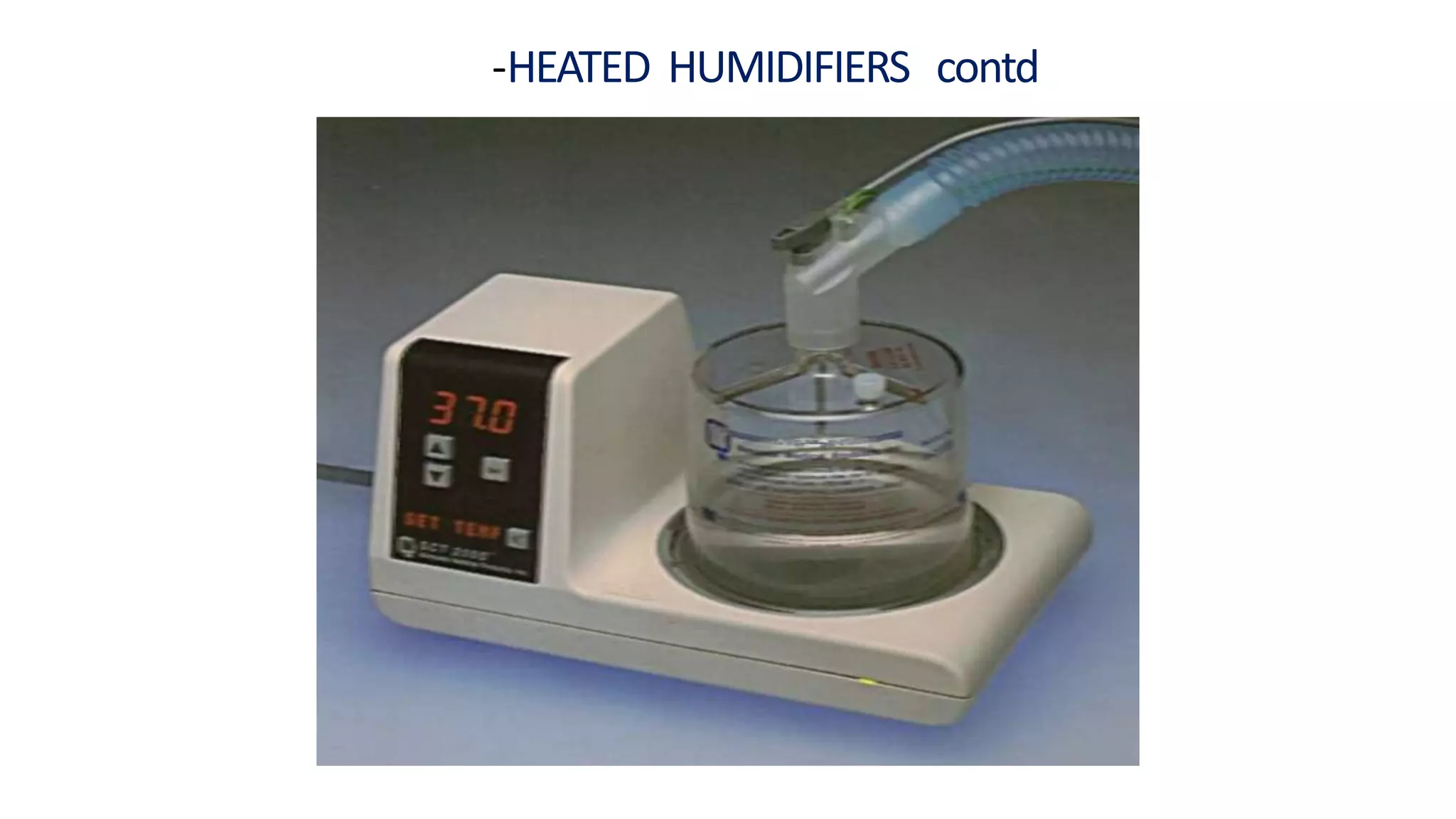
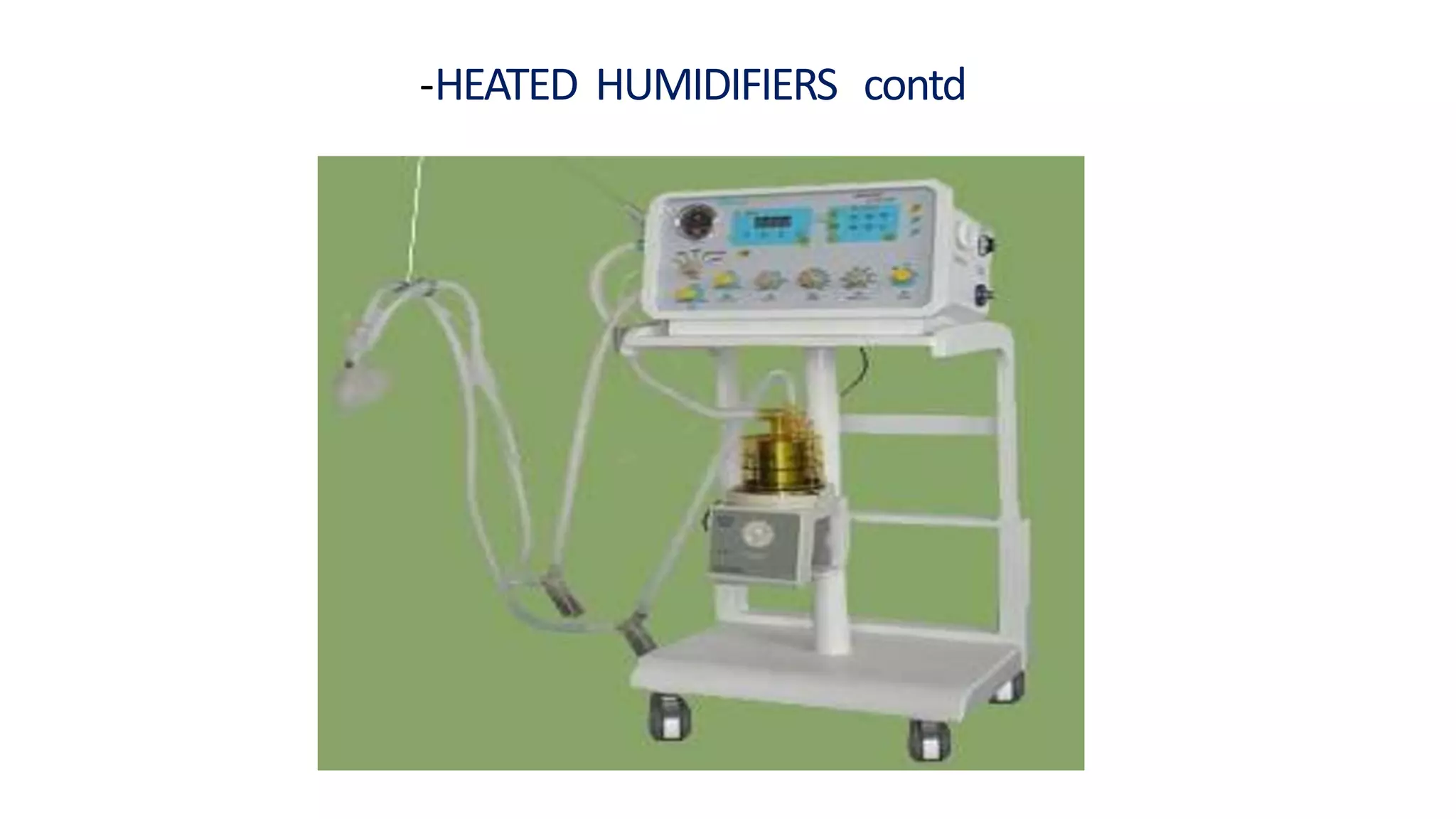
-HEATED HUMIDIFIERS
--In corporatea device to warm water in the
Humidifier some also heat inspiratory tube
--Humidification chamber – It contains following
a-Liquid water
b-Disposable and Re-useable
c-Clear (easy to check water level)
--Heat source – heated rods immersed in water /
plate at bottom of humidification chamber
27.
-HEATED HUMIDIFIERS contd.
--TemperatureMonitor – to measure gas
temperature At patient end of breathing
system
--Thermostat –
--1-SERVO CONTROLLED UNITS –
Automatically regulates power to heating
element in response to temperature sensed
by a probe near patient connection /
Humidifier outlet
--2-NON SERVO CONTROLLED UNITS –
provides power to heating element according
to setting of a Control, irrespective of
delivered temperature
28.
-HEATED HUMIDIFIERS contd.
--Inspiratorytube – conveys humidified gas from
Humidifier outlet to patient
a-IF UNHEATED – Gas will cool and loose some
of its moisture as it travels to the patient,
water tap necessary to collect condensed
water
b-HEATED OR INSULATED – more precise
control of temperature and humidity
delivered to the patient, avoids moisture
rain out
29.
-HEATED HUMIDIFIERS contd
--CONTROLS– Most allow temperature selection at the
end of delivery tube
-ALARMS – To indicate temperature deviation by a fixed
amount, displacement of temperature probe,
disconnection of heater wire, low water in
humidification chamber , faulty airway
temperature probe, lac of gas flow in the circuit
--STANDERED REQUIREMENTS - An international U.S.
standard On humidifiers have been published
-HEATED HUMIDIFIERS contd.
--Inthe circle system, heated Humidifiers is
placed in the inspiratory
limb downstream of the unidirectional
valve by using an accessory breathing
tube
--Must not be placed in the expiratory limb
--Filter, If used, must be placed upstream of
the Humidifier to prevent it from becoming
clogged
--In Mapleson systems, humidifier is usually
placed in fresh gas supply tube
35.
--HEATED HUMIDIFIERS contd.
---Humidifiermust be lower than the patient to avoid
risk of water running down the tubing into the
patient.
--Condensate must be drained periodically or a water
trap inserted in the most dependent part of the
tubing to prevent Blockage or Aspiration
--Heater wire in delivery tube should not be
bunched, but srung evenly along length of the tube
--Delivery tube should not rest on other surfaces or be
covered with sheets, blankets, or other materials
a boom arm or tube tree may be used for support
-HEATED HUMIDIFIERS contd.
DISADVANTAGES
--Bulkyand somewhat complex
--Involve high maintenance costs, electrical hazards,
and increased work (temperature control, refilling
the reservoir, draining condensate, cleaning, and
sterilization)
--Offers relative little protection against heat loss
during anesthesia as compared to circulating
water and forced- air-warming
38.
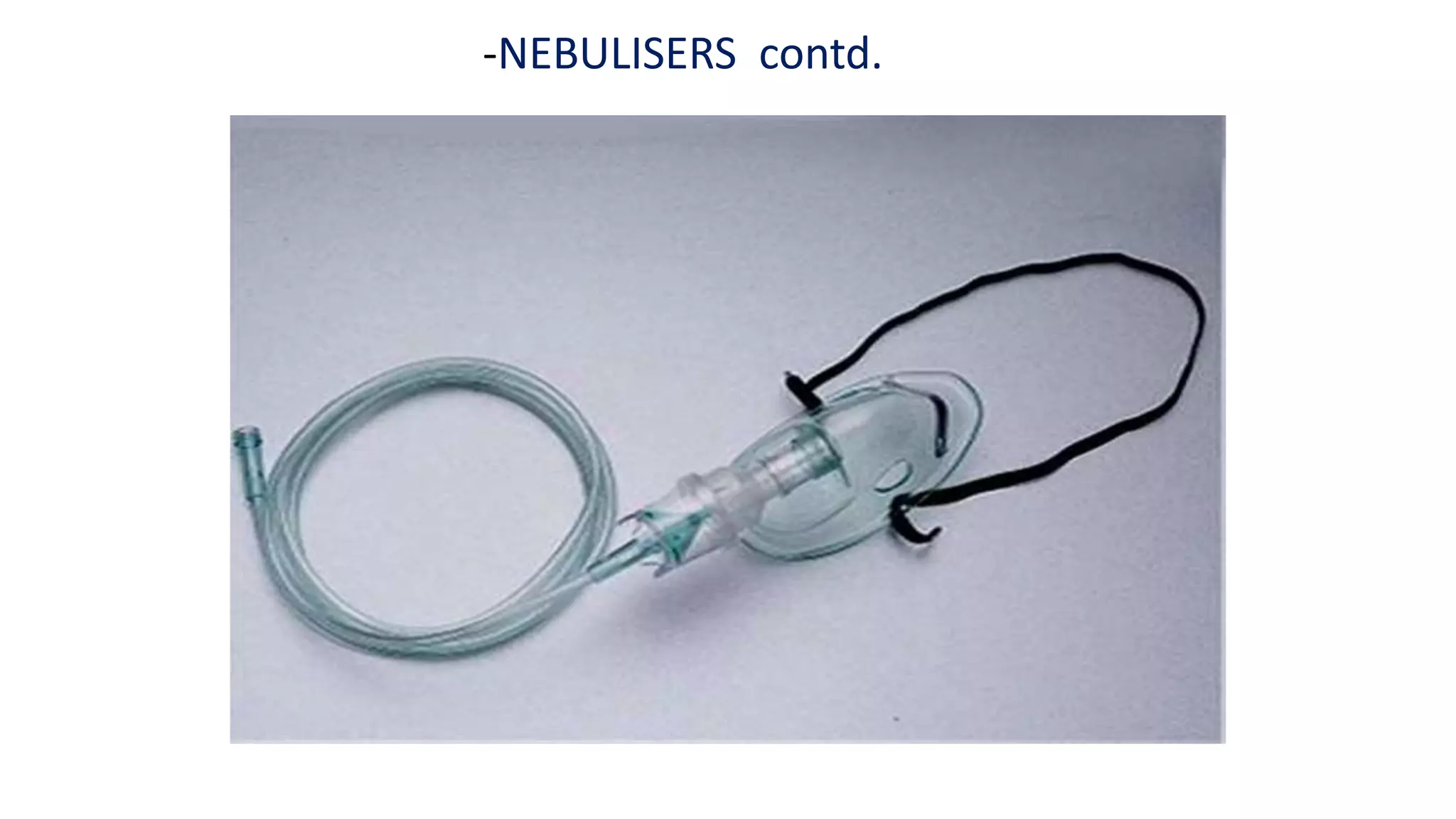
-NEBULISERS
--Aerosol generators /Automizers / Nebulizing
Humidifiers
--Emit water in the form of an aerosol mist
(Water vapour plus particulate water)
--Used for producing Humidification and
delivery of drug directly into respiratory
tract
--Drugs delivered by nebulizers:-
--Bronchodilators
--Decongestants
--Mucolytic agents
--Steroids
39.
-NEBULISERS contd.
--Optical particlesize of droplet
(aerosol = 0.5 to 5.5 micron meter
--Particle size more than > micron meter
– which is unable to reach peripheral
airways, and remain deposited in the
main airways
--Particles < 0.5 micron meter – are very
light, and comes back with expired
gases without being deposited in the
airways
40.
-NEBULISERS contd.
--These aremost commonly used are of two types
--1-Pneumatically Driven
a-Gas Driven
b-Jet
c-High Pressure
d-Compressed Gas
--2-Ultrasonic
41.
-NEBULISERS contd.
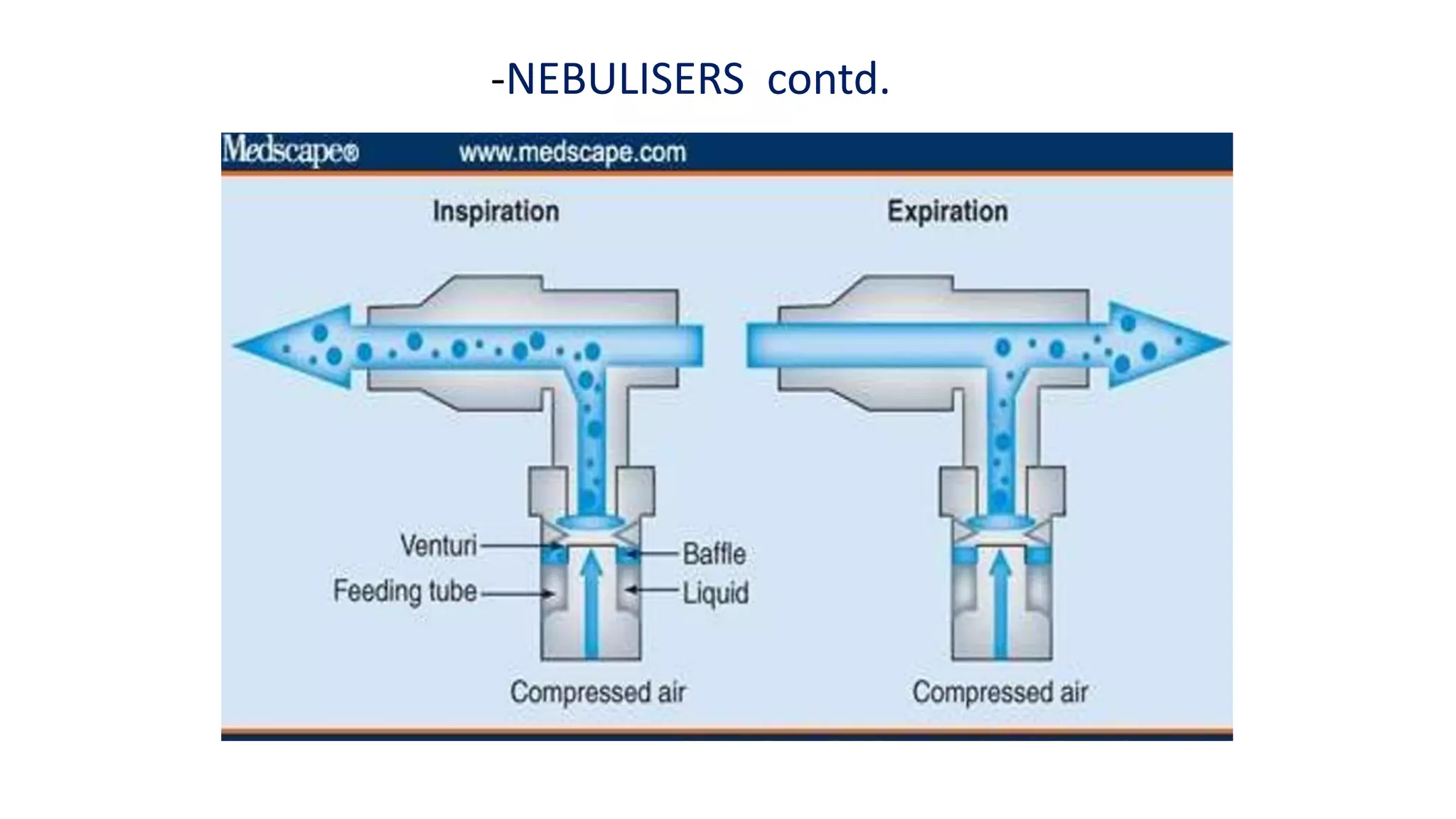
--PNEUMATICALLY DRIVENNEBULIZER –
works by pushing a jet of high pressure
gas into a liquid, inducing shearing forces
and breaking the water up into fine
particles.
--Should be placed in the fresh gas line
(High flow of gas must be used with
pneumatic nebulizer)
--Produces particles from 5 to 30 micron
meter (only 30% to 40% of particles
produced are in optimal range)
--Most of the particles get deposited in
the wall of the main airways
-NEBULISERS contd.
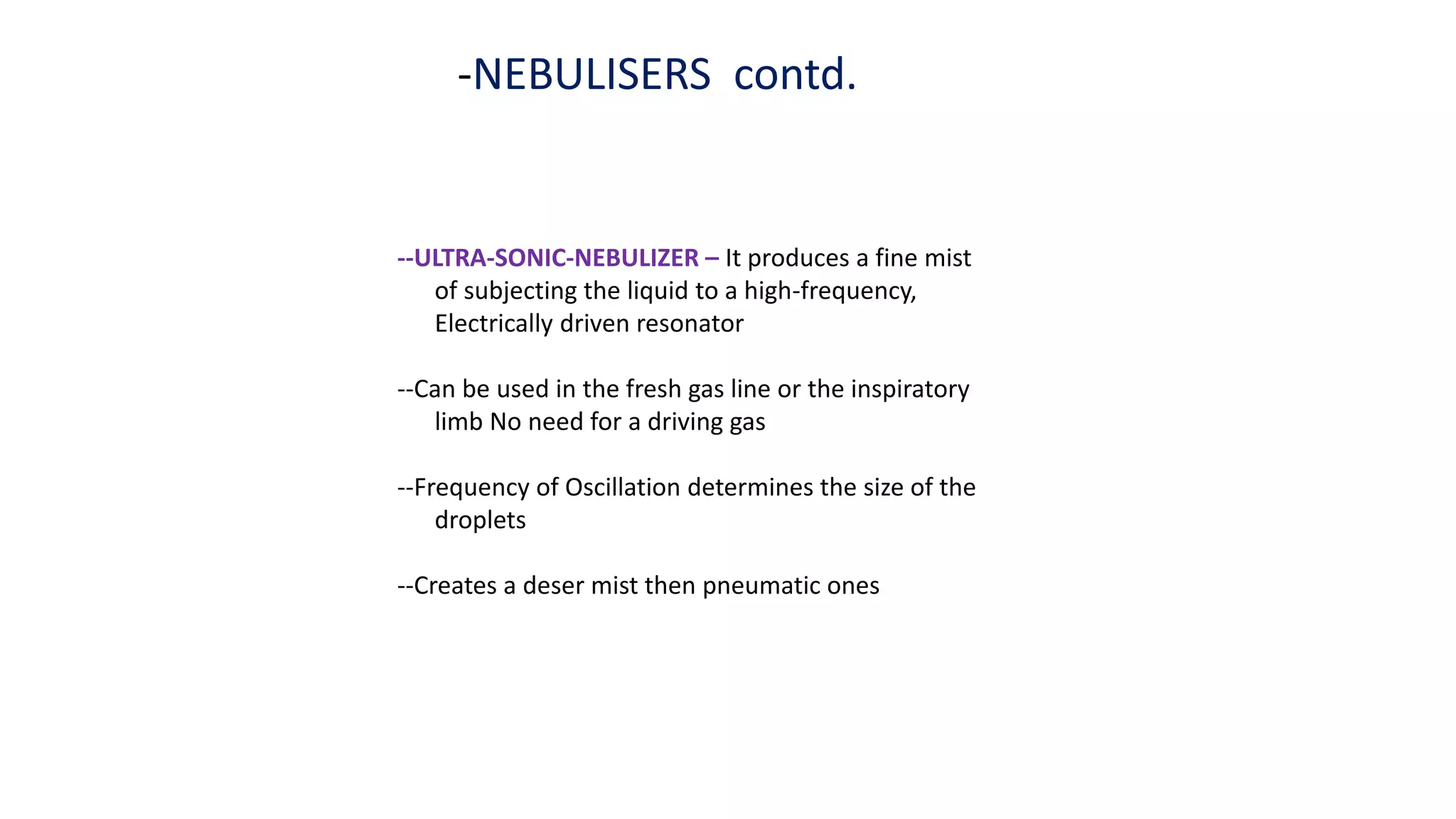
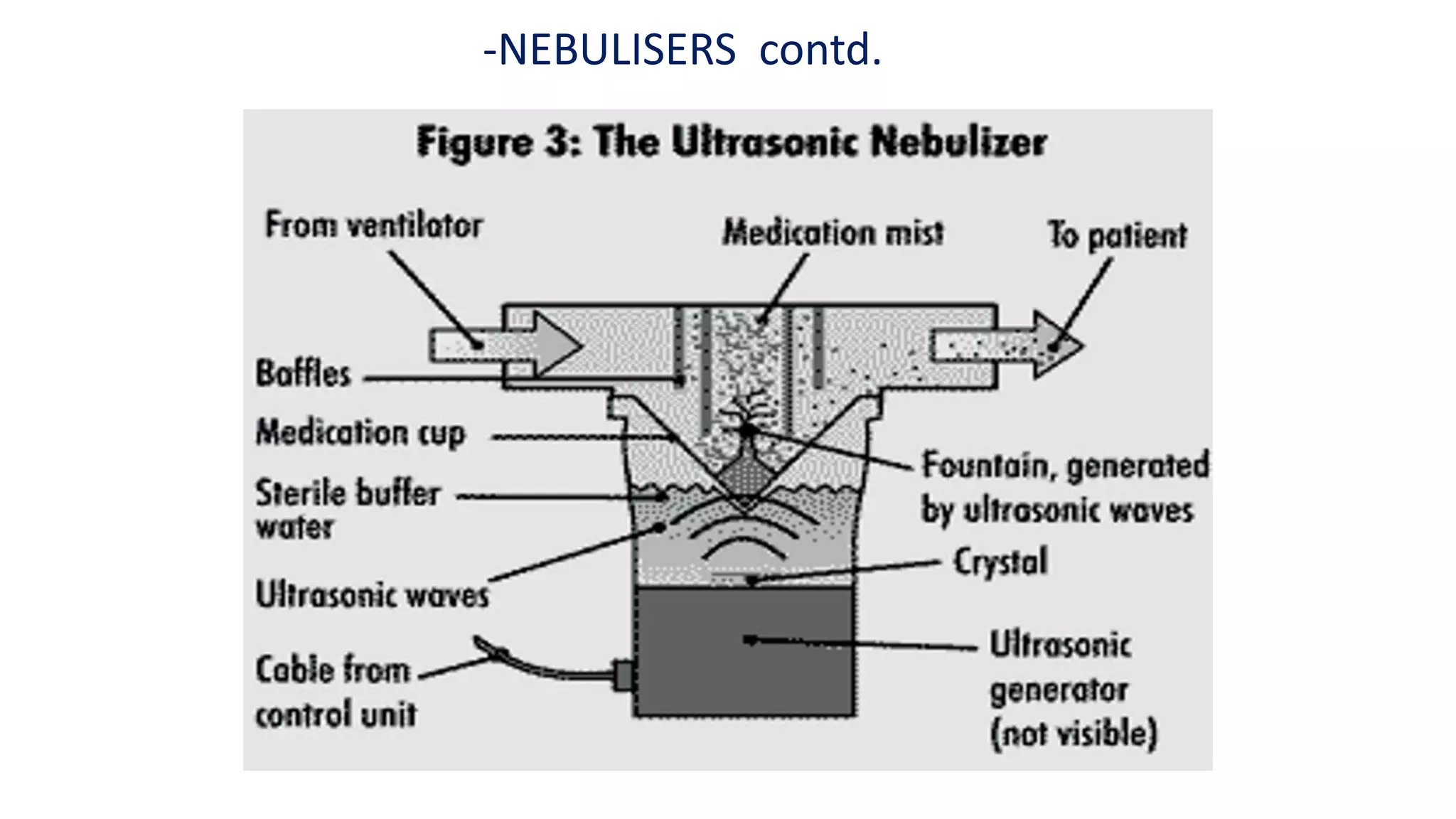
--ULTRA-SONIC-NEBULIZER –It produces a fine mist
of subjecting the liquid to a high-frequency,
Electrically driven resonator
--Can be used in the fresh gas line or the inspiratory
limb No need for a driving gas
--Frequency of Oscillation determines the size of the
droplets
--Creates a deser mist then pneumatic ones
-NEBULISERS contd.
--Ultrasonic nebulizersproduces mist
with aerosol size of 1 to 10 micron
meter (95% of particles produced
are in optimal range)
a-Particles get deposited directly in
airways, so are very useful for
delivery of “Bronchodilators”
directly in the peripheral airways
--Can nebulize 6 mL of water or drug
in 1(one) minute
47.
-NEBULISERS contd.
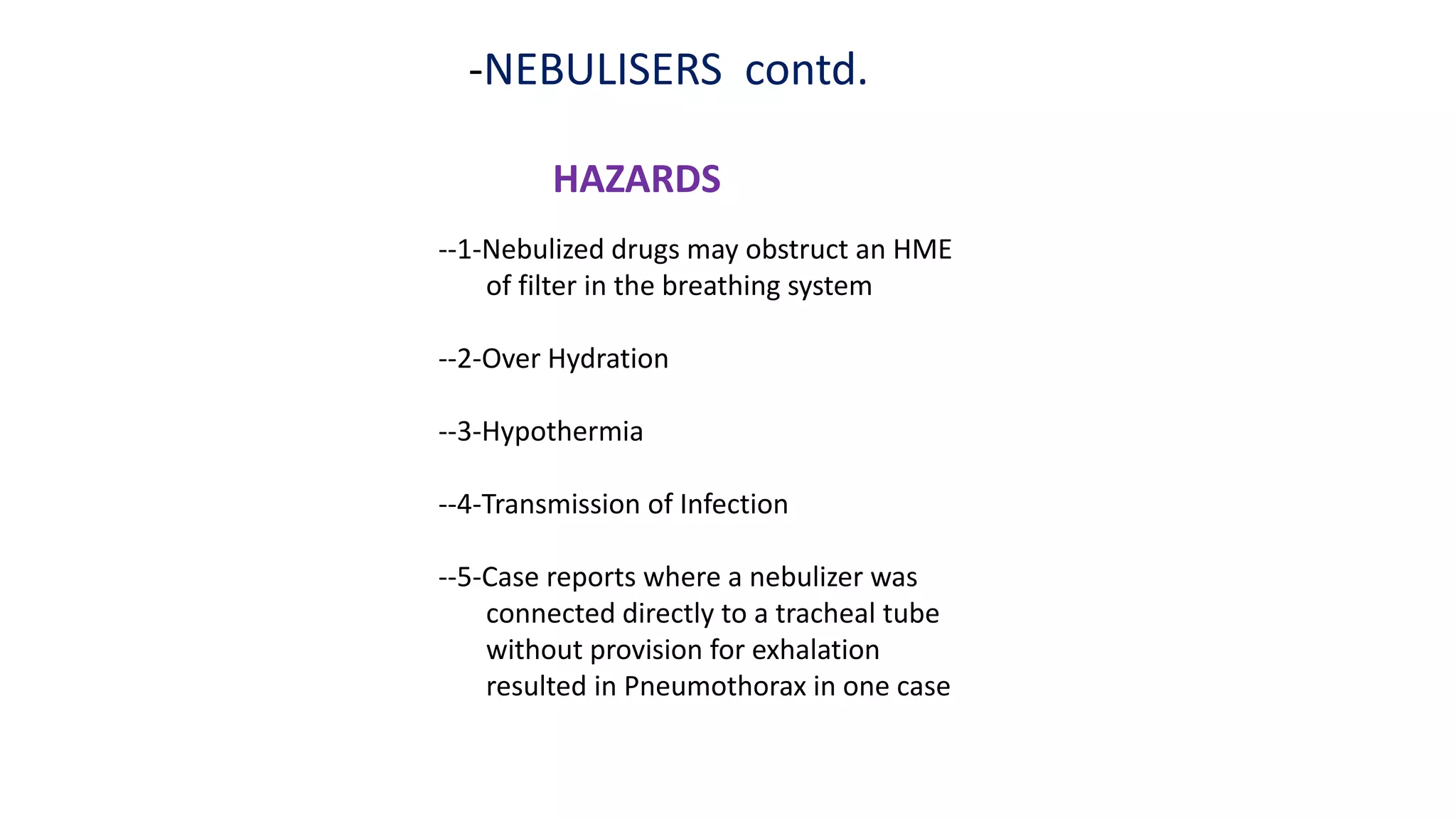
HAZARDS
--1-Nebulized drugsmay obstruct an HME
of filter in the breathing system
--2-Over Hydration
--3-Hypothermia
--4-Transmission of Infection
--5-Case reports where a nebulizer was
connected directly to a tracheal tube
without provision for exhalation
resulted in Pneumothorax in one case
48.
-NEBULISERS contd.
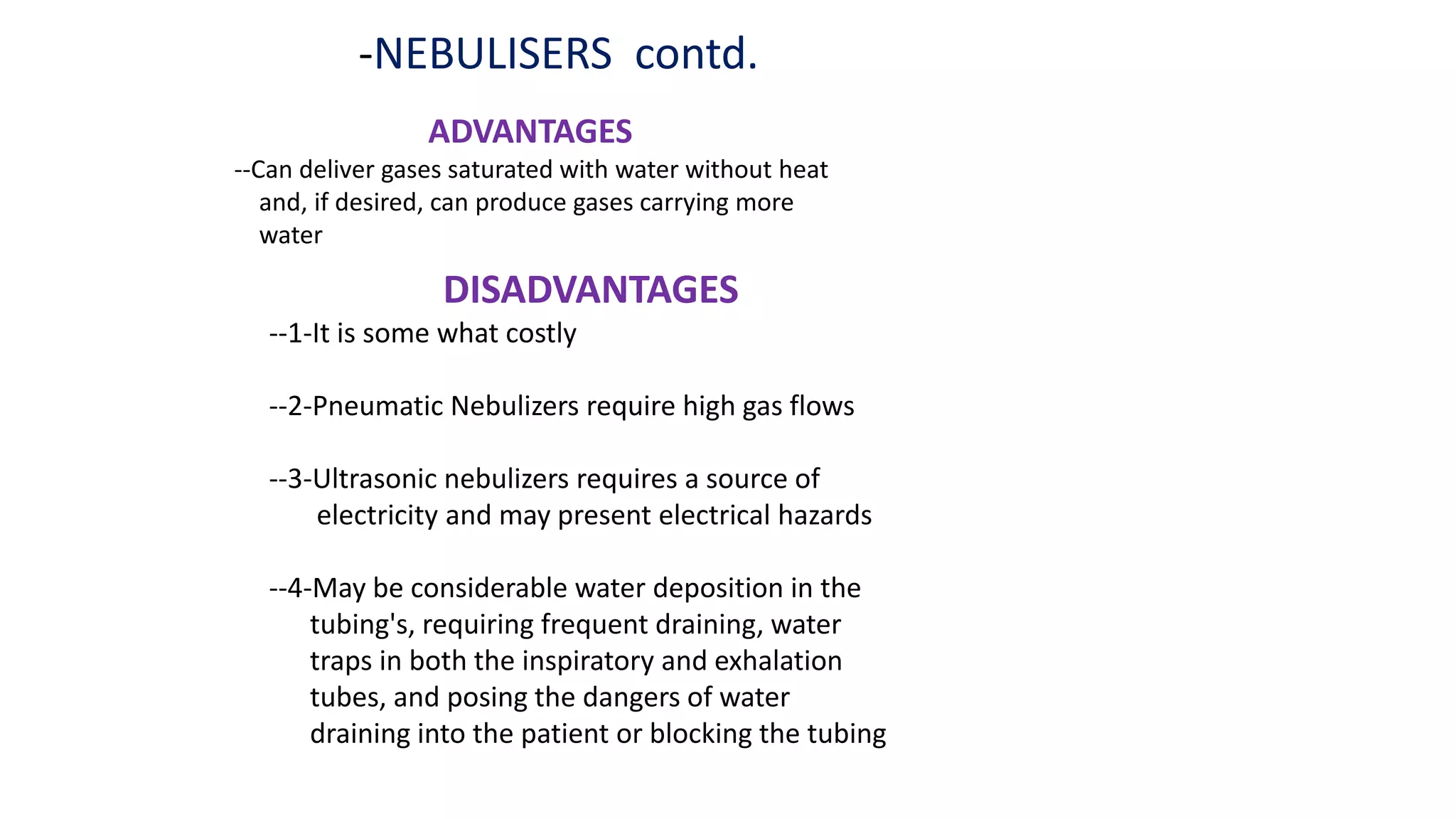
ADVANTAGES
--Can delivergases saturated with water without heat
and, if desired, can produce gases carrying more
water
DISADVANTAGES
--1-It is some what costly
--2-Pneumatic Nebulizers require high gas flows
--3-Ultrasonic nebulizers requires a source of
electricity and may present electrical hazards
--4-May be considerable water deposition in the
tubing's, requiring frequent draining, water
traps in both the inspiratory and exhalation
tubes, and posing the dangers of water
draining into the patient or blocking the tubing
49.
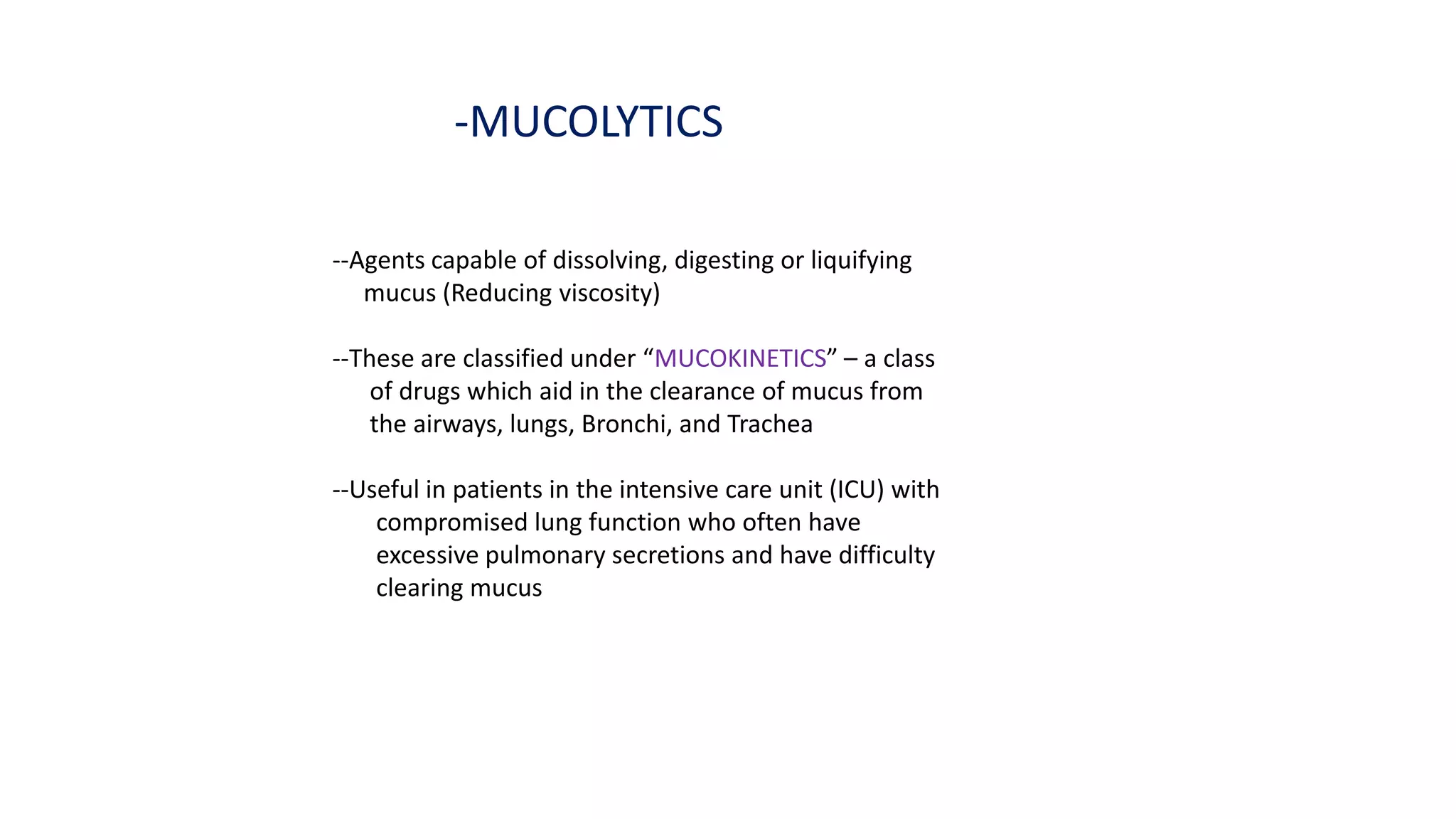
-MUCOLYTICS
--Agents capable ofdissolving, digesting or liquifying
mucus (Reducing viscosity)
--These are classified under “MUCOKINETICS” – a class
of drugs which aid in the clearance of mucus from
the airways, lungs, Bronchi, and Trachea
--Useful in patients in the intensive care unit (ICU) with
compromised lung function who often have
excessive pulmonary secretions and have difficulty
clearing mucus
-MUCOLYTICS contd.
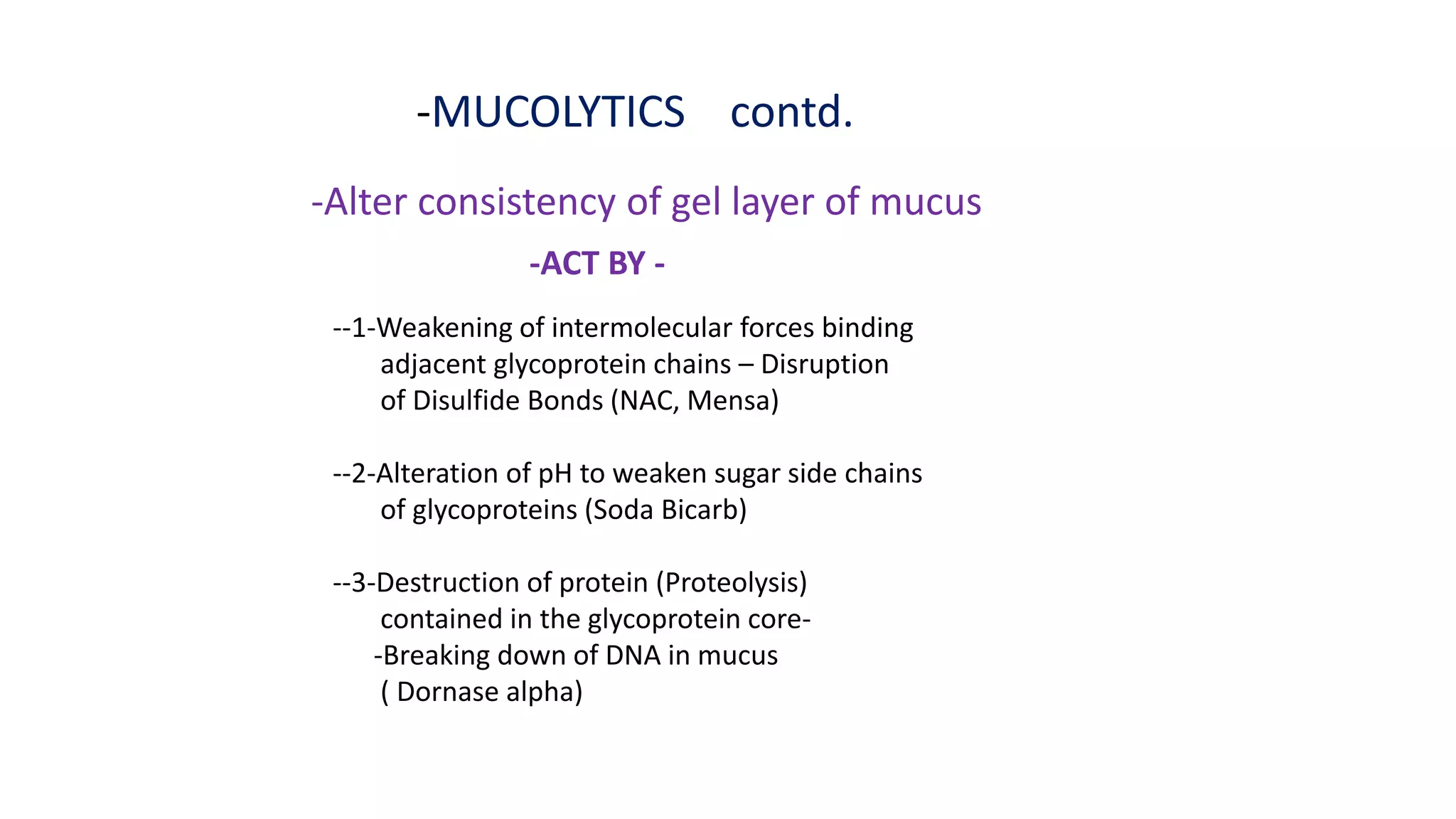
-Alter consistencyof gel layer of mucus
-ACT BY -
--1-Weakening of intermolecular forces binding
adjacent glycoprotein chains – Disruption
of Disulfide Bonds (NAC, Mensa)
--2-Alteration of pH to weaken sugar side chains
of glycoproteins (Soda Bicarb)
--3-Destruction of protein (Proteolysis)
contained in the glycoprotein core-
-Breaking down of DNA in mucus
( Dornase alpha)
52.
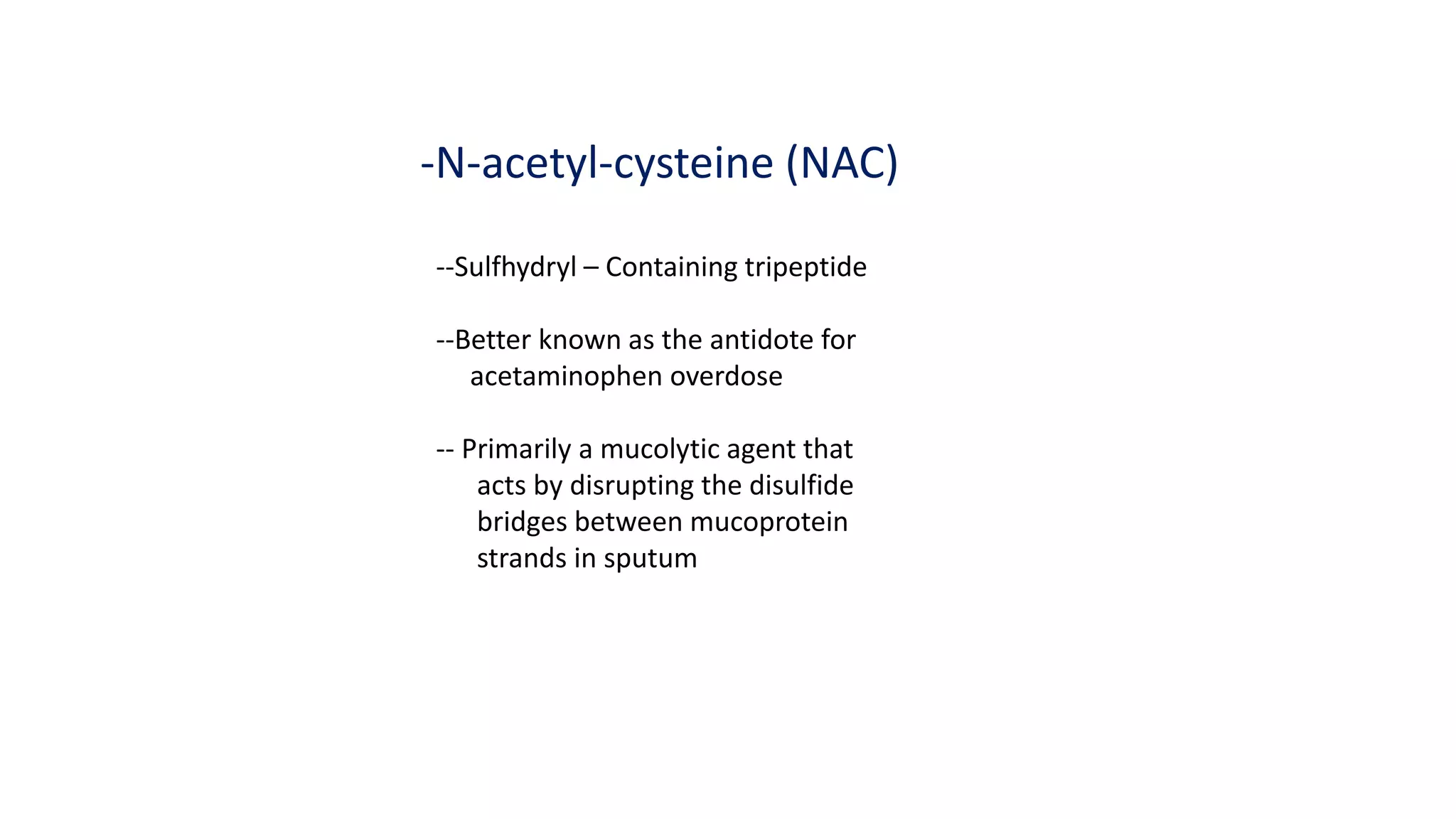
-N-acetyl-cysteine (NAC)
--Sulfhydryl –Containing tripeptide
--Better known as the antidote for
acetaminophen overdose
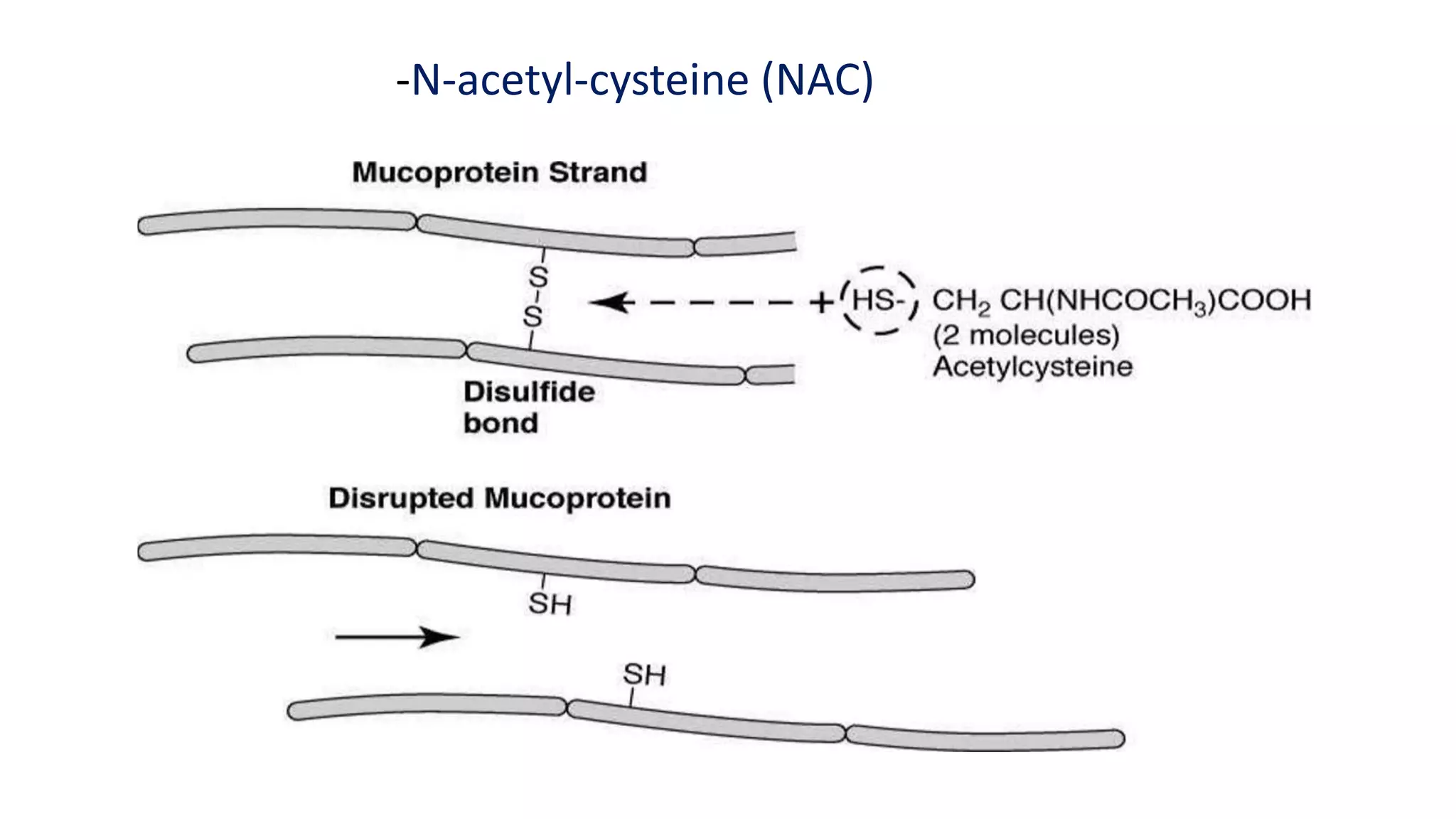
-- Primarily a mucolytic agent that
acts by disrupting the disulfide
bridges between mucoprotein
strands in sputum
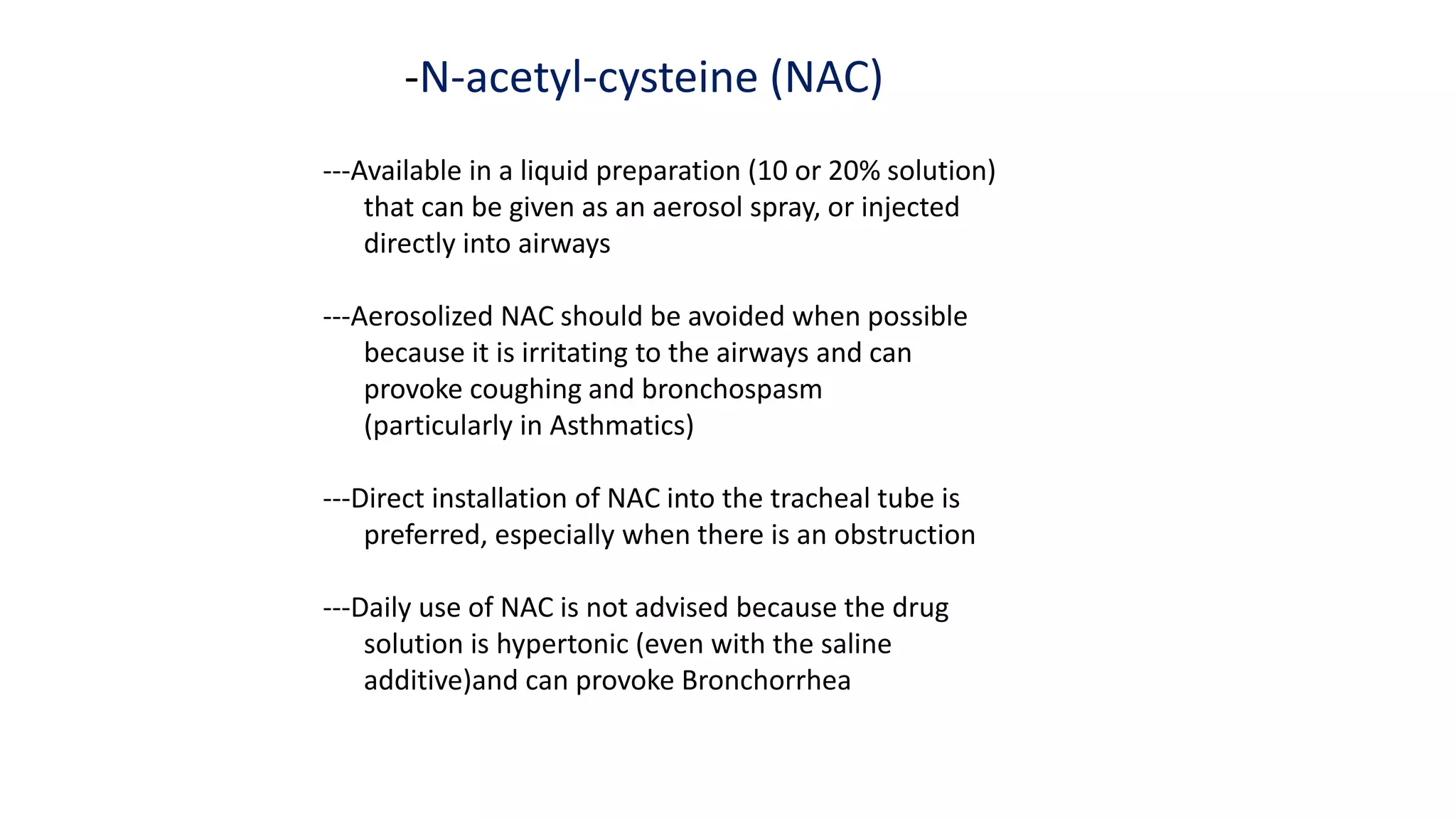
-N-acetyl-cysteine (NAC)
---Available ina liquid preparation (10 or 20% solution)
that can be given as an aerosol spray, or injected
directly into airways
---Aerosolized NAC should be avoided when possible
because it is irritating to the airways and can
provoke coughing and bronchospasm
(particularly in Asthmatics)
---Direct installation of NAC into the tracheal tube is
preferred, especially when there is an obstruction
---Daily use of NAC is not advised because the drug
solution is hypertonic (even with the saline
additive)and can provoke Bronchorrhea
55.
-N-acetyl-cysteine (NAC)
--Should notbe mixed with
antibiotics in the same
Nebulizer (Incompatible)
--Nausea and vomiting
-Disagreeable odor
(smells like rotten eggs)
due to the hydrogen sulfide.
--Open vials should be used within
96 hours to prevent
contamination
56.
-MENSA
--Organo-sulfer compound
--Mesna, soldunder the brand name Mesnex
among others, is a medication used in those
taking “Cyclophosphamide” or
“Ifos famide” to decrease the risk of bleeding
from the Bladder It is used either by mouth
or by injection
--It is also used in cancer chemotherapy as an
adjuvant. (That modifies the action of
principle ingredient)
--It is also used as a mucolytic- works in the
same way as NAC
57.
-SODIUM BI CARBONATE
--WeakBase
--increasing the pH of mucus
weakness the polysaccharide
chains
--2% NaHCO3 solutions are used
--Can be injected into the
trachea or aerosolized
(2 – 5 mL)
58.
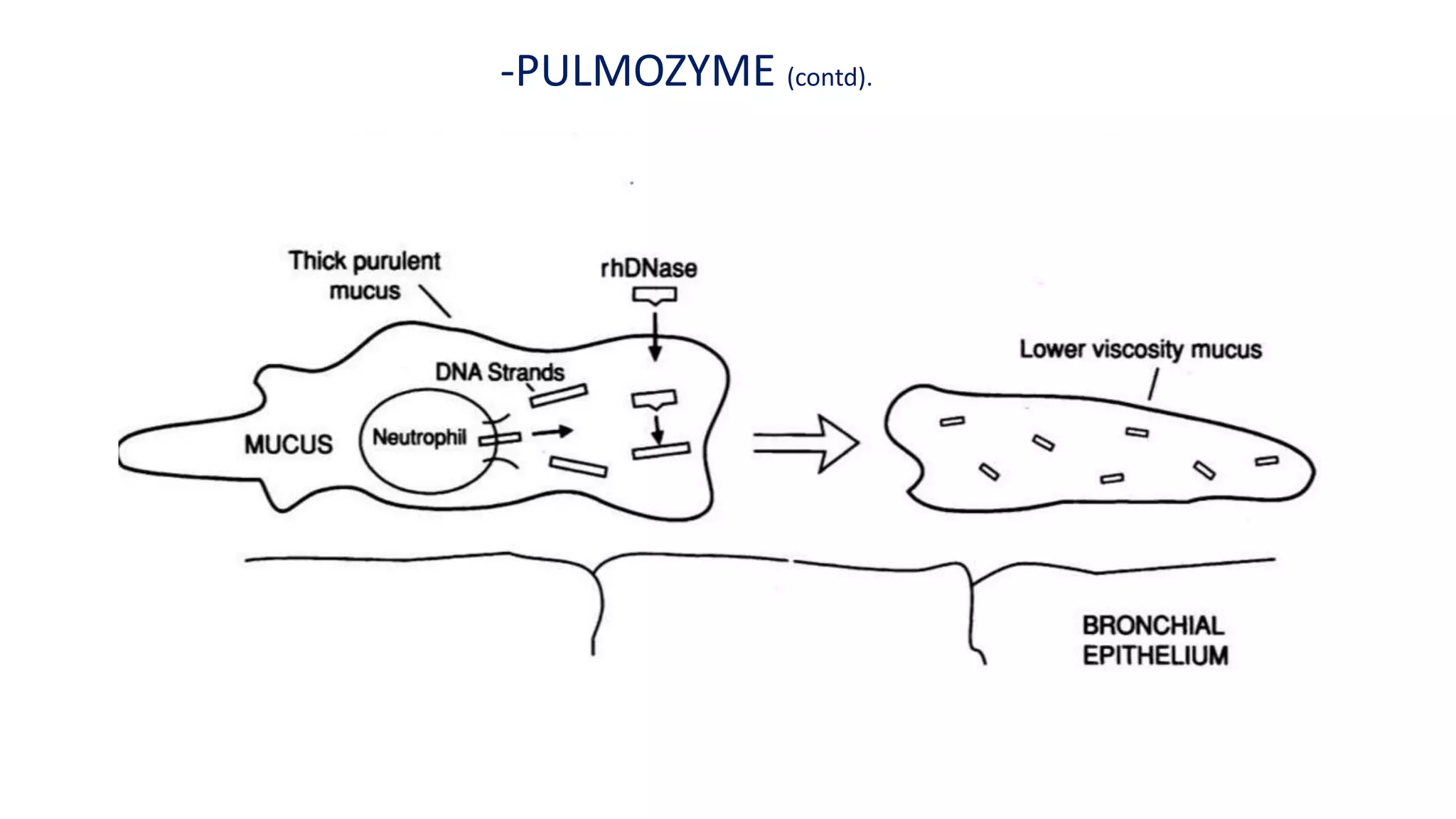
-DORNASE ALPHA (PULMOZYME)
--Highlypurified solution of
recombinant human
De-oxy-ribo-nuclease 1(rhDase)
an enzyme which selectively
cleaves DNA
--Produced in Chinese hamster ovary
cells
--Hydrolyses the DNA present in the
sputum mucus of cystic fibrosis
patients and reduces viscosity in
the lungs, promoting improved
clearance of secretions