Analog Integrated CircuitsAnalog Integrated Circuits
ECL 515 / ECL(X) 315ECL 515 / ECL(X) 315
Op amp Parameters
1
Sem-VII 90 INAC-L & X
AT2015
Prof.Satheesh Monikandan.B
HOD-ECE
Indian Naval Academy, Ezhimala
sathy24@gmail.com
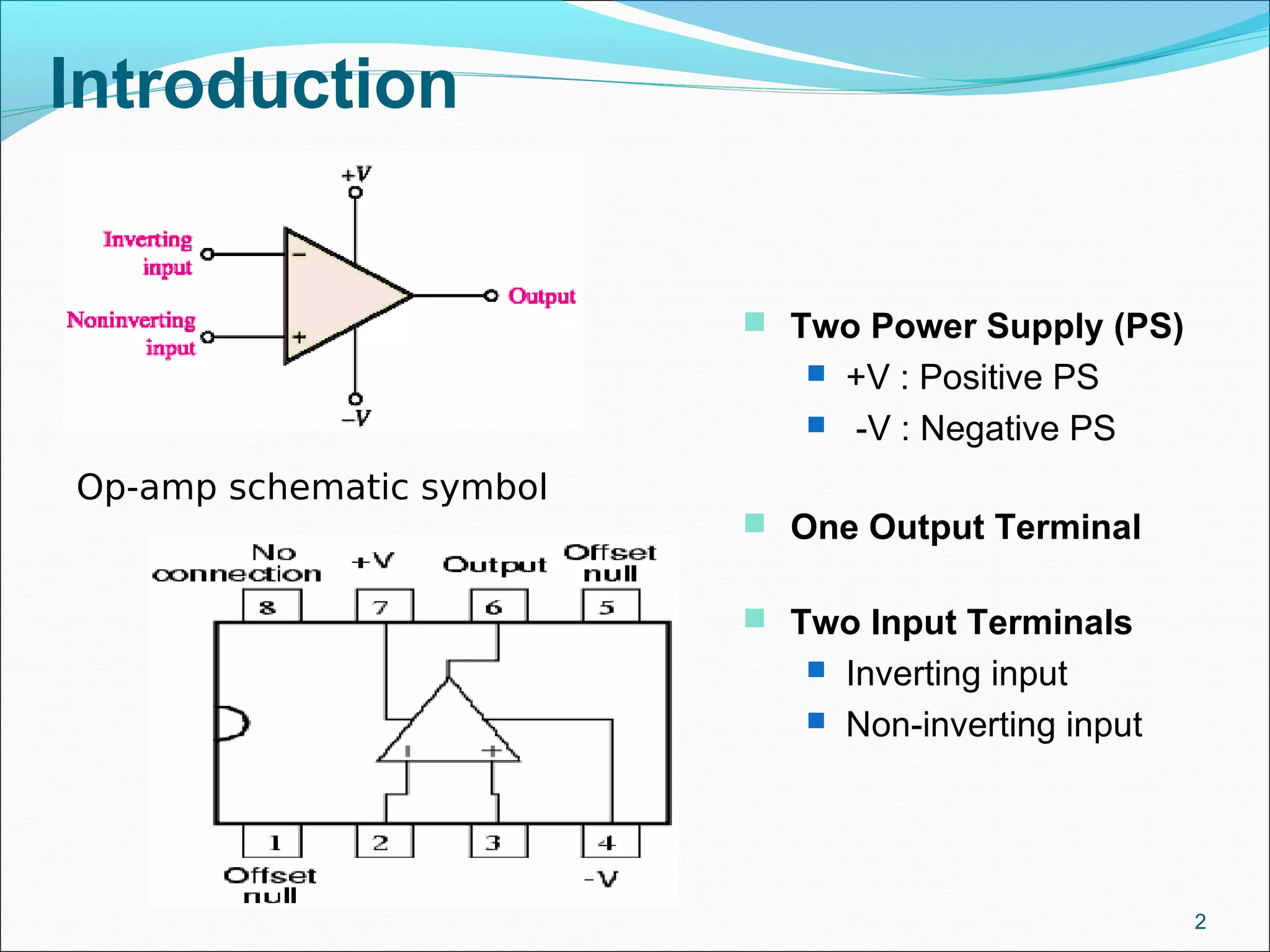
Introduction
2
Op-amp schematic symbol
 One Output Terminal
 Two Input Terminals
 Inverting input
 Non-inverting input
 Two Power Supply (PS)
 +V : Positive PS
 -V : Negative PS
3
Applications of Op-Amp
 To provide voltage amplitude changes
(amplitude and polarity)
 Comparators
 Oscillators
 Filters
 Sensors
 Instrumentation amplifiers
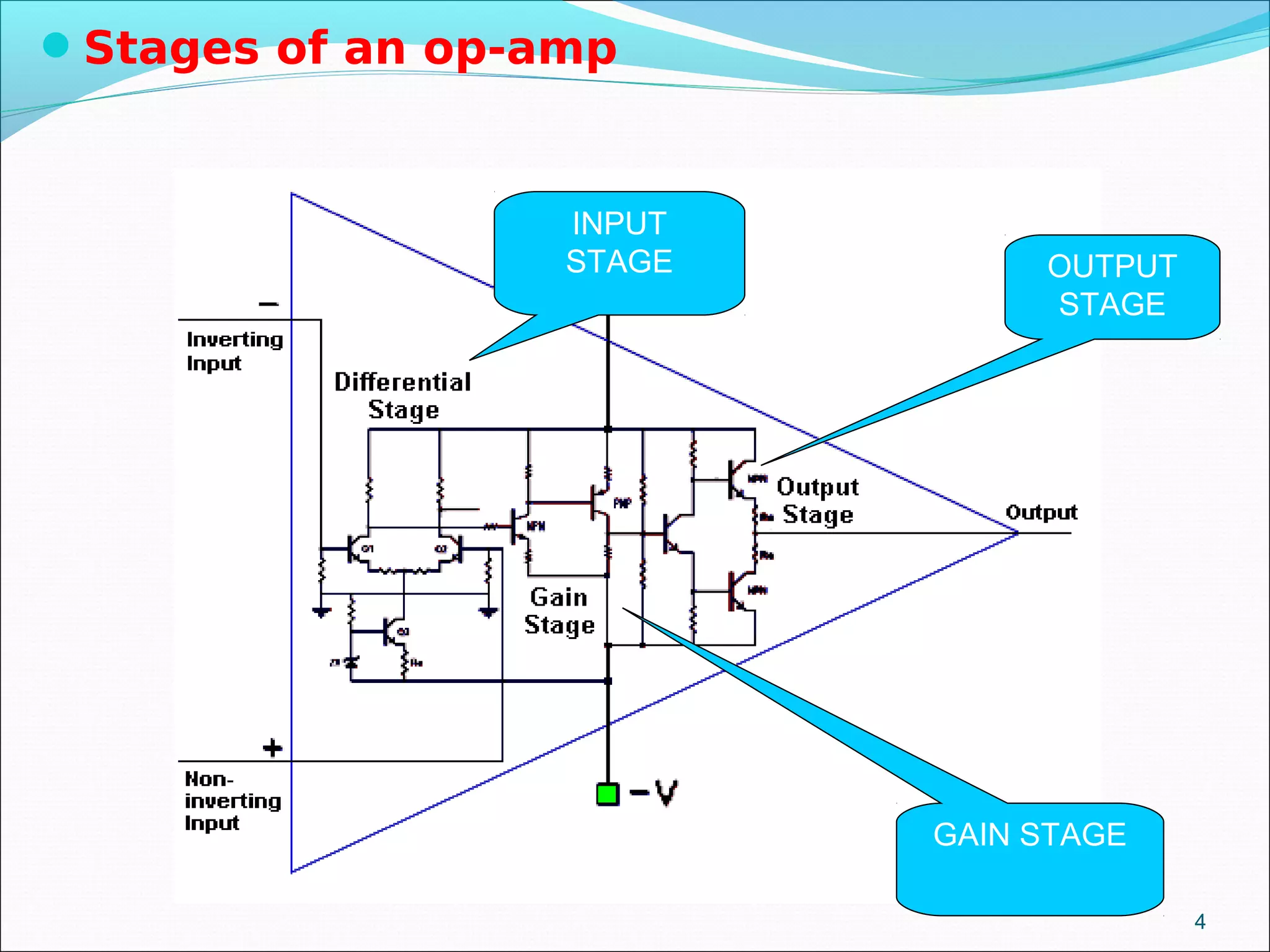
Stages of an op-amp
4
INPUT
STAGE OUTPUT
STAGE
GAIN STAGE
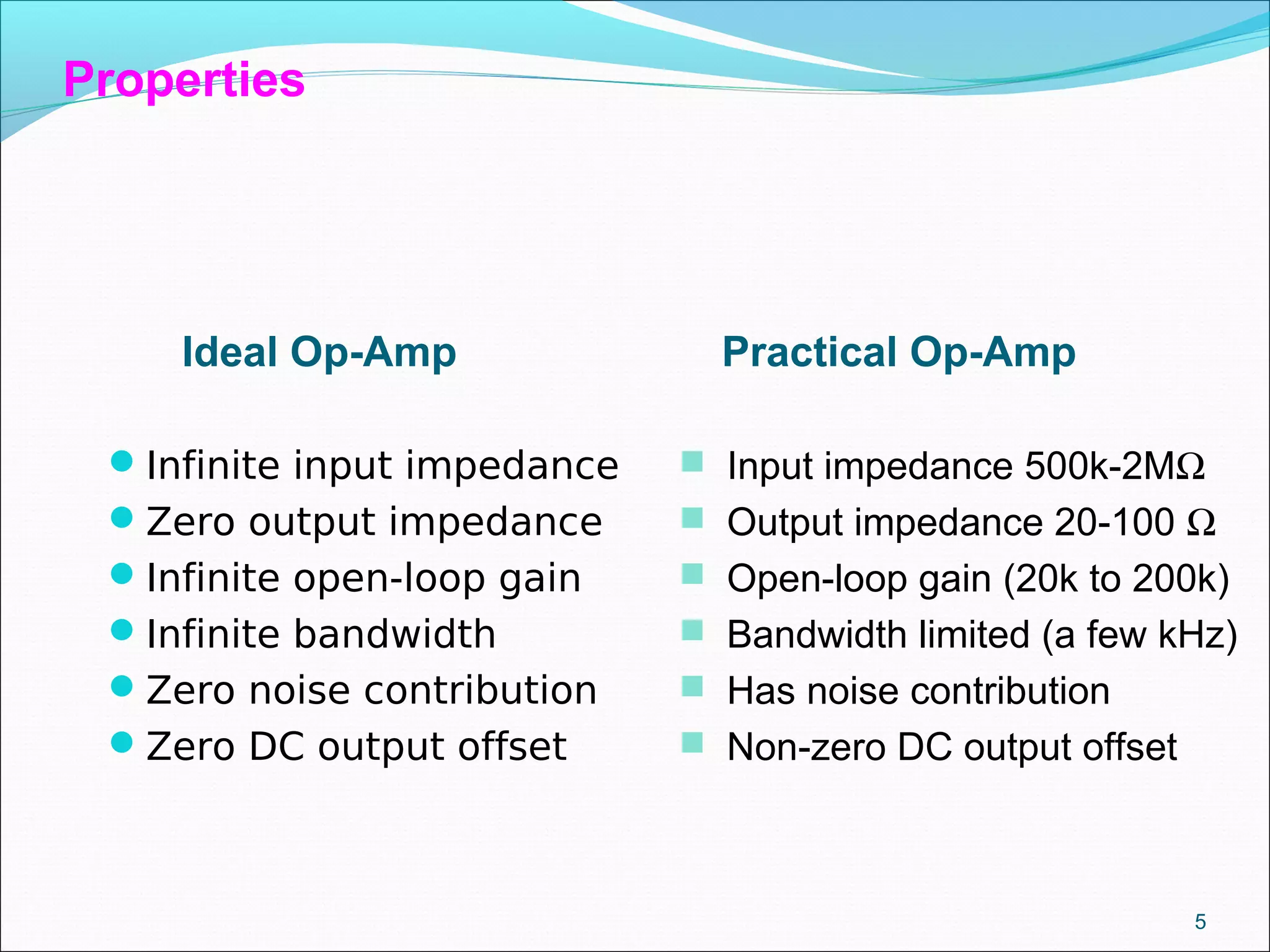
Infinite input impedance
Zero output impedance
Infinite open-loop gain
Infinite bandwidth
Zero noise contribution
Zero DC output offset
5
Ideal Op-Amp Practical Op-Amp
 Input impedance 500k-2MΩ
 Output impedance 20-100 Ω
 Open-loop gain (20k to 200k)
 Bandwidth limited (a few kHz)
 Has noise contribution
 Non-zero DC output offset
Properties
6
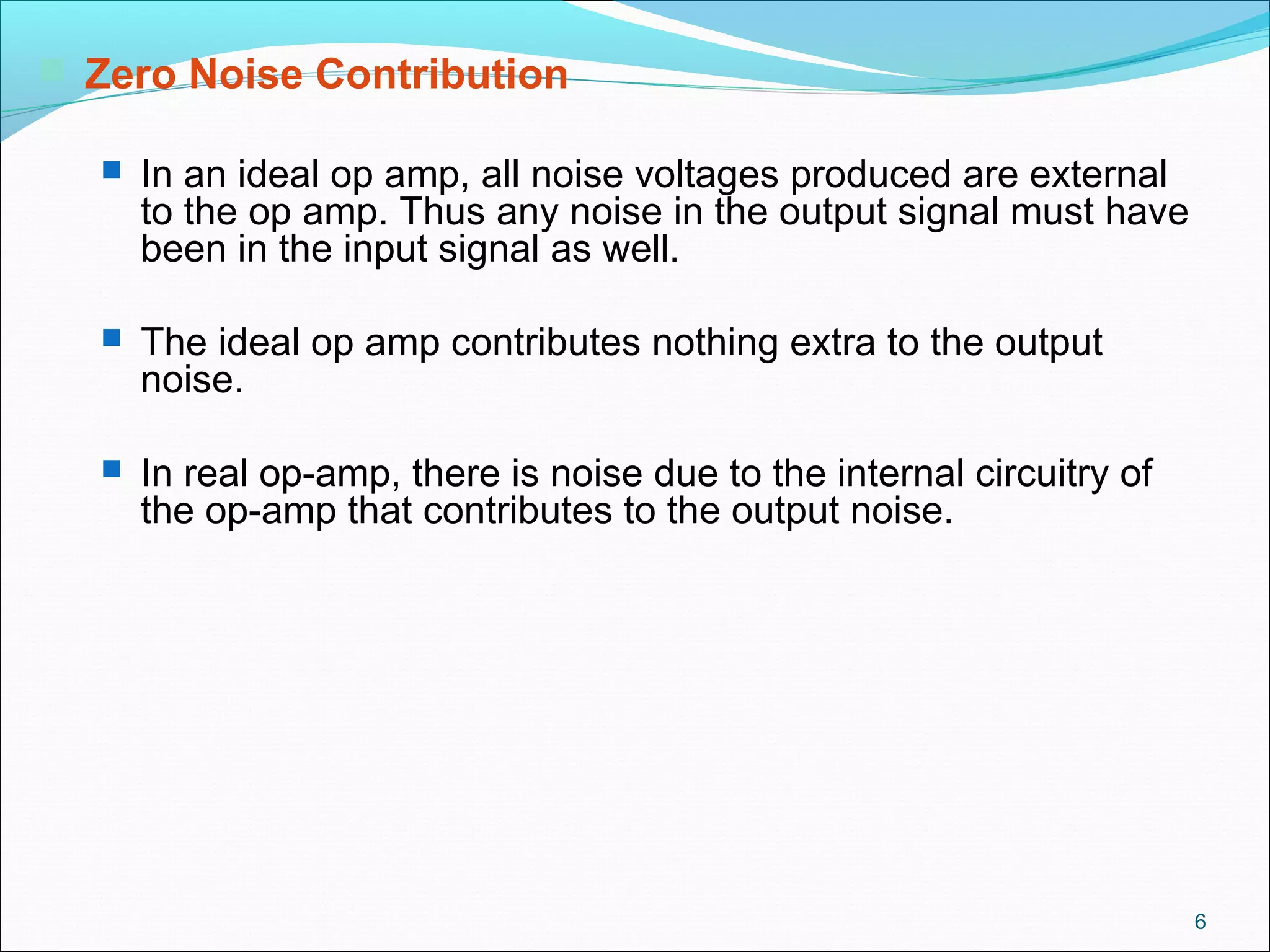
 Zero Noise Contribution
 In an ideal op amp, all noise voltages produced are external
to the op amp. Thus any noise in the output signal must have
been in the input signal as well.
 The ideal op amp contributes nothing extra to the output
noise.
 In real op-amp, there is noise due to the internal circuitry of
the op-amp that contributes to the output noise.
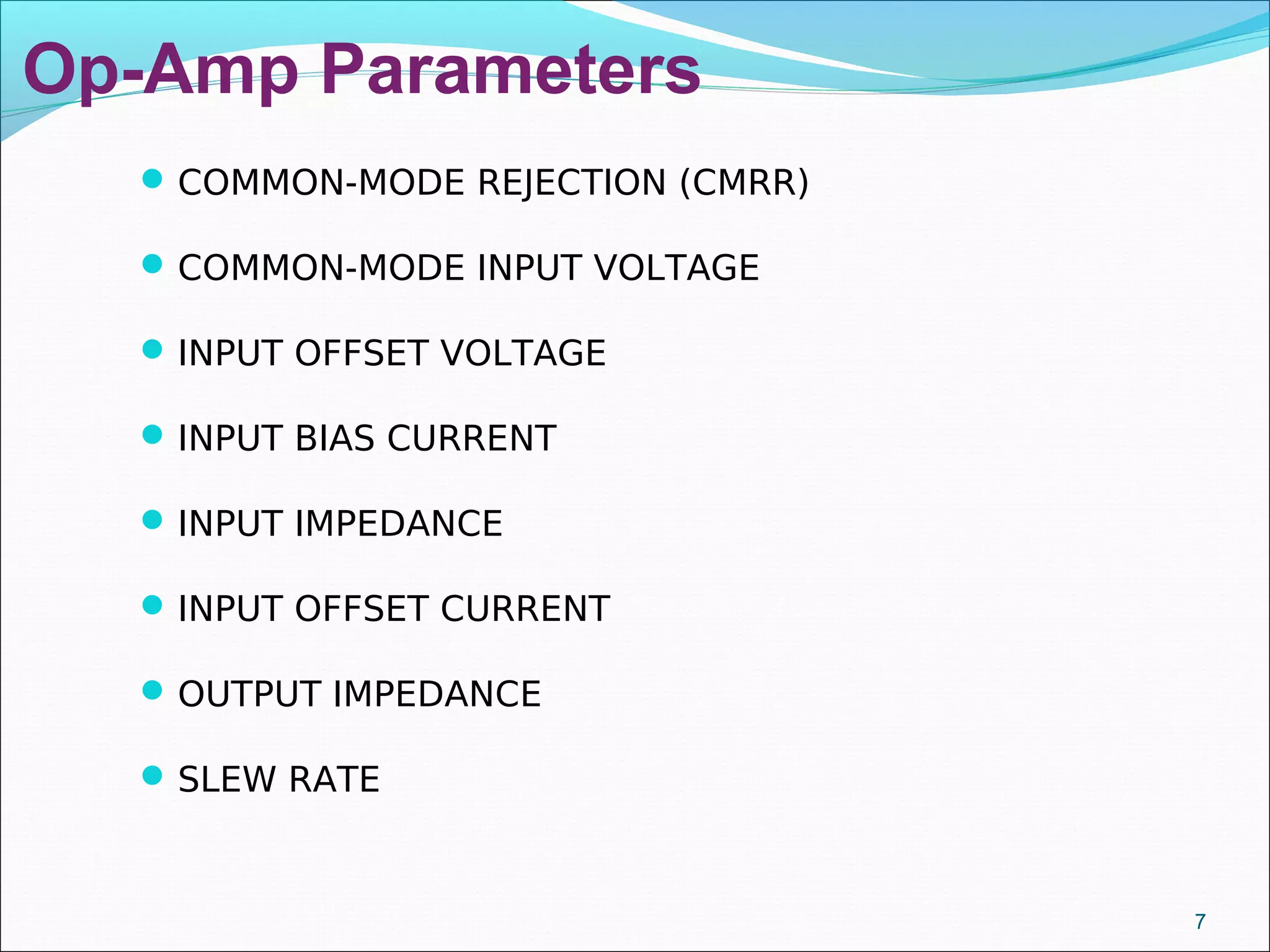
Op-Amp Parameters
COMMON-MODE REJECTION (CMRR)
COMMON-MODE INPUT VOLTAGE
INPUT OFFSET VOLTAGE
INPUT BIAS CURRENT
INPUT IMPEDANCE
INPUT OFFSET CURRENT
OUTPUT IMPEDANCE
SLEW RATE
7
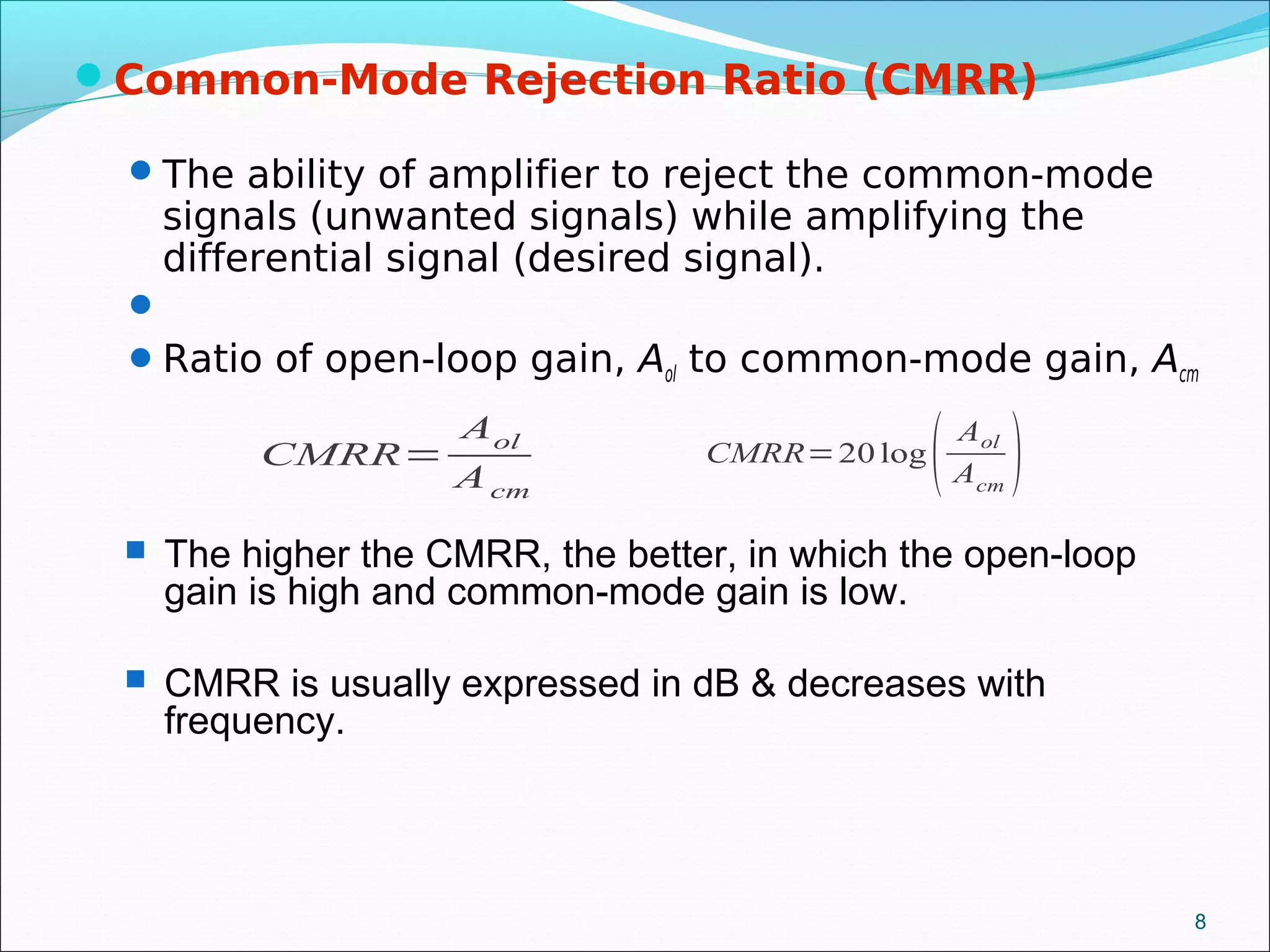
Common-Mode Rejection Ratio (CMRR)
The ability of amplifier to reject the common-mode
signals (unwanted signals) while amplifying the
differential signal (desired signal).

Ratio of open-loop gain, Aol to common-mode gain, Acm
CMRR=
Aol
Acm
CMRR=20 log
( Aol
Acm
)
8
 The higher the CMRR, the better, in which the open-loop
gain is high and common-mode gain is low.
 CMRR is usually expressed in dB & decreases with
frequency.
9
 Input Offset Voltage
 Ideally, output of an op-amp is 0 Volt if the input is 0 Volt.
 Realistically, a small dc voltage will appear at the output
when no input voltage is applied.
 Thus, differential dc voltage is required between the inputs
to force the output to zero volts.
 This is called the Input Offset Voltage, Vos. Range between
2 mV or less.
Input Bias Current
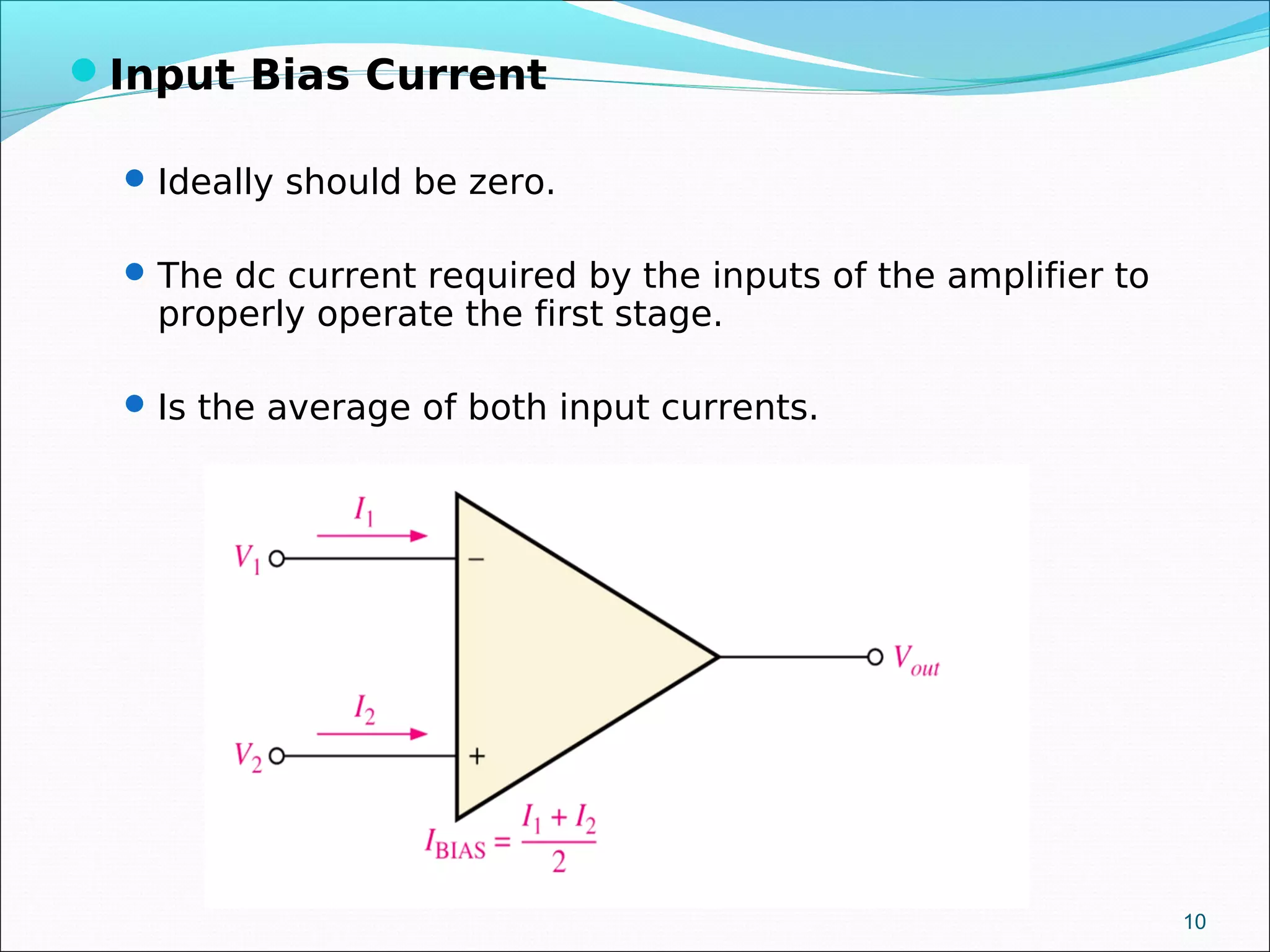
Ideally should be zero.
The dc current required by the inputs of the amplifier to
properly operate the first stage.
Is the average of both input currents.
10
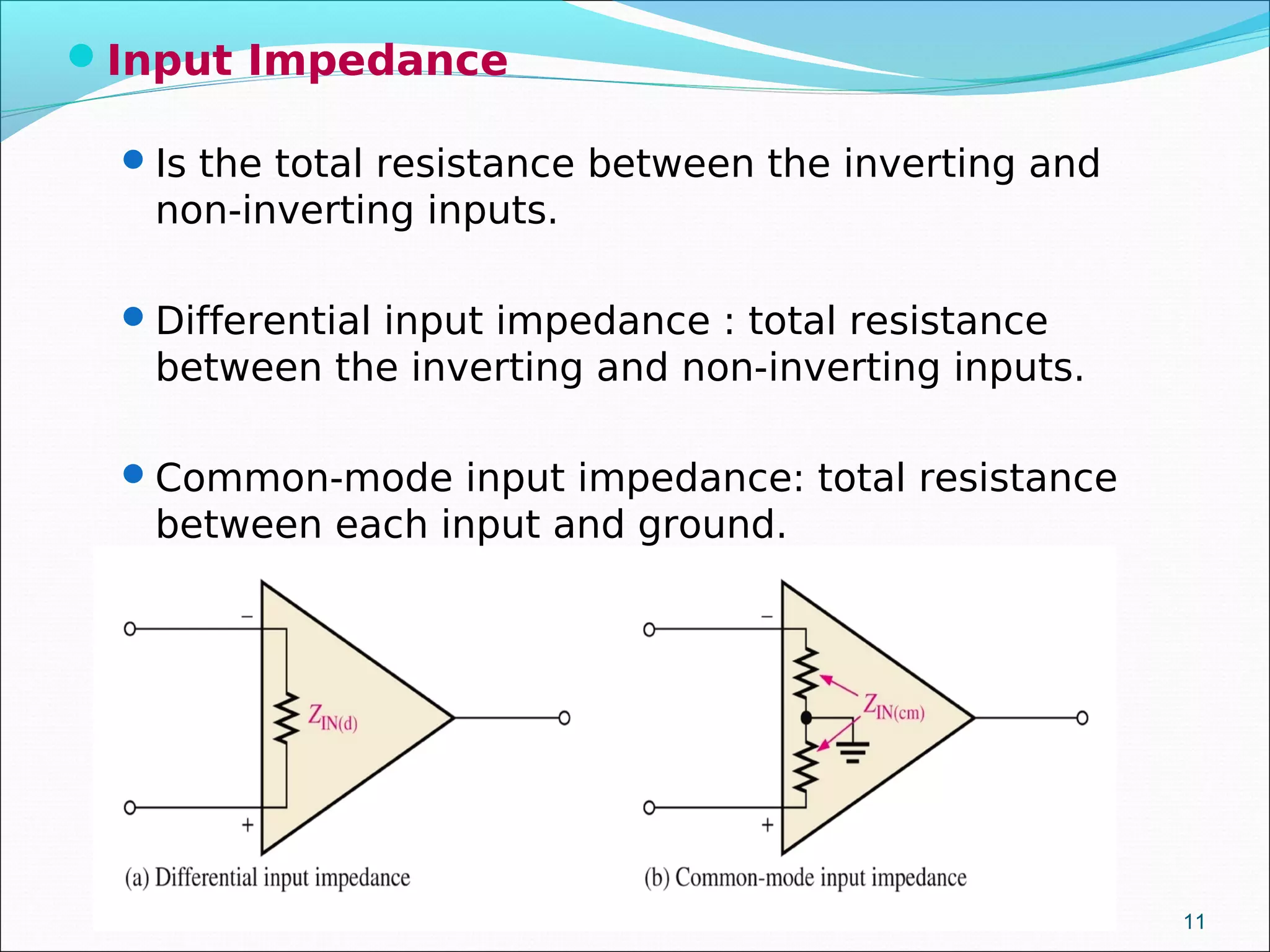
Input Impedance
Is the total resistance between the inverting and
non-inverting inputs.
Differential input impedance : total resistance
between the inverting and non-inverting inputs.
Common-mode input impedance: total resistance
between each input and ground.
11
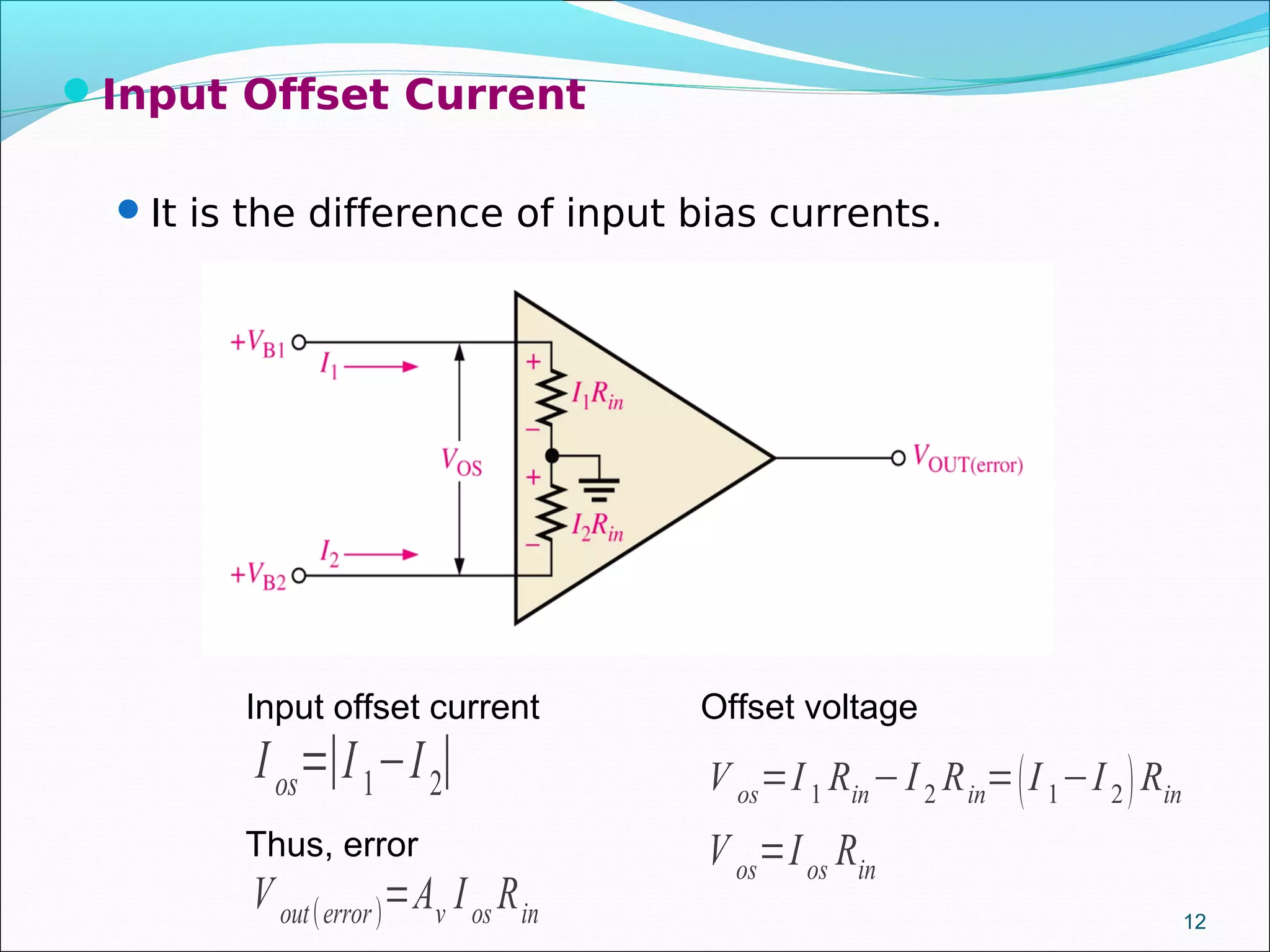
Input Offset Current
It is the difference of input bias currents.
Ios=∣I1−I2∣
12
V os=I1 Rin−I2 Rin=(I 1−I 2)Rin
V os=Ios Rin
V out(error)=Av Ios Rin
Input offset current Offset voltage
Thus, error
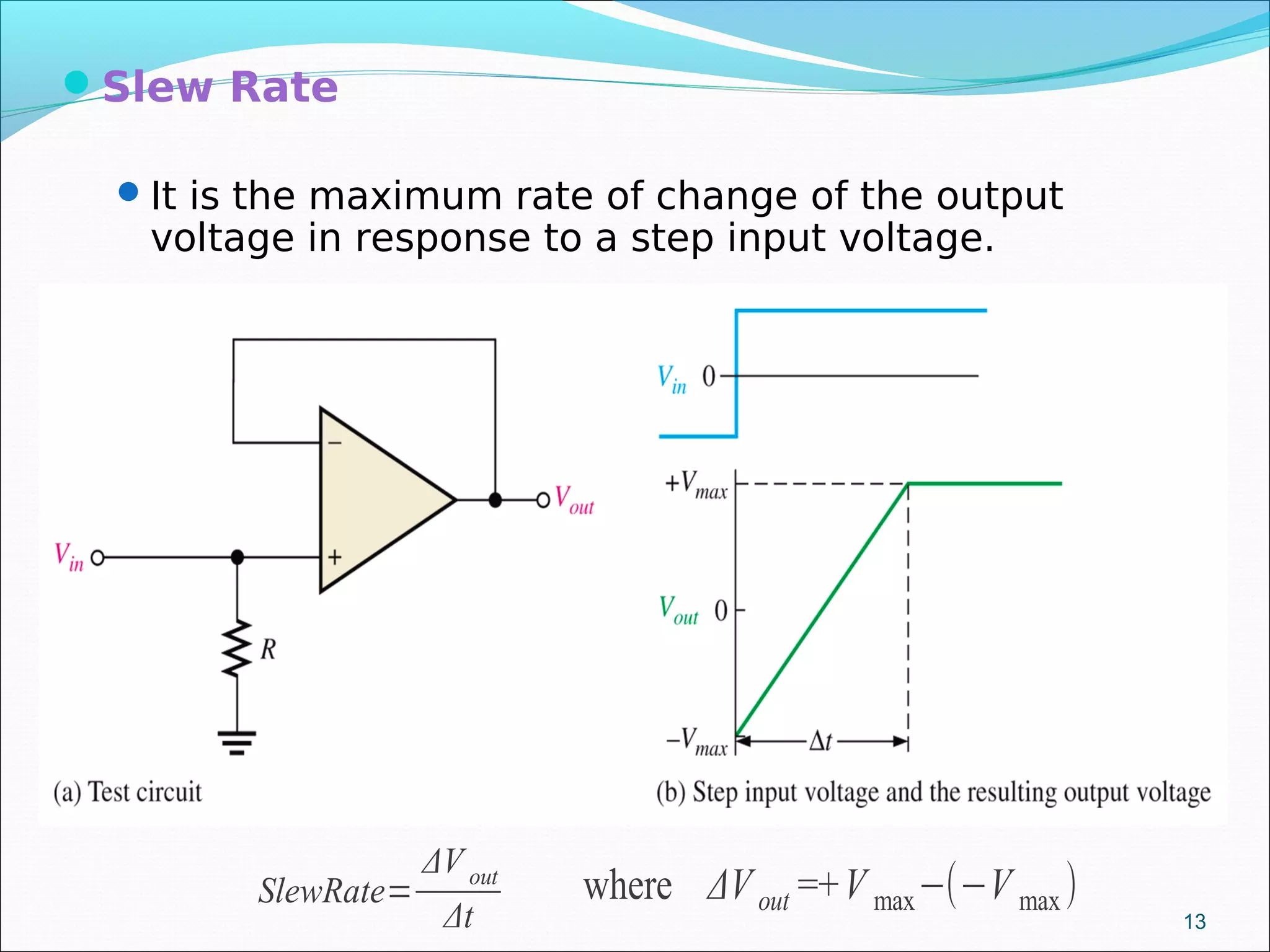
Slew Rate
It is the maximum rate of change of the output
voltage in response to a step input voltage.
SlewRate=
ΔV out
Δt 13
where ΔVout =+V max−(−V max )
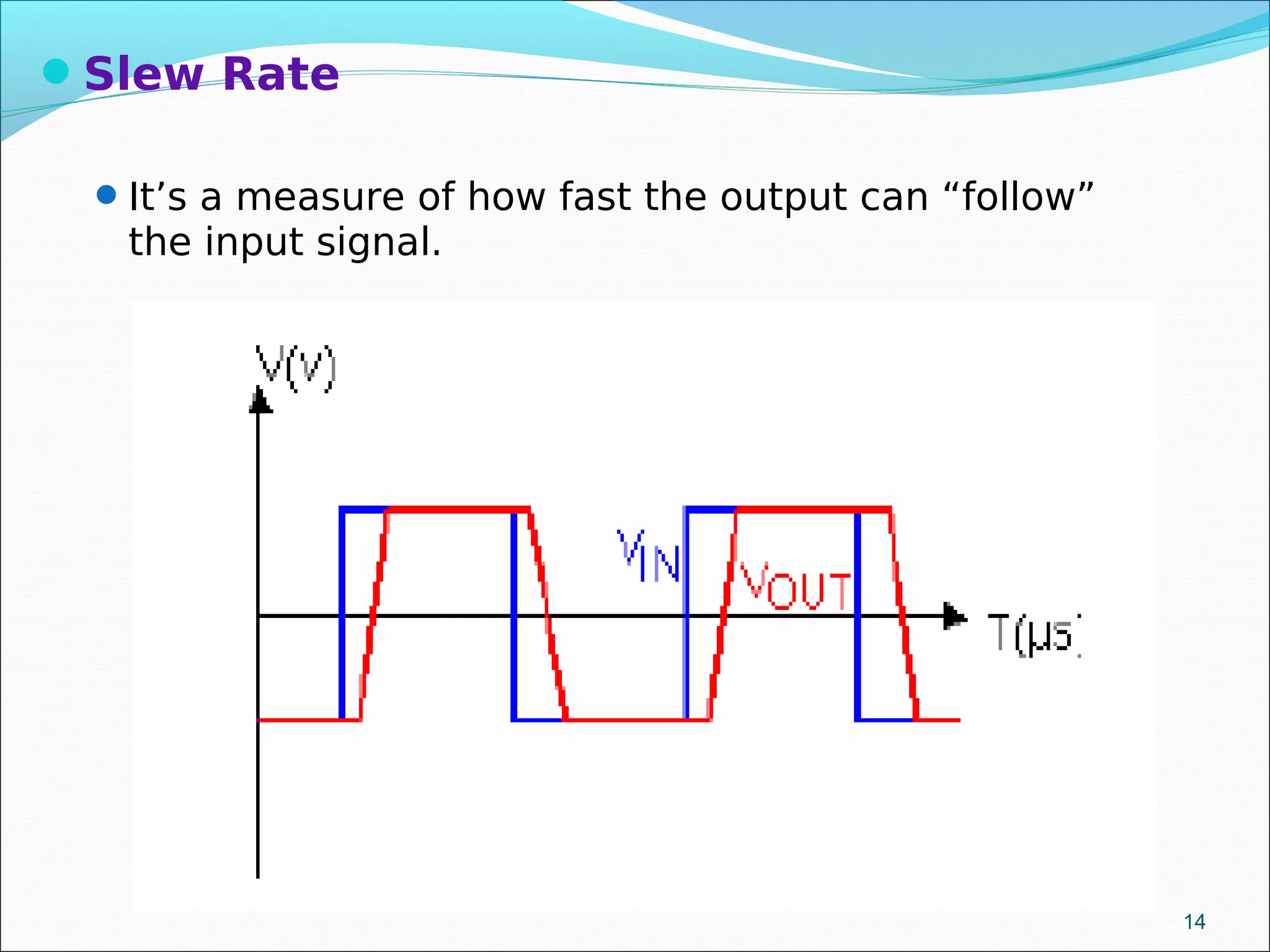
Slew Rate
It’s a measure of how fast the output can “follow”
the input signal.
14
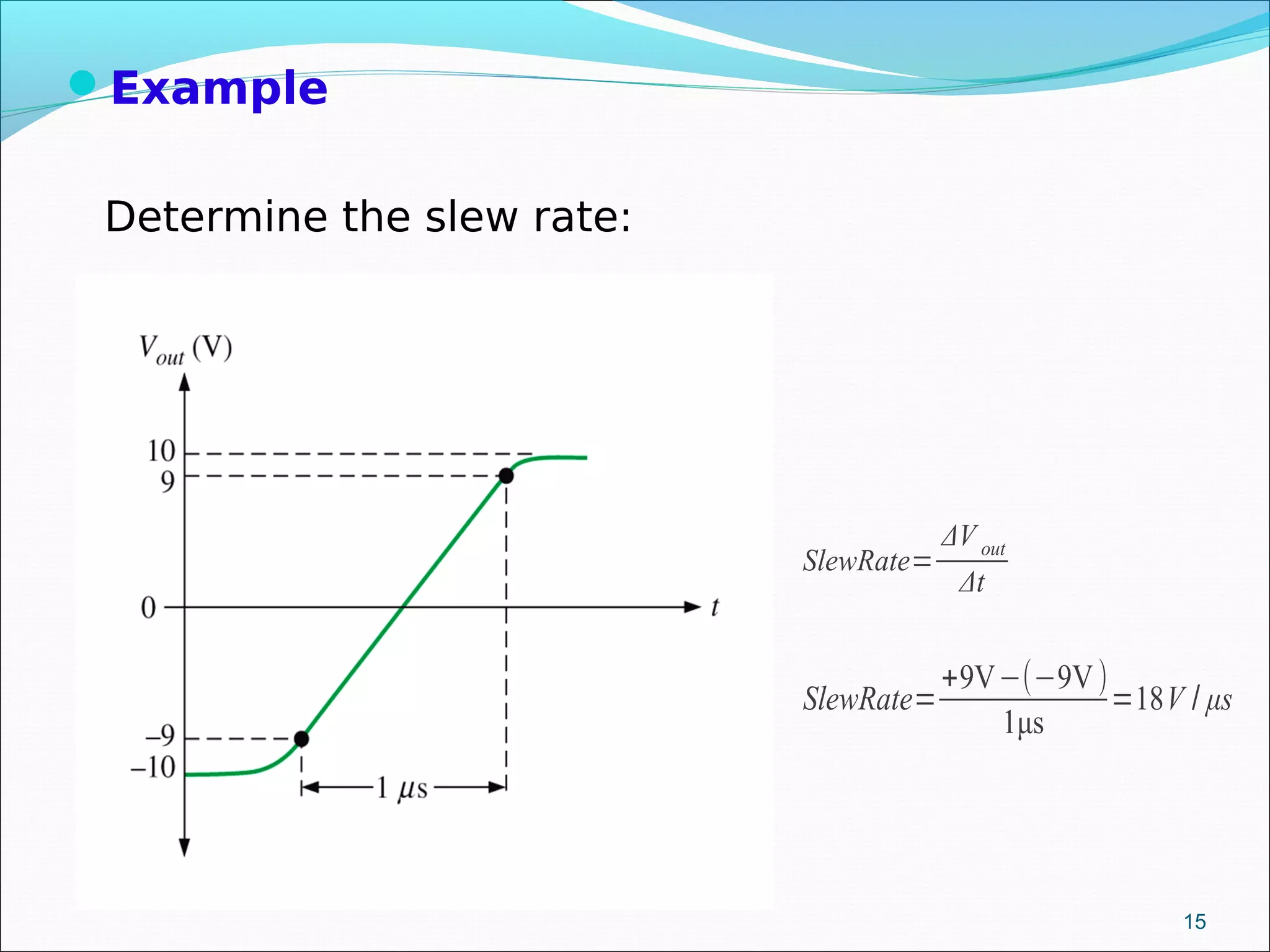
Example
Determine the slew rate:
SlewRate=
ΔV out
Δt
15
SlewRate=
+9V−(−9V)
1μs
=18V / μs

2.Opamp parameters

  • 1.
    Analog Integrated CircuitsAnalogIntegrated Circuits ECL 515 / ECL(X) 315ECL 515 / ECL(X) 315 Op amp Parameters 1 Sem-VII 90 INAC-L & X AT2015 Prof.Satheesh Monikandan.B HOD-ECE Indian Naval Academy, Ezhimala sathy24@gmail.com
  • 2.
    Introduction 2 Op-amp schematic symbol One Output Terminal  Two Input Terminals  Inverting input  Non-inverting input  Two Power Supply (PS)  +V : Positive PS  -V : Negative PS
  • 3.
    3 Applications of Op-Amp To provide voltage amplitude changes (amplitude and polarity)  Comparators  Oscillators  Filters  Sensors  Instrumentation amplifiers
  • 4.
    Stages of anop-amp 4 INPUT STAGE OUTPUT STAGE GAIN STAGE
  • 5.
    Infinite input impedance Zerooutput impedance Infinite open-loop gain Infinite bandwidth Zero noise contribution Zero DC output offset 5 Ideal Op-Amp Practical Op-Amp  Input impedance 500k-2MΩ  Output impedance 20-100 Ω  Open-loop gain (20k to 200k)  Bandwidth limited (a few kHz)  Has noise contribution  Non-zero DC output offset Properties
  • 6.
    6  Zero NoiseContribution  In an ideal op amp, all noise voltages produced are external to the op amp. Thus any noise in the output signal must have been in the input signal as well.  The ideal op amp contributes nothing extra to the output noise.  In real op-amp, there is noise due to the internal circuitry of the op-amp that contributes to the output noise.
  • 7.
    Op-Amp Parameters COMMON-MODE REJECTION(CMRR) COMMON-MODE INPUT VOLTAGE INPUT OFFSET VOLTAGE INPUT BIAS CURRENT INPUT IMPEDANCE INPUT OFFSET CURRENT OUTPUT IMPEDANCE SLEW RATE 7
  • 8.
    Common-Mode Rejection Ratio(CMRR) The ability of amplifier to reject the common-mode signals (unwanted signals) while amplifying the differential signal (desired signal).  Ratio of open-loop gain, Aol to common-mode gain, Acm CMRR= Aol Acm CMRR=20 log ( Aol Acm ) 8  The higher the CMRR, the better, in which the open-loop gain is high and common-mode gain is low.  CMRR is usually expressed in dB & decreases with frequency.
  • 9.
    9  Input OffsetVoltage  Ideally, output of an op-amp is 0 Volt if the input is 0 Volt.  Realistically, a small dc voltage will appear at the output when no input voltage is applied.  Thus, differential dc voltage is required between the inputs to force the output to zero volts.  This is called the Input Offset Voltage, Vos. Range between 2 mV or less.
  • 10.
    Input Bias Current Ideallyshould be zero. The dc current required by the inputs of the amplifier to properly operate the first stage. Is the average of both input currents. 10
  • 11.
    Input Impedance Is thetotal resistance between the inverting and non-inverting inputs. Differential input impedance : total resistance between the inverting and non-inverting inputs. Common-mode input impedance: total resistance between each input and ground. 11
  • 12.
    Input Offset Current Itis the difference of input bias currents. Ios=∣I1−I2∣ 12 V os=I1 Rin−I2 Rin=(I 1−I 2)Rin V os=Ios Rin V out(error)=Av Ios Rin Input offset current Offset voltage Thus, error
  • 13.
    Slew Rate It isthe maximum rate of change of the output voltage in response to a step input voltage. SlewRate= ΔV out Δt 13 where ΔVout =+V max−(−V max )
  • 14.
    Slew Rate It’s ameasure of how fast the output can “follow” the input signal. 14
  • 15.
    Example Determine the slewrate: SlewRate= ΔV out Δt 15 SlewRate= +9V−(−9V) 1μs =18V / μs