OperatiOnal amplifiers
(Op amps)
SHALET K S
Asst. Prof.
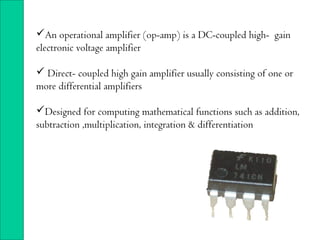
An operational amplifier (op-amp) is a DC-coupled high- gain
electronic voltage amplifier
 Direct- coupled high gain amplifier usually consisting of one or
more differential amplifiers
Designed for computing mathematical functions such as addition,
subtraction ,multiplication, integration & differentiation
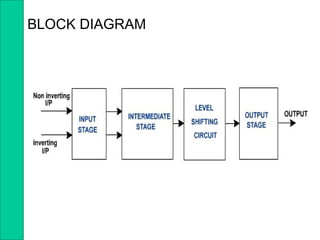
BLOCK DIAGRAM
INPUT STAGE
The input stage is a dual input balanced output differential
amplifier. This stage provides most of the voltage gain of the
amplifier and also establishes the input resistance of the
OPAMP.
INTERMEDIATE STAGE
The intermediate stage of OPAMP is another differential
amplifier which is driven by the output of the first stage. This
isusually dual input unbalanced output.
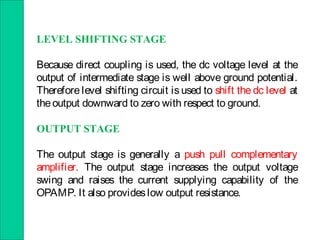
LEVEL SHIFTING STAGE
Because direct coupling is used, the dc voltage level at the
output of intermediate stage is well above ground potential.
Therefore level shifting circuit is used to shift the dc level at
theoutput downward to zero with respect to ground.
OUTPUT STAGE
The output stage is generally a push pull complementary
amplifier. The output stage increases the output voltage
swing and raises the current supplying capability of the
OPAMP. It also provideslow output resistance.
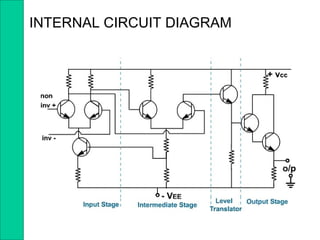
INTERNAL CIRCUIT DIAGRAM
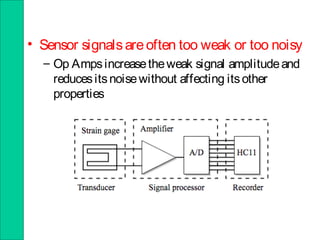
• Sensor signalsareoften too weak or too noisy
– Op Ampsincreasetheweak signal amplitudeand
reducesitsnoisewithout affecting itsother
properties
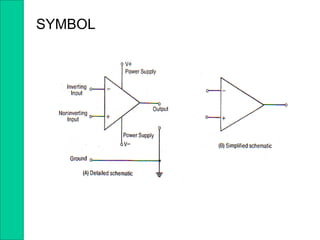
SYMBOL
V 1
V 2
_
+
V d R i
R o
A V d
V o
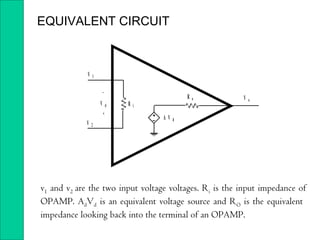
EQUIVALENT CIRCUIT
v1 and v2 are the two input voltage voltages. Ri is the input impedance of
OPAMP. AdVd is an equivalent voltage source and RO is the equivalent
impedance looking back into the terminal of an OPAMP.
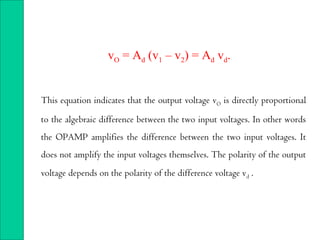
This equation indicates that the output voltage vO is directly proportional
to the algebraic difference between the two input voltages. In other words
the OPAMP amplifies the difference between the two input voltages. It
does not amplify the input voltages themselves. The polarity of the output
voltage depends on the polarity of the difference voltage vd .
vO = Ad (v1 – v2) = Ad vd.
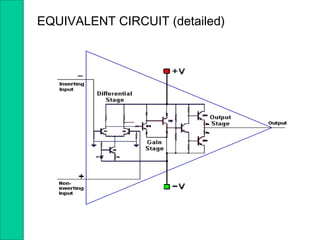
EQUIVALENT CIRCUIT (detailed)
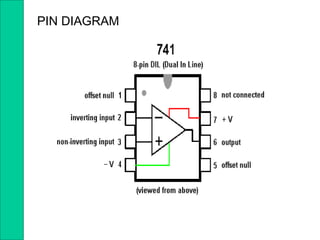
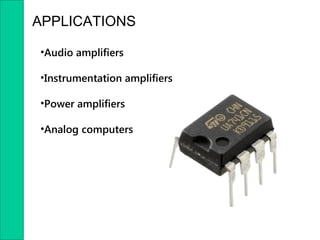
PIN DIAGRAM
•Audio amplifiers
•Instrumentation amplifiers
•Power amplifiers
•Analog computers
APPLICATIONS
 Infinitevoltagegain, approx – 2 lack
 Infiniteinput impedance, >100MΩ
 Zero output impedance, <100 Ω
 InfiniteCMRR
 Infinitebandwidth, 0 HZ – 1 MHZ
 Infiniteslew rate
 Zero output voltagewhen input voltageiszero.
IDEAL OPAMP CHARACTERISTICS
PARAMETERS OF
OPAMP
Input offset current (Iio)
The difference between the bias currents at the
input terminals of the op- amp is called as input offset
current.
Iio = IB1 – IB2
• 200nA for 741 IC
Input offset voltage (Vio)
A small voltage applied to the input terminals to
make the output voltage as zero when the two input
terminals are grounded is called input offset voltage.
• 2 mV for 741 IC
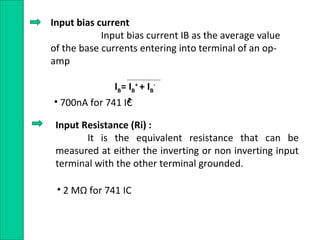
Input bias current
Input bias current IB as the average value
of the base currents entering into terminal of an op-
amp
IB= IB
+
+ IB
-
2• 700nA for 741 IC
Input Resistance (Ri) :
It is the equivalent resistance that can be
measured at either the inverting or non inverting input
terminal with the other terminal grounded.
• 2 MΩ for 741 IC
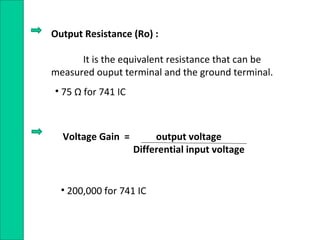
Output Resistance (Ro) :
It is the equivalent resistance that can be
measured ouput terminal and the ground terminal.
• 75 Ω for 741 IC
Voltage Gain = output voltage
Differential input voltage
• 200,000 for 741 IC
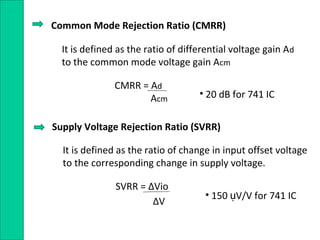
Common Mode Rejection Ratio (CMRR)
It is defined as the ratio of differential voltage gain Ad
to the common mode voltage gain Acm
CMRR = Ad
Acm
Supply Voltage Rejection Ratio (SVRR)
It is defined as the ratio of change in input offset voltage
to the corresponding change in supply voltage.
SVRR = ∆Vio
∆V
• 20 dB for 741 IC
• 150 V/V for 741 ICụ
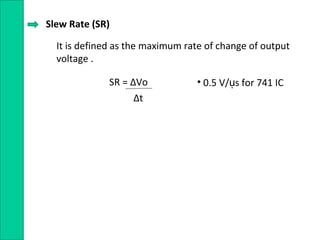
Slew Rate (SR)
It is defined as the maximum rate of change of output
voltage .
SR = ∆Vo
∆t
• 0.5 V/ s for 741 ICụ
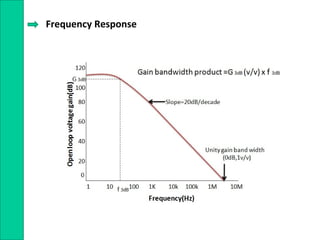
Frequency Response
• Gain islargeat very low frequencies
• Gain isconstant over few frequenciesuntil 10Hz
• After thisfrequency gain fallsuntil it reachesunity
at 1 MHz
• Theunity-gain frequency, funity isthefrequency at
which thegain isunity.
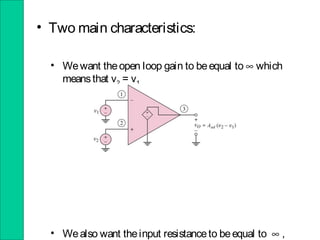
• Two main characteristics:
• Wewant theopen loop gain to beequal to ∞ which
meansthat v2 = v1
• Wealso want theinput resistanceto beequal to ∞ ,
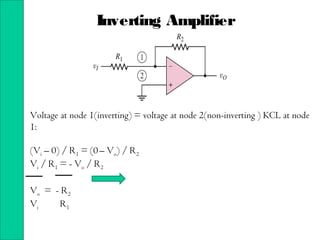
Inverting Amplifier
Voltage at node 1(inverting) = voltage at node 2(non-inverting ) KCL at node
1:
(Vi – 0) / R1 = (0– Vo) / R2
Vi / R1 = - Vo / R2
Vo = - R2
Vi R1
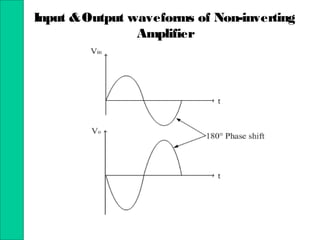
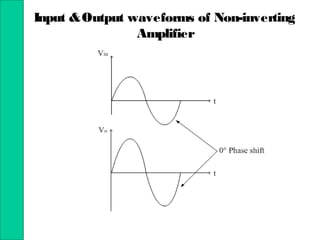
Input &Output waveforms of Non-inverting
Amplifier
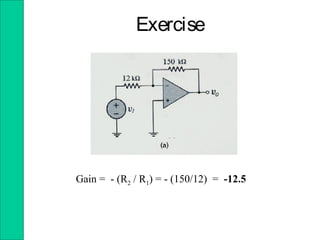
Gain = - (R2 / R1) = - (150/12) = -12.5
Exercise
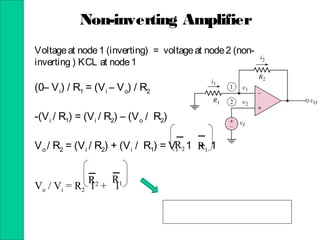
Non-inverting Amplifier
Voltageat node1 (inverting) = voltageat node2 (non-
inverting ) KCL at node1
(0– Vi) / R1 = (Vi – Vo) / R2
-(Vi / R1) = (Vi / R2) – (Vo / R2)
Vo / R2 = (Vi / R2) + (Vi / R1) = Vi 1 + 1
Vo / Vi = R2 1 + 1
R2 R1
R2
R1
Input &Output waveforms of Non-inverting
Amplifier
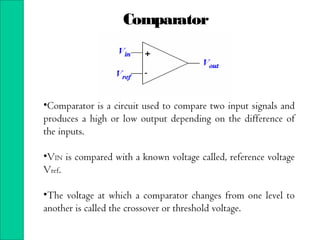
Comparator
•Comparator is a circuit used to compare two input signals and
produces a high or low output depending on the difference of
the inputs.
•VIN is compared with a known voltage called, reference voltage
Vref.
•The voltage at which a comparator changes from one level to
another is called the crossover or threshold voltage.
Refer textbook for the types of comparators
End of Lesson
Operational Amplifiers

Op amps

  • 1.
  • 2.
    An operational amplifier(op-amp) is a DC-coupled high- gain electronic voltage amplifier  Direct- coupled high gain amplifier usually consisting of one or more differential amplifiers Designed for computing mathematical functions such as addition, subtraction ,multiplication, integration & differentiation
  • 3.
  • 4.
    INPUT STAGE The inputstage is a dual input balanced output differential amplifier. This stage provides most of the voltage gain of the amplifier and also establishes the input resistance of the OPAMP. INTERMEDIATE STAGE The intermediate stage of OPAMP is another differential amplifier which is driven by the output of the first stage. This isusually dual input unbalanced output.
  • 5.
    LEVEL SHIFTING STAGE Becausedirect coupling is used, the dc voltage level at the output of intermediate stage is well above ground potential. Therefore level shifting circuit is used to shift the dc level at theoutput downward to zero with respect to ground. OUTPUT STAGE The output stage is generally a push pull complementary amplifier. The output stage increases the output voltage swing and raises the current supplying capability of the OPAMP. It also provideslow output resistance.
  • 6.
  • 7.
    • Sensor signalsareoftentoo weak or too noisy – Op Ampsincreasetheweak signal amplitudeand reducesitsnoisewithout affecting itsother properties
  • 8.
  • 10.
    V 1 V 2 _ + Vd R i R o A V d V o EQUIVALENT CIRCUIT v1 and v2 are the two input voltage voltages. Ri is the input impedance of OPAMP. AdVd is an equivalent voltage source and RO is the equivalent impedance looking back into the terminal of an OPAMP.
  • 11.
    This equation indicatesthat the output voltage vO is directly proportional to the algebraic difference between the two input voltages. In other words the OPAMP amplifies the difference between the two input voltages. It does not amplify the input voltages themselves. The polarity of the output voltage depends on the polarity of the difference voltage vd . vO = Ad (v1 – v2) = Ad vd.
  • 12.
  • 13.
  • 14.
    •Audio amplifiers •Instrumentation amplifiers •Poweramplifiers •Analog computers APPLICATIONS
  • 15.
     Infinitevoltagegain, approx– 2 lack  Infiniteinput impedance, >100MΩ  Zero output impedance, <100 Ω  InfiniteCMRR  Infinitebandwidth, 0 HZ – 1 MHZ  Infiniteslew rate  Zero output voltagewhen input voltageiszero. IDEAL OPAMP CHARACTERISTICS
  • 16.
    PARAMETERS OF OPAMP Input offsetcurrent (Iio) The difference between the bias currents at the input terminals of the op- amp is called as input offset current. Iio = IB1 – IB2 • 200nA for 741 IC Input offset voltage (Vio) A small voltage applied to the input terminals to make the output voltage as zero when the two input terminals are grounded is called input offset voltage. • 2 mV for 741 IC
  • 17.
    Input bias current Inputbias current IB as the average value of the base currents entering into terminal of an op- amp IB= IB + + IB - 2• 700nA for 741 IC Input Resistance (Ri) : It is the equivalent resistance that can be measured at either the inverting or non inverting input terminal with the other terminal grounded. • 2 MΩ for 741 IC
  • 18.
    Output Resistance (Ro): It is the equivalent resistance that can be measured ouput terminal and the ground terminal. • 75 Ω for 741 IC Voltage Gain = output voltage Differential input voltage • 200,000 for 741 IC
  • 19.
    Common Mode RejectionRatio (CMRR) It is defined as the ratio of differential voltage gain Ad to the common mode voltage gain Acm CMRR = Ad Acm Supply Voltage Rejection Ratio (SVRR) It is defined as the ratio of change in input offset voltage to the corresponding change in supply voltage. SVRR = ∆Vio ∆V • 20 dB for 741 IC • 150 V/V for 741 ICụ
  • 20.
    Slew Rate (SR) Itis defined as the maximum rate of change of output voltage . SR = ∆Vo ∆t • 0.5 V/ s for 741 ICụ
  • 21.
  • 22.
    • Gain islargeatvery low frequencies • Gain isconstant over few frequenciesuntil 10Hz • After thisfrequency gain fallsuntil it reachesunity at 1 MHz • Theunity-gain frequency, funity isthefrequency at which thegain isunity.
  • 23.
    • Two maincharacteristics: • Wewant theopen loop gain to beequal to ∞ which meansthat v2 = v1 • Wealso want theinput resistanceto beequal to ∞ ,
  • 24.
    Inverting Amplifier Voltage atnode 1(inverting) = voltage at node 2(non-inverting ) KCL at node 1: (Vi – 0) / R1 = (0– Vo) / R2 Vi / R1 = - Vo / R2 Vo = - R2 Vi R1
  • 25.
    Input &Output waveformsof Non-inverting Amplifier
  • 26.
    Gain = -(R2 / R1) = - (150/12) = -12.5 Exercise
  • 27.
    Non-inverting Amplifier Voltageat node1(inverting) = voltageat node2 (non- inverting ) KCL at node1 (0– Vi) / R1 = (Vi – Vo) / R2 -(Vi / R1) = (Vi / R2) – (Vo / R2) Vo / R2 = (Vi / R2) + (Vi / R1) = Vi 1 + 1 Vo / Vi = R2 1 + 1 R2 R1 R2 R1
  • 28.
    Input &Output waveformsof Non-inverting Amplifier
  • 29.
    Comparator •Comparator is acircuit used to compare two input signals and produces a high or low output depending on the difference of the inputs. •VIN is compared with a known voltage called, reference voltage Vref. •The voltage at which a comparator changes from one level to another is called the crossover or threshold voltage.
  • 30.
    Refer textbook forthe types of comparators
  • 31.