Chemical Process Industries-I
Lecture - 09
Lecturer: Engr. Babar Saeed
Explosives
Definitions
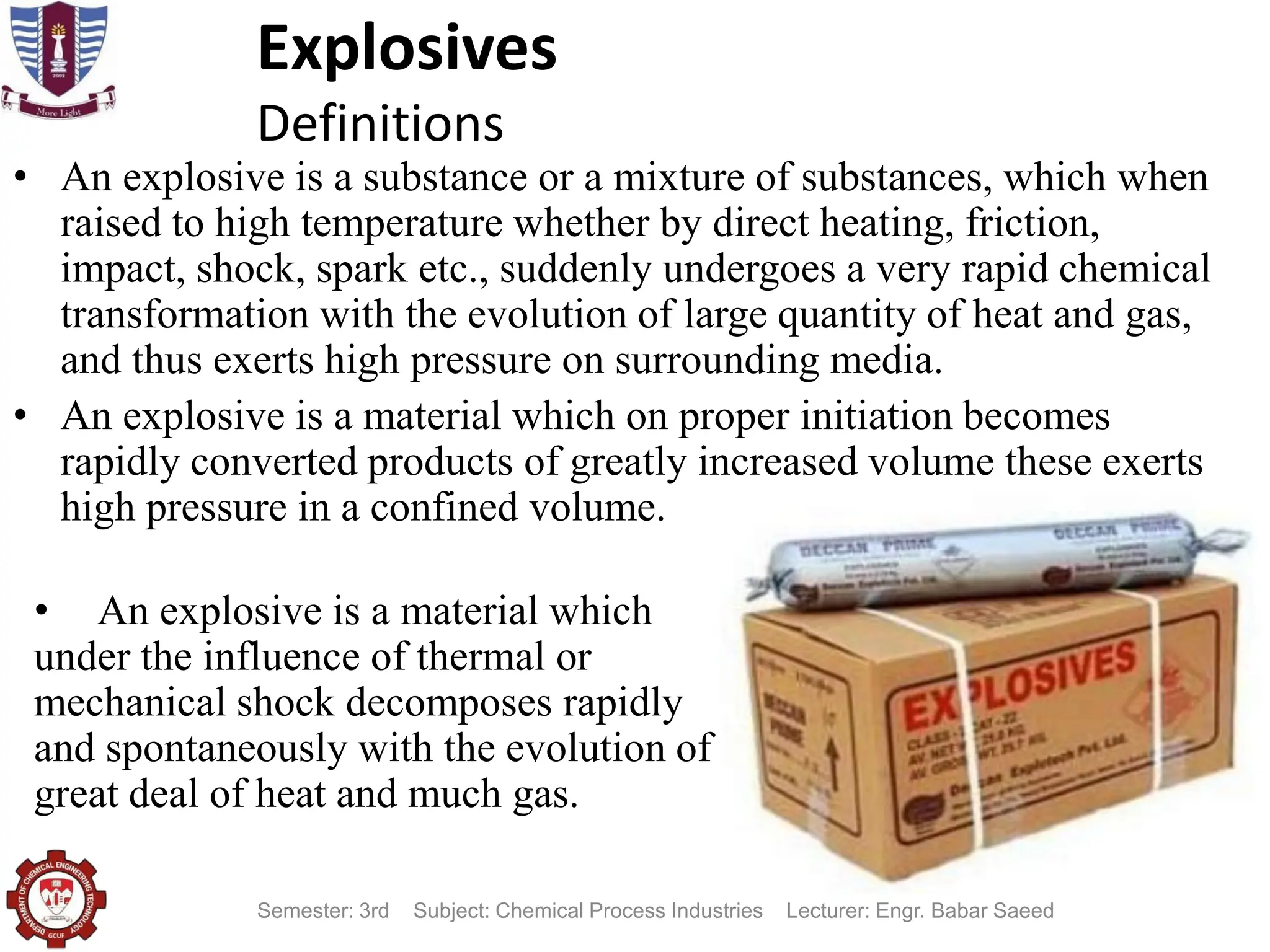
• An explosive is a substance or a mixture of substances, which when
raised to high temperature whether by direct heating, friction,
impact, shock, spark etc., suddenly undergoes a very rapid chemical
transformation with the evolution of large quantity of heat and gas,
and thus exerts high pressure on surrounding media.
• An explosive is a material which on proper initiation becomes
rapidly converted products of greatly increased volume these exerts
high pressure in a confined volume.
Semester: 3rd Subject: Chemical Process Industries Lecturer: Engr. Babar Saeed
• An explosive is a material which
under the influence of thermal or
mechanical shock decomposes rapidly
and spontaneously with the evolution of
great deal of heat and much gas.
Classification of Explosives
Explosives can be classified as
1. Chemical Explosives
2. Mechanical Explosives
3. Atomic or Nuclear Explosives
Semester: 3rd Subject: Chemical Process Industries Lecturer: Engr. Babar Saeed
1-Chemical Explosives
• The explosives which based on a chemical reaction are chemical explosives.
The important chemical reaction involved is the oxidation — reduction
reaction. Examples are TNT, Nitroglycerine, Black Powder
(KNO3+Charcoal+S) and many others
• Chemical explosives are further classified as
– Low or deflagrating Explosives
– High or detonating
• N2+O2=> 2NO (at 2000C)
• This reaction takes place with great rapidity but mixture is not an explosive
because does not evolve heat rather absorbs heat.
• For a chemical to be explosive
• Evolution of heat, Rapid expansion/rapidity of reaction ( rapid production of
gases having high pressure) Ex. A pound of coal yields 5 times as much heat
as a pound of nitroglycerine but coal can not be used as an explosive as heat
rate is low.
Semester: 3rd Subject: Chemical Process Industries Lecturer: Engr. Babar Saeed
• It is this high energy release, rather than the total energy
which makes a product an explosives.
• Examples may include RDX (cyclonite), PETN
(pentaerythritol tetra nitrate), pressed tetryl.
• BOOSTERS
• One of the more sensitive secondary explosives.
i.e. although it is a secondary explosive but it is more sensitive
than its classmates, thus it is lying between primary and
secondary high explosives.
Semester: 3rd Subject: Chemical Process Industries Lecturer: Engr. Babar Saeed
2- Mechanical Explosives
These are based on some mechanical means.
• “Cardox” is an example which is used in coal mining.
• Carddox consists of a heavy and re-usable shell (tube).
• This shell is equipped with a rupture disk, and filled with carbon
dioxide (due to which perhaps the name card ox car= carbon, d= di,
ox= oxide). More a heating element is there.
• This heating element is fused, the pressure of CO 2 increases until
the disk is ruptured.
• Gas releases at high pressure and can be used to do useful work when
properly confined in the borehole.
• Another example is steam explosion may be caused naturally when
accidentally molten slag car (lava) drops itself into a body of water.
Semester: 3rd Subject: Chemical Process Industries Lecturer: Engr. Babar Saeed
3- Nuclear Explosives
• Those explosives which depend on nuclear reactions for their
ability to explode are called nuclear explosives.
• There are two reactions called nuclear reaction on which nuclear
explosion depends
– Fusion
– Fission
• On the basis of these two we can simply classify exposures of
nuclear type as: Those depend upon fusion reaction (Hydrogen
bomb) Those depend upon fission reaction (Atom bomb)
Semester: 3rd Subject: Chemical Process Industries Lecturer: Engr. Babar Saeed
Explosions depend on fission reaction are
quite common and are useful. The explosion
materials (nuclear fuels) depending on
fission reaction are called FISSILE. Fissile's
are synonymous to fissionable material and
may be U.
Characteristics / Properties Of Explosives
In order to compare explosives certain properties of them are
considered, such common properties are
• Strength: “The maximum energy available for useful work.” i.e. the
gas pressure developed for a given weight or volume of a material.
• Velocity: “The rate at which the effective strength is developed.” It too
determines the shattering effect of the explosive. It is used to classify
explosives as high or low
• Brisance : (French word briser to shatter) It is defined as the shattering
ability of the explosive. It is sometimes deemed as power of an
explosive. It is a probably a combination of strength and velocity of the
explosive
• Sensitivity Or Sensitiviness :“The ease of initiating the explosion.” It
is increased by the addition of NO2 groups into organic formulas.
Sensitivity of an explosive to an impact is found by the height from
which a known weight must be allowed to fall in order to detonate
explosive.
Semester: 3rd Subject: Chemical Process Industries Lecturer: Engr. Babar Saeed
Industrial Explosives
• Those explosives which are used on commercial side are industrial. Used in
mining, bore holing, blasting works.
• The requirement of such explosives is the low cost. Cost per unit work is the
key point along with safety. Example may include black powders, blasting
agents, slurry explosive(Ammonium nitrate mixtures), nitroglycerine and
dynamite etc.
• Centuries ago Chinese knew the formulation of black powder, a low
explosive of mixture of sulphur, charcoal and saltpeter (NaNO3).
• However it is used today but replaced usually NaNO3 with KNO3. The
typical composition is (75% KNO3, 10 or 15% charcoal, 15 or 10% sulphur)
• For cheap blasting explosives the less desirable NaNO3 is used in the place
of KNO3.
• NaNO3 is less desirable as it absorbs water from air.
• Black powder is relatively un desirable for use because of persistent flame
produced so it is useful for igniting propellants.
Semester: 3rd Subject: Chemical Process Industries Lecturer: Engr. Babar Saeed
•NITROGLYCERIN: discovered by Sobrero in 1845 and first
produced by Nobel in 1862 (commercially)
first high explosive used on large scale. Nitroglycerine is white to
yellowish viscous oily liquid. It freezes at nearly 13°c and exploded
on friction, impact or temperature changes.
It is in fact glycerin trinitrat because the term nitro group is reserved
for compounds having nitro group bonded to carbon but in this case
nitro is bonded to oxygen thus this is trinitrate ester.
Semester: 3rd Subject: Chemical Process Industries Lecturer: Engr. Babar Saeed
• RAW MATERIALS: Following raw materials are used for the
production of nitroglycerine
• High purity glycerin
• Mixed acid having composition as,
H2SO4: 59.5%, HNO3: 40%, H2O 0.5%
• Mixed Acid is a mixture of nitric acid and sulphuric acid is
commonly used for organic nitration reactions because the
sulphuric acid is capable of forming a hydrated molecule, thus
removes effectively one of the products of any nitration reaction
i.e. water. Thus its act is like dehydrating agent.
• This shifts the equilibrium to the right, allowing more of the
nitrated product to form and result ring in a higher yield.
• The sulphuric acid does not take part in the reaction and normally
is completely recovered for re-use, except for minor wastage.
• Nitroglycerine is currently manufactured by both batch and
continuous processes. The modern continuous process developed
(by Mario Biazzi of Switzerland) in 1935 has been taking the
place of old Batch processes.
Semester: 3rd Subject: Chemical Process Industries Lecturer: Engr. Babar Saeed
NITROGLYCERIN
Manufacturing
• Following manufacturing steps involved which are developed by Mario
Biazzi of Switezerland
• Nitration: Glycerin and mixed acid are fed in the correct ratio on the
top of the nitrator. The entire nitrating unit is fabricated in polished
stainless steel, which not only enhances equipment appearance of the
plants but also polished surfaces present accumulation of pockets of
nitroglycerine.
– The nitrator is equipped with sealed spiral system of coils in which
sodium nitrate brine is circulated during nitration to maintain
temperature at 10-15 °C.
– The agitation is provided by a specially designed high speed stirrer,
which causes the emulsion to circulate around the cooling coils
before it flows off continuously through an overflow to the next step.
Semester: 3rd Subject: Chemical Process Industries Lecturer: Engr. Babar Saeed
Reaction: In the nitrator following reaction occurs,
Semester: 3rd Subject: Chemical Process Industries Lecturer: Engr. Babar Saeed
NITROGLYCERIN
Manufacturing
• Use Of Acid Seperation Tank: Emulsion of nitroglycerine
and spent acid enters the circular separator tangentially.
• Here contests get a rotating movement which helps to
accelerate the separation of nitroglycerine from the acid.
• The spent acid leaves at the bottom and falls into a dilution
vessel, where a small %age of water is added to avoid
separation of dissolved nitroglycerine.
• This acid is then sent to denitration.
Semester: 3rd Subject: Chemical Process Industries Lecturer: Engr. Babar Saeed
NITROGLYCERIN
Manufacturing
• Neutralization (Washing): The separated nitroglycerine flows off
continuously from the top of the separator into the first of the three
mechanically agitated washers.
• As nitroglycerine is acidic at this point 12% sodium carbonate
solution of equal volume is fed here. A very fine emulsion is
prepared due to heavy stirring.
• This emulsion flows from first washing tank to the second and from
here to the third.
• The three washing tanks provide enough time to acidic
nitroglycerine and sodium carbonate solution to have a complete
neutralization of the former.
• From here the product is sent to storage tank before which a
separator and final washing tank is placed to remove soda solution
etc.
Semester: 3rd Subject: Chemical Process Industries Lecturer: Engr. Babar Saeed
NITROGLYCERIN
Manufacturing
Semester: 3rd Subject: Chemical Process Industries Lecturer: Engr. Babar Saeed
Nitroglycerine Product
(Dynamite):
• Nitroglycerine first came into use as commercial explosive by Nobel.
• Nobel mixed it with kieselguhr (a kind of clay (86 Si,5%Na, 3%Mg & 2%Fe),
“dynamite” was produced.
• To make nitroglycerine safer and easier to handle it is usually absorbed in
material to produce dynamite. Modern dynamite generally used wood flour
(wood meal), ammonium nitrate or sodium nitrate. Dynamites are easy to
handle and can be made to contain as much as 75% nitroglycerine yet retain
solid form.
• As from their name they are used in military work. Unlike industrial explosives
cost is not a important factor, but stress is laid on the good performance and
good storage life. Also these contain more organic materials than industrial
explosives.
• Examples (Military Explosives) may include lead azide ,tetryl, nitro cellulose,
PETN (pentaerythritol tetra nitrate), TNT, RDX (Cyclotrimethylene
trinitramine) etc.
Semester: 3rd Subject: Chemical Process Industries Lecturer: Engr. Babar Saeed
TNT
• TNT stands for tri-nitro-toluene.
• TNT monoclinic crystals (needless) are yellow in color
• Soluble in alcohol and ether but insoluble in water.
• Manufacturing is done in three stages.
– In the first mono nitrotoluene is prepared,
– In the second di nitro toluene is prepared.
– Then in the final step trinitration is done.
• TNT is one of the most commonly used explosives for
military, industrial, and mining applications. TNT has been
used in conjunction with hydraulic fracturing, a process used
to recover oil and gas from shale formations.
Semester: 3rd Subject: Chemical Process Industries Lecturer: Engr. Babar Saeed
TNT
Manufacturing Steps
• 1) Trinitration:
• Trinitration is usually carried out in two stages. Nearly half of
the mixed acid having composition approximately as H2S04:
79.5%, HNO3: 17.8% H20: 2.7%, is added at such a state that
temperature does not rise more then 70— 80°C. And it is then
stirred for some hours.
• Remaining acid is also followed the same procedure however
the temperature may rise to 110°C.
• Continuous stirring is done up to following nitration is there
Semester: 3rd Subject: Chemical Process Industries Lecturer: Engr. Babar Saeed
2) Neutralization:
• TNT produced is transferred in hot state to a washer.
• Where it is washed thorough with hot water and soda-ash solution.
• This is done to reduce (neutralize) the excess acid.
3) Sodium Sulphite Treatment:
• It is then washed with “sellite” (acidulated 16% Na2SO3).
• Sodium sulphite treatment is necessary because in this way we
remove symmetrical trinitrotoluene's as soluble nitro-sulphonate’s,
e.g. 3, 4, 6trinitrotoluene, with the reaction given next
Semester: 3rd Subject: Chemical Process Industries Lecturer: Engr. Babar Saeed
TNT
Manufacturing Steps
4) Finishing:
• After sulphite wash, it is washed with hot water containing a
little acid and then with hot water.
• It is then dried in dryers and sent to trays.
• It is allowed to set here and is broken up in lumps.
Semester: 3rd Subject: Chemical Process Industries Lecturer: Engr. Babar Saeed
TNT
Manufacturing Steps
Explosive Industries in Pakistan
Semester: 3rd Subject: Chemical
Process Industries Lecturer: Engr.
Babar Saeed

Explosives Industry manufacturing process.pdf

  • 1.
    Chemical Process Industries-I Lecture- 09 Lecturer: Engr. Babar Saeed
  • 2.
    Explosives Definitions • An explosiveis a substance or a mixture of substances, which when raised to high temperature whether by direct heating, friction, impact, shock, spark etc., suddenly undergoes a very rapid chemical transformation with the evolution of large quantity of heat and gas, and thus exerts high pressure on surrounding media. • An explosive is a material which on proper initiation becomes rapidly converted products of greatly increased volume these exerts high pressure in a confined volume. Semester: 3rd Subject: Chemical Process Industries Lecturer: Engr. Babar Saeed • An explosive is a material which under the influence of thermal or mechanical shock decomposes rapidly and spontaneously with the evolution of great deal of heat and much gas.
  • 3.
    Classification of Explosives Explosivescan be classified as 1. Chemical Explosives 2. Mechanical Explosives 3. Atomic or Nuclear Explosives Semester: 3rd Subject: Chemical Process Industries Lecturer: Engr. Babar Saeed
  • 4.
    1-Chemical Explosives • Theexplosives which based on a chemical reaction are chemical explosives. The important chemical reaction involved is the oxidation — reduction reaction. Examples are TNT, Nitroglycerine, Black Powder (KNO3+Charcoal+S) and many others • Chemical explosives are further classified as – Low or deflagrating Explosives – High or detonating • N2+O2=> 2NO (at 2000C) • This reaction takes place with great rapidity but mixture is not an explosive because does not evolve heat rather absorbs heat. • For a chemical to be explosive • Evolution of heat, Rapid expansion/rapidity of reaction ( rapid production of gases having high pressure) Ex. A pound of coal yields 5 times as much heat as a pound of nitroglycerine but coal can not be used as an explosive as heat rate is low. Semester: 3rd Subject: Chemical Process Industries Lecturer: Engr. Babar Saeed
  • 5.
    • It isthis high energy release, rather than the total energy which makes a product an explosives. • Examples may include RDX (cyclonite), PETN (pentaerythritol tetra nitrate), pressed tetryl. • BOOSTERS • One of the more sensitive secondary explosives. i.e. although it is a secondary explosive but it is more sensitive than its classmates, thus it is lying between primary and secondary high explosives. Semester: 3rd Subject: Chemical Process Industries Lecturer: Engr. Babar Saeed
  • 6.
    2- Mechanical Explosives Theseare based on some mechanical means. • “Cardox” is an example which is used in coal mining. • Carddox consists of a heavy and re-usable shell (tube). • This shell is equipped with a rupture disk, and filled with carbon dioxide (due to which perhaps the name card ox car= carbon, d= di, ox= oxide). More a heating element is there. • This heating element is fused, the pressure of CO 2 increases until the disk is ruptured. • Gas releases at high pressure and can be used to do useful work when properly confined in the borehole. • Another example is steam explosion may be caused naturally when accidentally molten slag car (lava) drops itself into a body of water. Semester: 3rd Subject: Chemical Process Industries Lecturer: Engr. Babar Saeed
  • 7.
    3- Nuclear Explosives •Those explosives which depend on nuclear reactions for their ability to explode are called nuclear explosives. • There are two reactions called nuclear reaction on which nuclear explosion depends – Fusion – Fission • On the basis of these two we can simply classify exposures of nuclear type as: Those depend upon fusion reaction (Hydrogen bomb) Those depend upon fission reaction (Atom bomb) Semester: 3rd Subject: Chemical Process Industries Lecturer: Engr. Babar Saeed Explosions depend on fission reaction are quite common and are useful. The explosion materials (nuclear fuels) depending on fission reaction are called FISSILE. Fissile's are synonymous to fissionable material and may be U.
  • 8.
    Characteristics / PropertiesOf Explosives In order to compare explosives certain properties of them are considered, such common properties are • Strength: “The maximum energy available for useful work.” i.e. the gas pressure developed for a given weight or volume of a material. • Velocity: “The rate at which the effective strength is developed.” It too determines the shattering effect of the explosive. It is used to classify explosives as high or low • Brisance : (French word briser to shatter) It is defined as the shattering ability of the explosive. It is sometimes deemed as power of an explosive. It is a probably a combination of strength and velocity of the explosive • Sensitivity Or Sensitiviness :“The ease of initiating the explosion.” It is increased by the addition of NO2 groups into organic formulas. Sensitivity of an explosive to an impact is found by the height from which a known weight must be allowed to fall in order to detonate explosive. Semester: 3rd Subject: Chemical Process Industries Lecturer: Engr. Babar Saeed
  • 9.
    Industrial Explosives • Thoseexplosives which are used on commercial side are industrial. Used in mining, bore holing, blasting works. • The requirement of such explosives is the low cost. Cost per unit work is the key point along with safety. Example may include black powders, blasting agents, slurry explosive(Ammonium nitrate mixtures), nitroglycerine and dynamite etc. • Centuries ago Chinese knew the formulation of black powder, a low explosive of mixture of sulphur, charcoal and saltpeter (NaNO3). • However it is used today but replaced usually NaNO3 with KNO3. The typical composition is (75% KNO3, 10 or 15% charcoal, 15 or 10% sulphur) • For cheap blasting explosives the less desirable NaNO3 is used in the place of KNO3. • NaNO3 is less desirable as it absorbs water from air. • Black powder is relatively un desirable for use because of persistent flame produced so it is useful for igniting propellants. Semester: 3rd Subject: Chemical Process Industries Lecturer: Engr. Babar Saeed
  • 10.
    •NITROGLYCERIN: discovered bySobrero in 1845 and first produced by Nobel in 1862 (commercially) first high explosive used on large scale. Nitroglycerine is white to yellowish viscous oily liquid. It freezes at nearly 13°c and exploded on friction, impact or temperature changes. It is in fact glycerin trinitrat because the term nitro group is reserved for compounds having nitro group bonded to carbon but in this case nitro is bonded to oxygen thus this is trinitrate ester. Semester: 3rd Subject: Chemical Process Industries Lecturer: Engr. Babar Saeed • RAW MATERIALS: Following raw materials are used for the production of nitroglycerine • High purity glycerin • Mixed acid having composition as, H2SO4: 59.5%, HNO3: 40%, H2O 0.5%
  • 11.
    • Mixed Acidis a mixture of nitric acid and sulphuric acid is commonly used for organic nitration reactions because the sulphuric acid is capable of forming a hydrated molecule, thus removes effectively one of the products of any nitration reaction i.e. water. Thus its act is like dehydrating agent. • This shifts the equilibrium to the right, allowing more of the nitrated product to form and result ring in a higher yield. • The sulphuric acid does not take part in the reaction and normally is completely recovered for re-use, except for minor wastage. • Nitroglycerine is currently manufactured by both batch and continuous processes. The modern continuous process developed (by Mario Biazzi of Switzerland) in 1935 has been taking the place of old Batch processes. Semester: 3rd Subject: Chemical Process Industries Lecturer: Engr. Babar Saeed
  • 12.
    NITROGLYCERIN Manufacturing • Following manufacturingsteps involved which are developed by Mario Biazzi of Switezerland • Nitration: Glycerin and mixed acid are fed in the correct ratio on the top of the nitrator. The entire nitrating unit is fabricated in polished stainless steel, which not only enhances equipment appearance of the plants but also polished surfaces present accumulation of pockets of nitroglycerine. – The nitrator is equipped with sealed spiral system of coils in which sodium nitrate brine is circulated during nitration to maintain temperature at 10-15 °C. – The agitation is provided by a specially designed high speed stirrer, which causes the emulsion to circulate around the cooling coils before it flows off continuously through an overflow to the next step. Semester: 3rd Subject: Chemical Process Industries Lecturer: Engr. Babar Saeed
  • 13.
    Reaction: In thenitrator following reaction occurs, Semester: 3rd Subject: Chemical Process Industries Lecturer: Engr. Babar Saeed NITROGLYCERIN Manufacturing
  • 14.
    • Use OfAcid Seperation Tank: Emulsion of nitroglycerine and spent acid enters the circular separator tangentially. • Here contests get a rotating movement which helps to accelerate the separation of nitroglycerine from the acid. • The spent acid leaves at the bottom and falls into a dilution vessel, where a small %age of water is added to avoid separation of dissolved nitroglycerine. • This acid is then sent to denitration. Semester: 3rd Subject: Chemical Process Industries Lecturer: Engr. Babar Saeed NITROGLYCERIN Manufacturing
  • 15.
    • Neutralization (Washing):The separated nitroglycerine flows off continuously from the top of the separator into the first of the three mechanically agitated washers. • As nitroglycerine is acidic at this point 12% sodium carbonate solution of equal volume is fed here. A very fine emulsion is prepared due to heavy stirring. • This emulsion flows from first washing tank to the second and from here to the third. • The three washing tanks provide enough time to acidic nitroglycerine and sodium carbonate solution to have a complete neutralization of the former. • From here the product is sent to storage tank before which a separator and final washing tank is placed to remove soda solution etc. Semester: 3rd Subject: Chemical Process Industries Lecturer: Engr. Babar Saeed NITROGLYCERIN Manufacturing
  • 16.
    Semester: 3rd Subject:Chemical Process Industries Lecturer: Engr. Babar Saeed
  • 17.
    Nitroglycerine Product (Dynamite): • Nitroglycerinefirst came into use as commercial explosive by Nobel. • Nobel mixed it with kieselguhr (a kind of clay (86 Si,5%Na, 3%Mg & 2%Fe), “dynamite” was produced. • To make nitroglycerine safer and easier to handle it is usually absorbed in material to produce dynamite. Modern dynamite generally used wood flour (wood meal), ammonium nitrate or sodium nitrate. Dynamites are easy to handle and can be made to contain as much as 75% nitroglycerine yet retain solid form. • As from their name they are used in military work. Unlike industrial explosives cost is not a important factor, but stress is laid on the good performance and good storage life. Also these contain more organic materials than industrial explosives. • Examples (Military Explosives) may include lead azide ,tetryl, nitro cellulose, PETN (pentaerythritol tetra nitrate), TNT, RDX (Cyclotrimethylene trinitramine) etc. Semester: 3rd Subject: Chemical Process Industries Lecturer: Engr. Babar Saeed
  • 18.
    TNT • TNT standsfor tri-nitro-toluene. • TNT monoclinic crystals (needless) are yellow in color • Soluble in alcohol and ether but insoluble in water. • Manufacturing is done in three stages. – In the first mono nitrotoluene is prepared, – In the second di nitro toluene is prepared. – Then in the final step trinitration is done. • TNT is one of the most commonly used explosives for military, industrial, and mining applications. TNT has been used in conjunction with hydraulic fracturing, a process used to recover oil and gas from shale formations. Semester: 3rd Subject: Chemical Process Industries Lecturer: Engr. Babar Saeed
  • 19.
    TNT Manufacturing Steps • 1)Trinitration: • Trinitration is usually carried out in two stages. Nearly half of the mixed acid having composition approximately as H2S04: 79.5%, HNO3: 17.8% H20: 2.7%, is added at such a state that temperature does not rise more then 70— 80°C. And it is then stirred for some hours. • Remaining acid is also followed the same procedure however the temperature may rise to 110°C. • Continuous stirring is done up to following nitration is there Semester: 3rd Subject: Chemical Process Industries Lecturer: Engr. Babar Saeed
  • 21.
    2) Neutralization: • TNTproduced is transferred in hot state to a washer. • Where it is washed thorough with hot water and soda-ash solution. • This is done to reduce (neutralize) the excess acid. 3) Sodium Sulphite Treatment: • It is then washed with “sellite” (acidulated 16% Na2SO3). • Sodium sulphite treatment is necessary because in this way we remove symmetrical trinitrotoluene's as soluble nitro-sulphonate’s, e.g. 3, 4, 6trinitrotoluene, with the reaction given next Semester: 3rd Subject: Chemical Process Industries Lecturer: Engr. Babar Saeed TNT Manufacturing Steps
  • 22.
    4) Finishing: • Aftersulphite wash, it is washed with hot water containing a little acid and then with hot water. • It is then dried in dryers and sent to trays. • It is allowed to set here and is broken up in lumps. Semester: 3rd Subject: Chemical Process Industries Lecturer: Engr. Babar Saeed TNT Manufacturing Steps
  • 23.
    Explosive Industries inPakistan Semester: 3rd Subject: Chemical Process Industries Lecturer: Engr. Babar Saeed