- A.Usha Rani
M.Sc. Physics
The following are the parameters
of Op-Amp
Input offset voltage
Output offset voltage
Input offset current
Input bias current
CMRR(Common Mode Rejection Ratio)
Slew Rate
Input offset voltage
It is the amount of voltage that must be applied at
the input terminals to make the output voltage zero
and is denoted by Vio.
For an ideal Op-Amp, the output voltage must be
zero if the voltage at both the input terminals is zero.
But in practice a small amount of voltage appears(due
to imbalance in the differential amplifier in the Op-
Amp) at the output even if the voltage at both input
terminals is zero.
To make this output voltage zero, an equal amount
of voltage is applied at input terminals which is called
input offset voltage.
Output offset voltage
It is the amount of voltage that appears at the
output terminal (due to imbalance in the differential
amplifier in the OP-Amp), even if the voltage at both
the input terminals is zero.
To make this output voltage zero, an equal amount
of voltage is applied at input terminal.
It is denoted by Voo
Input bias current
Ideally no current flows into the input
terminals of Op-Amp.
But in practice a small amount of current flows
into the input terminals when power supply is
given to an Op-Amp. These currents are called
bias currents.
It is the average of both the bias currents
flowing into the input terminals of Op-Amp.
It is denoted by IB
Input offset current
It is the difference between the two input bias
currents flowing into the input terminals of Op-
Amp.
It is denoted by Iio
CMRR(Common Mode Rejection Ratio)
CMRR gives the ability of the Op-Amp to reject
common mode signals.
It is defined as the ratio of differential mode
gain to common mode gain.
CMRR = Ad/Ac
Where Ad is gain of the Op-Amp in differential
mode and Ac is the gain of the Op-Amp in
common mode.
When two signals of same magnitude are applied
at the two inputs of Op-Amp, the gain of the Op-
Amp is called common mode gain(Ac).
When two signals of different magnitude are
applied the two inputs of Op-Amp the gain of the
Op-Amp is called differential mode gain(Ad).
Since Op-Amp is a differential amplifier, ideally
common mode gain should be zero. Hence the
ideal value of CMRR for an Op-Amp is ∞.
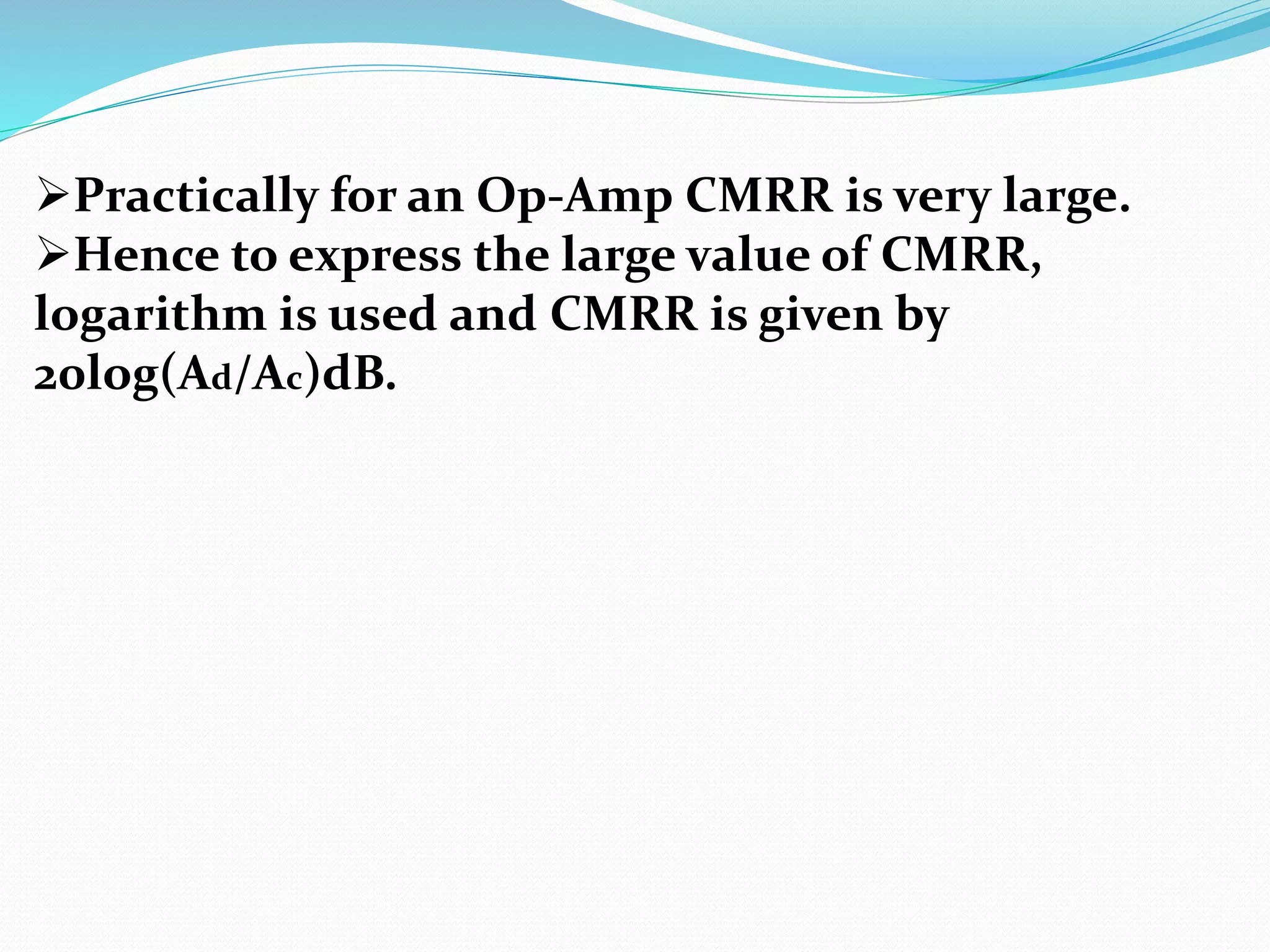
Practically for an Op-Amp CMRR is very large.
Hence to express the large value of CMRR,
logarithm is used and CMRR is given by
20log(Ad/Ac)dB.
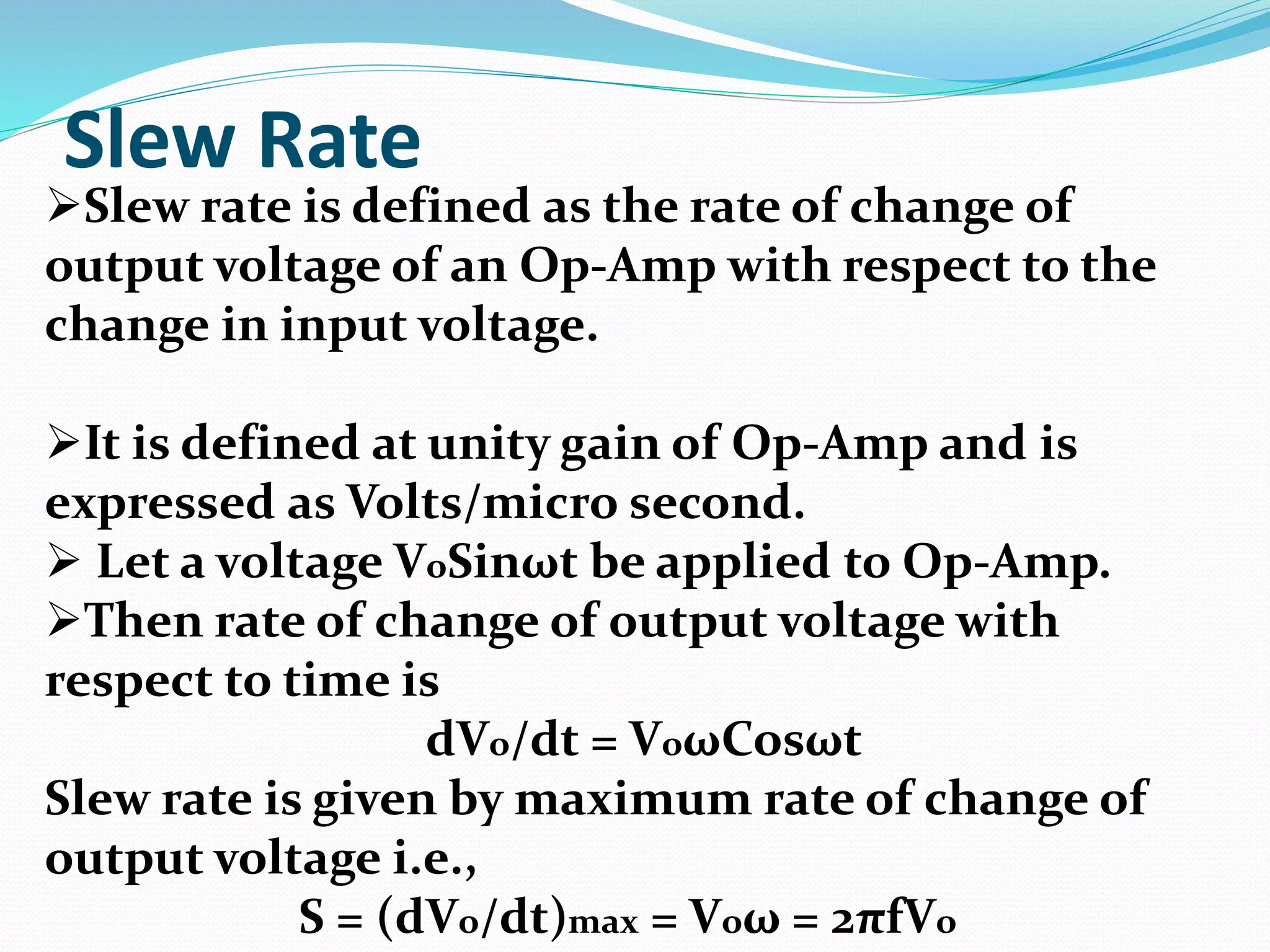
Slew Rate
Slew rate is defined as the rate of change of
output voltage of an Op-Amp with respect to the
change in input voltage.
It is defined at unity gain of Op-Amp and is
expressed as Volts/micro second.
 Let a voltage VoSinωt be applied to Op-Amp.
Then rate of change of output voltage with
respect to time is
dVo/dt = VoωCosωt
Slew rate is given by maximum rate of change of
output voltage i.e.,
S = (dVo/dt)max = Voω = 2πfVo
Operational amplifier parameters

Operational amplifier parameters

  • 1.
  • 2.
    The following arethe parameters of Op-Amp Input offset voltage Output offset voltage Input offset current Input bias current CMRR(Common Mode Rejection Ratio) Slew Rate
  • 3.
    Input offset voltage Itis the amount of voltage that must be applied at the input terminals to make the output voltage zero and is denoted by Vio. For an ideal Op-Amp, the output voltage must be zero if the voltage at both the input terminals is zero. But in practice a small amount of voltage appears(due to imbalance in the differential amplifier in the Op- Amp) at the output even if the voltage at both input terminals is zero. To make this output voltage zero, an equal amount of voltage is applied at input terminals which is called input offset voltage.
  • 4.
    Output offset voltage Itis the amount of voltage that appears at the output terminal (due to imbalance in the differential amplifier in the OP-Amp), even if the voltage at both the input terminals is zero. To make this output voltage zero, an equal amount of voltage is applied at input terminal. It is denoted by Voo
  • 5.
    Input bias current Ideallyno current flows into the input terminals of Op-Amp. But in practice a small amount of current flows into the input terminals when power supply is given to an Op-Amp. These currents are called bias currents. It is the average of both the bias currents flowing into the input terminals of Op-Amp. It is denoted by IB
  • 6.
    Input offset current Itis the difference between the two input bias currents flowing into the input terminals of Op- Amp. It is denoted by Iio
  • 7.
    CMRR(Common Mode RejectionRatio) CMRR gives the ability of the Op-Amp to reject common mode signals. It is defined as the ratio of differential mode gain to common mode gain. CMRR = Ad/Ac Where Ad is gain of the Op-Amp in differential mode and Ac is the gain of the Op-Amp in common mode.
  • 8.
    When two signalsof same magnitude are applied at the two inputs of Op-Amp, the gain of the Op- Amp is called common mode gain(Ac). When two signals of different magnitude are applied the two inputs of Op-Amp the gain of the Op-Amp is called differential mode gain(Ad). Since Op-Amp is a differential amplifier, ideally common mode gain should be zero. Hence the ideal value of CMRR for an Op-Amp is ∞.
  • 9.
    Practically for anOp-Amp CMRR is very large. Hence to express the large value of CMRR, logarithm is used and CMRR is given by 20log(Ad/Ac)dB.
  • 10.
    Slew Rate Slew rateis defined as the rate of change of output voltage of an Op-Amp with respect to the change in input voltage. It is defined at unity gain of Op-Amp and is expressed as Volts/micro second.  Let a voltage VoSinωt be applied to Op-Amp. Then rate of change of output voltage with respect to time is dVo/dt = VoωCosωt Slew rate is given by maximum rate of change of output voltage i.e., S = (dVo/dt)max = Voω = 2πfVo