EDEMAEDEMA
Prepared byPrepared by
Dr. Mizanur Rahman ChowdhuryDr. Mizanur Rahman Chowdhury
EdemaEdema
DefinitionDefinition
Excessive accumulation of abnormaExcessive accumulation of abnorma
amount of fluid into the interstitialamount of fluid into the interstitial
space and or body cavities.space and or body cavities.
Normal homeostasisNormal homeostasis
Factor tending to drive the fluid out of the bloodFactor tending to drive the fluid out of the blood
vessels:vessels:
• Hydrostatic pressure with in theHydrostatic pressure with in the
vesselsvessels
• The colloidal osmotic pressure ofThe colloidal osmotic pressure of
interstitial spacesinterstitial spaces
Factor tending to drive the fluid with in theFactor tending to drive the fluid with in the
blood vessels:blood vessels:
• Tissue tensionTissue tension
• The colloidal osmotic pressure ofThe colloidal osmotic pressure of
interstitial spacesinterstitial spaces
Classification of edemaClassification of edema
OnOn the basis of involvementthe basis of involvement
Localized edemaLocalized edema
Generalized edemaGeneralized edema
On the basis of inflammationOn the basis of inflammation
Inflammatory/Exudative edemaInflammatory/Exudative edema
Non inflammatory/Transudative edemaNon inflammatory/Transudative edema
Clinical ClassificationClinical Classification
Pitting edemaPitting edema
Non pitting edemaNon pitting edema
Pathophysiological Categories ofPathophysiological Categories of
edemaedema
Increase hydrostatic pressureIncrease hydrostatic pressure
• Impaired venous returnImpaired venous return
Congestive cardiac failureCongestive cardiac failure
Constrictive pericarditConstrictive pericardit
Liver cirrhosisLiver cirrhosis
• Venous pressure or obstructionVenous pressure or obstruction
ThrombosisThrombosis
External pressureExternal pressure
• Arteriolar dilationArteriolar dilation
HeatHeat
Neurohumoral dysregulationNeurohumoral dysregulation
Pathophysiological Categories ofPathophysiological Categories of
edemaedema
Decrease plasma colloidal osmoticDecrease plasma colloidal osmotic
pressurepressure
Nephrotic syndromeNephrotic syndrome
Liver cirrhosisLiver cirrhosis
MalnutritionMalnutrition
Protein loosing gastroenteropathyProtein loosing gastroenteropathy
Pathophysiological Categories ofPathophysiological Categories of
edemaedema
Lymphatic obstructionLymphatic obstruction
oInflammatoryInflammatory
oNeoplasticNeoplastic
oPost surgicalPost surgical
oPost irradiationPost irradiation
Pathophysiological Categories ofPathophysiological Categories of
edemaedema
Sodium retentionSodium retention
 Excessive salt intake with renalExcessive salt intake with renal
insufficiencyinsufficiency
 Increase tubular reabsorption of sodiumIncrease tubular reabsorption of sodium
 Renal hypoperfusionRenal hypoperfusion
 Increase renal angiotensin aldosteroneIncrease renal angiotensin aldosterone
secretionsecretion
Pathophysiological CategoriesPathophysiological Categories
of edemaof edema
InflammatoryInflammatory
• Acute inflammationAcute inflammation
• Chronic inflammationChronic inflammation
• AngiogenesisAngiogenesis
Localised oedemaLocalised oedema
Inflammatory edema:Inflammatory edema:
Exudate are formed due to increase vascularExudate are formed due to increase vascular
permeability proteinpermeability protein
Edema due to venous obstructionEdema due to venous obstruction::
In venous obstruction there is rise of hydrostaticIn venous obstruction there is rise of hydrostatic
pressure, this lead formation of exudates.pressure, this lead formation of exudates.
Edema due to lymphatic obstruction:Edema due to lymphatic obstruction:
Excessive lymphatic obstruction can produce anExcessive lymphatic obstruction can produce an
oedema of high protein content but not as that ofoedema of high protein content but not as that of
exudateexudate
Hypersensitivity edemaHypersensitivity edema
Generalized edemaGeneralized edema
Cardiac edemaCardiac edema
Renal edemaRenal edema
Hepatic edemaHepatic edema
Famine edemaFamine edema
OthersOthers
Cardiac edemaCardiac edema
Most common cause is right sided congestiveMost common cause is right sided congestive
cardiac failurecardiac failure
Transudative edemaTransudative edema
Dependant peripheral edemaDependant peripheral edema
Distribution is influenced by gravity i.e.Distribution is influenced by gravity i.e.
When patient is ambulant: ankle edemaWhen patient is ambulant: ankle edema
When patient is recumbent: sacral edemaWhen patient is recumbent: sacral edema
Edema pits on pressureEdema pits on pressure
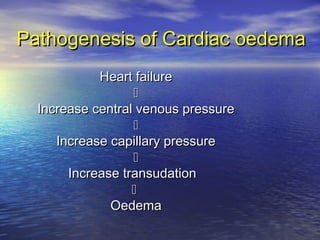
Pathogenesis of Cardiac oedemaPathogenesis of Cardiac oedema
Heart failureHeart failure

Increase central venous pressureIncrease central venous pressure

Increase capillary pressureIncrease capillary pressure

Increase transudationIncrease transudation

OedemaOedema
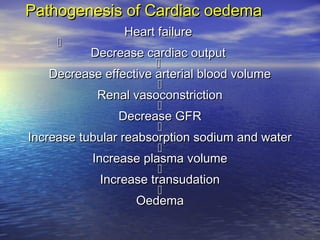
Pathogenesis of Cardiac oedemaPathogenesis of Cardiac oedema
Heart failureHeart failure

Decrease cardiac outputDecrease cardiac output

Decrease effective arterial blood volumeDecrease effective arterial blood volume

Renal vasoconstrictionRenal vasoconstriction

Decrease GFRDecrease GFR

Increase tubular reabsorption sodium and waterIncrease tubular reabsorption sodium and water

Increase plasma volumeIncrease plasma volume

Increase transudationIncrease transudation

OedemaOedema
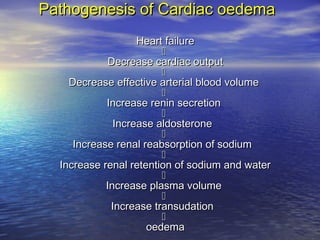
Pathogenesis of Cardiac oedemaPathogenesis of Cardiac oedema
Heart failureHeart failure

Decrease cardiac outputDecrease cardiac output

Decrease effective arterial blood volumeDecrease effective arterial blood volume

Increase renin secretionIncrease renin secretion

Increase aldosteroneIncrease aldosterone

Increase renal reabsorption of sodiumIncrease renal reabsorption of sodium

Increase renal retention of sodium and waterIncrease renal retention of sodium and water

Increase plasma volumeIncrease plasma volume

Increase transudationIncrease transudation

oedemaoedema
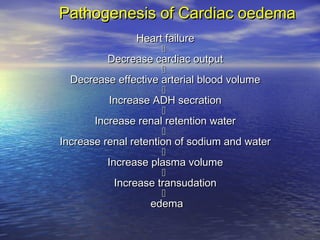
Pathogenesis of Cardiac oedemaPathogenesis of Cardiac oedema
Heart failureHeart failure

Decrease cardiac outputDecrease cardiac output

Decrease effective arterial blood volumeDecrease effective arterial blood volume

Increase ADH secrationIncrease ADH secration

Increase renal retention waterIncrease renal retention water

Increase renal retention of sodium and waterIncrease renal retention of sodium and water

Increase plasma volumeIncrease plasma volume

Increase transudationIncrease transudation

edemaedema
Renal edemaRenal edema
Cause of renal edemaCause of renal edema
 Acute glomerulonephritisAcute glomerulonephritis
Nephrotic syndromeNephrotic syndrome
Pathogenesis of Renal oedemaPathogenesis of Renal oedema
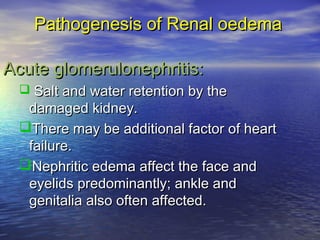
Acute glomerulonephritis:Acute glomerulonephritis:
 Salt and water retention by theSalt and water retention by the
damaged kidney.damaged kidney.
There may be additional factor of heartThere may be additional factor of heart
failure.failure.
Nephritic edema affect the face andNephritic edema affect the face and
eyelids predominantly; ankle andeyelids predominantly; ankle and
genitalia also often affected.genitalia also often affected.
Pathogenesis of Renal edemaPathogenesis of Renal edema
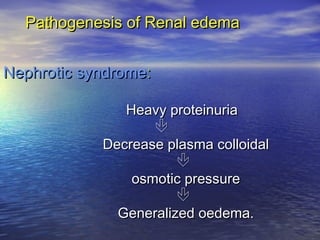
Nephrotic syndromeNephrotic syndrome::
Heavy proteinuriaHeavy proteinuria

Decrease plasma colloidalDecrease plasma colloidal

osmotic pressureosmotic pressure

Generalized oedema.Generalized oedema.
Pathogenesis of Renal oedemaPathogenesis of Renal oedema
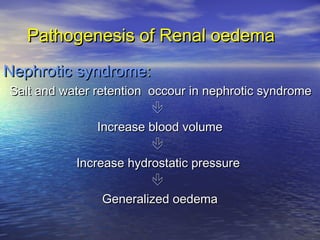
Nephrotic syndromeNephrotic syndrome::
Salt and water retention occour in nephrotic syndromeSalt and water retention occour in nephrotic syndrome

Increase blood volumeIncrease blood volume

Increase hydrostatic pressureIncrease hydrostatic pressure

Generalized oedemaGeneralized oedema
Pathogenesis of Renal edemaPathogenesis of Renal edema
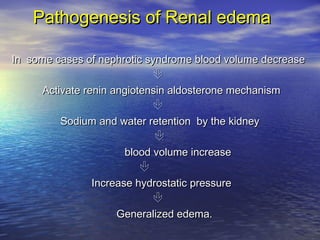
In some cases of nephrotic syndrome blood volume decreaseIn some cases of nephrotic syndrome blood volume decrease

Activate renin angiotensin aldosterone mechanismActivate renin angiotensin aldosterone mechanism

Sodium and water retention by the kidneySodium and water retention by the kidney

blood volume increaseblood volume increase

Increase hydrostatic pressureIncrease hydrostatic pressure

Generalized edema.Generalized edema.
Famine edema/Nutritional edema:Famine edema/Nutritional edema:
o It is due to hypoproteinaemiaIt is due to hypoproteinaemia
o sometimes oedema is extensive butsometimes oedema is extensive but
plasma protein level is normal in famineplasma protein level is normal in famine
oedema.oedema.
o The true explanation is unknown. But thereThe true explanation is unknown. But there
is an important factor is loss of compactis an important factor is loss of compact
tissue and replace by loose connectivetissue and replace by loose connective
tissue which can accumulate fluid withouttissue which can accumulate fluid without
rise of tissue tensionrise of tissue tension
Hepatic edemaHepatic edema
The main manifestation of hepatic edema is ascitis.The main manifestation of hepatic edema is ascitis.
The factor responsible for hepatic edemaThe factor responsible for hepatic edema
Lymphatic obstructionLymphatic obstruction
Low plasma protein levelLow plasma protein level
Increase regional venous pressure due toIncrease regional venous pressure due to
portal hypertensionportal hypertension
Failure to hepatic inactivation ofFailure to hepatic inactivation of
aldosteronealdosterone
Pulmonary edemaPulmonary edema
Hydrostatic balance of lung capillaries is someHydrostatic balance of lung capillaries is some
what different from the systemic circulation.what different from the systemic circulation.
Blood pressure in the pulmonary circuit isBlood pressure in the pulmonary circuit is
about 15-25mm hg systolic and 6-12mm Hgabout 15-25mm hg systolic and 6-12mm Hg
diastolic mean capillary pressure is 7mm Hgdiastolic mean capillary pressure is 7mm Hg
being highest at the base and lowest at thebeing highest at the base and lowest at the
apex.apex.
The interstitial fluid pressure is -16mm Hg.The interstitial fluid pressure is -16mm Hg.
Both these forces tend to drive fluid out ofBoth these forces tend to drive fluid out of
capillaries in to the interstitial space whichcapillaries in to the interstitial space which
consist of mucopolysacchadide. Normally theconsist of mucopolysacchadide. Normally the
plasma colloidal osmotic pressure25-28mm Hgplasma colloidal osmotic pressure25-28mm Hg
is adequate to prevent fluid escaping in theis adequate to prevent fluid escaping in the
interstitial tissue.interstitial tissue.
Pulmonary edemaPulmonary edema
Cause of pulmonary edema:Cause of pulmonary edema:
Left heart failure ,Left ventricularLeft heart failure ,Left ventricular
failure ,Mitral stenosis particularlyfailure ,Mitral stenosis particularly
in fibrilationin fibrilation
Inflammation of lung,Inflammation of lung,
PneumoniaPneumonia
ARDSARDS
Associated with anaemia,Associated with anaemia,
Nephrotic syndromeNephrotic syndrome
Overloading of circulationOverloading of circulation
Withdrawal of pleural fluidWithdrawal of pleural fluid
Cerebral edemaCerebral edema
There are two types of cerebralThere are two types of cerebral
edemaedema
 Vesogenic edemaVesogenic edema
Cytotoxic edemaCytotoxic edema
Vesogenic cerebral edemaVesogenic cerebral edema
It occurs when the integrity ofIt occurs when the integrity of
the normal blood brain barrierthe normal blood brain barrier
is disrupted and increasedis disrupted and increased
vascular permeability occursvascular permeability occurs
allowing fluid to escape fromallowing fluid to escape from
the intravascular space of thethe intravascular space of the
brainbrain
Cytotoxic CerebralCytotoxic Cerebral
EdemaEdema
ItIt occurs when there is increaseedoccurs when there is increaseed
intracellular fluid secondary to nneural,intracellular fluid secondary to nneural,
glial, or endothelial cell membreneglial, or endothelial cell membrene
injury in a patient with a generalizedinjury in a patient with a generalized
hypoxic/ischemic insult or with somehypoxic/ischemic insult or with some
intoxication.intoxication.
Thank youThank you

Oedema new edited

  • 1.
    EDEMAEDEMA Prepared byPrepared by Dr.Mizanur Rahman ChowdhuryDr. Mizanur Rahman Chowdhury
  • 2.
    EdemaEdema DefinitionDefinition Excessive accumulation ofabnormaExcessive accumulation of abnorma amount of fluid into the interstitialamount of fluid into the interstitial space and or body cavities.space and or body cavities.
  • 3.
    Normal homeostasisNormal homeostasis Factortending to drive the fluid out of the bloodFactor tending to drive the fluid out of the blood vessels:vessels: • Hydrostatic pressure with in theHydrostatic pressure with in the vesselsvessels • The colloidal osmotic pressure ofThe colloidal osmotic pressure of interstitial spacesinterstitial spaces Factor tending to drive the fluid with in theFactor tending to drive the fluid with in the blood vessels:blood vessels: • Tissue tensionTissue tension • The colloidal osmotic pressure ofThe colloidal osmotic pressure of interstitial spacesinterstitial spaces
  • 5.
    Classification of edemaClassificationof edema OnOn the basis of involvementthe basis of involvement Localized edemaLocalized edema Generalized edemaGeneralized edema On the basis of inflammationOn the basis of inflammation Inflammatory/Exudative edemaInflammatory/Exudative edema Non inflammatory/Transudative edemaNon inflammatory/Transudative edema Clinical ClassificationClinical Classification Pitting edemaPitting edema Non pitting edemaNon pitting edema
  • 6.
    Pathophysiological Categories ofPathophysiologicalCategories of edemaedema Increase hydrostatic pressureIncrease hydrostatic pressure • Impaired venous returnImpaired venous return Congestive cardiac failureCongestive cardiac failure Constrictive pericarditConstrictive pericardit Liver cirrhosisLiver cirrhosis • Venous pressure or obstructionVenous pressure or obstruction ThrombosisThrombosis External pressureExternal pressure • Arteriolar dilationArteriolar dilation HeatHeat Neurohumoral dysregulationNeurohumoral dysregulation
  • 7.
    Pathophysiological Categories ofPathophysiologicalCategories of edemaedema Decrease plasma colloidal osmoticDecrease plasma colloidal osmotic pressurepressure Nephrotic syndromeNephrotic syndrome Liver cirrhosisLiver cirrhosis MalnutritionMalnutrition Protein loosing gastroenteropathyProtein loosing gastroenteropathy
  • 8.
    Pathophysiological Categories ofPathophysiologicalCategories of edemaedema Lymphatic obstructionLymphatic obstruction oInflammatoryInflammatory oNeoplasticNeoplastic oPost surgicalPost surgical oPost irradiationPost irradiation
  • 9.
    Pathophysiological Categories ofPathophysiologicalCategories of edemaedema Sodium retentionSodium retention  Excessive salt intake with renalExcessive salt intake with renal insufficiencyinsufficiency  Increase tubular reabsorption of sodiumIncrease tubular reabsorption of sodium  Renal hypoperfusionRenal hypoperfusion  Increase renal angiotensin aldosteroneIncrease renal angiotensin aldosterone secretionsecretion
  • 10.
    Pathophysiological CategoriesPathophysiological Categories ofedemaof edema InflammatoryInflammatory • Acute inflammationAcute inflammation • Chronic inflammationChronic inflammation • AngiogenesisAngiogenesis
  • 11.
    Localised oedemaLocalised oedema Inflammatoryedema:Inflammatory edema: Exudate are formed due to increase vascularExudate are formed due to increase vascular permeability proteinpermeability protein Edema due to venous obstructionEdema due to venous obstruction:: In venous obstruction there is rise of hydrostaticIn venous obstruction there is rise of hydrostatic pressure, this lead formation of exudates.pressure, this lead formation of exudates. Edema due to lymphatic obstruction:Edema due to lymphatic obstruction: Excessive lymphatic obstruction can produce anExcessive lymphatic obstruction can produce an oedema of high protein content but not as that ofoedema of high protein content but not as that of exudateexudate Hypersensitivity edemaHypersensitivity edema
  • 12.
    Generalized edemaGeneralized edema CardiacedemaCardiac edema Renal edemaRenal edema Hepatic edemaHepatic edema Famine edemaFamine edema OthersOthers
  • 13.
    Cardiac edemaCardiac edema Mostcommon cause is right sided congestiveMost common cause is right sided congestive cardiac failurecardiac failure Transudative edemaTransudative edema Dependant peripheral edemaDependant peripheral edema Distribution is influenced by gravity i.e.Distribution is influenced by gravity i.e. When patient is ambulant: ankle edemaWhen patient is ambulant: ankle edema When patient is recumbent: sacral edemaWhen patient is recumbent: sacral edema Edema pits on pressureEdema pits on pressure
  • 14.
    Pathogenesis of CardiacoedemaPathogenesis of Cardiac oedema Heart failureHeart failure  Increase central venous pressureIncrease central venous pressure  Increase capillary pressureIncrease capillary pressure  Increase transudationIncrease transudation  OedemaOedema
  • 15.
    Pathogenesis of CardiacoedemaPathogenesis of Cardiac oedema Heart failureHeart failure  Decrease cardiac outputDecrease cardiac output  Decrease effective arterial blood volumeDecrease effective arterial blood volume  Renal vasoconstrictionRenal vasoconstriction  Decrease GFRDecrease GFR  Increase tubular reabsorption sodium and waterIncrease tubular reabsorption sodium and water  Increase plasma volumeIncrease plasma volume  Increase transudationIncrease transudation  OedemaOedema
  • 16.
    Pathogenesis of CardiacoedemaPathogenesis of Cardiac oedema Heart failureHeart failure  Decrease cardiac outputDecrease cardiac output  Decrease effective arterial blood volumeDecrease effective arterial blood volume  Increase renin secretionIncrease renin secretion  Increase aldosteroneIncrease aldosterone  Increase renal reabsorption of sodiumIncrease renal reabsorption of sodium  Increase renal retention of sodium and waterIncrease renal retention of sodium and water  Increase plasma volumeIncrease plasma volume  Increase transudationIncrease transudation  oedemaoedema
  • 17.
    Pathogenesis of CardiacoedemaPathogenesis of Cardiac oedema Heart failureHeart failure  Decrease cardiac outputDecrease cardiac output  Decrease effective arterial blood volumeDecrease effective arterial blood volume  Increase ADH secrationIncrease ADH secration  Increase renal retention waterIncrease renal retention water  Increase renal retention of sodium and waterIncrease renal retention of sodium and water  Increase plasma volumeIncrease plasma volume  Increase transudationIncrease transudation  edemaedema
  • 18.
    Renal edemaRenal edema Causeof renal edemaCause of renal edema  Acute glomerulonephritisAcute glomerulonephritis Nephrotic syndromeNephrotic syndrome
  • 19.
    Pathogenesis of RenaloedemaPathogenesis of Renal oedema Acute glomerulonephritis:Acute glomerulonephritis:  Salt and water retention by theSalt and water retention by the damaged kidney.damaged kidney. There may be additional factor of heartThere may be additional factor of heart failure.failure. Nephritic edema affect the face andNephritic edema affect the face and eyelids predominantly; ankle andeyelids predominantly; ankle and genitalia also often affected.genitalia also often affected.
  • 20.
    Pathogenesis of RenaledemaPathogenesis of Renal edema Nephrotic syndromeNephrotic syndrome:: Heavy proteinuriaHeavy proteinuria  Decrease plasma colloidalDecrease plasma colloidal  osmotic pressureosmotic pressure  Generalized oedema.Generalized oedema.
  • 21.
    Pathogenesis of RenaloedemaPathogenesis of Renal oedema Nephrotic syndromeNephrotic syndrome:: Salt and water retention occour in nephrotic syndromeSalt and water retention occour in nephrotic syndrome  Increase blood volumeIncrease blood volume  Increase hydrostatic pressureIncrease hydrostatic pressure  Generalized oedemaGeneralized oedema
  • 22.
    Pathogenesis of RenaledemaPathogenesis of Renal edema In some cases of nephrotic syndrome blood volume decreaseIn some cases of nephrotic syndrome blood volume decrease  Activate renin angiotensin aldosterone mechanismActivate renin angiotensin aldosterone mechanism  Sodium and water retention by the kidneySodium and water retention by the kidney  blood volume increaseblood volume increase  Increase hydrostatic pressureIncrease hydrostatic pressure  Generalized edema.Generalized edema.
  • 23.
    Famine edema/Nutritional edema:Famineedema/Nutritional edema: o It is due to hypoproteinaemiaIt is due to hypoproteinaemia o sometimes oedema is extensive butsometimes oedema is extensive but plasma protein level is normal in famineplasma protein level is normal in famine oedema.oedema. o The true explanation is unknown. But thereThe true explanation is unknown. But there is an important factor is loss of compactis an important factor is loss of compact tissue and replace by loose connectivetissue and replace by loose connective tissue which can accumulate fluid withouttissue which can accumulate fluid without rise of tissue tensionrise of tissue tension
  • 24.
    Hepatic edemaHepatic edema Themain manifestation of hepatic edema is ascitis.The main manifestation of hepatic edema is ascitis. The factor responsible for hepatic edemaThe factor responsible for hepatic edema Lymphatic obstructionLymphatic obstruction Low plasma protein levelLow plasma protein level Increase regional venous pressure due toIncrease regional venous pressure due to portal hypertensionportal hypertension Failure to hepatic inactivation ofFailure to hepatic inactivation of aldosteronealdosterone
  • 25.
    Pulmonary edemaPulmonary edema Hydrostaticbalance of lung capillaries is someHydrostatic balance of lung capillaries is some what different from the systemic circulation.what different from the systemic circulation. Blood pressure in the pulmonary circuit isBlood pressure in the pulmonary circuit is about 15-25mm hg systolic and 6-12mm Hgabout 15-25mm hg systolic and 6-12mm Hg diastolic mean capillary pressure is 7mm Hgdiastolic mean capillary pressure is 7mm Hg being highest at the base and lowest at thebeing highest at the base and lowest at the apex.apex. The interstitial fluid pressure is -16mm Hg.The interstitial fluid pressure is -16mm Hg. Both these forces tend to drive fluid out ofBoth these forces tend to drive fluid out of capillaries in to the interstitial space whichcapillaries in to the interstitial space which consist of mucopolysacchadide. Normally theconsist of mucopolysacchadide. Normally the plasma colloidal osmotic pressure25-28mm Hgplasma colloidal osmotic pressure25-28mm Hg is adequate to prevent fluid escaping in theis adequate to prevent fluid escaping in the interstitial tissue.interstitial tissue.
  • 26.
    Pulmonary edemaPulmonary edema Causeof pulmonary edema:Cause of pulmonary edema: Left heart failure ,Left ventricularLeft heart failure ,Left ventricular failure ,Mitral stenosis particularlyfailure ,Mitral stenosis particularly in fibrilationin fibrilation Inflammation of lung,Inflammation of lung, PneumoniaPneumonia ARDSARDS Associated with anaemia,Associated with anaemia, Nephrotic syndromeNephrotic syndrome Overloading of circulationOverloading of circulation Withdrawal of pleural fluidWithdrawal of pleural fluid
  • 27.
    Cerebral edemaCerebral edema Thereare two types of cerebralThere are two types of cerebral edemaedema  Vesogenic edemaVesogenic edema Cytotoxic edemaCytotoxic edema
  • 28.
    Vesogenic cerebral edemaVesogeniccerebral edema It occurs when the integrity ofIt occurs when the integrity of the normal blood brain barrierthe normal blood brain barrier is disrupted and increasedis disrupted and increased vascular permeability occursvascular permeability occurs allowing fluid to escape fromallowing fluid to escape from the intravascular space of thethe intravascular space of the brainbrain
  • 29.
    Cytotoxic CerebralCytotoxic Cerebral EdemaEdema ItItoccurs when there is increaseedoccurs when there is increaseed intracellular fluid secondary to nneural,intracellular fluid secondary to nneural, glial, or endothelial cell membreneglial, or endothelial cell membrene injury in a patient with a generalizedinjury in a patient with a generalized hypoxic/ischemic insult or with somehypoxic/ischemic insult or with some intoxication.intoxication.
  • 30.