Dr. RAGHU PRASADA M S
MBBS,MD
ASSISTANT PROFESSOR
DEPT. OF PHARMACOLOGY
SSIMS & RC.
1
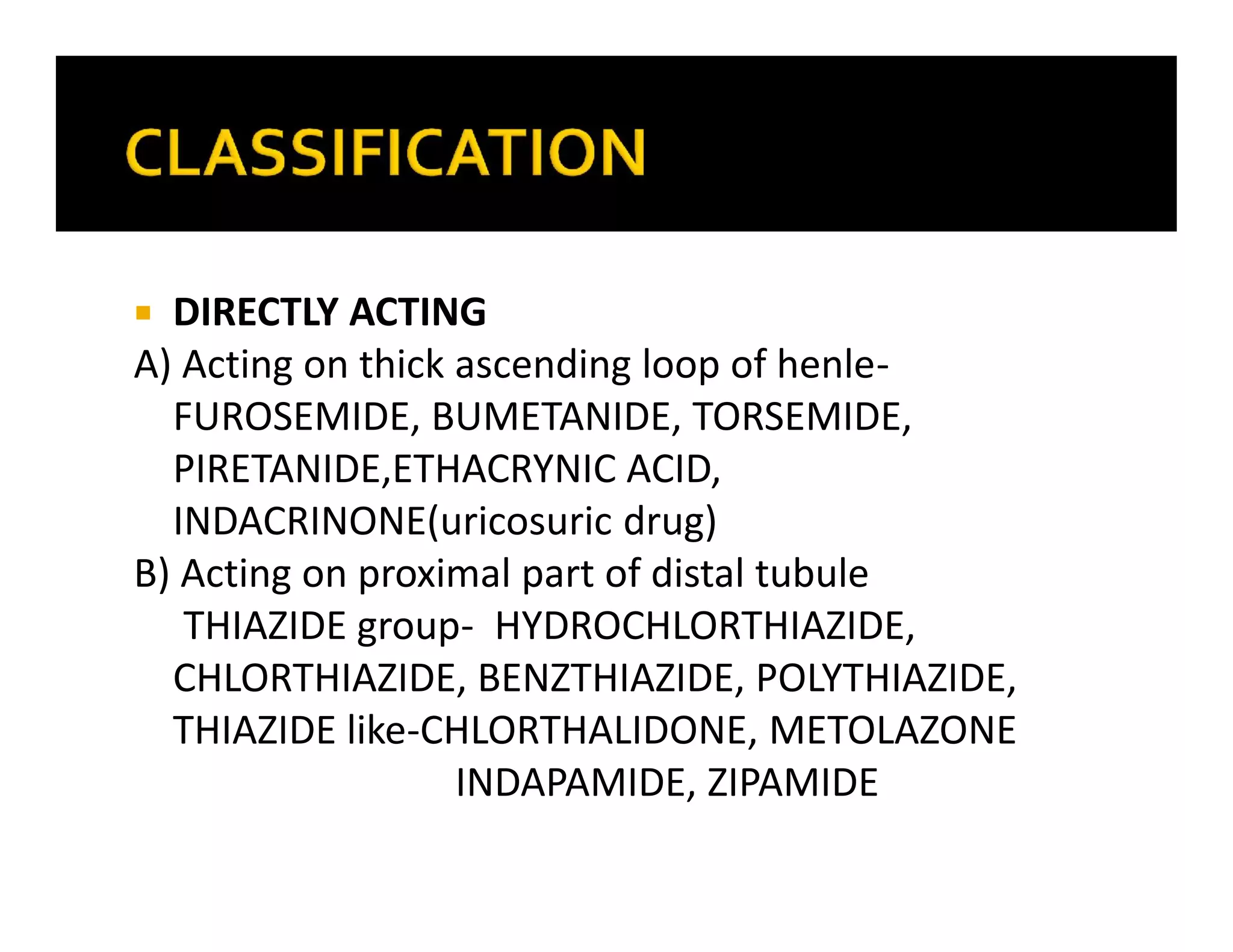
 DIRECTLY ACTING
A) Acting on thick ascending loop of henle-
FUROSEMIDE, BUMETANIDE, TORSEMIDE,
PIRETANIDE,ETHACRYNIC ACID,
INDACRINONE(uricosuric drug)
B) Acting on proximal part of distal tubule
THIAZIDE group- HYDROCHLORTHIAZIDE,
CHLORTHIAZIDE, BENZTHIAZIDE, POLYTHIAZIDE,
THIAZIDE like-CHLORTHALIDONE, METOLAZONE
INDAPAMIDE, ZIPAMIDE
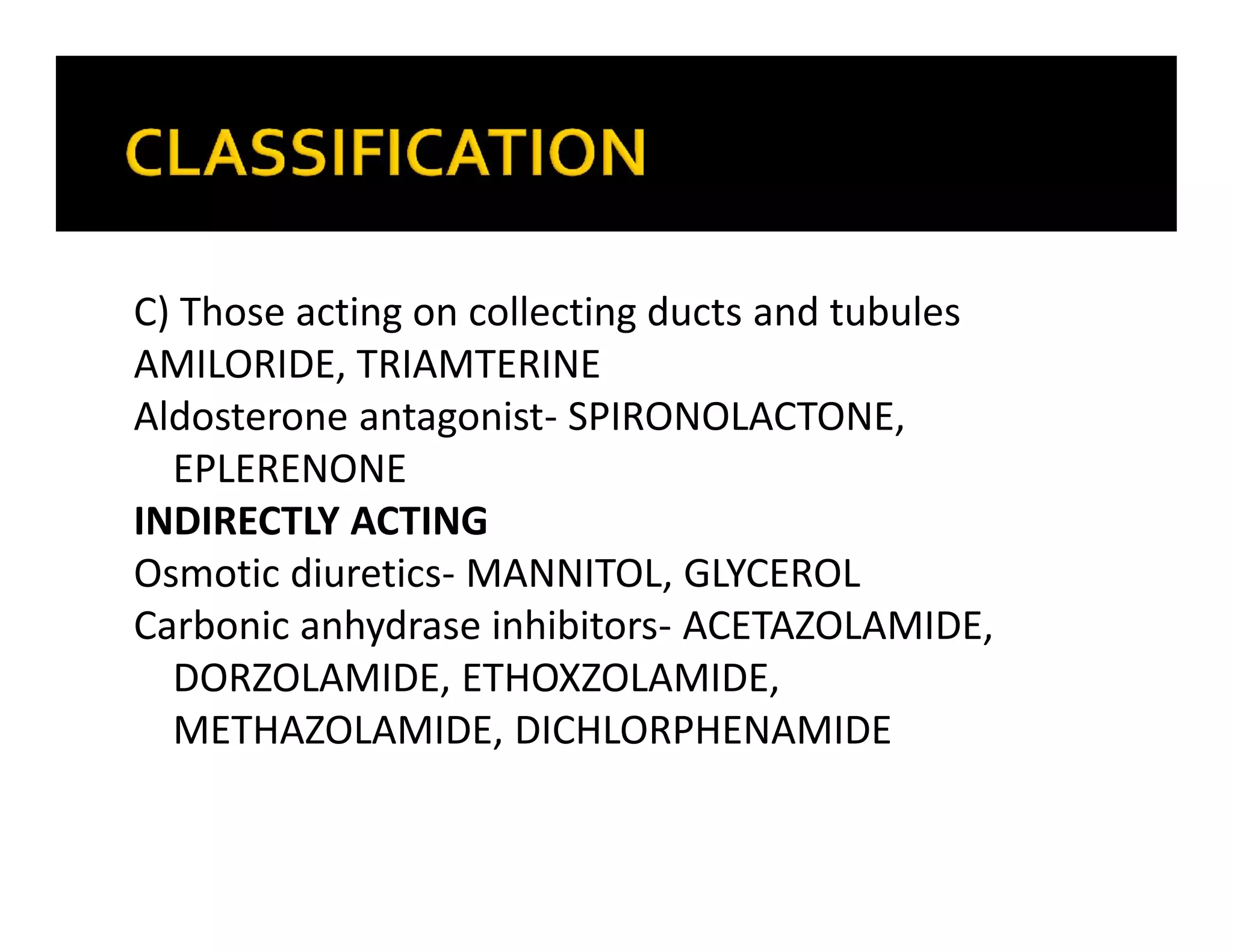
C) Those acting on collecting ducts and tubules
AMILORIDE, TRIAMTERINE
Aldosterone antagonist- SPIRONOLACTONE,
EPLERENONE
INDIRECTLY ACTING
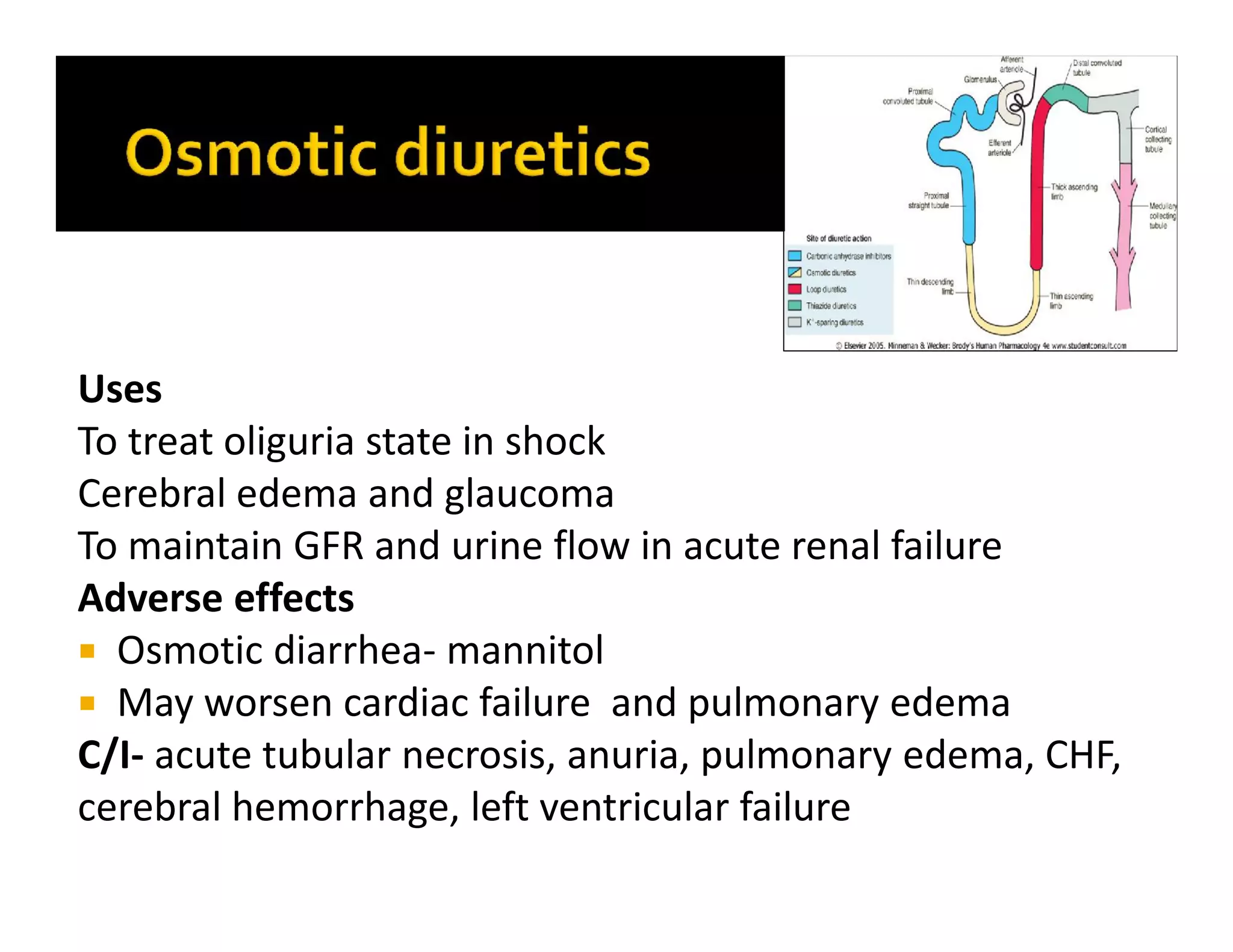
Osmotic diuretics- MANNITOL, GLYCEROL
Carbonic anhydrase inhibitors- ACETAZOLAMIDE,
DORZOLAMIDE, ETHOXZOLAMIDE,
METHAZOLAMIDE, DICHLORPHENAMIDE
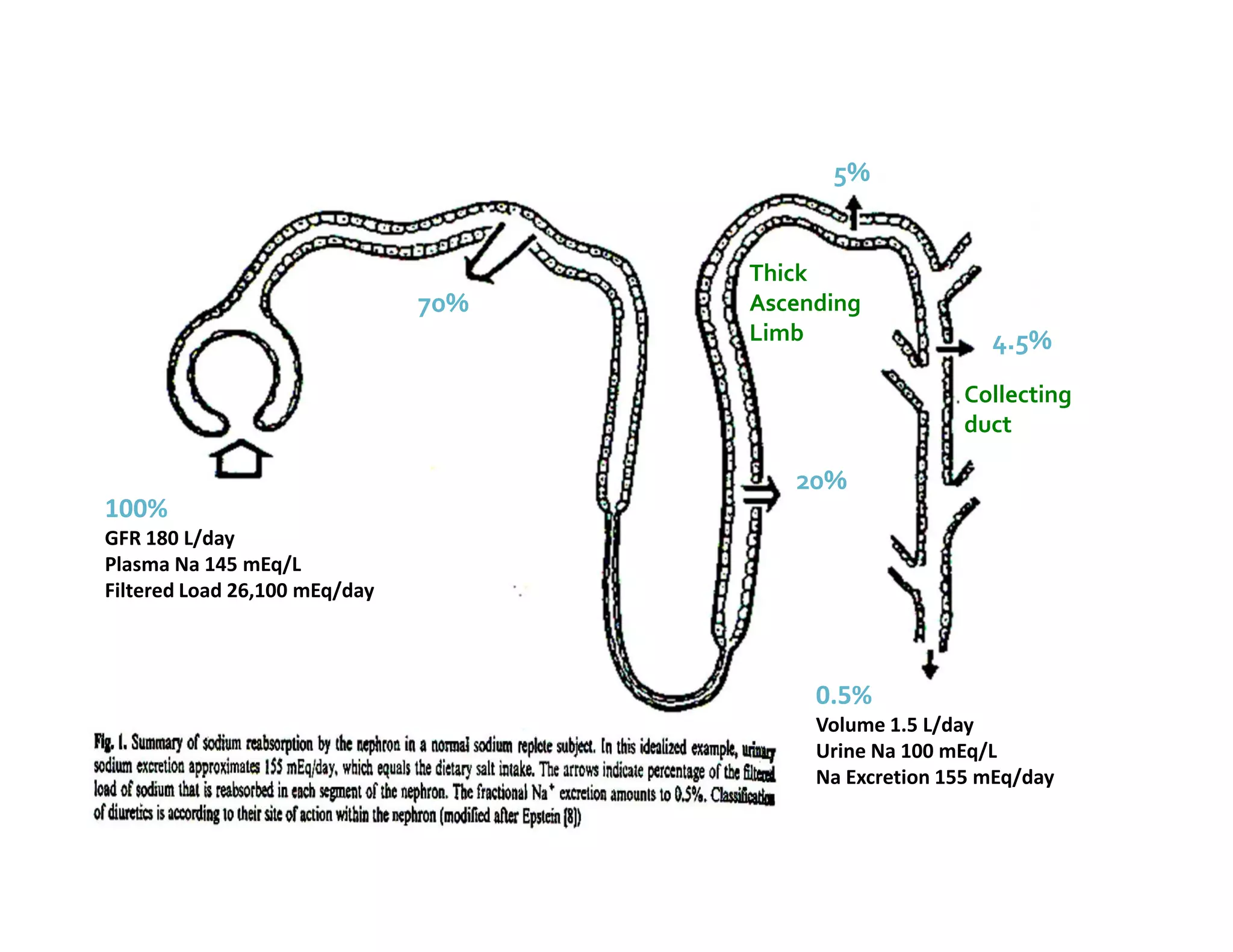
70%
20%
5%
4.5%
0.5%
Volume 1.5 L/day
Urine Na 100 mEq/L
Na Excretion 155 mEq/day
100%
GFR 180 L/day
Plasma Na 145 mEq/L
Filtered Load 26,100 mEq/day
Collecting
duct
Thick
Ascending
Limb
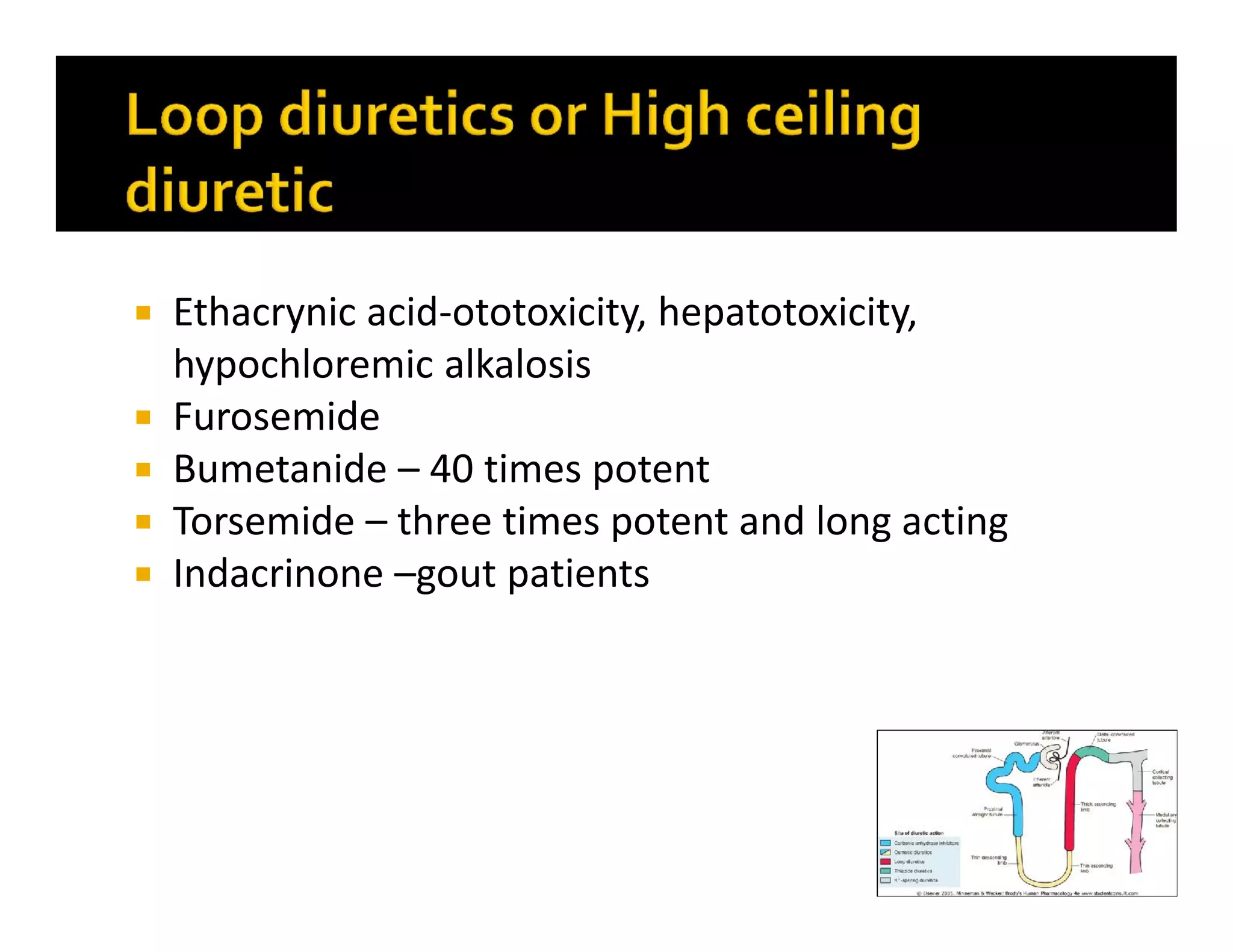
 Ethacrynic acid-ototoxicity, hepatotoxicity,
hypochloremic alkalosis
 Furosemide
 Bumetanide – 40 times potent
 Torsemide – three times potent and long acting
 Indacrinone –gout patients
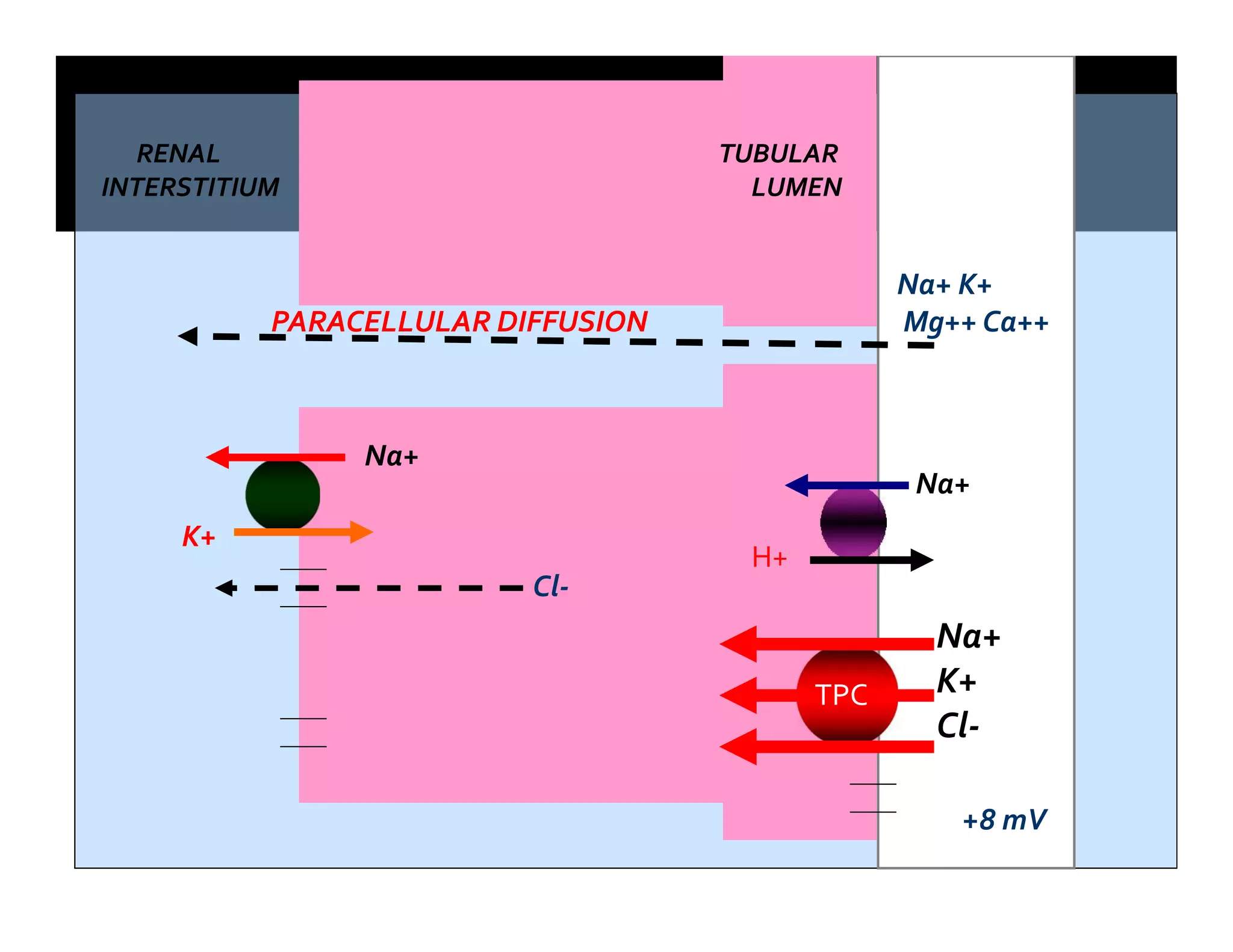
RENAL TUBULAR
INTERSTITIUM LUMEN
Na+
K+
Cl-
TPC
Na+
H+
Na+
K+
PARACELLULAR DIFFUSION
Na+ K+
Mg++ Ca++
Cl-
+8 mV
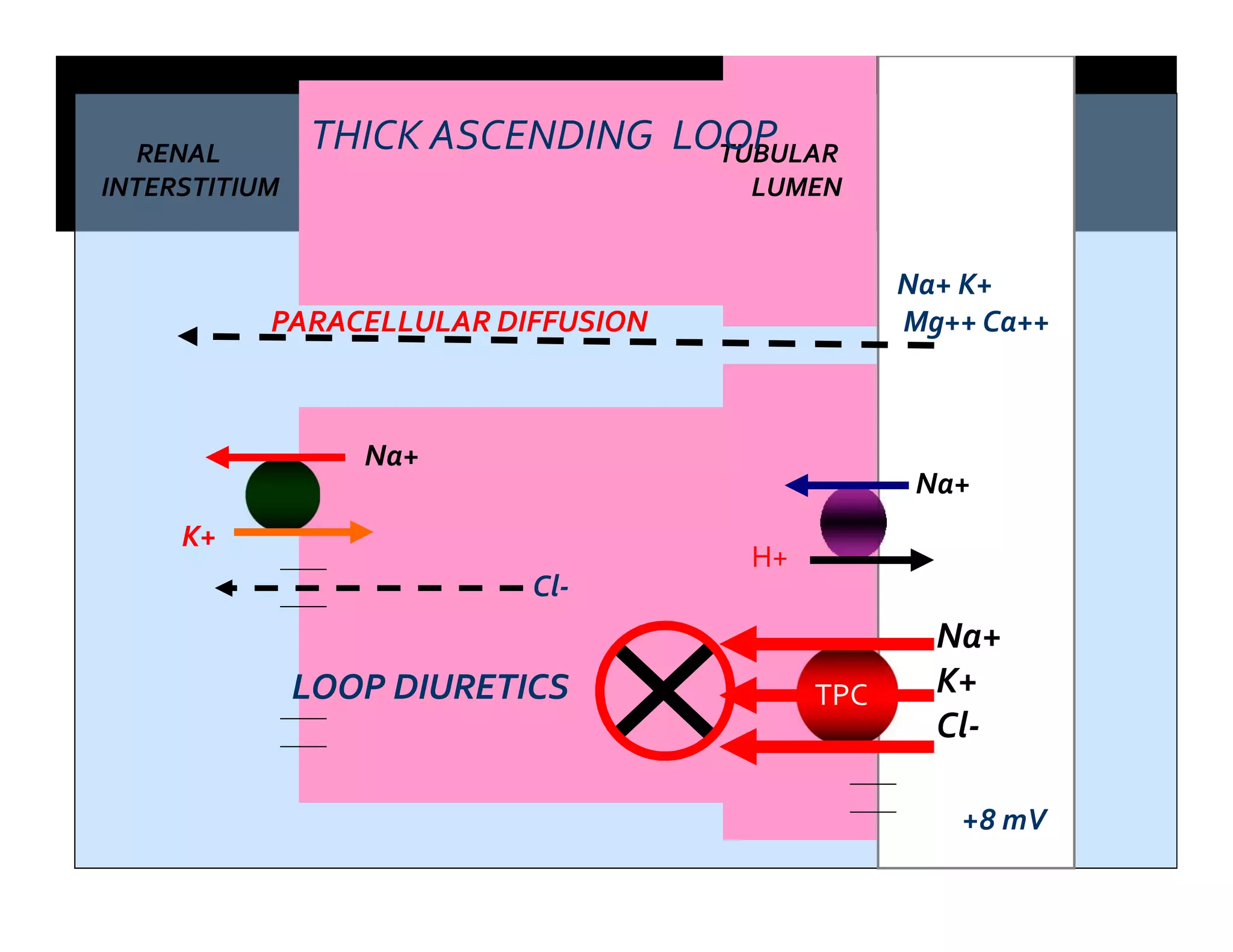
RENAL TUBULAR
INTERSTITIUM LUMEN
Na+
K+
Cl-
TPC
Na+
H+
Na+
K+
PARACELLULAR DIFFUSION
Na+ K+
Mg++ Ca++
Cl-
+8 mV
THICK ASCENDING LOOP
LOOP DIURETICS
 Edematous conditions associated with CCF,
 Cirrhosis of liver, renal disease including nephrotic
syndrome
 Hypertension
 Acute renal failure
 Toxicity of ions
 Mild hyperkalemia
Non-diuretic use-moderate hypercalcaemia
Hyperuricemia
Hypercalciurea and hypomagnesaemia
Hypokalemia
Ototoxicity
Hyperglycemia
Hypersensitivity reactions
RESISTANCE TO LOOP DIURETICS
Renal insufficiency
Nephrotic syndrome
Cirrhosis of liver
Congestive heart failure
 Digitalis toxicity—due to hypokalemia
 Elevated serum lithium levels
 Aminoglycosides – increased ototoxicity
 NSAIDs diminish the action
 Probenacid competitive inhibition
 Cotrimoxazole –thrombocytopenia
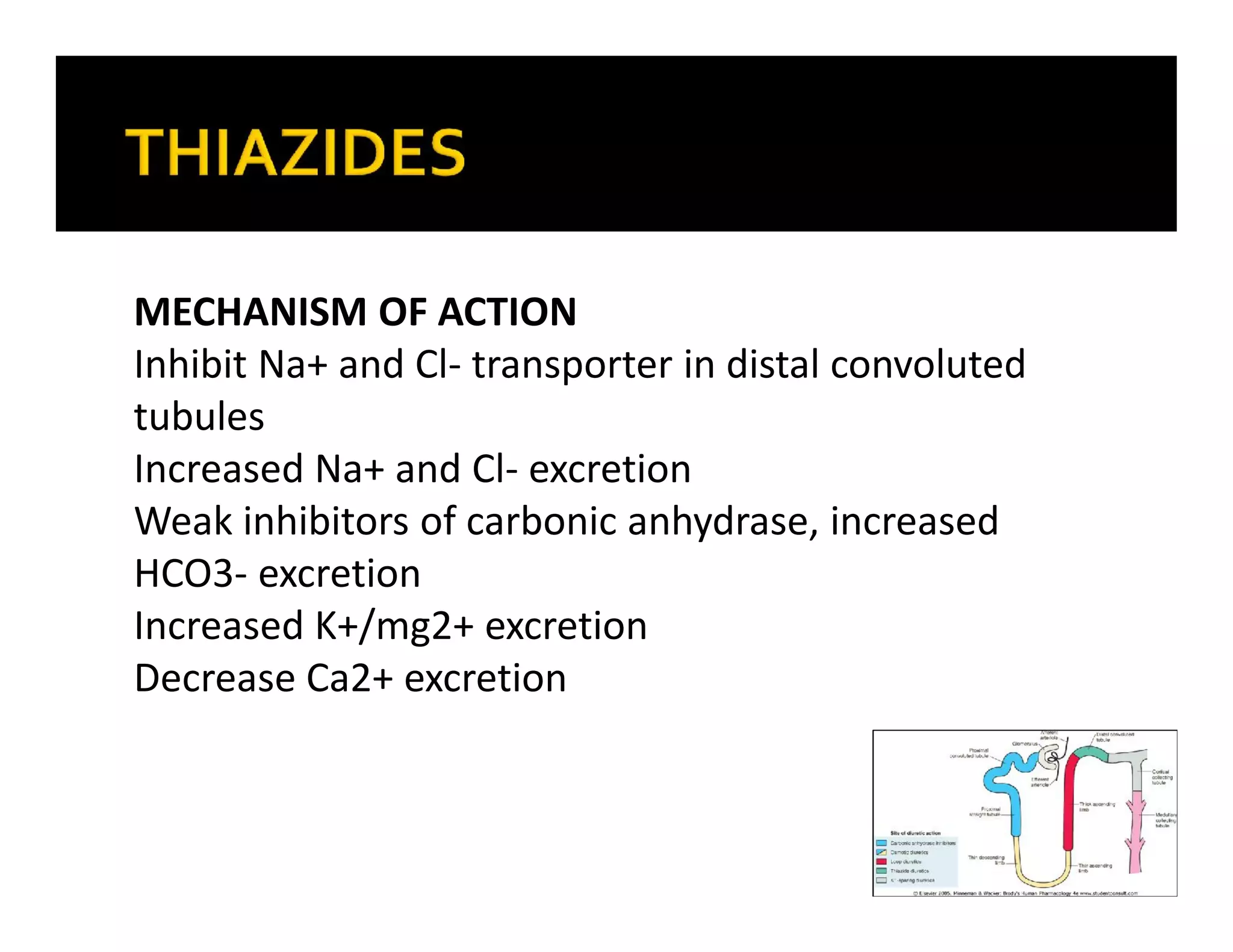
MECHANISM OF ACTION
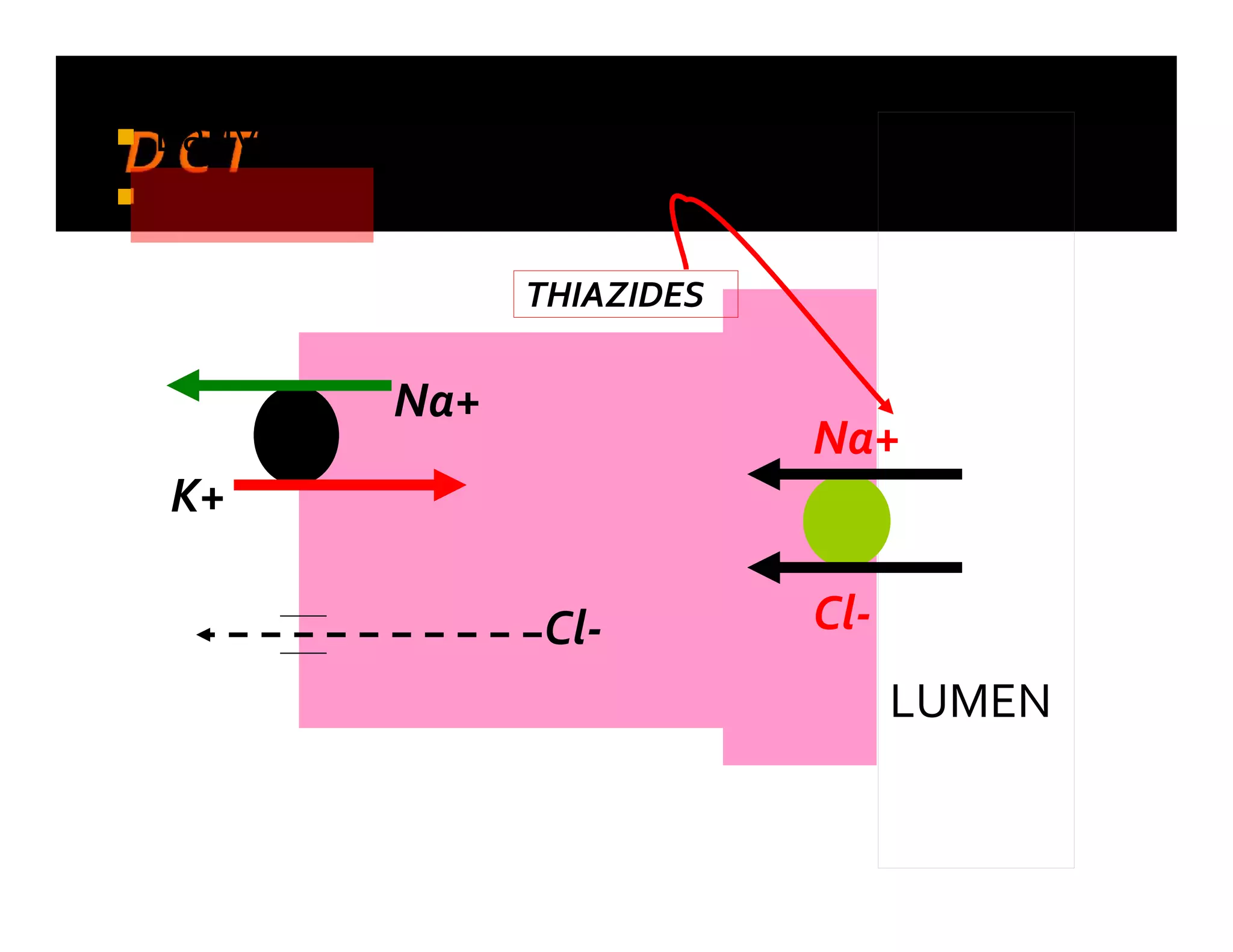
Inhibit Na+ and Cl- transporter in distal convoluted
tubules
Increased Na+ and Cl- excretion
Weak inhibitors of carbonic anhydrase, increased
HCO3- excretion
Increased K+/mg2+ excretion
Decrease Ca2+ excretion
 Early DCT
 Late DCT
Na+
Cl-
LUMEN
K+
Na+
Cl-
THIAZIDES
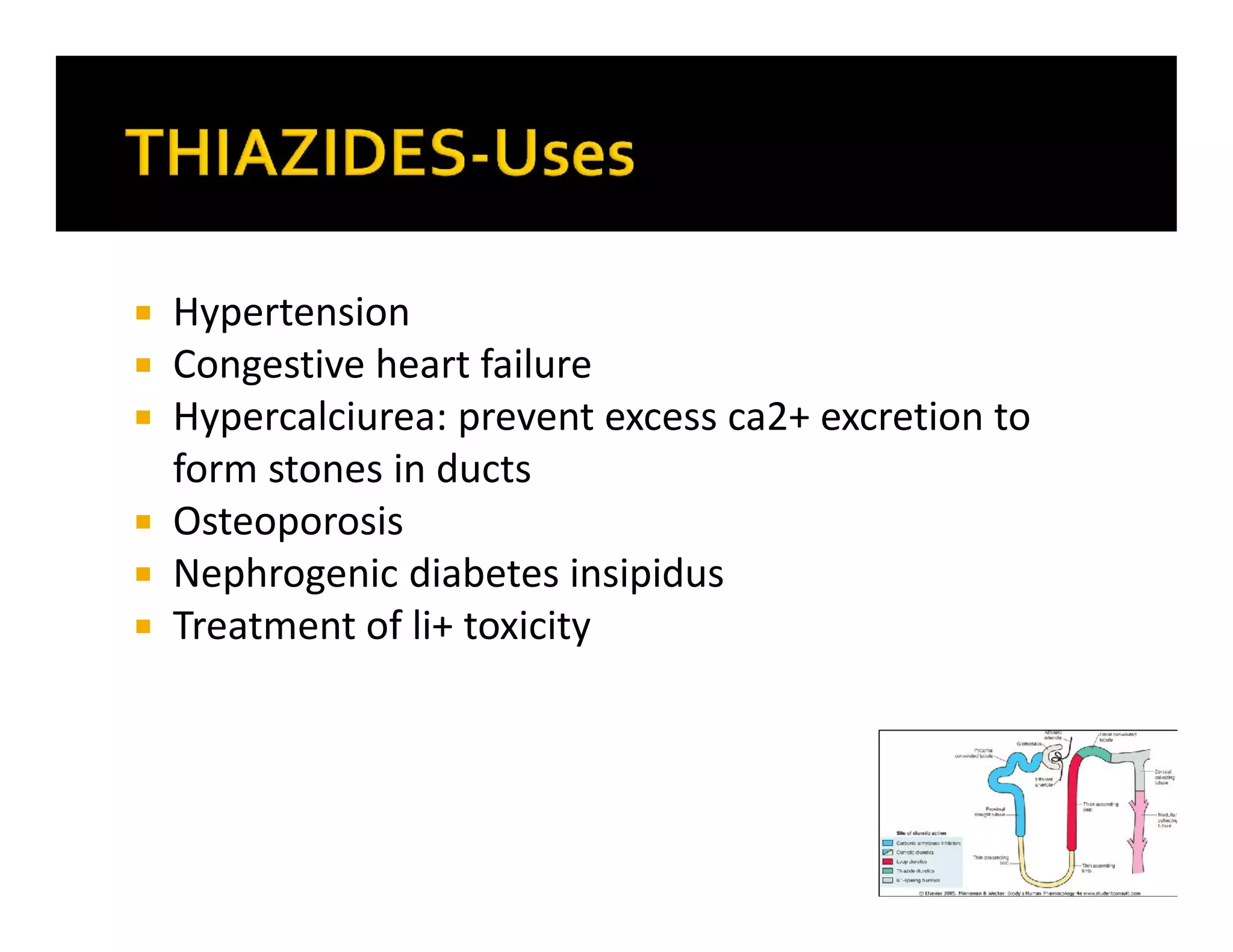
 Hypertension
 Congestive heart failure
 Hypercalciurea: prevent excess ca2+ excretion to
form stones in ducts
 Osteoporosis
 Nephrogenic diabetes insipidus
 Treatment of li+ toxicity
 Hypokalemia—digitalis toxicity
 Hyponatremia, hyperglycemia
 Hypochloremic alkalosis
 Diminished insulin secretion
 Elevated plasma lipids, hyperuricemia
 Hypercalcaemia
 Hypersensitivity reactions-sulfonamide derivative
 Spironolactone is a steroid compound, which is a
competitive aldosterone antagonist.
 It increases Na+ excretion and decreases K+ and
urea excretion. Its diuretic action is weak and is
achieved slowly.
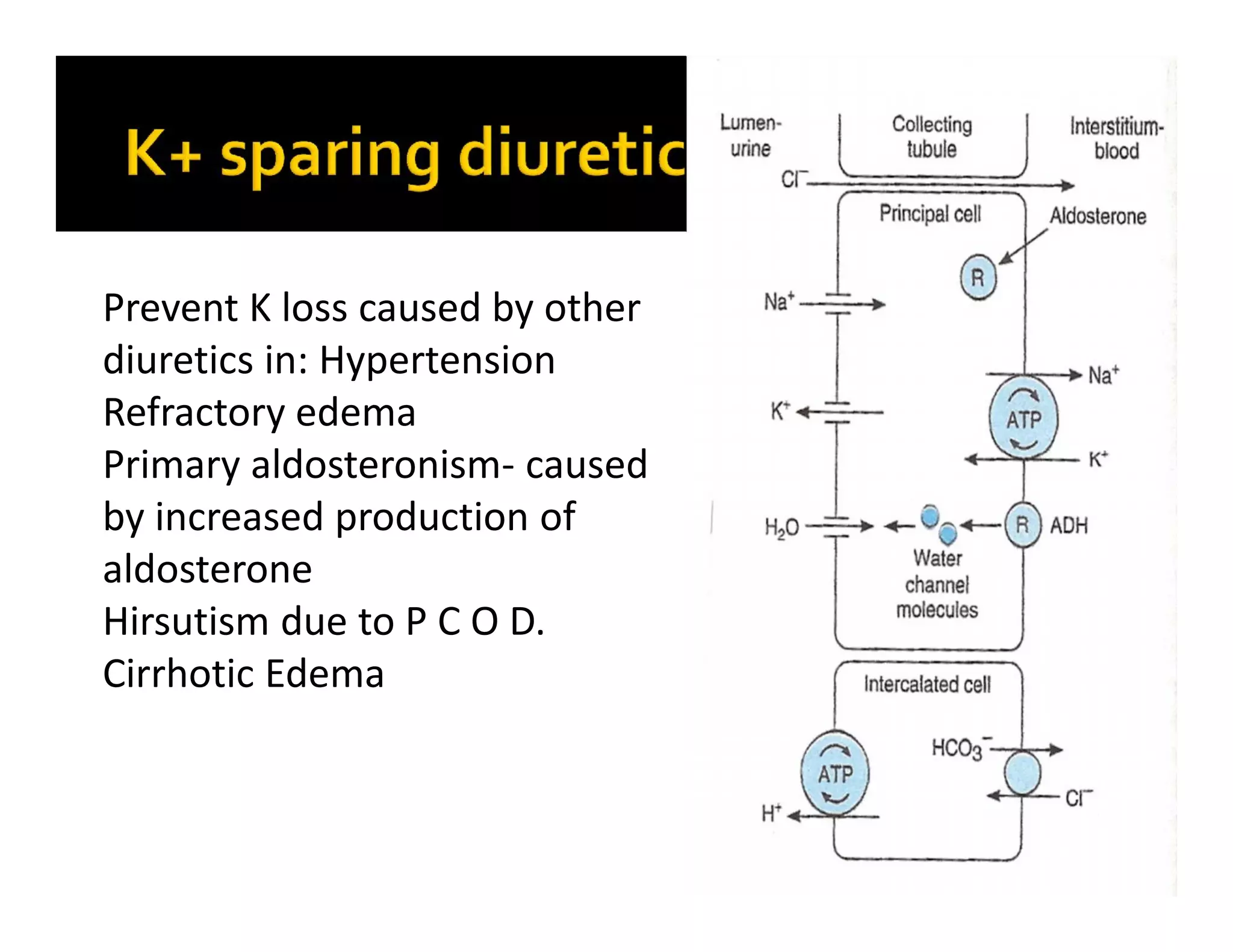
Prevent K loss caused by other
diuretics in: Hypertension
Refractory edema
Primary aldosteronism- caused
by increased production of
aldosterone
Hirsutism due to P C O D.
Cirrhotic Edema
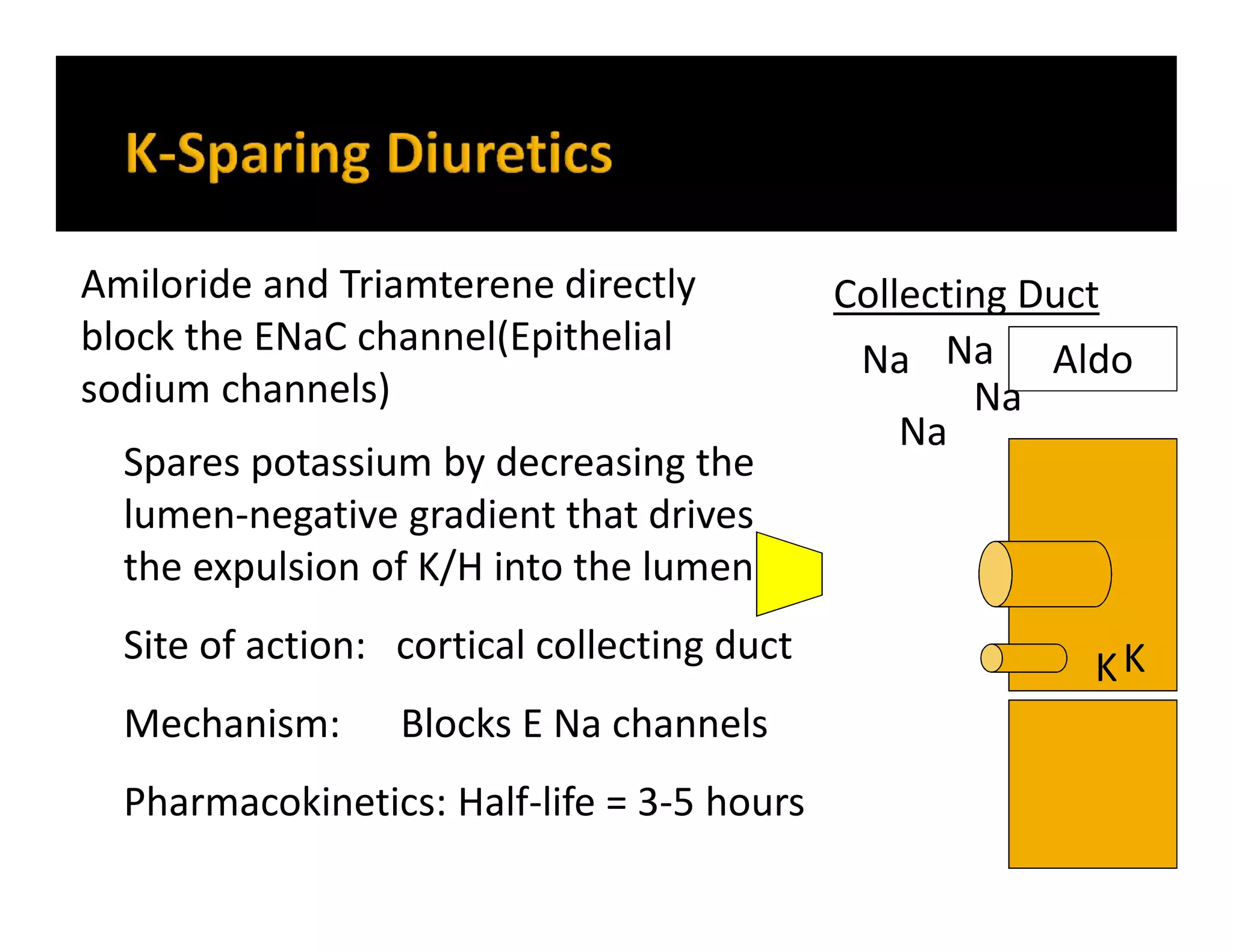
Collecting Duct
Na Na
Na
Na
Amiloride and Triamterene directly
block the ENaC channel(Epithelial
sodium channels)
Aldo
Spares potassium by decreasing the
lumen-negative gradient that drives
the expulsion of K/H into the lumen
Site of action: cortical collecting duct
Mechanism: Blocks E Na channels
Pharmacokinetics: Half-life = 3-5 hours
KK
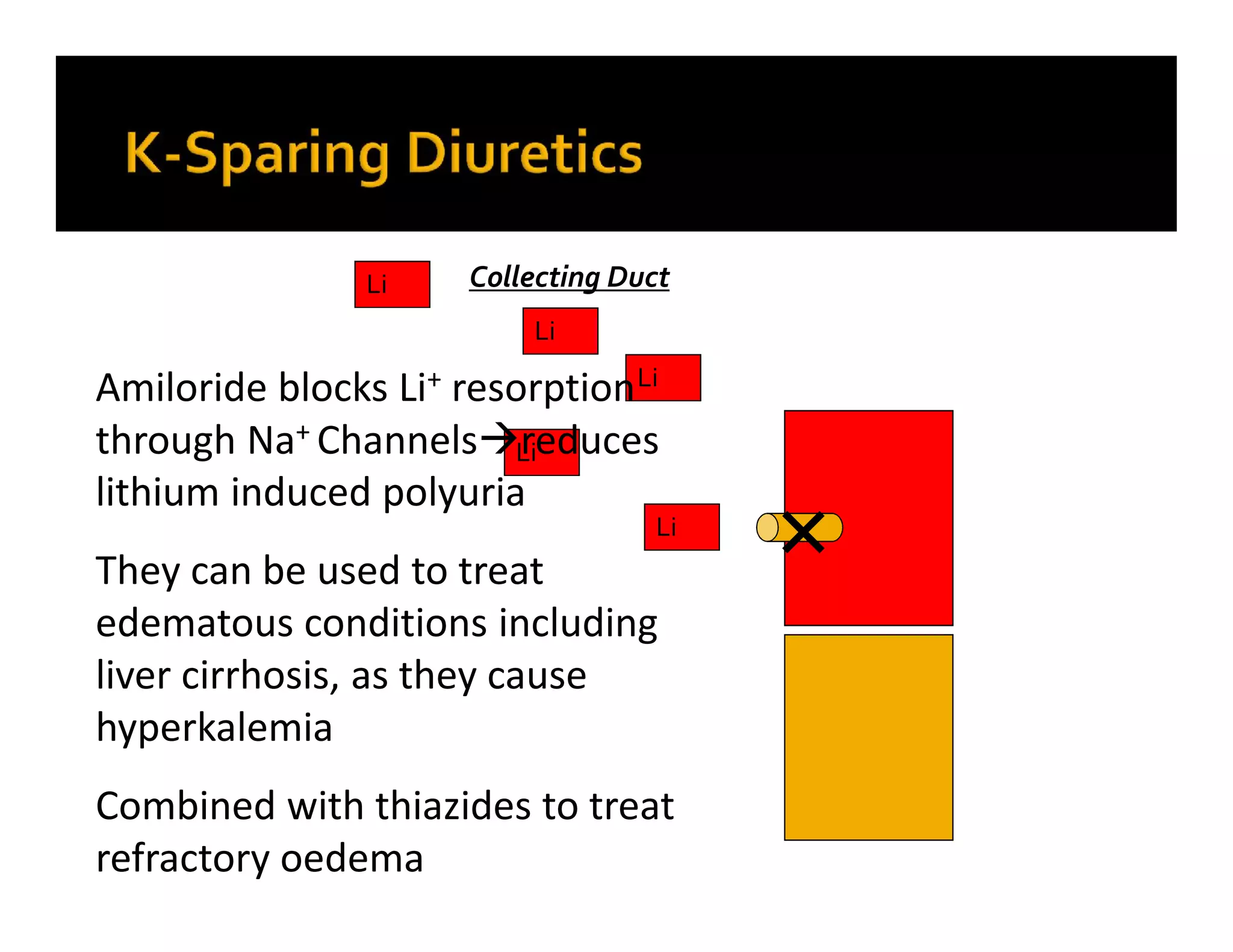
Collecting Duct
Li
Li
Li
Li
Li
Amiloride blocks Li+ resorption
through Na+ Channelsreduces
lithium induced polyuria
They can be used to treat
edematous conditions including
liver cirrhosis, as they cause
hyperkalemia
Combined with thiazides to treat
refractory oedema
 Hyperkalemia-better to avoid K+ supplementation
 Drug interaction - do not use their combination,
since the potassium sparing effect is greater than
additive
 Caution with ACE inhibitors
 Reversible azotemia (triamterine)
 Triamterene nephrolithiasis.
Acetazolamide
prototype carbonic anhydrase inhibitor
developed from sulfanilamide (causes metabolic
acidosis and alkaline urine)
limited uses as diuretic
It is well absorbed orally and excreted unchanged in
urine
Action lasts for 8-12hrs
1
1
1
1
1
1
1
1
1
1
1
1
1
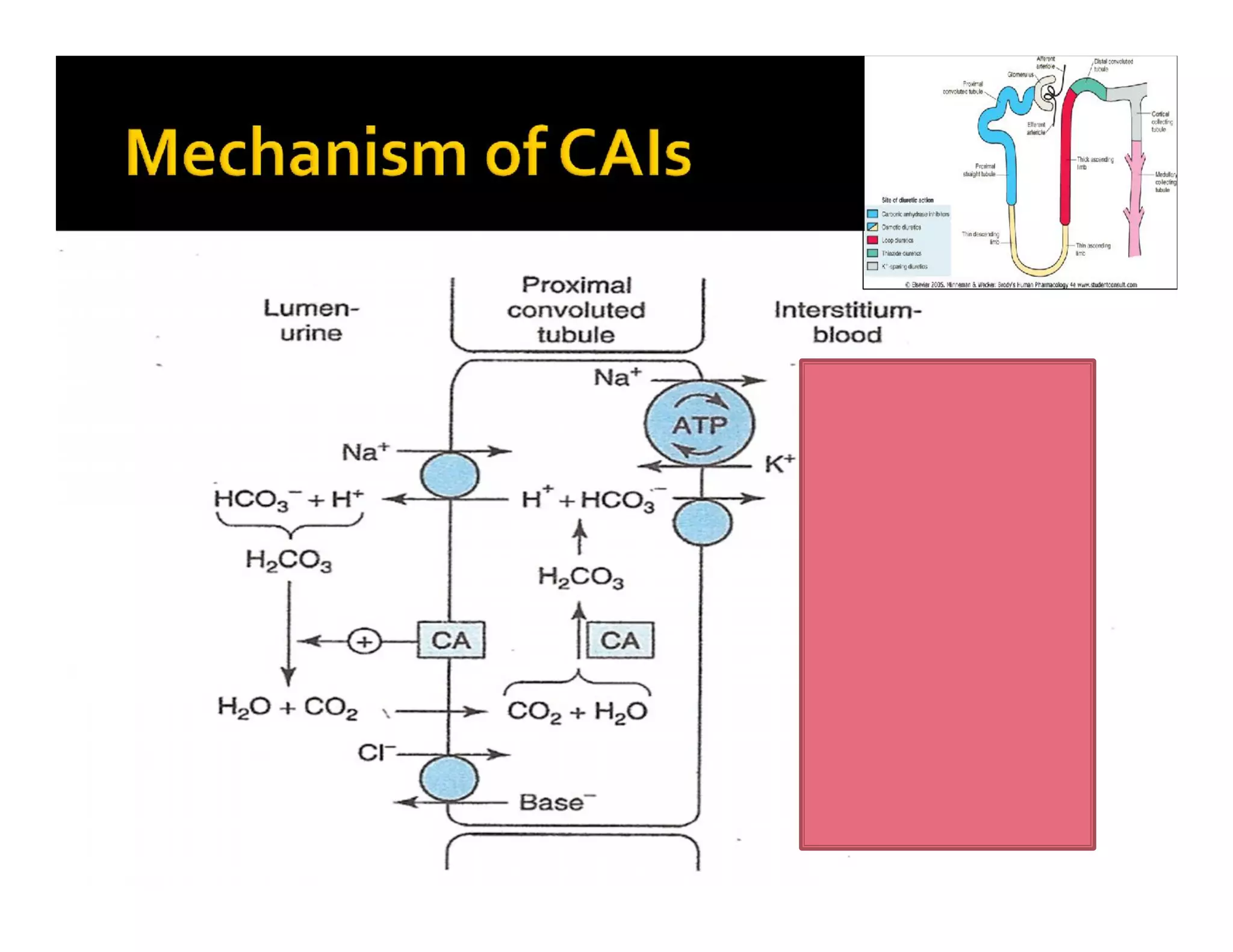
inhibits carbonic anhydrase in
renal proximal tubule cells
carbonic anhydrase catalyzes
formation of HCO3- and H+ from
H2O and CO2
inhibition of carbonic anhydrase
decreases [H+] in tubule lumen
less H+ for Na+/H+ exchange
increased lumen Na+, increased
H2O retention
 Used to treat chronic open-angle glaucoma
aqueous humor has high [HCO3-]
 Acute mountain sickness  decrease CSF formation
and by decreasing pH
 Metabolic alkalosis they can produce
hyperchloremic acidosis
 Sometimes in epilepsy decreasing the pH
 Mostly used in combination with other diuretics in
resistant patients
 Alkalinisation of urine
Rapid tolerance
Increased HCO3- excretion causes metabolic acidosis
Drowsiness, fatigue, CNS depression
Paresthesia (pins and needles under skin)
Nephrolithiasis (renal stones), K+ wasting
Mannitol (prototype), Glycerol,
Mannitol is a nonelectrolyte of low molecular weight and is
pharmacologically inert freely filtered at glomerulus
Do not interact with receptors or directly block renal transport
activity dependent on development of osmotic pressure
Osmotic diuretics are not reabsorbed
Increases osmotic pressure specifically in the proximal tubule
and loop of Henle expands Extracellular volume
Inhibits transport processes in thick ascending LH
Prevents passive reabsorption of H2o
It increases urinary volume, excretion of all cations(Na, K,Mg,
Ca) and anions(Cl, HCO3, PO4)
Uses
To treat oliguria state in shock
Cerebral edema and glaucoma
To maintain GFR and urine flow in acute renal failure
Adverse effects
 Osmotic diarrhea- mannitol
 May worsen cardiac failure and pulmonary edema
C/I- acute tubular necrosis, anuria, pulmonary edema, CHF,
cerebral hemorrhage, left ventricular failure
Loop diuretics can be used to treat mild to moderate
hypercalcaemia
Thiazides reduce volume of urine in diabetes
insipidus more water reabsorption from collecting
ducts
Thiazides are helpful in idiopathic hypercalciurea
Potassium sparing diuretics can reduce lithium induced
polyuria
Amiloride can be used to treat cystic fibrosis by
increasing the fluidity in respiratory secretions
Spironolactone in congestive heart failure retards the
disease progression and reduces mortality
Carbonic anhydrase inhibitors and osmotic diuretics in
glaucoma
Osmotic diuretic in cerebral oedema
CAs can be used in metabolic alkalosis-as they produce
hyperchloremic acidosis
CAs can be used to treat petitmal epilepsy
Acute mountain sickness
Download slides from
Authorstream-raghuprasada
Slideshare-raghuprasada
Youtube-raghuprasada

Class diuretics

  • 1.
    Dr. RAGHU PRASADAM S MBBS,MD ASSISTANT PROFESSOR DEPT. OF PHARMACOLOGY SSIMS & RC. 1
  • 2.
     DIRECTLY ACTING A)Acting on thick ascending loop of henle- FUROSEMIDE, BUMETANIDE, TORSEMIDE, PIRETANIDE,ETHACRYNIC ACID, INDACRINONE(uricosuric drug) B) Acting on proximal part of distal tubule THIAZIDE group- HYDROCHLORTHIAZIDE, CHLORTHIAZIDE, BENZTHIAZIDE, POLYTHIAZIDE, THIAZIDE like-CHLORTHALIDONE, METOLAZONE INDAPAMIDE, ZIPAMIDE
  • 3.
    C) Those actingon collecting ducts and tubules AMILORIDE, TRIAMTERINE Aldosterone antagonist- SPIRONOLACTONE, EPLERENONE INDIRECTLY ACTING Osmotic diuretics- MANNITOL, GLYCEROL Carbonic anhydrase inhibitors- ACETAZOLAMIDE, DORZOLAMIDE, ETHOXZOLAMIDE, METHAZOLAMIDE, DICHLORPHENAMIDE
  • 4.
    70% 20% 5% 4.5% 0.5% Volume 1.5 L/day UrineNa 100 mEq/L Na Excretion 155 mEq/day 100% GFR 180 L/day Plasma Na 145 mEq/L Filtered Load 26,100 mEq/day Collecting duct Thick Ascending Limb
  • 6.
     Ethacrynic acid-ototoxicity,hepatotoxicity, hypochloremic alkalosis  Furosemide  Bumetanide – 40 times potent  Torsemide – three times potent and long acting  Indacrinone –gout patients
  • 8.
  • 9.
    RENAL TUBULAR INTERSTITIUM LUMEN Na+ K+ Cl- TPC Na+ H+ Na+ K+ PARACELLULARDIFFUSION Na+ K+ Mg++ Ca++ Cl- +8 mV THICK ASCENDING LOOP LOOP DIURETICS
  • 10.
     Edematous conditionsassociated with CCF,  Cirrhosis of liver, renal disease including nephrotic syndrome  Hypertension  Acute renal failure  Toxicity of ions  Mild hyperkalemia Non-diuretic use-moderate hypercalcaemia
  • 11.
    Hyperuricemia Hypercalciurea and hypomagnesaemia Hypokalemia Ototoxicity Hyperglycemia Hypersensitivityreactions RESISTANCE TO LOOP DIURETICS Renal insufficiency Nephrotic syndrome Cirrhosis of liver Congestive heart failure
  • 12.
     Digitalis toxicity—dueto hypokalemia  Elevated serum lithium levels  Aminoglycosides – increased ototoxicity  NSAIDs diminish the action  Probenacid competitive inhibition  Cotrimoxazole –thrombocytopenia
  • 13.
    MECHANISM OF ACTION InhibitNa+ and Cl- transporter in distal convoluted tubules Increased Na+ and Cl- excretion Weak inhibitors of carbonic anhydrase, increased HCO3- excretion Increased K+/mg2+ excretion Decrease Ca2+ excretion
  • 14.
     Early DCT Late DCT Na+ Cl- LUMEN K+ Na+ Cl- THIAZIDES
  • 15.
     Hypertension  Congestiveheart failure  Hypercalciurea: prevent excess ca2+ excretion to form stones in ducts  Osteoporosis  Nephrogenic diabetes insipidus  Treatment of li+ toxicity
  • 16.
     Hypokalemia—digitalis toxicity Hyponatremia, hyperglycemia  Hypochloremic alkalosis  Diminished insulin secretion  Elevated plasma lipids, hyperuricemia  Hypercalcaemia  Hypersensitivity reactions-sulfonamide derivative
  • 17.
     Spironolactone isa steroid compound, which is a competitive aldosterone antagonist.  It increases Na+ excretion and decreases K+ and urea excretion. Its diuretic action is weak and is achieved slowly.
  • 18.
    Prevent K losscaused by other diuretics in: Hypertension Refractory edema Primary aldosteronism- caused by increased production of aldosterone Hirsutism due to P C O D. Cirrhotic Edema
  • 19.
    Collecting Duct Na Na Na Na Amilorideand Triamterene directly block the ENaC channel(Epithelial sodium channels) Aldo Spares potassium by decreasing the lumen-negative gradient that drives the expulsion of K/H into the lumen Site of action: cortical collecting duct Mechanism: Blocks E Na channels Pharmacokinetics: Half-life = 3-5 hours KK
  • 20.
    Collecting Duct Li Li Li Li Li Amiloride blocksLi+ resorption through Na+ Channelsreduces lithium induced polyuria They can be used to treat edematous conditions including liver cirrhosis, as they cause hyperkalemia Combined with thiazides to treat refractory oedema
  • 21.
     Hyperkalemia-better toavoid K+ supplementation  Drug interaction - do not use their combination, since the potassium sparing effect is greater than additive  Caution with ACE inhibitors  Reversible azotemia (triamterine)  Triamterene nephrolithiasis.
  • 22.
    Acetazolamide prototype carbonic anhydraseinhibitor developed from sulfanilamide (causes metabolic acidosis and alkaline urine) limited uses as diuretic It is well absorbed orally and excreted unchanged in urine Action lasts for 8-12hrs
  • 23.
  • 24.
    inhibits carbonic anhydrasein renal proximal tubule cells carbonic anhydrase catalyzes formation of HCO3- and H+ from H2O and CO2 inhibition of carbonic anhydrase decreases [H+] in tubule lumen less H+ for Na+/H+ exchange increased lumen Na+, increased H2O retention
  • 25.
     Used totreat chronic open-angle glaucoma aqueous humor has high [HCO3-]  Acute mountain sickness  decrease CSF formation and by decreasing pH  Metabolic alkalosis they can produce hyperchloremic acidosis  Sometimes in epilepsy decreasing the pH  Mostly used in combination with other diuretics in resistant patients  Alkalinisation of urine
  • 26.
    Rapid tolerance Increased HCO3-excretion causes metabolic acidosis Drowsiness, fatigue, CNS depression Paresthesia (pins and needles under skin) Nephrolithiasis (renal stones), K+ wasting
  • 27.
    Mannitol (prototype), Glycerol, Mannitolis a nonelectrolyte of low molecular weight and is pharmacologically inert freely filtered at glomerulus Do not interact with receptors or directly block renal transport activity dependent on development of osmotic pressure Osmotic diuretics are not reabsorbed Increases osmotic pressure specifically in the proximal tubule and loop of Henle expands Extracellular volume Inhibits transport processes in thick ascending LH Prevents passive reabsorption of H2o It increases urinary volume, excretion of all cations(Na, K,Mg, Ca) and anions(Cl, HCO3, PO4)
  • 28.
    Uses To treat oliguriastate in shock Cerebral edema and glaucoma To maintain GFR and urine flow in acute renal failure Adverse effects  Osmotic diarrhea- mannitol  May worsen cardiac failure and pulmonary edema C/I- acute tubular necrosis, anuria, pulmonary edema, CHF, cerebral hemorrhage, left ventricular failure
  • 29.
    Loop diuretics canbe used to treat mild to moderate hypercalcaemia Thiazides reduce volume of urine in diabetes insipidus more water reabsorption from collecting ducts Thiazides are helpful in idiopathic hypercalciurea Potassium sparing diuretics can reduce lithium induced polyuria Amiloride can be used to treat cystic fibrosis by increasing the fluidity in respiratory secretions
  • 30.
    Spironolactone in congestiveheart failure retards the disease progression and reduces mortality Carbonic anhydrase inhibitors and osmotic diuretics in glaucoma Osmotic diuretic in cerebral oedema CAs can be used in metabolic alkalosis-as they produce hyperchloremic acidosis CAs can be used to treat petitmal epilepsy Acute mountain sickness
  • 31.