February11,2012
1
THALASSAEMIA –
HEMOGLOBINOPATHIES
Presented by: Dr. Neela Ferdoushi
2
February11,2012
THALASSEMIAS
 Thalassemias are a heterogenous group of
genetic disorders
Individuals with homozygous forms are
severely affected and die early in childhood
without treatment
Heterozygous individuals exhibit varying
levels of severity
The disorders are due to mutations that
decrease the rate of synthesis of one of the two
globin chains (α or β). The genetic defect may
be the result of:
3
February11,2012
THALASSEMIAS
 A mutation in the noncoding introns of the gene
resulting in inefficient RNA splicing to produce
mRNA, and therefore, decreased mRNA production
 The partial or total deletion of a globin gene
 A mutation in the promoter leading to decreased
expression
 A mutation at the termination site leading to
production of longer, unstable mRNA
 A nonsense mutation
Any of these defects lead to:
 An excess of the other normal globin chain
 A decrease in the normal amount of physiologic
hemoglobin made
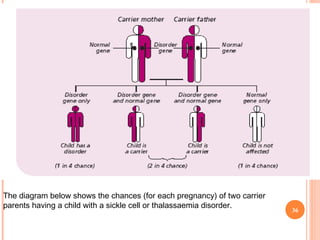
 Development of a hypochromic, microcytic anemia
4
February11,2012
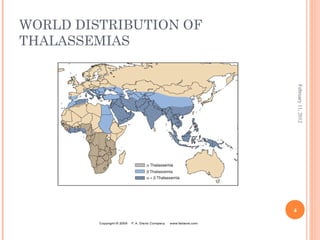
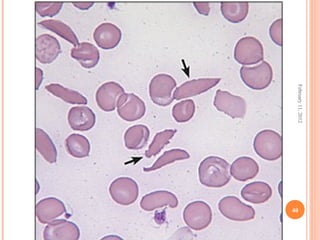
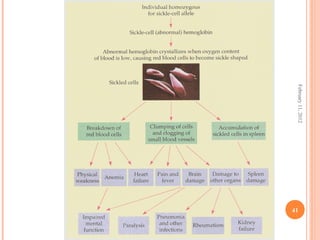
WORLD DISTRIBUTION OF
THALASSEMIAS
5
February11,2012
THALASSEMIAS
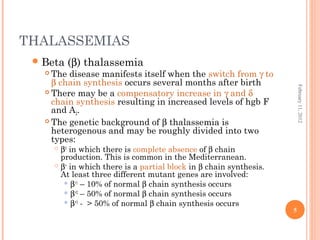
Beta (β) thalassemia
 The disease manifests itself when the switch from γ to
β chain synthesis occurs several months after birth
 There may be a compensatory increase in γ and δ
chain synthesis resulting in increased levels of hgb F
and A2.
 The genetic background of β thalassemia is
heterogenous and may be roughly divided into two
types:
 β0
in which there is complete absence of β chain
production. This is common in the Mediterranean.
 β+
in which there is a partial block in β chain synthesis.
At least three different mutant genes are involved:
 β+1
– 10% of normal β chain synthesis occurs
 β+2
– 50% of normal β chain synthesis occurs
 β+3
- > 50% of normal β chain synthesis occurs
6
February11,2012
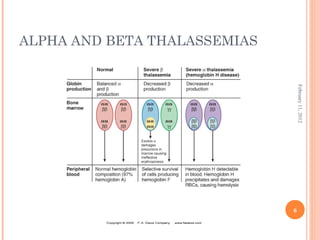
ALPHA AND BETA THALASSEMIAS
7
February11,2012
THALASSEMIAS
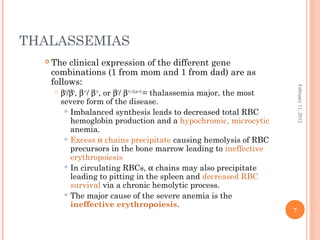
 The clinical expression of the different gene
combinations (1 from mom and 1 from dad) are as
follows:
 β0
/β0
, β+1
/ β+1
, or β0
/ β+1,+2,or +3
= thalassemia major, the most
severe form of the disease.
 Imbalanced synthesis leads to decreased total RBC
hemoglobin production and a hypochromic, microcytic
anemia.
 Excess α chains precipitate causing hemolysis of RBC
precursors in the bone marrow leading to ineffective
erythropoiesis
 In circulating RBCs, α chains may also precipitate
leading to pitting in the spleen and decreased RBC
survival via a chronic hemolytic process.
 The major cause of the severe anemia is the
ineffective erythropoiesis.
8
February11,2012
THALASSEMIAS
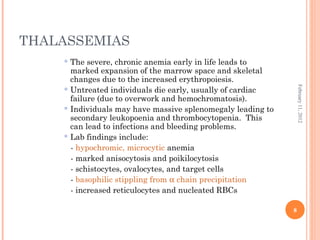
 The severe, chronic anemia early in life leads to
marked expansion of the marrow space and skeletal
changes due to the increased erythropoiesis.
 Untreated individuals die early, usually of cardiac
failure (due to overwork and hemochromatosis).
 Individuals may have massive splenomegaly leading to
secondary leukopoenia and thrombocytopenia. This
can lead to infections and bleeding problems.
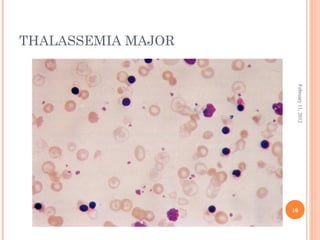
 Lab findings include:
- hypochromic, microcytic anemia
- marked anisocytosis and poikilocytosis
- schistocytes, ovalocytes, and target cells
- basophilic stippling from α chain precipitation
- increased reticulocytes and nucleated RBCs
9
February11,2012
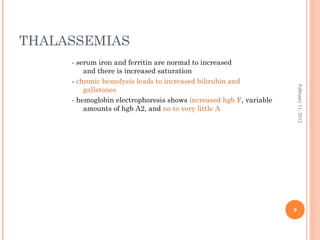
THALASSEMIAS
- serum iron and ferritin are normal to increased
and there is increased saturation
- chronic hemolysis leads to increased bilirubin and
gallstones
- hemoglobin electrophoresis shows increased hgb F, variable
amounts of hgb A2, and no to very little A
10
February11,2012
THALASSEMIA MAJOR
11
February11,2012
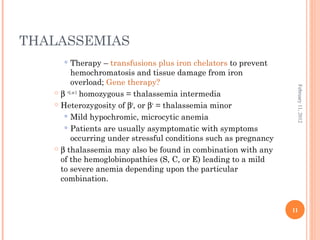
THALASSEMIAS
 Therapy – transfusions plus iron chelators to prevent
hemochromatosis and tissue damage from iron
overload; Gene therapy?
 β +2, or 3
homozygous = thalassemia intermedia
 Heterozygosity of β0
, or β+
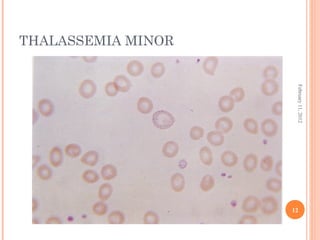
= thalassemia minor
 Mild hypochromic, microcytic anemia
 Patients are usually asymptomatic with symptoms
occurring under stressful conditions such as pregnancy
 β thalassemia may also be found in combination with any
of the hemoglobinopathies (S, C, or E) leading to a mild
to severe anemia depending upon the particular
combination.
12
February11,2012
THALASSEMIA MINOR
13
February11,2012
THALASSEMIAS
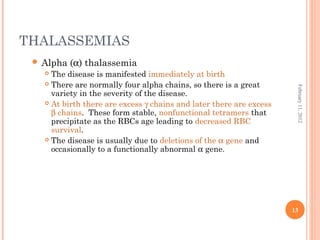
 Alpha (α) thalassemia
 The disease is manifested immediately at birth
 There are normally four alpha chains, so there is a great
variety in the severity of the disease.
 At birth there are excess γ chains and later there are excess
β chains. These form stable, nonfunctional tetramers that
precipitate as the RBCs age leading to decreased RBC
survival.
 The disease is usually due to deletions of the α gene and
occasionally to a functionally abnormal α gene.
14
February11,2012
THALASSEMIAS
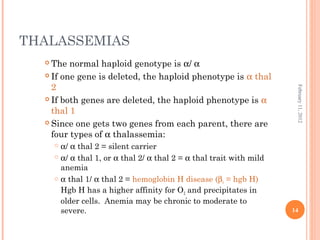
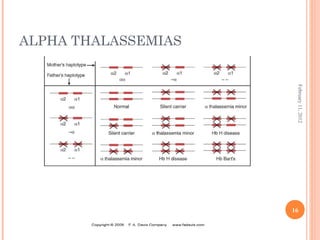
 The normal haploid genotype is α/ α
 If one gene is deleted, the haploid phenotype is α thal
2
 If both genes are deleted, the haploid phenotype is α
thal 1
 Since one gets two genes from each parent, there are
four types of α thalassemia:
 α/ α thal 2 = silent carrier
 α/ α thal 1, or α thal 2/ α thal 2 = α thal trait with mild
anemia
 α thal 1/ α thal 2 = hemoglobin H disease (β4 = hgb H)
Hgb H has a higher affinity for O2 and precipitates in
older cells. Anemia may be chronic to moderate to
severe.
15
February11,2012
THALASSEMIAS
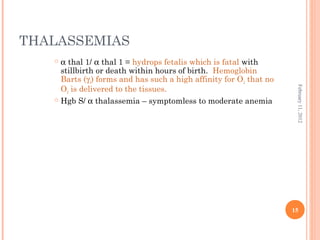
 α thal 1/ α thal 1 = hydrops fetalis which is fatal with
stillbirth or death within hours of birth. Hemoglobin
Barts (γ4) forms and has such a high affinity for O2 that no
O2 is delivered to the tissues.
 Hgb S/ α thalassemia – symptomless to moderate anemia
16
February11,2012
ALPHA THALASSEMIAS
17
February11,2012
THALASSEMIAS
Delta/beta (δ/β) thalassemia – both δ and β
chains are absent with no or little
compensatory increase in γ chain synthesis.
This leads to 100% hgb F and mild
hypochromic, microcytic anemia
Hereditary persistence of hgb F – are a group
of heterogenous disorders with the absence of δ
and β chain synthesis which is compensated
for by an increase in γ chain synthesis leading
to 100% hgb F. Since hgb F has an increased
affinity for O2, this results in polycythemia.
18
February11,2012
Primary Laboratory Investigation
Thalassemia
Variable hemogram results proportional to the
severity of the thalassemia
19
February11,2012
Primary Laboratory Investigation
Thalassemia
• Severe cases present with
• Microcytosis
• Hypochromia
• Poikilocytosis
• RBC counts higher than expected for the level of
anemia
20
February11,2012
Primary Laboratory Investigation
Thalassemia
• Findings in severe cases can mimic those seen in
other microcytic/hypochromic anemias
• Results of the reticulocyte count are variable
• NRBCs may be present (contrast with iron
deficiency anemia)
21
February11,2012
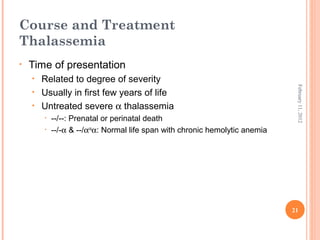
Course and Treatment
Thalassemia
• Time of presentation
• Related to degree of severity
• Usually in first few years of life
• Untreated severe α thalassemia
• --/--: Prenatal or perinatal death
• --/-α & --/αcs
α: Normal life span with chronic hemolytic anemia
22
February11,2012
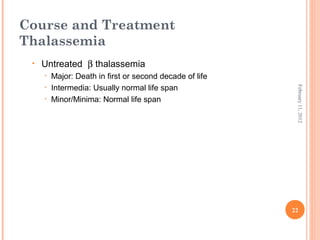
Course and Treatment
Thalassemia
• Untreated β thalassemia
• Major: Death in first or second decade of life
• Intermedia: Usually normal life span
• Minor/Minima: Normal life span
Haemoglobinopathy
24
February11,2012
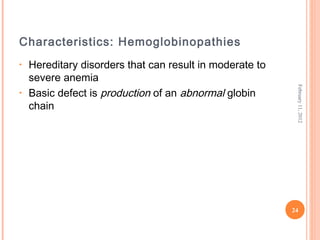
Characteristics: Hemoglobinopathies
• Hereditary disorders that can result in moderate to
severe anemia
• Basic defect is production of an abnormal globin
chain
25
February11,2012
Definition:
The haemoglobinopathies are inherited disorders of
haemoglobin synthesis (thalassaemias) or structure (sickle
cell disorders) that are responsible for significant morbidity
and mortality allover the world.
They are seen mainly in individuals who originate from Africa,
the Middle East,, the Mediterranean, Asia and the Far East.
However, the increased mobility of the world’s population and
inter-ethnic mixing lead to prevailing of these conditions within
any region of the world.
26
February11,2012
These disorders result in errors in oxygen-carrying capacity
of haemoglobin . Diseases linked to genetic predisposition
are not only kill prematurely, but result in long years of ill
health and disability, loss of work and income, possible
poverty, loneliness and depression.
27
February11,2012
Sickle cell and thalassaemia are inherited disorders that are
passed on from parents to children through unusual
haemoglobin genes.
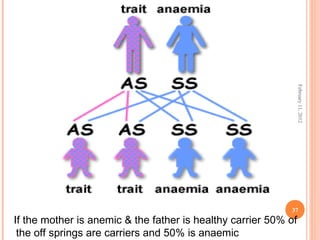
People only have these disorders if they inherit two unusual
haemoglobin genes – one from their mother, and one from their
father.
People who inherit just one unusual gene are known as ‘carriers’.
(Some people call this having a ‘trait’.) Carriers are healthy and do
not have the disorders.
28
February11,2012
Hemoglobinopathy Genetics
• Homozygous: Inheritance of two genes from each
parent coding for the same type of abnormal
hemoglobin, e.g., Hb SS
• Heterozygous: Inheritance of genes from each
parent which code for a different type of abnormal
hemoglobin each, e.g., Hb SC
29
February11,2012
Terminology
Hemoglobinopathy
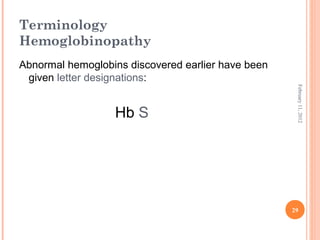
Abnormal hemoglobins discovered earlier have been
given letter designations:
Hb S
30
February11,2012
Amino Acid Substitution
Hemoglobinopathy
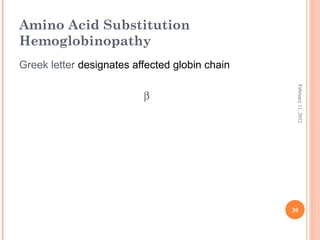
Greek letter designates affected globin chain
β
31
February11,2012
Amino Acid Substitution
Hemoglobinopathy
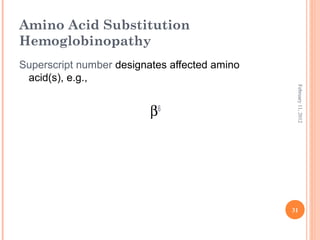
Superscript number designates affected amino
acid(s), e.g.,
β6
32
February11,2012
Amino Acid Substitution
Hemoglobinopathy
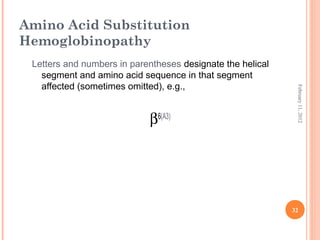
Letters and numbers in parentheses designate the helical
segment and amino acid sequence in that segment
affected (sometimes omitted), e.g.,
β6(A3)
33
February11,2012
Amino Acid Substitution
Hemoglobinopathy
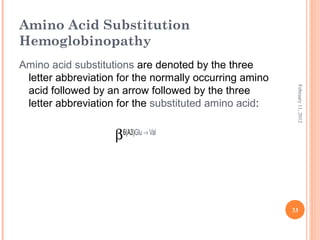
Amino acid substitutions are denoted by the three
letter abbreviation for the normally occurring amino
acid followed by an arrow followed by the three
letter abbreviation for the substituted amino acid:
β6(A3)Glu → Val
34
February11,2012
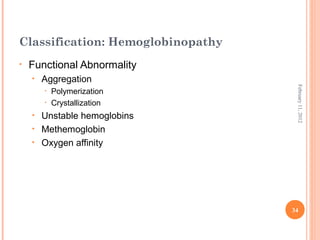
Classification: Hemoglobinopathy
• Functional Abnormality
• Aggregation
• Polymerization
• Crystallization
• Unstable hemoglobins
• Methemoglobin
• Oxygen affinity
35
February11,2012
Individuals with Haemoglobinopathy are:
either healthy carriers (trait ) i.e. unaware of their carrier
status unless specifically screened. If a couple both carry a
haemoglobinopathy trait there is a 1 in 4 chance with each
pregnancy that their child will inherit a clinically manifested
haemoglobinopathy.
or having clinically manifested haemoglobinopathy
36
February11,2012
The diagram below shows the chances (for each pregnancy) of two carrier
parents having a child with a sickle cell or thalassaemia disorder.
37
February11,2012
If the mother is anemic & the father is healthy carrier 50% of
the off springs are carriers and 50% is anaemic
38
February11,2012
Sickle Cell is a condition that affects the normal oxygen carrying
capacity of red blood cells. When the cells are de-oxygenated and
under stress in sickle cell conditions, they can change from round
flexible disc-like cells to elongated sickle or crescent moon shape.
The effect of these changes is that the cells do not pass freely
through small capillaries and form clusters, which block the blood
vessels. This blockage prevents oxygenation of the tissues in the
affected areas resulting in tissue hypoxia and consequent pain
(known as sickle cell crisis pain) other symptoms of sickle cell
disorders include severe anaemia, susceptibility to infections and
damage to major organs.
39
February11,2012
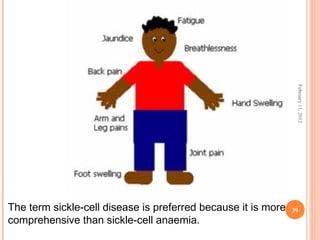
The term sickle-cell disease is preferred because it is more
comprehensive than sickle-cell anaemia.
40
February11,2012
41
February11,2012
42
February11,2012
In children, sickle-shaped red blood cells often become trapped
in the spleen, leading to a serious risk of death before the age of
seven years from a sudden profound anaemia associated with
rapid splenic enlargement or because lack of splenic function
permits an infection.
Affected children may present with painful swelling of the hands
and/or feet (hand-foot syndrome).
Survivors may suffer recurrent & severe painful crises, as well
as “acute chest syndrome” (pneumonia or pulmonary infarction),
bone or joint necrosis, or renal failure.
43
February11,2012
Primary Laboratory Investigation
Hemoglobinopathy
• Variety of hemogram findings depending on
• Type
• Severity
of the specific disorder
• Only sickle hemoglobinopathies and Hb C will be
described here
44
February11,2012
Primary Laboratory Investigation
Heterozygous & Other Disorders
• AS
• S-Thal
• Other hemoglobinopathies, e.g., SC
• Hb C
45
February11,2012
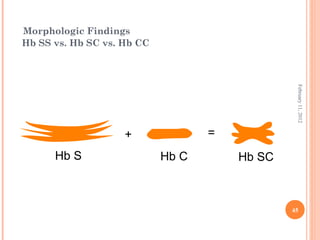
Morphologic Findings
Hb SS vs. Hb SC vs. Hb CC
=+
Hb S Hb C Hb SC
46
February11,2012
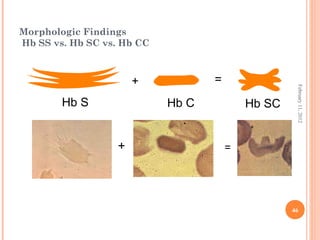
Morphologic Findings
Hb SS vs. Hb SC vs. Hb CC
=+
Hb S Hb C Hb SC
+ =
47
February11,2012
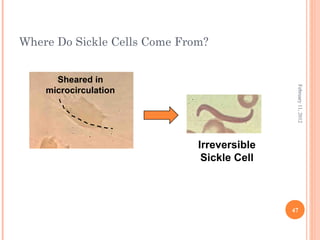
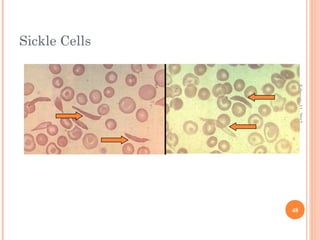
Where Do Sickle Cells Come From?
Sheared in
microcirculation
Irreversible
Sickle Cell
48
February11,2012
Sickle Cells
49
February11,2012
Secondary Laboratory Investigation
• Hemoglobin electrophoresis
• Major test for identifying thalassemia and
hemoglobinopathy
• Types
• Cellulose acetate: Alkaline pH
• Citrate agar: Acid ph
50
February11,2012
Secondary Laboratory Investigation
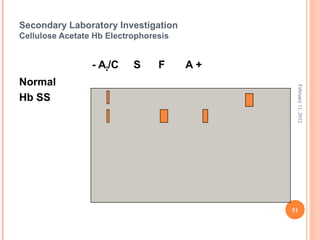
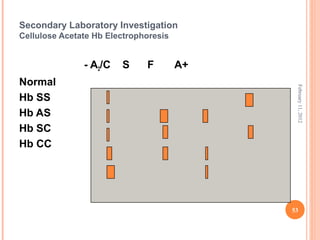
Cellulose Acetate Hb Electrophoresis
- A2/C S F A +
Normal
51
February11,2012
Secondary Laboratory Investigation
Cellulose Acetate Hb Electrophoresis
- A2/C S F A +
Normal
Hb SS
52
February11,2012
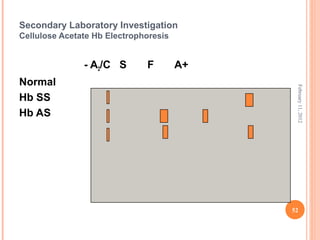
Secondary Laboratory Investigation
Cellulose Acetate Hb Electrophoresis
- A2/C S F A+
Normal
Hb SS
Hb AS
53
February11,2012
Secondary Laboratory Investigation
Cellulose Acetate Hb Electrophoresis
- A2/C S F A+
Normal
Hb SS
Hb AS
Hb SC
Hb CC
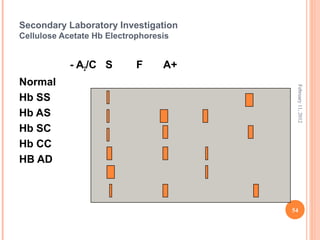
54
February11,2012
Secondary Laboratory Investigation
Cellulose Acetate Hb Electrophoresis
- A2/C S F A+
Normal
Hb SS
Hb AS
Hb SC
Hb CC
HB AD
55
February11,2012
Secondary Laboratory Investigation
• Solubility testing-Dithionite tube test
• Alkali denaturation test for quantification of fetal
hemoglobin
• Acid elution test for fetal hemoglobin distribution
• Unstable hemoglobin testing for Heinz bodies
56
February11,2012
Alkali Denaturation for Hemoglobin
F
• Recommended assay for hgb F in the range of 2-
40%
• Principle
• Other hemoglobins are more susceptible than hgb F to
denaturation at alkaline pH
• Denaturation stopped by addition of ammonium
sulphate
• Denatured hemoglobin precipitates
57
February11,2012
Alkali Denaturation for Hemoglobin
F
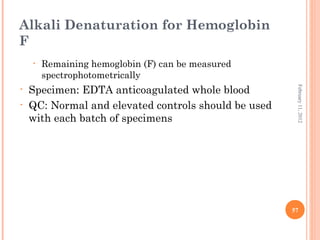
• Remaining hemoglobin (F) can be measured
spectrophotometrically
• Specimen: EDTA anticoagulated whole blood
• QC: Normal and elevated controls should be used
with each batch of specimens
58
February11,2012
Alkali Denaturation for Hemoglobin
F
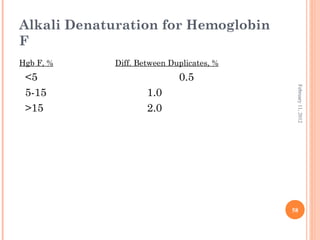
Hgb F, % Diff. Between Duplicates, %
<5 0.5
5-15 1.0
>15 2.0
59
February11,2012
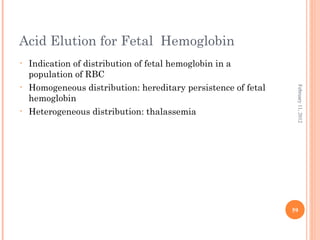
Acid Elution for Fetal Hemoglobin
• Indication of distribution of fetal hemoglobin in a
population of RBC
• Homogeneous distribution: hereditary persistence of fetal
hemoglobin
• Heterogeneous distribution: thalassemia
60
February11,2012
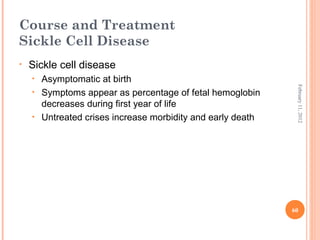
Course and Treatment
Sickle Cell Disease
• Sickle cell disease
• Asymptomatic at birth
• Symptoms appear as percentage of fetal hemoglobin
decreases during first year of life
• Untreated crises increase morbidity and early death
61
February11,2012
Course and Treatment
Sickle Cell Disease
• Sickle cell disease
• Asymptomatic at birth
• Symptoms appear as percentage of fetal hemoglobin
decreases during first year of life
• Untreated crises increase morbidity and early death
62
February11,2012
Course and Treatment
Sickle Cell Disease
• Life span can be significantly increased with early and
effective treatment
• Studies of natural populations reveal that individuals
with sickle cell disease are capable of normal life spans
63
February11,2012
Course and Treatment
In both thalassemia and hemoglobinopathy therapy is
usually supportive rather than curative
64
February11,2012
Course and Treatment
• Blood transfusion is used to
• Control severe anemia
• Reduce the risk of complications of sickle
hemoglobinopathies (cerebrovascular accident,
hypersplenism, etc.)
65
February11,2012
Course and Treatment
• Chronic blood transfusion
• Results in iron overload of major organs resulting in
increased morbidity
• Laboratory monitoring
• Necessitates the use of chelating agents to remove
excess iron
66
February11,2012
Course and Treatment
• Excess iron can cause the appearance of sideroblastic
conditions
• Transfusion interferes with the typical laboratory findings
for the disorder
67
February11,2012
Course and Treatment
• Alternative treatment
• Activation of fetal hemoglobin genes
• Bone marrow transplantation
Thalassaemia hemoglobinopathies  dr.neela-feb_2012

Thalassaemia hemoglobinopathies dr.neela-feb_2012

  • 1.
  • 2.
    2 February11,2012 THALASSEMIAS  Thalassemias area heterogenous group of genetic disorders Individuals with homozygous forms are severely affected and die early in childhood without treatment Heterozygous individuals exhibit varying levels of severity The disorders are due to mutations that decrease the rate of synthesis of one of the two globin chains (α or β). The genetic defect may be the result of:
  • 3.
    3 February11,2012 THALASSEMIAS  A mutationin the noncoding introns of the gene resulting in inefficient RNA splicing to produce mRNA, and therefore, decreased mRNA production  The partial or total deletion of a globin gene  A mutation in the promoter leading to decreased expression  A mutation at the termination site leading to production of longer, unstable mRNA  A nonsense mutation Any of these defects lead to:  An excess of the other normal globin chain  A decrease in the normal amount of physiologic hemoglobin made  Development of a hypochromic, microcytic anemia
  • 4.
  • 5.
    5 February11,2012 THALASSEMIAS Beta (β) thalassemia The disease manifests itself when the switch from γ to β chain synthesis occurs several months after birth  There may be a compensatory increase in γ and δ chain synthesis resulting in increased levels of hgb F and A2.  The genetic background of β thalassemia is heterogenous and may be roughly divided into two types:  β0 in which there is complete absence of β chain production. This is common in the Mediterranean.  β+ in which there is a partial block in β chain synthesis. At least three different mutant genes are involved:  β+1 – 10% of normal β chain synthesis occurs  β+2 – 50% of normal β chain synthesis occurs  β+3 - > 50% of normal β chain synthesis occurs
  • 6.
  • 7.
    7 February11,2012 THALASSEMIAS  The clinicalexpression of the different gene combinations (1 from mom and 1 from dad) are as follows:  β0 /β0 , β+1 / β+1 , or β0 / β+1,+2,or +3 = thalassemia major, the most severe form of the disease.  Imbalanced synthesis leads to decreased total RBC hemoglobin production and a hypochromic, microcytic anemia.  Excess α chains precipitate causing hemolysis of RBC precursors in the bone marrow leading to ineffective erythropoiesis  In circulating RBCs, α chains may also precipitate leading to pitting in the spleen and decreased RBC survival via a chronic hemolytic process.  The major cause of the severe anemia is the ineffective erythropoiesis.
  • 8.
    8 February11,2012 THALASSEMIAS  The severe,chronic anemia early in life leads to marked expansion of the marrow space and skeletal changes due to the increased erythropoiesis.  Untreated individuals die early, usually of cardiac failure (due to overwork and hemochromatosis).  Individuals may have massive splenomegaly leading to secondary leukopoenia and thrombocytopenia. This can lead to infections and bleeding problems.  Lab findings include: - hypochromic, microcytic anemia - marked anisocytosis and poikilocytosis - schistocytes, ovalocytes, and target cells - basophilic stippling from α chain precipitation - increased reticulocytes and nucleated RBCs
  • 9.
    9 February11,2012 THALASSEMIAS - serum ironand ferritin are normal to increased and there is increased saturation - chronic hemolysis leads to increased bilirubin and gallstones - hemoglobin electrophoresis shows increased hgb F, variable amounts of hgb A2, and no to very little A
  • 10.
  • 11.
    11 February11,2012 THALASSEMIAS  Therapy –transfusions plus iron chelators to prevent hemochromatosis and tissue damage from iron overload; Gene therapy?  β +2, or 3 homozygous = thalassemia intermedia  Heterozygosity of β0 , or β+ = thalassemia minor  Mild hypochromic, microcytic anemia  Patients are usually asymptomatic with symptoms occurring under stressful conditions such as pregnancy  β thalassemia may also be found in combination with any of the hemoglobinopathies (S, C, or E) leading to a mild to severe anemia depending upon the particular combination.
  • 12.
  • 13.
    13 February11,2012 THALASSEMIAS  Alpha (α)thalassemia  The disease is manifested immediately at birth  There are normally four alpha chains, so there is a great variety in the severity of the disease.  At birth there are excess γ chains and later there are excess β chains. These form stable, nonfunctional tetramers that precipitate as the RBCs age leading to decreased RBC survival.  The disease is usually due to deletions of the α gene and occasionally to a functionally abnormal α gene.
  • 14.
    14 February11,2012 THALASSEMIAS  The normalhaploid genotype is α/ α  If one gene is deleted, the haploid phenotype is α thal 2  If both genes are deleted, the haploid phenotype is α thal 1  Since one gets two genes from each parent, there are four types of α thalassemia:  α/ α thal 2 = silent carrier  α/ α thal 1, or α thal 2/ α thal 2 = α thal trait with mild anemia  α thal 1/ α thal 2 = hemoglobin H disease (β4 = hgb H) Hgb H has a higher affinity for O2 and precipitates in older cells. Anemia may be chronic to moderate to severe.
  • 15.
    15 February11,2012 THALASSEMIAS  α thal1/ α thal 1 = hydrops fetalis which is fatal with stillbirth or death within hours of birth. Hemoglobin Barts (γ4) forms and has such a high affinity for O2 that no O2 is delivered to the tissues.  Hgb S/ α thalassemia – symptomless to moderate anemia
  • 16.
  • 17.
    17 February11,2012 THALASSEMIAS Delta/beta (δ/β) thalassemia– both δ and β chains are absent with no or little compensatory increase in γ chain synthesis. This leads to 100% hgb F and mild hypochromic, microcytic anemia Hereditary persistence of hgb F – are a group of heterogenous disorders with the absence of δ and β chain synthesis which is compensated for by an increase in γ chain synthesis leading to 100% hgb F. Since hgb F has an increased affinity for O2, this results in polycythemia.
  • 18.
    18 February11,2012 Primary Laboratory Investigation Thalassemia Variablehemogram results proportional to the severity of the thalassemia
  • 19.
    19 February11,2012 Primary Laboratory Investigation Thalassemia •Severe cases present with • Microcytosis • Hypochromia • Poikilocytosis • RBC counts higher than expected for the level of anemia
  • 20.
    20 February11,2012 Primary Laboratory Investigation Thalassemia •Findings in severe cases can mimic those seen in other microcytic/hypochromic anemias • Results of the reticulocyte count are variable • NRBCs may be present (contrast with iron deficiency anemia)
  • 21.
    21 February11,2012 Course and Treatment Thalassemia •Time of presentation • Related to degree of severity • Usually in first few years of life • Untreated severe α thalassemia • --/--: Prenatal or perinatal death • --/-α & --/αcs α: Normal life span with chronic hemolytic anemia
  • 22.
    22 February11,2012 Course and Treatment Thalassemia •Untreated β thalassemia • Major: Death in first or second decade of life • Intermedia: Usually normal life span • Minor/Minima: Normal life span
  • 23.
  • 24.
    24 February11,2012 Characteristics: Hemoglobinopathies • Hereditarydisorders that can result in moderate to severe anemia • Basic defect is production of an abnormal globin chain
  • 25.
    25 February11,2012 Definition: The haemoglobinopathies areinherited disorders of haemoglobin synthesis (thalassaemias) or structure (sickle cell disorders) that are responsible for significant morbidity and mortality allover the world. They are seen mainly in individuals who originate from Africa, the Middle East,, the Mediterranean, Asia and the Far East. However, the increased mobility of the world’s population and inter-ethnic mixing lead to prevailing of these conditions within any region of the world.
  • 26.
    26 February11,2012 These disorders resultin errors in oxygen-carrying capacity of haemoglobin . Diseases linked to genetic predisposition are not only kill prematurely, but result in long years of ill health and disability, loss of work and income, possible poverty, loneliness and depression.
  • 27.
    27 February11,2012 Sickle cell andthalassaemia are inherited disorders that are passed on from parents to children through unusual haemoglobin genes. People only have these disorders if they inherit two unusual haemoglobin genes – one from their mother, and one from their father. People who inherit just one unusual gene are known as ‘carriers’. (Some people call this having a ‘trait’.) Carriers are healthy and do not have the disorders.
  • 28.
    28 February11,2012 Hemoglobinopathy Genetics • Homozygous:Inheritance of two genes from each parent coding for the same type of abnormal hemoglobin, e.g., Hb SS • Heterozygous: Inheritance of genes from each parent which code for a different type of abnormal hemoglobin each, e.g., Hb SC
  • 29.
  • 30.
  • 31.
    31 February11,2012 Amino Acid Substitution Hemoglobinopathy Superscriptnumber designates affected amino acid(s), e.g., β6
  • 32.
    32 February11,2012 Amino Acid Substitution Hemoglobinopathy Lettersand numbers in parentheses designate the helical segment and amino acid sequence in that segment affected (sometimes omitted), e.g., β6(A3)
  • 33.
    33 February11,2012 Amino Acid Substitution Hemoglobinopathy Aminoacid substitutions are denoted by the three letter abbreviation for the normally occurring amino acid followed by an arrow followed by the three letter abbreviation for the substituted amino acid: β6(A3)Glu → Val
  • 34.
    34 February11,2012 Classification: Hemoglobinopathy • FunctionalAbnormality • Aggregation • Polymerization • Crystallization • Unstable hemoglobins • Methemoglobin • Oxygen affinity
  • 35.
    35 February11,2012 Individuals with Haemoglobinopathyare: either healthy carriers (trait ) i.e. unaware of their carrier status unless specifically screened. If a couple both carry a haemoglobinopathy trait there is a 1 in 4 chance with each pregnancy that their child will inherit a clinically manifested haemoglobinopathy. or having clinically manifested haemoglobinopathy
  • 36.
    36 February11,2012 The diagram belowshows the chances (for each pregnancy) of two carrier parents having a child with a sickle cell or thalassaemia disorder.
  • 37.
    37 February11,2012 If the motheris anemic & the father is healthy carrier 50% of the off springs are carriers and 50% is anaemic
  • 38.
    38 February11,2012 Sickle Cell isa condition that affects the normal oxygen carrying capacity of red blood cells. When the cells are de-oxygenated and under stress in sickle cell conditions, they can change from round flexible disc-like cells to elongated sickle or crescent moon shape. The effect of these changes is that the cells do not pass freely through small capillaries and form clusters, which block the blood vessels. This blockage prevents oxygenation of the tissues in the affected areas resulting in tissue hypoxia and consequent pain (known as sickle cell crisis pain) other symptoms of sickle cell disorders include severe anaemia, susceptibility to infections and damage to major organs.
  • 39.
    39 February11,2012 The term sickle-celldisease is preferred because it is more comprehensive than sickle-cell anaemia.
  • 40.
  • 41.
  • 42.
    42 February11,2012 In children, sickle-shapedred blood cells often become trapped in the spleen, leading to a serious risk of death before the age of seven years from a sudden profound anaemia associated with rapid splenic enlargement or because lack of splenic function permits an infection. Affected children may present with painful swelling of the hands and/or feet (hand-foot syndrome). Survivors may suffer recurrent & severe painful crises, as well as “acute chest syndrome” (pneumonia or pulmonary infarction), bone or joint necrosis, or renal failure.
  • 43.
    43 February11,2012 Primary Laboratory Investigation Hemoglobinopathy •Variety of hemogram findings depending on • Type • Severity of the specific disorder • Only sickle hemoglobinopathies and Hb C will be described here
  • 44.
    44 February11,2012 Primary Laboratory Investigation Heterozygous& Other Disorders • AS • S-Thal • Other hemoglobinopathies, e.g., SC • Hb C
  • 45.
    45 February11,2012 Morphologic Findings Hb SSvs. Hb SC vs. Hb CC =+ Hb S Hb C Hb SC
  • 46.
    46 February11,2012 Morphologic Findings Hb SSvs. Hb SC vs. Hb CC =+ Hb S Hb C Hb SC + =
  • 47.
    47 February11,2012 Where Do SickleCells Come From? Sheared in microcirculation Irreversible Sickle Cell
  • 48.
  • 49.
    49 February11,2012 Secondary Laboratory Investigation •Hemoglobin electrophoresis • Major test for identifying thalassemia and hemoglobinopathy • Types • Cellulose acetate: Alkaline pH • Citrate agar: Acid ph
  • 50.
    50 February11,2012 Secondary Laboratory Investigation CelluloseAcetate Hb Electrophoresis - A2/C S F A + Normal
  • 51.
    51 February11,2012 Secondary Laboratory Investigation CelluloseAcetate Hb Electrophoresis - A2/C S F A + Normal Hb SS
  • 52.
    52 February11,2012 Secondary Laboratory Investigation CelluloseAcetate Hb Electrophoresis - A2/C S F A+ Normal Hb SS Hb AS
  • 53.
    53 February11,2012 Secondary Laboratory Investigation CelluloseAcetate Hb Electrophoresis - A2/C S F A+ Normal Hb SS Hb AS Hb SC Hb CC
  • 54.
    54 February11,2012 Secondary Laboratory Investigation CelluloseAcetate Hb Electrophoresis - A2/C S F A+ Normal Hb SS Hb AS Hb SC Hb CC HB AD
  • 55.
    55 February11,2012 Secondary Laboratory Investigation •Solubility testing-Dithionite tube test • Alkali denaturation test for quantification of fetal hemoglobin • Acid elution test for fetal hemoglobin distribution • Unstable hemoglobin testing for Heinz bodies
  • 56.
    56 February11,2012 Alkali Denaturation forHemoglobin F • Recommended assay for hgb F in the range of 2- 40% • Principle • Other hemoglobins are more susceptible than hgb F to denaturation at alkaline pH • Denaturation stopped by addition of ammonium sulphate • Denatured hemoglobin precipitates
  • 57.
    57 February11,2012 Alkali Denaturation forHemoglobin F • Remaining hemoglobin (F) can be measured spectrophotometrically • Specimen: EDTA anticoagulated whole blood • QC: Normal and elevated controls should be used with each batch of specimens
  • 58.
    58 February11,2012 Alkali Denaturation forHemoglobin F Hgb F, % Diff. Between Duplicates, % <5 0.5 5-15 1.0 >15 2.0
  • 59.
    59 February11,2012 Acid Elution forFetal Hemoglobin • Indication of distribution of fetal hemoglobin in a population of RBC • Homogeneous distribution: hereditary persistence of fetal hemoglobin • Heterogeneous distribution: thalassemia
  • 60.
    60 February11,2012 Course and Treatment SickleCell Disease • Sickle cell disease • Asymptomatic at birth • Symptoms appear as percentage of fetal hemoglobin decreases during first year of life • Untreated crises increase morbidity and early death
  • 61.
    61 February11,2012 Course and Treatment SickleCell Disease • Sickle cell disease • Asymptomatic at birth • Symptoms appear as percentage of fetal hemoglobin decreases during first year of life • Untreated crises increase morbidity and early death
  • 62.
    62 February11,2012 Course and Treatment SickleCell Disease • Life span can be significantly increased with early and effective treatment • Studies of natural populations reveal that individuals with sickle cell disease are capable of normal life spans
  • 63.
    63 February11,2012 Course and Treatment Inboth thalassemia and hemoglobinopathy therapy is usually supportive rather than curative
  • 64.
    64 February11,2012 Course and Treatment •Blood transfusion is used to • Control severe anemia • Reduce the risk of complications of sickle hemoglobinopathies (cerebrovascular accident, hypersplenism, etc.)
  • 65.
    65 February11,2012 Course and Treatment •Chronic blood transfusion • Results in iron overload of major organs resulting in increased morbidity • Laboratory monitoring • Necessitates the use of chelating agents to remove excess iron
  • 66.
    66 February11,2012 Course and Treatment •Excess iron can cause the appearance of sideroblastic conditions • Transfusion interferes with the typical laboratory findings for the disorder
  • 67.
    67 February11,2012 Course and Treatment •Alternative treatment • Activation of fetal hemoglobin genes • Bone marrow transplantation