Diuretics

Special focus on
hydrochlorthiazide
Topics for discussion
 Renal pathology
 Diuretics
 Thiazides
Renal pathology

& pharmocology
Renal Pathology
   Kidneys: Represent 0.5%
    of total body weight, but
    receive ~25% of the total
    arterial blood pumped by
    the heart
   Each contains from 1-2
    million nephrons:
     Glomerulus
     Proximal   convoluted
      tubule
     Loop of Henle
     Distal convoluted tubule
Renal Pharmacology
                                  Renal processes
   Functions                       Filtration - glomerulus
     Clean  extracellular          Reabsorption

      fluid and maintain ECF        Tubular secretion

      volume and
      composition                 In 24 hours the kidneys
                                   reclaim:
     Acid-base balance             ~ 1,300 g of NaCl
     Excretion of wastes           ~ 400 g NaHCO3
                                    ~ 180 g glucose
      and toxic substances          almost all of the 180 L of water
                                     that entered the tubules
Renal Pharmacology
   Blood enters the glomerulus under pressure
   This causes water, small molecules (but not
    macromolecules like proteins) and ions to filter
    through the capillary walls into the Bowman's capsule
   This fluid is called nephric filtrate
        Not much different from interstitial fluid
   Nephric filtrate collects within the Bowman's capsule
    and flows into the proximal tubule:
   Here all of the glucose and amino acids, >90% of the
    uric acid, and ~60% of inorganic salts are reabsorbed by active transport
        The active transport of Na+ out of the proximal tubule is controlled by angiotensin II.
        The active transport of phosphate (PO4)3- is regulated (suppressed by) the parathyroid hormone.
   As these solutes are removed from the nephric filtrate, a large volume of the water follows
    them by osmosis:
        80–85% of the 180 liters deposited in the Bowman's capsules in 24 hours
   As the fluid flows into the descending segment of the loop of Henle, water continues to
    leave by osmosis because the interstitial fluid is very hypertonic:
        This is caused by the active transport of Na+ out of the tubular fluid as it moves up the ascending
         segment of the loop of Henle
   In the distal tubules, more sodium is reclaimed by active transport, and still more water
    follows by osmosis.
Diuretics
Diuretics
 Diuretics are drugs which increase urine
  excretion mainly by ↓ reabsorption of salts
  and water from kidney tubules
 General clinical uses:
     Hypertension
     Oedema    of heart, renal, and liver failure
     Pulmonary oedema
     ↑ intracranial pressure (Mannitol)
     ↑ Intraocular pressure=Glaucoma ( CA inhibitors)
Diuretics – main types
   Loop Diuretics
     Frusemide,   Torasemide
   Potassium Sparing Diuretics:
     Spiranolactone,   Eplerenone, Triamterene,
      amiloride
   Osmotic diretics
     Mannitol
 Carbonic anhydrase inhibitors
 Thiazides
Diuretic- applications
 Hypercalcemia (Furosemide=Frusemide)
 Idiopathic hypercalciuria (Thiazides)
 Inappropriate ADH secretion (Furosemide)
 Nephrogenic diabetes insipidus
     Basicknowledge of renal physiology
     particularly salt and water movements
     (absorption, reabsorption and secretion) and
     cotransporter systems is mandatory.
Diuretics – what are they?
   Diuretics are considered 1st line therapy for
    most hypertensive patients
     They  are effective, relatively safe and cheap
     Accumulating evidence proves that diuretics,
      particularly thiazides decrease the risk of
      cardiovascular disease, fatal and nonfatal MI and
      stroke.
Diuretics - MOA
 Diuretics act simply by increasing urine
  output → ↓ plasma and stroke volume →↓
  CO → ↓ BP
 The initial ↓ CO leads to an ↑ in peripheral
  resistance but with chronic use extra cellular
  fluid and plasma volume return to normal
  and peripheral resistance ↓ to values lower
  than those observed before diuretic therapy
 Thiazide diuretics also are believed to have
  direct vasodilating effect
Diuretics – Common Thiazides
   Thiazides and Thiazide Like Diuretics = Low
    to moderate efficacy diuretics
     Hydrochlorothiazide
     Chlorthiazide
     Chlorthalidone
     Indapamide
     Metolazone
Diuretics – Rare Thiazides
   Bendroflumethiazide
   Hydroflumethiazide
   Methyclothiazide
   Polythiazide
   Benzthiazide
   Quinethazone
   Trichlormethiazide
   **All are usually given orally (Chlorthiazide could
    be given IV); they differ in potency, DOA and t½
Thiazides

Special focus on
hydrochlorthiazide
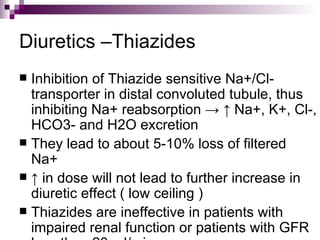
Diuretics –Thiazides
 Inhibition of Thiazide sensitive Na+/Cl-
  transporter in distal convoluted tubule, thus
  inhibiting Na+ reabsorption → ↑ Na+, K+, Cl-,
  HCO3- and H2O excretion
 They lead to about 5-10% loss of filtered
  Na+
 ↑ in dose will not lead to further increase in
  diuretic effect ( low ceiling )
 Thiazides are ineffective in patients with
  impaired renal function or patients with GFR
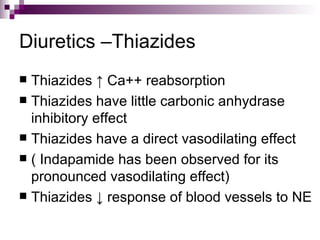
Diuretics –Thiazides
 Thiazides ↑ Ca++ reabsorption
 Thiazides have little carbonic anhydrase
  inhibitory effect
 Thiazides have a direct vasodilating effect
 ( Indapamide has been observed for its
  pronounced vasodilating effect)
 Thiazides ↓ response of blood vessels to NE
Diuretics – Common Thiazides
   Widely used Thiazides are Hydrochlorothiazide and
    Chlorthalidone and Thiazide kinetics are as follows:
     Usually given orally
     Strongly bind to plasma albumin
     Excreted via the kidney by a specific secretory
      mechanism (not filtered) (small fraction biliary excretion)
   Thiazides are highly effective in lowering BP when
    combined with other antihypertensive agents
    (synergistic effect )
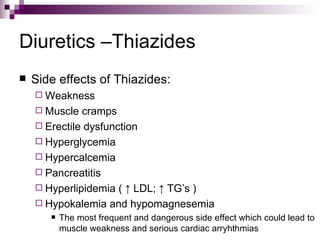
Diuretics –Thiazides
   Side effects of Thiazides:
     Weakness
     Muscle  cramps
     Erectile dysfunction
     Hyperglycemia
     Hypercalcemia
     Pancreatitis
     Hyperlipidemia ( ↑ LDL; ↑ TG’s )
     Hypokalemia and hypomagnesemia
          The most frequent and dangerous side effect which could lead to
           muscle weakness and serious cardiac arryhthmias
Diuretics – Thiazides
   Patients at high risk of hypokalemia are those with:
     LVH
     Previous history of MI
     Previous history of cardiac arrhythmias, or
     Patients who are on digoxin therapy

   Hyperuricemia → could precipitate Gout
     The effect of thiazides on blood uric acid is dose
      dependent…Low doses → Hyperuricemia
     Large doses → ↓ uric acid reabsorption →↓ uric acid
      blood levels.
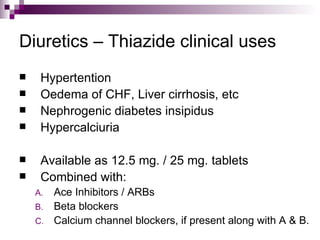
Diuretics – Thiazide clinical uses
    Hypertention
    Oedema of CHF, Liver cirrhosis, etc
    Nephrogenic diabetes insipidus
    Hypercalciuria

    Available as 12.5 mg. / 25 mg. tablets
    Combined with:
    A.   Ace Inhibitors / ARBs
    B.   Beta blockers
    C.   Calcium channel blockers, if present along with A & B.

Hydrochlorthiazide

  • 1.
  • 2.
    Topics for discussion Renal pathology  Diuretics  Thiazides
  • 3.
  • 4.
    Renal Pathology  Kidneys: Represent 0.5% of total body weight, but receive ~25% of the total arterial blood pumped by the heart  Each contains from 1-2 million nephrons:  Glomerulus  Proximal convoluted tubule  Loop of Henle  Distal convoluted tubule
  • 5.
    Renal Pharmacology  Renal processes  Functions  Filtration - glomerulus  Clean extracellular  Reabsorption fluid and maintain ECF  Tubular secretion volume and composition  In 24 hours the kidneys reclaim:  Acid-base balance  ~ 1,300 g of NaCl  Excretion of wastes  ~ 400 g NaHCO3  ~ 180 g glucose and toxic substances  almost all of the 180 L of water that entered the tubules
  • 6.
    Renal Pharmacology  Blood enters the glomerulus under pressure  This causes water, small molecules (but not macromolecules like proteins) and ions to filter through the capillary walls into the Bowman's capsule  This fluid is called nephric filtrate  Not much different from interstitial fluid  Nephric filtrate collects within the Bowman's capsule and flows into the proximal tubule:  Here all of the glucose and amino acids, >90% of the uric acid, and ~60% of inorganic salts are reabsorbed by active transport  The active transport of Na+ out of the proximal tubule is controlled by angiotensin II.  The active transport of phosphate (PO4)3- is regulated (suppressed by) the parathyroid hormone.  As these solutes are removed from the nephric filtrate, a large volume of the water follows them by osmosis:  80–85% of the 180 liters deposited in the Bowman's capsules in 24 hours  As the fluid flows into the descending segment of the loop of Henle, water continues to leave by osmosis because the interstitial fluid is very hypertonic:  This is caused by the active transport of Na+ out of the tubular fluid as it moves up the ascending segment of the loop of Henle  In the distal tubules, more sodium is reclaimed by active transport, and still more water follows by osmosis.
  • 7.
  • 8.
    Diuretics  Diuretics aredrugs which increase urine excretion mainly by ↓ reabsorption of salts and water from kidney tubules  General clinical uses:  Hypertension  Oedema of heart, renal, and liver failure  Pulmonary oedema  ↑ intracranial pressure (Mannitol)  ↑ Intraocular pressure=Glaucoma ( CA inhibitors)
  • 9.
    Diuretics – maintypes  Loop Diuretics  Frusemide, Torasemide  Potassium Sparing Diuretics:  Spiranolactone, Eplerenone, Triamterene, amiloride  Osmotic diretics  Mannitol  Carbonic anhydrase inhibitors  Thiazides
  • 10.
    Diuretic- applications  Hypercalcemia(Furosemide=Frusemide)  Idiopathic hypercalciuria (Thiazides)  Inappropriate ADH secretion (Furosemide)  Nephrogenic diabetes insipidus  Basicknowledge of renal physiology particularly salt and water movements (absorption, reabsorption and secretion) and cotransporter systems is mandatory.
  • 11.
    Diuretics – whatare they?  Diuretics are considered 1st line therapy for most hypertensive patients  They are effective, relatively safe and cheap  Accumulating evidence proves that diuretics, particularly thiazides decrease the risk of cardiovascular disease, fatal and nonfatal MI and stroke.
  • 12.
    Diuretics - MOA Diuretics act simply by increasing urine output → ↓ plasma and stroke volume →↓ CO → ↓ BP  The initial ↓ CO leads to an ↑ in peripheral resistance but with chronic use extra cellular fluid and plasma volume return to normal and peripheral resistance ↓ to values lower than those observed before diuretic therapy  Thiazide diuretics also are believed to have direct vasodilating effect
  • 13.
    Diuretics – CommonThiazides  Thiazides and Thiazide Like Diuretics = Low to moderate efficacy diuretics  Hydrochlorothiazide  Chlorthiazide  Chlorthalidone  Indapamide  Metolazone
  • 14.
    Diuretics – RareThiazides  Bendroflumethiazide  Hydroflumethiazide  Methyclothiazide  Polythiazide  Benzthiazide  Quinethazone  Trichlormethiazide  **All are usually given orally (Chlorthiazide could be given IV); they differ in potency, DOA and t½
  • 15.
  • 16.
    Diuretics –Thiazides  Inhibitionof Thiazide sensitive Na+/Cl- transporter in distal convoluted tubule, thus inhibiting Na+ reabsorption → ↑ Na+, K+, Cl-, HCO3- and H2O excretion  They lead to about 5-10% loss of filtered Na+  ↑ in dose will not lead to further increase in diuretic effect ( low ceiling )  Thiazides are ineffective in patients with impaired renal function or patients with GFR
  • 17.
    Diuretics –Thiazides  Thiazides↑ Ca++ reabsorption  Thiazides have little carbonic anhydrase inhibitory effect  Thiazides have a direct vasodilating effect  ( Indapamide has been observed for its pronounced vasodilating effect)  Thiazides ↓ response of blood vessels to NE
  • 18.
    Diuretics – CommonThiazides  Widely used Thiazides are Hydrochlorothiazide and Chlorthalidone and Thiazide kinetics are as follows:  Usually given orally  Strongly bind to plasma albumin  Excreted via the kidney by a specific secretory mechanism (not filtered) (small fraction biliary excretion)  Thiazides are highly effective in lowering BP when combined with other antihypertensive agents (synergistic effect )
  • 19.
    Diuretics –Thiazides  Side effects of Thiazides:  Weakness  Muscle cramps  Erectile dysfunction  Hyperglycemia  Hypercalcemia  Pancreatitis  Hyperlipidemia ( ↑ LDL; ↑ TG’s )  Hypokalemia and hypomagnesemia  The most frequent and dangerous side effect which could lead to muscle weakness and serious cardiac arryhthmias
  • 20.
    Diuretics – Thiazides  Patients at high risk of hypokalemia are those with:  LVH  Previous history of MI  Previous history of cardiac arrhythmias, or  Patients who are on digoxin therapy  Hyperuricemia → could precipitate Gout  The effect of thiazides on blood uric acid is dose dependent…Low doses → Hyperuricemia  Large doses → ↓ uric acid reabsorption →↓ uric acid blood levels.
  • 21.
    Diuretics – Thiazideclinical uses  Hypertention  Oedema of CHF, Liver cirrhosis, etc  Nephrogenic diabetes insipidus  Hypercalciuria  Available as 12.5 mg. / 25 mg. tablets  Combined with: A. Ace Inhibitors / ARBs B. Beta blockers C. Calcium channel blockers, if present along with A & B.