ODONTOMA


 Compound odontoma,
 complex odontomas,
  odontogenic hamartoma.
ONE OF THE TUMORS OF ODONTOGENIC EPITHELIUM


This group of tumors is composed of proliferating odontogenic
epithelium in a cellular ectomesenchyme resembling the dental papilla.
Odontomas are composed of all mature components of
dental hard and soft tissue: enamel, dentin, and pulp
tissue. Because of their limited slow growth and well-
differentiation, they are generally considered to
represent hamartomas rather than true neoplasm


DEFINITION
CLINICAL FEATURES
•They   are the most common odontogenic tumors

•   and they interfere with eruption of permanent teeth.

•   They begin to develop as normal dentition start to

•develop    and cease when the teeth development ends.

•   There is no sex predilection.

•Theyoccur in young age group, with the average age being
second decade of life.
CLINICAL FEATURES

•   They are usually asymptomatic and are
    discovered during routine radiographic
    examination when there is delayed eruption of
    permanent tooth.

   Location: Somewhat more common in the maxilla.
    The compound type is more often in the anterior
    maxilla while the complex type occurs more often
    in the posterior regions of either jaw.
TWO TYPES OF ODONTOMAS ARE
RECOGNIZED
   Complex         Compound
COMPOUND ODONTOMA
It is a collection of small radiopaque masses,
some or all may be tooth-like structures
“denticles”.
It tends to occur in 62% in the anterior region of
the maxilla and usually associated with the crown
of an unerupted canine. It is formed by exuberant
growth of the dental lamina or into a number of
small enamel organs by proliferation of the
enamel organ.
COMPLEX ODONTOMA

   It is composed of haphazardly arranged dental
    hard and soft tissue. It has no resemblance to
    a normal tooth. It tends to occur in 70% in the
    posterior region of the mandible. There might
    be a missing tooth if it arises from a normal
    tooth follice.
RADIOGRAPHIC FEATURES
Early lesions are radiolucent with smooth, well-defined contours.

Later a well-defined radiopaque appearance develops.

Most odontomas are small and do not exceed the size of a normal
  tooth in the region.

However, large ones do occur and these may cause expansion of
  the jaw.

Most odontomas are asymptomatic and as a result are discovered
  upon routine radiographic examination.
RADIOGRAPHIC FEATURES

*Odontomas may block the eruption of a
 permanent tooth and in these cases are often
 discovered when “searching for” the “missing”
 tooth radiographically.

*They can be associated with impacted,
  malposition, malformation, and displacement
  of adjacent teeth.
COMPLEX ODONTOMA RADIOGRAPHICLLY

 Common lesions that persist through life
 Usually detected in adolescence
 most commonly in mandibular molars
 not painful, or swelling
 radiographically "sunburst radiopacities, thin
  uniform radiolucent rim
 similar description as osteosarcoma, but assoc
  w/ tooth, clear of bony borders
•   large radioopaque
    lesion
•   well encapsulated w/
    radioiolucent border
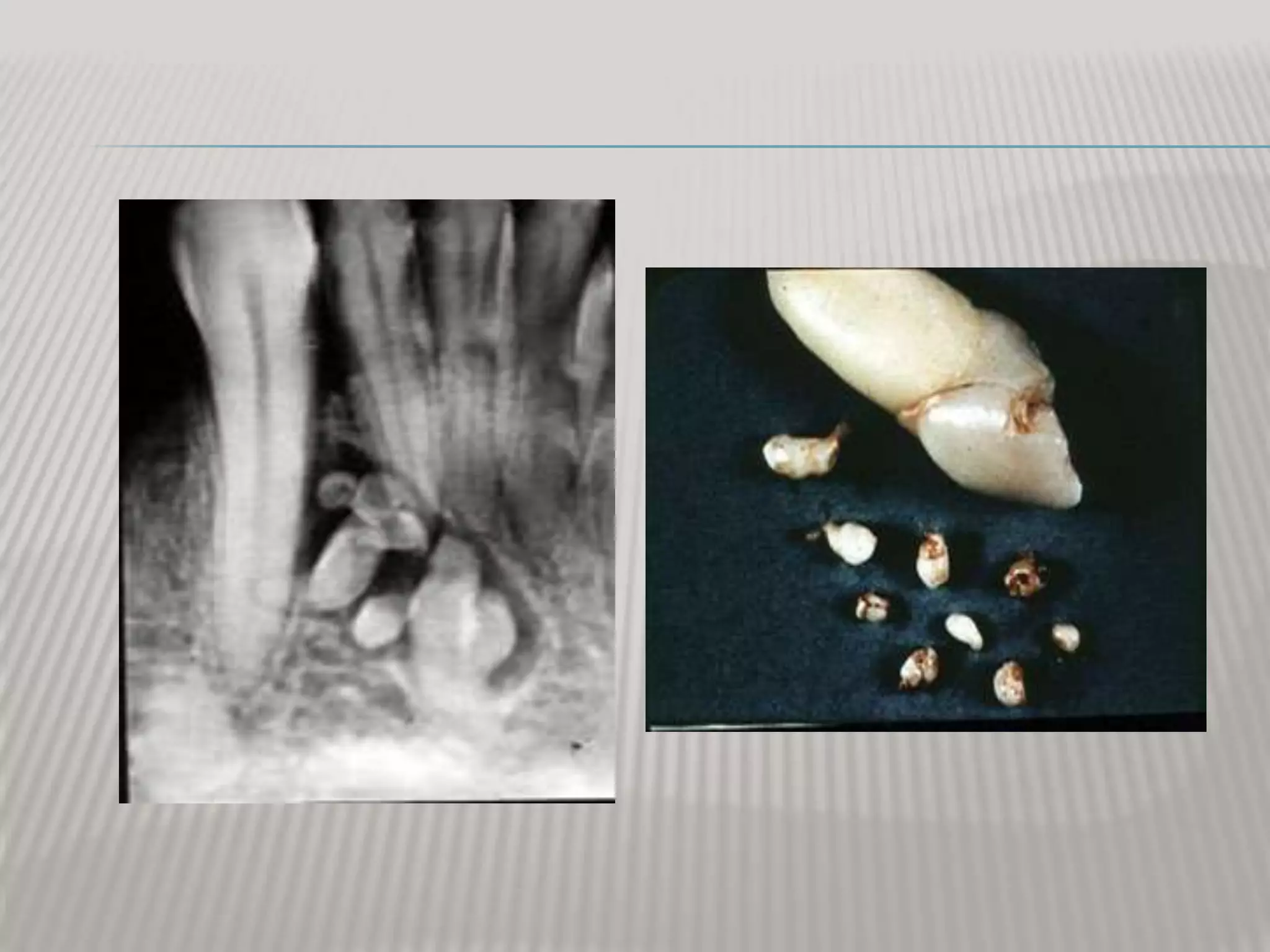
COMPOUND ODONTOMA RADIOGRAPHICLLY
  *Most common odontogenic tumor
  *Appears as a cluster of multiple abortive teeth
  *Often prevents normal tooth eruption
  *Radiographically multiple tiny toothlike structures
  are contained within a fine radiolucent rim
  *Do not recur after excision

  *thus discovered during adolescence
  Histology of compound odontomas approaches
  normal tooth strcture. Gross clinical examination
  usually is sufficient for diagnosis.
   3 small radioopaque
    lesion w/ radiolucent rim
DIFFERENTIAL DIAGNOSIS

Compound odontomas can be detected easily
 due to their tooth-like appearance. Complex
 odontomas can be differentiated from
 cemento-ossifying fibromas due to their
 propensity to be associated with crown of
 unerupted molar and they are more radiopaque
 than cement-ossifying fibromas.
 They can also develop at much younger age
 than cemento-ossifying fibromas.
DIFFERENTIAL DIAGNOSIS

   A dense bony island can be included in the
    differential. However, the presence of a soft
    tissue capsule is very useful in differentiation.
    Periapical cemental dysplasia may resemble
    complex odontomas but usually they are
    multiple, surrounded by sclerotic borders and
    centered around apices of teeth, whereas
    odontomas are commonly found occlusal or
    overlapping the involved teeth.
TREATMENT


   Odontomas are treated by
    simple local excision and
    the prognosis is excellent

   They don’t recur and are not
    invasive.
Case Reports
HISTORY:
A 28-YEAR-OLD FEMALE WAS REFERRED FOR A
CONE BEAM CT SCAN FOR EVALUATION OF LEFT
MANDIBULAR CANINE/PREMOLAR AREA FOR
PATHOLOGY.

FINDINGS:
THERE IS A WELL-DEFINED MIXED DENSITY
LESION BETWEEN ROOTS OF TEETH #20-21. THE
LESION IS SURROUNDS BY RADIOLUCENT BAND
AND RADIOPAQUE CORTEX GIVING IT A TARGET
APPEARANCE. THE HETEROGENEOUS DENSITY
WITHIN THE LESION HAS TOOTH LIKE
APPEARANCE AND DENSITY. IT MEASURES
APPROXIMATELY 12 MM AT ITS GREATEST
DIMENSION. THERE IS DISPLACEMENT OF ROOTS
OF #20 AND #21. THERE ARE NO SIGNS OF ROOT
RESORPTION. THE LESION IS IN CLOSE PROXIMITY
TO THE MENTAL FORAMEN. THE MANDIBULAR
CANAL IS LOCATED INFERIOR AND BUCCAL TO THE
LESION.

Odontoma (Doctor Faris Alabeedi MSc, MMedSc, PgDip, BDS.)

  • 1.
    ODONTOMA Compound odontoma, complex odontomas, odontogenic hamartoma.
  • 2.
    ONE OF THETUMORS OF ODONTOGENIC EPITHELIUM This group of tumors is composed of proliferating odontogenic epithelium in a cellular ectomesenchyme resembling the dental papilla.
  • 4.
    Odontomas are composedof all mature components of dental hard and soft tissue: enamel, dentin, and pulp tissue. Because of their limited slow growth and well- differentiation, they are generally considered to represent hamartomas rather than true neoplasm DEFINITION
  • 5.
    CLINICAL FEATURES •They are the most common odontogenic tumors • and they interfere with eruption of permanent teeth. • They begin to develop as normal dentition start to •develop and cease when the teeth development ends. • There is no sex predilection. •Theyoccur in young age group, with the average age being second decade of life.
  • 6.
    CLINICAL FEATURES • They are usually asymptomatic and are discovered during routine radiographic examination when there is delayed eruption of permanent tooth.  Location: Somewhat more common in the maxilla. The compound type is more often in the anterior maxilla while the complex type occurs more often in the posterior regions of either jaw.
  • 7.
    TWO TYPES OFODONTOMAS ARE RECOGNIZED  Complex  Compound
  • 8.
    COMPOUND ODONTOMA It isa collection of small radiopaque masses, some or all may be tooth-like structures “denticles”. It tends to occur in 62% in the anterior region of the maxilla and usually associated with the crown of an unerupted canine. It is formed by exuberant growth of the dental lamina or into a number of small enamel organs by proliferation of the enamel organ.
  • 9.
    COMPLEX ODONTOMA  It is composed of haphazardly arranged dental hard and soft tissue. It has no resemblance to a normal tooth. It tends to occur in 70% in the posterior region of the mandible. There might be a missing tooth if it arises from a normal tooth follice.
  • 10.
    RADIOGRAPHIC FEATURES Early lesionsare radiolucent with smooth, well-defined contours. Later a well-defined radiopaque appearance develops. Most odontomas are small and do not exceed the size of a normal tooth in the region. However, large ones do occur and these may cause expansion of the jaw. Most odontomas are asymptomatic and as a result are discovered upon routine radiographic examination.
  • 11.
    RADIOGRAPHIC FEATURES *Odontomas mayblock the eruption of a permanent tooth and in these cases are often discovered when “searching for” the “missing” tooth radiographically. *They can be associated with impacted, malposition, malformation, and displacement of adjacent teeth.
  • 12.
    COMPLEX ODONTOMA RADIOGRAPHICLLY Common lesions that persist through life  Usually detected in adolescence  most commonly in mandibular molars  not painful, or swelling  radiographically "sunburst radiopacities, thin uniform radiolucent rim  similar description as osteosarcoma, but assoc w/ tooth, clear of bony borders
  • 15.
    large radioopaque lesion • well encapsulated w/ radioiolucent border
  • 16.
    COMPOUND ODONTOMA RADIOGRAPHICLLY *Most common odontogenic tumor *Appears as a cluster of multiple abortive teeth *Often prevents normal tooth eruption *Radiographically multiple tiny toothlike structures are contained within a fine radiolucent rim *Do not recur after excision *thus discovered during adolescence Histology of compound odontomas approaches normal tooth strcture. Gross clinical examination usually is sufficient for diagnosis.
  • 19.
    3 small radioopaque lesion w/ radiolucent rim
  • 20.
    DIFFERENTIAL DIAGNOSIS Compound odontomascan be detected easily due to their tooth-like appearance. Complex odontomas can be differentiated from cemento-ossifying fibromas due to their propensity to be associated with crown of unerupted molar and they are more radiopaque than cement-ossifying fibromas.  They can also develop at much younger age than cemento-ossifying fibromas.
  • 21.
    DIFFERENTIAL DIAGNOSIS  A dense bony island can be included in the differential. However, the presence of a soft tissue capsule is very useful in differentiation. Periapical cemental dysplasia may resemble complex odontomas but usually they are multiple, surrounded by sclerotic borders and centered around apices of teeth, whereas odontomas are commonly found occlusal or overlapping the involved teeth.
  • 22.
    TREATMENT  Odontomas are treated by simple local excision and the prognosis is excellent  They don’t recur and are not invasive.
  • 23.
    Case Reports HISTORY: A 28-YEAR-OLDFEMALE WAS REFERRED FOR A CONE BEAM CT SCAN FOR EVALUATION OF LEFT MANDIBULAR CANINE/PREMOLAR AREA FOR PATHOLOGY. FINDINGS: THERE IS A WELL-DEFINED MIXED DENSITY LESION BETWEEN ROOTS OF TEETH #20-21. THE LESION IS SURROUNDS BY RADIOLUCENT BAND AND RADIOPAQUE CORTEX GIVING IT A TARGET APPEARANCE. THE HETEROGENEOUS DENSITY WITHIN THE LESION HAS TOOTH LIKE APPEARANCE AND DENSITY. IT MEASURES APPROXIMATELY 12 MM AT ITS GREATEST DIMENSION. THERE IS DISPLACEMENT OF ROOTS OF #20 AND #21. THERE ARE NO SIGNS OF ROOT RESORPTION. THE LESION IS IN CLOSE PROXIMITY TO THE MENTAL FORAMEN. THE MANDIBULAR CANAL IS LOCATED INFERIOR AND BUCCAL TO THE LESION.