Odontogenic Tumors
      Islam Kassem


         ikassem@dr.com
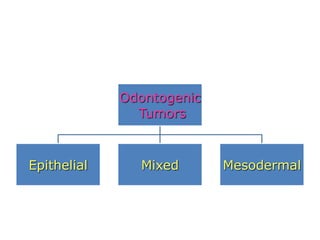
Odontogenic
               Tumors


Epithelial     Mixed       Mesodermal
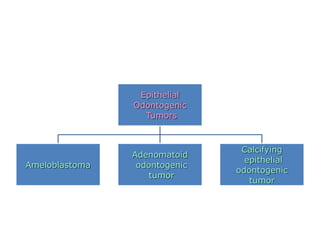
Epithelial
                Odontogenic
                  Tumors


                                Calcifying
                Adenomatoid
                                 epithelial
Ameloblastoma    odontogenic
                               odontogenic
                    tumor
                                  tumor
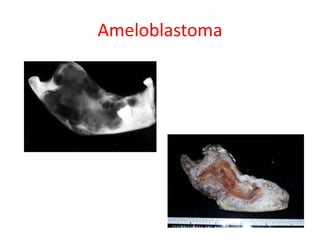
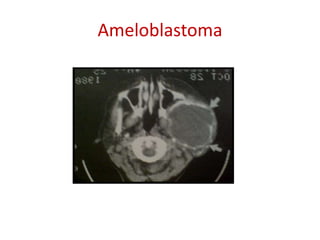
Ameloblastoma

• This a true neoplasm of
  odontogenic epithelium

• It is an aggressive neoplasm
  the arises from the
  remnants of the dental
  lamina and dental organ(
  odontogenic epithelium)
Ameloblastoma
• Benign, locally aggressive odontogenic
  tumor. Usually it slowly grows as
  painless swelling of the affected site.

• It can occur at any age.

• Localized invasion into the
  surrounding bone.

• 80-95% in the mandible (posterior
  body, ramus region). In the maxilla
  mostly in the premolar-molar region.
Ameloblastoma
• Unilocular (small lesions). Multilocular
  (large discrete areas or honeycomb
  appearance)

• Smooth, well-defined, well-corticated
  margins

• Adjacent teeth are often displaced
  and resorbed.

• It causes extensive bone expansion.

• Incomplete removal can result in
  recurrence.
Ameloblastoma
Ameloblastoma
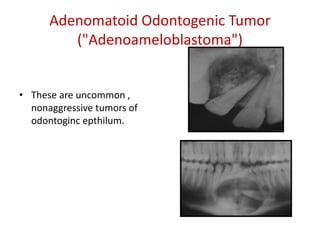
Adenomatoid Odontogenic Tumor
         ("Adenoameloblastoma")


• These are uncommon ,
  nonaggressive tumors of
  odontoginc epthilum.
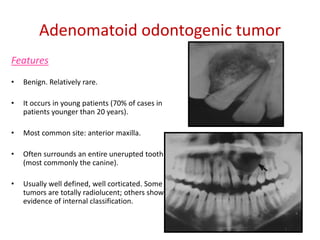
Adenomatoid odontogenic tumor
Features
•   Benign. Relatively rare.

•   It occurs in young patients (70% of cases in
    patients younger than 20 years).

•   Most common site: anterior maxilla.

•   Often surrounds an entire unerupted tooth
    (most commonly the canine).

•   Usually well defined, well corticated. Some
    tumors are totally radiolucent; others show
    evidence of internal classification.
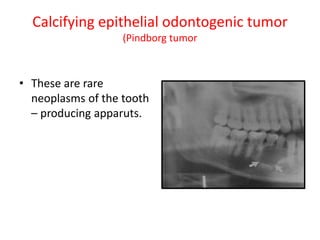
Calcifying epithelial odontogenic tumor
                   (Pindborg tumor


• These are rare
  neoplasms of the tooth
  – producing apparuts.
Calcifying epithelial odontogenic tumor
                           (Pindborg tumor
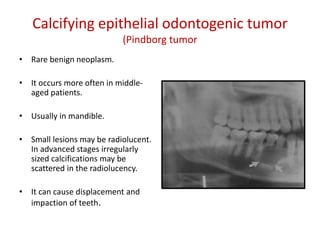
• Rare benign neoplasm.

• It occurs more often in middle-
  aged patients.

• Usually in mandible.

• Small lesions may be radiolucent.
  In advanced stages irregularly
  sized calcifications may be
  scattered in the radiolucency.

• It can cause displacement and
  impaction of teeth.
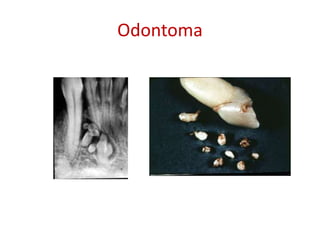
Odontomas

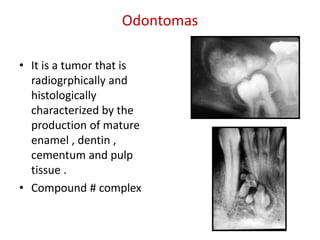
• It is a tumor that is
  radiogrphically and
  histologically
  characterized by the
  production of mature
  enamel , dentin ,
  cementum and pulp
  tissue .
• Compound # complex
Odontoma
• Features
• Relatively common lesion.

• It usually occurs in young patients.

• Usually asymptomatic.

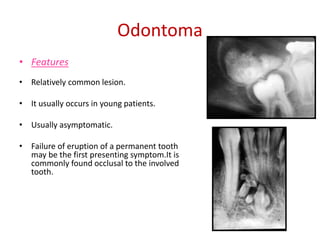
• Failure of eruption of a permanent tooth
  may be the first presenting symptom.It is
  commonly found occlusal to the involved
  tooth.
Odontoma
• Features

• Two types: complex and compound
  odontoma.

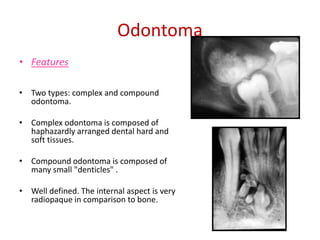
• Complex odontoma is composed of
  haphazardly arranged dental hard and
  soft tissues.

• Compound odontoma is composed of
  many small "denticles" .

• Well defined. The internal aspect is very
  radiopaque in comparison to bone.
Odontoma
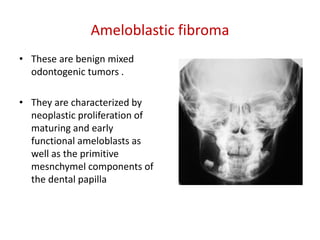
Ameloblastic fibroma
• These are benign mixed
  odontogenic tumors .

• They are characterized by
  neoplastic proliferation of
  maturing and early
  functional ameloblasts as
  well as the primitive
  mesnchymel components of
  the dental papilla
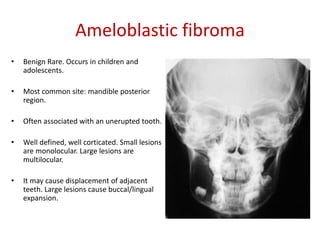
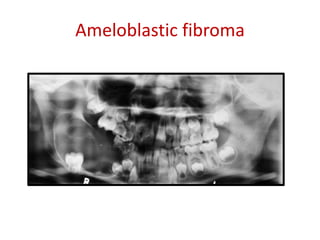
Ameloblastic fibroma
•   Benign Rare. Occurs in children and
    adolescents.

•   Most common site: mandible posterior
    region.

•   Often associated with an unerupted tooth.

•   Well defined, well corticated. Small lesions
    are monolocular. Large lesions are
    multilocular.

•   It may cause displacement of adjacent
    teeth. Large lesions cause buccal/lingual
    expansion.
Ameloblastic fibroma
Ameloblastic
                fibro-odontoma
• This is an extremely rare lesion. It consists of
  elements of ameloblastic fibroma with small
  segments of enamel and dentin.
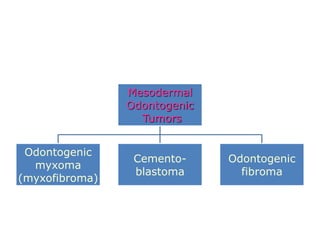
Mesodermal
                Odontogenic
                  Tumors


 Odontogenic
                 Cemento-     Odontogenic
  myxoma
                 blastoma       fibroma
(myxofibroma)
Odontogenic myxoma (myxofibroma)

• They are benign,
  intraosseous neoplasms
  that arise from the
  mesenchymal portion
  of the dental papilla.
Odontogenic myxoma (myxofibroma)
•   Features


•   It represents approximately 3 - 6% of
    all odontogenic tumors. It is painless
    and grows slowly.

•   It can occur at any age but most
    commonly in the second and third
    decades of life.

•   More often affect the mandible
    (molar/premolar region).
Odontogenic myxoma (myxofibroma)
•   Features


•   Typically multilocular (internal septa-
    strings of a tennis racket or
    honeycomb appearance). Large
    lesions can have the sun ray
    appearance of an osteosarcoma.

•   Often well-defined.

•   Adjacent teeth can be displaced but
    rarely resorbed. It causes less bone
    expansion than in other benign
    tumors.
Odontogenic myxoma (myxofibroma)
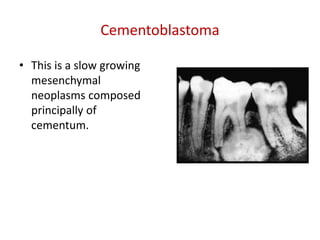
Cementoblastoma

• This is a slow growing
  mesenchymal
  neoplasms composed
  principally of
  cementum.
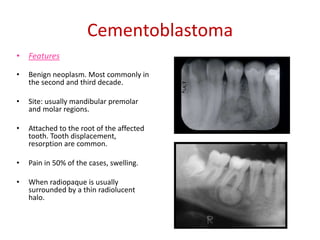
Cementoblastoma
• Features

•   Benign neoplasm. Most commonly in
    the second and third decade.

•   Site: usually mandibular premolar
    and molar regions.

•   Attached to the root of the affected
    tooth. Tooth displacement,
    resorption are common.

•   Pain in 50% of the cases, swelling.

•   When radiopaque is usually
    surrounded by a thin radiolucent
    halo.
Radiographic Features
• Location:

• Periphery: well defined RO with
  RL hallo surrounding the calcified
  mass.

• Internal structure: mixed RL-RO
  leseions may be amorphous

• Effect on surrounding tissues:
  expansion, external root
   resorption
Cementoblastoma
Odontogenic
                                    fibroma
• Features
•   Rare neoplasm. More often between
    the ages 10 and 40 years.

•   Asymptomatic or swelling and tooth
    mobility

•   More common sites: mandible
    (premolar-molar region), maxilla
    (anterior region)

•   Small lesions are usually unilocular, and
    larger lesions multilocular.

•   Well-defined margins.

•   Adjacent teeth: often displaced,
    impaction, root resorption.
Thank you


      ikassem@dr.com

Odontogenic tumours

  • 1.
    Odontogenic Tumors Islam Kassem ikassem@dr.com
  • 2.
    Odontogenic Tumors Epithelial Mixed Mesodermal
  • 3.
    Epithelial Odontogenic Tumors Calcifying Adenomatoid epithelial Ameloblastoma odontogenic odontogenic tumor tumor
  • 4.
    Ameloblastoma • This atrue neoplasm of odontogenic epithelium • It is an aggressive neoplasm the arises from the remnants of the dental lamina and dental organ( odontogenic epithelium)
  • 5.
    Ameloblastoma • Benign, locallyaggressive odontogenic tumor. Usually it slowly grows as painless swelling of the affected site. • It can occur at any age. • Localized invasion into the surrounding bone. • 80-95% in the mandible (posterior body, ramus region). In the maxilla mostly in the premolar-molar region.
  • 6.
    Ameloblastoma • Unilocular (smalllesions). Multilocular (large discrete areas or honeycomb appearance) • Smooth, well-defined, well-corticated margins • Adjacent teeth are often displaced and resorbed. • It causes extensive bone expansion. • Incomplete removal can result in recurrence.
  • 7.
  • 8.
  • 9.
    Adenomatoid Odontogenic Tumor ("Adenoameloblastoma") • These are uncommon , nonaggressive tumors of odontoginc epthilum.
  • 10.
    Adenomatoid odontogenic tumor Features • Benign. Relatively rare. • It occurs in young patients (70% of cases in patients younger than 20 years). • Most common site: anterior maxilla. • Often surrounds an entire unerupted tooth (most commonly the canine). • Usually well defined, well corticated. Some tumors are totally radiolucent; others show evidence of internal classification.
  • 11.
    Calcifying epithelial odontogenictumor (Pindborg tumor • These are rare neoplasms of the tooth – producing apparuts.
  • 12.
    Calcifying epithelial odontogenictumor (Pindborg tumor • Rare benign neoplasm. • It occurs more often in middle- aged patients. • Usually in mandible. • Small lesions may be radiolucent. In advanced stages irregularly sized calcifications may be scattered in the radiolucency. • It can cause displacement and impaction of teeth.
  • 13.
    Odontomas • It isa tumor that is radiogrphically and histologically characterized by the production of mature enamel , dentin , cementum and pulp tissue . • Compound # complex
  • 14.
    Odontoma • Features • Relativelycommon lesion. • It usually occurs in young patients. • Usually asymptomatic. • Failure of eruption of a permanent tooth may be the first presenting symptom.It is commonly found occlusal to the involved tooth.
  • 15.
    Odontoma • Features • Twotypes: complex and compound odontoma. • Complex odontoma is composed of haphazardly arranged dental hard and soft tissues. • Compound odontoma is composed of many small "denticles" . • Well defined. The internal aspect is very radiopaque in comparison to bone.
  • 16.
  • 17.
    Ameloblastic fibroma • Theseare benign mixed odontogenic tumors . • They are characterized by neoplastic proliferation of maturing and early functional ameloblasts as well as the primitive mesnchymel components of the dental papilla
  • 18.
    Ameloblastic fibroma • Benign Rare. Occurs in children and adolescents. • Most common site: mandible posterior region. • Often associated with an unerupted tooth. • Well defined, well corticated. Small lesions are monolocular. Large lesions are multilocular. • It may cause displacement of adjacent teeth. Large lesions cause buccal/lingual expansion.
  • 19.
  • 20.
    Ameloblastic fibro-odontoma • This is an extremely rare lesion. It consists of elements of ameloblastic fibroma with small segments of enamel and dentin.
  • 21.
    Mesodermal Odontogenic Tumors Odontogenic Cemento- Odontogenic myxoma blastoma fibroma (myxofibroma)
  • 22.
    Odontogenic myxoma (myxofibroma) •They are benign, intraosseous neoplasms that arise from the mesenchymal portion of the dental papilla.
  • 23.
    Odontogenic myxoma (myxofibroma) • Features • It represents approximately 3 - 6% of all odontogenic tumors. It is painless and grows slowly. • It can occur at any age but most commonly in the second and third decades of life. • More often affect the mandible (molar/premolar region).
  • 24.
    Odontogenic myxoma (myxofibroma) • Features • Typically multilocular (internal septa- strings of a tennis racket or honeycomb appearance). Large lesions can have the sun ray appearance of an osteosarcoma. • Often well-defined. • Adjacent teeth can be displaced but rarely resorbed. It causes less bone expansion than in other benign tumors.
  • 25.
  • 26.
    Cementoblastoma • This isa slow growing mesenchymal neoplasms composed principally of cementum.
  • 27.
    Cementoblastoma • Features • Benign neoplasm. Most commonly in the second and third decade. • Site: usually mandibular premolar and molar regions. • Attached to the root of the affected tooth. Tooth displacement, resorption are common. • Pain in 50% of the cases, swelling. • When radiopaque is usually surrounded by a thin radiolucent halo.
  • 28.
    Radiographic Features • Location: •Periphery: well defined RO with RL hallo surrounding the calcified mass. • Internal structure: mixed RL-RO leseions may be amorphous • Effect on surrounding tissues: expansion, external root resorption
  • 29.
  • 30.
    Odontogenic fibroma • Features • Rare neoplasm. More often between the ages 10 and 40 years. • Asymptomatic or swelling and tooth mobility • More common sites: mandible (premolar-molar region), maxilla (anterior region) • Small lesions are usually unilocular, and larger lesions multilocular. • Well-defined margins. • Adjacent teeth: often displaced, impaction, root resorption.
  • 31.
    Thank you ikassem@dr.com