Odontogenic Cyst
(OKC)
Dr. Maryam Arbab
1. INTRODUCTION
2. CLASSIFICATION
3. CAUSES
4. HISTOPATHOLOGY
5. CLINICAL FEATURES
6. RADIOGRAPHIC FEATURES
7. DIFFERENTIAL DIAGNOSIS
8. TREATMENT
9. PRINCIPLE OF TREATMENT
A. Types of Flaps.
B. Surgical removal the of the cyst .
OUTLINE
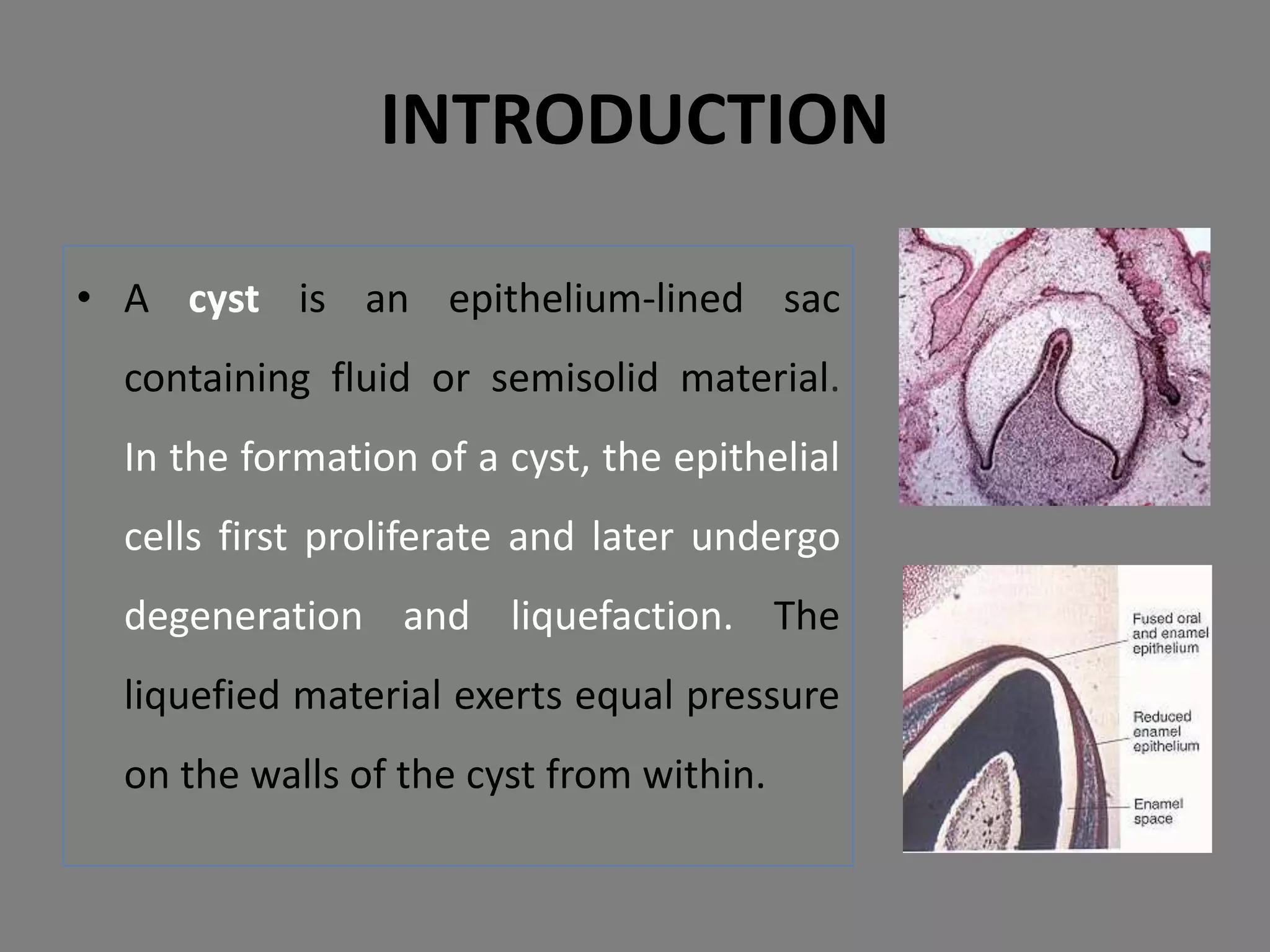
• A cyst is an epithelium-lined sac
containing fluid or semisolid material.
In the formation of a cyst, the epithelial
cells first proliferate and later undergo
degeneration and liquefaction. The
liquefied material exerts equal pressure
on the walls of the cyst from within.
INTRODUCTION
• Cysts grow by expansion and thus
displace the adjacent teeth by pressure.
May produce expansion of the cortical
bone. On a radiograph, the
radiolucency of a cyst is usually
bordered by a radiopaque periphery of
dense sclerotic bone. The radiolucency
may be unilocular or multilocular.
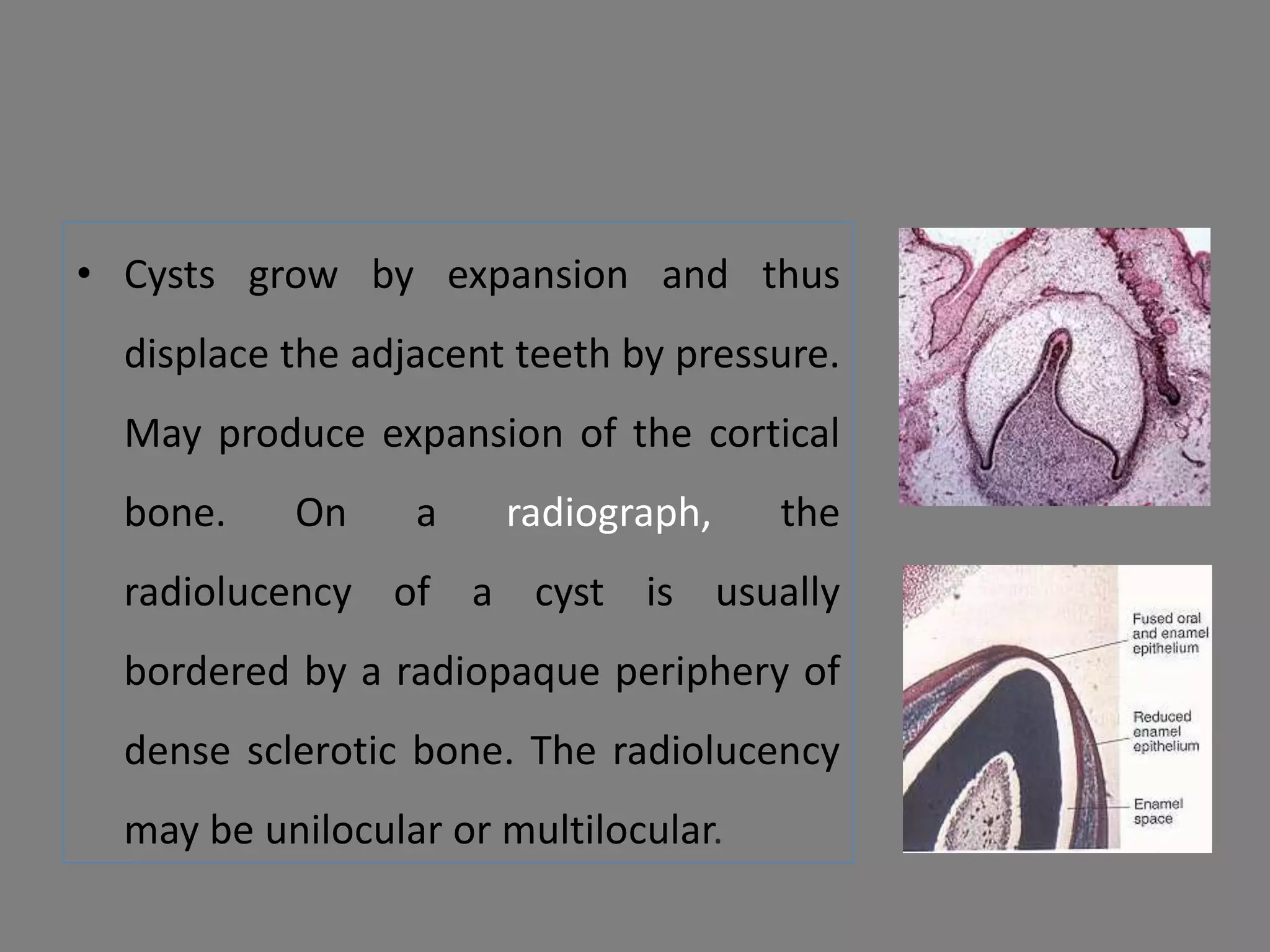
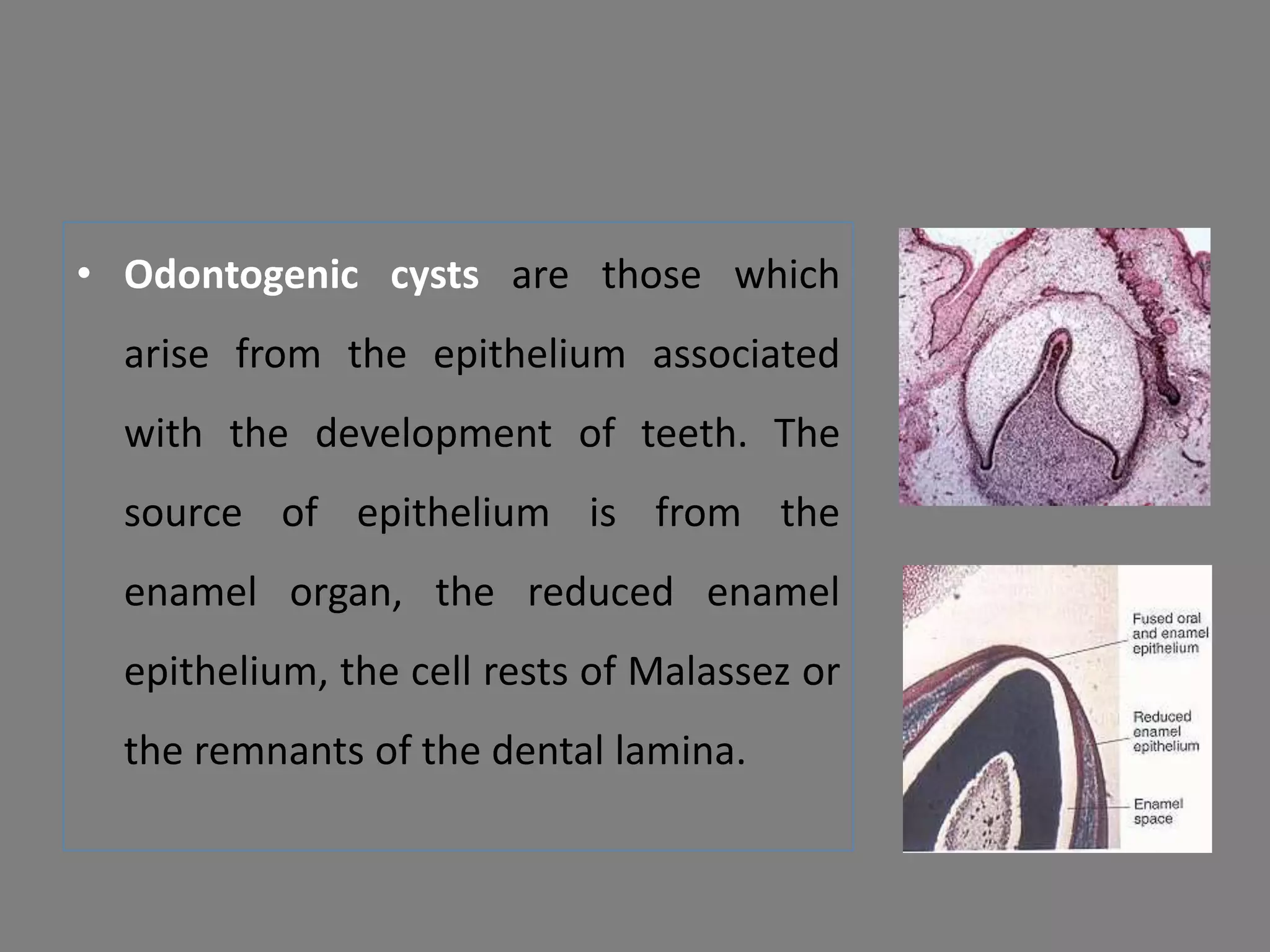
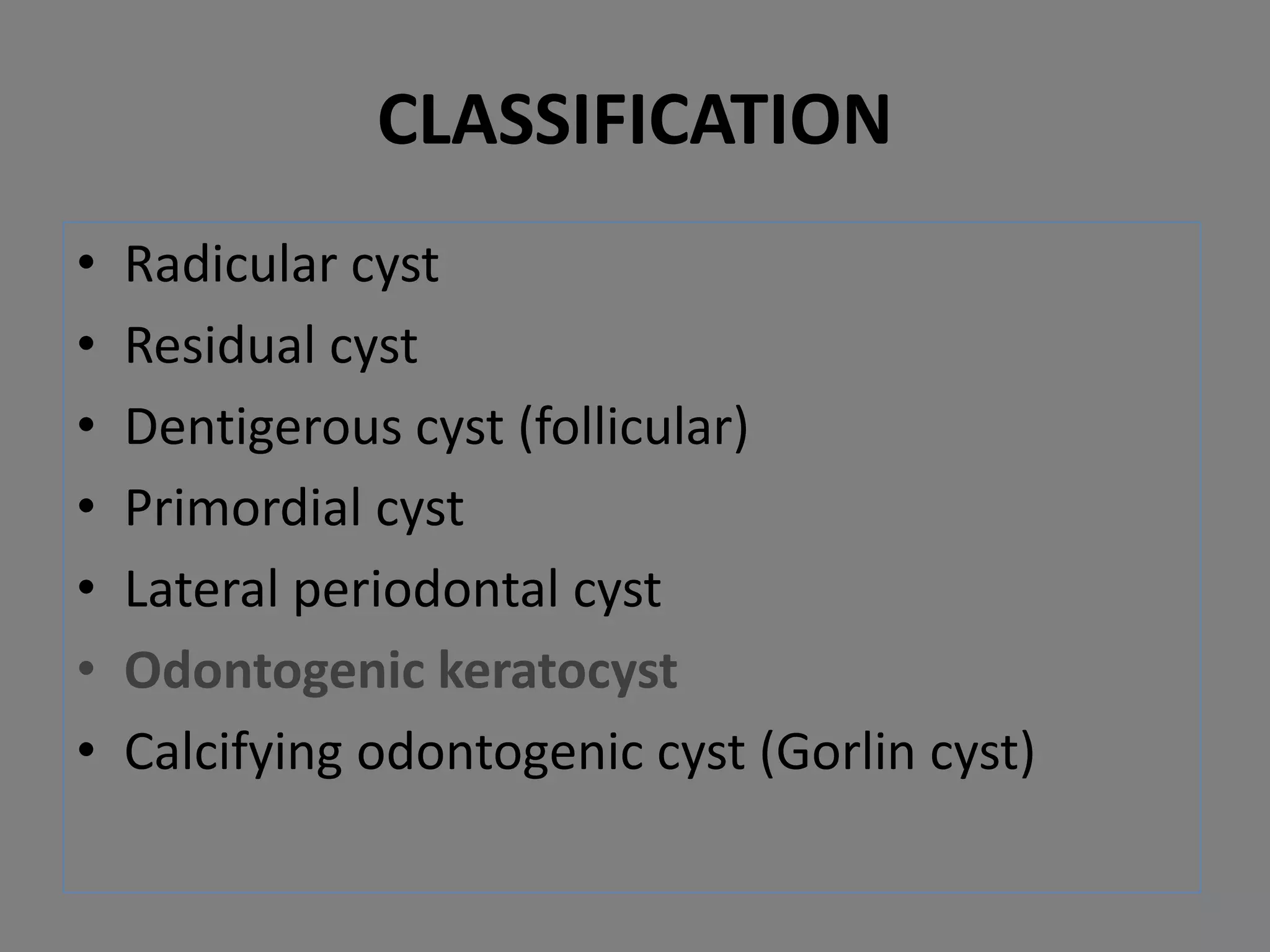
• Odontogenic cysts are those which
arise from the epithelium associated
with the development of teeth. The
source of epithelium is from the
enamel organ, the reduced enamel
epithelium, the cell rests of Malassez or
the remnants of the dental lamina.
• Radicular cyst
• Residual cyst
• Dentigerous cyst (follicular)
• Primordial cyst
• Lateral periodontal cyst
• Odontogenic keratocyst
• Calcifying odontogenic cyst (Gorlin cyst)
CLASSIFICATION
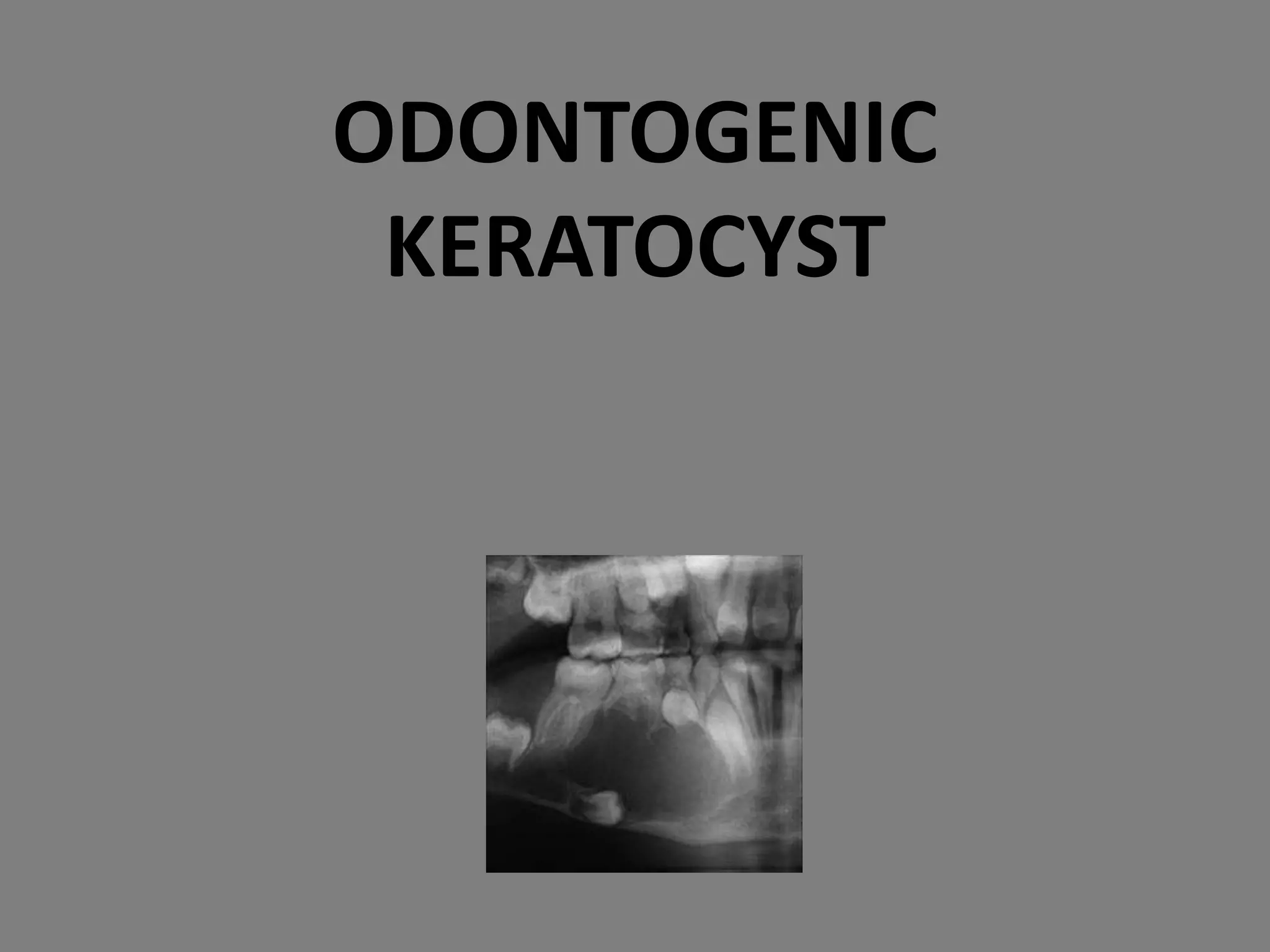
ODONTOGENIC
KERATOCYST
• There is general agreement that OKCs develop from dental
lamina remnants in the mandible and maxilla. However, an
origin of this cyst from extension of basal cells of the overlying
oral epithelium has also been suggested.
• Genetic
CAUSES
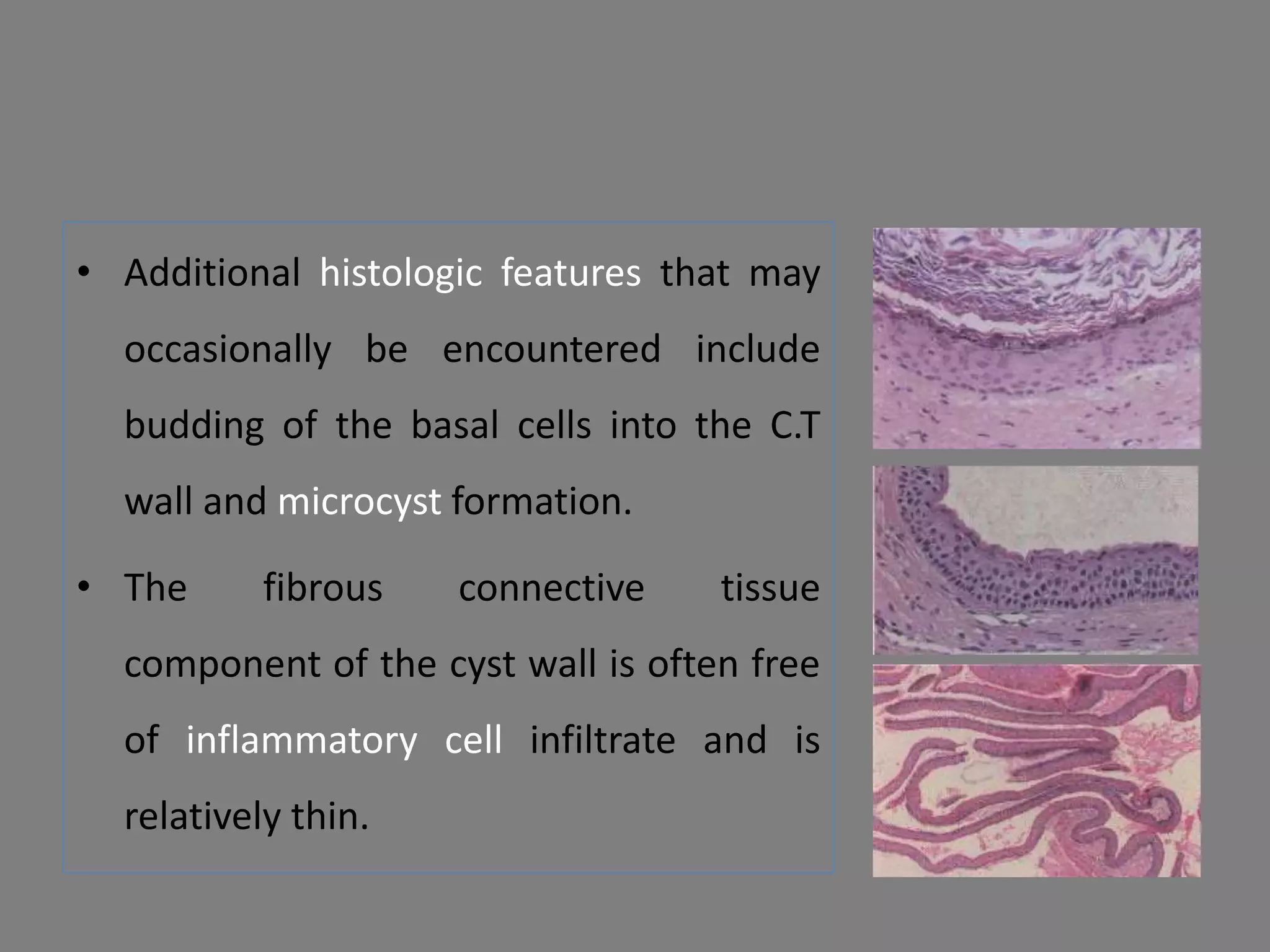
• The epithelial lining is uniformly thin, generally ranging from 8
to 10 cell layers thick.
• The basal layer exhibits a characteristic palisaded pattern with
polarized and intensely stained nuclei of uniform diameter.
The luminal epithelial cells are parakeratinized and produce an
uneven or corrugated profile.
HISTOPATHOLOGY
• Additional histologic features that may
occasionally be encountered include
budding of the basal cells into the C.T
wall and microcyst formation.
• The fibrous connective tissue
component of the cyst wall is often free
of inflammatory cell infiltrate and is
relatively thin.
• Age: Any age , especially adults.
• Location: Mandibular molar, ramus area favored; may be
found dentigerous, in position of lateral root, periapical, or
primordial cyst.
• OKCs are relatively common jaw cysts. They occur at any age
and have a peak incidence within the second and third
decades.
CLINICAL FEATURES
• Location: The most common is the posterior body of the
mandible (90% posterior to the canines) and ramus (more
than 50%). This type of cyst occasionally has the same
pericoronal position as dentigerous cyst.
• Periphery and shape: Usually with a cortical border unless
becomes secondarily infected. The cyst may have a smooth
(round or oval shape), or it may have a scalloped outline.
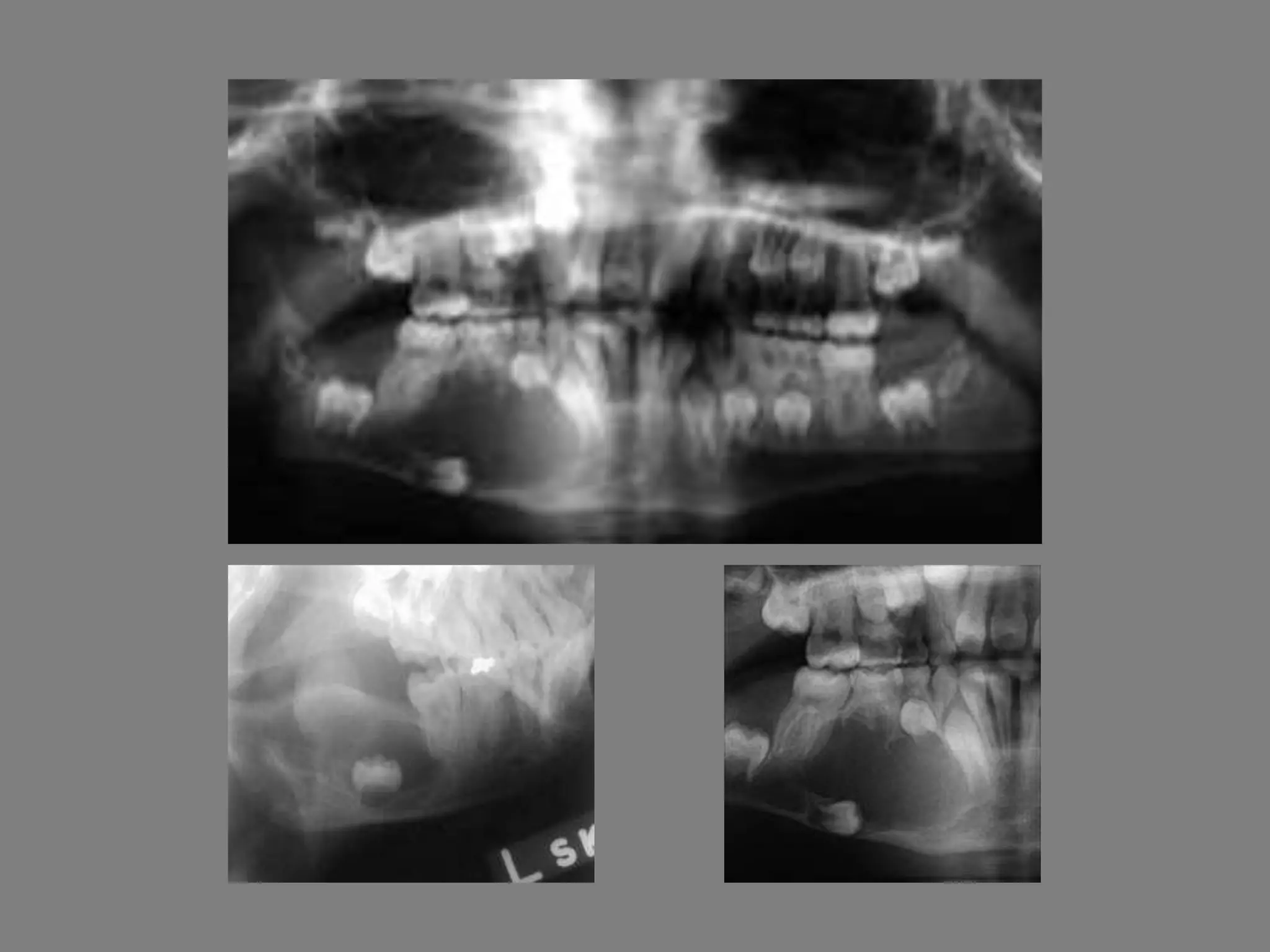
RADIOGRAPHIC FEATURES
• Internal structure:
• Most commonly is radiolucent.
• The cystic cavity contain keratin.
• In some cases curved internal septa may be present, giving
the lesion a multilocular appearance.
• The effects on surrounding structures: It grows along the
internal aspect of the jaws, causing minimal expansion except
for the upper ramus and coronoid process, where
considerable expansion may occur. OKCs can displace and
resorb teeth but to a slightly lesser degree than dentigerous
cysts. The inferior alveolar nerve canal may be displaced
inferiorly. In the maxilla this cyst can invaginate and occupy
the entire maxillary antrum.
• Dentigerous cyst OKC
• Ameloblastoma, AB has a greater propensity to expand.
• Odontogenic myxoma, multilocular with fine straight septa.
• A simple bone cyst often has a scalloped margin and minimal
bone expansion.
• Several OKCs are found. These cysts may constitute part of a
basal cell nevus syndrome.
DIFFERENTIAL DIAGNOSIS
Wide (local) surgical excision to prevent the
recurrence
or
Marsupialization - the surgical opening of the
(KCOT) cavity and a creation of a marsupial-
like pouch, so that the cavity is in contact with
outside for an extended period.
TREATMENT
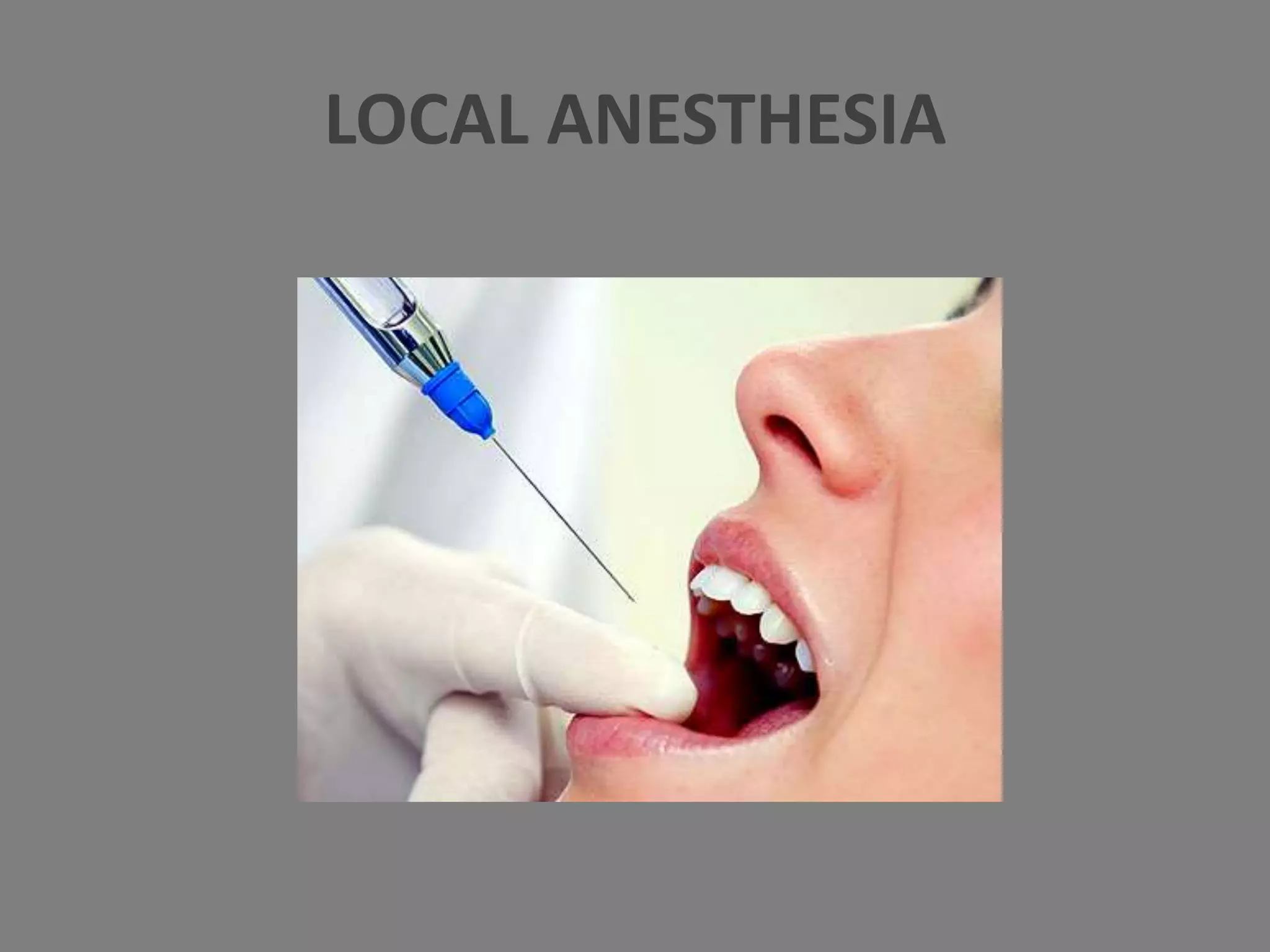
1. Local anesthesia.
2. Types of Flaps.
3. Surgical removal the of the cyst .
PRINCIPLES OF TREATMENT
LOCAL ANESTHESIA
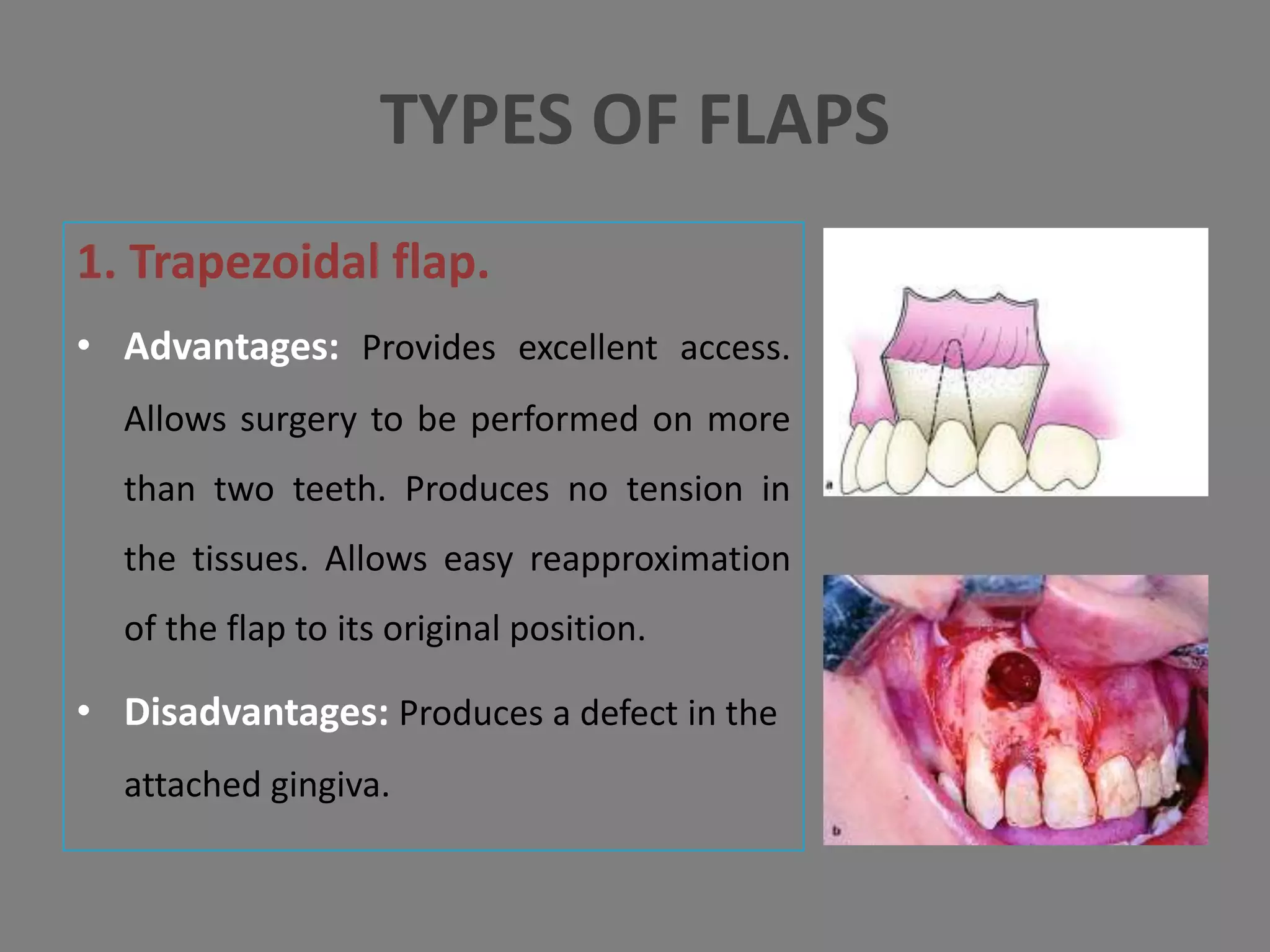
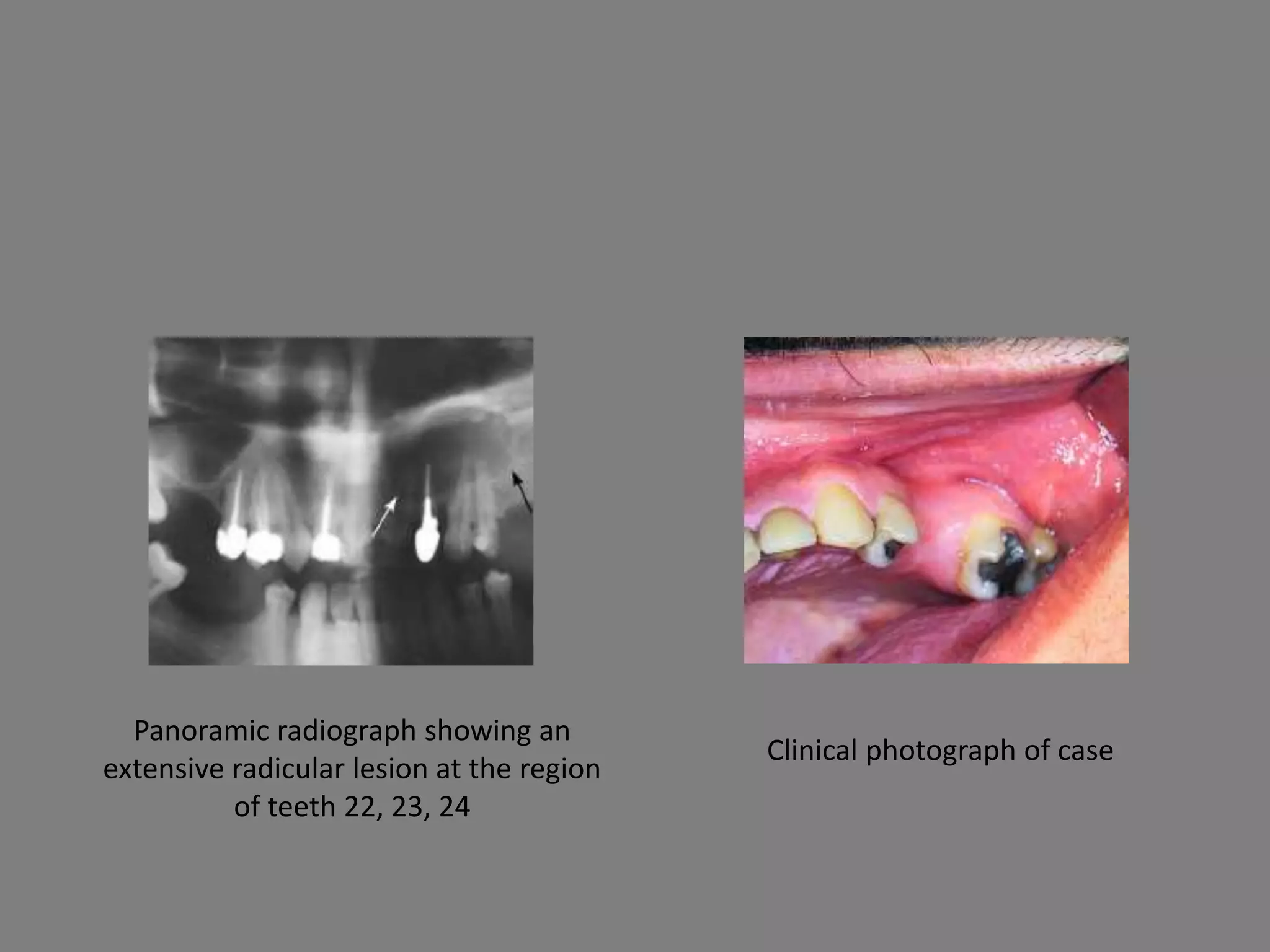
1. Trapezoidal flap.
• Advantages: Provides excellent access.
Allows surgery to be performed on more
than two teeth. Produces no tension in
the tissues. Allows easy reapproximation
of the flap to its original position.
• Disadvantages: Produces a defect in the
attached gingiva.
TYPES OF FLAPS
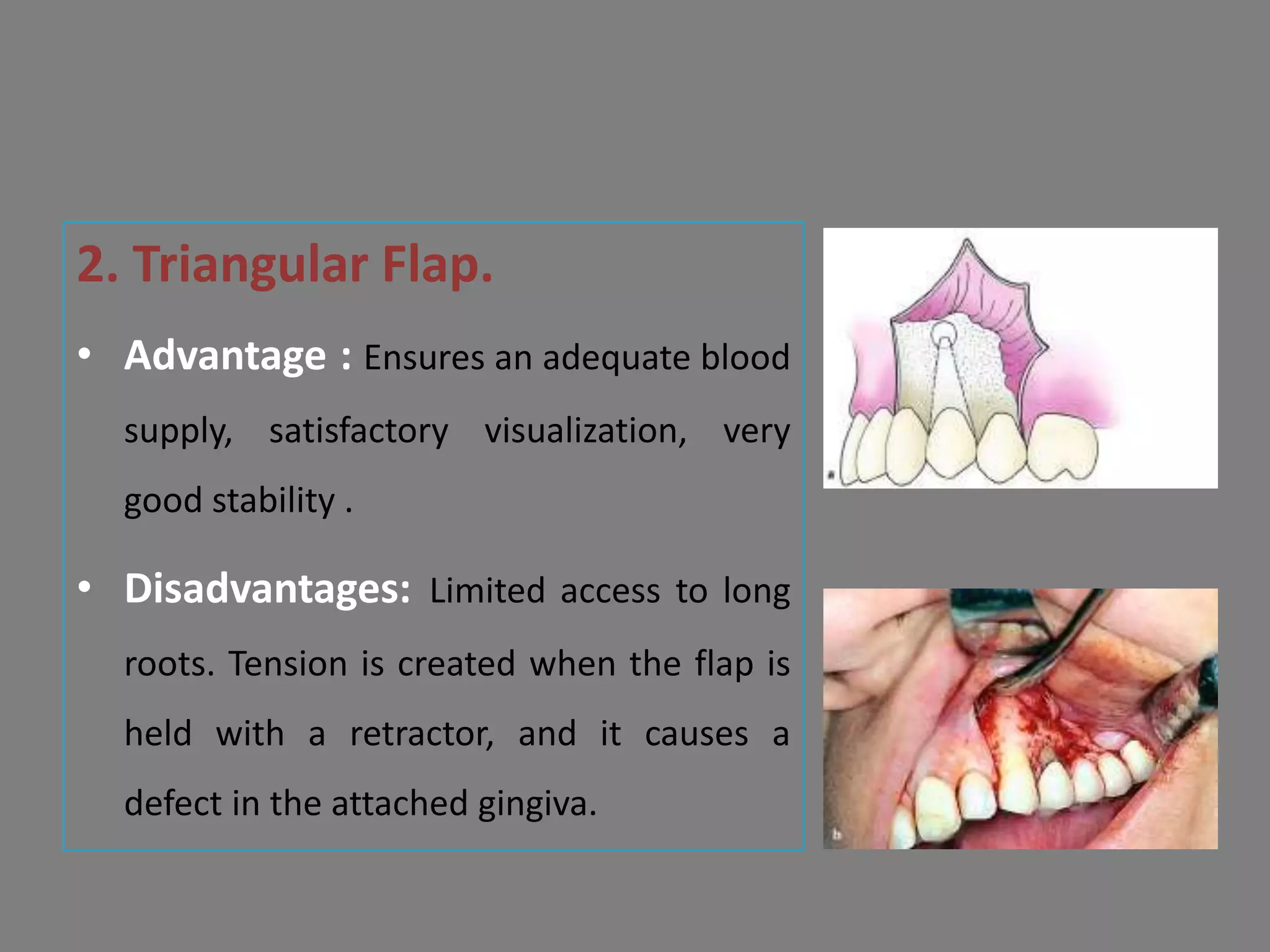
2. Triangular Flap.
• Advantage : Ensures an adequate blood
supply, satisfactory visualization, very
good stability .
• Disadvantages: Limited access to long
roots. Tension is created when the flap is
held with a retractor, and it causes a
defect in the attached gingiva.
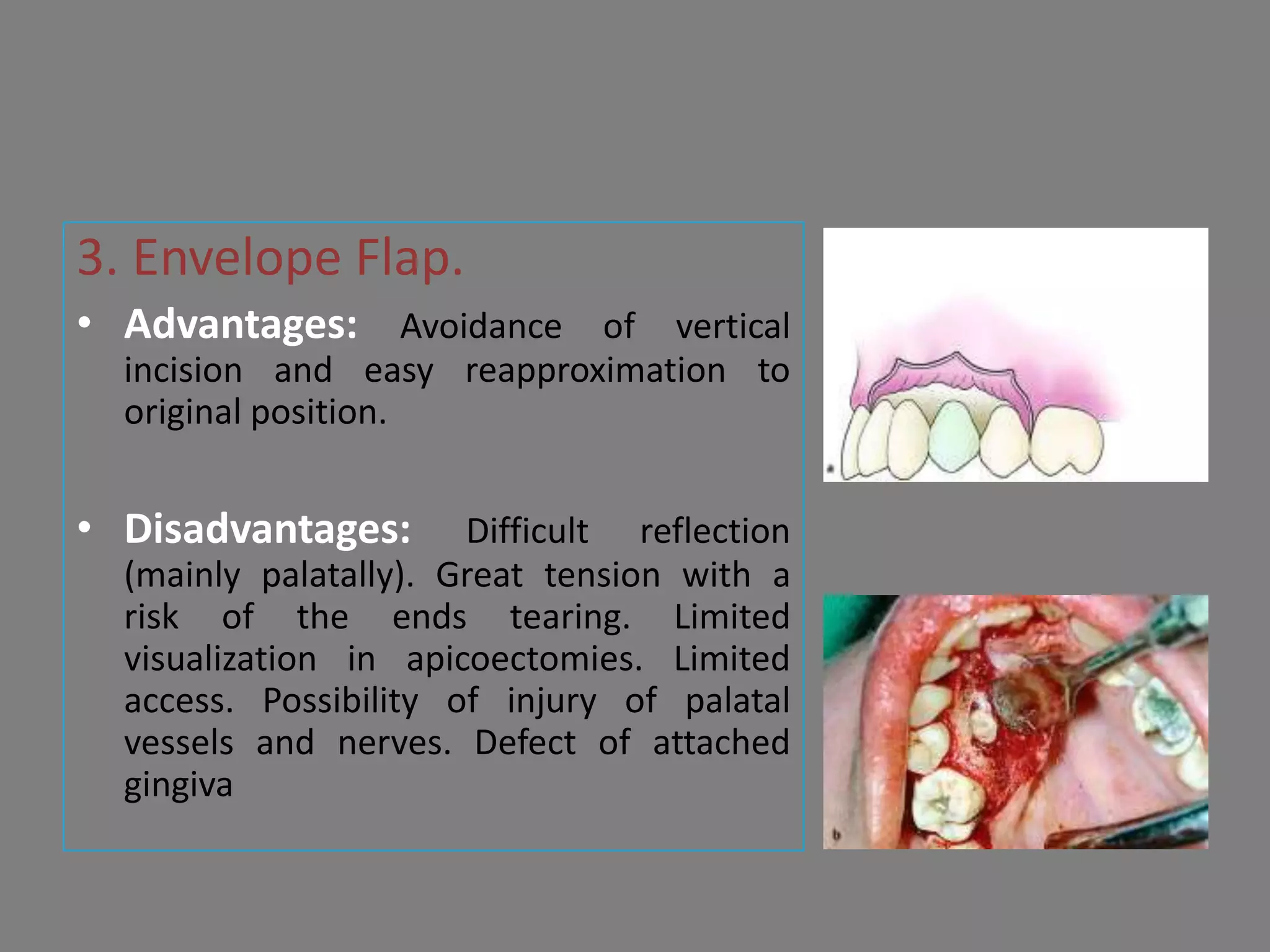
3. Envelope Flap.
• Advantages: Avoidance of vertical
incision and easy reapproximation to
original position.
• Disadvantages: Difficult reflection
(mainly palatally). Great tension with a
risk of the ends tearing. Limited
visualization in apicoectomies. Limited
access. Possibility of injury of palatal
vessels and nerves. Defect of attached
gingiva
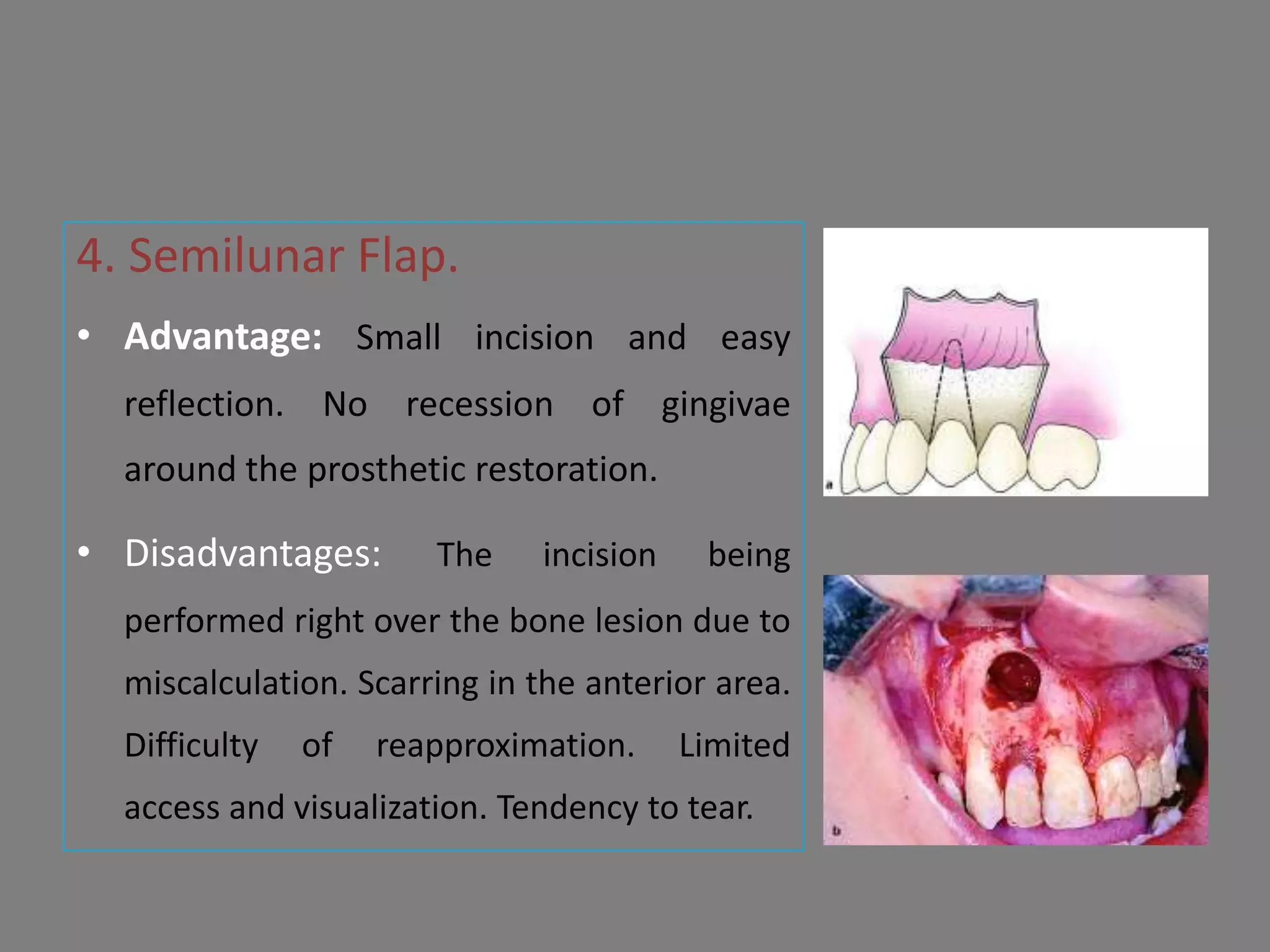
4. Semilunar Flap.
• Advantage: Small incision and easy
reflection. No recession of gingivae
around the prosthetic restoration.
• Disadvantages: The incision being
performed right over the bone lesion due to
miscalculation. Scarring in the anterior area.
Difficulty of reapproximation. Limited
access and visualization. Tendency to tear.
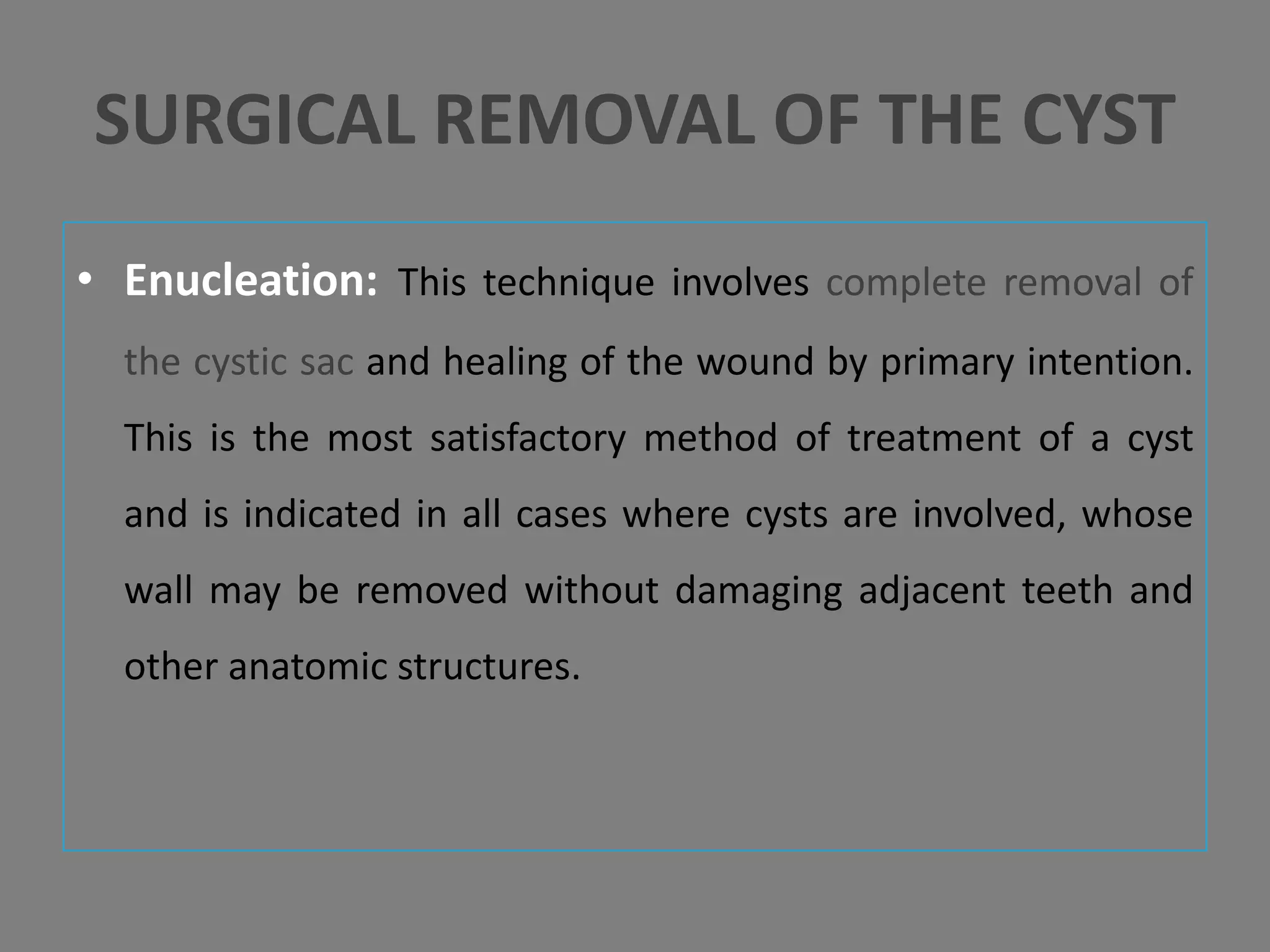
• Enucleation: This technique involves complete removal of
the cystic sac and healing of the wound by primary intention.
This is the most satisfactory method of treatment of a cyst
and is indicated in all cases where cysts are involved, whose
wall may be removed without damaging adjacent teeth and
other anatomic structures.
SURGICAL REMOVAL OF THE CYST
• The surgical procedure for treatment of a cyst with
enucleation includes the following steps:
1. Reflection of a mucoperiosteal flap.
2. Removal of bone and exposure of part of the cyst.
3. Enucleation of the cystic sac.
4. Care of the wound and suturing.
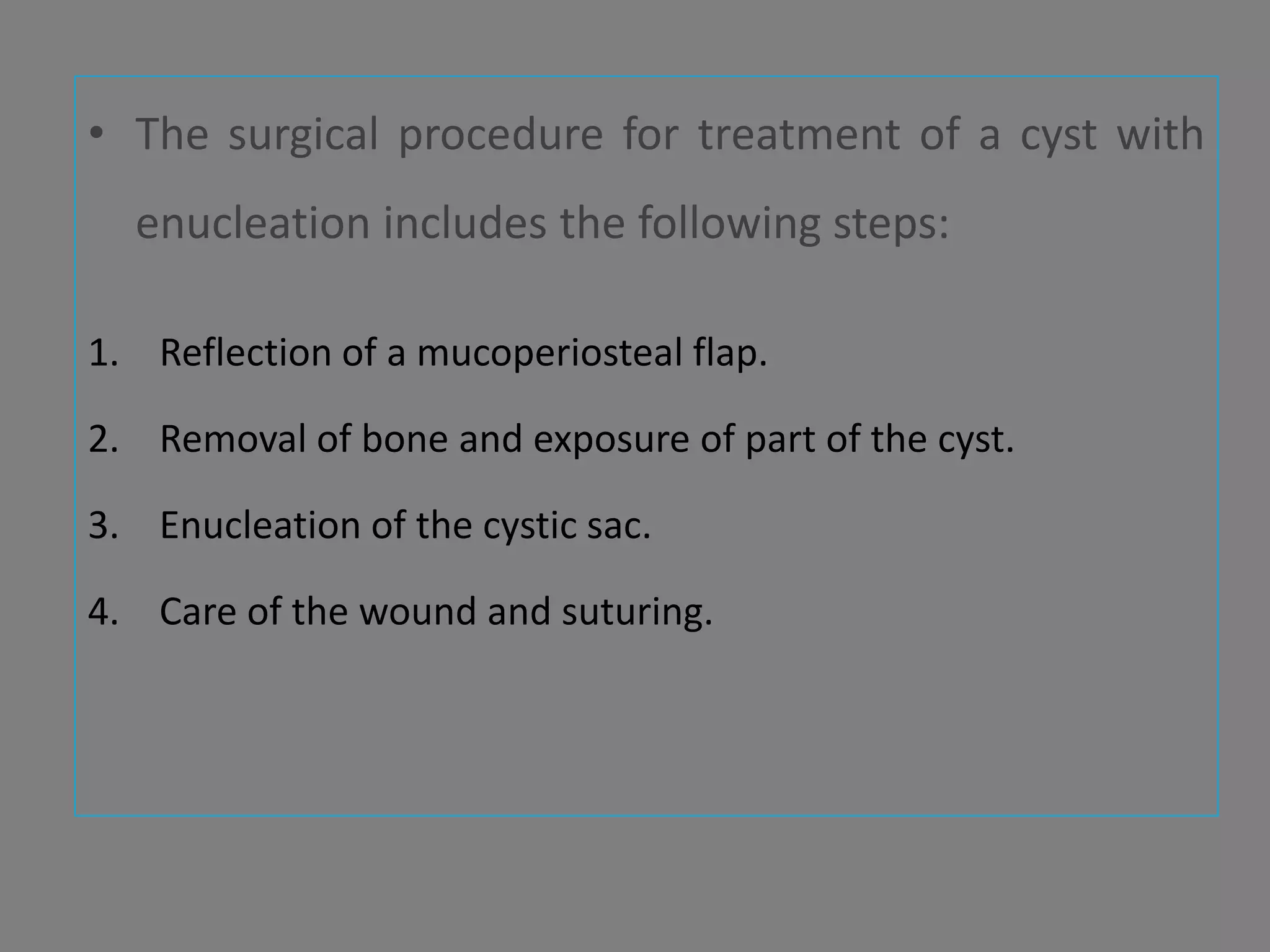
Panoramic radiograph showing an
extensive radicular lesion at the region
of teeth 22, 23, 24
Clinical photograph of case
Removal of maxillary cyst, with labial access. Incision for creating a trapezoidal flap.
Reflection of flap and exposure of surgical field.
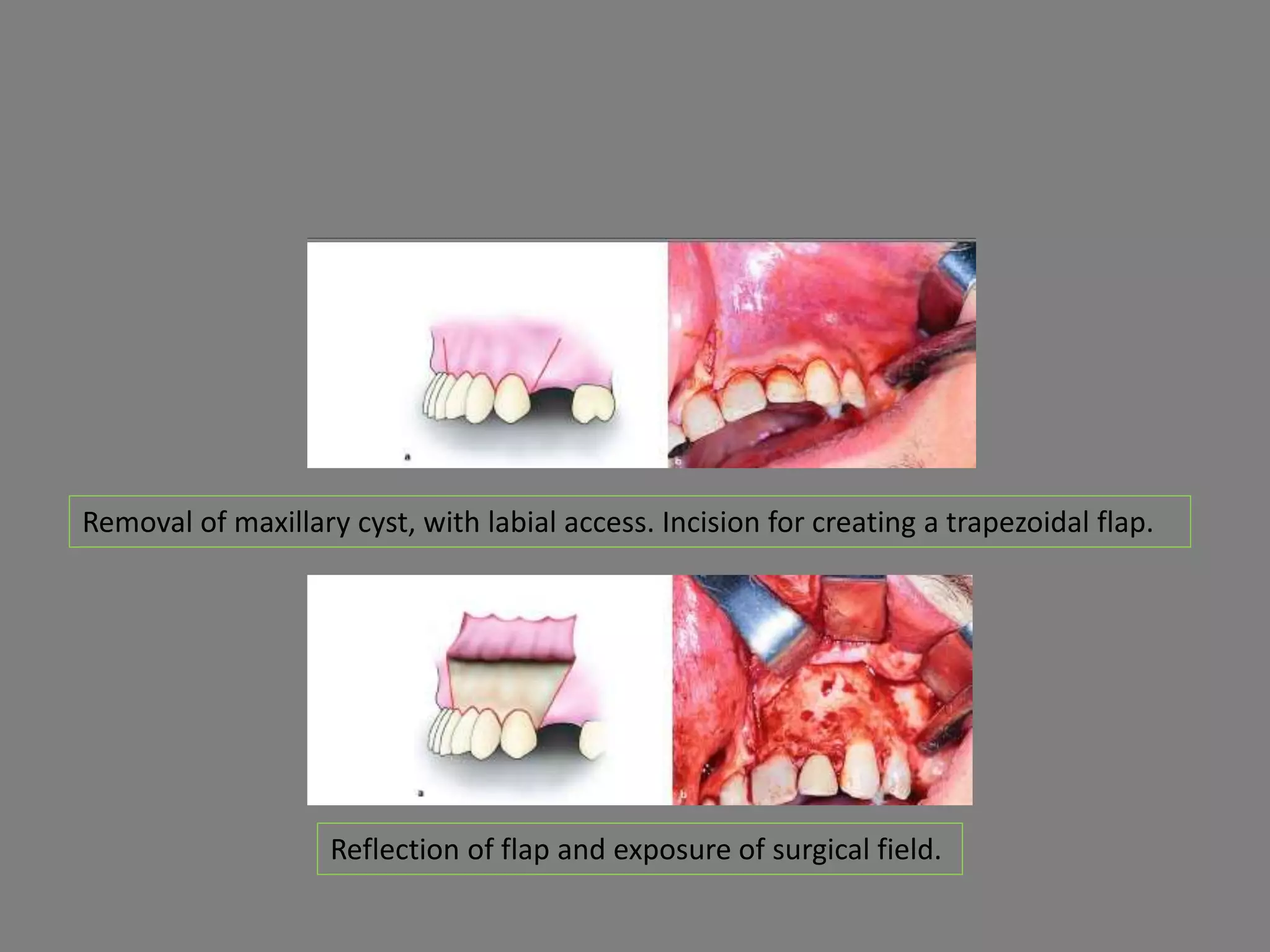
Removal of bone at the labial aspect respective to the
lesion.
Osseous window created to expose part of the
lesion.
Removal of cyst from bony cavity, using hemostat and curette.
Surgical field after removal of lesion.
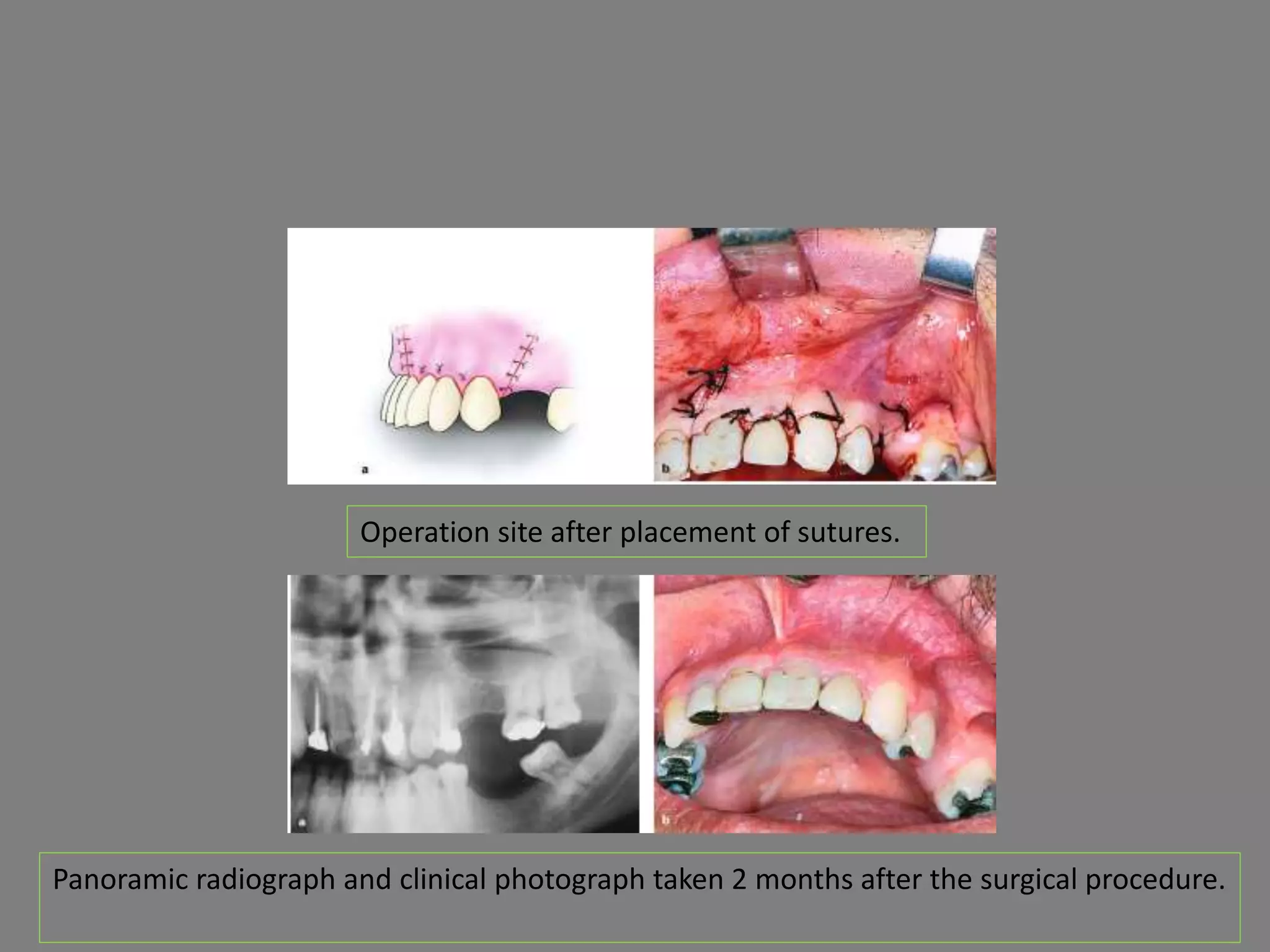
Operation site after placement of sutures.
Panoramic radiograph and clinical photograph taken 2 months after the surgical procedure.
• Marsupialization: This method is usually employed for the
removal of large cysts and entails opening a surgical window
at an appropriate site above the lesion. In order to create the
surgical window, initially a circular incision is made, which
includes the mucoperiosteum, the underlying perforated
(usually) bone, and the respective wall of the cystic sac.
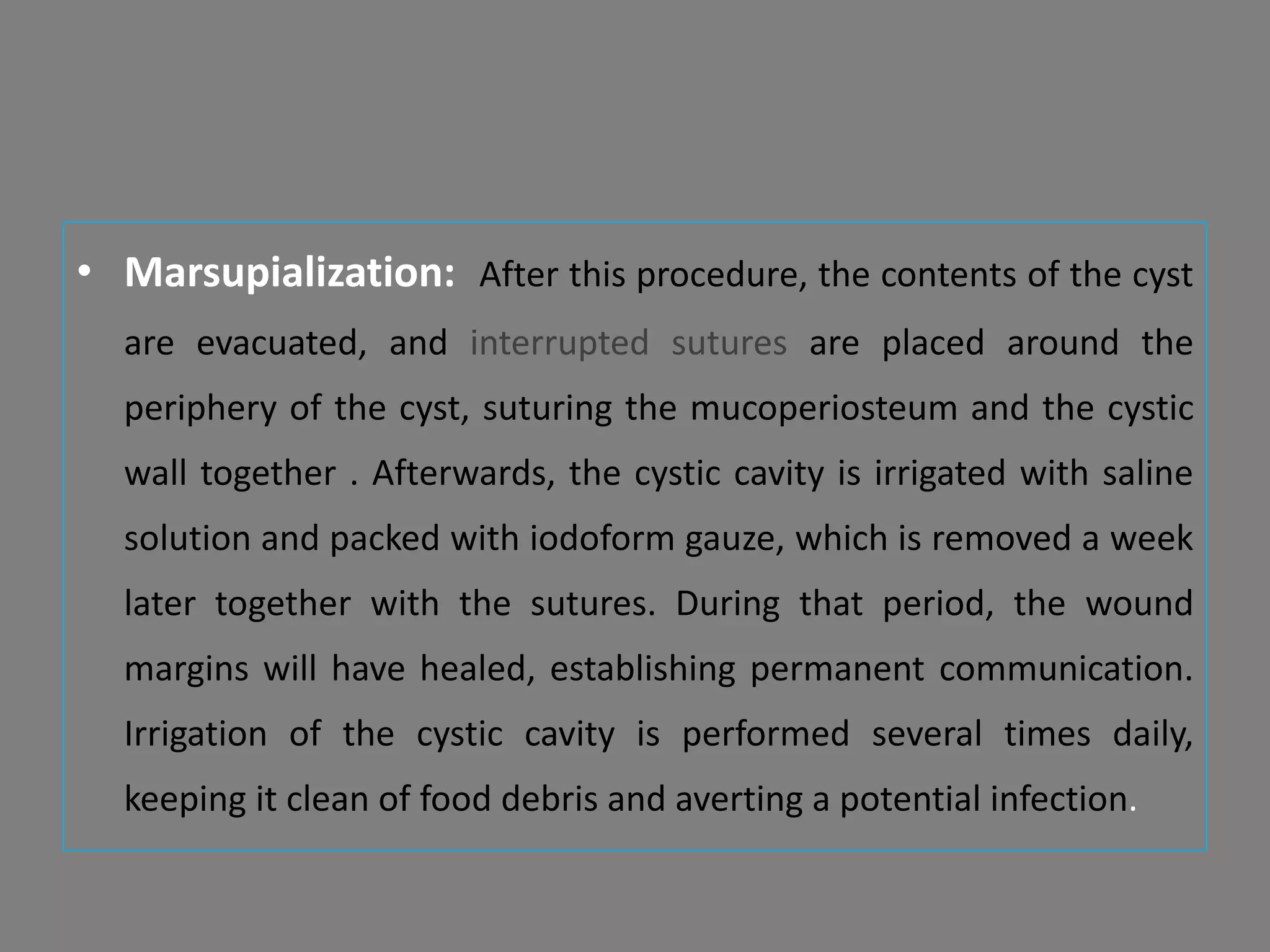
• Marsupialization: After this procedure, the contents of the cyst
are evacuated, and interrupted sutures are placed around the
periphery of the cyst, suturing the mucoperiosteum and the cystic
wall together . Afterwards, the cystic cavity is irrigated with saline
solution and packed with iodoform gauze, which is removed a week
later together with the sutures. During that period, the wound
margins will have healed, establishing permanent communication.
Irrigation of the cystic cavity is performed several times daily,
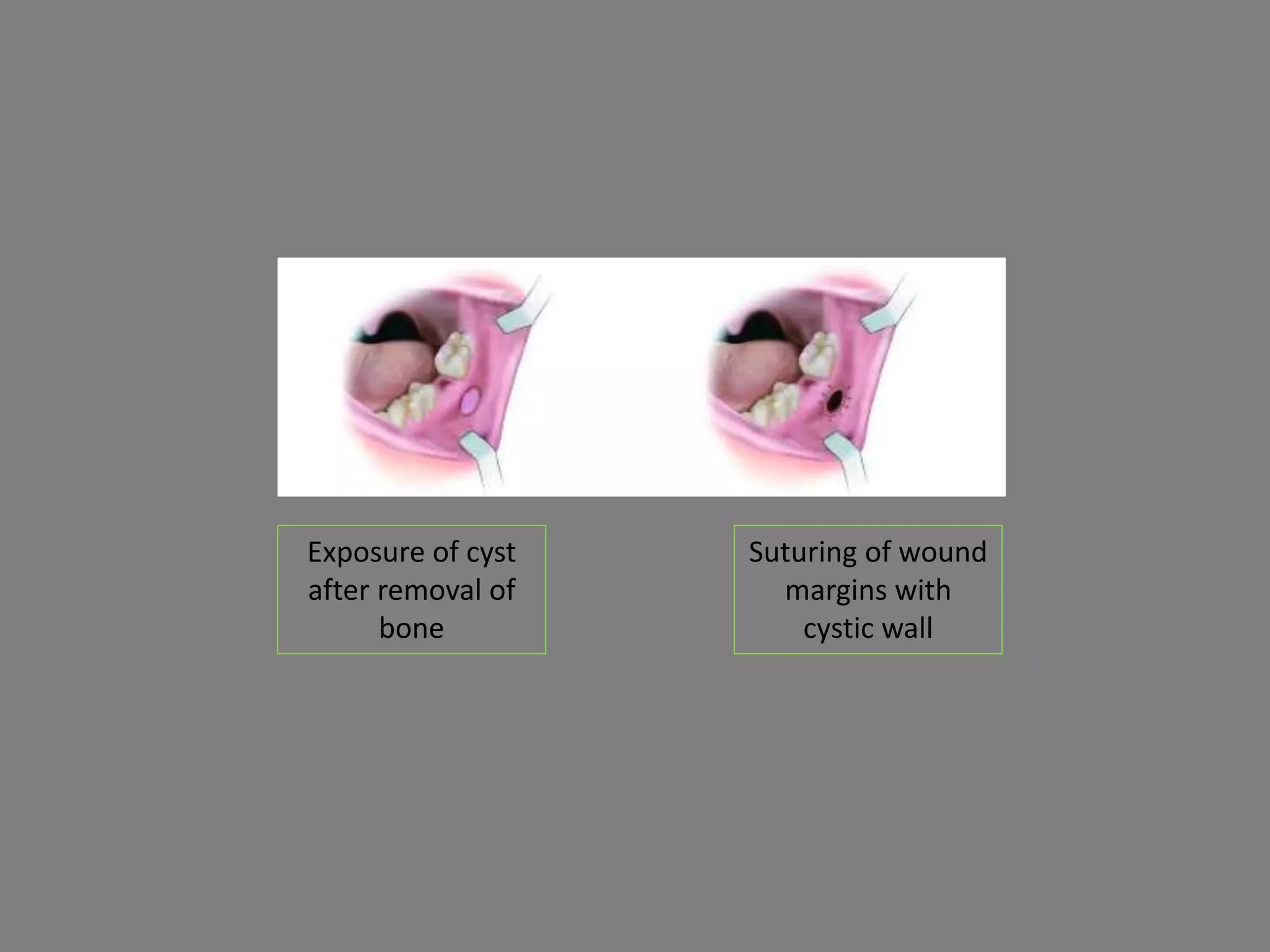
keeping it clean of food debris and averting a potential infection.
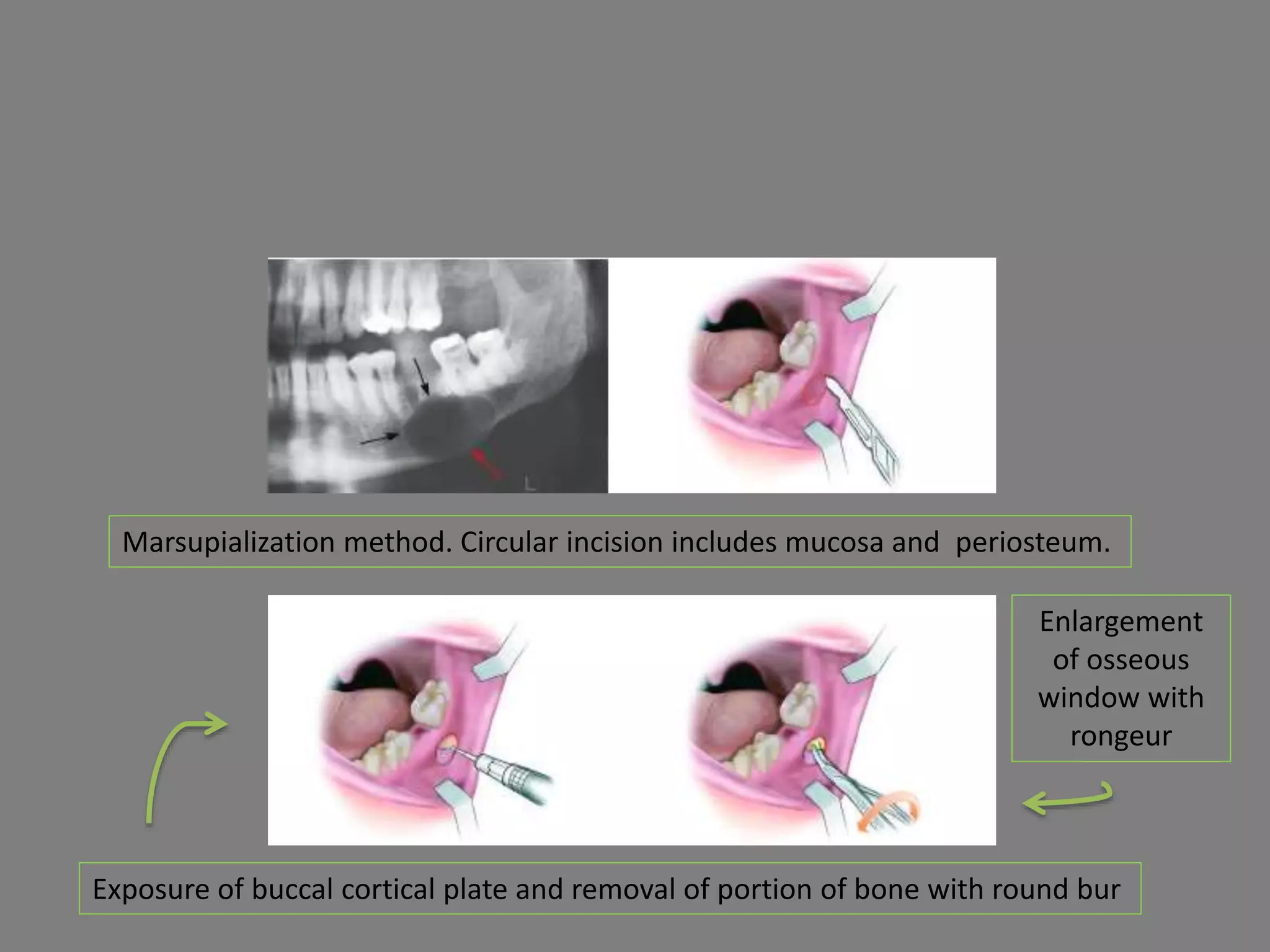
Marsupialization method. Circular incision includes mucosa and periosteum.
Exposure of buccal cortical plate and removal of portion of bone with round bur
Enlargement
of osseous
window with
rongeur
Exposure of cyst
after removal of
bone
Suturing of wound
margins with
cystic wall
Packing of cystic
cavity with
iodoform gauz
Cystic cavity after
insertion of
gauze
Thank
you

Odontogeniccysts OKC

  • 1.
  • 2.
    1. INTRODUCTION 2. CLASSIFICATION 3.CAUSES 4. HISTOPATHOLOGY 5. CLINICAL FEATURES 6. RADIOGRAPHIC FEATURES 7. DIFFERENTIAL DIAGNOSIS 8. TREATMENT 9. PRINCIPLE OF TREATMENT A. Types of Flaps. B. Surgical removal the of the cyst . OUTLINE
  • 3.
    • A cystis an epithelium-lined sac containing fluid or semisolid material. In the formation of a cyst, the epithelial cells first proliferate and later undergo degeneration and liquefaction. The liquefied material exerts equal pressure on the walls of the cyst from within. INTRODUCTION
  • 4.
    • Cysts growby expansion and thus displace the adjacent teeth by pressure. May produce expansion of the cortical bone. On a radiograph, the radiolucency of a cyst is usually bordered by a radiopaque periphery of dense sclerotic bone. The radiolucency may be unilocular or multilocular.
  • 5.
    • Odontogenic cystsare those which arise from the epithelium associated with the development of teeth. The source of epithelium is from the enamel organ, the reduced enamel epithelium, the cell rests of Malassez or the remnants of the dental lamina.
  • 6.
    • Radicular cyst •Residual cyst • Dentigerous cyst (follicular) • Primordial cyst • Lateral periodontal cyst • Odontogenic keratocyst • Calcifying odontogenic cyst (Gorlin cyst) CLASSIFICATION
  • 7.
  • 8.
    • There isgeneral agreement that OKCs develop from dental lamina remnants in the mandible and maxilla. However, an origin of this cyst from extension of basal cells of the overlying oral epithelium has also been suggested. • Genetic CAUSES
  • 9.
    • The epitheliallining is uniformly thin, generally ranging from 8 to 10 cell layers thick. • The basal layer exhibits a characteristic palisaded pattern with polarized and intensely stained nuclei of uniform diameter. The luminal epithelial cells are parakeratinized and produce an uneven or corrugated profile. HISTOPATHOLOGY
  • 10.
    • Additional histologicfeatures that may occasionally be encountered include budding of the basal cells into the C.T wall and microcyst formation. • The fibrous connective tissue component of the cyst wall is often free of inflammatory cell infiltrate and is relatively thin.
  • 11.
    • Age: Anyage , especially adults. • Location: Mandibular molar, ramus area favored; may be found dentigerous, in position of lateral root, periapical, or primordial cyst. • OKCs are relatively common jaw cysts. They occur at any age and have a peak incidence within the second and third decades. CLINICAL FEATURES
  • 12.
    • Location: Themost common is the posterior body of the mandible (90% posterior to the canines) and ramus (more than 50%). This type of cyst occasionally has the same pericoronal position as dentigerous cyst. • Periphery and shape: Usually with a cortical border unless becomes secondarily infected. The cyst may have a smooth (round or oval shape), or it may have a scalloped outline. RADIOGRAPHIC FEATURES
  • 13.
    • Internal structure: •Most commonly is radiolucent. • The cystic cavity contain keratin. • In some cases curved internal septa may be present, giving the lesion a multilocular appearance.
  • 14.
    • The effectson surrounding structures: It grows along the internal aspect of the jaws, causing minimal expansion except for the upper ramus and coronoid process, where considerable expansion may occur. OKCs can displace and resorb teeth but to a slightly lesser degree than dentigerous cysts. The inferior alveolar nerve canal may be displaced inferiorly. In the maxilla this cyst can invaginate and occupy the entire maxillary antrum.
  • 16.
    • Dentigerous cystOKC • Ameloblastoma, AB has a greater propensity to expand. • Odontogenic myxoma, multilocular with fine straight septa. • A simple bone cyst often has a scalloped margin and minimal bone expansion. • Several OKCs are found. These cysts may constitute part of a basal cell nevus syndrome. DIFFERENTIAL DIAGNOSIS
  • 17.
    Wide (local) surgicalexcision to prevent the recurrence or Marsupialization - the surgical opening of the (KCOT) cavity and a creation of a marsupial- like pouch, so that the cavity is in contact with outside for an extended period. TREATMENT
  • 18.
    1. Local anesthesia. 2.Types of Flaps. 3. Surgical removal the of the cyst . PRINCIPLES OF TREATMENT
  • 19.
  • 20.
    1. Trapezoidal flap. •Advantages: Provides excellent access. Allows surgery to be performed on more than two teeth. Produces no tension in the tissues. Allows easy reapproximation of the flap to its original position. • Disadvantages: Produces a defect in the attached gingiva. TYPES OF FLAPS
  • 21.
    2. Triangular Flap. •Advantage : Ensures an adequate blood supply, satisfactory visualization, very good stability . • Disadvantages: Limited access to long roots. Tension is created when the flap is held with a retractor, and it causes a defect in the attached gingiva.
  • 22.
    3. Envelope Flap. •Advantages: Avoidance of vertical incision and easy reapproximation to original position. • Disadvantages: Difficult reflection (mainly palatally). Great tension with a risk of the ends tearing. Limited visualization in apicoectomies. Limited access. Possibility of injury of palatal vessels and nerves. Defect of attached gingiva
  • 23.
    4. Semilunar Flap. •Advantage: Small incision and easy reflection. No recession of gingivae around the prosthetic restoration. • Disadvantages: The incision being performed right over the bone lesion due to miscalculation. Scarring in the anterior area. Difficulty of reapproximation. Limited access and visualization. Tendency to tear.
  • 24.
    • Enucleation: Thistechnique involves complete removal of the cystic sac and healing of the wound by primary intention. This is the most satisfactory method of treatment of a cyst and is indicated in all cases where cysts are involved, whose wall may be removed without damaging adjacent teeth and other anatomic structures. SURGICAL REMOVAL OF THE CYST
  • 25.
    • The surgicalprocedure for treatment of a cyst with enucleation includes the following steps: 1. Reflection of a mucoperiosteal flap. 2. Removal of bone and exposure of part of the cyst. 3. Enucleation of the cystic sac. 4. Care of the wound and suturing.
  • 26.
    Panoramic radiograph showingan extensive radicular lesion at the region of teeth 22, 23, 24 Clinical photograph of case
  • 27.
    Removal of maxillarycyst, with labial access. Incision for creating a trapezoidal flap. Reflection of flap and exposure of surgical field.
  • 28.
    Removal of boneat the labial aspect respective to the lesion. Osseous window created to expose part of the lesion.
  • 29.
    Removal of cystfrom bony cavity, using hemostat and curette. Surgical field after removal of lesion.
  • 30.
    Operation site afterplacement of sutures. Panoramic radiograph and clinical photograph taken 2 months after the surgical procedure.
  • 31.
    • Marsupialization: Thismethod is usually employed for the removal of large cysts and entails opening a surgical window at an appropriate site above the lesion. In order to create the surgical window, initially a circular incision is made, which includes the mucoperiosteum, the underlying perforated (usually) bone, and the respective wall of the cystic sac.
  • 32.
    • Marsupialization: Afterthis procedure, the contents of the cyst are evacuated, and interrupted sutures are placed around the periphery of the cyst, suturing the mucoperiosteum and the cystic wall together . Afterwards, the cystic cavity is irrigated with saline solution and packed with iodoform gauze, which is removed a week later together with the sutures. During that period, the wound margins will have healed, establishing permanent communication. Irrigation of the cystic cavity is performed several times daily, keeping it clean of food debris and averting a potential infection.
  • 33.
    Marsupialization method. Circularincision includes mucosa and periosteum. Exposure of buccal cortical plate and removal of portion of bone with round bur Enlargement of osseous window with rongeur
  • 34.
    Exposure of cyst afterremoval of bone Suturing of wound margins with cystic wall
  • 35.
    Packing of cystic cavitywith iodoform gauz Cystic cavity after insertion of gauze
  • 36.