GUIDED BY:
Dr. PRATIBHA POUDEL
Dr. BHOJ RAJ ADHIKARI
PRESENTED BY
Ashim Upadhyaya
Amod kumar Yadav
CONTENT
1. Classification
2. Ameloblastic fibroma
3. Ameloblastic fibro- odontoma
4. Odontoma
5. Ameloblastic odontoma
6. Calcifying cystic odontogenic tumor
and dentinogenic ghost cell tumor
7. Primordial odontogenic tumor
1.AMELOBLASTIC FIBROMA
 Also known as –Soft mixed odontogenic tumor
-Soft mixed odontoma
-Fibroadamantoblastoma
Introduction
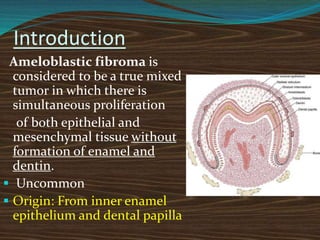
Ameloblastic fibroma is
considered to be a true mixed
tumor in which there is
simultaneous proliferation
of both epithelial and
mesenchymal tissue without
formation of enamel and
dentin.
 Uncommon
 Origin: From inner enamel
epithelium and dental papilla
Some investigators suggested that:
Ameloblastic fibroma
left undisturbed
Matures to form ameloblastic fibro- odontoma
Eventually into completely differentiated
odontoma
* But this concept is contraindicated
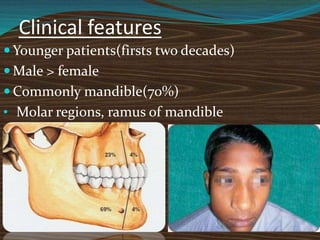
Clinical features
 Younger patients(firsts two decades)
 Male > female
 Commonly mandible(70%)
• Molar regions, ramus of mandible
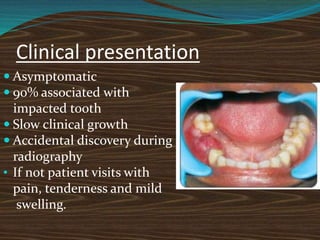
Clinical presentation
 Asymptomatic
 90% associated with
impacted tooth
 Slow clinical growth
 Accidental discovery during
radiography
• If not patient visits with
pain, tenderness and mild
swelling.
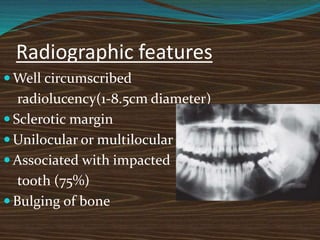
Radiographic features
 Well circumscribed
radiolucency(1-8.5cm diameter)
 Sclerotic margin
 Unilocular or multilocular
 Associated with impacted
tooth (75%)
 Bulging of bone
Histological features
components
1.Proliferating
Odontogenic
Epithelial
2.Cell rich
Mesenchymal
tissue
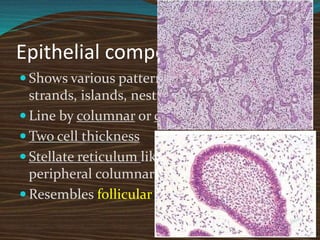
Epithelial component
 Shows various patterns like: rosettes,
strands, islands, nest, cords.
 Line by columnar or cuboidal cells
 Two cell thickness
 Stellate reticulum like cells surrounded by
peripheral columnar cells
 Resembles follicular stage of dental lamina
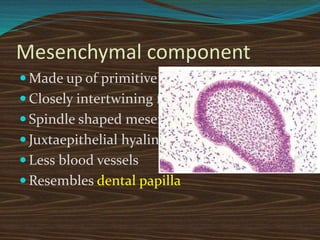
Mesenchymal component
 Made up of primitive connective tissue
 Closely intertwining fibrils
 Spindle shaped mesenchymal cells
 Juxtaepithelial hyalinization
 Less blood vessels
 Resembles dental papilla
Differential diagnosis
 Ameloblastoma(follicular)
 Dentigerous cyst
 Central giant cell granuloma
 Odontogenic myxoma
 Histiocytosis
Treatment
 Conservative resection , if incomplete 18.3%
(Zallen) chances of recurrence.
 Repeated recurrence may develop
ameloblastic fibrosarcoma.
2. Ameloblastic fibro - odontoma
 Before Slootweg represented as hamartoma as
immature complex odontoma
 But WHO defined AFO as:
‘A neoplasm composed of proliferating
odontogenic epithelium embedded in a cellular
ectomesenchymal tissue that resembles dental
papilla with varying degree at inductive change
and dental hard tissue formation.’
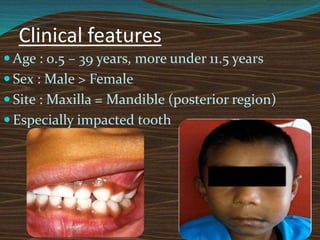
Clinical features
 Age : 0.5 – 39 years, more under 11.5 years
 Sex : Male > Female
 Site : Maxilla = Mandible (posterior region)
 Especially impacted tooth
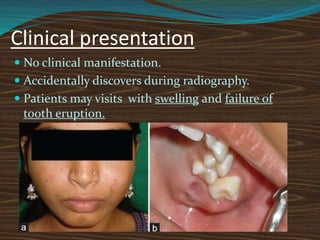
Clinical presentation
 No clinical manifestation.
 Accidentally discovers during radiography.
 Patients may visits with swelling and failure of
tooth eruption.
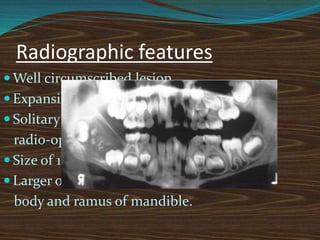
Radiographic features
 Well circumscribed lesion
 Expansile radiolucency
 Solitary or small multiple
radio-opaque masses.
 Size of 1-2 cm in diameter, but
 Larger ones extends up to
body and ramus of mandible.
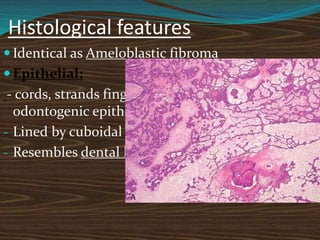
Histological features
 Identical as Ameloblastic fibroma
 Epithelial:
- cords, strands fingers and rosettes of
odontogenic epithelium
- Lined by cuboidal and columnar cells
- Resembles dental lamina
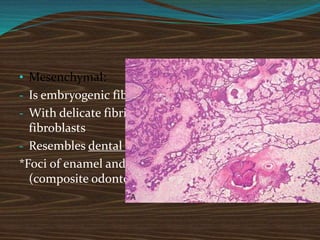
• Mesenchymal:
- Is embryogenic fibrous connective tissue
- With delicate fibrils, interspersed by primitive
fibroblasts
- Resembles dental papilla
*Foci of enamel and dentin matrix formation
(composite odontoma)
Differential diagnosis
1.Calcyfying odontogenic cyst
2.Calcfying epithelial odontogenic
tumor
3.Developing odontoma
4.Adenomatoid odontogenic tumor
Treatment
 Conservative curettage
 Recurrence rate is about 7%
 Rarely develops into Ameloblastic
fibrosarcoma
#Ameloblastic fibro dentinoma: calcifying
component consists only of dentin matrix
and dentinoid.
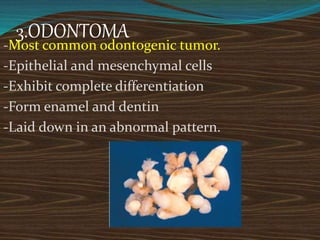
3.ODONTOMA
-Most common odontogenic tumor.
-Epithelial and mesenchymal cells
-Exhibit complete differentiation
-Form enamel and dentin
-Laid down in an abnormal pattern.
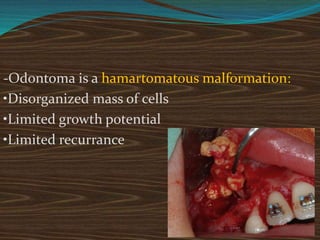
-Odontoma is a hamartomatous malformation:
•Disorganized mass of cells
•Limited growth potential
•Limited recurrance
Odontoma also called as Composite Odontoma.
•Because of more than one type of tissue.
-Two types:
•Compund composite odontoma
•Complex composite odontoma
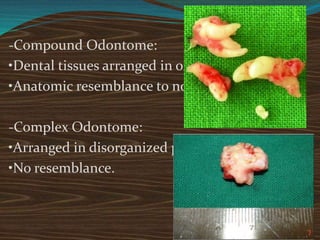
-Compound Odontome:
•Dental tissues arranged in orderly pattern.
•Anatomic resemblance to normal teeth.
-Complex Odontome:
•Arranged in disorganized pattern.
•No resemblance.
ETIOLOGY
-Unknown
-Local trauma
-Infection
-Genetic mutation
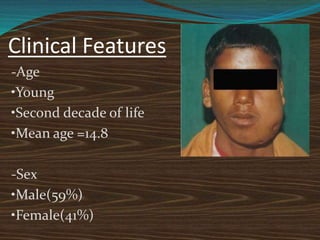
Clinical Features
-Age
•Young
•Second decade of life
•Mean age =14.8
-Sex
•Male(59%)
•Female(41%)
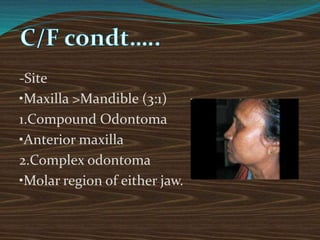
-Site
•Maxilla >Mandible (3:1)
1.Compound Odontoma
•Anterior maxilla
2.Complex odontoma
•Molar region of either jaw.
Clinical Presentation
-Asymptomatic and small
-Occassionally signs and symptoms
•unerrupted or impacted teeth
•Retained deciduous teeth
•Swelling
•infection
-Cyst formation mostly dentigerous cyst.
Radiographic Features
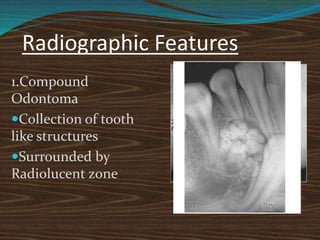
1.Compound
Odontoma
Collection of tooth
like structures
Surrounded by
Radiolucent zone
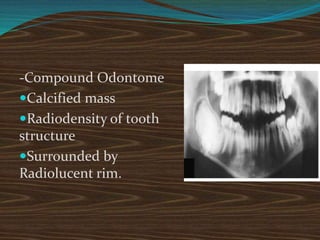
-Compound Odontome
Calcified mass
Radiodensity of tooth
structure
Surrounded by
Radiolucent rim.
Histopathology
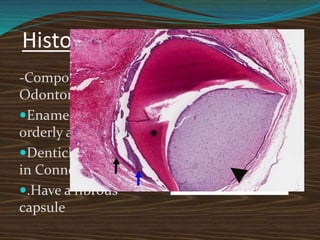
-Compound
Odontome
Enamel,dentin,pulp
orderly arranged
Denticles embedded
in Connective tissue
.Have a fibrous
capsule
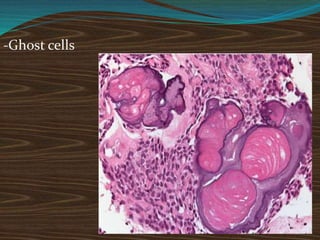
-Ghost cells
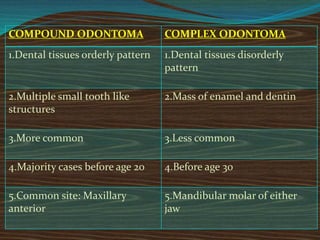
COMPOUND ODONTOMA COMPLEX ODONTOMA
1.Dental tissues orderly pattern 1.Dental tissues disorderly
pattern
2.Multiple small tooth like
structures
2.Mass of enamel and dentin
3.More common 3.Less common
4.Majority cases before age 20 4.Before age 30
5.Common site: Maxillary
anterior
5.Mandibular molar of either
jaw
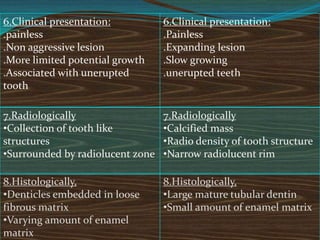
6.Clinical presentation:
.painless
.Non aggressive lesion
.More limited potential growth
.Associated with unerupted
tooth
6.Clinical presentation:
.Painless
.Expanding lesion
.Slow growing
.unerupted teeth
7.Radiologically
•Collection of tooth like
structures
•Surrounded by radiolucent zone
7.Radiologically
•Calcified mass
•Radio density of tooth structure
•Narrow radiolucent rim
8.Histologically,
•Denticles embedded in loose
fibrous matrix
•Varying amount of enamel
matrix
8.Histologically,
•Large mature tubular dentin
•Small amount of enamel matrix
Differential diagnosis
-Calcifying epithelial odontogenic tumor
-Ameloblastic fibrodentinoma
-Ameloblastic fibro-odontoma
-Osteoma
-Odontoameloblastoma
-Focal sclerosing osteomyelitis
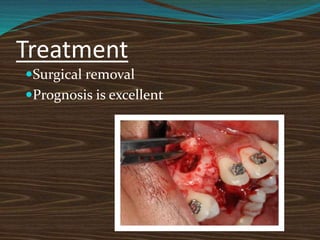
Treatment
Surgical removal
Prognosis is excellent
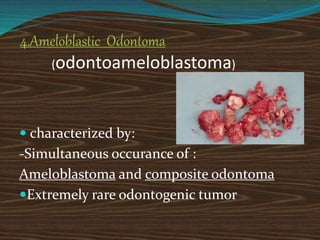
4.Ameloblastic Odontoma
(odontoameloblastoma)
 characterized by:
-Simultaneous occurance of :
Ameloblastoma and composite odontoma
Extremely rare odontogenic tumor
Clinical Feature
Age : between 6 month and 40 years of age
sex : male
Site : Mandible>Maxilla,molar and premolar region
-Pain
-Delayed eruption of teeth
-Expansion of the effected bone
Clinical presentation
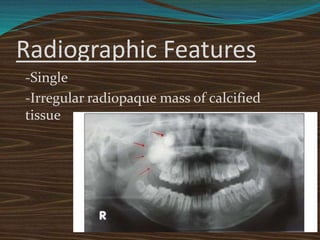
Radiographic Features
-Single
-Irregular radiopaque mass of calcified
tissue
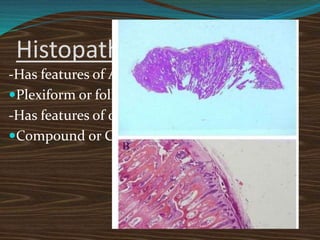
Histopathology
-Has features of Ameloblastoma
Plexiform or follicular pattern.
-Has features of odontoma
Compound or Complex
Treatment and Prognosis
-Surgical excision
-curettage
6.Calcifying cystic odontogenic tumor
and Dentinogenic ghost cell tumor
Q. Is the calcifying cystic odontogenic tumor
a cyst or is it a tumor ?
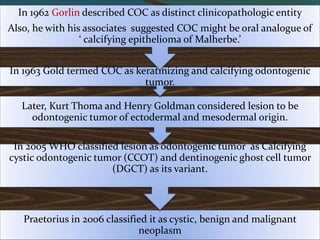
Praetorius in 2006 classified it as cystic, benign and malignant
neoplasm
In 2005 WHO classified lesion as odontogenic tumor as Calcifying
cystic odontogenic tumor (CCOT) and dentinogenic ghost cell tumor
(DGCT) as its variant.
Later, Kurt Thoma and Henry Goldman considered lesion to be
odontogenic tumor of ectodermal and mesodermal origin.
In 1963 Gold termed COC as keratinizing and calcifying odontogenic
tumor.
In 1962 Gorlin described COC as distinct clinicopathologic entity
Also, he with his associates suggested COC might be oral analogue of
‘ calcifying epithelioma of Malherbe.’
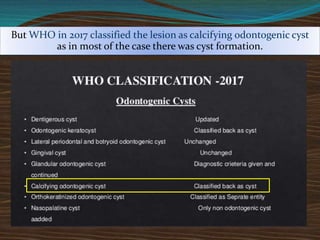
But WHO in 2017 classified the lesion as calcifying odontogenic cyst
as in most of the case there was cyst formation.
Introduction
Back in 2005:
 WHO defined calcifying cystic odontogenic tumor as a
‘ benign cystic neoplasm of odontogenic origin
characterized by ameloblastoma like epithelium with
ghost cells that may calcify’.
 WHO then defined dentinogenic ghost cell tumor as a
‘ benign neoplasm characterized by ameloblastoma
like islands of epithelial cells in mature connective
tissue stroma.
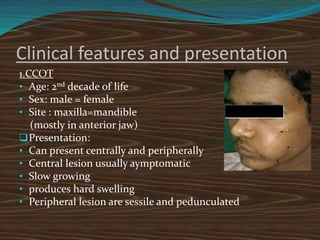
Clinical features and presentation
1.CCOT
• Age: 2nd decade of life
• Sex: male = female
• Site : maxilla=mandible
(mostly in anterior jaw)
Presentation:
• Can present centrally and peripherally
• Central lesion usually aymptomatic
• Slow growing
• produces hard swelling
• Peripheral lesion are sessile and pedunculated
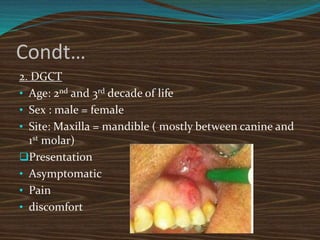
Condt…
2. DGCT
• Age: 2nd and 3rd decade of life
• Sex : male = female
• Site: Maxilla = mandible ( mostly between canine and
1st molar)
Presentation
• Asymptomatic
• Pain
• discomfort
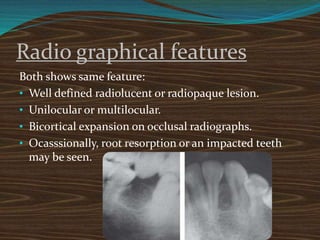
Radio graphical features
Both shows same feature:
• Well defined radiolucent or radiopaque lesion.
• Unilocular or multilocular.
• Bicortical expansion on occlusal radiographs.
• Ocasssionally, root resorption or an impacted teeth
may be seen.
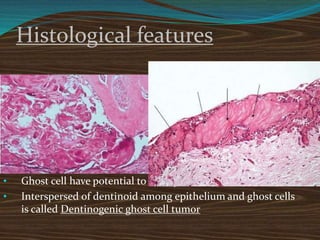
Histological features
• Fibrous capsule is lined by 4-10 cell thickness
• Basal cells are cuboidal or columnar with polarized nuclei
• Within epithelial component presence of
characterstic “ Ghost cells” undergoing keratinization
• Ghost cell are eosinophilic epithelial cells that lacks nuclei
with preservation of outline
• Ghost cell have potential to calcify
• Interspersed of dentinoid among epithelium and ghost cells
is called Dentinogenic ghost cell tumor
 Under Van Geison’s stain Ghost cell appears yellow and
dentinoid as red.
 In H and E stain ghost cell appears shadowy
Treatment
 Enucleation for calcifying cystic odontogenic tumor
 Surgical excision for dentinogenic ghost cell tumor
 Recurrence has been reported
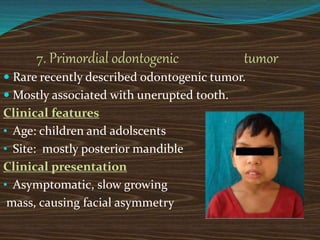
7. Primordial odontogenic tumor
 Rare recently described odontogenic tumor.
 Mostly associated with unerupted tooth.
Clinical features
• Age: children and adolscents
• Site: mostly posterior mandible
Clinical presentation
• Asymptomatic, slow growing
mass, causing facial asymmetry
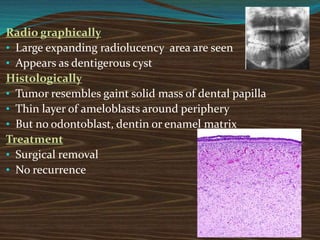
Radio graphically
• Large expanding radiolucency area are seen
• Appears as dentigerous cyst
Histologically
• Tumor resembles gaint solid mass of dental papilla
• Thin layer of ameloblasts around periphery
• But no odontoblast, dentin or enamel matrix
Treatment
• Surgical removal
• No recurrence
Summary
 Ameloblastic Fibroma Mixed tumor of odontogenic origin
that mostly occurs in children and teenagers,Often
associated with an impacted tooth,Composed of neoplastic
epithelium and neoplastic connective tissue , which can be
treated by curettage or excision and has rare malignant
conterpart.
 Ameloblastic Fibro- odontoma same as Ameloblastic
fibroma but composed of neoplastic epithelium and
neoplastic myxomatous connective tissue.
Summary
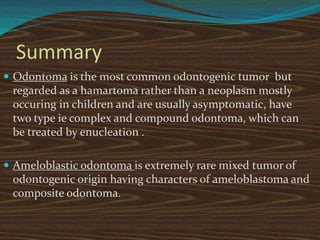
 Odontoma is the most common odontogenic tumor but
regarded as a hamartoma rather than a neoplasm mostly
occuring in children and are usually asymptomatic, have
two type ie complex and compound odontoma, which can
be treated by enucleation .
 Ameloblastic odontoma is extremely rare mixed tumor of
odontogenic origin having characters of ameloblastoma and
composite odontoma.
Summary
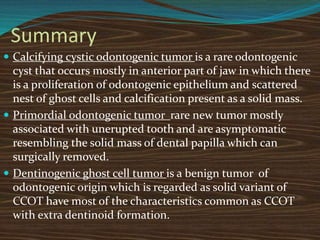
 Calcifying cystic odontogenic tumor is a rare odontogenic
cyst that occurs mostly in anterior part of jaw in which there
is a proliferation of odontogenic epithelium and scattered
nest of ghost cells and calcification present as a solid mass.
 Primordial odontogenic tumor rare new tumor mostly
associated with unerupted tooth and are asymptomatic
resembling the solid mass of dental papilla which can
surgically removed.
 Dentinogenic ghost cell tumor is a benign tumor of
odontogenic origin which is regarded as solid variant of
CCOT have most of the characteristics common as CCOT
with extra dentinoid formation.
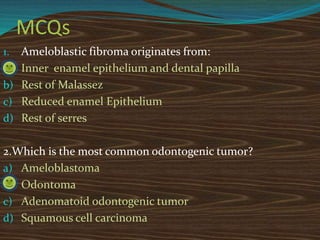
MCQs
1. Ameloblastic fibroma originates from:
a) Inner enamel epithelium and dental papilla
b) Rest of Malassez
c) Reduced enamel Epithelium
d) Rest of serres
2.Which is the most common odontogenic tumor?
a) Ameloblastoma
b) Odontoma
c) Adenomatoid odontogenic tumor
d) Squamous cell carcinoma
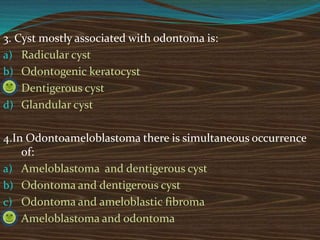
3. Cyst mostly associated with odontoma is:
a) Radicular cyst
b) Odontogenic keratocyst
c) Dentigerous cyst
d) Glandular cyst
4.In Odontoameloblastoma there is simultaneous occurrence
of:
a) Ameloblastoma and dentigerous cyst
b) Odontoma and dentigerous cyst
c) Odontoma and ameloblastic fibroma
d) Ameloblastoma and odontoma
Reference
 Shafer, Hine, Levy. Shafer's textbook of oral pathology.
8th edition. New Delhi: Elsevier; 2019
 Neville Brad W. Damm Douglas D. Allen Carl M. Chi
Angela C. Oral and Maxillofacial Pathology. 4th
edition. Missouri: Elsevier; 2016
 E.W. odell. Cawson’s essentials of oral pathology and
oral medicine. 9th edition. London; Elsevier; 2017
 Swapan Kumar Purkait. Essentials of oral pathology.
3rd edition. New Delhi; Jaypee; 2011
Past Questions
Q. Short notes on Odontoma.
Q. Describe the etiology, clinical features, radio
graphical features and histology of odontoma.
Q. Define and classify odontomes.
THANK YOU

mixed tumors.pptx

  • 1.
    GUIDED BY: Dr. PRATIBHAPOUDEL Dr. BHOJ RAJ ADHIKARI PRESENTED BY Ashim Upadhyaya Amod kumar Yadav
  • 2.
    CONTENT 1. Classification 2. Ameloblasticfibroma 3. Ameloblastic fibro- odontoma 4. Odontoma 5. Ameloblastic odontoma 6. Calcifying cystic odontogenic tumor and dentinogenic ghost cell tumor 7. Primordial odontogenic tumor
  • 4.
    1.AMELOBLASTIC FIBROMA  Alsoknown as –Soft mixed odontogenic tumor -Soft mixed odontoma -Fibroadamantoblastoma
  • 5.
    Introduction Ameloblastic fibroma is consideredto be a true mixed tumor in which there is simultaneous proliferation of both epithelial and mesenchymal tissue without formation of enamel and dentin.  Uncommon  Origin: From inner enamel epithelium and dental papilla
  • 6.
    Some investigators suggestedthat: Ameloblastic fibroma left undisturbed Matures to form ameloblastic fibro- odontoma Eventually into completely differentiated odontoma * But this concept is contraindicated
  • 7.
    Clinical features  Youngerpatients(firsts two decades)  Male > female  Commonly mandible(70%) • Molar regions, ramus of mandible
  • 8.
    Clinical presentation  Asymptomatic 90% associated with impacted tooth  Slow clinical growth  Accidental discovery during radiography • If not patient visits with pain, tenderness and mild swelling.
  • 9.
    Radiographic features  Wellcircumscribed radiolucency(1-8.5cm diameter)  Sclerotic margin  Unilocular or multilocular  Associated with impacted tooth (75%)  Bulging of bone
  • 10.
  • 11.
    Epithelial component  Showsvarious patterns like: rosettes, strands, islands, nest, cords.  Line by columnar or cuboidal cells  Two cell thickness  Stellate reticulum like cells surrounded by peripheral columnar cells  Resembles follicular stage of dental lamina
  • 12.
    Mesenchymal component  Madeup of primitive connective tissue  Closely intertwining fibrils  Spindle shaped mesenchymal cells  Juxtaepithelial hyalinization  Less blood vessels  Resembles dental papilla
  • 14.
    Differential diagnosis  Ameloblastoma(follicular) Dentigerous cyst  Central giant cell granuloma  Odontogenic myxoma  Histiocytosis
  • 15.
    Treatment  Conservative resection, if incomplete 18.3% (Zallen) chances of recurrence.  Repeated recurrence may develop ameloblastic fibrosarcoma.
  • 16.
    2. Ameloblastic fibro- odontoma  Before Slootweg represented as hamartoma as immature complex odontoma  But WHO defined AFO as: ‘A neoplasm composed of proliferating odontogenic epithelium embedded in a cellular ectomesenchymal tissue that resembles dental papilla with varying degree at inductive change and dental hard tissue formation.’
  • 17.
    Clinical features  Age: 0.5 – 39 years, more under 11.5 years  Sex : Male > Female  Site : Maxilla = Mandible (posterior region)  Especially impacted tooth
  • 18.
    Clinical presentation  Noclinical manifestation.  Accidentally discovers during radiography.  Patients may visits with swelling and failure of tooth eruption.
  • 19.
    Radiographic features  Wellcircumscribed lesion  Expansile radiolucency  Solitary or small multiple radio-opaque masses.  Size of 1-2 cm in diameter, but  Larger ones extends up to body and ramus of mandible.
  • 20.
    Histological features  Identicalas Ameloblastic fibroma  Epithelial: - cords, strands fingers and rosettes of odontogenic epithelium - Lined by cuboidal and columnar cells - Resembles dental lamina
  • 21.
    • Mesenchymal: - Isembryogenic fibrous connective tissue - With delicate fibrils, interspersed by primitive fibroblasts - Resembles dental papilla *Foci of enamel and dentin matrix formation (composite odontoma)
  • 22.
    Differential diagnosis 1.Calcyfying odontogeniccyst 2.Calcfying epithelial odontogenic tumor 3.Developing odontoma 4.Adenomatoid odontogenic tumor
  • 23.
    Treatment  Conservative curettage Recurrence rate is about 7%  Rarely develops into Ameloblastic fibrosarcoma #Ameloblastic fibro dentinoma: calcifying component consists only of dentin matrix and dentinoid.
  • 24.
    3.ODONTOMA -Most common odontogenictumor. -Epithelial and mesenchymal cells -Exhibit complete differentiation -Form enamel and dentin -Laid down in an abnormal pattern.
  • 25.
    -Odontoma is ahamartomatous malformation: •Disorganized mass of cells •Limited growth potential •Limited recurrance
  • 26.
    Odontoma also calledas Composite Odontoma. •Because of more than one type of tissue. -Two types: •Compund composite odontoma •Complex composite odontoma
  • 27.
    -Compound Odontome: •Dental tissuesarranged in orderly pattern. •Anatomic resemblance to normal teeth. -Complex Odontome: •Arranged in disorganized pattern. •No resemblance.
  • 28.
  • 29.
    Clinical Features -Age •Young •Second decadeof life •Mean age =14.8 -Sex •Male(59%) •Female(41%)
  • 30.
    -Site •Maxilla >Mandible (3:1) 1.CompoundOdontoma •Anterior maxilla 2.Complex odontoma •Molar region of either jaw.
  • 31.
    Clinical Presentation -Asymptomatic andsmall -Occassionally signs and symptoms •unerrupted or impacted teeth •Retained deciduous teeth •Swelling •infection -Cyst formation mostly dentigerous cyst.
  • 32.
    Radiographic Features 1.Compound Odontoma Collection oftooth like structures Surrounded by Radiolucent zone
  • 33.
    -Compound Odontome Calcified mass Radiodensityof tooth structure Surrounded by Radiolucent rim.
  • 34.
  • 35.
  • 36.
    COMPOUND ODONTOMA COMPLEXODONTOMA 1.Dental tissues orderly pattern 1.Dental tissues disorderly pattern 2.Multiple small tooth like structures 2.Mass of enamel and dentin 3.More common 3.Less common 4.Majority cases before age 20 4.Before age 30 5.Common site: Maxillary anterior 5.Mandibular molar of either jaw
  • 37.
    6.Clinical presentation: .painless .Non aggressivelesion .More limited potential growth .Associated with unerupted tooth 6.Clinical presentation: .Painless .Expanding lesion .Slow growing .unerupted teeth 7.Radiologically •Collection of tooth like structures •Surrounded by radiolucent zone 7.Radiologically •Calcified mass •Radio density of tooth structure •Narrow radiolucent rim 8.Histologically, •Denticles embedded in loose fibrous matrix •Varying amount of enamel matrix 8.Histologically, •Large mature tubular dentin •Small amount of enamel matrix
  • 38.
    Differential diagnosis -Calcifying epithelialodontogenic tumor -Ameloblastic fibrodentinoma -Ameloblastic fibro-odontoma -Osteoma -Odontoameloblastoma -Focal sclerosing osteomyelitis
  • 39.
  • 41.
    4.Ameloblastic Odontoma (odontoameloblastoma)  characterizedby: -Simultaneous occurance of : Ameloblastoma and composite odontoma Extremely rare odontogenic tumor
  • 42.
    Clinical Feature Age :between 6 month and 40 years of age sex : male Site : Mandible>Maxilla,molar and premolar region -Pain -Delayed eruption of teeth -Expansion of the effected bone Clinical presentation
  • 43.
  • 44.
    Histopathology -Has features ofAmeloblastoma Plexiform or follicular pattern. -Has features of odontoma Compound or Complex
  • 45.
  • 46.
    6.Calcifying cystic odontogenictumor and Dentinogenic ghost cell tumor Q. Is the calcifying cystic odontogenic tumor a cyst or is it a tumor ?
  • 47.
    Praetorius in 2006classified it as cystic, benign and malignant neoplasm In 2005 WHO classified lesion as odontogenic tumor as Calcifying cystic odontogenic tumor (CCOT) and dentinogenic ghost cell tumor (DGCT) as its variant. Later, Kurt Thoma and Henry Goldman considered lesion to be odontogenic tumor of ectodermal and mesodermal origin. In 1963 Gold termed COC as keratinizing and calcifying odontogenic tumor. In 1962 Gorlin described COC as distinct clinicopathologic entity Also, he with his associates suggested COC might be oral analogue of ‘ calcifying epithelioma of Malherbe.’
  • 49.
    But WHO in2017 classified the lesion as calcifying odontogenic cyst as in most of the case there was cyst formation.
  • 50.
    Introduction Back in 2005: WHO defined calcifying cystic odontogenic tumor as a ‘ benign cystic neoplasm of odontogenic origin characterized by ameloblastoma like epithelium with ghost cells that may calcify’.  WHO then defined dentinogenic ghost cell tumor as a ‘ benign neoplasm characterized by ameloblastoma like islands of epithelial cells in mature connective tissue stroma.
  • 51.
    Clinical features andpresentation 1.CCOT • Age: 2nd decade of life • Sex: male = female • Site : maxilla=mandible (mostly in anterior jaw) Presentation: • Can present centrally and peripherally • Central lesion usually aymptomatic • Slow growing • produces hard swelling • Peripheral lesion are sessile and pedunculated
  • 52.
    Condt… 2. DGCT • Age:2nd and 3rd decade of life • Sex : male = female • Site: Maxilla = mandible ( mostly between canine and 1st molar) Presentation • Asymptomatic • Pain • discomfort
  • 53.
    Radio graphical features Bothshows same feature: • Well defined radiolucent or radiopaque lesion. • Unilocular or multilocular. • Bicortical expansion on occlusal radiographs. • Ocasssionally, root resorption or an impacted teeth may be seen.
  • 54.
    Histological features • Fibrouscapsule is lined by 4-10 cell thickness • Basal cells are cuboidal or columnar with polarized nuclei • Within epithelial component presence of characterstic “ Ghost cells” undergoing keratinization • Ghost cell are eosinophilic epithelial cells that lacks nuclei with preservation of outline • Ghost cell have potential to calcify • Interspersed of dentinoid among epithelium and ghost cells is called Dentinogenic ghost cell tumor
  • 55.
     Under VanGeison’s stain Ghost cell appears yellow and dentinoid as red.  In H and E stain ghost cell appears shadowy Treatment  Enucleation for calcifying cystic odontogenic tumor  Surgical excision for dentinogenic ghost cell tumor  Recurrence has been reported
  • 56.
    7. Primordial odontogenictumor  Rare recently described odontogenic tumor.  Mostly associated with unerupted tooth. Clinical features • Age: children and adolscents • Site: mostly posterior mandible Clinical presentation • Asymptomatic, slow growing mass, causing facial asymmetry
  • 57.
    Radio graphically • Largeexpanding radiolucency area are seen • Appears as dentigerous cyst Histologically • Tumor resembles gaint solid mass of dental papilla • Thin layer of ameloblasts around periphery • But no odontoblast, dentin or enamel matrix Treatment • Surgical removal • No recurrence
  • 58.
    Summary  Ameloblastic FibromaMixed tumor of odontogenic origin that mostly occurs in children and teenagers,Often associated with an impacted tooth,Composed of neoplastic epithelium and neoplastic connective tissue , which can be treated by curettage or excision and has rare malignant conterpart.  Ameloblastic Fibro- odontoma same as Ameloblastic fibroma but composed of neoplastic epithelium and neoplastic myxomatous connective tissue.
  • 59.
    Summary  Odontoma isthe most common odontogenic tumor but regarded as a hamartoma rather than a neoplasm mostly occuring in children and are usually asymptomatic, have two type ie complex and compound odontoma, which can be treated by enucleation .  Ameloblastic odontoma is extremely rare mixed tumor of odontogenic origin having characters of ameloblastoma and composite odontoma.
  • 60.
    Summary  Calcifying cysticodontogenic tumor is a rare odontogenic cyst that occurs mostly in anterior part of jaw in which there is a proliferation of odontogenic epithelium and scattered nest of ghost cells and calcification present as a solid mass.  Primordial odontogenic tumor rare new tumor mostly associated with unerupted tooth and are asymptomatic resembling the solid mass of dental papilla which can surgically removed.  Dentinogenic ghost cell tumor is a benign tumor of odontogenic origin which is regarded as solid variant of CCOT have most of the characteristics common as CCOT with extra dentinoid formation.
  • 61.
    MCQs 1. Ameloblastic fibromaoriginates from: a) Inner enamel epithelium and dental papilla b) Rest of Malassez c) Reduced enamel Epithelium d) Rest of serres 2.Which is the most common odontogenic tumor? a) Ameloblastoma b) Odontoma c) Adenomatoid odontogenic tumor d) Squamous cell carcinoma
  • 62.
    3. Cyst mostlyassociated with odontoma is: a) Radicular cyst b) Odontogenic keratocyst c) Dentigerous cyst d) Glandular cyst 4.In Odontoameloblastoma there is simultaneous occurrence of: a) Ameloblastoma and dentigerous cyst b) Odontoma and dentigerous cyst c) Odontoma and ameloblastic fibroma d) Ameloblastoma and odontoma
  • 63.
    Reference  Shafer, Hine,Levy. Shafer's textbook of oral pathology. 8th edition. New Delhi: Elsevier; 2019  Neville Brad W. Damm Douglas D. Allen Carl M. Chi Angela C. Oral and Maxillofacial Pathology. 4th edition. Missouri: Elsevier; 2016  E.W. odell. Cawson’s essentials of oral pathology and oral medicine. 9th edition. London; Elsevier; 2017  Swapan Kumar Purkait. Essentials of oral pathology. 3rd edition. New Delhi; Jaypee; 2011
  • 64.
    Past Questions Q. Shortnotes on Odontoma. Q. Describe the etiology, clinical features, radio graphical features and histology of odontoma. Q. Define and classify odontomes.
  • 65.