ODONTOMA
• This is a hamartoma of odontogenic origin in which both epithelial and
mesenchymal cells exhibit complete differentiation with enamel and dentine
laid down in abnormal position.
• The term odontome was coined by Paul Broca in 1867
 It may result from the extraneous buds of odontogenic epithelial cells from the
lamina dura, from any of the three dental tissues, enamel, dentine or cementum.
 The cause may be trauma, infection or genetic transmission or due to hereditary
anomalies (Gardner’s syndrome, Hermanns syndrome)
ETIOLOGY
• Second and third decades of life
• commonly occur in permanent dentition
• 22% of all odontogenic tumors of the jaws.
• 10% of all odontogenic tumors of the jaws are compound odontomas.
• Compound odontome : 9 and 37%
• Complex odontome :5 and 30%.
EPIDEMIOLOGY
• The anterior segment of the jaws: compound composite (61%)
• The posterior segment of the jaws: complex composite (34%)
• Occur more frequently on the right side of the jaw than on the left
• The compound composite odontoma most frequently occurred in incisor cuspid region of the
upper jaw in contrast to the complex odontome which were commonly found in molar and
premolar region of the mandible.
• Compound is twice as common than complex.
SIGNS AND SYMPTOMS
* Asymptomatic
* These generally consist of unerupted or impacted teeth, retained deciduous teeth, swelling
and evidence of infection.
* Compound odontomas seldom cause bony expansion but complex odontomes often cause
slight or even marked bony expansion.
* The presence of odontomas may lead to malpositioning or displacement of adjacent teeth,
aplasia, malformation and devitalization of adjacent teeth
CLASSIFICATION
Four lesions containing enamel and dentine of normal appearance are defined in the
WHO classification. They are as follows:
1. Ameloblastic fibro-odontome
2. Odonto-ameloblastoma
3. Complex odontome
4. Compound odontome
On the basis of gross, radiographic and microscopic features, two types of
odontoma are recognized:
a. Compound
b. Complex
On the basis of their developmental origin in 1914, Gabell, James and Payne
grouped odontome into three types:
a. Epithelial
b. Composite (epithelial and mesodermal) and
c. Connective tissue.
According to their position within the jaws:
a. Intraosseous (erupted odontoma): They occur inside the bone and may erupt into
the oral cavity.
b. Extraosseous or peripheral odontomas: These are odontomas occurring in the
soft tissue covering the tooth bearing portions of the jaws, having a tendency to
exfoliate.
According to Thoma and Goldman:
• Germinated composite odontomas: two or more, more or less well-developed teeth fused
together
• Compound composite odontomas: made up of more or less rudimentary teeth
• Complex composite odontomas: calcified structure, which bears no great resemblance to
the normal anatomical arrangement of dental tissues
• Dilated odontomas: the crown or root part of tooth shows marked enlargement
• Cystic odontomas: an odontome that is normally encapsulated by fibrous connective
Z Gorlin et al eliminated the term composite as redundant and classified odontomas as
either complex or compound.
There are essentially two types of odontome:
• Complex composite odontome
• Compound composite odontome
A. Ectodermal origin
• Enameloma (enamel pearl, enamel nodule)
B. Mesodermal origin
• Dentinoma
• Cementoma
C. Mixed
• Complex composite odontoma
• Compound composite odontoma- multiple well formed teeth
• Compound complex odontoma
• Geminated odontoma
• Dilated odontoma with dens in dente.
COMPOUND ODONTOME
Definition: Malformation in which all dental tissues are represented in a more orderly
pattern than in the complex odontome represented, so that the lesion consists of many tooth-
like structures.
Shape : Regularly shaped, solitary or multiple small denticles. The compound odontoma is
usually between 1-3 cm in diameter in size
Appearance : Bizarre peg shaped teeth show anatomic resemblance to normal teeth.
Classification Compound odontome was classified as acc to Gravey et al
• Denticulo type : Composed of two or more of tissues separate denticles, having
crown and root, dental hard tissues resembling to that of tooth
• Particulate type : Composed of two or more separate masses or particles, bearing no
resemblance to tooth, consists of hard dental tissues
• Denticulo-particulate type: In this type, denticles and particles are present together.
Radiographic features:
 Shows a number of teeth like structures or denticles that look like deformed teeth, mostly in
the region of the canine.
 Each tooth like structure has radiopaque with a dark line surrounding it
 The radiopaque mass is surrounded by a radiolucent line that separates the pericoronal space
of the unerupted teeth.
Definition: Malformation in which all dental tissues are represented, individual tissues
being mainly well formed cut occurring in more or less disorderly pattern
Shape : Amorphous conglomeration of dental tissues
Appearance : An irregular mass
COMPLEX ODONTOME
• This appears as a dense radiopaque object, density greater than that of bone
and equivalent to that of teeth.
• It is associated with unerupted teeth.
Radiographic features:
Cystic odontoma
 It shows a solid mass of the odontoma but without any associated unerupted tooth.
 There is a dark shadow of the cystic cavity and has well-defined corticated
margins except in the cases of infection.
Cystic compound odontoma
• There is an area of bone destruction which appears as a dark shadow having well defined
margins lined by a thin white layer of cortical border.
• Within the cystic cavity there are numerous white radiopacities which vary in size and
shape.
• In some cases there are small amorphous granular densities scattered through out the
cavity and in some cases there are small denticles with enamel caps or without distinction
of the compound mass.
Dilated odontoma
Has a single calcified structure with more radiolucent central portion that has an
overall form of a doughnut.
Early diagnosis of odontomas helps us to:
1. Adopt a less complex and less expensive treatment
2. Ensures better prognosis
3. Avoid relapse of the lesion
4. Avoid displacement or devitalization of adjacent tooth.
TREATMENT
The treatment of choice is surgical removal of the lesion because it contains various tooth
formulations that can predispose to cystic change, interfere with eruption of permanent
teeth and cause considerable destruction of bone.
ADENOMATOID ODONTOGENIC TUMOUR
 Adenomatoid odontogenic tumor (AOT)
was first described by Steensland in 1905
 Adenomatoid Odontogenic Hamartoma
was first introduced in 2006 by Vargas et
al
SYNONYMS
• Adenoameloblastoma
• Ameloblastic Adenomatoid Tumor
• Adamantinoma
• Epithelioma Adamantinum
• Teratomatous Odontoma
 The AOT is a benign, non-neoplastic (hamartomatous) lesion with a slow but
progressive growth.
 Philipsen and Birn (1971), defined it as an odontogenic epithelial tumor with an
inductive effect on the odontogenic mesenchyme. The nature of the lesion is
uncertain and it may be hamartomatous rather than truly neoplastic.
DEFINITION
CLASSIFICATION
Based on the location it can be classified as:
❍ Follicular
❍ Extra follicular
❍ Peripheral
 The 2nd and 3rd decades of life
 The anterior part of the maxilla especially in the canine areas
 The lesion usually presents as asymptomatic swelling which is slowly growing and
often associated with an unerupted tooth.
 Adenomatoid odontogenic tumors are relatively small. They seldom exceed 3 cm in
greatest diameter
CLINICAL FEATURES
AOT may be seen in one of two stages of development:
(I) the early radiolucent stage, with histologic evidence of calcification only
(II)the mature stage, characterized by calcification within the lesion.
• AOT is well encapsulated by a fibrous capsule.
• Tumor shows various-sized solid nodules of cuboidal or spindle-shaped odontogenic
epithelium with minimal stroma.
• Within these nodules, there are characteristic rosette- or duct like spaces that are the
most characteristic features of AOT
HISTOPATHOLOGICAL FEATURES
RADIOLOGIC FEATURES
 The size of the lesion ranges from 1.5 to 3 cm.
 There is often a well-corticated non-scalloped outer margin, and sometimes it may be
very thick; this feature may be absent in parts of the lesion.
 The expanded cortex may appear thick and firm or thin and yielding.
 Fine snowflake calcifications are often present in the radiolucent lesion
MANAGEMENT
The AOT is readily enucleated
SQUAMOUS ODONTOGENIC TUMOUR
 Squamous odontogenic tumor first was reported in 1975 by Pullon and associates.
 Squamous odontogenic tumor is a rare benign epithelial odontogenic tumor
consisting of islands of well differentiated squamous epithelium in a fibrous
stroma.
• Mean age of 38 years
• The male to female ratio is 1.8:1
• Squamous odontogenic tumors mostly arise intraosseously around the alveolar processes
between the roots of vital erupted teeth.
• Possible indicator of the underlying tumor: mobility of the teeth, swelling of the alveolar
process, and moderate pain
• SOTs occurring in the maxilla seem to be more aggressive than those in the mandible
CLINICAL FEATURES
• squamous odontogenic tumors consist of islands of terminally differentiated squamous
epithelium.
• There is no peripheral palisading or cytological atypia.
HISTOPATHOLOGICAL FEATURES
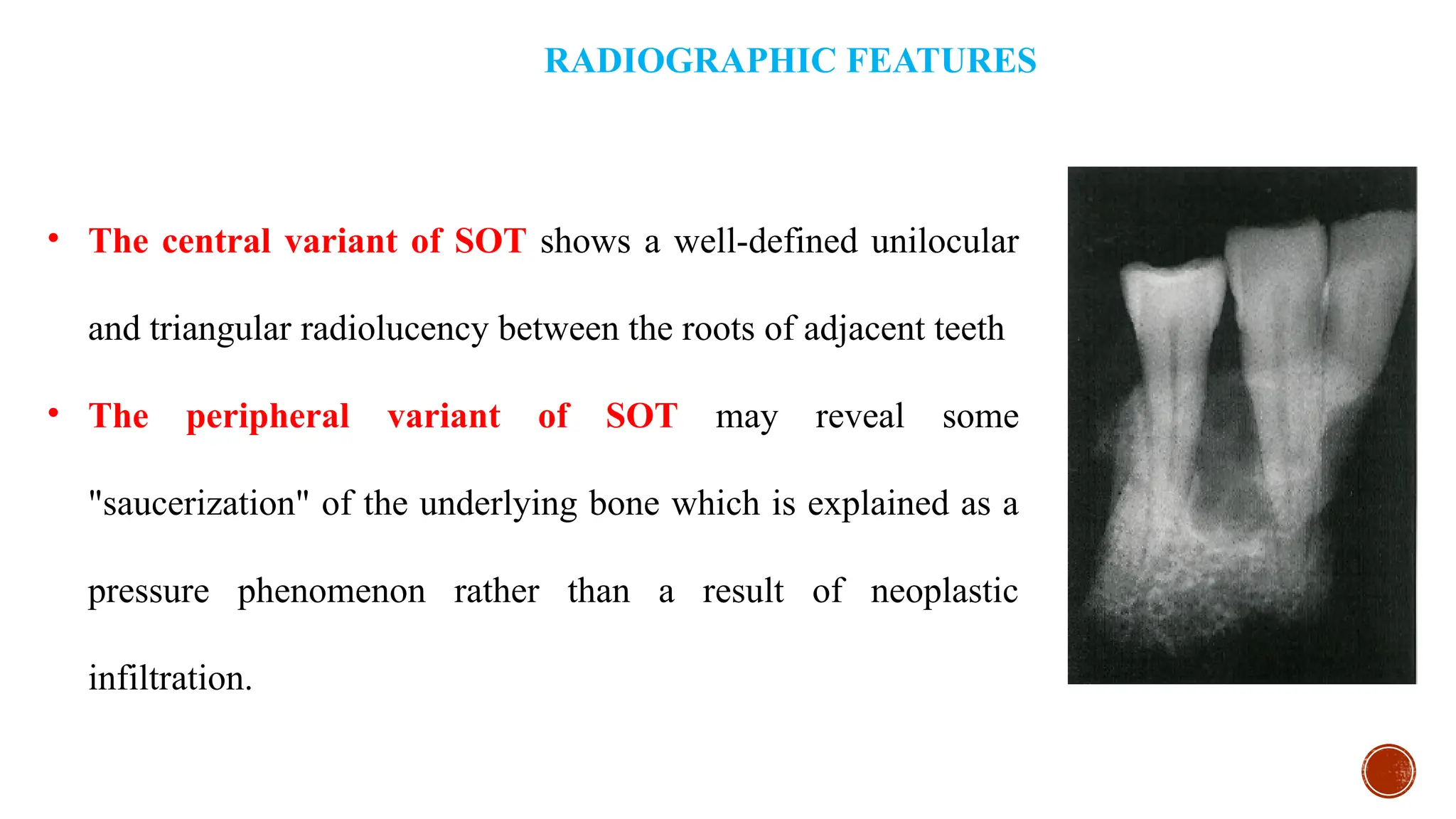
• The central variant of SOT shows a well-defined unilocular
and triangular radiolucency between the roots of adjacent teeth
• The peripheral variant of SOT may reveal some
"saucerization" of the underlying bone which is explained as a
pressure phenomenon rather than a result of neoplastic
infiltration.
RADIOGRAPHIC FEATURES
Conservative surgical excision
MANAGEMENT
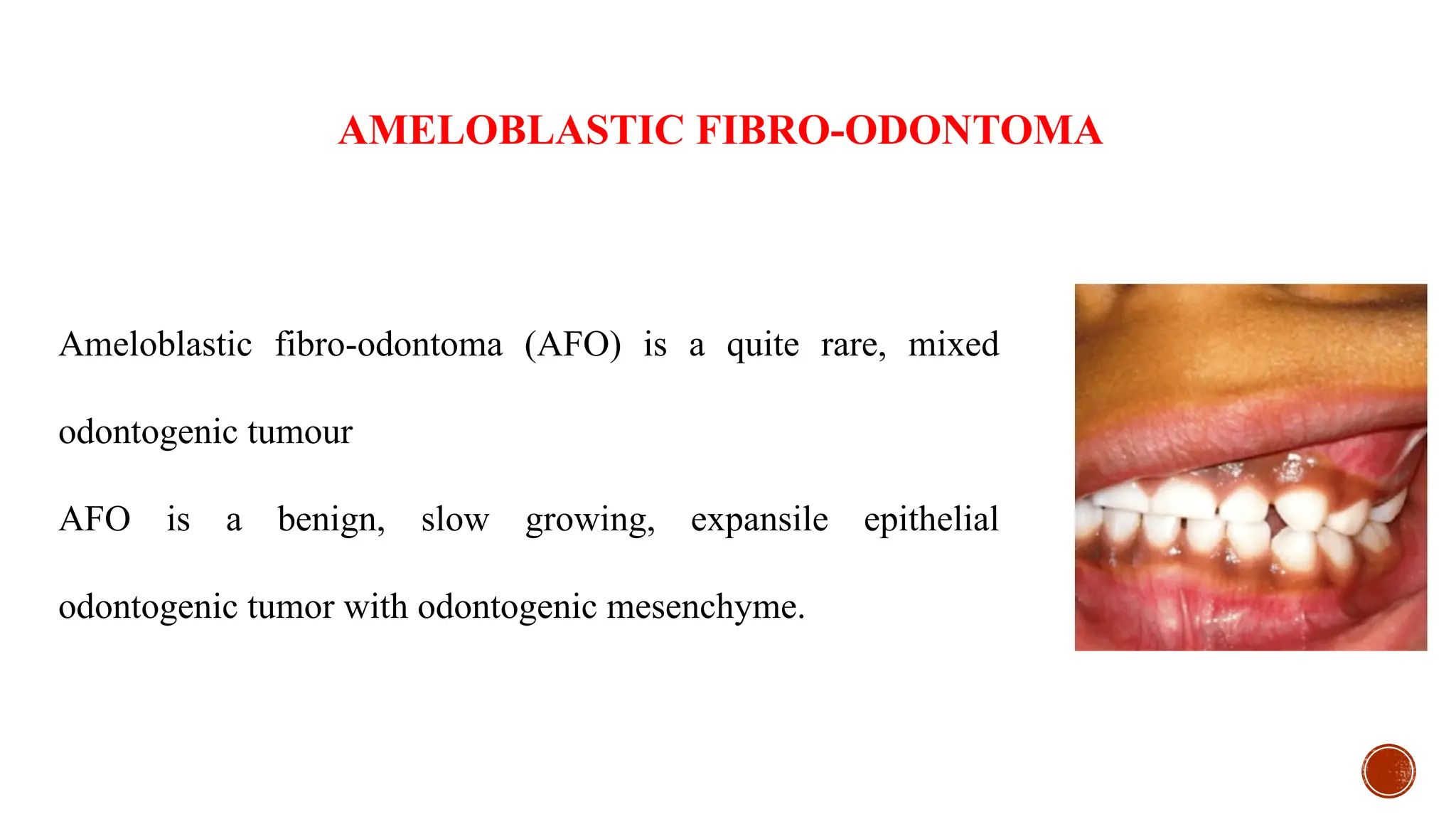
AMELOBLASTIC FIBRO-ODONTOMA
Ameloblastic fibro-odontoma (AFO) is a quite rare, mixed
odontogenic tumour
AFO is a benign, slow growing, expansile epithelial
odontogenic tumor with odontogenic mesenchyme.
• The lesions are usually diagnosed during the first and second decades of life
• It occurs with equal frequency in the maxilla and the mandible and with equal
frequency in males and females
• It may inhibit tooth eruption or displace involved teeth although teeth in the
affected area are vital
CLINICAL FEATURES
The lesion is composed of strands, cords, and islands of odontogenic epithelium
embedded in a cell-rich primitive ectomesenchyme, resembling the dental papilla.
HISTOPATHOLOGICAL FEATURES
Well-defined, radiolucent area containing various amounts of radiopaque material
of irregular size and form
RADIOLOGIC FEATURES
DIFFERENTIAL DIAGNOSIS
Complex odontoma
HAMARTOMAS OF OSSEOUS TISSUES
TORI
45
• These are benign, developmental bony growths that are
commonly observed in the oral cavity.
• Latin word torus : “to stand out” / “lump”
SYNONYMS:
• Exostosis of oral cavity
• Buccal exostosis.
INTRODUCTION
• More common and are specific to the midline hard palate and anterolateral lingual
mandible.
• Similar lesions involving the buccal aspect of the maxilla or mandible are called
exostoses.
• These areas are covered by keratinized or nonkeratinized mucosa, depending on the
anatomic location.
Torus maxillaris externus is a sessile nodule of bone signifies one or multiple unilateral
or bilateral hyperostoses arising from the alveolar portion of the maxilla, usually in the
molar region
Torus mandibularis is a bony protruberance located on the lingual aspect of the mandible
(commonly between the canine and premolar areas).
Torus palatinus is a benign thickening of normal cortical and medullary bone on the oral
surface of the hard palate.
DEFINITION
49
ETIOLOGY:
• Mild nasal septum pressures, which form palatal torus
• The torquing action of the arch of the mandible, which form
mandibular torus
• Lateral pressures from the roots of the underlying teeth, which
form buccal exostosis
• Bruxism (tooth grinding) forms the torus, which is more common
in early adult life
50
Reichart’s modification of Haugen's classification:
Grade I – Tori up to 3 mm in their largest dimension
Grade II – Tori up to 6 mm in their largest dimension
Grade III – Tori above 6 mm belong to this group
51
Maxillary Tori can be categorized by their appearance
1.Flat tori - Arising as a broad base and a smooth surface, are located on the
midline of the palate and extend symmetrically to either side.
2.Spindle tori - Have a ridge located at their midline.
3.Nodular tori - Have multiple bony growths that each have their own base.
4.Lobular tori - Have multiple bony growths with a common base.
52
Mandibular Tori can be categorized as:
• Unilateral solitary
• Bilateral solitary
• Unilateral multiple
• Bilateral multiple
• Bilateral combined
53
CLINICAL PRESENTATION
• They are usually asymptomatic and discovered incidentally but
when tori continues growth become large and interfere with
tongue mobility and speech, and the thin mucosa
• The growth of tori is very slow and may stop spontaneously
54
RADIOGRAPHIC FINDINGS
• Appear as well-defined radiopacities superimposed on the roots of
the teeth.
• Palatal tori may not be appreciated in periapical radiographs.
• Occlusal radiographs may show a faint radiopaque shadow over the
midpalatal region
• Mandibular tori are readily visualized as radiopaque areas projecting
from the lingual cortical plate on mandibular occlusal radiographs
55
DIFFERENTIAL DIAGNOSIS
Osteoma
Fibrous Dysplasia
Paget’s Disease
Management :
• No management is required unless tori pose a
functional problem
• Surgical Excision
• The mucosa over torus is ulcerated
• Speech interference.
• Prosthodontic reconstruction.
• Patient with poor oral hygiene around the lower posterior teeth.
• Cancer phobia.
• Traumatic ulceration from mastication
• Disturbances involving masticatory apparatus
• Esthetic reasons
INDICATIONS FOR SURGICAL REMOVAL:
FIBROUS DYSPLASIA
59
• It is a benign developmental disorder, where normal bone is
substituted by fibrous tissue with abnormal mineralization
also called as a dysplastic process of transformed
osteogenesis.
INTRODUCTION
ETIOLOGY AND PATHOGENESIS
• It is caused by a mutation in the G
protein alpha- subunit (Gs- alpha)
gene, which disrupts guanosine
triphosphatase function, resulting in
an increase in cyclic adenosine
monophosphate levels, which excite
endocrine receptors.
61
CLINICAL FEATURES:
FD may manifest as:
1. The monostotic form; a single bone lesion
2. The polyostotic form; multiple bone lesions:
 Craniofacial Fibrous Dysplasia
 Jaffe–lichtenstein Type
 Mccune–albright Syndrome
Monostotic form is at least six times more common than polyostotic form
Monostotic form
• Asymptomatic bone swelling with buccolingual and inferior cortical bone expansion
• Obliteration of the maxillary sinus
• Root and tooth displacement
• Root resorption
• Dislocation of inferior mandibular canal
63
POLYOSTOTIC FORM
• Hormonal abnormalities
• Early puberty
• Skin pigmentation
64
 equally in male and female patients
 maxilla slightly more often than the mandible.
 the most frequent sites-
* In the mandible: molar, premolar, and canine areas,
the ramus and the symphysis.
* In the maxilla: the molar-premolar region with the
maxillary sinus being frequently involved. FD may
extend into the floor of the orbit, the zygomatic
process, and backward toward the base of the skull
65
• The lesion forms a painless expansion of the jawbone, which
grows slowly over the years and then stops.
• The expansion is usually fusiform (low plateau) rather than
nodular or dome shaped and is firm, smoothly contoured, and
covered with normal mucosa.
• Teeth in the region remain firm and are not displaced.
ORAL MANIFESTATION
66
RADIOGRAPHIC FEATURES
Early lesions of FD :
* Usually an elongated rather than spherical
radiolucency.
* Margins are ragged and poorly defined,
merging imperceptibly into normal bone.
* These lesions are usually situated deep within
the jawbone rather than superficially in the
alveolus .
67
LATE STAGES
* The maturing changes that produce the ground-glass
appearance may commence at the periphery of the lesion.
* Gross displacement of the mandibular canal is frequently
associated with FD of the mandible
68
• Waters’ view of maxillary lesions frequently shows a radiodense
area that largely obliterates the maxillary sinus and involves the
zygoma and lower rim of the orbit.
• Most common manifestation of fibrous dysplasia in the skull is the
thickening of the occiput and base of skull.
• Involved dentition shows narrowing of the periodontal ligament
space with an ill-defined lamina dura that blends with the abnormal
bone.
• Grossly, the tissue is calcified, firm, gritty or granular.
• The characteristic microscopic features of fibrous
dysplasia comprises a fibrous stroma in which
spicules of woven bone are found.
• The woven bone is present in the form of irregular
shaped trabeculae which can be resembled to Chinese
script writing
HISTOPATHOLOGIC FEATURES
• The disease tends to stabilize and essentially stops growing when skeletal maturation is
reached.
• Small lesions, particularly in mandible can be removed by complete resection.
• Cosmetic deformity, with associated psychological problems or functional deformity
may require surgical intervention
MANAGEMENT
oral hamartomas detailed second part.pptx

oral hamartomas detailed second part.pptx

  • 2.
    ODONTOMA • This isa hamartoma of odontogenic origin in which both epithelial and mesenchymal cells exhibit complete differentiation with enamel and dentine laid down in abnormal position. • The term odontome was coined by Paul Broca in 1867
  • 3.
     It mayresult from the extraneous buds of odontogenic epithelial cells from the lamina dura, from any of the three dental tissues, enamel, dentine or cementum.  The cause may be trauma, infection or genetic transmission or due to hereditary anomalies (Gardner’s syndrome, Hermanns syndrome) ETIOLOGY
  • 4.
    • Second andthird decades of life • commonly occur in permanent dentition • 22% of all odontogenic tumors of the jaws. • 10% of all odontogenic tumors of the jaws are compound odontomas. • Compound odontome : 9 and 37% • Complex odontome :5 and 30%. EPIDEMIOLOGY
  • 5.
    • The anteriorsegment of the jaws: compound composite (61%) • The posterior segment of the jaws: complex composite (34%) • Occur more frequently on the right side of the jaw than on the left • The compound composite odontoma most frequently occurred in incisor cuspid region of the upper jaw in contrast to the complex odontome which were commonly found in molar and premolar region of the mandible. • Compound is twice as common than complex.
  • 6.
    SIGNS AND SYMPTOMS *Asymptomatic * These generally consist of unerupted or impacted teeth, retained deciduous teeth, swelling and evidence of infection. * Compound odontomas seldom cause bony expansion but complex odontomes often cause slight or even marked bony expansion. * The presence of odontomas may lead to malpositioning or displacement of adjacent teeth, aplasia, malformation and devitalization of adjacent teeth
  • 7.
    CLASSIFICATION Four lesions containingenamel and dentine of normal appearance are defined in the WHO classification. They are as follows: 1. Ameloblastic fibro-odontome 2. Odonto-ameloblastoma 3. Complex odontome 4. Compound odontome
  • 8.
    On the basisof gross, radiographic and microscopic features, two types of odontoma are recognized: a. Compound b. Complex
  • 9.
    On the basisof their developmental origin in 1914, Gabell, James and Payne grouped odontome into three types: a. Epithelial b. Composite (epithelial and mesodermal) and c. Connective tissue.
  • 10.
    According to theirposition within the jaws: a. Intraosseous (erupted odontoma): They occur inside the bone and may erupt into the oral cavity. b. Extraosseous or peripheral odontomas: These are odontomas occurring in the soft tissue covering the tooth bearing portions of the jaws, having a tendency to exfoliate.
  • 11.
    According to Thomaand Goldman: • Germinated composite odontomas: two or more, more or less well-developed teeth fused together • Compound composite odontomas: made up of more or less rudimentary teeth • Complex composite odontomas: calcified structure, which bears no great resemblance to the normal anatomical arrangement of dental tissues • Dilated odontomas: the crown or root part of tooth shows marked enlargement • Cystic odontomas: an odontome that is normally encapsulated by fibrous connective
  • 12.
    Z Gorlin etal eliminated the term composite as redundant and classified odontomas as either complex or compound. There are essentially two types of odontome: • Complex composite odontome • Compound composite odontome
  • 13.
    A. Ectodermal origin •Enameloma (enamel pearl, enamel nodule) B. Mesodermal origin • Dentinoma • Cementoma C. Mixed • Complex composite odontoma • Compound composite odontoma- multiple well formed teeth • Compound complex odontoma • Geminated odontoma • Dilated odontoma with dens in dente.
  • 14.
    COMPOUND ODONTOME Definition: Malformationin which all dental tissues are represented in a more orderly pattern than in the complex odontome represented, so that the lesion consists of many tooth- like structures. Shape : Regularly shaped, solitary or multiple small denticles. The compound odontoma is usually between 1-3 cm in diameter in size Appearance : Bizarre peg shaped teeth show anatomic resemblance to normal teeth.
  • 15.
    Classification Compound odontomewas classified as acc to Gravey et al • Denticulo type : Composed of two or more of tissues separate denticles, having crown and root, dental hard tissues resembling to that of tooth • Particulate type : Composed of two or more separate masses or particles, bearing no resemblance to tooth, consists of hard dental tissues • Denticulo-particulate type: In this type, denticles and particles are present together.
  • 16.
    Radiographic features:  Showsa number of teeth like structures or denticles that look like deformed teeth, mostly in the region of the canine.  Each tooth like structure has radiopaque with a dark line surrounding it  The radiopaque mass is surrounded by a radiolucent line that separates the pericoronal space of the unerupted teeth.
  • 17.
    Definition: Malformation inwhich all dental tissues are represented, individual tissues being mainly well formed cut occurring in more or less disorderly pattern Shape : Amorphous conglomeration of dental tissues Appearance : An irregular mass COMPLEX ODONTOME
  • 18.
    • This appearsas a dense radiopaque object, density greater than that of bone and equivalent to that of teeth. • It is associated with unerupted teeth. Radiographic features:
  • 19.
    Cystic odontoma  Itshows a solid mass of the odontoma but without any associated unerupted tooth.  There is a dark shadow of the cystic cavity and has well-defined corticated margins except in the cases of infection.
  • 20.
    Cystic compound odontoma •There is an area of bone destruction which appears as a dark shadow having well defined margins lined by a thin white layer of cortical border. • Within the cystic cavity there are numerous white radiopacities which vary in size and shape. • In some cases there are small amorphous granular densities scattered through out the cavity and in some cases there are small denticles with enamel caps or without distinction of the compound mass.
  • 21.
    Dilated odontoma Has asingle calcified structure with more radiolucent central portion that has an overall form of a doughnut.
  • 22.
    Early diagnosis ofodontomas helps us to: 1. Adopt a less complex and less expensive treatment 2. Ensures better prognosis 3. Avoid relapse of the lesion 4. Avoid displacement or devitalization of adjacent tooth.
  • 23.
    TREATMENT The treatment ofchoice is surgical removal of the lesion because it contains various tooth formulations that can predispose to cystic change, interfere with eruption of permanent teeth and cause considerable destruction of bone.
  • 24.
    ADENOMATOID ODONTOGENIC TUMOUR Adenomatoid odontogenic tumor (AOT) was first described by Steensland in 1905  Adenomatoid Odontogenic Hamartoma was first introduced in 2006 by Vargas et al
  • 25.
    SYNONYMS • Adenoameloblastoma • AmeloblasticAdenomatoid Tumor • Adamantinoma • Epithelioma Adamantinum • Teratomatous Odontoma
  • 26.
     The AOTis a benign, non-neoplastic (hamartomatous) lesion with a slow but progressive growth.  Philipsen and Birn (1971), defined it as an odontogenic epithelial tumor with an inductive effect on the odontogenic mesenchyme. The nature of the lesion is uncertain and it may be hamartomatous rather than truly neoplastic. DEFINITION
  • 27.
    CLASSIFICATION Based on thelocation it can be classified as: ❍ Follicular ❍ Extra follicular ❍ Peripheral
  • 28.
     The 2ndand 3rd decades of life  The anterior part of the maxilla especially in the canine areas  The lesion usually presents as asymptomatic swelling which is slowly growing and often associated with an unerupted tooth.  Adenomatoid odontogenic tumors are relatively small. They seldom exceed 3 cm in greatest diameter CLINICAL FEATURES
  • 29.
    AOT may beseen in one of two stages of development: (I) the early radiolucent stage, with histologic evidence of calcification only (II)the mature stage, characterized by calcification within the lesion.
  • 30.
    • AOT iswell encapsulated by a fibrous capsule. • Tumor shows various-sized solid nodules of cuboidal or spindle-shaped odontogenic epithelium with minimal stroma. • Within these nodules, there are characteristic rosette- or duct like spaces that are the most characteristic features of AOT HISTOPATHOLOGICAL FEATURES
  • 31.
    RADIOLOGIC FEATURES  Thesize of the lesion ranges from 1.5 to 3 cm.  There is often a well-corticated non-scalloped outer margin, and sometimes it may be very thick; this feature may be absent in parts of the lesion.  The expanded cortex may appear thick and firm or thin and yielding.  Fine snowflake calcifications are often present in the radiolucent lesion
  • 32.
    MANAGEMENT The AOT isreadily enucleated
  • 33.
    SQUAMOUS ODONTOGENIC TUMOUR Squamous odontogenic tumor first was reported in 1975 by Pullon and associates.  Squamous odontogenic tumor is a rare benign epithelial odontogenic tumor consisting of islands of well differentiated squamous epithelium in a fibrous stroma.
  • 34.
    • Mean ageof 38 years • The male to female ratio is 1.8:1 • Squamous odontogenic tumors mostly arise intraosseously around the alveolar processes between the roots of vital erupted teeth. • Possible indicator of the underlying tumor: mobility of the teeth, swelling of the alveolar process, and moderate pain • SOTs occurring in the maxilla seem to be more aggressive than those in the mandible CLINICAL FEATURES
  • 35.
    • squamous odontogenictumors consist of islands of terminally differentiated squamous epithelium. • There is no peripheral palisading or cytological atypia. HISTOPATHOLOGICAL FEATURES
  • 36.
    • The centralvariant of SOT shows a well-defined unilocular and triangular radiolucency between the roots of adjacent teeth • The peripheral variant of SOT may reveal some "saucerization" of the underlying bone which is explained as a pressure phenomenon rather than a result of neoplastic infiltration. RADIOGRAPHIC FEATURES
  • 37.
  • 38.
    AMELOBLASTIC FIBRO-ODONTOMA Ameloblastic fibro-odontoma(AFO) is a quite rare, mixed odontogenic tumour AFO is a benign, slow growing, expansile epithelial odontogenic tumor with odontogenic mesenchyme.
  • 39.
    • The lesionsare usually diagnosed during the first and second decades of life • It occurs with equal frequency in the maxilla and the mandible and with equal frequency in males and females • It may inhibit tooth eruption or displace involved teeth although teeth in the affected area are vital CLINICAL FEATURES
  • 40.
    The lesion iscomposed of strands, cords, and islands of odontogenic epithelium embedded in a cell-rich primitive ectomesenchyme, resembling the dental papilla. HISTOPATHOLOGICAL FEATURES
  • 41.
    Well-defined, radiolucent areacontaining various amounts of radiopaque material of irregular size and form RADIOLOGIC FEATURES
  • 42.
  • 43.
  • 44.
  • 45.
    45 • These arebenign, developmental bony growths that are commonly observed in the oral cavity. • Latin word torus : “to stand out” / “lump” SYNONYMS: • Exostosis of oral cavity • Buccal exostosis. INTRODUCTION
  • 46.
    • More commonand are specific to the midline hard palate and anterolateral lingual mandible. • Similar lesions involving the buccal aspect of the maxilla or mandible are called exostoses. • These areas are covered by keratinized or nonkeratinized mucosa, depending on the anatomic location.
  • 47.
    Torus maxillaris externusis a sessile nodule of bone signifies one or multiple unilateral or bilateral hyperostoses arising from the alveolar portion of the maxilla, usually in the molar region Torus mandibularis is a bony protruberance located on the lingual aspect of the mandible (commonly between the canine and premolar areas). Torus palatinus is a benign thickening of normal cortical and medullary bone on the oral surface of the hard palate. DEFINITION
  • 49.
    49 ETIOLOGY: • Mild nasalseptum pressures, which form palatal torus • The torquing action of the arch of the mandible, which form mandibular torus • Lateral pressures from the roots of the underlying teeth, which form buccal exostosis • Bruxism (tooth grinding) forms the torus, which is more common in early adult life
  • 50.
    50 Reichart’s modification ofHaugen's classification: Grade I – Tori up to 3 mm in their largest dimension Grade II – Tori up to 6 mm in their largest dimension Grade III – Tori above 6 mm belong to this group
  • 51.
    51 Maxillary Tori canbe categorized by their appearance 1.Flat tori - Arising as a broad base and a smooth surface, are located on the midline of the palate and extend symmetrically to either side. 2.Spindle tori - Have a ridge located at their midline. 3.Nodular tori - Have multiple bony growths that each have their own base. 4.Lobular tori - Have multiple bony growths with a common base.
  • 52.
    52 Mandibular Tori canbe categorized as: • Unilateral solitary • Bilateral solitary • Unilateral multiple • Bilateral multiple • Bilateral combined
  • 53.
    53 CLINICAL PRESENTATION • Theyare usually asymptomatic and discovered incidentally but when tori continues growth become large and interfere with tongue mobility and speech, and the thin mucosa • The growth of tori is very slow and may stop spontaneously
  • 54.
    54 RADIOGRAPHIC FINDINGS • Appearas well-defined radiopacities superimposed on the roots of the teeth. • Palatal tori may not be appreciated in periapical radiographs. • Occlusal radiographs may show a faint radiopaque shadow over the midpalatal region • Mandibular tori are readily visualized as radiopaque areas projecting from the lingual cortical plate on mandibular occlusal radiographs
  • 55.
  • 56.
    Management : • Nomanagement is required unless tori pose a functional problem • Surgical Excision
  • 57.
    • The mucosaover torus is ulcerated • Speech interference. • Prosthodontic reconstruction. • Patient with poor oral hygiene around the lower posterior teeth. • Cancer phobia. • Traumatic ulceration from mastication • Disturbances involving masticatory apparatus • Esthetic reasons INDICATIONS FOR SURGICAL REMOVAL:
  • 58.
  • 59.
    59 • It isa benign developmental disorder, where normal bone is substituted by fibrous tissue with abnormal mineralization also called as a dysplastic process of transformed osteogenesis. INTRODUCTION
  • 60.
    ETIOLOGY AND PATHOGENESIS •It is caused by a mutation in the G protein alpha- subunit (Gs- alpha) gene, which disrupts guanosine triphosphatase function, resulting in an increase in cyclic adenosine monophosphate levels, which excite endocrine receptors.
  • 61.
    61 CLINICAL FEATURES: FD maymanifest as: 1. The monostotic form; a single bone lesion 2. The polyostotic form; multiple bone lesions:  Craniofacial Fibrous Dysplasia  Jaffe–lichtenstein Type  Mccune–albright Syndrome Monostotic form is at least six times more common than polyostotic form
  • 62.
    Monostotic form • Asymptomaticbone swelling with buccolingual and inferior cortical bone expansion • Obliteration of the maxillary sinus • Root and tooth displacement • Root resorption • Dislocation of inferior mandibular canal
  • 63.
    63 POLYOSTOTIC FORM • Hormonalabnormalities • Early puberty • Skin pigmentation
  • 64.
    64  equally inmale and female patients  maxilla slightly more often than the mandible.  the most frequent sites- * In the mandible: molar, premolar, and canine areas, the ramus and the symphysis. * In the maxilla: the molar-premolar region with the maxillary sinus being frequently involved. FD may extend into the floor of the orbit, the zygomatic process, and backward toward the base of the skull
  • 65.
    65 • The lesionforms a painless expansion of the jawbone, which grows slowly over the years and then stops. • The expansion is usually fusiform (low plateau) rather than nodular or dome shaped and is firm, smoothly contoured, and covered with normal mucosa. • Teeth in the region remain firm and are not displaced. ORAL MANIFESTATION
  • 66.
    66 RADIOGRAPHIC FEATURES Early lesionsof FD : * Usually an elongated rather than spherical radiolucency. * Margins are ragged and poorly defined, merging imperceptibly into normal bone. * These lesions are usually situated deep within the jawbone rather than superficially in the alveolus .
  • 67.
    67 LATE STAGES * Thematuring changes that produce the ground-glass appearance may commence at the periphery of the lesion. * Gross displacement of the mandibular canal is frequently associated with FD of the mandible
  • 68.
    68 • Waters’ viewof maxillary lesions frequently shows a radiodense area that largely obliterates the maxillary sinus and involves the zygoma and lower rim of the orbit. • Most common manifestation of fibrous dysplasia in the skull is the thickening of the occiput and base of skull. • Involved dentition shows narrowing of the periodontal ligament space with an ill-defined lamina dura that blends with the abnormal bone.
  • 69.
    • Grossly, thetissue is calcified, firm, gritty or granular. • The characteristic microscopic features of fibrous dysplasia comprises a fibrous stroma in which spicules of woven bone are found. • The woven bone is present in the form of irregular shaped trabeculae which can be resembled to Chinese script writing HISTOPATHOLOGIC FEATURES
  • 70.
    • The diseasetends to stabilize and essentially stops growing when skeletal maturation is reached. • Small lesions, particularly in mandible can be removed by complete resection. • Cosmetic deformity, with associated psychological problems or functional deformity may require surgical intervention MANAGEMENT

Editor's Notes

  • #7 Consists of varying amounts of calcified dental tissue and dental papilla like tissue, the latter component resembling fibroma. The ameloblastic fibro-odontome is considered as an immature precursor of complex odontoma Its a very rare neoplasm which resembles an ameloblastoma both structurally and clinically but contains enamel and dentine When the calcified dental tissues are simply arranged in an irregular mass bearing no morphologic similarity to rudimentary teeth Composed of all odontogenic tissues in an orderly pattern that results in many teethlike structures but without morphologic resemblance to normal teeth.
  • #27 In the intraosseous follicular type variant (F) the tumor is located around the crown and often- as shown here-covers part of the root of an unerupted tooth (envelopmental). Among extrafollicular types, E, = no relation to tooth structures either erupted or unerupted; E2 = interradicular, adjacent roots diverge apically due to tumor expansion; E3 = superimposed on the root apex (radicular/periapical); E, = superimposed at themidroot level.The extraosseous peripheralepulistypevariant (P)exhibits slight erosion of the bone crest
  • #31 Radiograph of adenomatoid odontogenic tumor showing a welldefined Unilocular radiolucency surrounding the crown of an unerupted upper left canine (black dashed oval). Fine snowflake calcifications are present in the radiolucent lesion. (
  • #60 Fibrous dysplasia (FD) results from post-zygotic, activating mutations in the gene GNAS, which encodes for the Gsα subunit of the G protein complex. In FD, a mutated Gsα results in ligand-independent, continuous activation of adenylyl cyclase, resulting in excess production of intracellular cAMP. In bone, this causes proliferation of bone marrow stromal cells, leading to fibrosis, loss of hematopoiesis/marrow adipocytes, and a structurally abnormal matrix.
  • #67 Fibrous dysplasia (late phase): the frosted glass trabeculations that develop in the latter stages of fibrous dysplasia have reduced the clarity of the mandibular canal