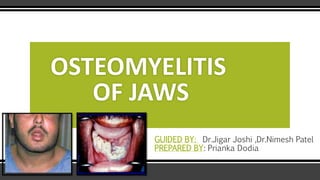
OSTEOMYELITIS
OF JAWS
GUIDED BY: Dr.Jigar Joshi ,Dr.Nimesh Patel
PREPARED BY: Prianka Dodia
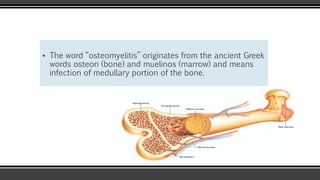
▪ The word “osteomyelitis” originates from the ancient Greek
words osteon (bone) and muelinos (marrow) and means
infection of medullary portion of the bone.
▪ It define as the inflammation of bone and its marrow contents.(Shafer,7th
edition)
▪ It is an acute or chronic inflammatory process in the medullary spaces or
cortical surfaces of the bone that extends away from the initial site of
involvement (Neville,3rd edition)
DEFINITION
▪ According to anatomic location of infectious process
• Intramedullary
• Subperiosteal
• Periosteal
CLASSIFICATION
▪ According to duration and severity
1.Acute —it occurs initial infection with the micro-organism
2.Chronic—it can be primary or secondary
a.Primary -virulence of the microorganism is low and the host
resistance is high. This type is not preceded by an episode of
acute symptoms
b.Secondary-it is secondary to incompletely treated acute
osteomyelitis
▪ Depending upon the presence or absence of
suppuration
A.SUPPURATIVE OSTEOMYELITIS
1.Acute suppurative osteomyelitis
2.Chronic suppurative osteomyelitis
a. Primary not followed by acute phase
b. secondary followed by acute phase
3.Infantile osteomyelitis
B.NONSUPPURATIVE OSTEOMYELITIS
1.Chronic diffuse sclerosing osteomyelitis
2.Chronic focal sclerosing osteomyelitis (condensing osteitis)
3.Chronic osteomyelitis with proliferative periostitis(Garre’s
osteomyelitis)
4.Sclerotic cemental masses
5.Florrid osseous dysplasia
6.Osteoradionecrosis
PREDISPOSING FACTORS
▪ Fracture due to trauma and road traffic accidents
▪ Gunshot wounds
▪ Radiation damage
▪ Pagets disease
▪ Osteopetrosis
▪ Systemic conditions like malnutrition,acute
leukemia,uncontrolled diabetes mellitus,sickle cell anaemia
and chronic alcoholism
PATHOGENESIS
Clinical Staging of Osteomyelitis
1.Initial stage—spontaneous pain (localized).
2.Acute stage (suppurative stage)—in this stage, there is severe
pain, soreness and looseness of the involved teeth
▪ Early acute stage—progressive sensitivity of the adjacent teeth
to percussion and pain in the involved side of jaw.
▪ Late acute stage—paresthesia or anesthesia of the lip region
supplied by the mental nerve. Other systemic symptoms can
occur.
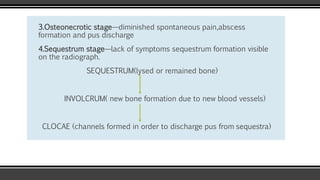
3.Osteonecrotic stage—diminished spontaneous pain,abscess
formation and pus discharge
4.Sequestrum stage—lack of symptoms sequestrum formation visible
on the radiograph.
SEQUESTRUM(lysed or remained bone)
INVOLCRUM( new bone formation due to new blood vessels)
CLOCAE (channels formed in order to discharge pus from sequestra)
Occurrance
▪ Sex—it is more common in men, than women.
▪ Site-May involve either maxilla or the mandible .
Osteomyelitis in maxilla :
Rare occurrance due to-
- Extensive blood supply and significant collaterals
- Porous nature of membranous bones
- Thin cortical plates
- Abundant medullary spaces
Osteomyelitis in mandible
▪ An important factor in establishment of osteomyelitis in
mandible is compromise of blood supply
▪ Blood supply
- Primary supply – by inferior alveolar artery, except coronoid
(temporalis vessels)
- Secondary supply – periosteal supply
▪ Venous drainage – upwards via inferior alveolar vein to
pharyngeal plexus
▪ Downwards to external jugular veins
Clinical features
▪ Acute
▪ Initial symptoms—it has rapid onset and course. Patient
complaint of severe pain, paresthesia or anesthesia of the
mental nerve.
▪ Initial signs—at this stage, the process is truly intra-medullary,
therefore swelling is absent, teeth are notmobile and fistulae
are not present.
▪ Late symptoms—there is deep intense pain, anorexia,malaise,
fever, and regional lymphadenopathy. Patient also complain of
soreness of involved teeth which become loose within 10 to 14
days. There is also fetid oral odor.
▪ Late signs—pus exudates around the gingival sulcus or
through mucosal and cutaneous fistula. There is firm cellulitis
of cheek and abscess formation with localized warmth and
tenderness on palpation. The patient feels toxic and
dehydrated.
▪ Chronic
▪ Onset—it has insidious onset with slight pain, slow increase in
jaw size and a gradual development of sequestra without
fistula.
▪ Symptoms—it is painless unless there is an acute or sub-acute
exacerbation.
▪ Necrotic bone—in some cases, necrotic bone may be visible
inside the oral cavity
▪ Sinus—intraorally and extraorally sinus developed
intermittently and drains small amount of pus and then
gradually heals. Sinus extends from medullary bone, through
cortical plate, to mucous membrane or skin. Sinus may be at
a considerable distance from the offending infection.
▪ Signs—local tenderness and swelling develop over the bone in
the area of abscess
▪ Lymph nodes—regional lymphadenopathy is present
Radiographic features
▪ Acute- develops at least after one to two weeks .At this time
diffuse lytic changes in the bone begin to appear .Individual
trabeculae become fuzzy and indistinct and radiolucent areas
begin to appear
▪ Chronic –
1.Radiodensity—single or multiple radiolucencies of variable
sizes are seen.
2.Margins—irregular outline and poorly defined borders.
3.Moth eaten appearance
4. Sequestra
4.Teeth— the roots of the teeth may undergo external
resorption and the lamina dura may become less
apparent as it blends with surrounding granular
sclerotic bone
5.Fistula tract—fistula tracts may appear on the radiograph as
radiolucent bands transversing the body of the jaw and
penetrating the cortical plates.
6.Joint involvement—in patients with extensive chronic
osteomyelitis, the disease may spread to mandibular condyle
and joint, resulting in septic arthritis
7.Pathological fracture
Diagnosis
▪ Clinical diagnosis—pain, swelling, fever is present.
▪ Radiological diagnosis—loss of lamina dura, saucer shaped
destruction, sequestrum formation and motheaten
appearance will give clue to the diagnosis.
▪ Laboratory diagnosis—the medullary spaces are filled with
inflammatory exudate that may or may not progress to the
actual formation of pus. The inflammatory cells are chiefly
neutrophilic polymorphonuclear leukocytes, but may show
occasional lymphocytes and plasma cells.
▪ Investigation to be carried out in osteomyelitis—investigation
like gram staining, culture and sensitivity,WBC count and
complete hemogram, blood sugar,Mantoux test, radiographs,
scintigraphy and computerized tomography.
Differential diagnosis
▪ Paget’s disease—it affects multiple bones and the complete
involvement of individual bone.
▪ Eosinophilic granuloma—margins are better than osteomyelitis
and have no evidence of bone sclerosis
Management
The goal of definitive therapy is to attenuate and eradicate
the proliferating pathogenic microorganisms and to
support healing. This is accomplished by removing
pathogenic supporative debris, providing regional stability
and disrupting pathophysiology barriers while re-
establishing vascular permeability to the infected area
1.Incision and drainage
2.Irrigation and debridement of necrotic areas
3.Empiric therapy:
▪ Regimen I—aqueous penicillin 2 million units, IV, 4hourly plus
oxacillin 1 gm, IV, 4 hourly.
▪ Regimen II—if the patient is asymptomatic after 48 to72 hours,
then penicillin V 500 mg, 6 hourly and dicloxacillin 250 mg, 4
hourly, for an additional 2 to 4 weeks
4. Extraction—extraction of carious teeth with periapical
infection, should be done. It should be carried out to remove
the source of infection from the oral cavity.
5.• Supportive therapy:
Adequate rehydration —patients is suffering from osteomyelitis
required adequate rehydration in the form of fluids.
Rich nutritional diet —rich nutritional diet should be given.
Vitamin therapy—multivitamin supplements should be given.
▪ Sequestrectomy
▪ Saucerization
▪ Closed wound irrigation and suction
▪ Decortication
▪ Resection and immediate reconstruction
▪ Hyperberic oxygen therapy
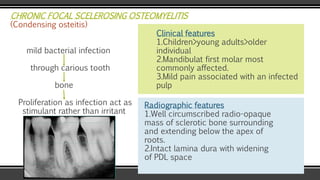
CHRONIC FOCAL SCELEROSING OSTEOMYELITIS
(Condensing osteitis)
mild bacterial infection
through carious tooth
bone
Proliferation as infection act as
stimulant rather than irritant
Clinical features
1.Children>young adults>older
individual
2.Mandibulat first molar most
commonly affected.
3.Mild pain associated with an infected
pulp
Radiographic features
1.Well circumscribed radio-opaque
mass of sclerotic bone surrounding
and extending below the apex of
roots.
2.Intact lamina dura with widening
of PDL space
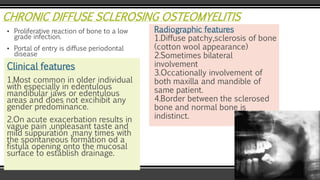
CHRONIC DIFFUSE SCLEROSING OSTEOMYELITIS
▪ Proliferative reaction of bone to a low
grade infection.
▪ Portal of entry is diffuse periodontal
disease
Clinical features
1.Most common in older individual
with especially in edentulous
mandibular jaws or edentulous
areas and does not excihibit any
gender predominance.
2.On acute exacerbation results in
vague pain ,unpleasant taste and
mild suppuration ,many times with
the spontaneous formation od a
fistula opening onto the mucosal
surface to establish drainage.
Radiographic features
1.Diffuse patchy,sclerosis of bone
(cotton wool appearance)
2.Sometimes bilateral
involvement
3.Occationally involvement of
both maxilla and mandible of
same patient.
4.Border between the sclerosed
bone and normal bone is
indistinct.
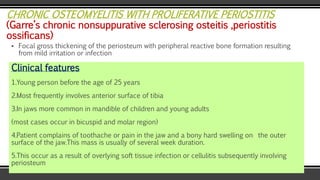
CHRONIC OSTEOMYELITIS WITH PROLIFERATIVE PERIOSTITIS
(Garre’s chronic nonsuppurative sclerosing osteitis ,periostitis
ossificans)
▪ Focal gross thickening of the periosteum with peripheral reactive bone formation resulting
from mild irritation or infection
Clinical features
1.Young person before the age of 25 years
2.Most frequently involves anterior surface of tibia
3.In jaws more common in mandible of children and young adults
(most cases occur in bicuspid and molar region)
4.Patient complains of toothache or pain in the jaw and a bony hard swelling on the outer
surface of the jaw.This mass is usually of several week duration.
5.This occur as a result of overlying soft tissue infection or cellulitis subsequently involving
periosteum
Radiographic features
1.Often reveals an carious tooth opposite the hard bony mass
2.Occlusal radiograph shows a focal overgrowth of bone on the
outer surface of the cortex ,which may be described as
duplication of the cortical layer of bone .
3.This mass of bone is smooth and rather well calcified and may
itself show a thin but definite cortical layer.
Osteomyelitis
Osteomyelitis

Osteomyelitis

  • 1.
    OSTEOMYELITIS OF JAWS GUIDED BY:Dr.Jigar Joshi ,Dr.Nimesh Patel PREPARED BY: Prianka Dodia
  • 2.
    ▪ The word“osteomyelitis” originates from the ancient Greek words osteon (bone) and muelinos (marrow) and means infection of medullary portion of the bone.
  • 3.
    ▪ It defineas the inflammation of bone and its marrow contents.(Shafer,7th edition) ▪ It is an acute or chronic inflammatory process in the medullary spaces or cortical surfaces of the bone that extends away from the initial site of involvement (Neville,3rd edition) DEFINITION
  • 4.
    ▪ According toanatomic location of infectious process • Intramedullary • Subperiosteal • Periosteal CLASSIFICATION
  • 5.
    ▪ According toduration and severity 1.Acute —it occurs initial infection with the micro-organism 2.Chronic—it can be primary or secondary a.Primary -virulence of the microorganism is low and the host resistance is high. This type is not preceded by an episode of acute symptoms b.Secondary-it is secondary to incompletely treated acute osteomyelitis
  • 6.
    ▪ Depending uponthe presence or absence of suppuration A.SUPPURATIVE OSTEOMYELITIS 1.Acute suppurative osteomyelitis 2.Chronic suppurative osteomyelitis a. Primary not followed by acute phase b. secondary followed by acute phase 3.Infantile osteomyelitis
  • 7.
    B.NONSUPPURATIVE OSTEOMYELITIS 1.Chronic diffusesclerosing osteomyelitis 2.Chronic focal sclerosing osteomyelitis (condensing osteitis) 3.Chronic osteomyelitis with proliferative periostitis(Garre’s osteomyelitis) 4.Sclerotic cemental masses 5.Florrid osseous dysplasia 6.Osteoradionecrosis
  • 8.
    PREDISPOSING FACTORS ▪ Fracturedue to trauma and road traffic accidents ▪ Gunshot wounds ▪ Radiation damage ▪ Pagets disease ▪ Osteopetrosis ▪ Systemic conditions like malnutrition,acute leukemia,uncontrolled diabetes mellitus,sickle cell anaemia and chronic alcoholism
  • 9.
  • 10.
    Clinical Staging ofOsteomyelitis 1.Initial stage—spontaneous pain (localized). 2.Acute stage (suppurative stage)—in this stage, there is severe pain, soreness and looseness of the involved teeth ▪ Early acute stage—progressive sensitivity of the adjacent teeth to percussion and pain in the involved side of jaw. ▪ Late acute stage—paresthesia or anesthesia of the lip region supplied by the mental nerve. Other systemic symptoms can occur.
  • 11.
    3.Osteonecrotic stage—diminished spontaneouspain,abscess formation and pus discharge 4.Sequestrum stage—lack of symptoms sequestrum formation visible on the radiograph. SEQUESTRUM(lysed or remained bone) INVOLCRUM( new bone formation due to new blood vessels) CLOCAE (channels formed in order to discharge pus from sequestra)
  • 12.
    Occurrance ▪ Sex—it ismore common in men, than women. ▪ Site-May involve either maxilla or the mandible . Osteomyelitis in maxilla : Rare occurrance due to- - Extensive blood supply and significant collaterals - Porous nature of membranous bones - Thin cortical plates - Abundant medullary spaces
  • 13.
    Osteomyelitis in mandible ▪An important factor in establishment of osteomyelitis in mandible is compromise of blood supply ▪ Blood supply - Primary supply – by inferior alveolar artery, except coronoid (temporalis vessels) - Secondary supply – periosteal supply ▪ Venous drainage – upwards via inferior alveolar vein to pharyngeal plexus ▪ Downwards to external jugular veins
  • 14.
    Clinical features ▪ Acute ▪Initial symptoms—it has rapid onset and course. Patient complaint of severe pain, paresthesia or anesthesia of the mental nerve. ▪ Initial signs—at this stage, the process is truly intra-medullary, therefore swelling is absent, teeth are notmobile and fistulae are not present.
  • 15.
    ▪ Late symptoms—thereis deep intense pain, anorexia,malaise, fever, and regional lymphadenopathy. Patient also complain of soreness of involved teeth which become loose within 10 to 14 days. There is also fetid oral odor. ▪ Late signs—pus exudates around the gingival sulcus or through mucosal and cutaneous fistula. There is firm cellulitis of cheek and abscess formation with localized warmth and tenderness on palpation. The patient feels toxic and dehydrated.
  • 16.
    ▪ Chronic ▪ Onset—ithas insidious onset with slight pain, slow increase in jaw size and a gradual development of sequestra without fistula. ▪ Symptoms—it is painless unless there is an acute or sub-acute exacerbation. ▪ Necrotic bone—in some cases, necrotic bone may be visible inside the oral cavity
  • 17.
    ▪ Sinus—intraorally andextraorally sinus developed intermittently and drains small amount of pus and then gradually heals. Sinus extends from medullary bone, through cortical plate, to mucous membrane or skin. Sinus may be at a considerable distance from the offending infection. ▪ Signs—local tenderness and swelling develop over the bone in the area of abscess ▪ Lymph nodes—regional lymphadenopathy is present
  • 18.
    Radiographic features ▪ Acute-develops at least after one to two weeks .At this time diffuse lytic changes in the bone begin to appear .Individual trabeculae become fuzzy and indistinct and radiolucent areas begin to appear ▪ Chronic – 1.Radiodensity—single or multiple radiolucencies of variable sizes are seen. 2.Margins—irregular outline and poorly defined borders. 3.Moth eaten appearance 4. Sequestra
  • 19.
    4.Teeth— the rootsof the teeth may undergo external resorption and the lamina dura may become less apparent as it blends with surrounding granular sclerotic bone 5.Fistula tract—fistula tracts may appear on the radiograph as radiolucent bands transversing the body of the jaw and penetrating the cortical plates. 6.Joint involvement—in patients with extensive chronic osteomyelitis, the disease may spread to mandibular condyle and joint, resulting in septic arthritis 7.Pathological fracture
  • 21.
    Diagnosis ▪ Clinical diagnosis—pain,swelling, fever is present. ▪ Radiological diagnosis—loss of lamina dura, saucer shaped destruction, sequestrum formation and motheaten appearance will give clue to the diagnosis. ▪ Laboratory diagnosis—the medullary spaces are filled with inflammatory exudate that may or may not progress to the actual formation of pus. The inflammatory cells are chiefly neutrophilic polymorphonuclear leukocytes, but may show occasional lymphocytes and plasma cells. ▪ Investigation to be carried out in osteomyelitis—investigation like gram staining, culture and sensitivity,WBC count and complete hemogram, blood sugar,Mantoux test, radiographs, scintigraphy and computerized tomography.
  • 22.
    Differential diagnosis ▪ Paget’sdisease—it affects multiple bones and the complete involvement of individual bone. ▪ Eosinophilic granuloma—margins are better than osteomyelitis and have no evidence of bone sclerosis
  • 23.
    Management The goal ofdefinitive therapy is to attenuate and eradicate the proliferating pathogenic microorganisms and to support healing. This is accomplished by removing pathogenic supporative debris, providing regional stability and disrupting pathophysiology barriers while re- establishing vascular permeability to the infected area
  • 24.
    1.Incision and drainage 2.Irrigationand debridement of necrotic areas 3.Empiric therapy: ▪ Regimen I—aqueous penicillin 2 million units, IV, 4hourly plus oxacillin 1 gm, IV, 4 hourly. ▪ Regimen II—if the patient is asymptomatic after 48 to72 hours, then penicillin V 500 mg, 6 hourly and dicloxacillin 250 mg, 4 hourly, for an additional 2 to 4 weeks
  • 25.
    4. Extraction—extraction ofcarious teeth with periapical infection, should be done. It should be carried out to remove the source of infection from the oral cavity. 5.• Supportive therapy: Adequate rehydration —patients is suffering from osteomyelitis required adequate rehydration in the form of fluids. Rich nutritional diet —rich nutritional diet should be given. Vitamin therapy—multivitamin supplements should be given.
  • 26.
    ▪ Sequestrectomy ▪ Saucerization ▪Closed wound irrigation and suction ▪ Decortication ▪ Resection and immediate reconstruction ▪ Hyperberic oxygen therapy
  • 27.
    CHRONIC FOCAL SCELEROSINGOSTEOMYELITIS (Condensing osteitis) mild bacterial infection through carious tooth bone Proliferation as infection act as stimulant rather than irritant Clinical features 1.Children>young adults>older individual 2.Mandibulat first molar most commonly affected. 3.Mild pain associated with an infected pulp Radiographic features 1.Well circumscribed radio-opaque mass of sclerotic bone surrounding and extending below the apex of roots. 2.Intact lamina dura with widening of PDL space
  • 28.
    CHRONIC DIFFUSE SCLEROSINGOSTEOMYELITIS ▪ Proliferative reaction of bone to a low grade infection. ▪ Portal of entry is diffuse periodontal disease Clinical features 1.Most common in older individual with especially in edentulous mandibular jaws or edentulous areas and does not excihibit any gender predominance. 2.On acute exacerbation results in vague pain ,unpleasant taste and mild suppuration ,many times with the spontaneous formation od a fistula opening onto the mucosal surface to establish drainage. Radiographic features 1.Diffuse patchy,sclerosis of bone (cotton wool appearance) 2.Sometimes bilateral involvement 3.Occationally involvement of both maxilla and mandible of same patient. 4.Border between the sclerosed bone and normal bone is indistinct.
  • 29.
    CHRONIC OSTEOMYELITIS WITHPROLIFERATIVE PERIOSTITIS (Garre’s chronic nonsuppurative sclerosing osteitis ,periostitis ossificans) ▪ Focal gross thickening of the periosteum with peripheral reactive bone formation resulting from mild irritation or infection Clinical features 1.Young person before the age of 25 years 2.Most frequently involves anterior surface of tibia 3.In jaws more common in mandible of children and young adults (most cases occur in bicuspid and molar region) 4.Patient complains of toothache or pain in the jaw and a bony hard swelling on the outer surface of the jaw.This mass is usually of several week duration. 5.This occur as a result of overlying soft tissue infection or cellulitis subsequently involving periosteum
  • 30.
    Radiographic features 1.Often revealsan carious tooth opposite the hard bony mass 2.Occlusal radiograph shows a focal overgrowth of bone on the outer surface of the cortex ,which may be described as duplication of the cortical layer of bone . 3.This mass of bone is smooth and rather well calcified and may itself show a thin but definite cortical layer.