ODONTOMA
PRESENTED BY
Dr. Mazhar. I. Khan
Sapporo Dental College & Hospital,
INTRODUCTION
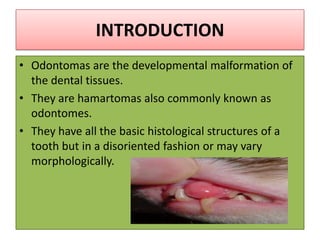
• Odontomas are the developmental malformation of
the dental tissues.
• They are hamartomas also commonly known as
odontomes.
• They have all the basic histological structures of a
tooth but in a disoriented fashion or may vary
morphologically.
ETIOLOGY AND BEHAVIOUR
• Odontomas are hamartomas of
odontogenic epithelium and
mesenchyme.
• They are usually found between
the age of 10 and 20 years
• They are benign in nature.
• Most common sites are anterior
maxilla and posterior mandible.
CLASSIFIACTION
 In the past, complex type of classification was
devised to include developmental anomalies such as
dilated,invaginated and geminated Odontomas.
They are now simply classified as
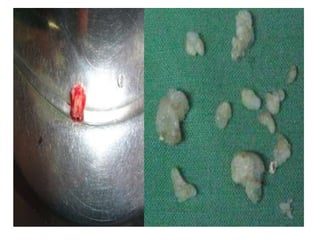
• compound Odontomas
• complex Odontomas
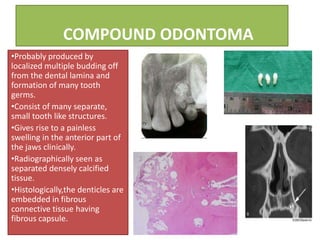
COMPOUND ODONTOMA
•Probably produced by
localized multiple budding off
from the dental lamina and
formation of many tooth
germs.
•Consist of many separate,
small tooth like structures.
•Gives rise to a painless
swelling in the anterior part of
the jaws clinically.
•Radiographically seen as
separated densely calcified
tissue.
•Histologically,the denticles are
embedded in fibrous
connective tissue having
fibrous capsule.
COMPLEX ODONTOMA
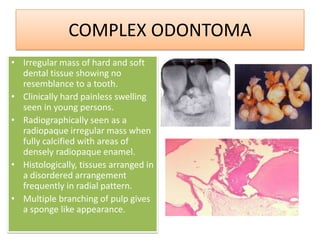
• Irregular mass of hard and soft
dental tissue showing no
resemblance to a tooth.
• Clinically hard painless swelling
seen in young persons.
• Radiographically seen as a
radiopaque irregular mass when
fully calcified with areas of
densely radiopaque enamel.
• Histologically, tissues arranged in
a disordered arrangement
frequently in radial pattern.
• Multiple branching of pulp gives
a sponge like appearance.
COMPLICATIONS
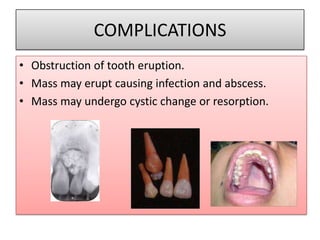
• Obstruction of tooth eruption.
• Mass may erupt causing infection and abscess.
• Mass may undergo cystic change or resorption.
MANAGEMENT
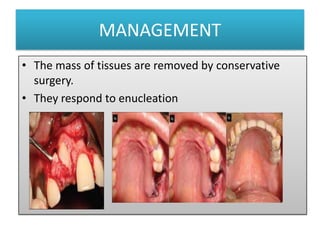
• The mass of tissues are removed by conservative
surgery.
• They respond to enucleation
CASE PRESENTATION
REFERENCES
• Cawson RA,Binnie WH,Barrete AW,Speight P,Wright JM 1998 Lucas’s pathology of
tumors of the the oral tissues. Churchill livingston,Edinburgh.
• ^ Jonquiere L, de Vicente JC, Roig P, Olay S, Rodríguez-Recio O
(2005). "Intraosseous odontoma erupted into the oral cavity: an unusual
pathology". Med Oral Patol Oral Cir Bucal10 (3): 248–51. PMID 15876969.
• ^ "Oral Pathology Glossary O". Retrieved 2009-01-04.
• ^ "Odontogenic tumors". Retrieved 2009-01-04.
• ^ da Costa CT, Torriani DD, Torriani MA, da Silva RB (2008). "Central incisor
impacted by an odontoma". J Contemp Dent Pract 9 (6): 122–8. PMID 18784868.
• ^ Amado Cuesta S, Gargallo Albiol J, Berini Aytés L, Gay Escoda C (2003). "Review
of 61 cases of odontoma. Presentation of an erupted complex odontoma". Med
Oral 8 (5): 366–73.PMID 14595262.
THANK YOU

ODONTOMA

  • 1.
    ODONTOMA PRESENTED BY Dr. Mazhar.I. Khan Sapporo Dental College & Hospital,
  • 2.
    INTRODUCTION • Odontomas arethe developmental malformation of the dental tissues. • They are hamartomas also commonly known as odontomes. • They have all the basic histological structures of a tooth but in a disoriented fashion or may vary morphologically.
  • 3.
    ETIOLOGY AND BEHAVIOUR •Odontomas are hamartomas of odontogenic epithelium and mesenchyme. • They are usually found between the age of 10 and 20 years • They are benign in nature. • Most common sites are anterior maxilla and posterior mandible.
  • 4.
    CLASSIFIACTION  In thepast, complex type of classification was devised to include developmental anomalies such as dilated,invaginated and geminated Odontomas. They are now simply classified as • compound Odontomas • complex Odontomas
  • 5.
    COMPOUND ODONTOMA •Probably producedby localized multiple budding off from the dental lamina and formation of many tooth germs. •Consist of many separate, small tooth like structures. •Gives rise to a painless swelling in the anterior part of the jaws clinically. •Radiographically seen as separated densely calcified tissue. •Histologically,the denticles are embedded in fibrous connective tissue having fibrous capsule.
  • 6.
    COMPLEX ODONTOMA • Irregularmass of hard and soft dental tissue showing no resemblance to a tooth. • Clinically hard painless swelling seen in young persons. • Radiographically seen as a radiopaque irregular mass when fully calcified with areas of densely radiopaque enamel. • Histologically, tissues arranged in a disordered arrangement frequently in radial pattern. • Multiple branching of pulp gives a sponge like appearance.
  • 7.
    COMPLICATIONS • Obstruction oftooth eruption. • Mass may erupt causing infection and abscess. • Mass may undergo cystic change or resorption.
  • 8.
    MANAGEMENT • The massof tissues are removed by conservative surgery. • They respond to enucleation
  • 9.
  • 14.
    REFERENCES • Cawson RA,BinnieWH,Barrete AW,Speight P,Wright JM 1998 Lucas’s pathology of tumors of the the oral tissues. Churchill livingston,Edinburgh. • ^ Jonquiere L, de Vicente JC, Roig P, Olay S, Rodríguez-Recio O (2005). "Intraosseous odontoma erupted into the oral cavity: an unusual pathology". Med Oral Patol Oral Cir Bucal10 (3): 248–51. PMID 15876969. • ^ "Oral Pathology Glossary O". Retrieved 2009-01-04. • ^ "Odontogenic tumors". Retrieved 2009-01-04. • ^ da Costa CT, Torriani DD, Torriani MA, da Silva RB (2008). "Central incisor impacted by an odontoma". J Contemp Dent Pract 9 (6): 122–8. PMID 18784868. • ^ Amado Cuesta S, Gargallo Albiol J, Berini Aytés L, Gay Escoda C (2003). "Review of 61 cases of odontoma. Presentation of an erupted complex odontoma". Med Oral 8 (5): 366–73.PMID 14595262.
  • 15.

Editor's Notes

  • #2 There are various causes of jaw swelling. odontogenic tumors are pretty much common among them..some are benign some are malignant and some behave like tumors but are not true neoplams. I am drshwetauprety and today in a presenting a case on the non neoplastic odontogenic sweeling of jaw know as odontomas