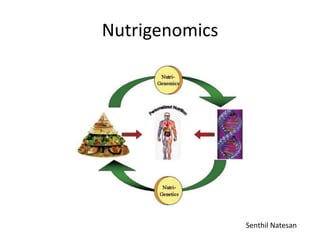
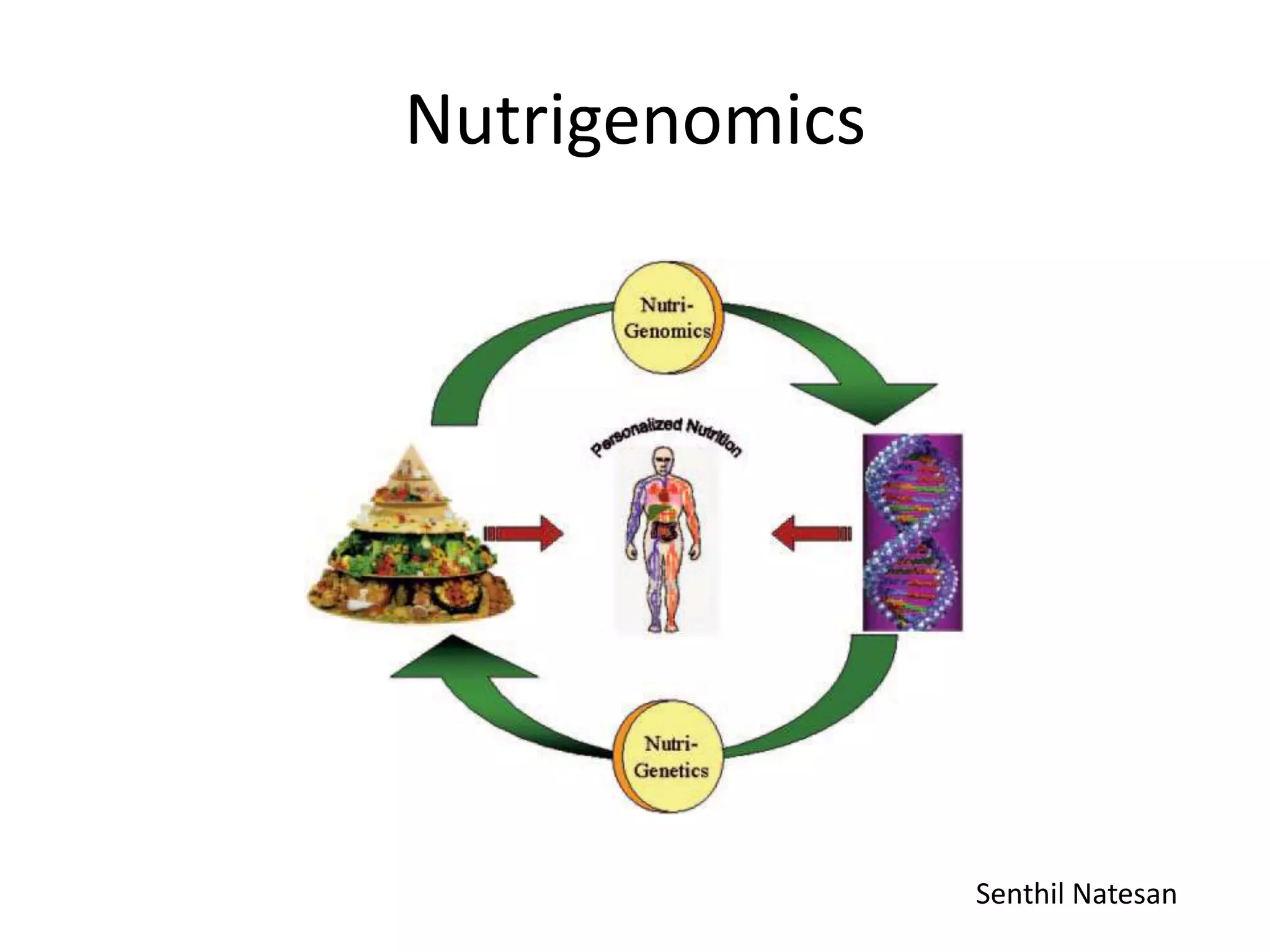
Nutrigenomics


                Senthil Natesan
What is nutrigenomics?
• Nutrigenomics attempts to study the genome-wide
  influences of nutrition and to understand the
  mechanisms that underlie these genetic
  predispositions
• Patterns of gene expression, protein expression and
  metabolite production in response to particular
  nutrients or nutritional regimes can be viewed as
  ‘dietary signatures
• Nutrigenomics seeks to examine these dietary
  signatures in specific cells, tissues and organisms, and
  to understand how nutrition influences homeostasis.
    Muller and Kersten, 2003.Nutrigenomics: goals and strategies.
    Nature reviews Genetics 4 :315-322
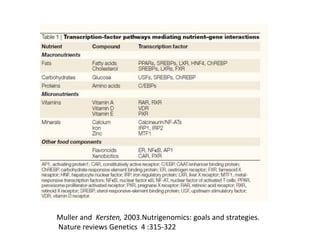
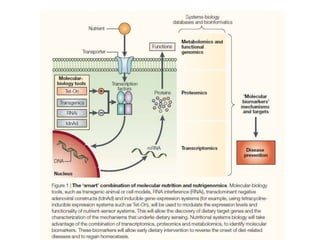
Muller and Kersten, 2003.Nutrigenomics: goals and strategies.
Nature reviews Genetics 4 :315-322
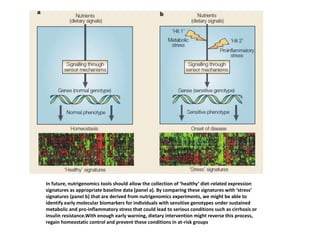
In future, nutrigenomics tools should allow the collection of ‘healthy’ diet-related expression
signatures as appropriate baseline data (panel a). By comparing these signatures with ‘stress’
signatures (panel b) that are derived from nutrigenomics experiments, we might be able to
identify early molecular biomarkers for individuals with sensitive genotypes under sustained
metabolic and pro-inflammatory stress that could lead to serious conditions such as cirrhosis or
insulin resistance.With enough early warning, dietary intervention might reverse this process,
regain homeostatic control and prevent these conditions in at-risk groups
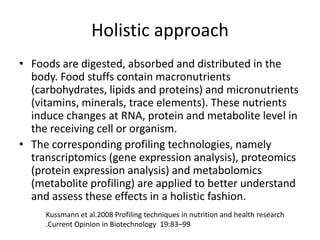
Holistic approach
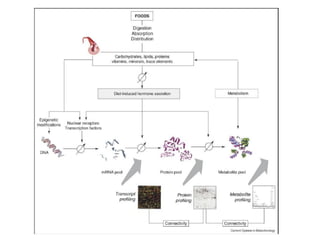
• Foods are digested, absorbed and distributed in the
  body. Food stuffs contain macronutrients
  (carbohydrates, lipids and proteins) and micronutrients
  (vitamins, minerals, trace elements). These nutrients
  induce changes at RNA, protein and metabolite level in
  the receiving cell or organism.
• The corresponding profiling technologies, namely
  transcriptomics (gene expression analysis), proteomics
  (protein expression analysis) and metabolomics
  (metabolite profiling) are applied to better understand
  and assess these effects in a holistic fashion.
     Kussmann et al.2008 Profiling techniques in nutrition and health research
     .Current Opinion in Biotechnology 19:83–99
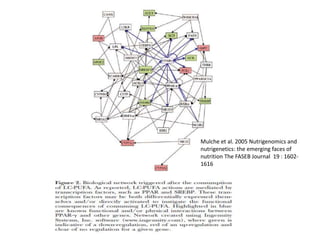
Mulche et al. 2005 Nutrigenomics and
nutrigenetics: the emerging faces of
nutrition The FASEB Journal 19 : 1602-
1616
Insulin resistance and type 2 diabetes
                mellitus
• T2DM is a metabolic disorder, stemming from either an
  insufficient secretion or impaired action of
  insulin, characterized by hyperglycemia, dyslipidemia, and
  associated with impaired carbohydrate, protein and lipid
  metabolism diets high in fat and energy have been
  repeatedly shown to play a fundamental role in the onset
  of T2DM.
• However, evidence exists that both environmental and
  genetic factors are important in the etiology of T2DM.
• Recent mechanistic work using mouse models with various
  genetic modifications affecting lipid metabolism have
  conclusively demonstrated a relationship between lipids
  and disease state
     Mulche et al. 2005 Nutrigenomics and nutrigenetics: the emerging
     faces of nutrition The FASEB Journal 19 : 1602-1616
Genotype and nutrition
• The field of Nutrigenetics is rapidly discovering in
  molecular (sequence) detail those genetic
  differences across the human population that are
  related to differences in needs for or responses to
  various nutritional variables
• Nonetheless, as the genes responsible for human
  diversity are recognized, the capabilities of
  genotyping to provide individuals with actionable
  knowledge about their unique predispositions for
  diet, drugs, and lifestyle will invariably increase as
  both a scientific and commercial reality.
     Fay and Gernman 2008.Personalizing foods: is genotype necessary?
     Current Opinion in Biotechnology 19:121–128
Environment x genotype = imprinting

Lifestage
• The nutritional requirements of humans vary according tomany
    features of an individual’s stage in life.
Environment
• The environment in which an individual lives is taken in this review
    to include all aspects of exogenous inputs to their
    phenotypes, including acute and chronic, random and
    volitional, and chemical and behavioral.
Environment x genotype = imprinting
• Environment at one stage of an individual’s life can exert persistent
    effects on the nutritional phenotype later in life
    (imprinting, programming, memorization, or colonization). The
    explicit covalent modifications of DNA that persists through cell
    divisions are now recognized and are increasingly well described in
    the field of epigenetics
    Fay and Gernman 2008.Personalizing foods: is genotype necessary?
    Current Opinion in Biotechnology 19:121–128
olfactory preference and nutrition
• The remarkable property of olfactory preference is the
  process by which positive and negative preferences for
  particular flavors are acquired in an individual as a
  series of complex, contextual memories early in life .
• This system of acquired flavor preferences underlies
  much of the cultural variation in foods and cuisines
  around the world.
• This also means that flavor preferences for foods with
  poor nutrient quality, if acquired by an individual early
  in life, will guide a life long habit of poor food choice

      Fay and Gernman 2008.Personalizing foods: is genotype necessary?
      Current Opinion in Biotechnology 19:121–128
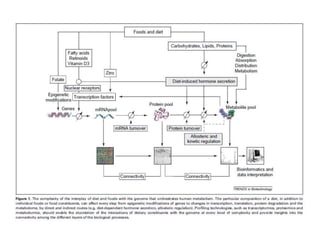
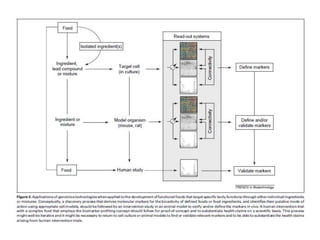
Nutrition and food science go genomic
    • Diet and food components are prime environmental factors
      that affect the genome, transcriptome, proteome and
      metabolome, and this life-long interaction defines the
      health or disease state of an individual.
    • Profiling technologies are used in basic-science applications
      for identifying the mode of action of foods or particular
      ingredients, and are similarly taken into the science-driven
      development of foods with a defined biofunctionality.
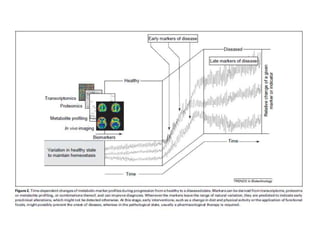
    • Biomarker profiles and patterns derived from genomics
      applications in humans should guide nutrition and food
      science in developing evidence-based dietary
      recommendations and health-promoting foods.


Rist et al. 2006. Nutrition and food science go genomic TRENDS in Biotechnology 24(4): 172-178
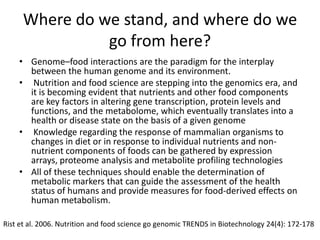
Where do we stand, and where do we
               go from here?
    • Genome–food interactions are the paradigm for the interplay
      between the human genome and its environment.
    • Nutrition and food science are stepping into the genomics era, and
      it is becoming evident that nutrients and other food components
      are key factors in altering gene transcription, protein levels and
      functions, and the metabolome, which eventually translates into a
      health or disease state on the basis of a given genome
    • Knowledge regarding the response of mammalian organisms to
      changes in diet or in response to individual nutrients and non-
      nutrient components of foods can be gathered by expression
      arrays, proteome analysis and metabolite profiling technologies
    • All of these techniques should enable the determination of
      metabolic markers that can guide the assessment of the health
      status of humans and provide measures for food-derived effects on
      human metabolism.

Rist et al. 2006. Nutrition and food science go genomic TRENDS in Biotechnology 24(4): 172-178
Products Fabricated
           for Personalized Nutrition
    The nutritional genomics approach has created hopes that gene-
    based nutrition planning can one day play a significant role in
    preventing chronic disease, and industry has an interest in using
    this knowledge for commercial purposes.
    Some relevant questions in this respect include
 (a) whether the scientific evidence base is sufficiently strong to justify
    creating a special nutritional product;
(b) how personalized-nutrition products can reach the correct target
    group;
(c) whether the advent of personalized-nutrition products will
    encourage people to believe that only some individuals need to
    adopt a healthy diet or will create unwarranted or exaggerated
    hopes and expectations; and
(d ) how such a development can be counteracted.
Biobanks in Nutrigenomics
• A biobank is a repository of collected bodily substances or
  DNA often linkable to data on health or lifestyle of the
  donor.
• Related terms include gene bank, genetic biobank, DNA
  bank, or genetic database .
• Large population-based gene banks such as DeCode (from
  Iceland), the BioBank UK, the Estonian Genome Project, or
  the Genome Database of the Latvian Population
• Other types of biobanks include smaller collections of
  samples and data from single studies or derived within a
  clinical context that are stored in a systematic manner and
  may be linked to health relevant data

Nutrigenomics

  • 1.
    Nutrigenomics Senthil Natesan
  • 2.
    What is nutrigenomics? •Nutrigenomics attempts to study the genome-wide influences of nutrition and to understand the mechanisms that underlie these genetic predispositions • Patterns of gene expression, protein expression and metabolite production in response to particular nutrients or nutritional regimes can be viewed as ‘dietary signatures • Nutrigenomics seeks to examine these dietary signatures in specific cells, tissues and organisms, and to understand how nutrition influences homeostasis. Muller and Kersten, 2003.Nutrigenomics: goals and strategies. Nature reviews Genetics 4 :315-322
  • 3.
    Muller and Kersten,2003.Nutrigenomics: goals and strategies. Nature reviews Genetics 4 :315-322
  • 4.
    In future, nutrigenomicstools should allow the collection of ‘healthy’ diet-related expression signatures as appropriate baseline data (panel a). By comparing these signatures with ‘stress’ signatures (panel b) that are derived from nutrigenomics experiments, we might be able to identify early molecular biomarkers for individuals with sensitive genotypes under sustained metabolic and pro-inflammatory stress that could lead to serious conditions such as cirrhosis or insulin resistance.With enough early warning, dietary intervention might reverse this process, regain homeostatic control and prevent these conditions in at-risk groups
  • 6.
    Holistic approach • Foodsare digested, absorbed and distributed in the body. Food stuffs contain macronutrients (carbohydrates, lipids and proteins) and micronutrients (vitamins, minerals, trace elements). These nutrients induce changes at RNA, protein and metabolite level in the receiving cell or organism. • The corresponding profiling technologies, namely transcriptomics (gene expression analysis), proteomics (protein expression analysis) and metabolomics (metabolite profiling) are applied to better understand and assess these effects in a holistic fashion. Kussmann et al.2008 Profiling techniques in nutrition and health research .Current Opinion in Biotechnology 19:83–99
  • 8.
    Mulche et al.2005 Nutrigenomics and nutrigenetics: the emerging faces of nutrition The FASEB Journal 19 : 1602- 1616
  • 9.
    Insulin resistance andtype 2 diabetes mellitus • T2DM is a metabolic disorder, stemming from either an insufficient secretion or impaired action of insulin, characterized by hyperglycemia, dyslipidemia, and associated with impaired carbohydrate, protein and lipid metabolism diets high in fat and energy have been repeatedly shown to play a fundamental role in the onset of T2DM. • However, evidence exists that both environmental and genetic factors are important in the etiology of T2DM. • Recent mechanistic work using mouse models with various genetic modifications affecting lipid metabolism have conclusively demonstrated a relationship between lipids and disease state Mulche et al. 2005 Nutrigenomics and nutrigenetics: the emerging faces of nutrition The FASEB Journal 19 : 1602-1616
  • 10.
    Genotype and nutrition •The field of Nutrigenetics is rapidly discovering in molecular (sequence) detail those genetic differences across the human population that are related to differences in needs for or responses to various nutritional variables • Nonetheless, as the genes responsible for human diversity are recognized, the capabilities of genotyping to provide individuals with actionable knowledge about their unique predispositions for diet, drugs, and lifestyle will invariably increase as both a scientific and commercial reality. Fay and Gernman 2008.Personalizing foods: is genotype necessary? Current Opinion in Biotechnology 19:121–128
  • 11.
    Environment x genotype= imprinting Lifestage • The nutritional requirements of humans vary according tomany features of an individual’s stage in life. Environment • The environment in which an individual lives is taken in this review to include all aspects of exogenous inputs to their phenotypes, including acute and chronic, random and volitional, and chemical and behavioral. Environment x genotype = imprinting • Environment at one stage of an individual’s life can exert persistent effects on the nutritional phenotype later in life (imprinting, programming, memorization, or colonization). The explicit covalent modifications of DNA that persists through cell divisions are now recognized and are increasingly well described in the field of epigenetics Fay and Gernman 2008.Personalizing foods: is genotype necessary? Current Opinion in Biotechnology 19:121–128
  • 12.
    olfactory preference andnutrition • The remarkable property of olfactory preference is the process by which positive and negative preferences for particular flavors are acquired in an individual as a series of complex, contextual memories early in life . • This system of acquired flavor preferences underlies much of the cultural variation in foods and cuisines around the world. • This also means that flavor preferences for foods with poor nutrient quality, if acquired by an individual early in life, will guide a life long habit of poor food choice Fay and Gernman 2008.Personalizing foods: is genotype necessary? Current Opinion in Biotechnology 19:121–128
  • 13.
    Nutrition and foodscience go genomic • Diet and food components are prime environmental factors that affect the genome, transcriptome, proteome and metabolome, and this life-long interaction defines the health or disease state of an individual. • Profiling technologies are used in basic-science applications for identifying the mode of action of foods or particular ingredients, and are similarly taken into the science-driven development of foods with a defined biofunctionality. • Biomarker profiles and patterns derived from genomics applications in humans should guide nutrition and food science in developing evidence-based dietary recommendations and health-promoting foods. Rist et al. 2006. Nutrition and food science go genomic TRENDS in Biotechnology 24(4): 172-178
  • 17.
    Where do westand, and where do we go from here? • Genome–food interactions are the paradigm for the interplay between the human genome and its environment. • Nutrition and food science are stepping into the genomics era, and it is becoming evident that nutrients and other food components are key factors in altering gene transcription, protein levels and functions, and the metabolome, which eventually translates into a health or disease state on the basis of a given genome • Knowledge regarding the response of mammalian organisms to changes in diet or in response to individual nutrients and non- nutrient components of foods can be gathered by expression arrays, proteome analysis and metabolite profiling technologies • All of these techniques should enable the determination of metabolic markers that can guide the assessment of the health status of humans and provide measures for food-derived effects on human metabolism. Rist et al. 2006. Nutrition and food science go genomic TRENDS in Biotechnology 24(4): 172-178
  • 18.
    Products Fabricated for Personalized Nutrition The nutritional genomics approach has created hopes that gene- based nutrition planning can one day play a significant role in preventing chronic disease, and industry has an interest in using this knowledge for commercial purposes. Some relevant questions in this respect include (a) whether the scientific evidence base is sufficiently strong to justify creating a special nutritional product; (b) how personalized-nutrition products can reach the correct target group; (c) whether the advent of personalized-nutrition products will encourage people to believe that only some individuals need to adopt a healthy diet or will create unwarranted or exaggerated hopes and expectations; and (d ) how such a development can be counteracted.
  • 19.
    Biobanks in Nutrigenomics •A biobank is a repository of collected bodily substances or DNA often linkable to data on health or lifestyle of the donor. • Related terms include gene bank, genetic biobank, DNA bank, or genetic database . • Large population-based gene banks such as DeCode (from Iceland), the BioBank UK, the Estonian Genome Project, or the Genome Database of the Latvian Population • Other types of biobanks include smaller collections of samples and data from single studies or derived within a clinical context that are stored in a systematic manner and may be linked to health relevant data

Editor's Notes