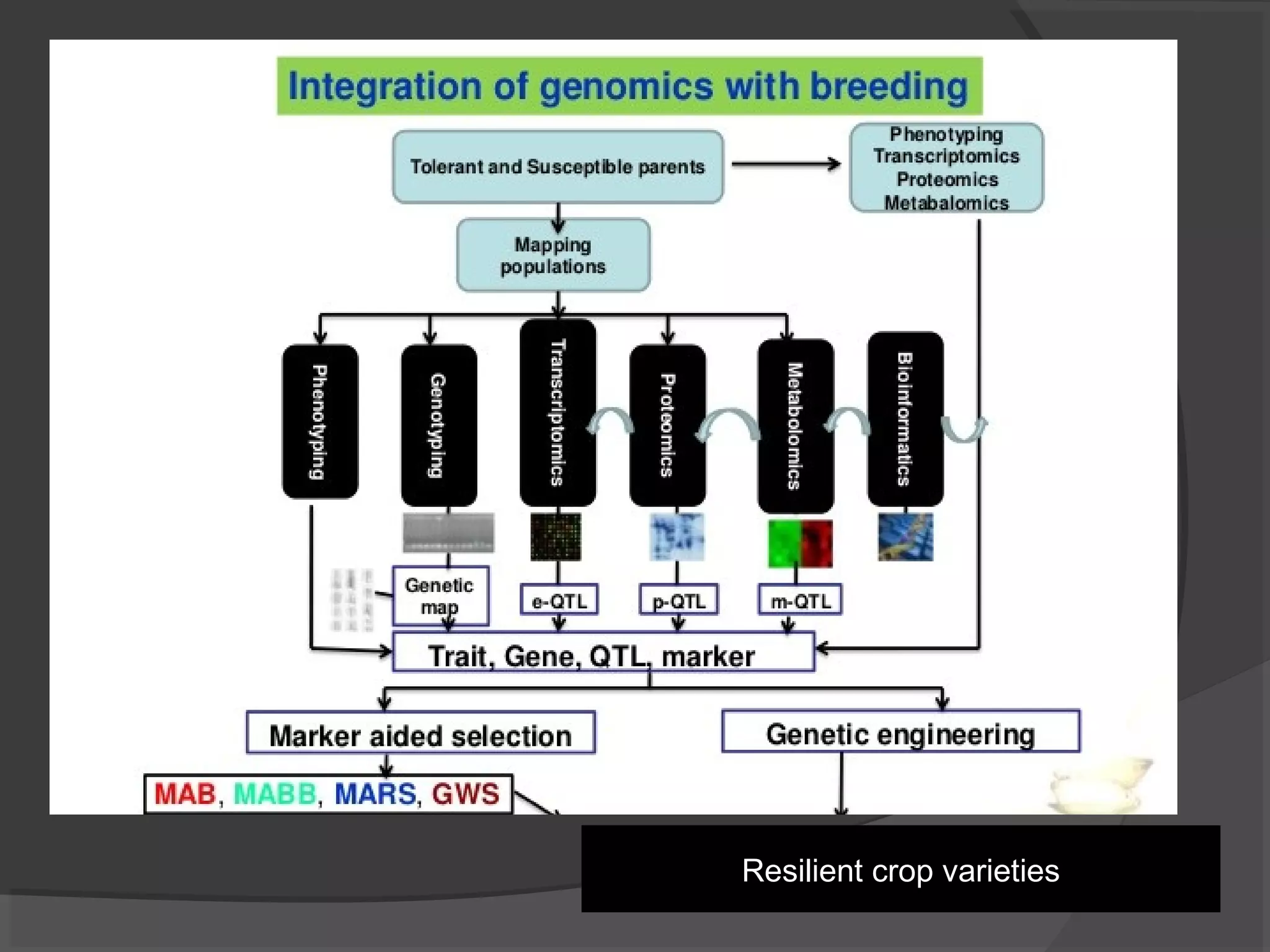

Genomics Assisted Breeding for Resilient Rice:
Progress and Prospects
R. Chandra Babu
Center for Plant Molecular Biology and Biotechnology
Tamil Nadu Agricultural University
Coimbatore-641 003, India
Email: chandrarc2000@yahoo.com
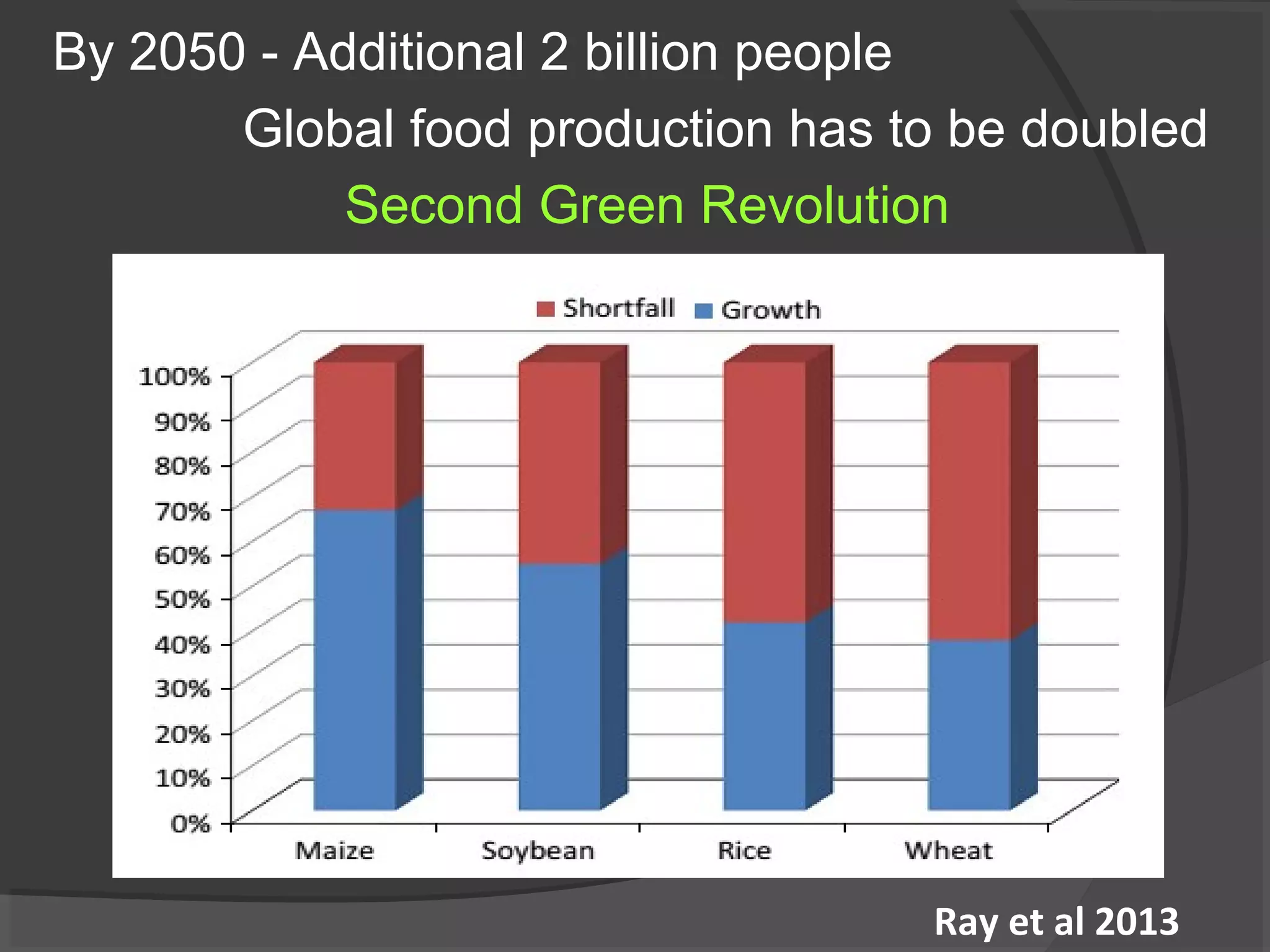
By 2050 - Additional 2 billion people
Global food production has to be doubled
Second Green Revolution
Ray et al 2013
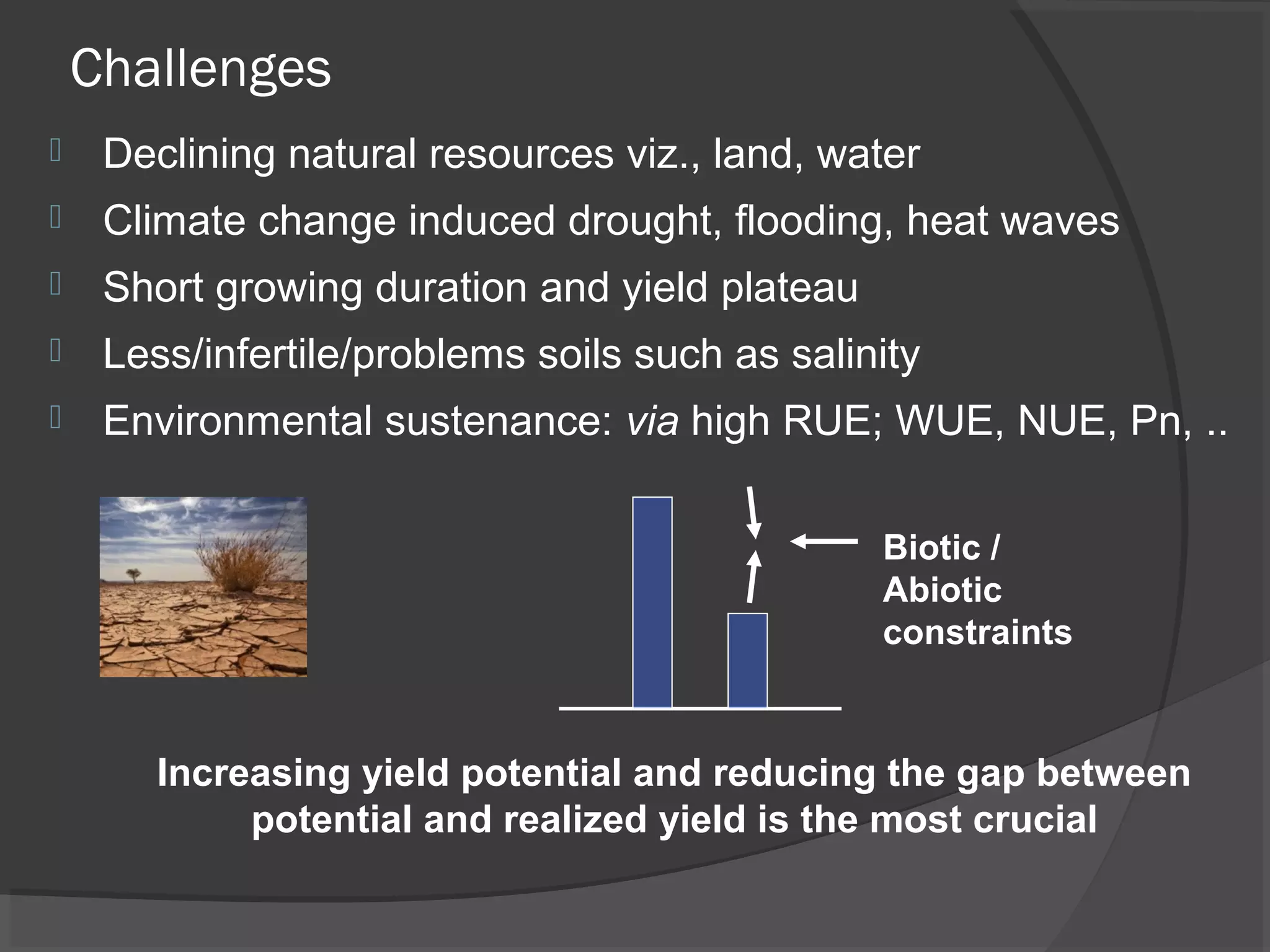
Challenges
 Declining natural resources viz., land, water
 Climate change induced drought, flooding, heat waves
 Short growing duration and yield plateau
 Less/infertile/problems soils such as salinity
 Environmental sustenance: via high RUE; WUE, NUE, Pn, ..
Biotic /
Abiotic
constraints
Increasing yield potential and reducing the gap between
potential and realized yield is the most crucial
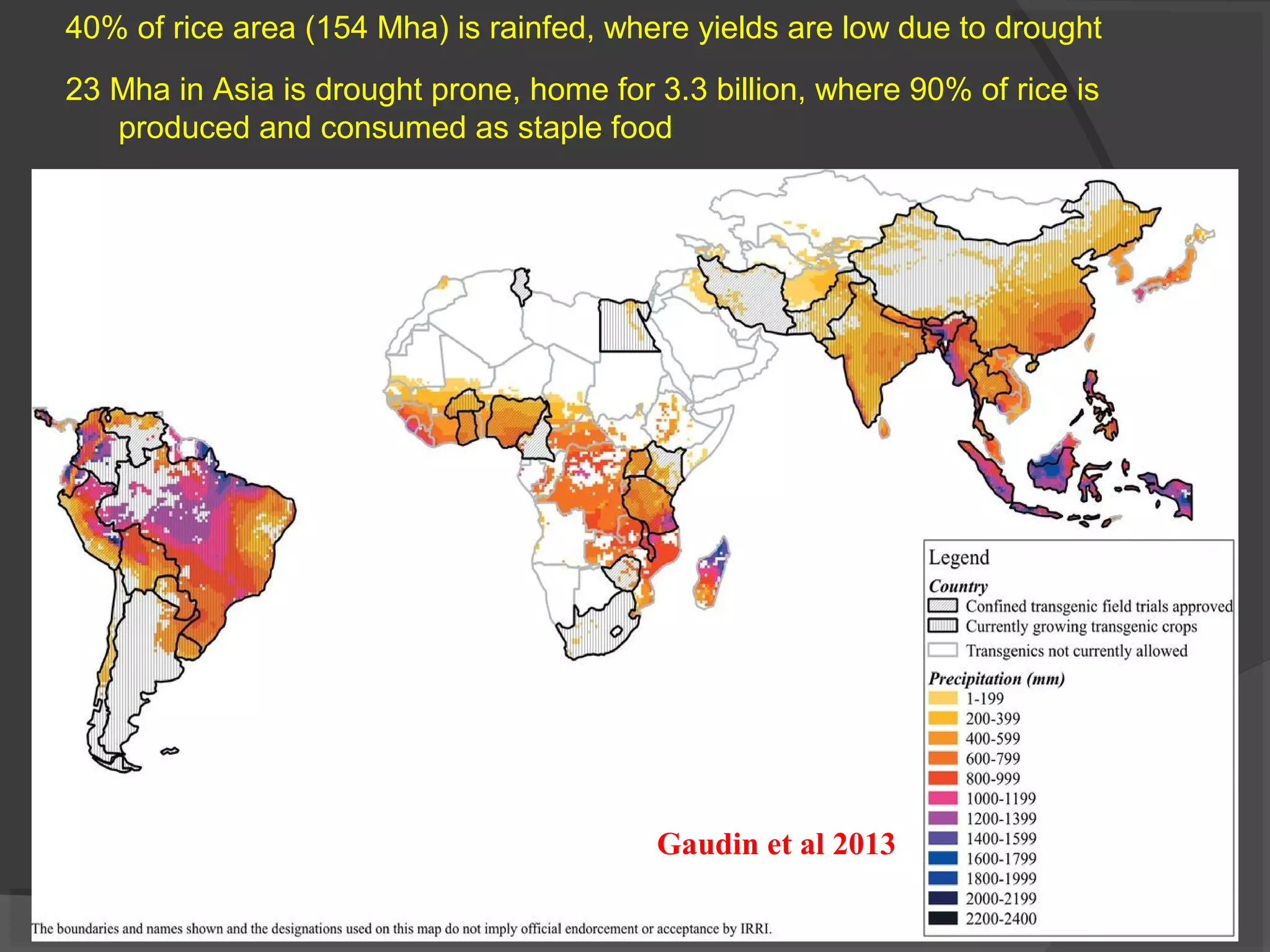
Gaudin et al 2013
40% of rice area (154 Mha) is rainfed, where yields are low due to drought
23 Mha in Asia is drought prone, home for 3.3 billion, where 90% of rice is
produced and consumed as staple food
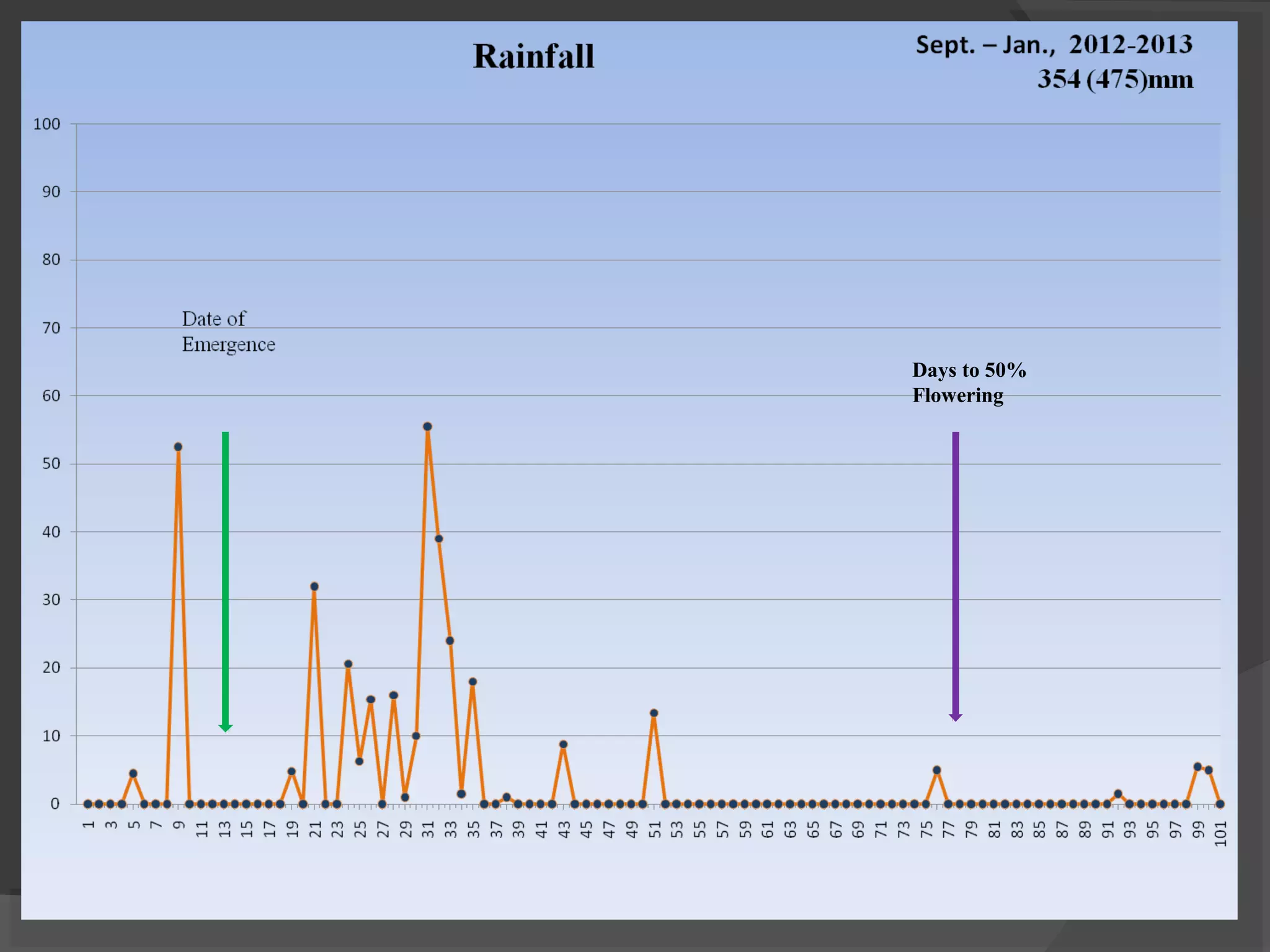
Days to 50%
Flowering
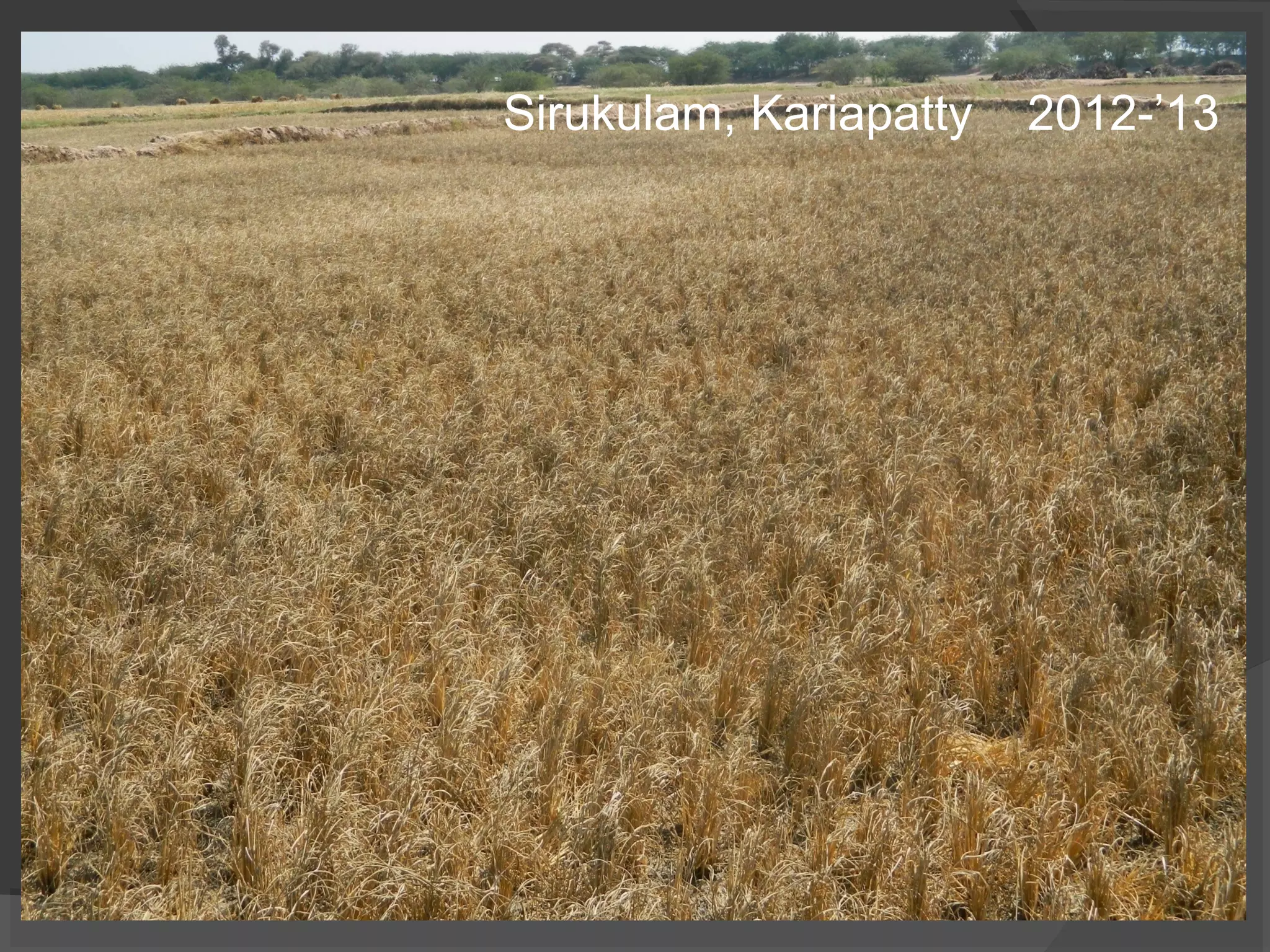
Sirukulam, Kariapatty 2012-’13
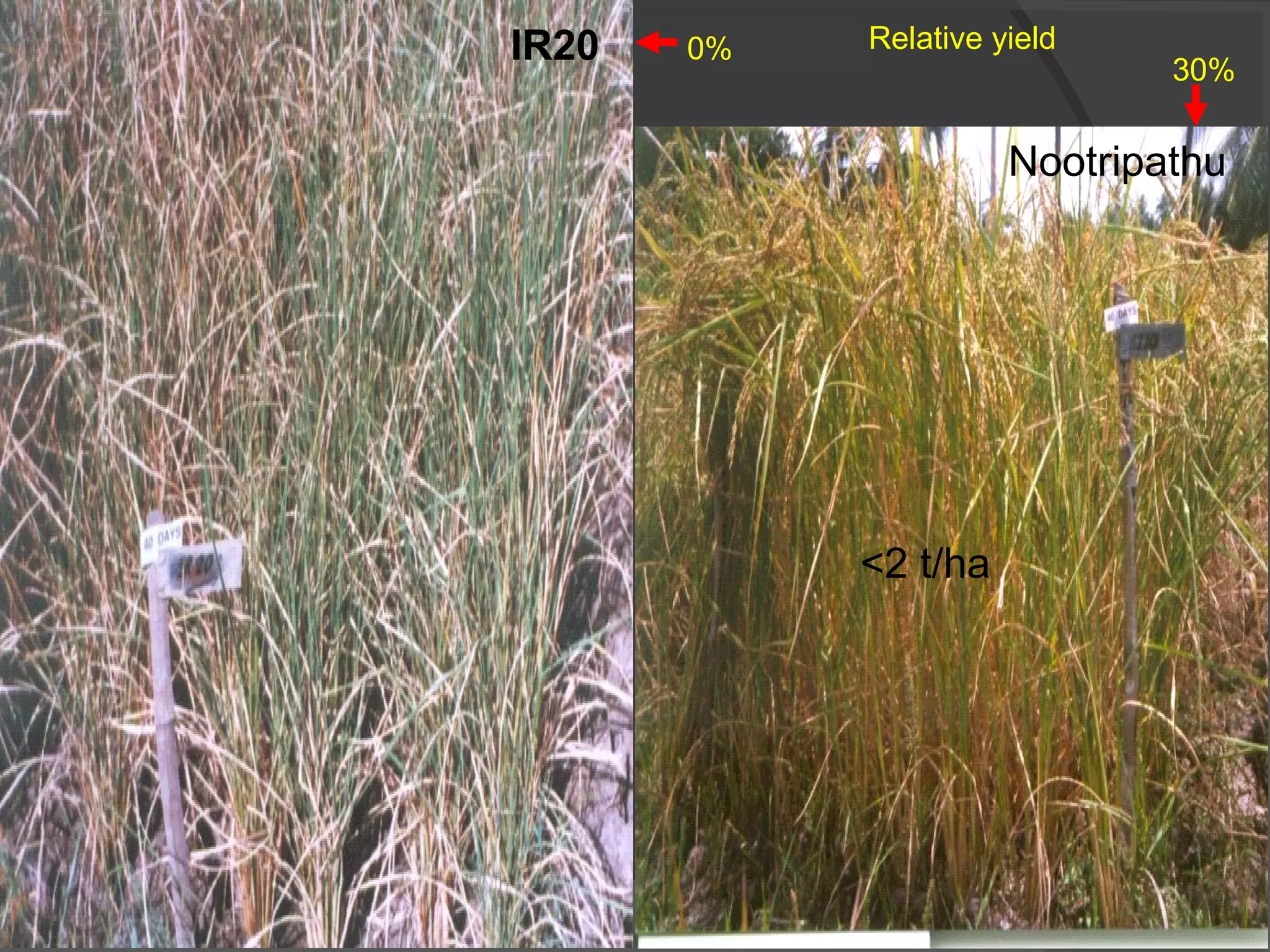
Relative yield
30%
IR20
Nootripathu
0%
<2 t/ha
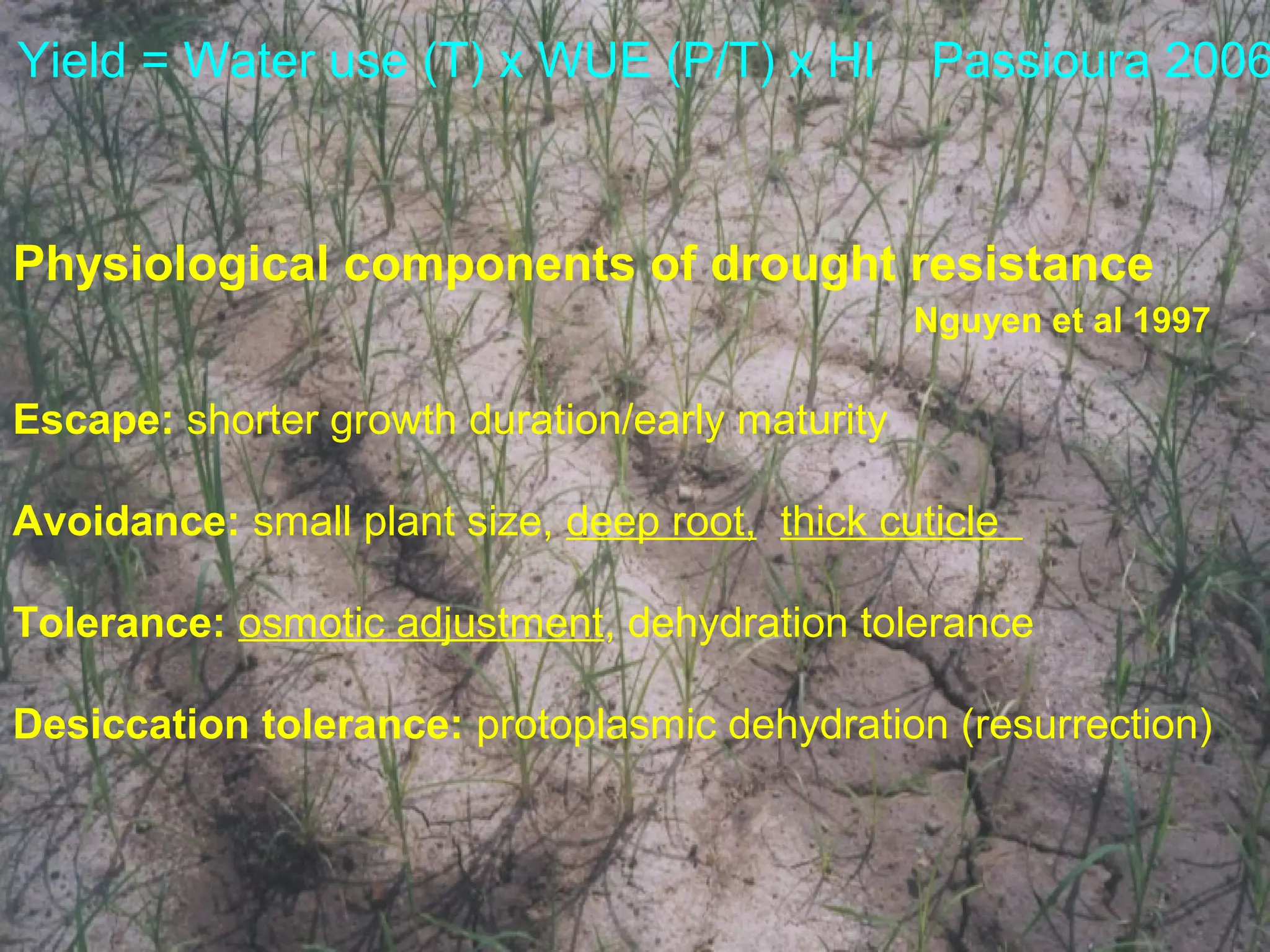
Physiological components of drought resistance
Nguyen et al 1997
Escape: shorter growth duration/early maturity
Avoidance: small plant size, deep root, thick cuticle
Tolerance: osmotic adjustment, dehydration tolerance
Desiccation tolerance: protoplasmic dehydration (resurrection)
Yield = Water use (T) x WUE (P/T) x HI Passioura 2006
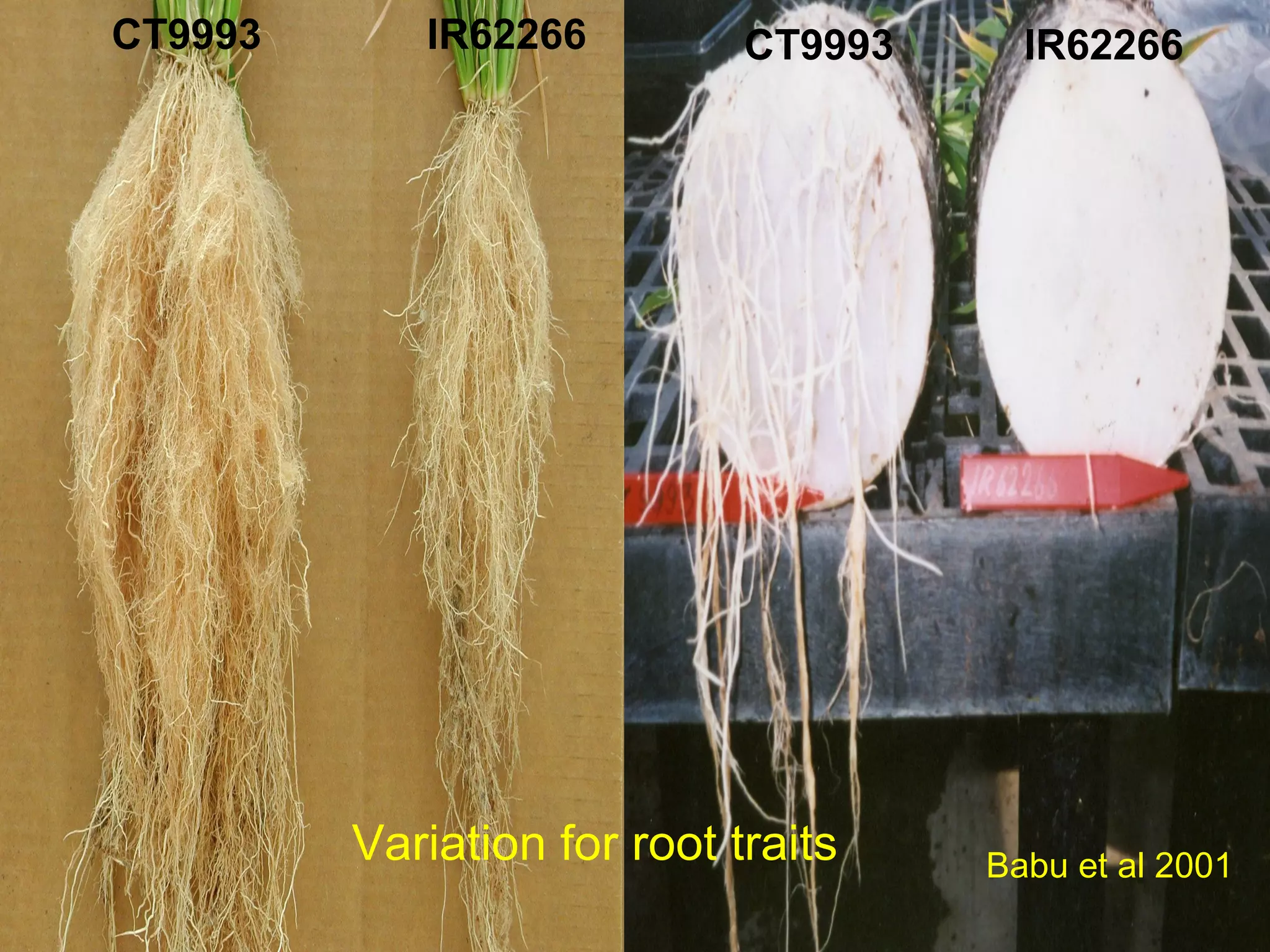
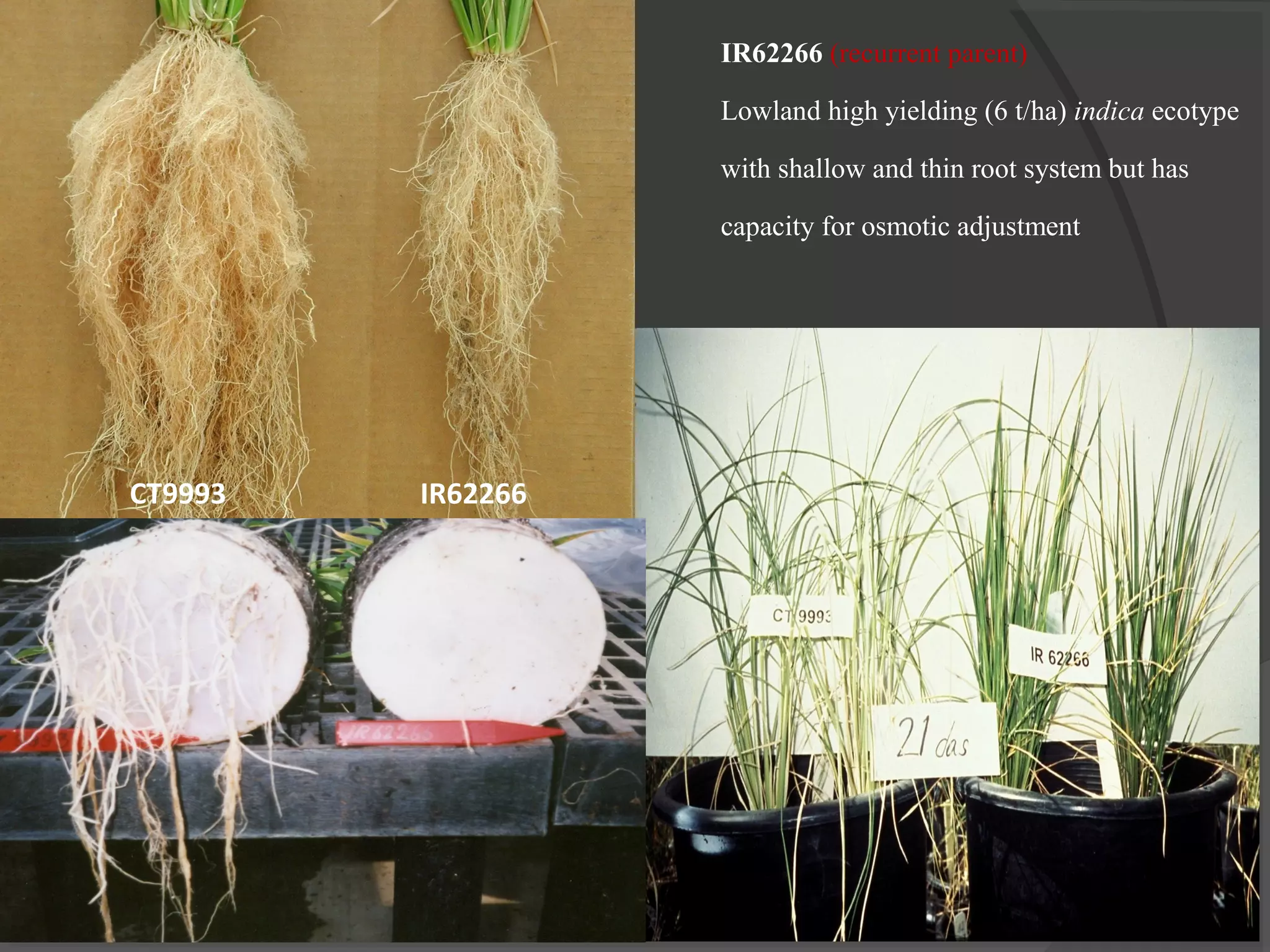
CT9993 IR62266 CT9993 IR62266
Babu et al 2001
Variation for root traits
0
10
20
30
40
50
60
70
80
90
100
0 20 40 60 80 100 120 140 160 180
minutes
RWC(%)
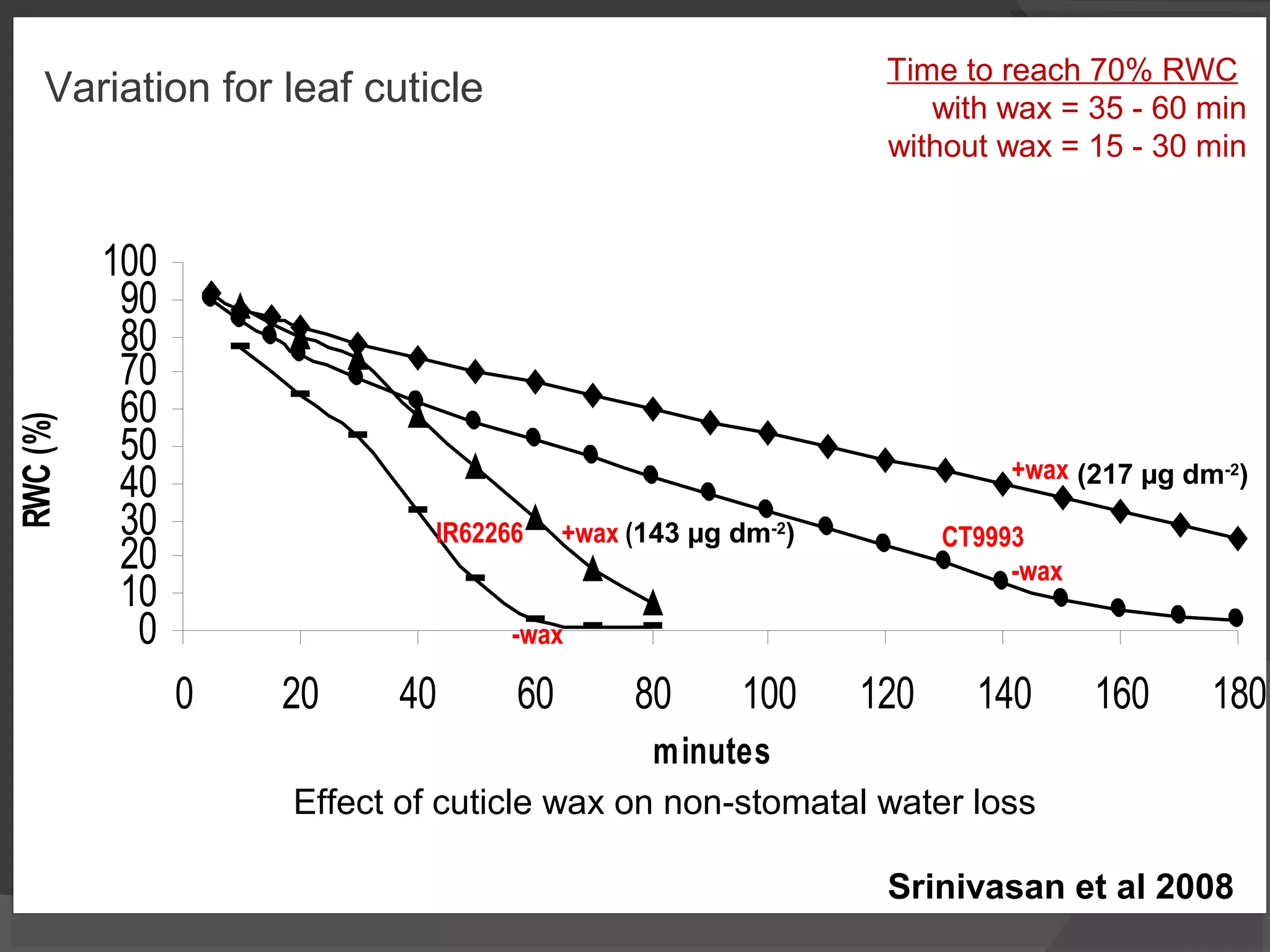
Time to reach 70% RWC
with wax = 35 - 60 min
without wax = 15 - 30 min
+wax
 
CT9993
-wax
 
IR62266 +wax (143 µg dm-2
)
-wax
Effect of cuticle wax on non-stomatal water loss
(217 µg dm-2
)
Variation for leaf cuticle
Srinivasan et al 2008
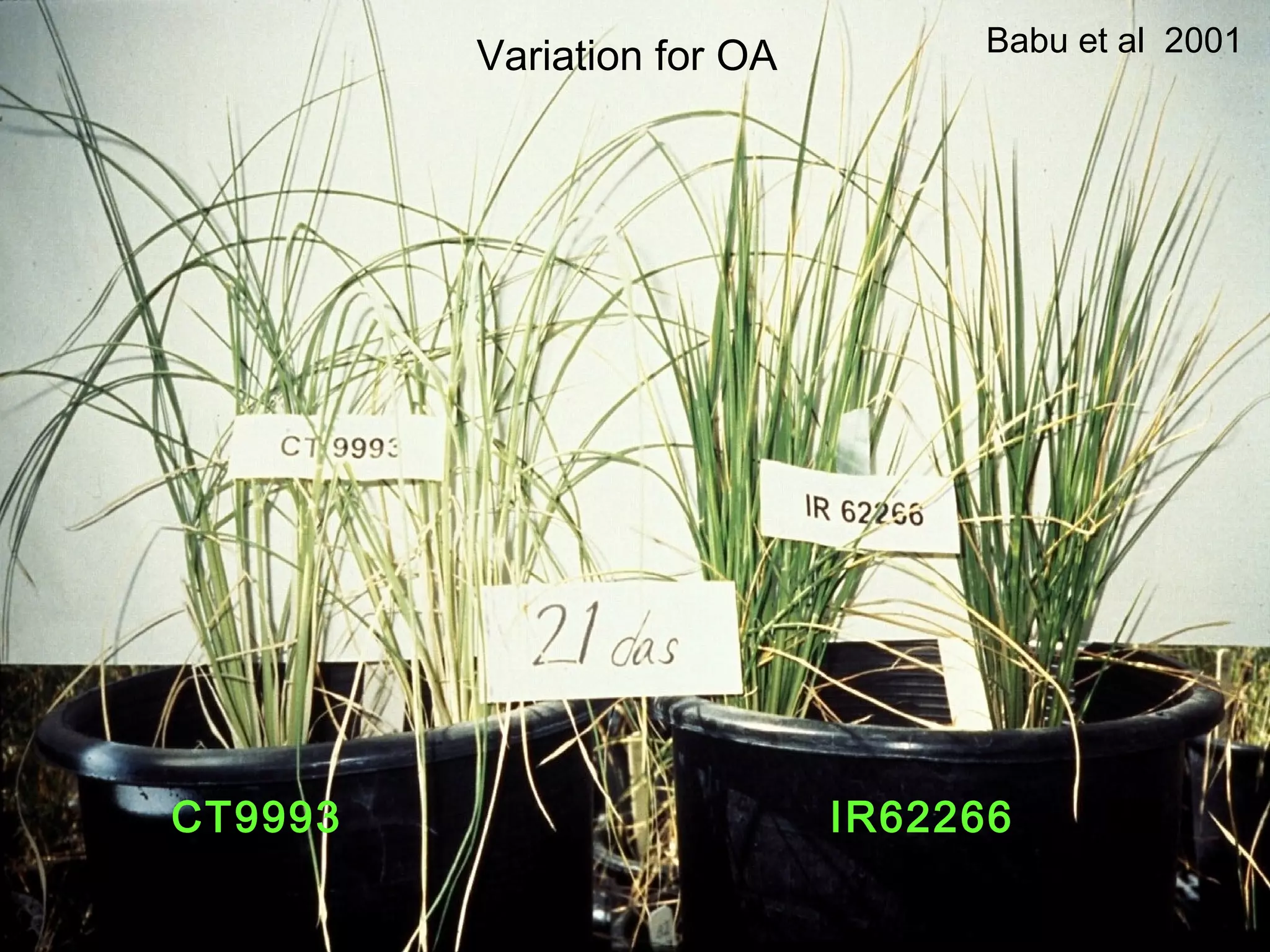
CT9993 IR62266
Babu et al 2001
Variation for OA
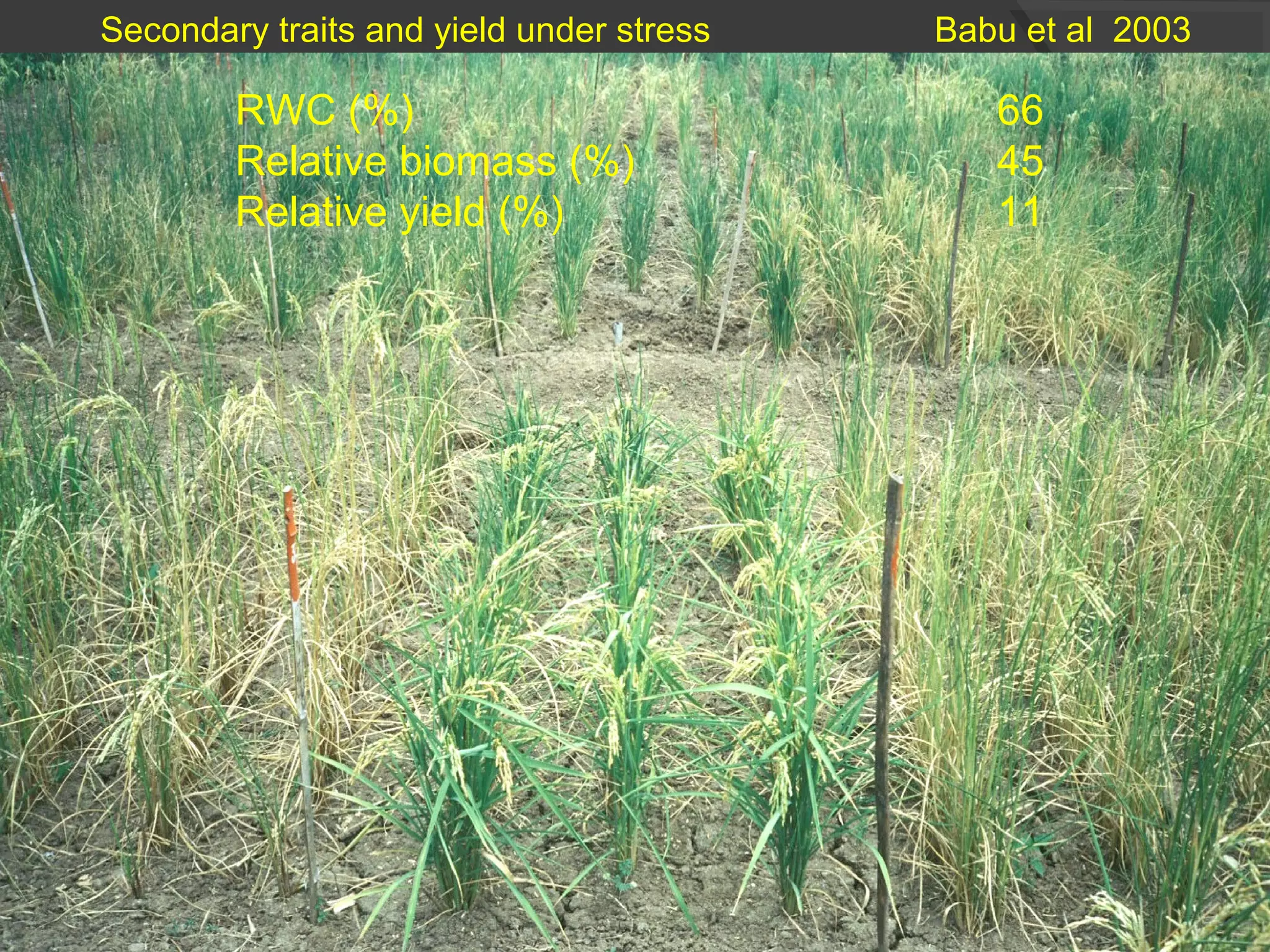
RWC (%) 66
Relative biomass (%) 45
Relative yield (%) 11
Secondary traits and yield under stress Babu et al 2003
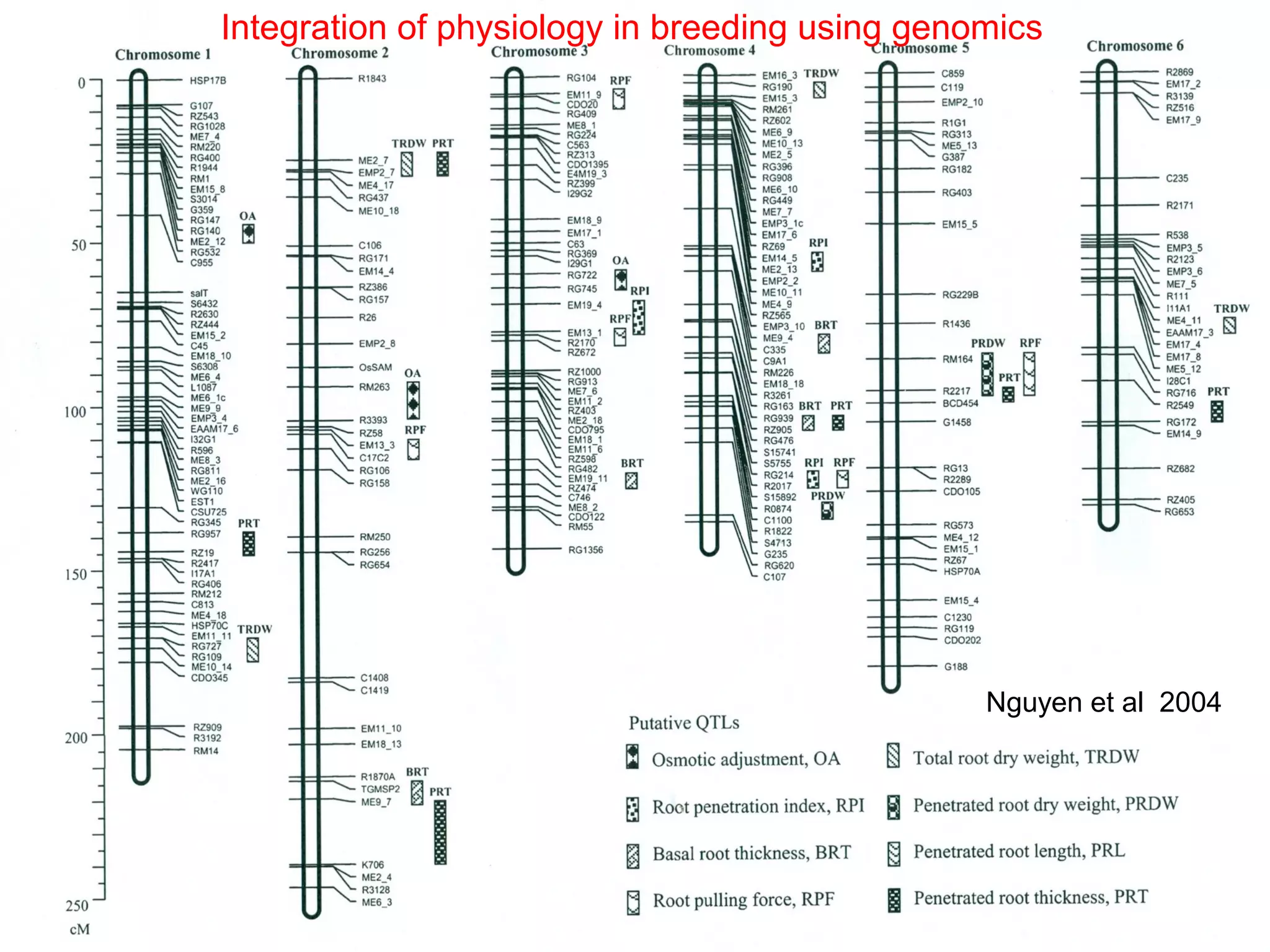
Nguyen et al 2004
Integration of physiology in breeding using genomics
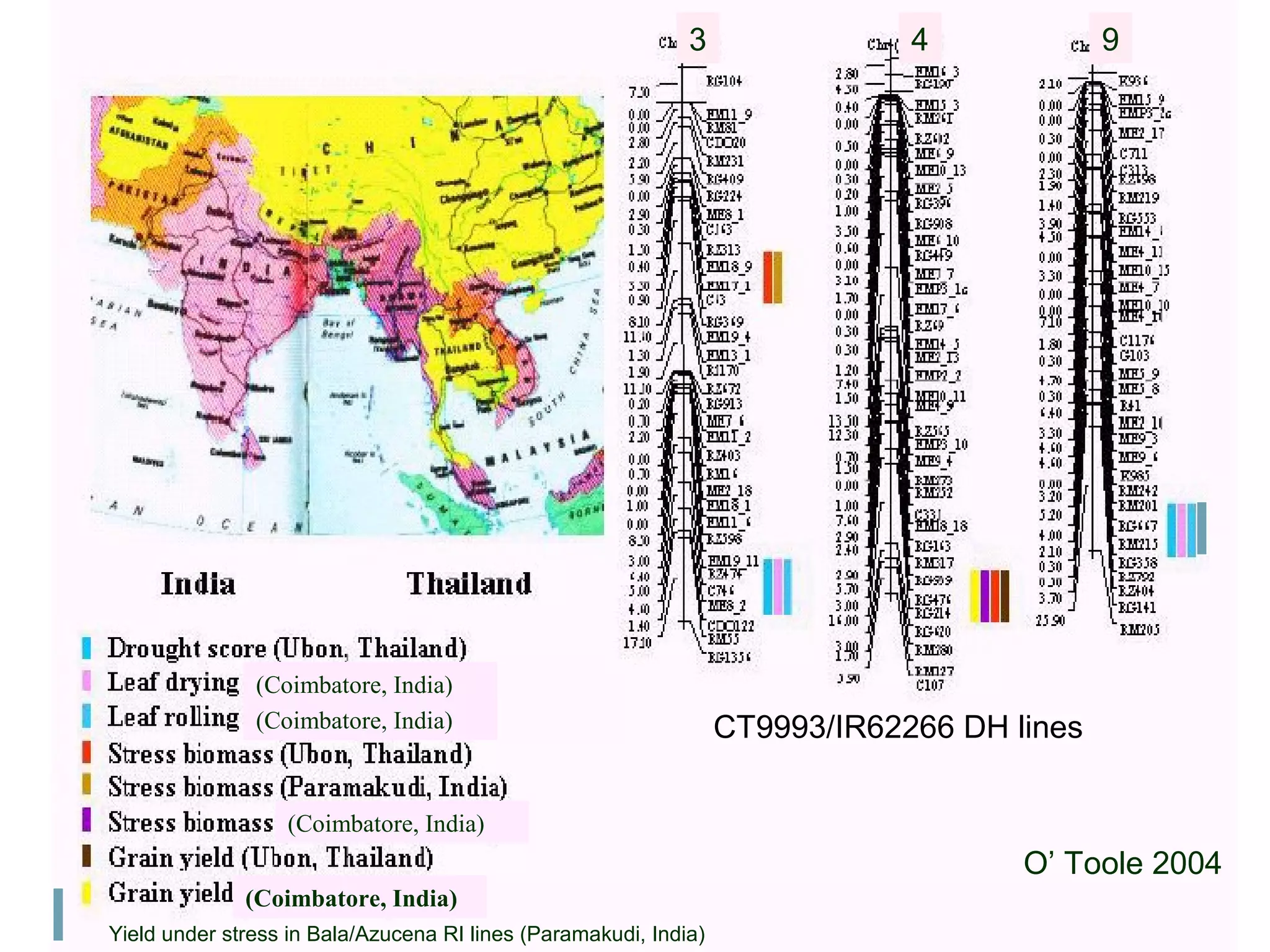
O’ Toole 2004
(Coimbatore, India)
(Coimbatore, India)
(Coimbatore, India)
(Coimbatore, India)
Yield under stress in Bala/Azucena RI lines (Paramakudi, India)
3 4 9
CT9993/IR62266 DH lines
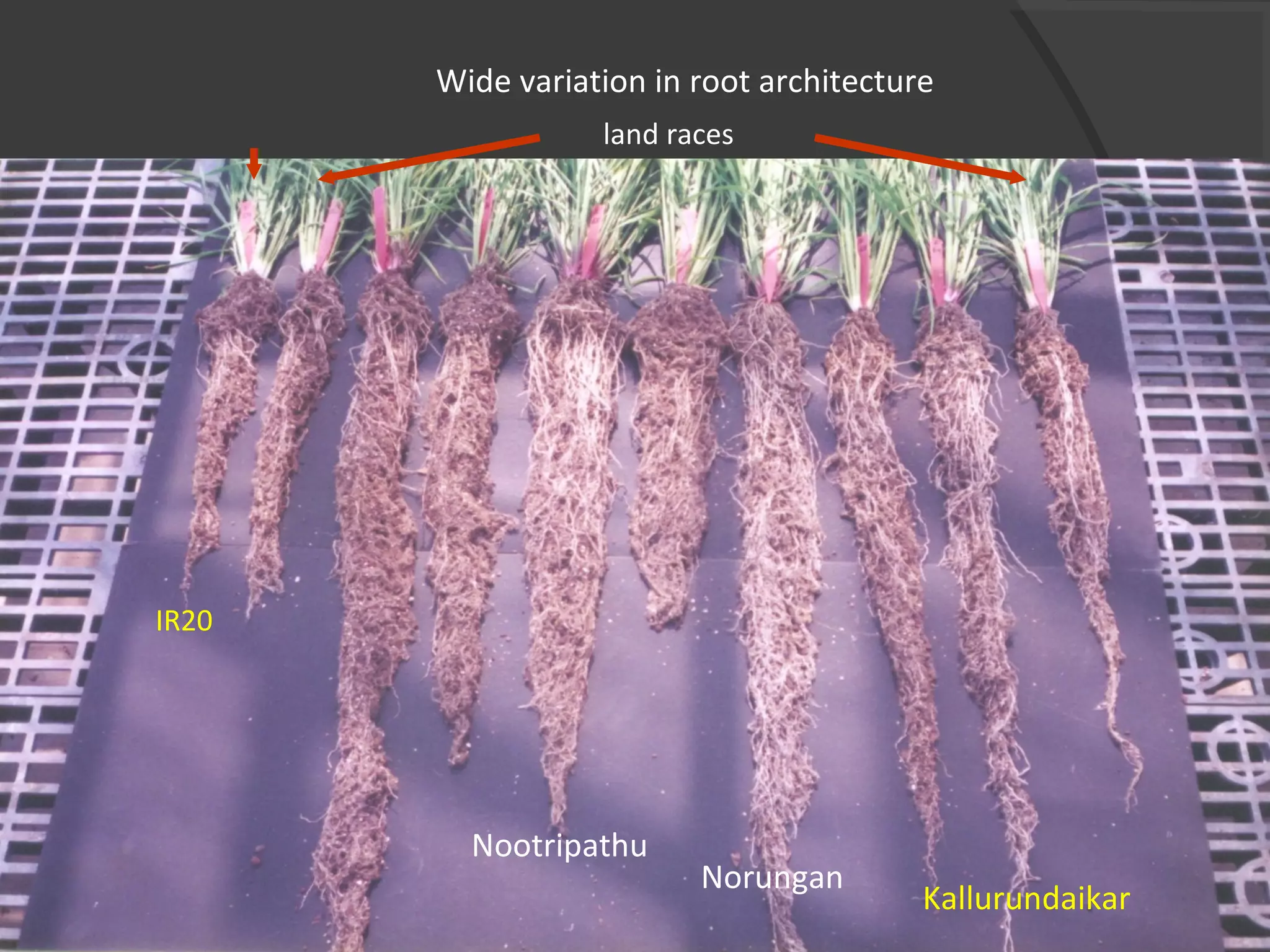
land races
Nootripathu
Norungan
Kallurundaikar
IR20
Wide variation in root architecture
IR62266 (recurrent parent)
Lowland high yielding (6 t/ha) indica ecotype
with shallow and thin root system but has
capacity for osmotic adjustment
CT9993 IR62266
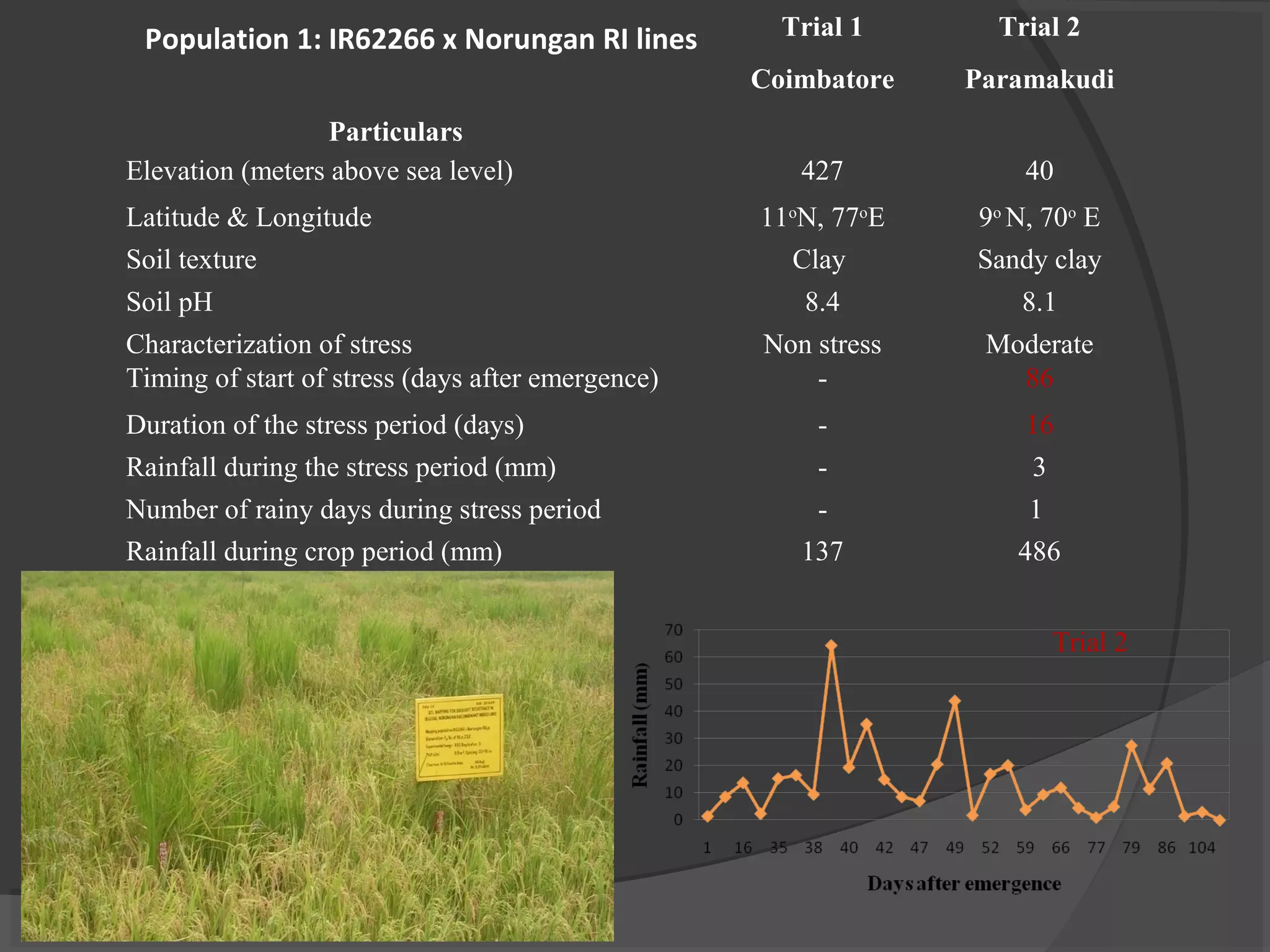
Particulars
Trial 1
Coimbatore
Trial 2
Paramakudi
Elevation (meters above sea level) 427 40
Latitude & Longitude 11o
N, 77o
E 9o
N, 70o
E
Soil texture Clay Sandy clay
Soil pH 8.4 8.1
Characterization of stress Non stress Moderate
Timing of start of stress (days after emergence) - 86
Duration of the stress period (days) - 16
Rainfall during the stress period (mm) - 3
Number of rainy days during stress period - 1
Rainfall during crop period (mm) 137 486
Trial 2
Population 1: IR62266 x Norungan RI lines
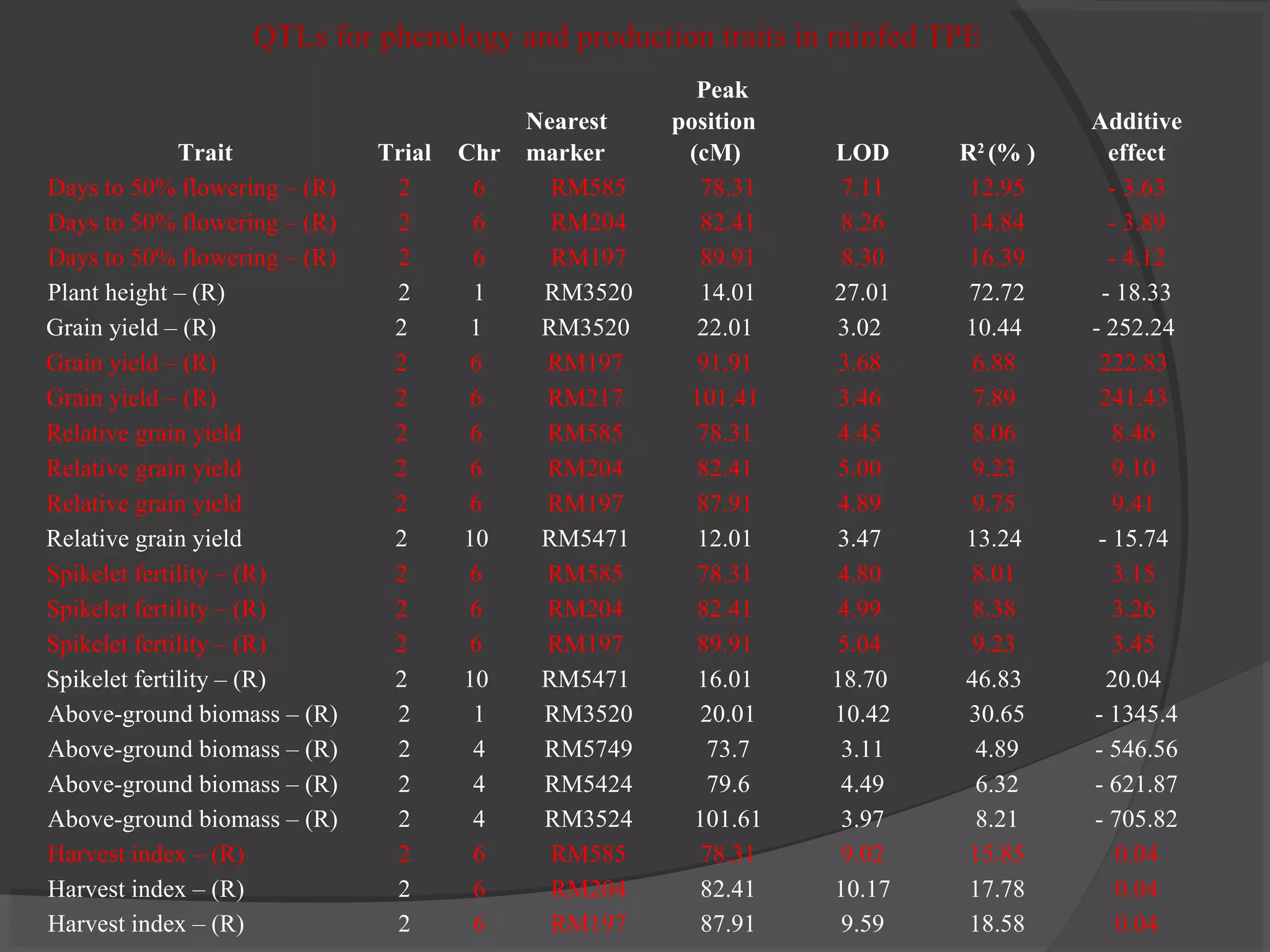
Trait Trial Chr
Nearest
marker
Peak
position
(cM) LOD R2
(% )
Additive
effect
Days to 50% flowering – (R) 2 6 RM585 78.31 7.11 12.95 - 3.63
Days to 50% flowering – (R) 2 6 RM204 82.41 8.26 14.84 - 3.89
Days to 50% flowering – (R) 2 6 RM197 89.91 8.30 16.39 - 4.12
Plant height – (R) 2 1 RM3520 14.01 27.01 72.72 - 18.33
Grain yield – (R) 2 1 RM3520 22.01 3.02 10.44 - 252.24
Grain yield – (R) 2 6 RM197 91.91 3.68 6.88 222.83
Grain yield – (R) 2 6 RM217 101.41 3.46 7.89 241.43
Relative grain yield 2 6 RM585 78.31 4.45 8.06 8.46
Relative grain yield 2 6 RM204 82.41 5.00 9.23 9.10
Relative grain yield 2 6 RM197 87.91 4.89 9.75 9.41
Relative grain yield 2 10 RM5471 12.01 3.47 13.24 - 15.74
Spikelet fertility – (R) 2 6 RM585 78.31 4.80 8.01 3.15
Spikelet fertility – (R) 2 6 RM204 82.41 4.99 8.38 3.26
Spikelet fertility – (R) 2 6 RM197 89.91 5.04 9.23 3.45
Spikelet fertility – (R) 2 10 RM5471 16.01 18.70 46.83 20.04
Above-ground biomass – (R) 2 1 RM3520 20.01 10.42 30.65 - 1345.4
Above-ground biomass – (R) 2 4 RM5749 73.7 3.11 4.89 - 546.56
Above-ground biomass – (R) 2 4 RM5424 79.6 4.49 6.32 - 621.87
Above-ground biomass – (R) 2 4 RM3524 101.61 3.97 8.21 - 705.82
Harvest index – (R) 2 6 RM585 78.31 9.02 15.85 0.04
Harvest index – (R) 2 6 RM204 82.41 10.17 17.78 0.04
Harvest index – (R) 2 6 RM197 87.91 9.59 18.58 0.04
QTLs for phenology and production traits in rainfed TPE
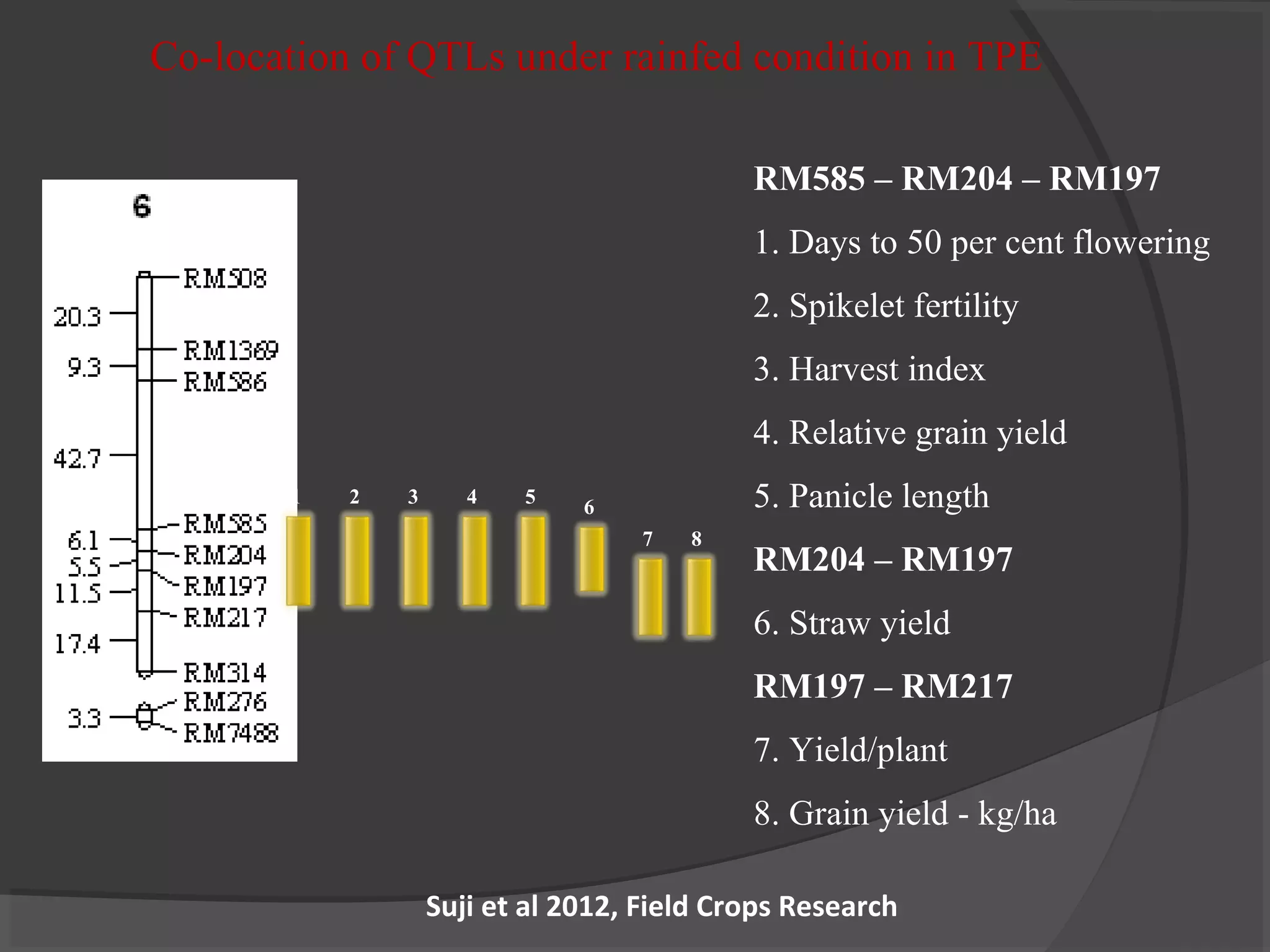
1 2 3 4 5 6
7 8
RM585 – RM204 – RM197
1. Days to 50 per cent flowering
2. Spikelet fertility
3. Harvest index
4. Relative grain yield
5. Panicle length
RM204 – RM197
6. Straw yield
RM197 – RM217
7. Yield/plant
8. Grain yield - kg/ha
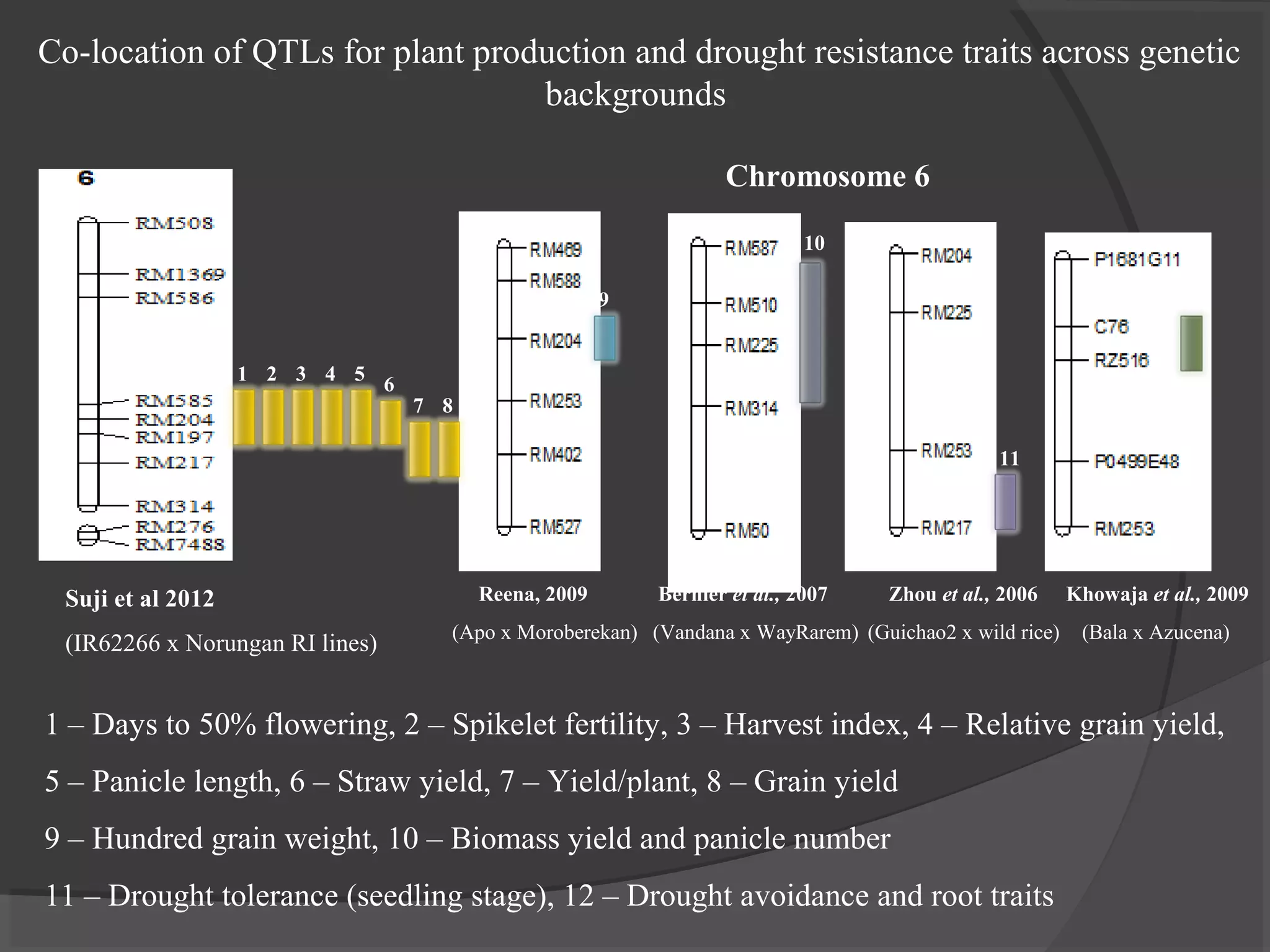
Co-location of QTLs under rainfed condition in TPE
Suji et al 2012, Field Crops Research
Suji et al 2012
(IR62266 x Norungan RI lines)
Chromosome 6
Reena, 2009
(Apo x Moroberekan)
Bernier et al., 2007
(Vandana x WayRarem)
Zhou et al., 2006
(Guichao2 x wild rice)
Khowaja et al., 2009
(Bala x Azucena)
1 2
87
3 4 5
6
9
10
11
12
Co-location of QTLs for plant production and drought resistance traits across genetic
backgrounds
1 – Days to 50% flowering, 2 – Spikelet fertility, 3 – Harvest index, 4 – Relative grain yield,
5 – Panicle length, 6 – Straw yield, 7 – Yield/plant, 8 – Grain yield
9 – Hundred grain weight, 10 – Biomass yield and panicle number
11 – Drought tolerance (seedling stage), 12 – Drought avoidance and root traits
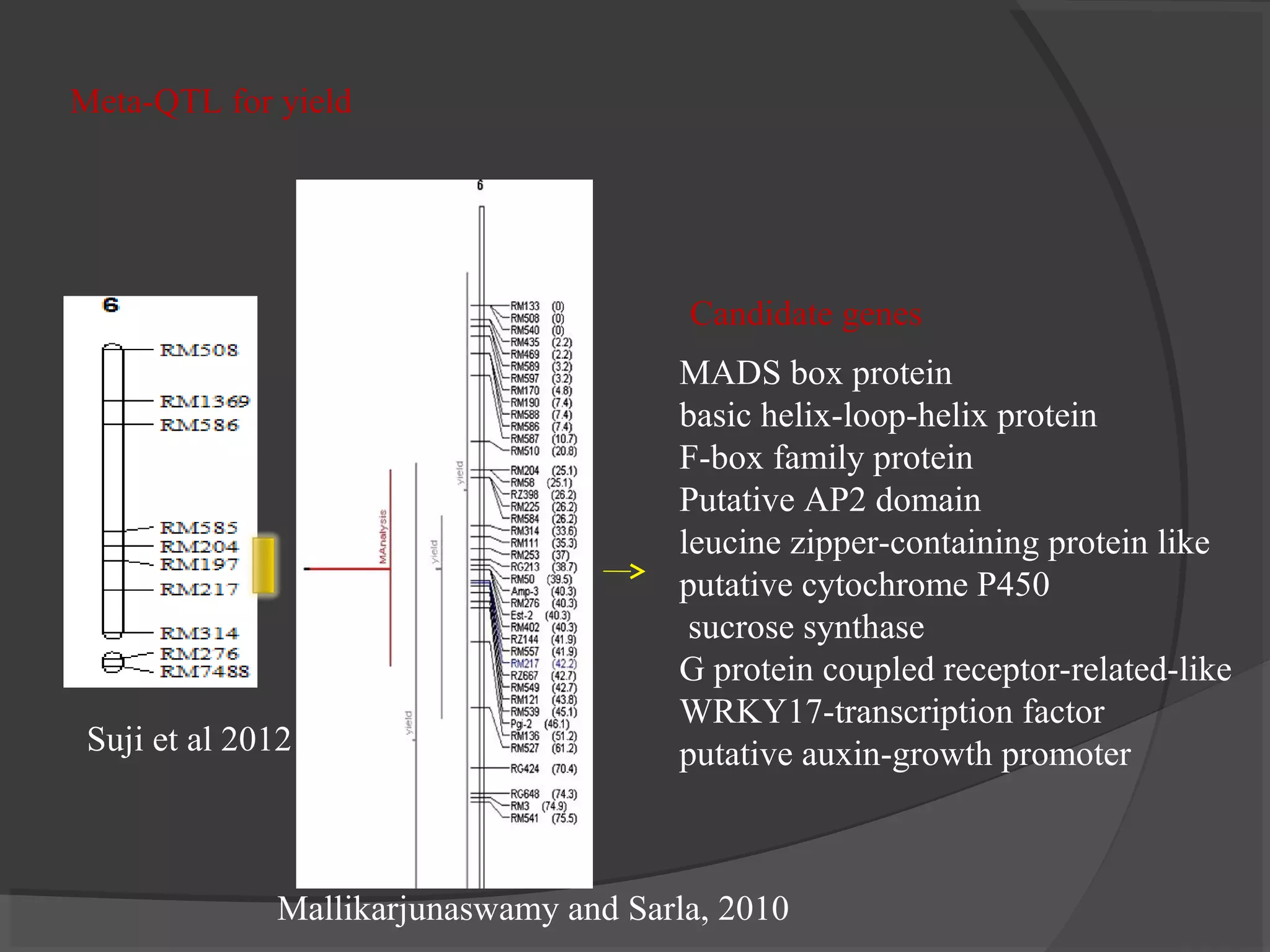
Meta-QTL for yield
Mallikarjunaswamy and Sarla, 2010
Suji et al 2012
MADS box protein
basic helix-loop-helix protein
F-box family protein
Putative AP2 domain
leucine zipper-containing protein like
putative cytochrome P450
sucrose synthase
G protein coupled receptor-related-like
WRKY17-transcription factor
putative auxin-growth promoter
Candidate genes
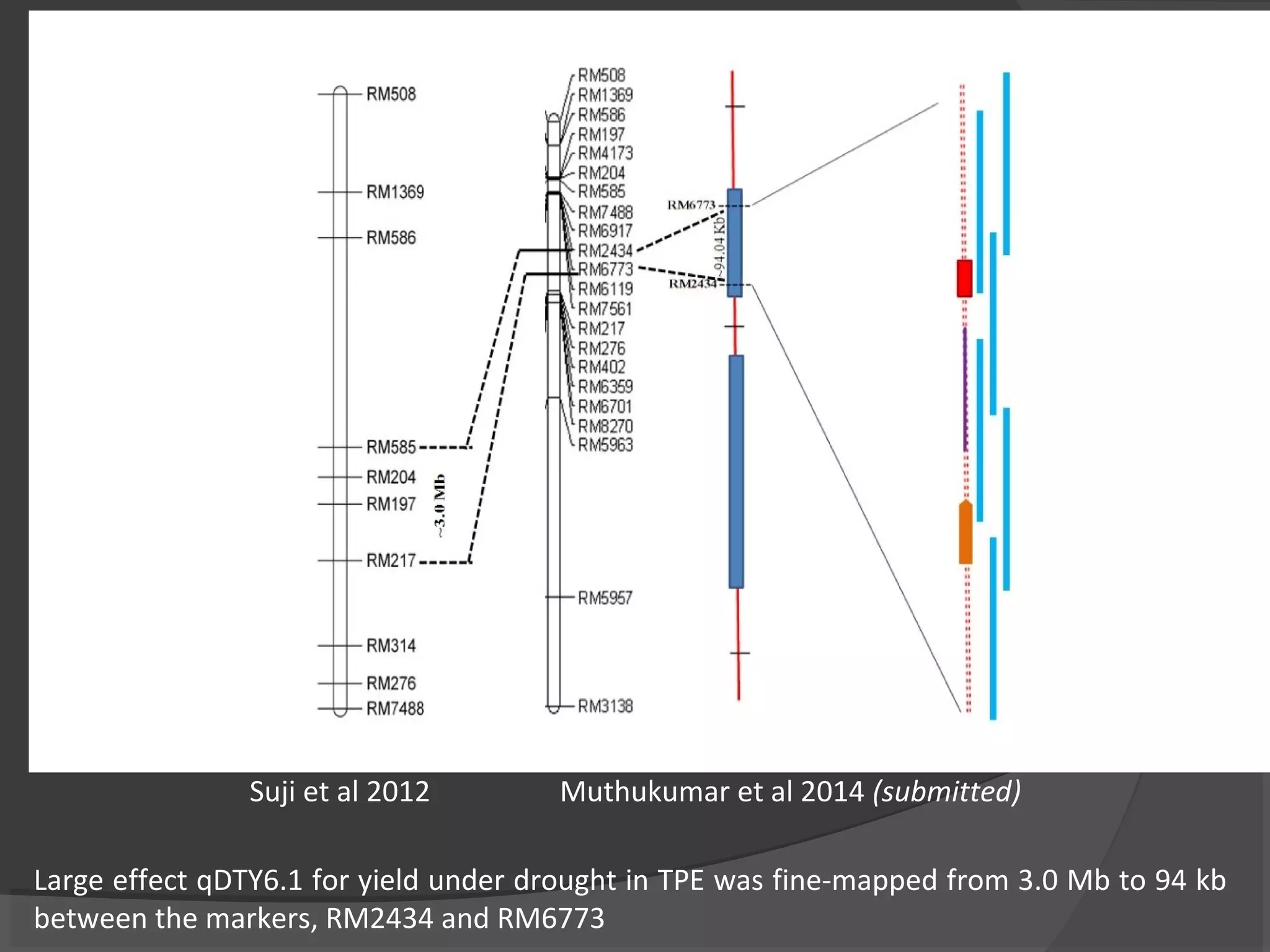
Large effect qDTY6.1 for yield under drought in TPE was fine-mapped from 3.0 Mb to 94 kb
between the markers, RM2434 and RM6773
Muthukumar et al 2014 (submitted)Suji et al 2012
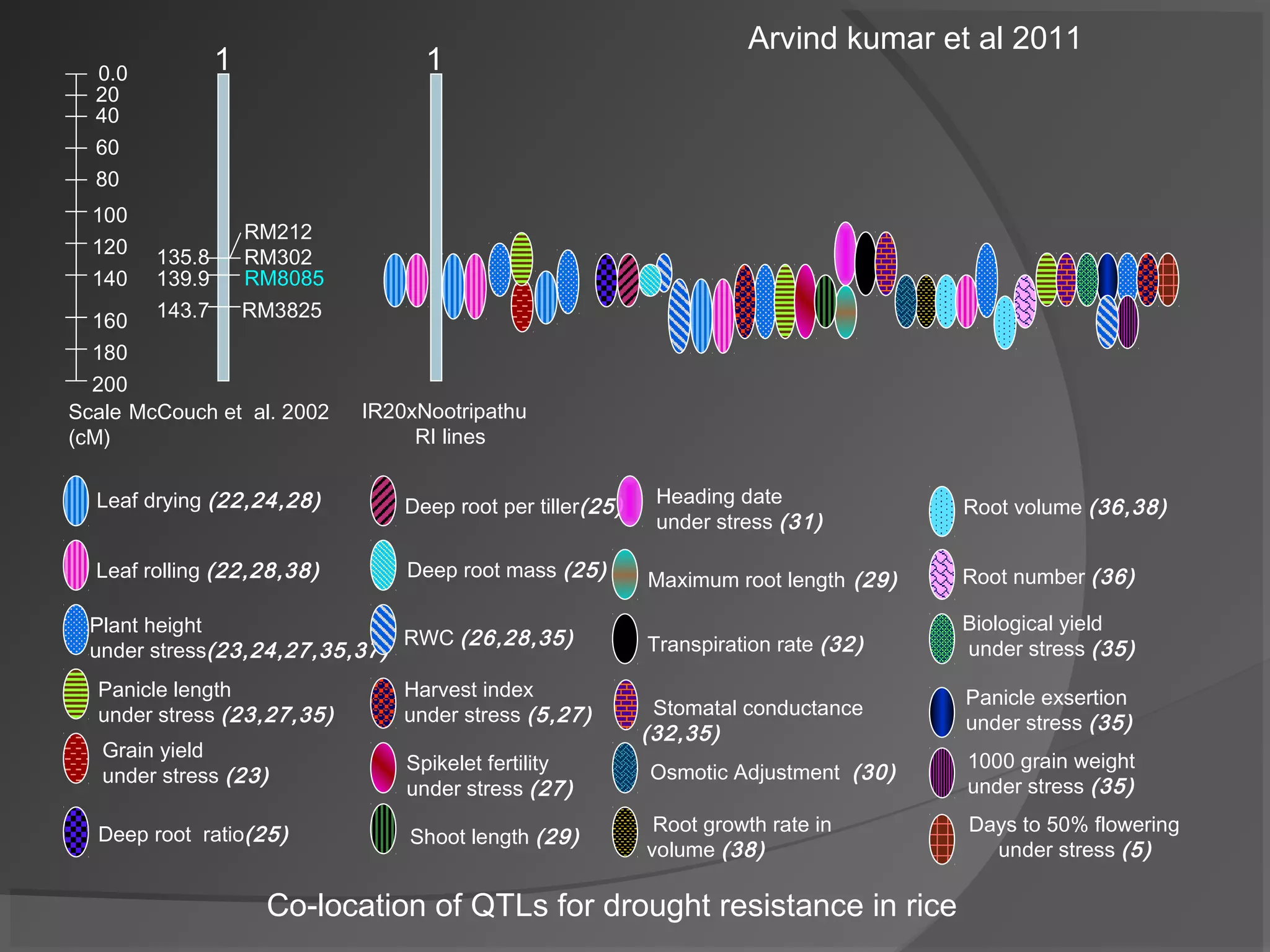
Co-location of QTLs for drought resistance in rice
IR20xNootripathu
RI lines
Scale
(cM)
0.0
20
40
60
80
100
120
140
160
180
200
McCouch et al. 2002
139.9 RM8085
RM212
RM302
RM3825143.7
135.8
Osmotic Adjustment (30)
Deep root mass (25)
Deep root per tiller(25)Leaf drying (22,24,28)
Deep root ratio(25)
Root number (36)
Panicle exsertion
under stress (35)
Days to 50% flowering
under stress (5)
Shoot length (29)
Plant height
under stress(23,24,27,35,37)
Maximum root length (29)
1000 grain weight
under stress (35)
RWC (26,28,35) Transpiration rate (32)
Root growth rate in
volume (38)
Biological yield
under stress (35)
Panicle length
under stress (23,27,35)
Harvest index
under stress (5,27) Stomatal conductance
(32,35)
Spikelet fertility
under stress (27)
Root volume (36,38)
Grain yield
under stress (23)
Leaf rolling (22,28,38)
Heading date
under stress (31)
Arvind kumar et al 2011
1 1
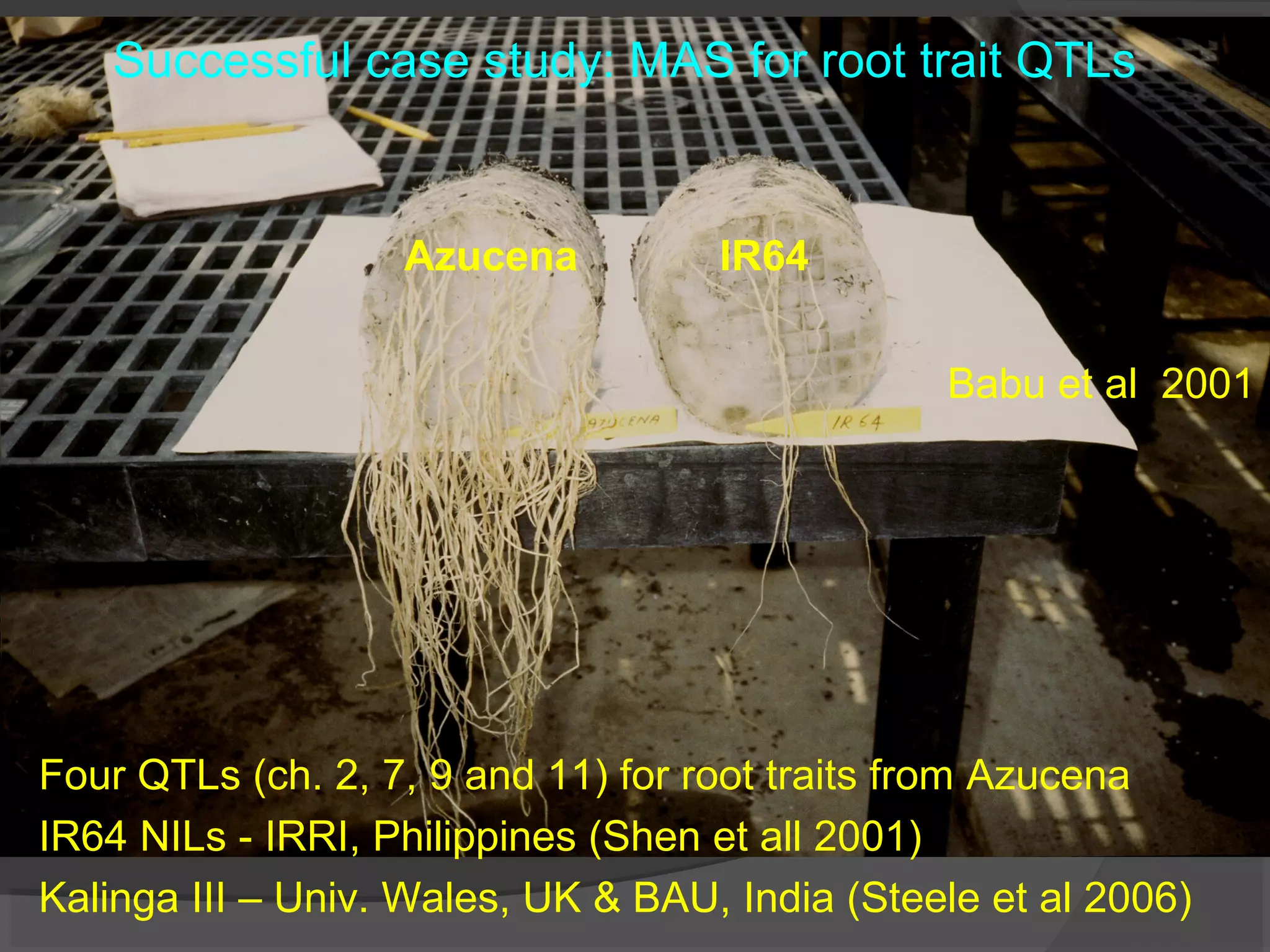
Successful case study: MAS for root trait QTLs
Azucena IR64
Babu et al 2001
Four QTLs (ch. 2, 7, 9 and 11) for root traits from Azucena
IR64 NILs - IRRI, Philippines (Shen et all 2001)
Kalinga III – Univ. Wales, UK & BAU, India (Steele et al 2006)
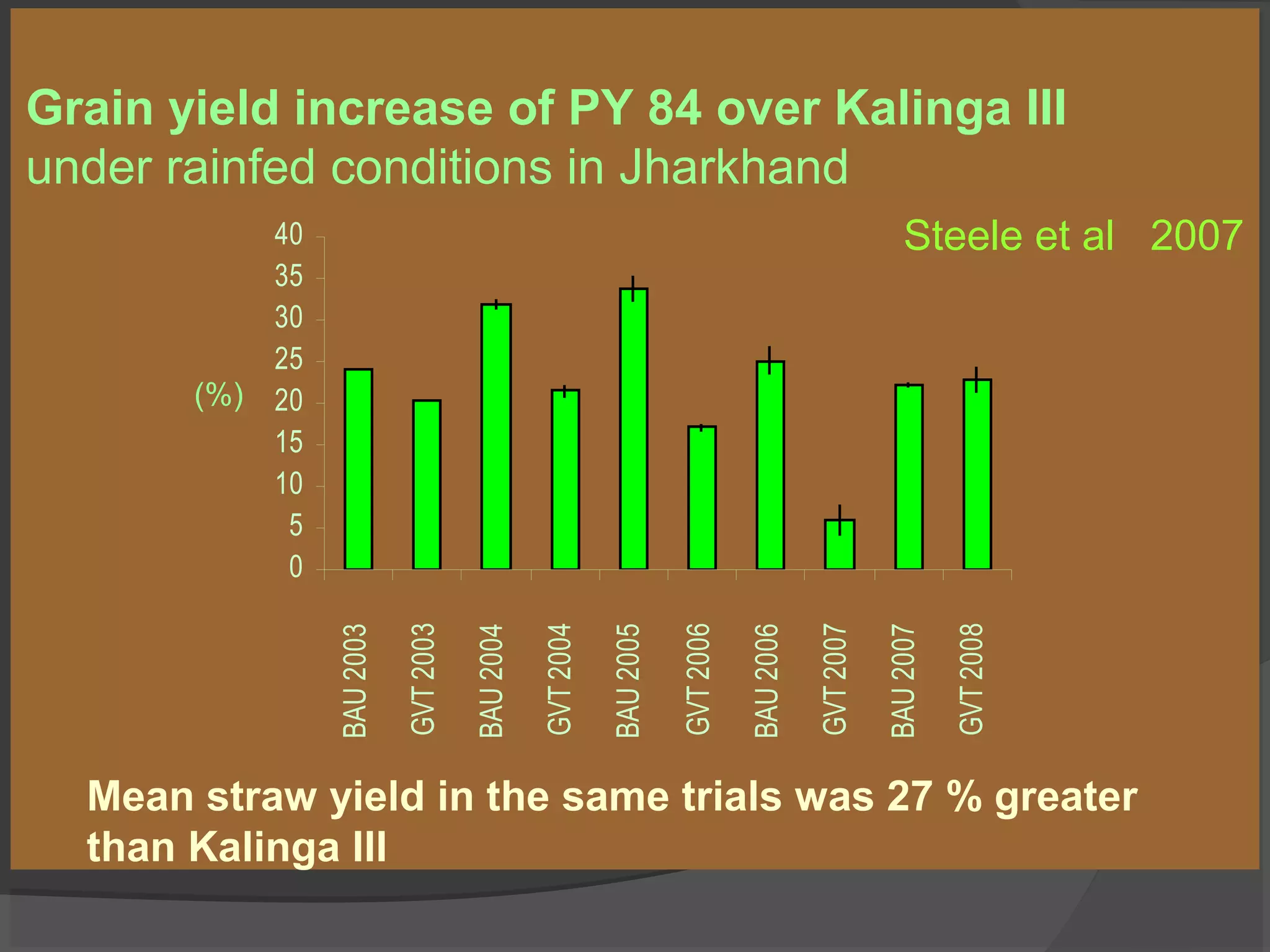
Grain yield increase of PY 84 over Kalinga III
under rainfed conditions in Jharkhand
(%)
0
5
10
15
20
25
30
35
40
BAU2003
GVT2003
BAU2004
GVT2004
BAU2005
GVT2006
BAU2006
GVT2007
BAU2007
GVT2008
Mean straw yield in the same trials was 27 % greater
than Kalinga III
Steele et al 2007
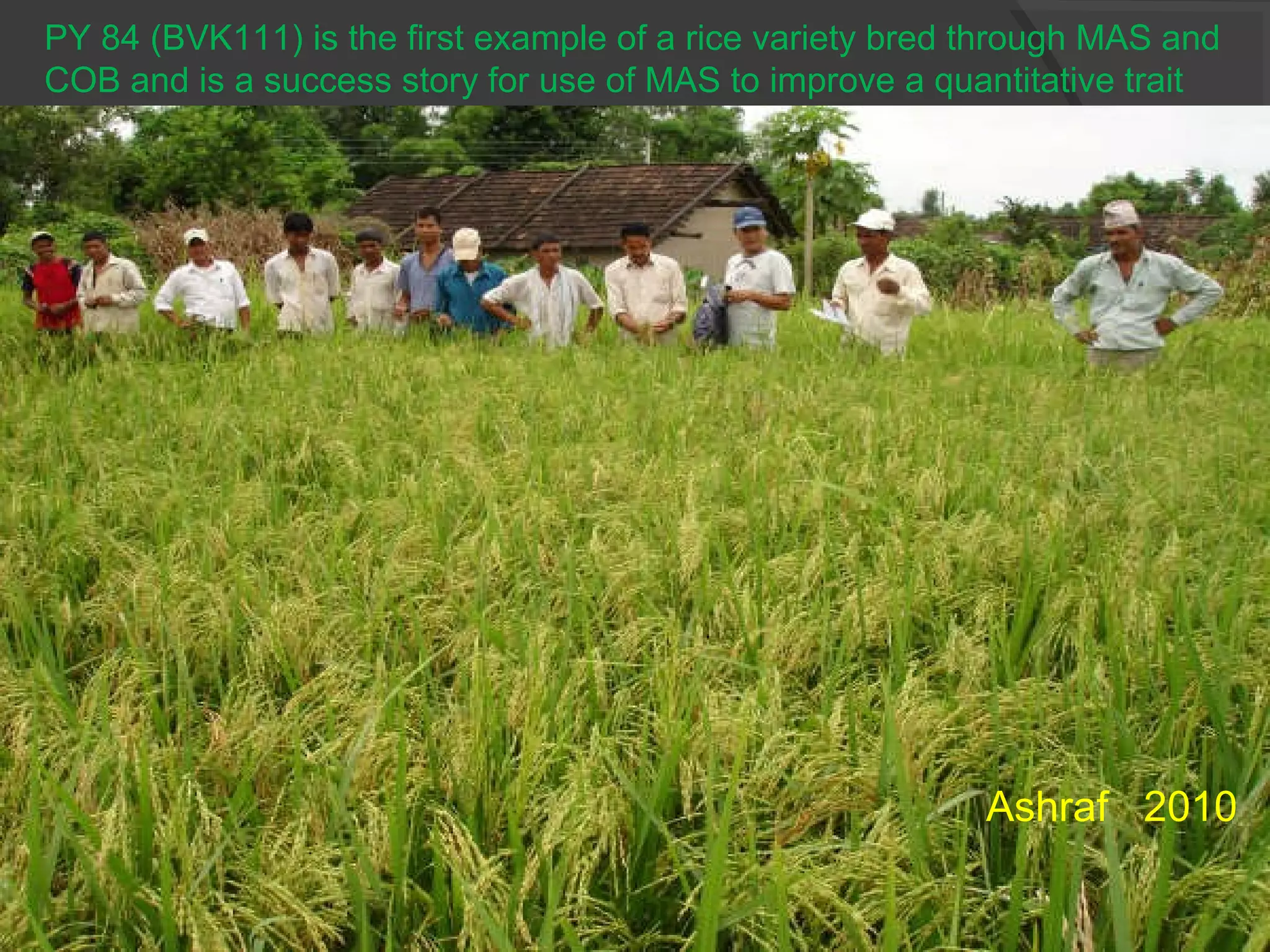
PY 84 (BVK111) is the first example of a rice variety bred through MAS and
COB and is a success story for use of MAS to improve a quantitative trait
Ashraf 2010
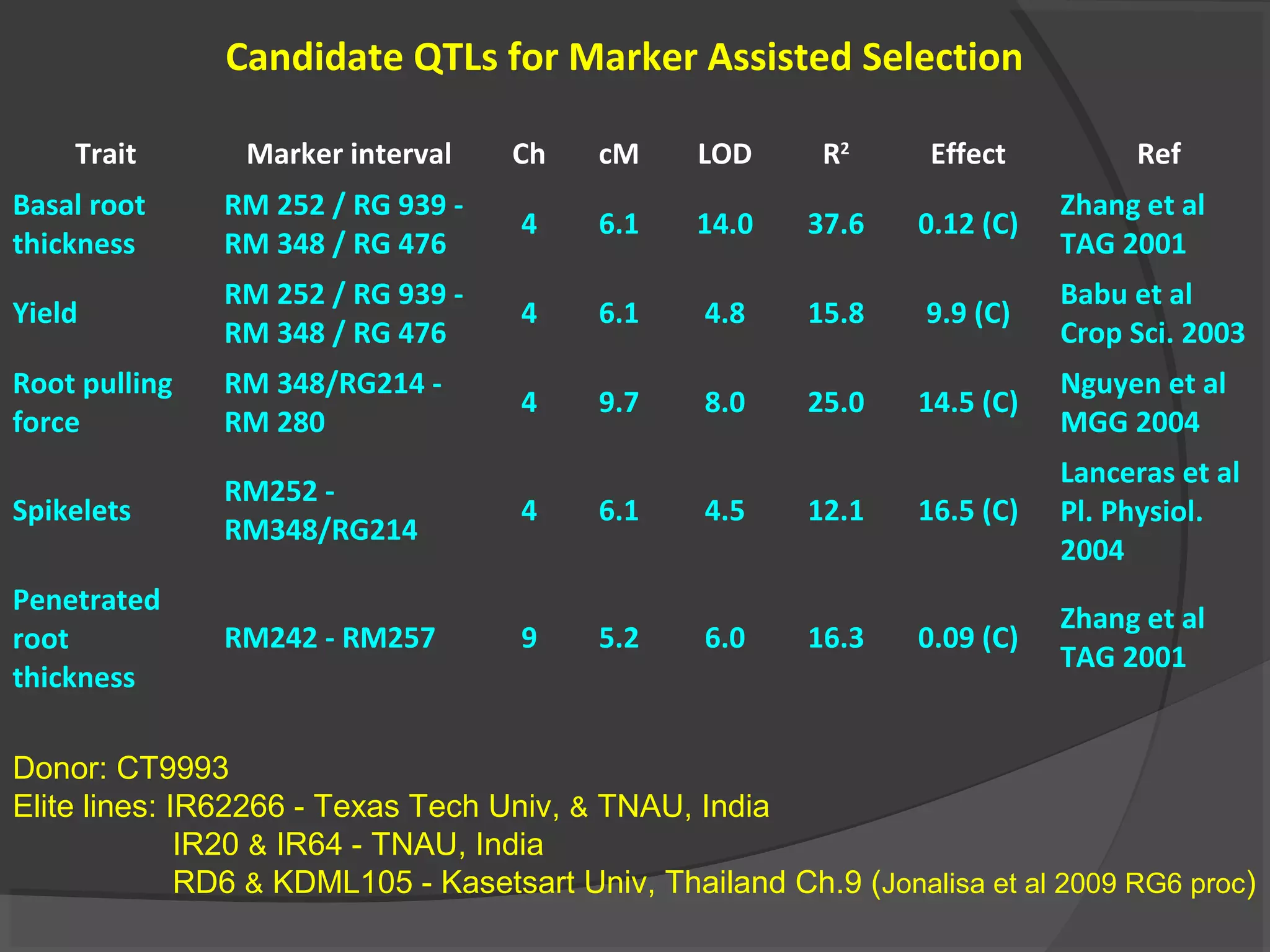
Candidate QTLs for Marker Assisted Selection
Trait Marker interval Ch cM LOD R2
Effect Ref
Basal root
thickness
RM 252 / RG 939 -
RM 348 / RG 476
4 6.1 14.0 37.6 0.12 (C)
Zhang et al
TAG 2001
Yield
RM 252 / RG 939 -
RM 348 / RG 476
4 6.1 4.8 15.8 9.9 (C)
Babu et al
Crop Sci. 2003
Root pulling
force
RM 348/RG214 -
RM 280
4 9.7 8.0 25.0 14.5 (C)
Nguyen et al
MGG 2004
Spikelets
RM252 -
RM348/RG214
4 6.1 4.5 12.1 16.5 (C)
Lanceras et al
Pl. Physiol.
2004
Penetrated
root
thickness
RM242 - RM257 9 5.2 6.0 16.3 0.09 (C)
Zhang et al
TAG 2001
Donor: CT9993
Elite lines: IR62266 - Texas Tech Univ, & TNAU, India
IR20 & IR64 - TNAU, India
RD6 & KDML105 - Kasetsart Univ, Thailand Ch.9 (Jonalisa et al 2009 RG6 proc)
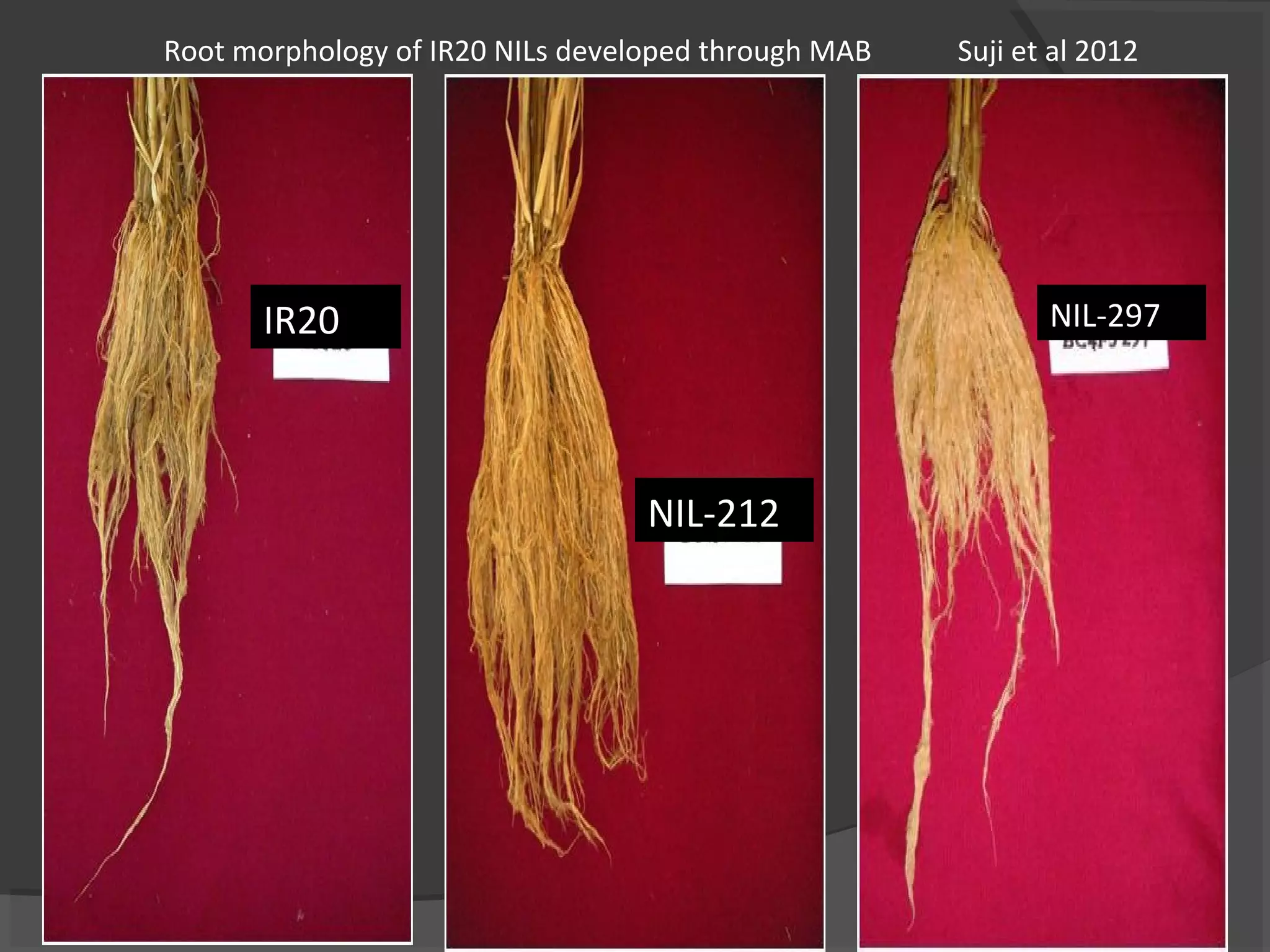
IR20
NIL-212
NIL-297
Root morphology of IR20 NILs developed through MAB Suji et al 2012
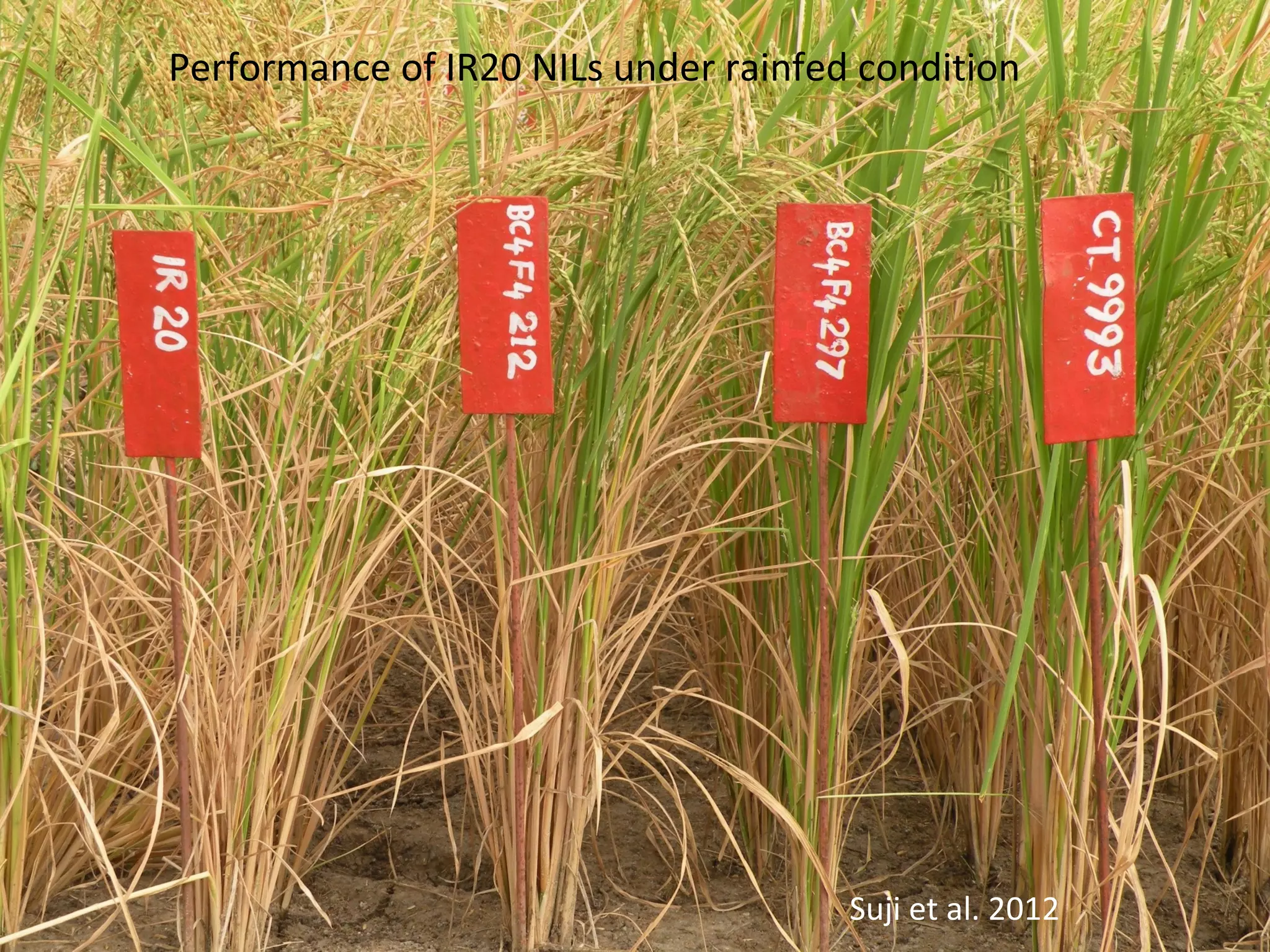
Performance of IR20 NILs under rainfed condition
Suji et al. 2012
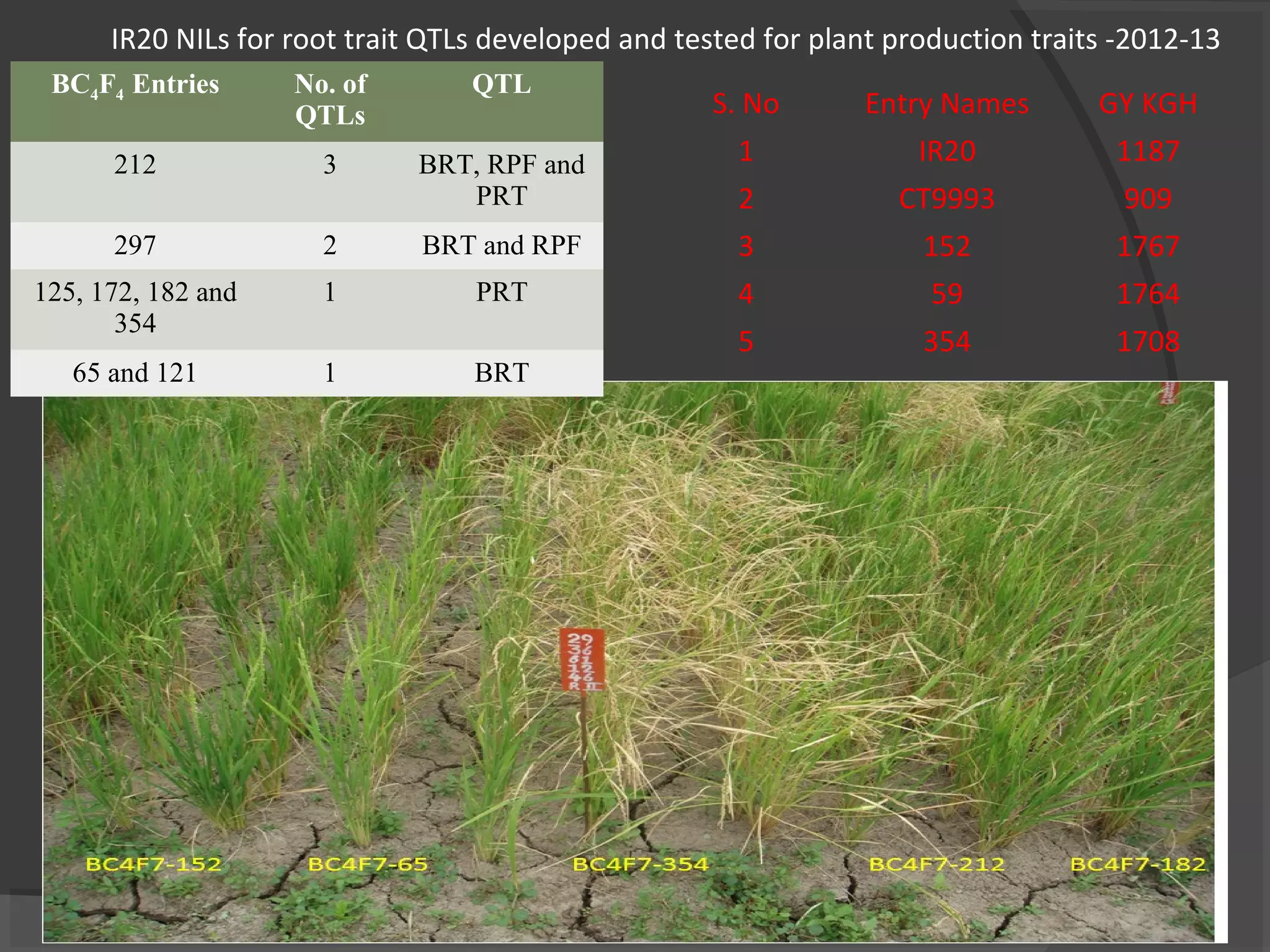
S. No Entry Names GY KGH
1 IR20 1187
2 CT9993 909
3 152 1767
4 59 1764
5 354 1708
IR20 NILs for root trait QTLs developed and tested for plant production traits -2012-13
BC4F4 Entries No. of
QTLs
QTL
212 3 BRT, RPF and
PRT
297 2 BRT and RPF
125, 172, 182 and
354
1 PRT
65 and 121 1 BRT
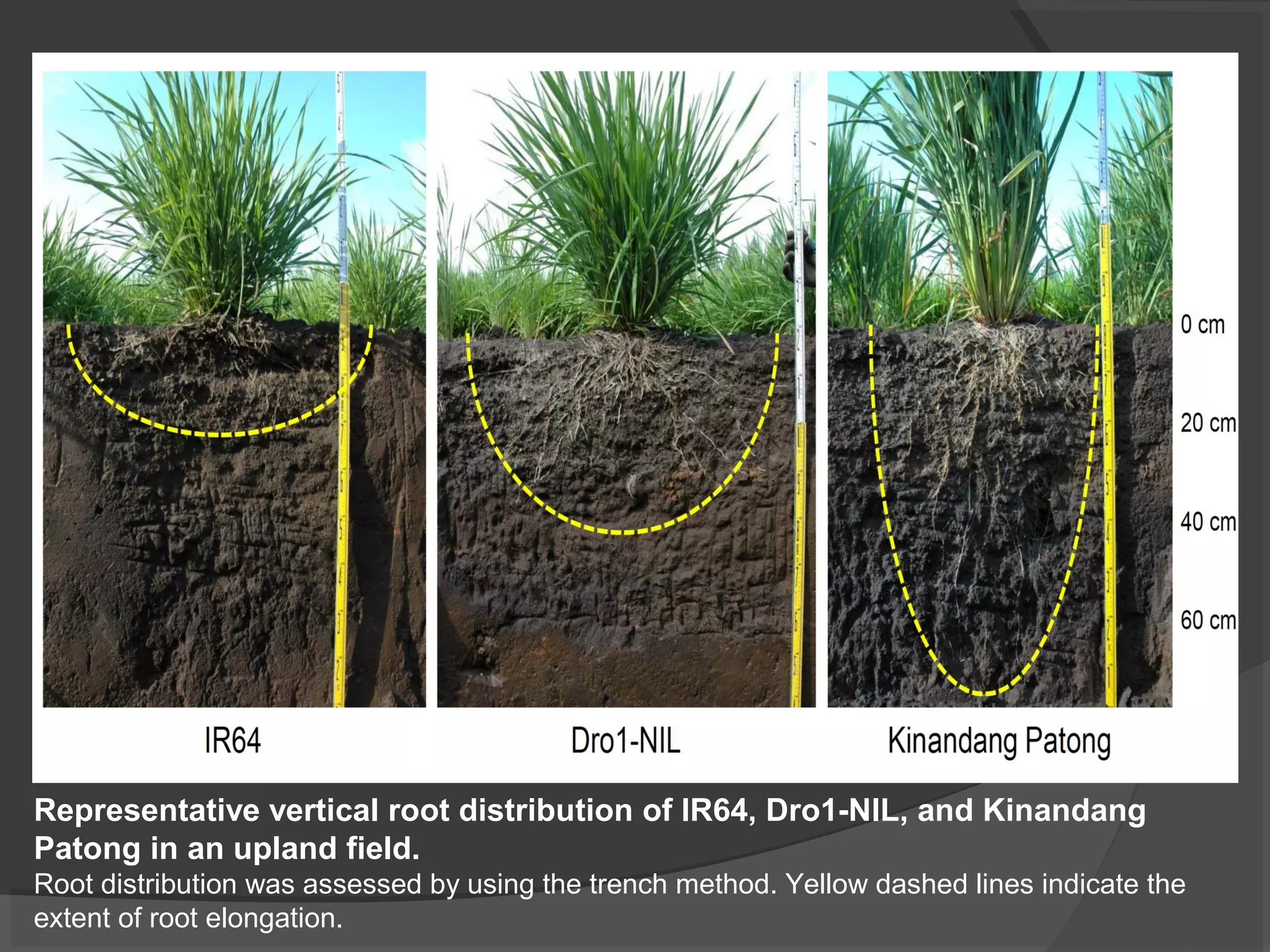
Representative vertical root distribution of IR64, Dro1-NIL, and Kinandang
Patong in an upland field.
Root distribution was assessed by using the trench method. Yellow dashed lines indicate the
extent of root elongation.
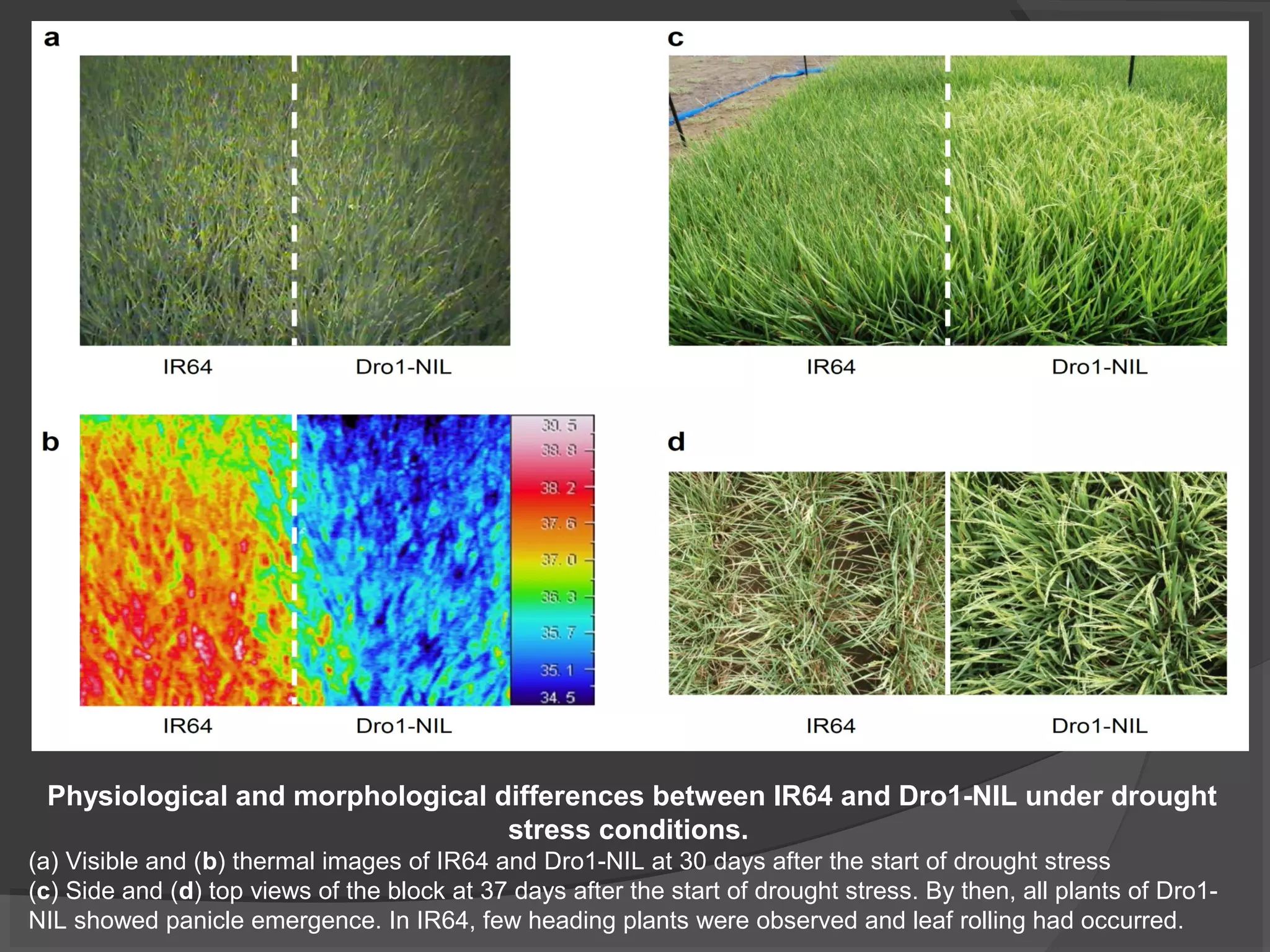
Physiological and morphological differences between IR64 and Dro1-NIL under drought
stress conditions.
(a) Visible and (b) thermal images of IR64 and Dro1-NIL at 30 days after the start of drought stress
(c) Side and (d) top views of the block at 37 days after the start of drought stress. By then, all plants of Dro1-
NIL showed panicle emergence. In IR64, few heading plants were observed and leaf rolling had occurred.
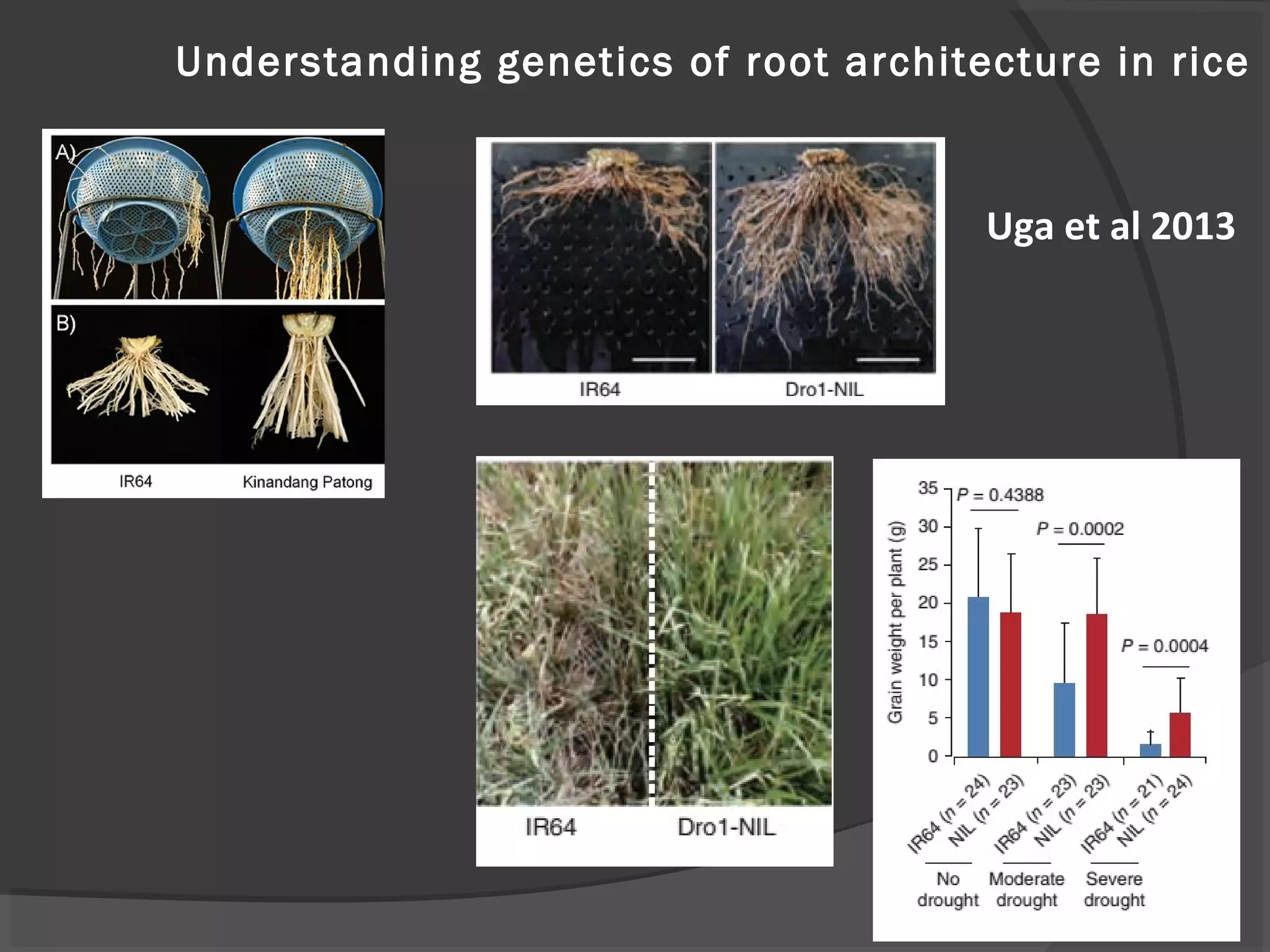
Understanding genetics of root architecture in rice
Uga et al 2013
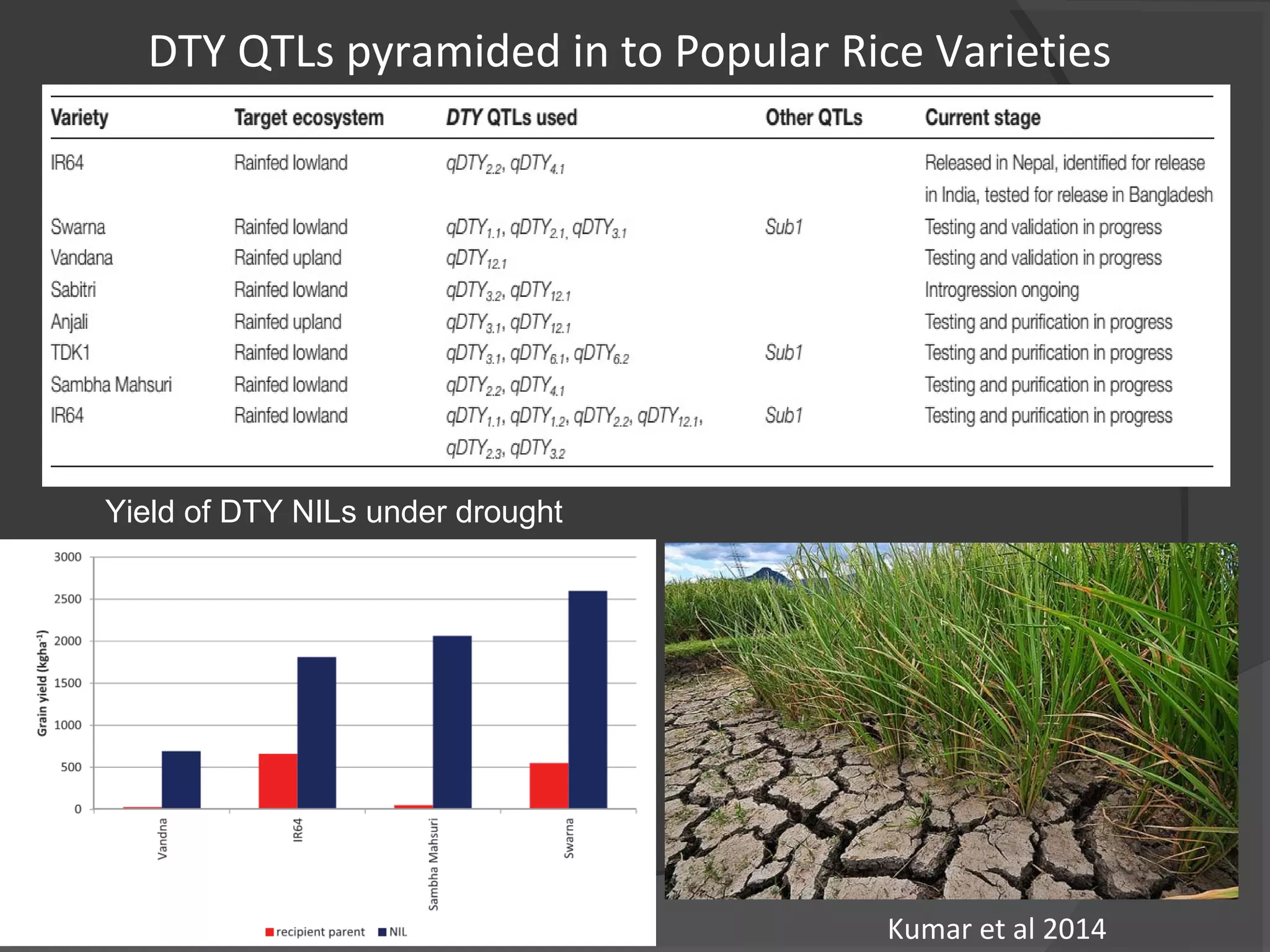
DTY QTLs pyramided in to Popular Rice Varieties
Kumar et al 2014
Yield of DTY NILs under drought
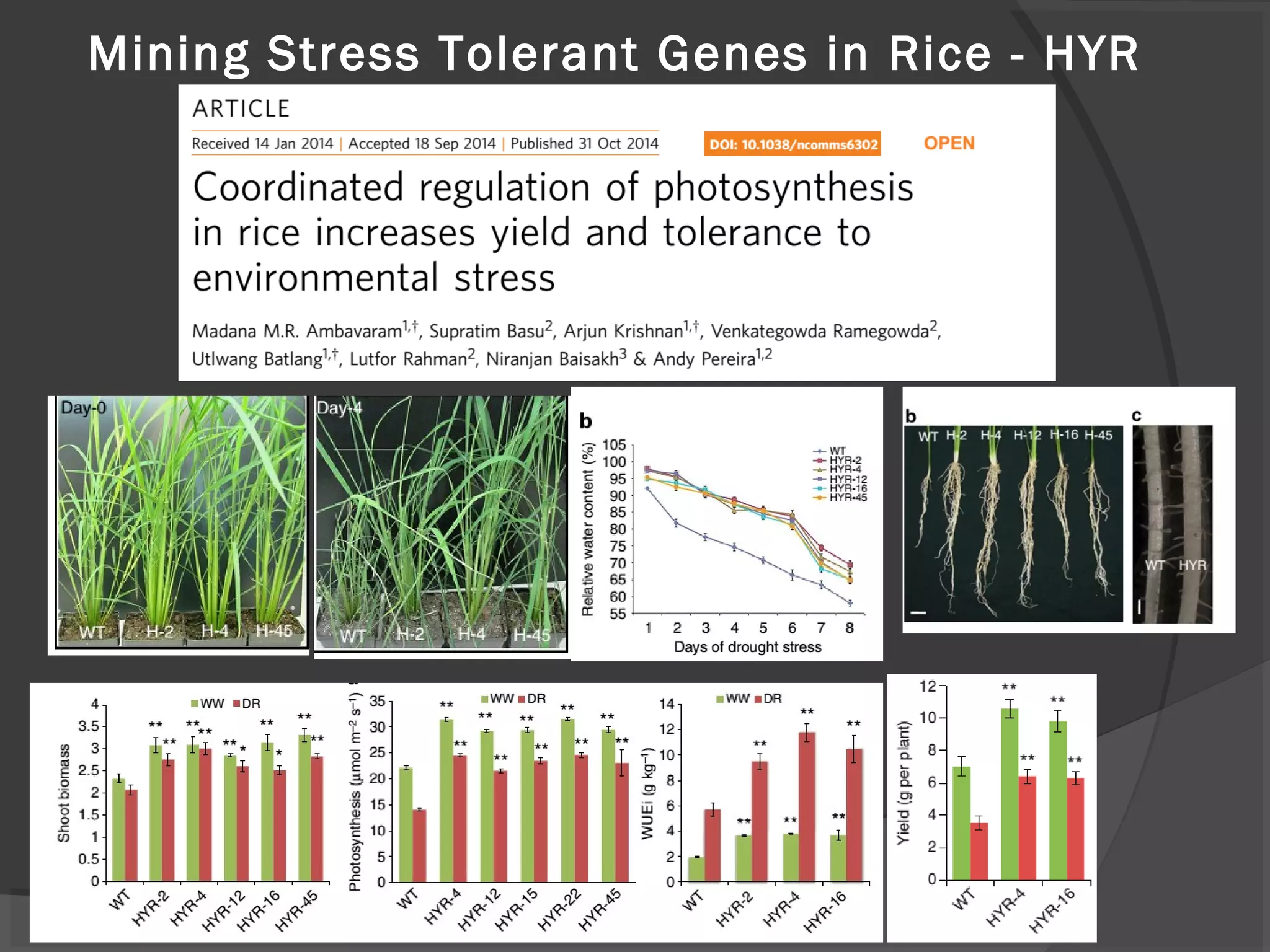
Mining Stress Tolerant Genes in Rice - HYR
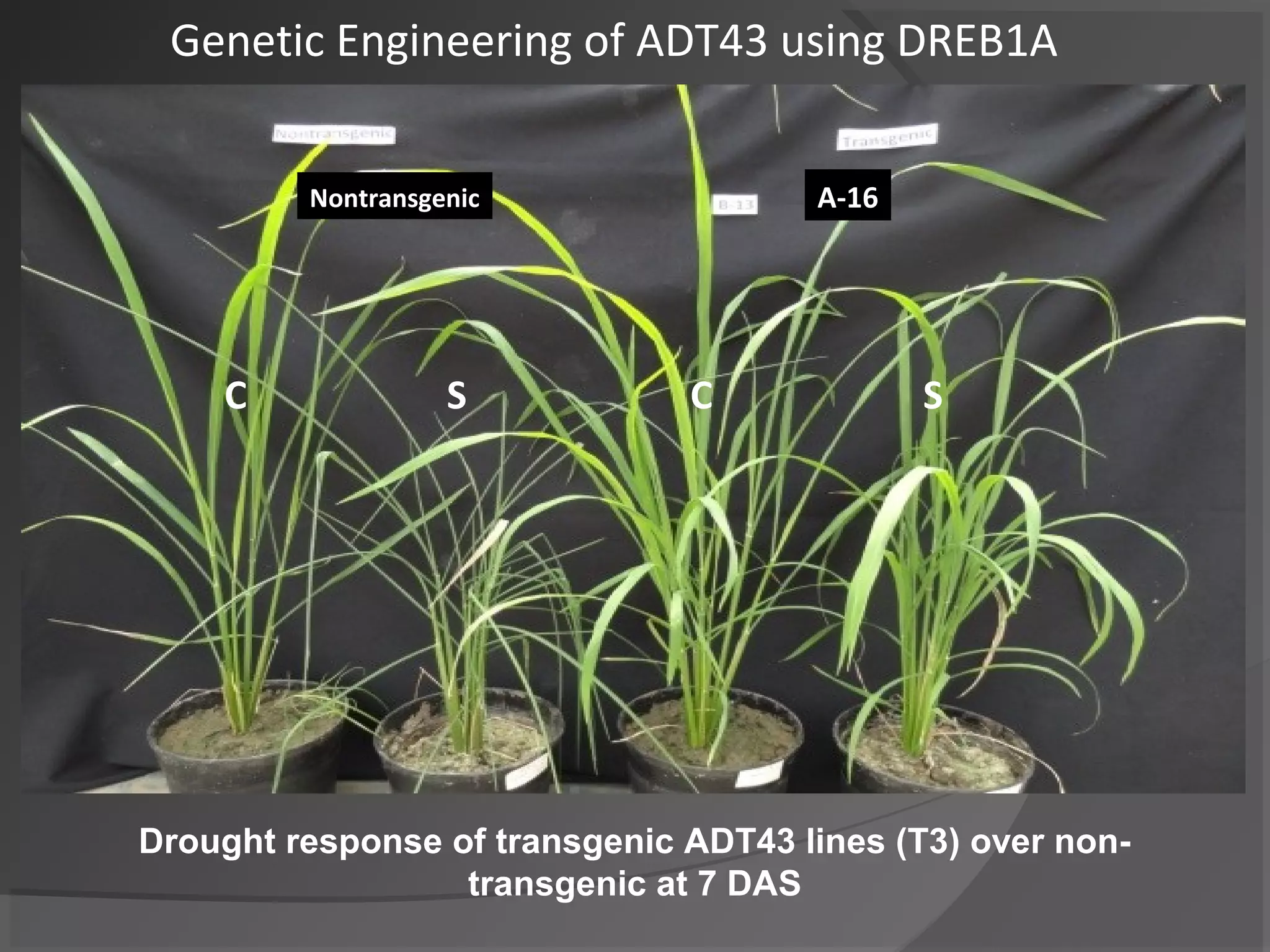
Nontransgenic A-16
CC SS
Drought response of transgenic ADT43 lines (T3) over non-
transgenic at 7 DAS
Genetic Engineering of ADT43 using DREB1A
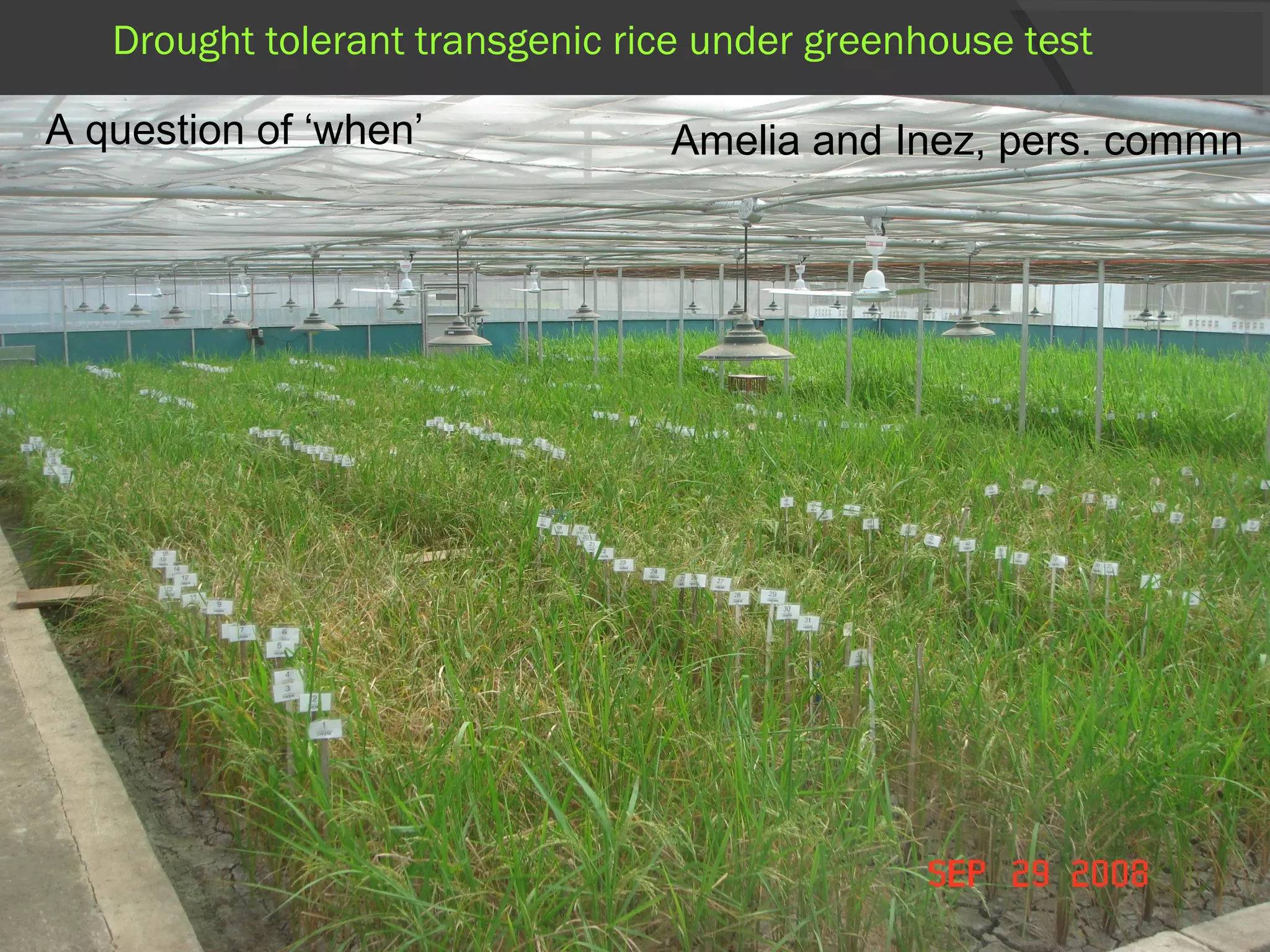
Drought tolerant transgenic rice under greenhouse test
Amelia and Inez, pers. commnA question of ‘when’
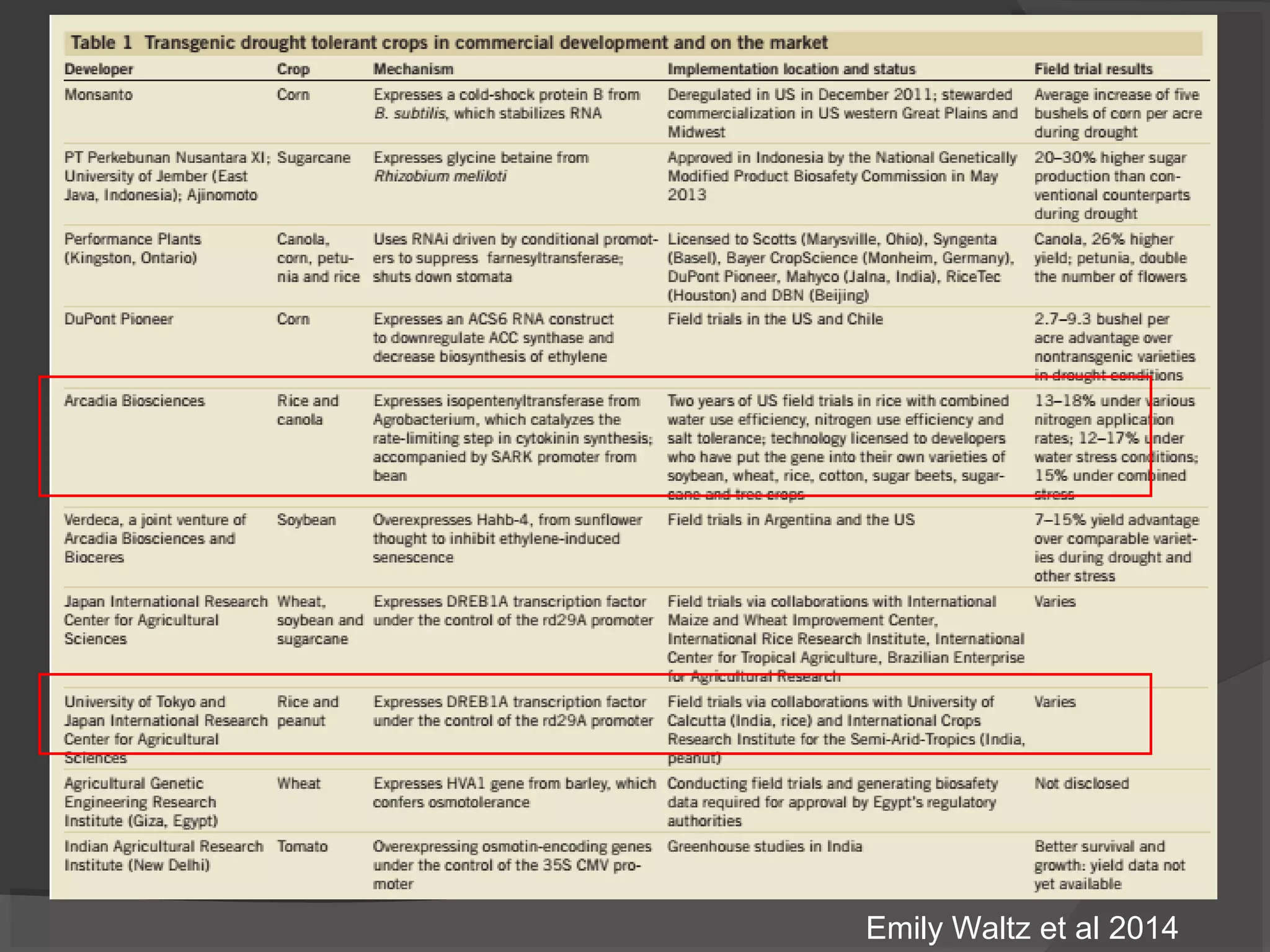
Emily Waltz et al 2014
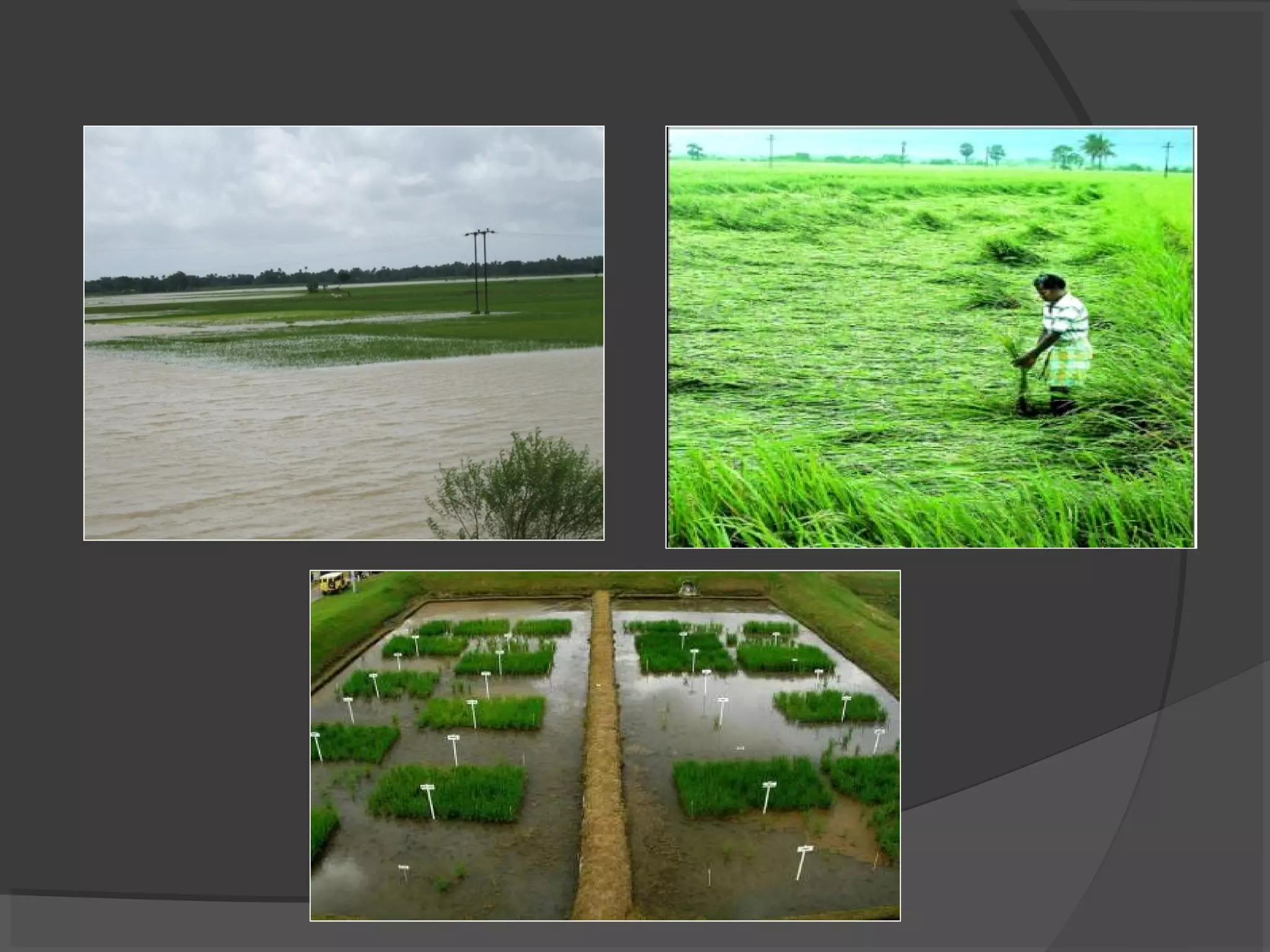
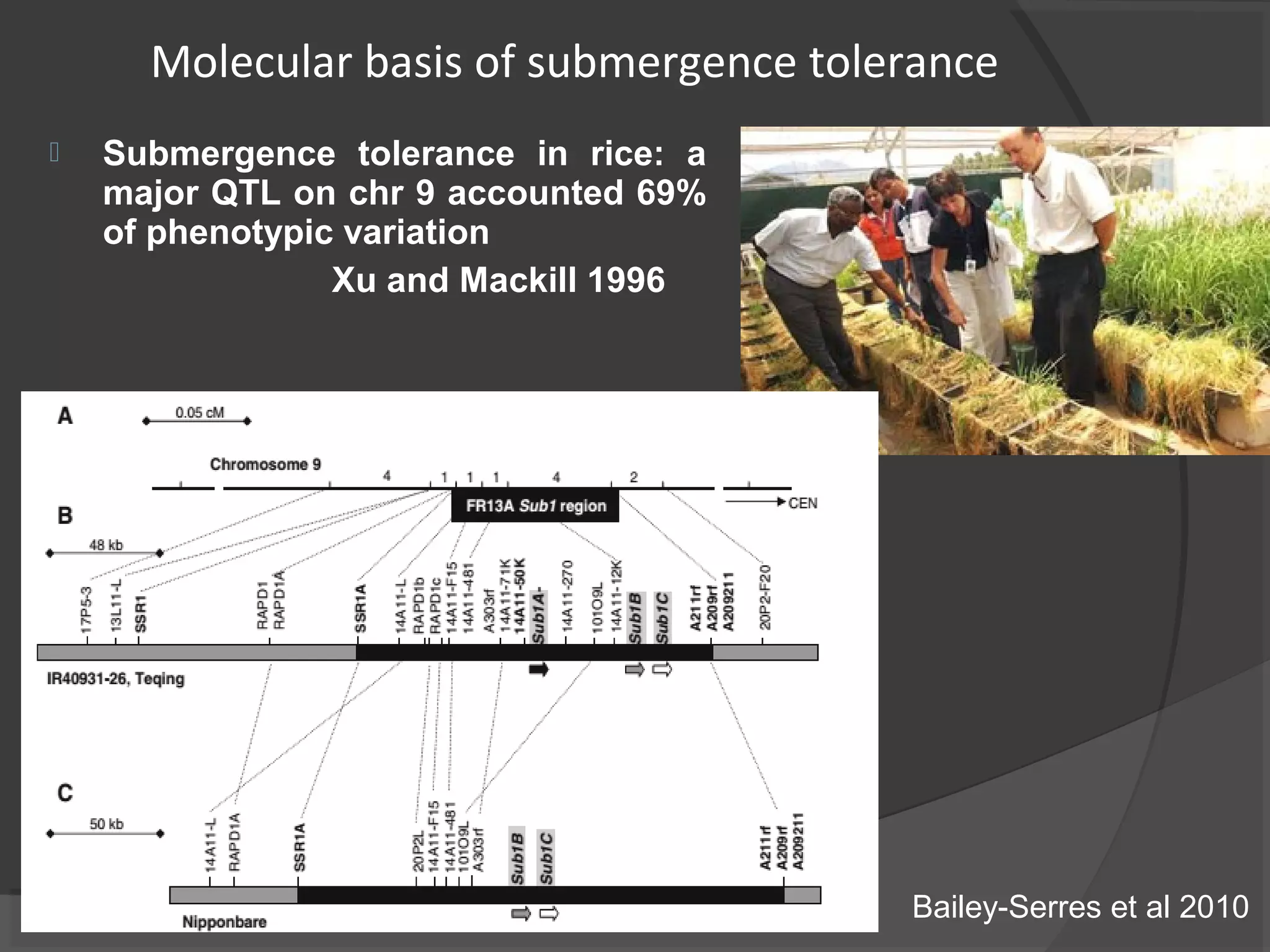
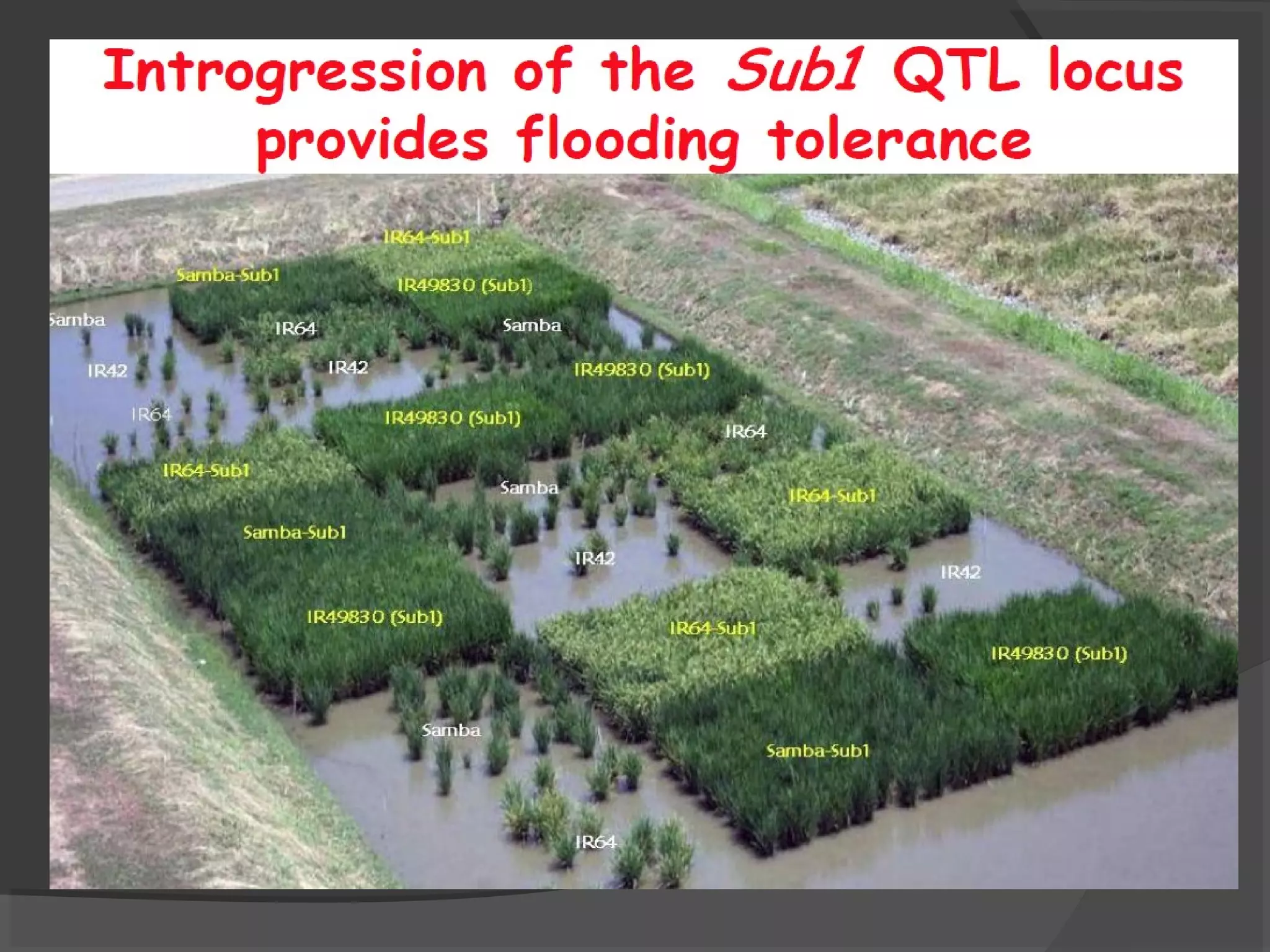
 Submergence tolerance in rice: a
major QTL on chr 9 accounted 69%
of phenotypic variation
Xu and Mackill 1996
Molecular basis of submergence tolerance
Bailey-Serres et al 2010
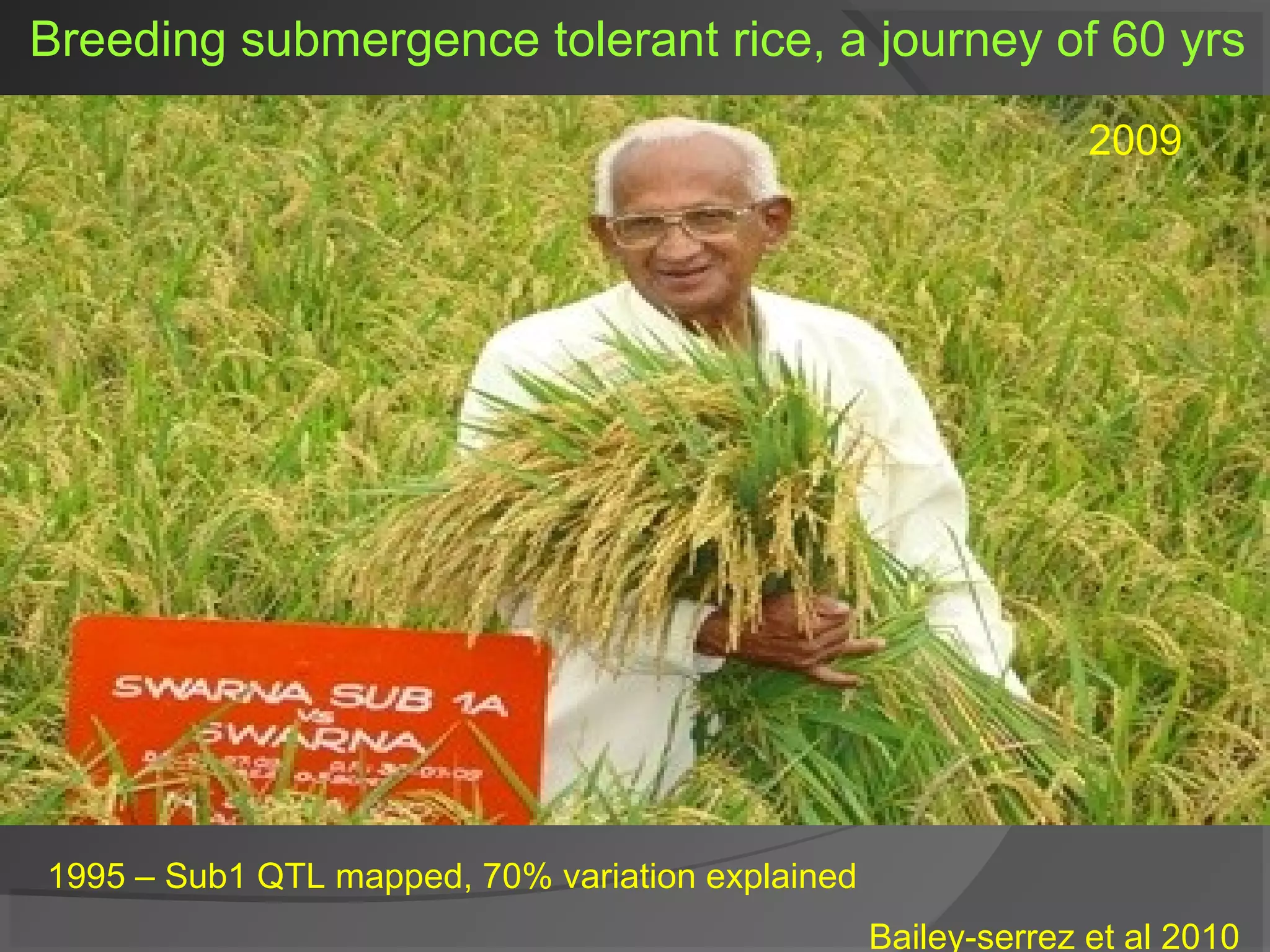
Breeding submergence tolerant rice, a journey of 60 yrs
Bailey-serrez et al 2010
1995 – Sub1 QTL mapped, 70% variation explained
2009
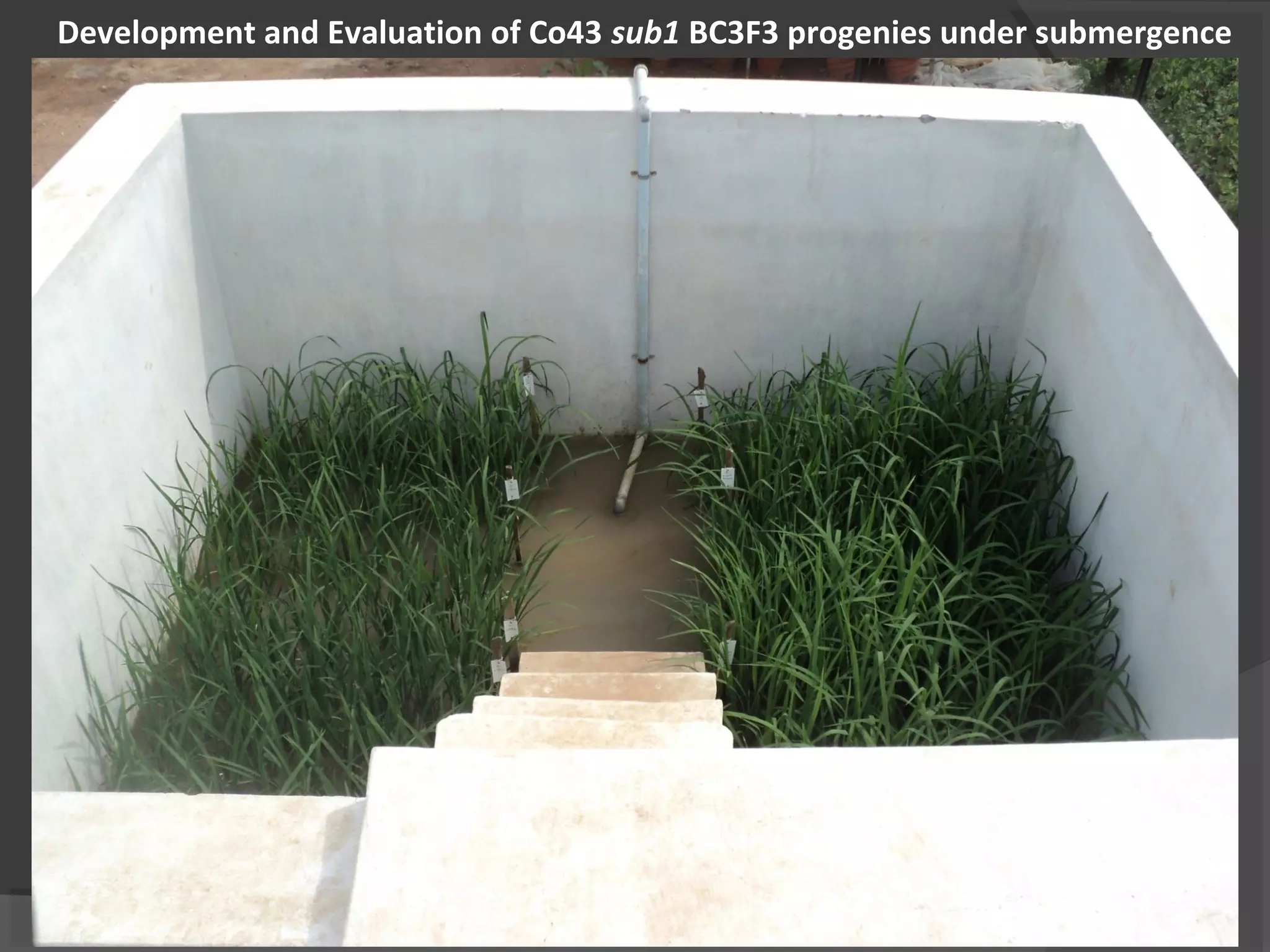
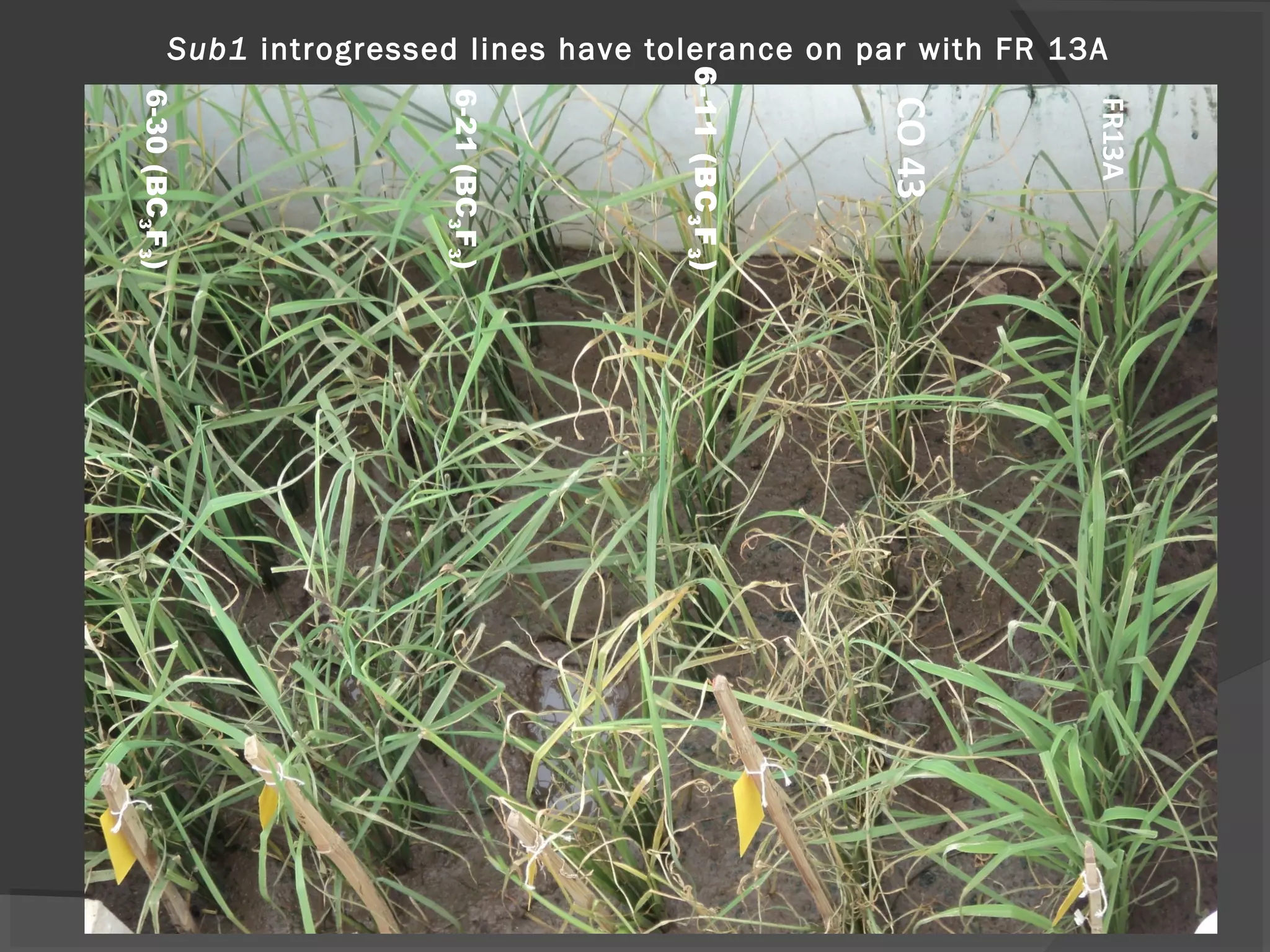
Development and Evaluation of Co43 sub1 BC3F3 progenies under submergence
FR13A
CO43
6-11(BC3F3)
6-21(BC3F3)
6-30(BC3F3)
Sub1 introgressed lines have tolerance on par with FR 13A
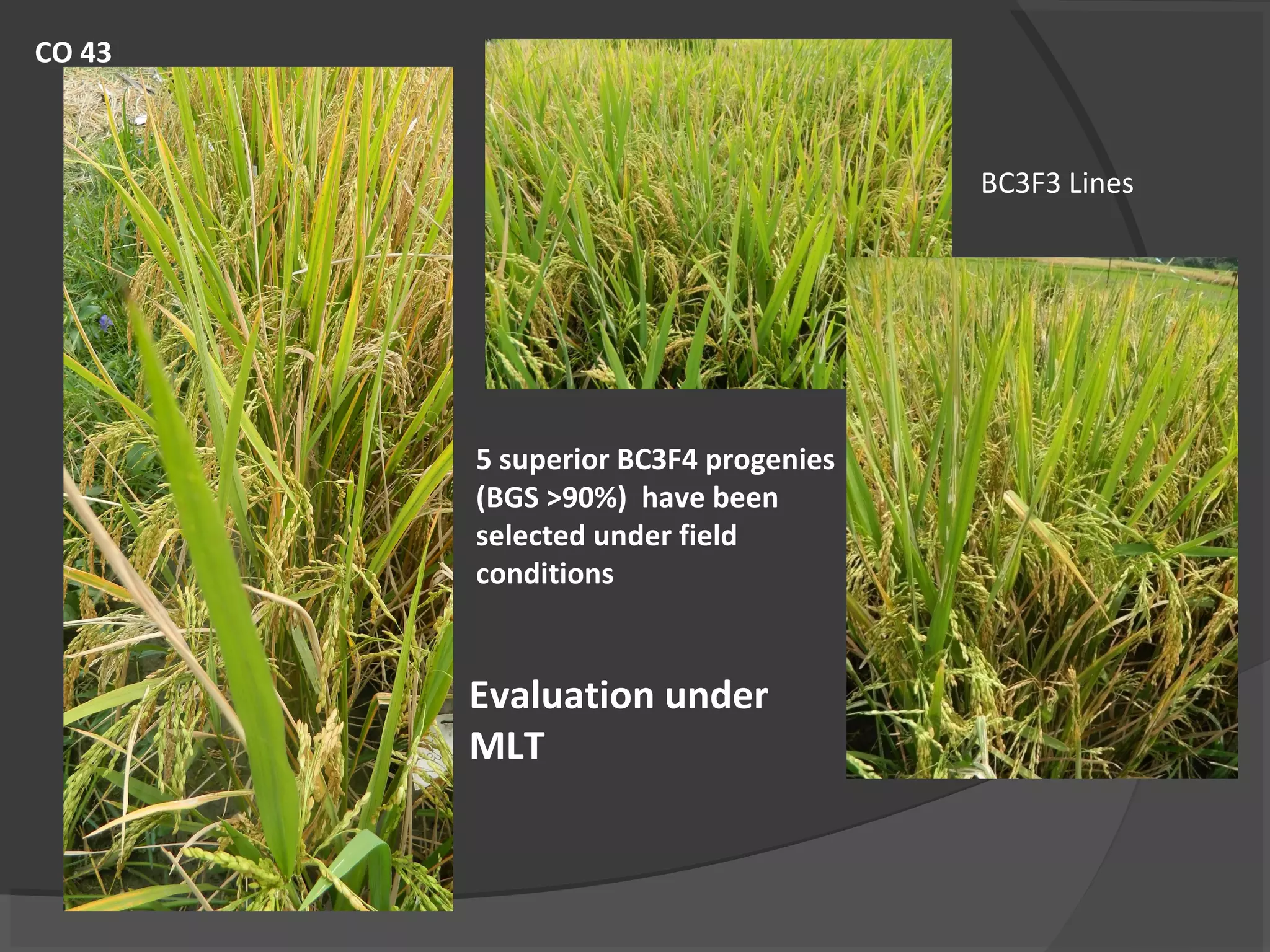
CO 43
BC3F3 Lines
5 superior BC3F4 progenies
(BGS >90%) have been
selected under field
conditions
Evaluation under
MLT
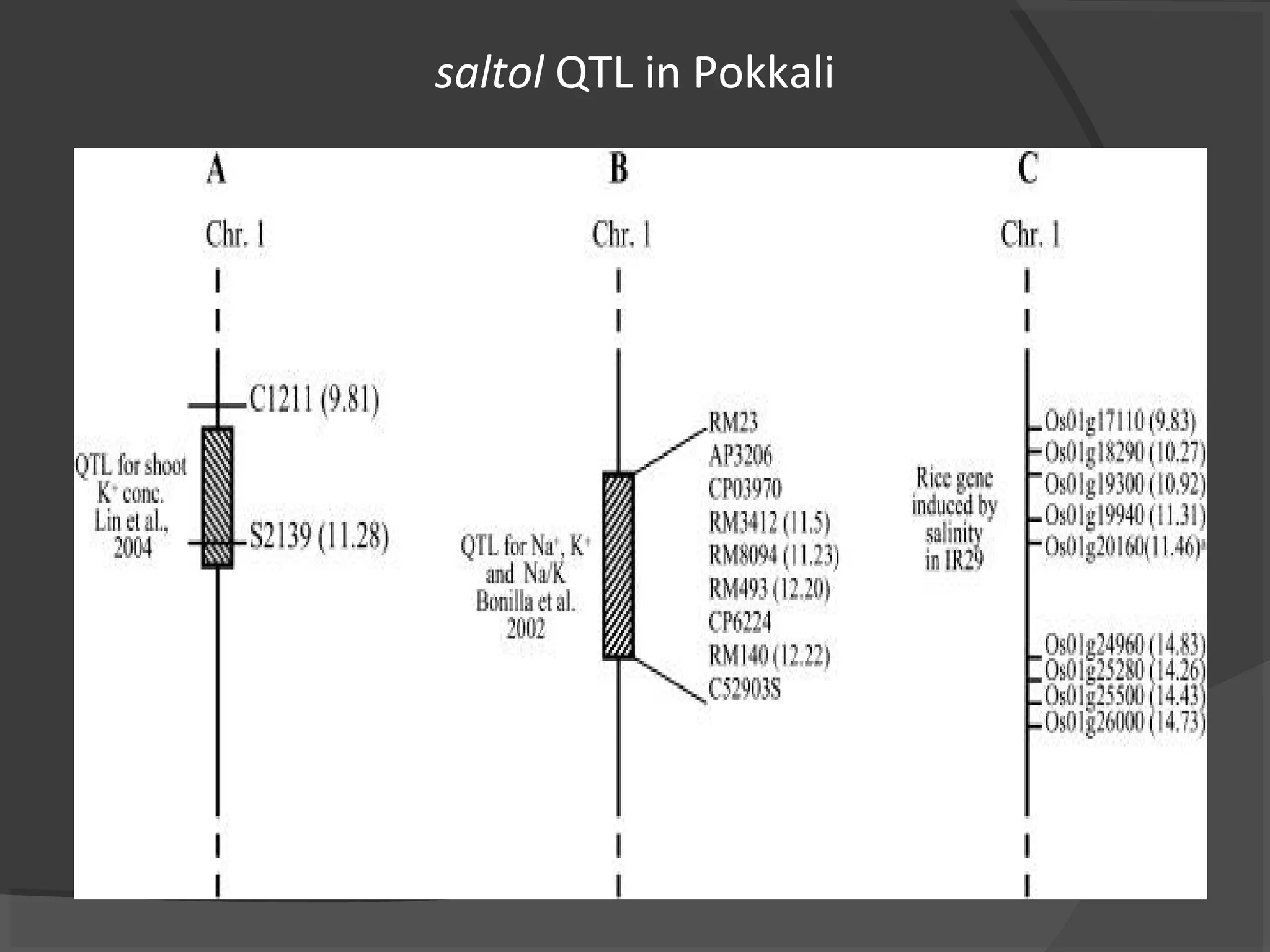
saltol QTL in Pokkali
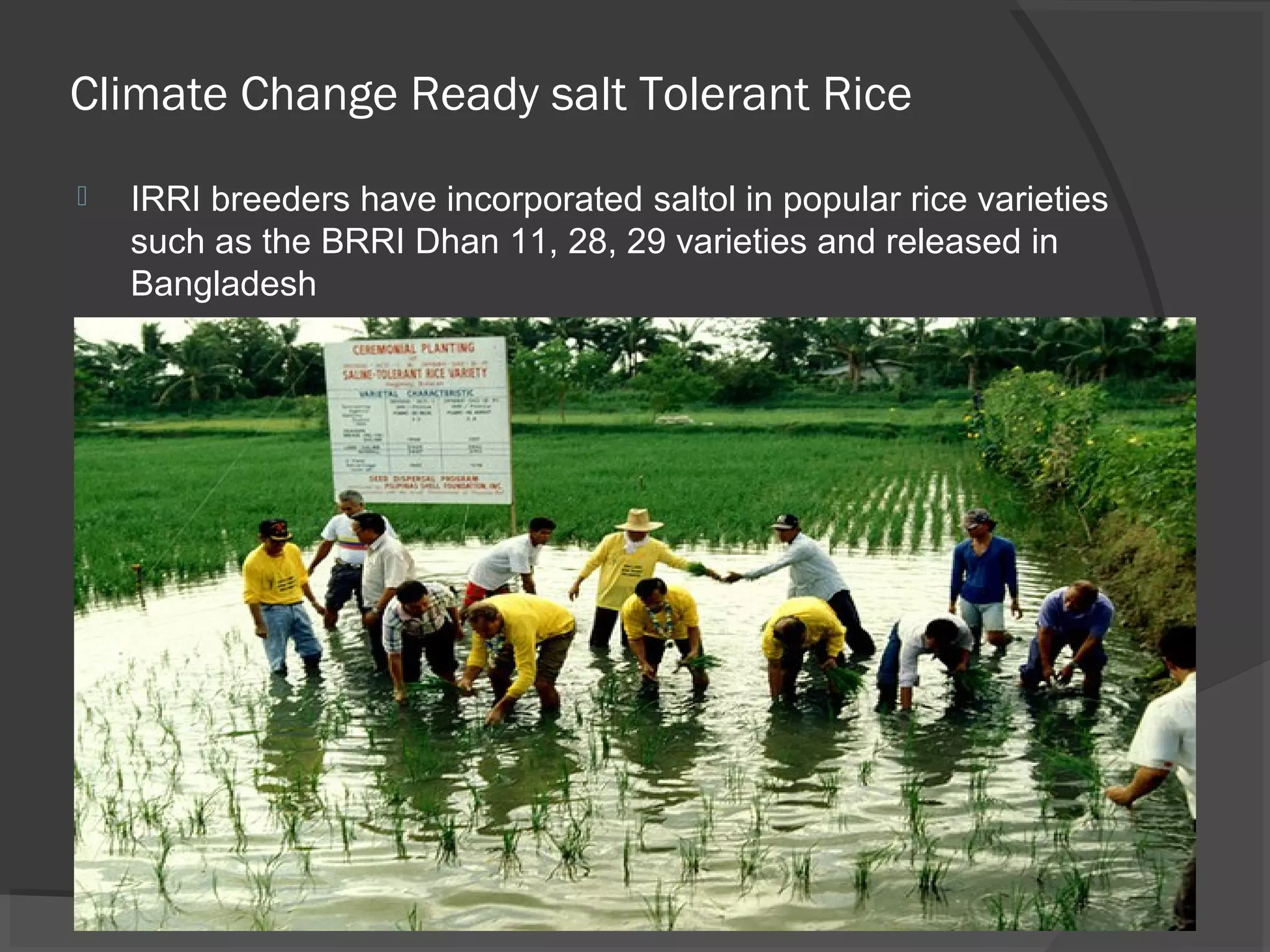
Climate Change Ready salt Tolerant Rice
 IRRI breeders have incorporated saltol in popular rice varieties
such as the BRRI Dhan 11, 28, 29 varieties and released in
Bangladesh
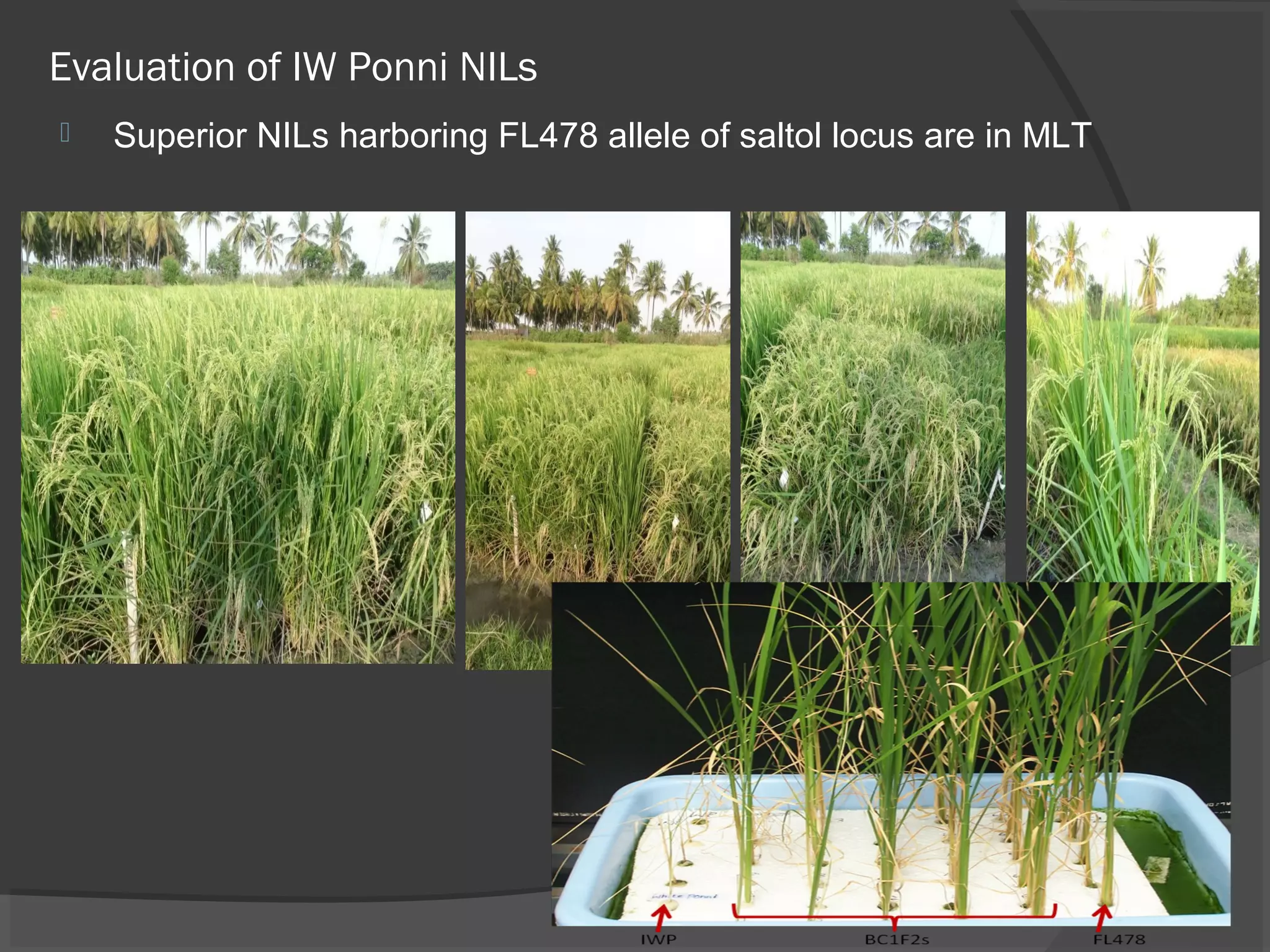
Evaluation of IW Ponni NILs
 Superior NILs harboring FL478 allele of saltol locus are in MLT
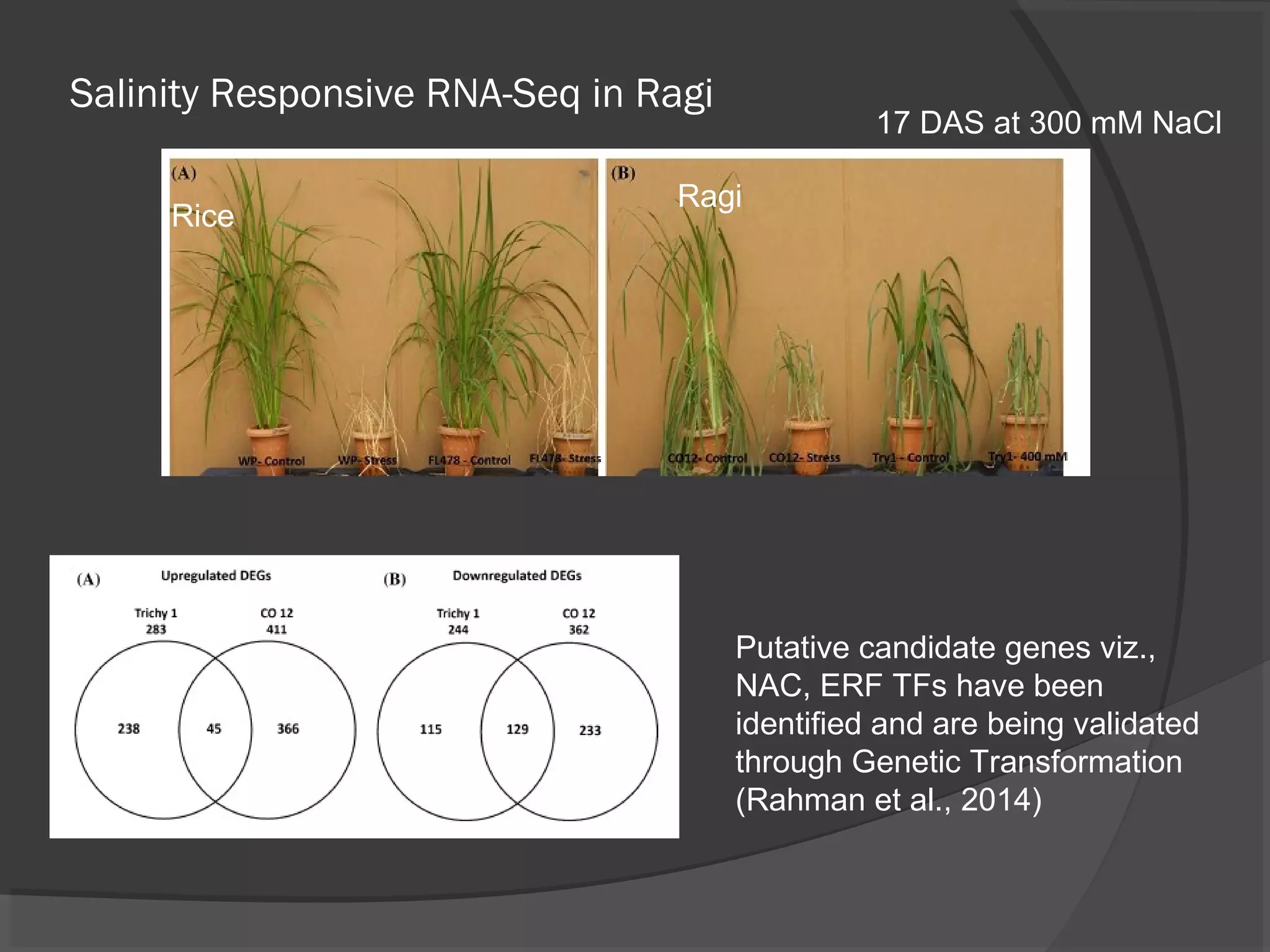
Salinity Responsive RNA-Seq in Ragi
Rice
Ragi
17 DAS at 300 mM NaCl
Putative candidate genes viz.,
NAC, ERF TFs have been
identified and are being validated
through Genetic Transformation
(Rahman et al., 2014)
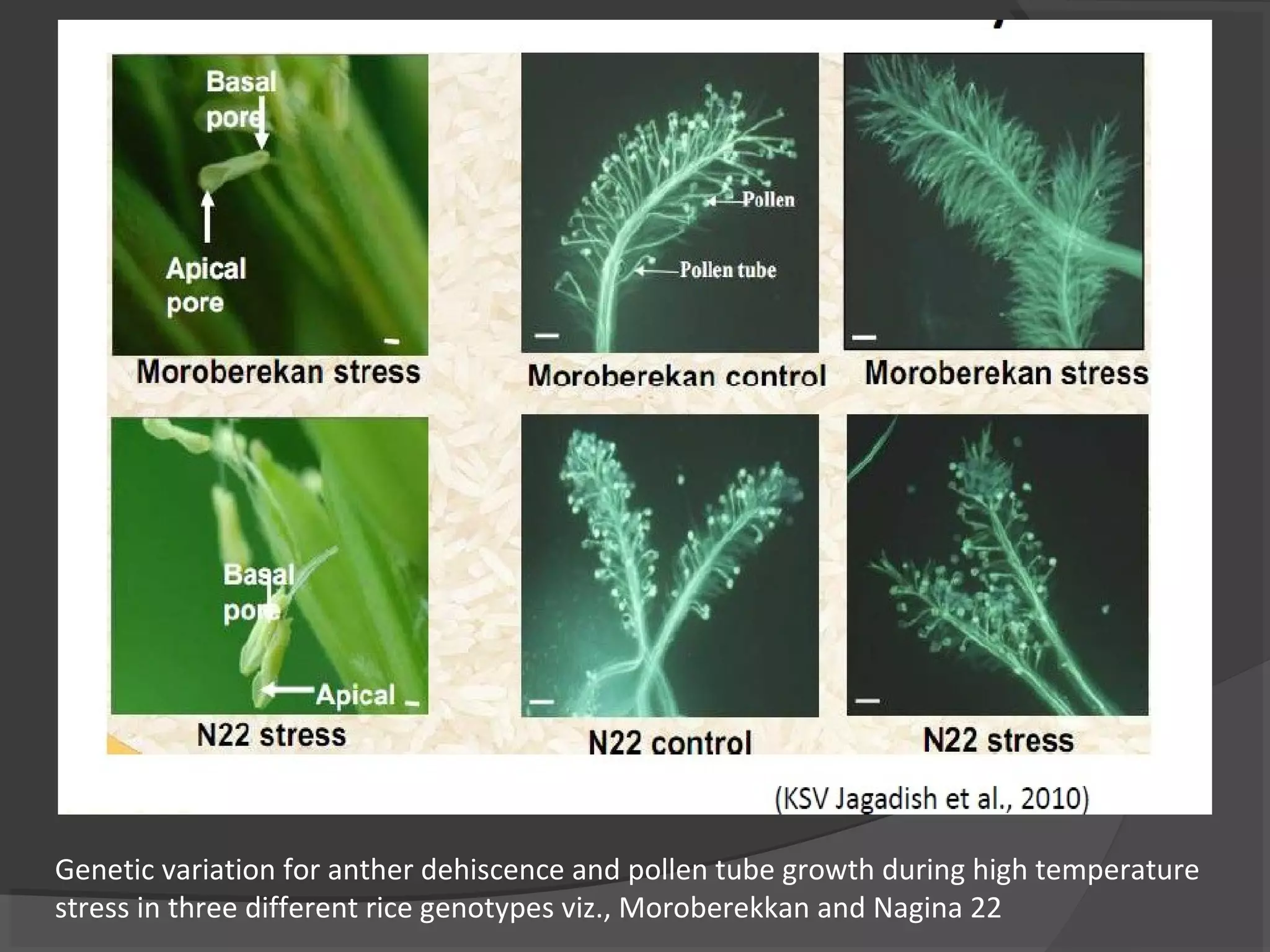
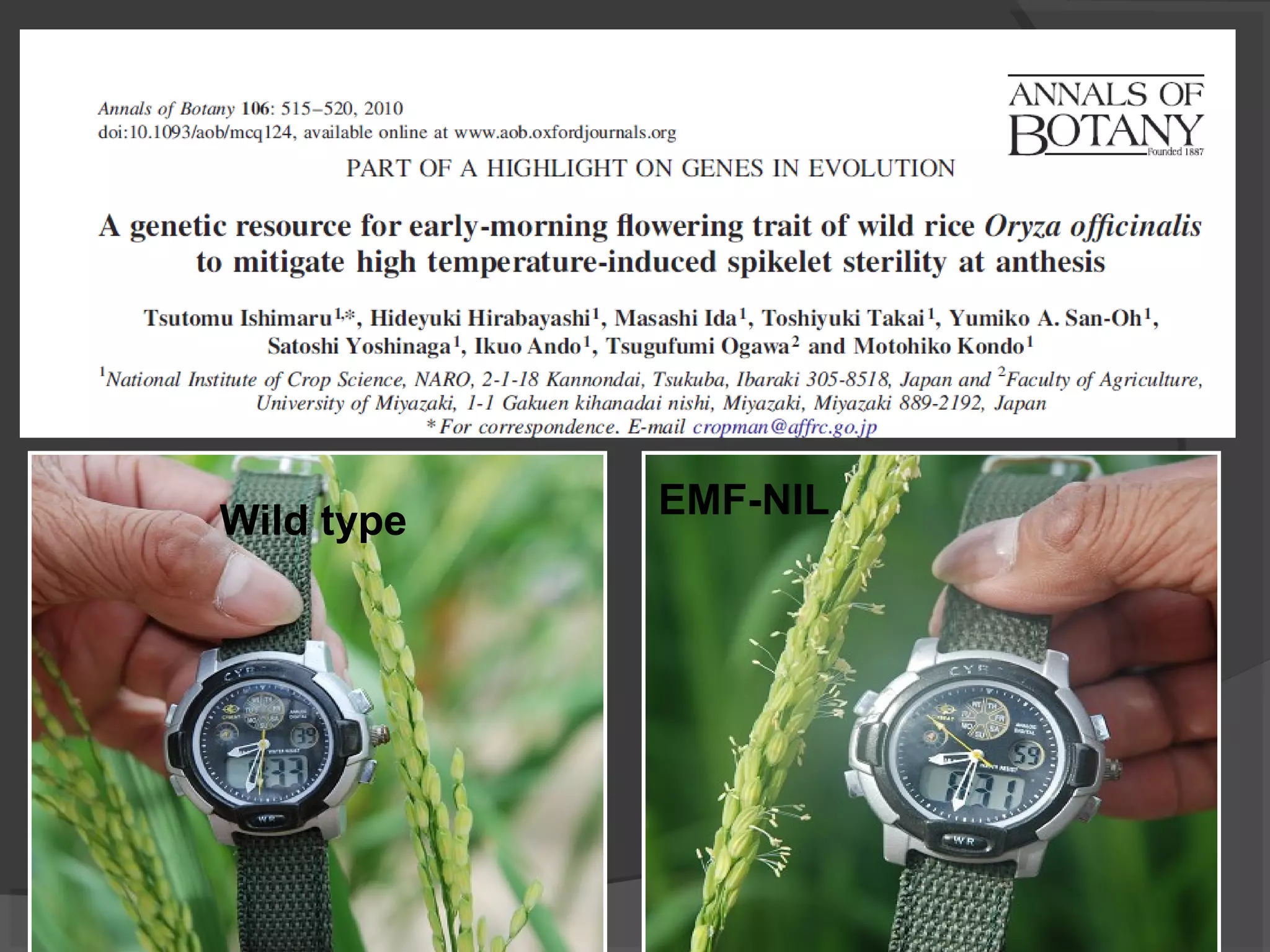
Genetic variation for anther dehiscence and pollen tube growth during high temperature
stress in three different rice genotypes viz., Moroberekkan and Nagina 22
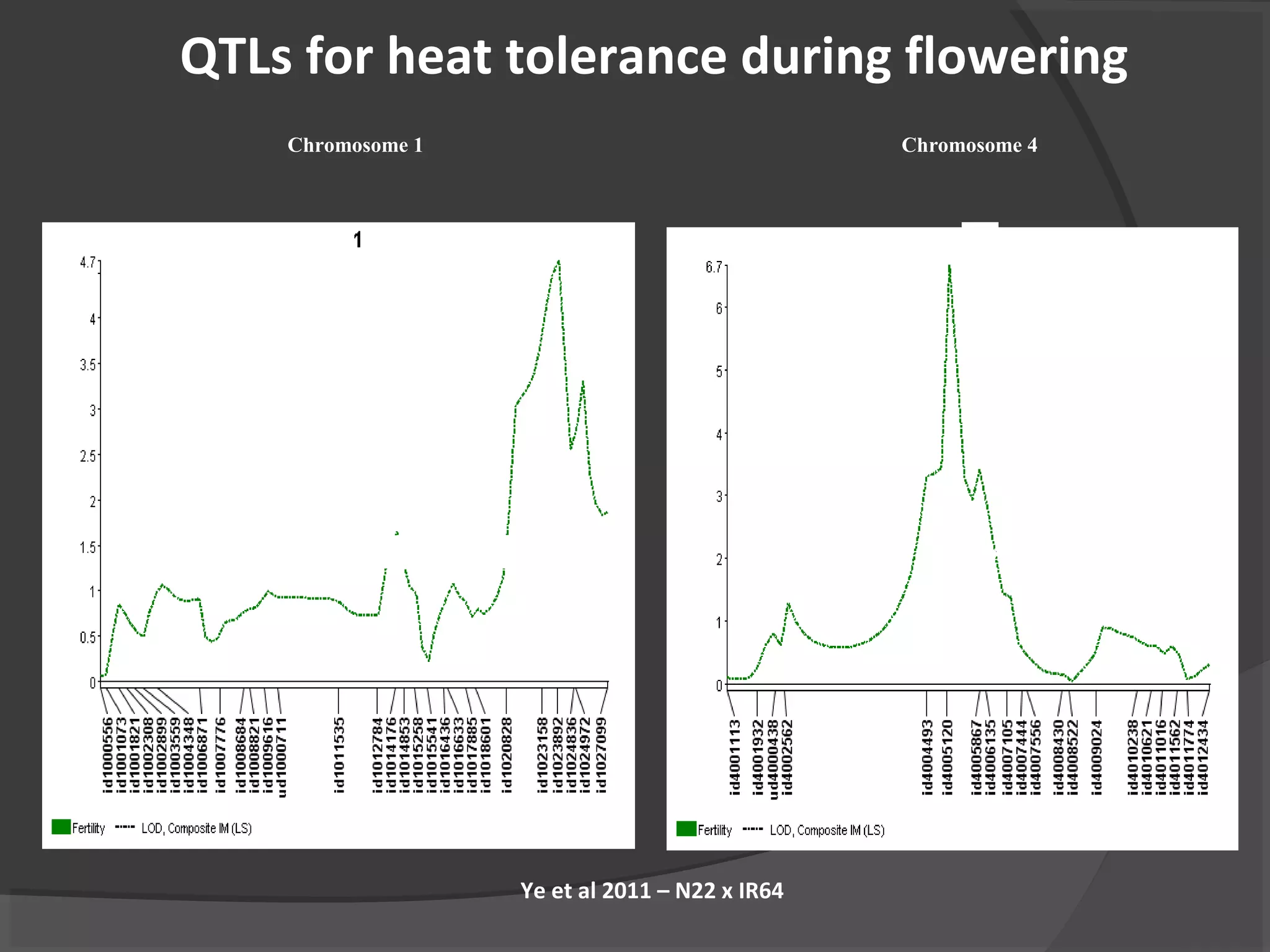
Chromosome 1 Chromosome 4
Chromosome 1
qHTSF1.1
Chromosome 1
qHTSF4.1
Chromosome 4
QTLs for heat tolerance during flowering
Ye et al 2011 – N22 x IR64
Wild type EMF-NIL
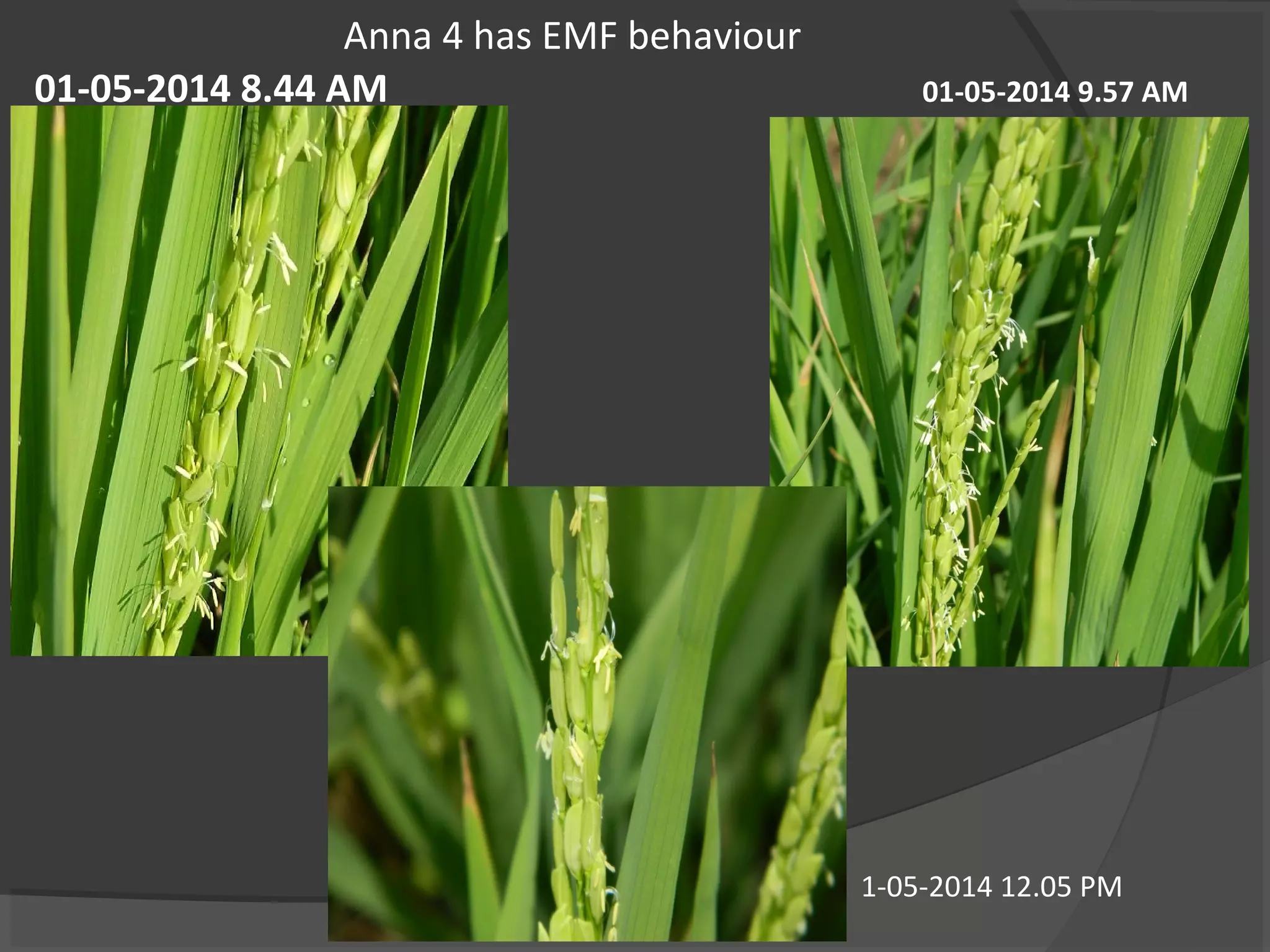
01-05-2014 8.44 AM
Anna 4 has EMF behaviour
01-05-2014 9.57 AM
1-05-2014 12.05 PM
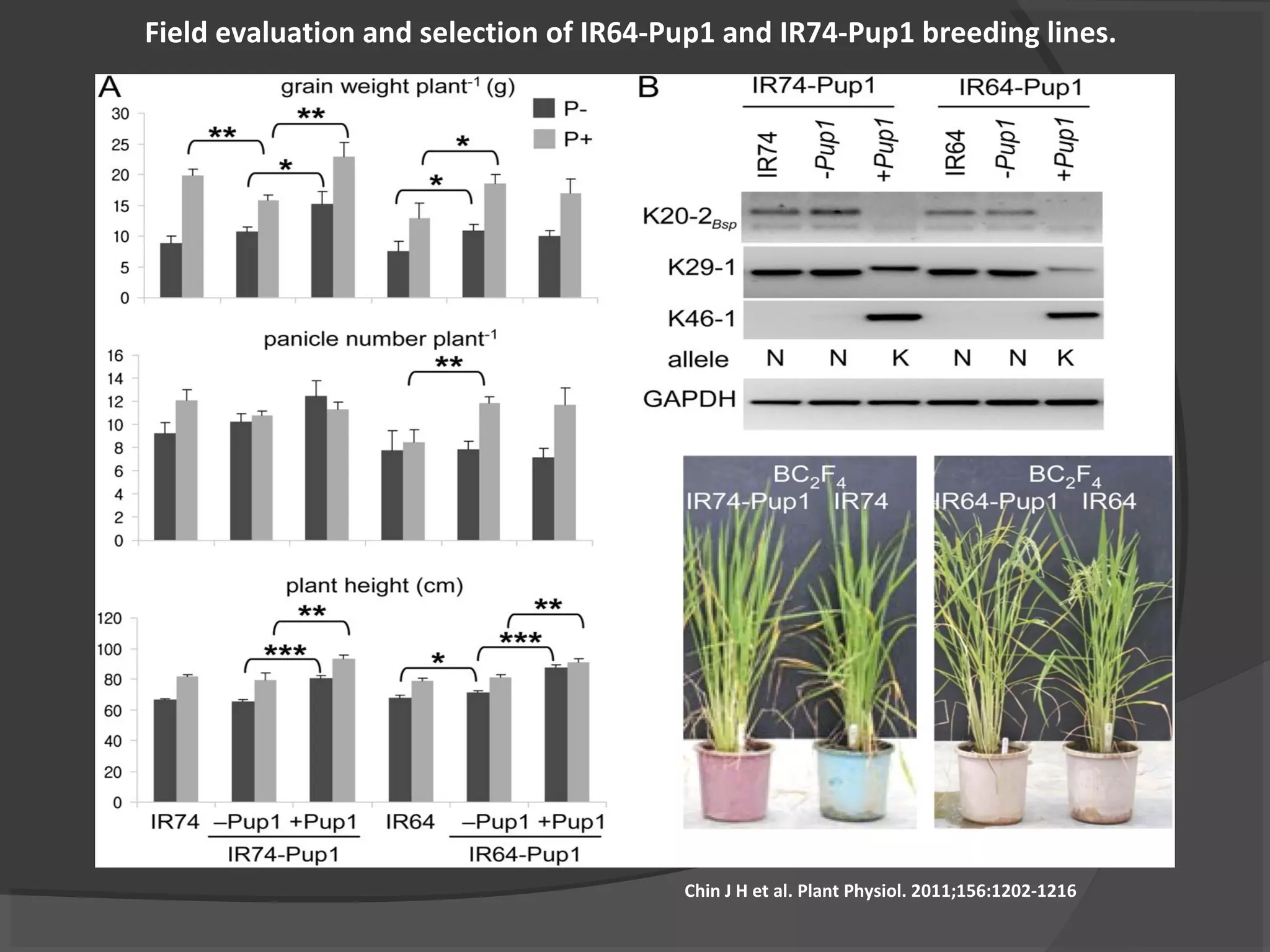
Field evaluation and selection of IR64-Pup1 and IR74-Pup1 breeding lines.
Chin J H et al. Plant Physiol. 2011;156:1202-1216
Resilient crop varieties
Thank you

Genomics Assisted Breeding for Resilient Rice: Progress and Prospects

  • 1.
    Genomics Assisted Breedingfor Resilient Rice: Progress and Prospects R. Chandra Babu Center for Plant Molecular Biology and Biotechnology Tamil Nadu Agricultural University Coimbatore-641 003, India Email: chandrarc2000@yahoo.com
  • 2.
    By 2050 -Additional 2 billion people Global food production has to be doubled Second Green Revolution Ray et al 2013
  • 3.
    Challenges  Declining naturalresources viz., land, water  Climate change induced drought, flooding, heat waves  Short growing duration and yield plateau  Less/infertile/problems soils such as salinity  Environmental sustenance: via high RUE; WUE, NUE, Pn, .. Biotic / Abiotic constraints Increasing yield potential and reducing the gap between potential and realized yield is the most crucial
  • 4.
    Gaudin et al2013 40% of rice area (154 Mha) is rainfed, where yields are low due to drought 23 Mha in Asia is drought prone, home for 3.3 billion, where 90% of rice is produced and consumed as staple food
  • 5.
  • 6.
  • 7.
  • 8.
    Physiological components ofdrought resistance Nguyen et al 1997 Escape: shorter growth duration/early maturity Avoidance: small plant size, deep root, thick cuticle Tolerance: osmotic adjustment, dehydration tolerance Desiccation tolerance: protoplasmic dehydration (resurrection) Yield = Water use (T) x WUE (P/T) x HI Passioura 2006
  • 9.
    CT9993 IR62266 CT9993IR62266 Babu et al 2001 Variation for root traits
  • 10.
    0 10 20 30 40 50 60 70 80 90 100 0 20 4060 80 100 120 140 160 180 minutes RWC(%) Time to reach 70% RWC with wax = 35 - 60 min without wax = 15 - 30 min +wax   CT9993 -wax   IR62266 +wax (143 µg dm-2 ) -wax Effect of cuticle wax on non-stomatal water loss (217 µg dm-2 ) Variation for leaf cuticle Srinivasan et al 2008
  • 11.
    CT9993 IR62266 Babu etal 2001 Variation for OA
  • 13.
    RWC (%) 66 Relativebiomass (%) 45 Relative yield (%) 11 Secondary traits and yield under stress Babu et al 2003
  • 14.
    Nguyen et al2004 Integration of physiology in breeding using genomics
  • 15.
    O’ Toole 2004 (Coimbatore,India) (Coimbatore, India) (Coimbatore, India) (Coimbatore, India) Yield under stress in Bala/Azucena RI lines (Paramakudi, India) 3 4 9 CT9993/IR62266 DH lines
  • 16.
  • 17.
    IR62266 (recurrent parent) Lowlandhigh yielding (6 t/ha) indica ecotype with shallow and thin root system but has capacity for osmotic adjustment CT9993 IR62266
  • 18.
    Particulars Trial 1 Coimbatore Trial 2 Paramakudi Elevation(meters above sea level) 427 40 Latitude & Longitude 11o N, 77o E 9o N, 70o E Soil texture Clay Sandy clay Soil pH 8.4 8.1 Characterization of stress Non stress Moderate Timing of start of stress (days after emergence) - 86 Duration of the stress period (days) - 16 Rainfall during the stress period (mm) - 3 Number of rainy days during stress period - 1 Rainfall during crop period (mm) 137 486 Trial 2 Population 1: IR62266 x Norungan RI lines
  • 19.
    Trait Trial Chr Nearest marker Peak position (cM)LOD R2 (% ) Additive effect Days to 50% flowering – (R) 2 6 RM585 78.31 7.11 12.95 - 3.63 Days to 50% flowering – (R) 2 6 RM204 82.41 8.26 14.84 - 3.89 Days to 50% flowering – (R) 2 6 RM197 89.91 8.30 16.39 - 4.12 Plant height – (R) 2 1 RM3520 14.01 27.01 72.72 - 18.33 Grain yield – (R) 2 1 RM3520 22.01 3.02 10.44 - 252.24 Grain yield – (R) 2 6 RM197 91.91 3.68 6.88 222.83 Grain yield – (R) 2 6 RM217 101.41 3.46 7.89 241.43 Relative grain yield 2 6 RM585 78.31 4.45 8.06 8.46 Relative grain yield 2 6 RM204 82.41 5.00 9.23 9.10 Relative grain yield 2 6 RM197 87.91 4.89 9.75 9.41 Relative grain yield 2 10 RM5471 12.01 3.47 13.24 - 15.74 Spikelet fertility – (R) 2 6 RM585 78.31 4.80 8.01 3.15 Spikelet fertility – (R) 2 6 RM204 82.41 4.99 8.38 3.26 Spikelet fertility – (R) 2 6 RM197 89.91 5.04 9.23 3.45 Spikelet fertility – (R) 2 10 RM5471 16.01 18.70 46.83 20.04 Above-ground biomass – (R) 2 1 RM3520 20.01 10.42 30.65 - 1345.4 Above-ground biomass – (R) 2 4 RM5749 73.7 3.11 4.89 - 546.56 Above-ground biomass – (R) 2 4 RM5424 79.6 4.49 6.32 - 621.87 Above-ground biomass – (R) 2 4 RM3524 101.61 3.97 8.21 - 705.82 Harvest index – (R) 2 6 RM585 78.31 9.02 15.85 0.04 Harvest index – (R) 2 6 RM204 82.41 10.17 17.78 0.04 Harvest index – (R) 2 6 RM197 87.91 9.59 18.58 0.04 QTLs for phenology and production traits in rainfed TPE
  • 20.
    1 2 34 5 6 7 8 RM585 – RM204 – RM197 1. Days to 50 per cent flowering 2. Spikelet fertility 3. Harvest index 4. Relative grain yield 5. Panicle length RM204 – RM197 6. Straw yield RM197 – RM217 7. Yield/plant 8. Grain yield - kg/ha Co-location of QTLs under rainfed condition in TPE Suji et al 2012, Field Crops Research
  • 21.
    Suji et al2012 (IR62266 x Norungan RI lines) Chromosome 6 Reena, 2009 (Apo x Moroberekan) Bernier et al., 2007 (Vandana x WayRarem) Zhou et al., 2006 (Guichao2 x wild rice) Khowaja et al., 2009 (Bala x Azucena) 1 2 87 3 4 5 6 9 10 11 12 Co-location of QTLs for plant production and drought resistance traits across genetic backgrounds 1 – Days to 50% flowering, 2 – Spikelet fertility, 3 – Harvest index, 4 – Relative grain yield, 5 – Panicle length, 6 – Straw yield, 7 – Yield/plant, 8 – Grain yield 9 – Hundred grain weight, 10 – Biomass yield and panicle number 11 – Drought tolerance (seedling stage), 12 – Drought avoidance and root traits
  • 22.
    Meta-QTL for yield Mallikarjunaswamyand Sarla, 2010 Suji et al 2012 MADS box protein basic helix-loop-helix protein F-box family protein Putative AP2 domain leucine zipper-containing protein like putative cytochrome P450 sucrose synthase G protein coupled receptor-related-like WRKY17-transcription factor putative auxin-growth promoter Candidate genes
  • 23.
    Large effect qDTY6.1for yield under drought in TPE was fine-mapped from 3.0 Mb to 94 kb between the markers, RM2434 and RM6773 Muthukumar et al 2014 (submitted)Suji et al 2012
  • 24.
    Co-location of QTLsfor drought resistance in rice IR20xNootripathu RI lines Scale (cM) 0.0 20 40 60 80 100 120 140 160 180 200 McCouch et al. 2002 139.9 RM8085 RM212 RM302 RM3825143.7 135.8 Osmotic Adjustment (30) Deep root mass (25) Deep root per tiller(25)Leaf drying (22,24,28) Deep root ratio(25) Root number (36) Panicle exsertion under stress (35) Days to 50% flowering under stress (5) Shoot length (29) Plant height under stress(23,24,27,35,37) Maximum root length (29) 1000 grain weight under stress (35) RWC (26,28,35) Transpiration rate (32) Root growth rate in volume (38) Biological yield under stress (35) Panicle length under stress (23,27,35) Harvest index under stress (5,27) Stomatal conductance (32,35) Spikelet fertility under stress (27) Root volume (36,38) Grain yield under stress (23) Leaf rolling (22,28,38) Heading date under stress (31) Arvind kumar et al 2011 1 1
  • 25.
    Successful case study:MAS for root trait QTLs Azucena IR64 Babu et al 2001 Four QTLs (ch. 2, 7, 9 and 11) for root traits from Azucena IR64 NILs - IRRI, Philippines (Shen et all 2001) Kalinga III – Univ. Wales, UK & BAU, India (Steele et al 2006)
  • 26.
    Grain yield increaseof PY 84 over Kalinga III under rainfed conditions in Jharkhand (%) 0 5 10 15 20 25 30 35 40 BAU2003 GVT2003 BAU2004 GVT2004 BAU2005 GVT2006 BAU2006 GVT2007 BAU2007 GVT2008 Mean straw yield in the same trials was 27 % greater than Kalinga III Steele et al 2007
  • 27.
    PY 84 (BVK111)is the first example of a rice variety bred through MAS and COB and is a success story for use of MAS to improve a quantitative trait Ashraf 2010
  • 28.
    Candidate QTLs forMarker Assisted Selection Trait Marker interval Ch cM LOD R2 Effect Ref Basal root thickness RM 252 / RG 939 - RM 348 / RG 476 4 6.1 14.0 37.6 0.12 (C) Zhang et al TAG 2001 Yield RM 252 / RG 939 - RM 348 / RG 476 4 6.1 4.8 15.8 9.9 (C) Babu et al Crop Sci. 2003 Root pulling force RM 348/RG214 - RM 280 4 9.7 8.0 25.0 14.5 (C) Nguyen et al MGG 2004 Spikelets RM252 - RM348/RG214 4 6.1 4.5 12.1 16.5 (C) Lanceras et al Pl. Physiol. 2004 Penetrated root thickness RM242 - RM257 9 5.2 6.0 16.3 0.09 (C) Zhang et al TAG 2001 Donor: CT9993 Elite lines: IR62266 - Texas Tech Univ, & TNAU, India IR20 & IR64 - TNAU, India RD6 & KDML105 - Kasetsart Univ, Thailand Ch.9 (Jonalisa et al 2009 RG6 proc)
  • 29.
    IR20 NIL-212 NIL-297 Root morphology ofIR20 NILs developed through MAB Suji et al 2012
  • 30.
    Performance of IR20NILs under rainfed condition Suji et al. 2012
  • 31.
    S. No EntryNames GY KGH 1 IR20 1187 2 CT9993 909 3 152 1767 4 59 1764 5 354 1708 IR20 NILs for root trait QTLs developed and tested for plant production traits -2012-13 BC4F4 Entries No. of QTLs QTL 212 3 BRT, RPF and PRT 297 2 BRT and RPF 125, 172, 182 and 354 1 PRT 65 and 121 1 BRT
  • 32.
    Representative vertical rootdistribution of IR64, Dro1-NIL, and Kinandang Patong in an upland field. Root distribution was assessed by using the trench method. Yellow dashed lines indicate the extent of root elongation.
  • 33.
    Physiological and morphologicaldifferences between IR64 and Dro1-NIL under drought stress conditions. (a) Visible and (b) thermal images of IR64 and Dro1-NIL at 30 days after the start of drought stress (c) Side and (d) top views of the block at 37 days after the start of drought stress. By then, all plants of Dro1- NIL showed panicle emergence. In IR64, few heading plants were observed and leaf rolling had occurred.
  • 34.
    Understanding genetics ofroot architecture in rice Uga et al 2013
  • 35.
    DTY QTLs pyramidedin to Popular Rice Varieties Kumar et al 2014 Yield of DTY NILs under drought
  • 36.
    Mining Stress TolerantGenes in Rice - HYR
  • 37.
    Nontransgenic A-16 CC SS Droughtresponse of transgenic ADT43 lines (T3) over non- transgenic at 7 DAS Genetic Engineering of ADT43 using DREB1A
  • 38.
    Drought tolerant transgenicrice under greenhouse test Amelia and Inez, pers. commnA question of ‘when’
  • 39.
  • 41.
     Submergence tolerancein rice: a major QTL on chr 9 accounted 69% of phenotypic variation Xu and Mackill 1996 Molecular basis of submergence tolerance Bailey-Serres et al 2010
  • 43.
    Breeding submergence tolerantrice, a journey of 60 yrs Bailey-serrez et al 2010 1995 – Sub1 QTL mapped, 70% variation explained 2009
  • 44.
    Development and Evaluationof Co43 sub1 BC3F3 progenies under submergence
  • 45.
  • 46.
    CO 43 BC3F3 Lines 5superior BC3F4 progenies (BGS >90%) have been selected under field conditions Evaluation under MLT
  • 48.
  • 49.
    Climate Change Readysalt Tolerant Rice  IRRI breeders have incorporated saltol in popular rice varieties such as the BRRI Dhan 11, 28, 29 varieties and released in Bangladesh
  • 50.
    Evaluation of IWPonni NILs  Superior NILs harboring FL478 allele of saltol locus are in MLT
  • 51.
    Salinity Responsive RNA-Seqin Ragi Rice Ragi 17 DAS at 300 mM NaCl Putative candidate genes viz., NAC, ERF TFs have been identified and are being validated through Genetic Transformation (Rahman et al., 2014)
  • 52.
    Genetic variation foranther dehiscence and pollen tube growth during high temperature stress in three different rice genotypes viz., Moroberekkan and Nagina 22
  • 53.
    Chromosome 1 Chromosome4 Chromosome 1 qHTSF1.1 Chromosome 1 qHTSF4.1 Chromosome 4 QTLs for heat tolerance during flowering Ye et al 2011 – N22 x IR64
  • 54.
  • 55.
    01-05-2014 8.44 AM Anna4 has EMF behaviour 01-05-2014 9.57 AM 1-05-2014 12.05 PM
  • 56.
    Field evaluation andselection of IR64-Pup1 and IR74-Pup1 breeding lines. Chin J H et al. Plant Physiol. 2011;156:1202-1216
  • 57.
  • 58.

Editor's Notes

  • #34 (a) Visible and (b) thermal images of IR64 and Dro1-NIL at 30 days after the start of drought stress (field conditions are shown in Supplementary Figure 19). The scale at the right of b indicates the relationship between image color and temperature (ºC). The leaf temperature of Dro1-NIL was clearly lower than that of IR64. (c) Side and (d) top views of the block at 37 days after the start of drought stress. By then, all plants of Dro1-NIL showed panicle emergence. In IR64, few heading plants were observed and leaf rolling had occurred.