Codex in relation to
            Functional Foods

                Dr. Biplab K. Nandi
       Senior Food and Nutrition Officer (Retd.)
Food and Agriculture Organization of the United Nations

                       President
Society for Nutrition, Education and Health Advancement
                      (SNEHA), Kolkata
Outline of Presentation
Introduction
Functional Foods and Health Benefits
Regulatory Matters
Codex and Functional Foods
Concluding Remarks
Introduction
 Research and development over the years have
shown that in addition to nutrients, there are
various other components in foods that may be
beneficial to health.
These bioactive or functional ingredients are
believed to be able to serve physiological roles
beyond provisions of simple nutrient
requirements, for example ability to promote
general well being or even reduce the risk of
chronic diseases.
Introduction (Contd.)

Foods containing such functional ingredients are
termed ‘functional foods’. These foods are
similar in appearance to conventional foods and
are intended to be consumed as part of a normal
diet.
Functional foods should be in conventional food
form and possess inherent or added
bioactive/biologically active components that
have characteristics of promoting health benefits
beyond basic nutrition that can be substantiated
scientifically.
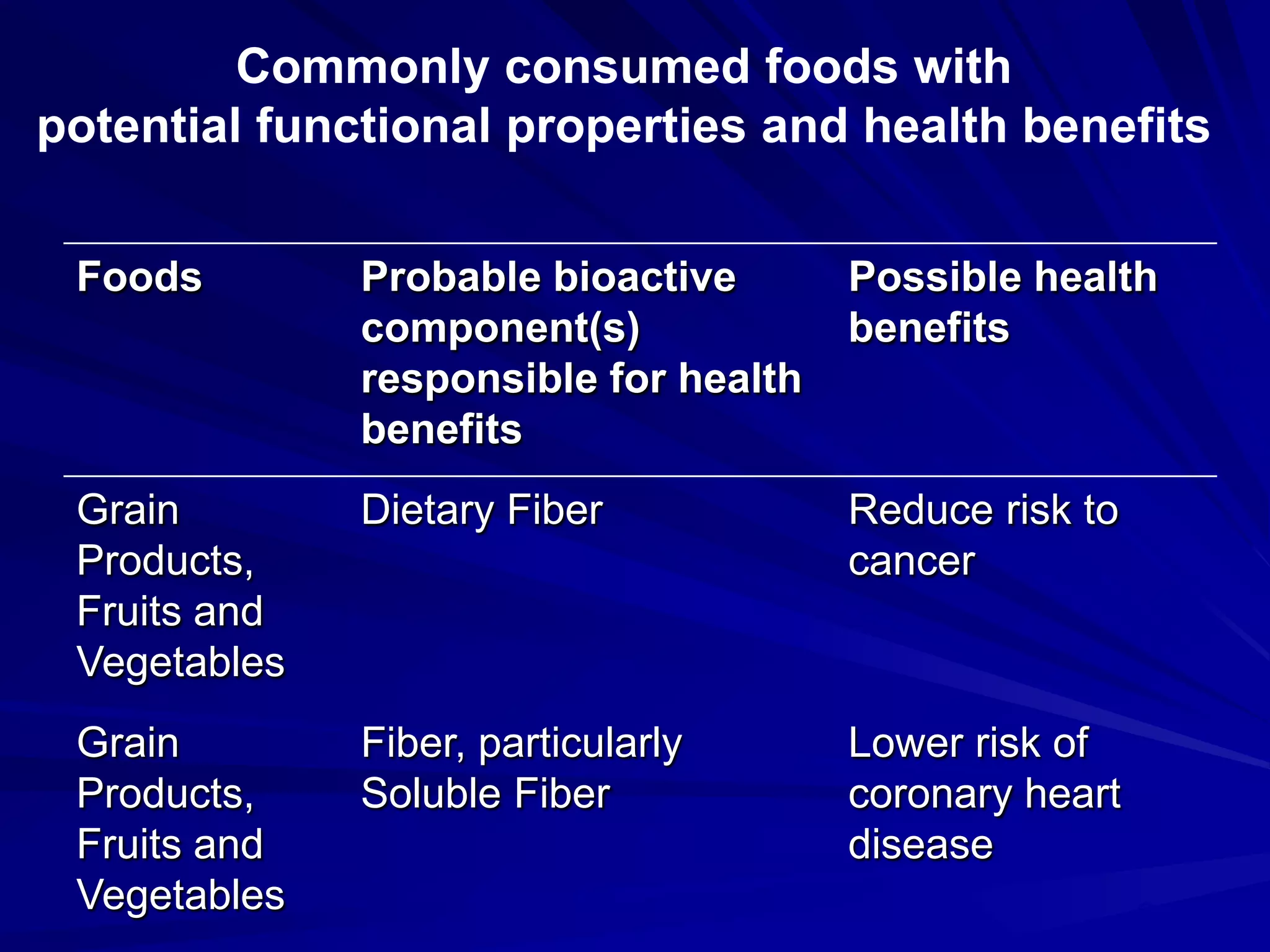
Commonly consumed foods with
potential functional properties and health benefits


 Foods        Probable bioactive       Possible health
              component(s)             benefits
              responsible for health
              benefits
 Grain        Dietary Fiber            Reduce risk to
 Products,                             cancer
 Fruits and
 Vegetables
 Grain        Fiber, particularly      Lower risk of
 Products,    Soluble Fiber            coronary heart
 Fruits and                            disease
 Vegetables                                             Contd.
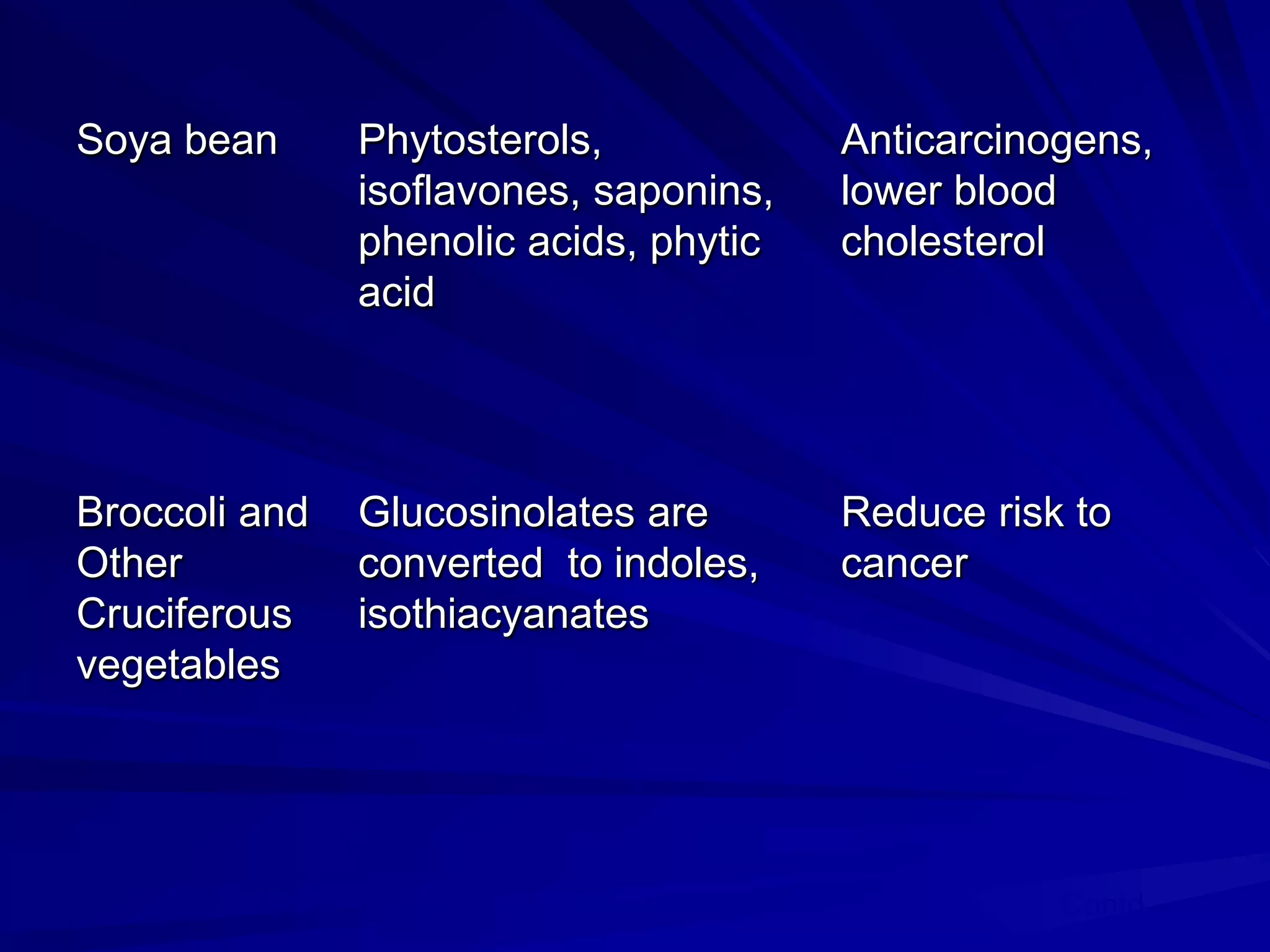
Soya bean      Phytosterols,            Anticarcinogens,
               isoflavones, saponins,   lower blood
               phenolic acids, phytic   cholesterol
               acid


Broccoli and   Glucosinolates are       Reduce risk to
Other          converted to indoles,    cancer
Cruciferous    isothiacyanates
vegetables


                                                   Contd.
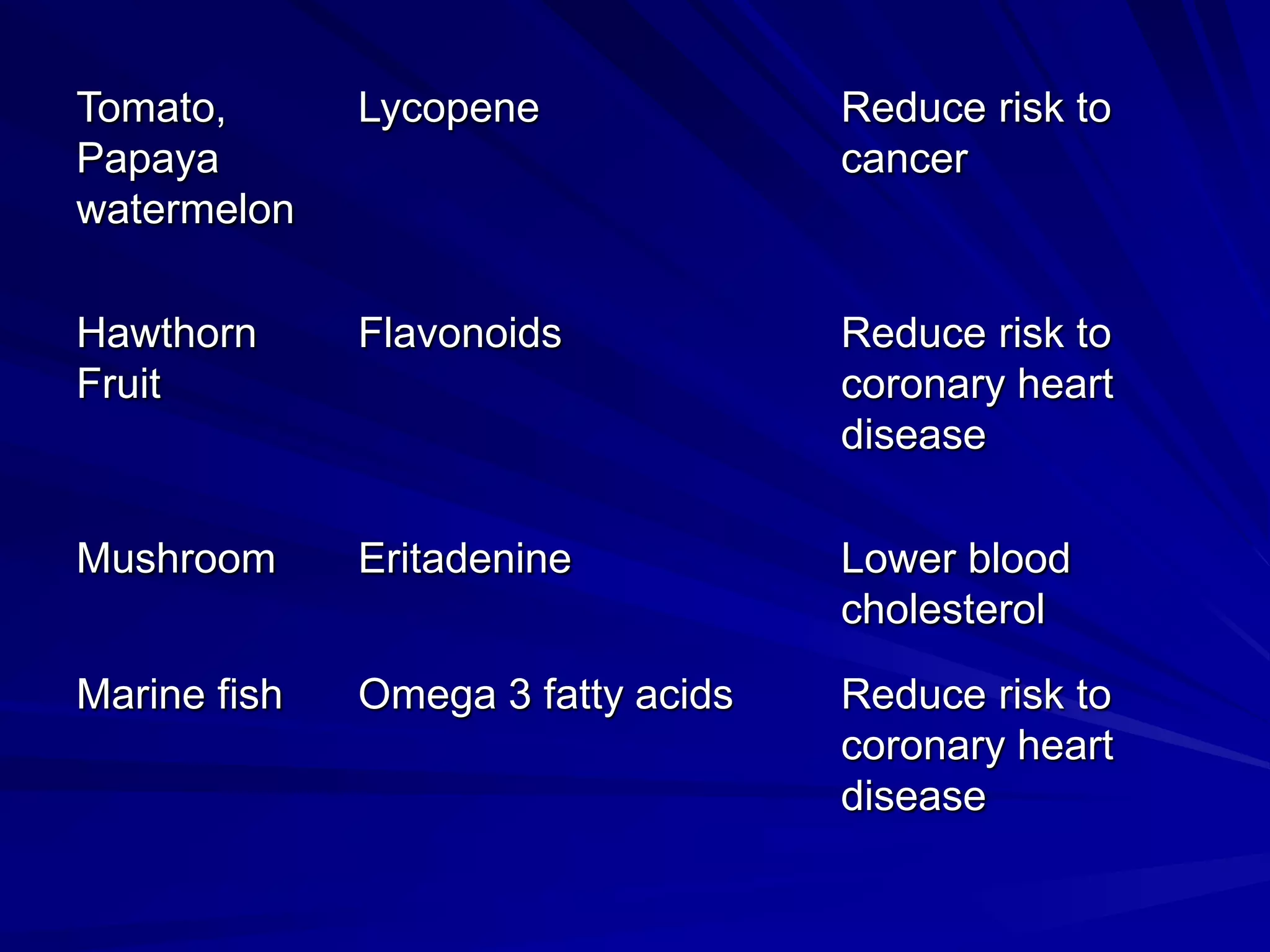
Tomato,       Lycopene              Reduce risk to
Papaya                              cancer
watermelon

Hawthorn      Flavonoids            Reduce risk to
Fruit                               coronary heart
                                    disease

Mushroom      Eritadenine           Lower blood
                                    cholesterol

Marine fish   Omega 3 fatty acids   Reduce risk to
                                    coronary heart
                                    disease
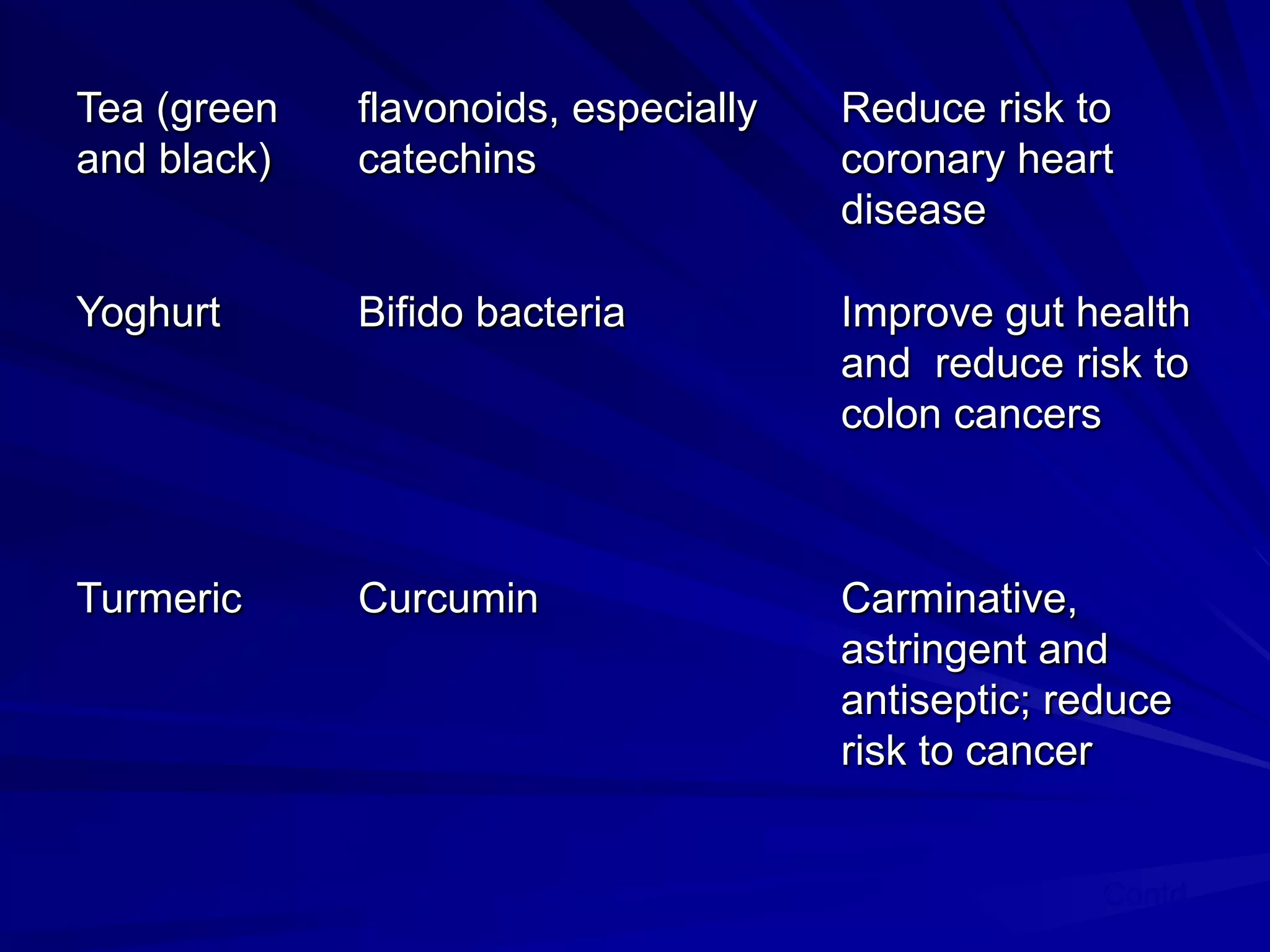
Tea (green   flavonoids, especially   Reduce risk to
and black)   catechins                coronary heart
                                      disease

Yoghurt      Bifido bacteria          Improve gut health
                                      and reduce risk to
                                      colon cancers


Turmeric     Curcumin                 Carminative,
                                      astringent and
                                      antiseptic; reduce
                                      risk to cancer


                                                    Contd.
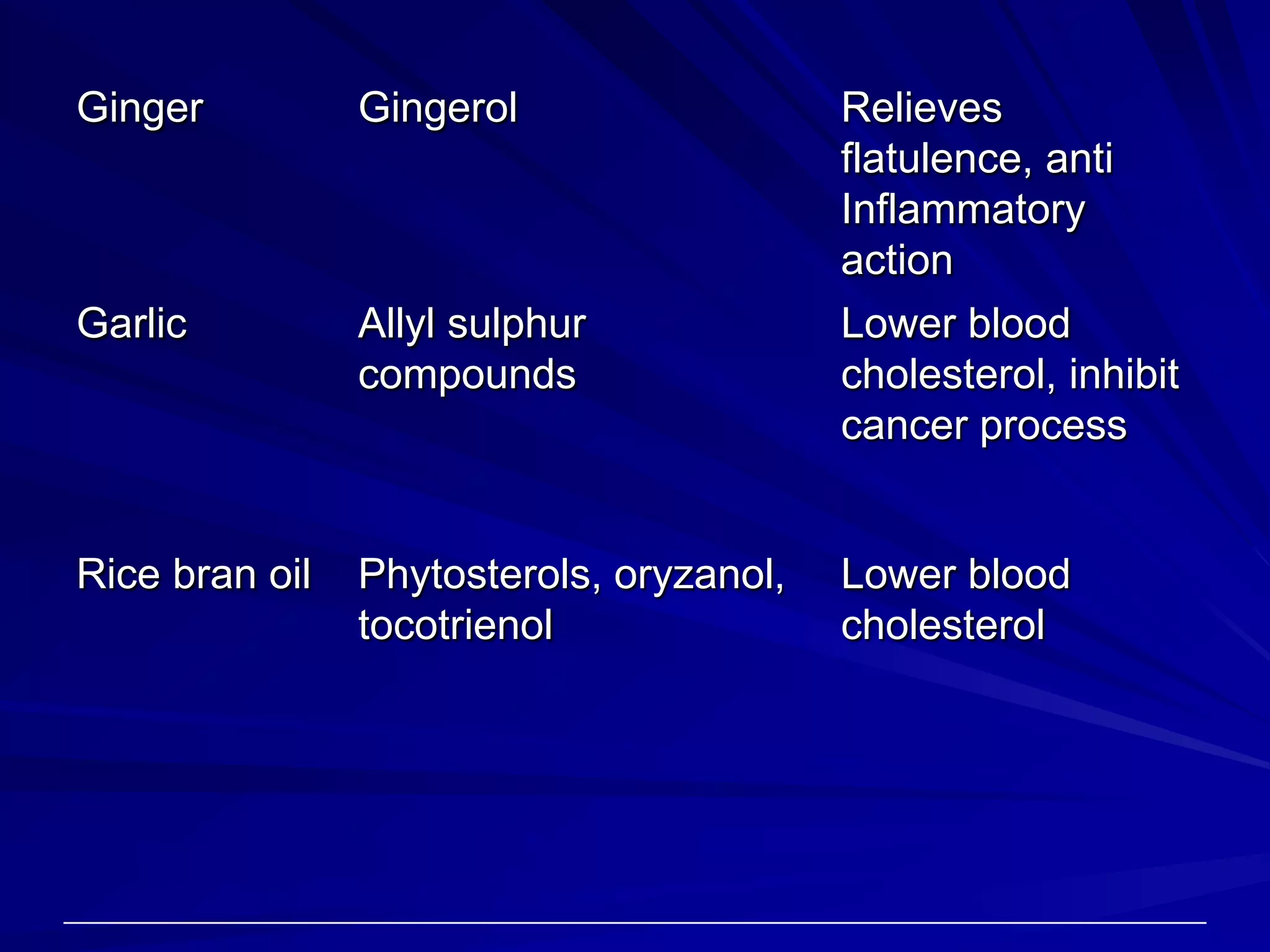
Ginger          Gingerol                  Relieves
                                          flatulence, anti
                                          Inflammatory
                                          action
Garlic          Allyl sulphur             Lower blood
                compounds                 cholesterol, inhibit
                                          cancer process


Rice bran oil   Phytosterols, oryzanol,   Lower blood
                tocotrienol               cholesterol
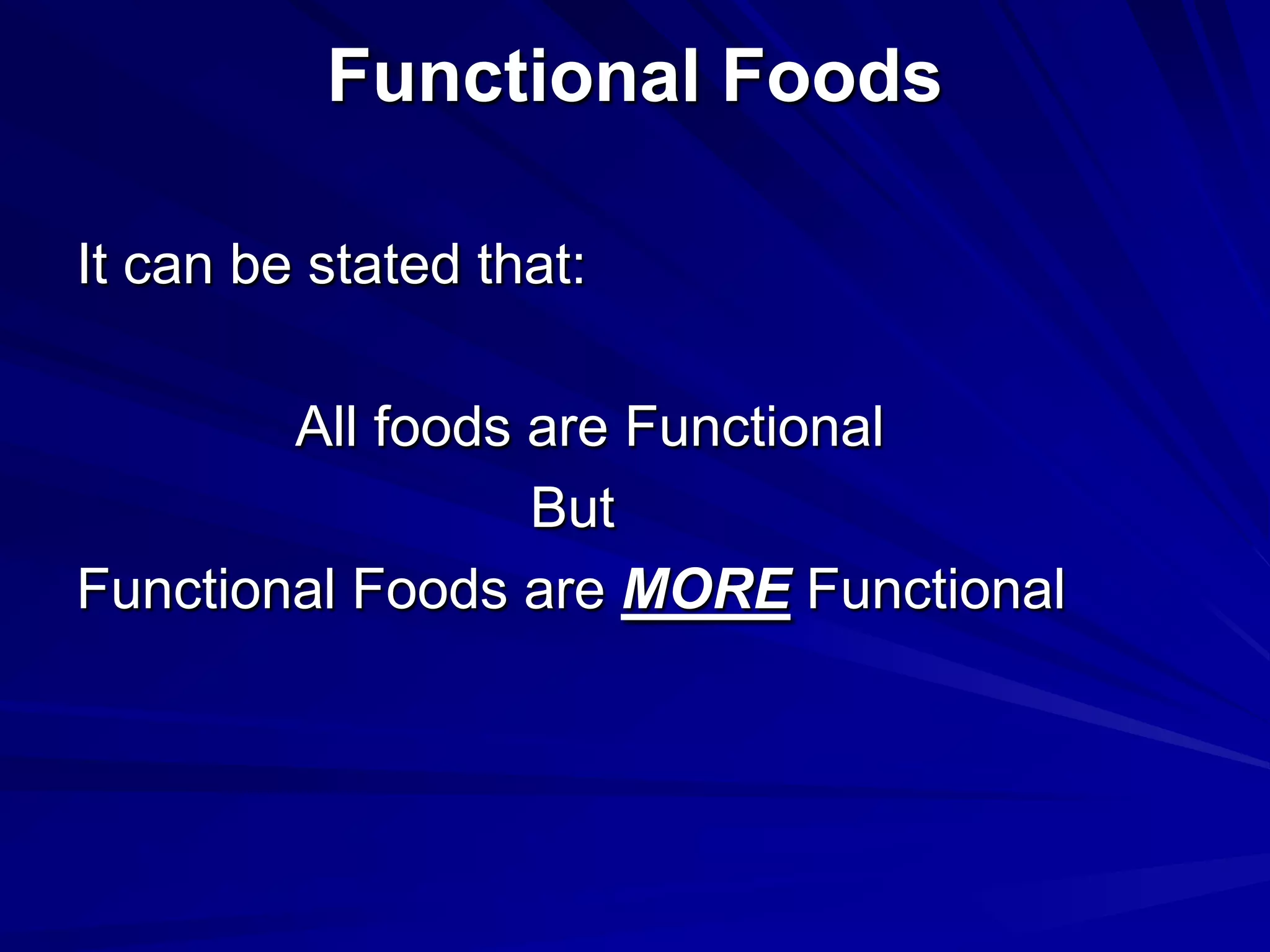
Functional Foods

It can be stated that:

        All foods are Functional
                  But
Functional Foods are MORE Functional
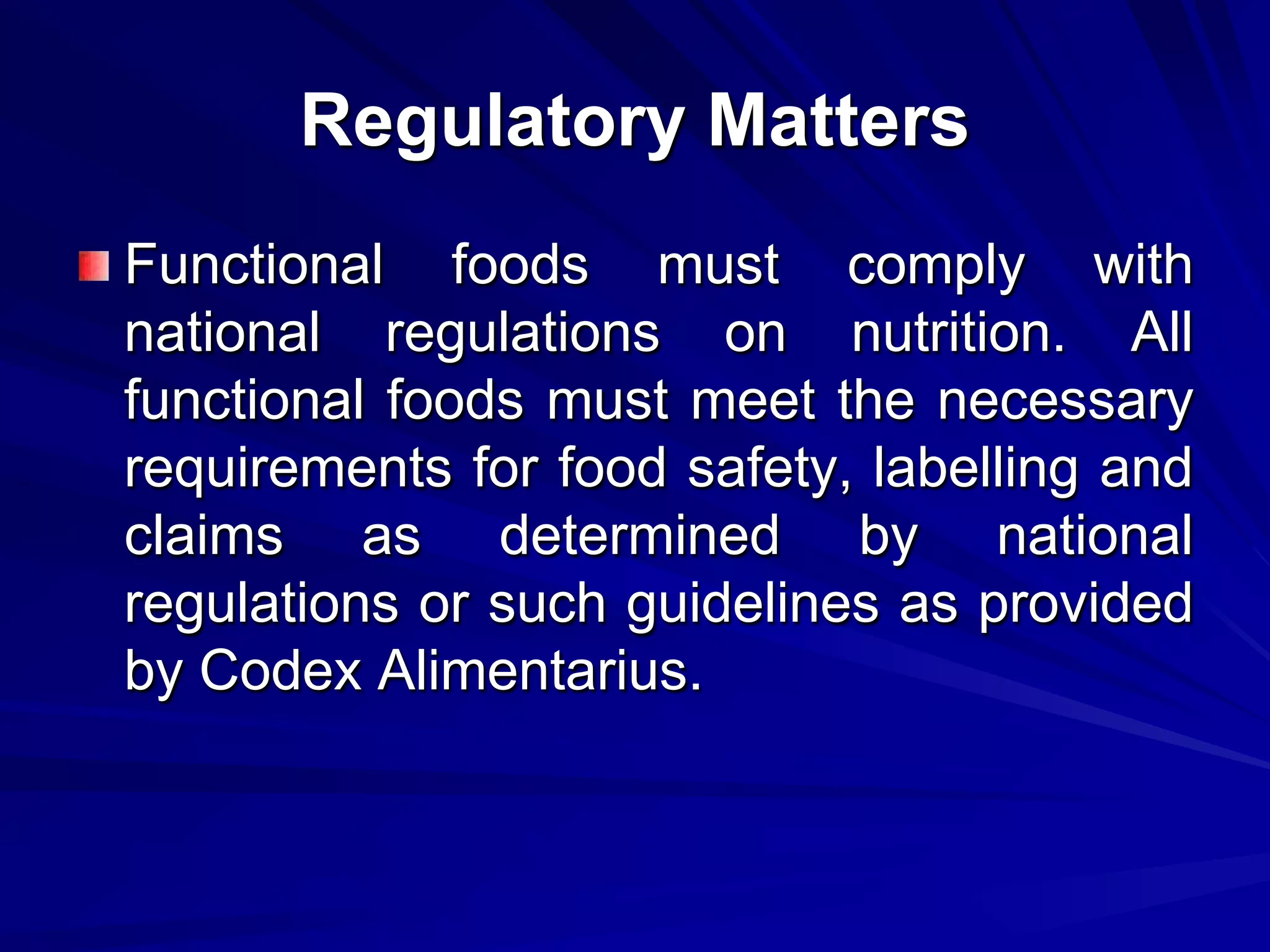
Regulatory Matters
Functional foods must comply with
national regulations on nutrition. All
functional foods must meet the necessary
requirements for food safety, labelling and
claims as determined by national
regulations or such guidelines as provided
by Codex Alimentarius.
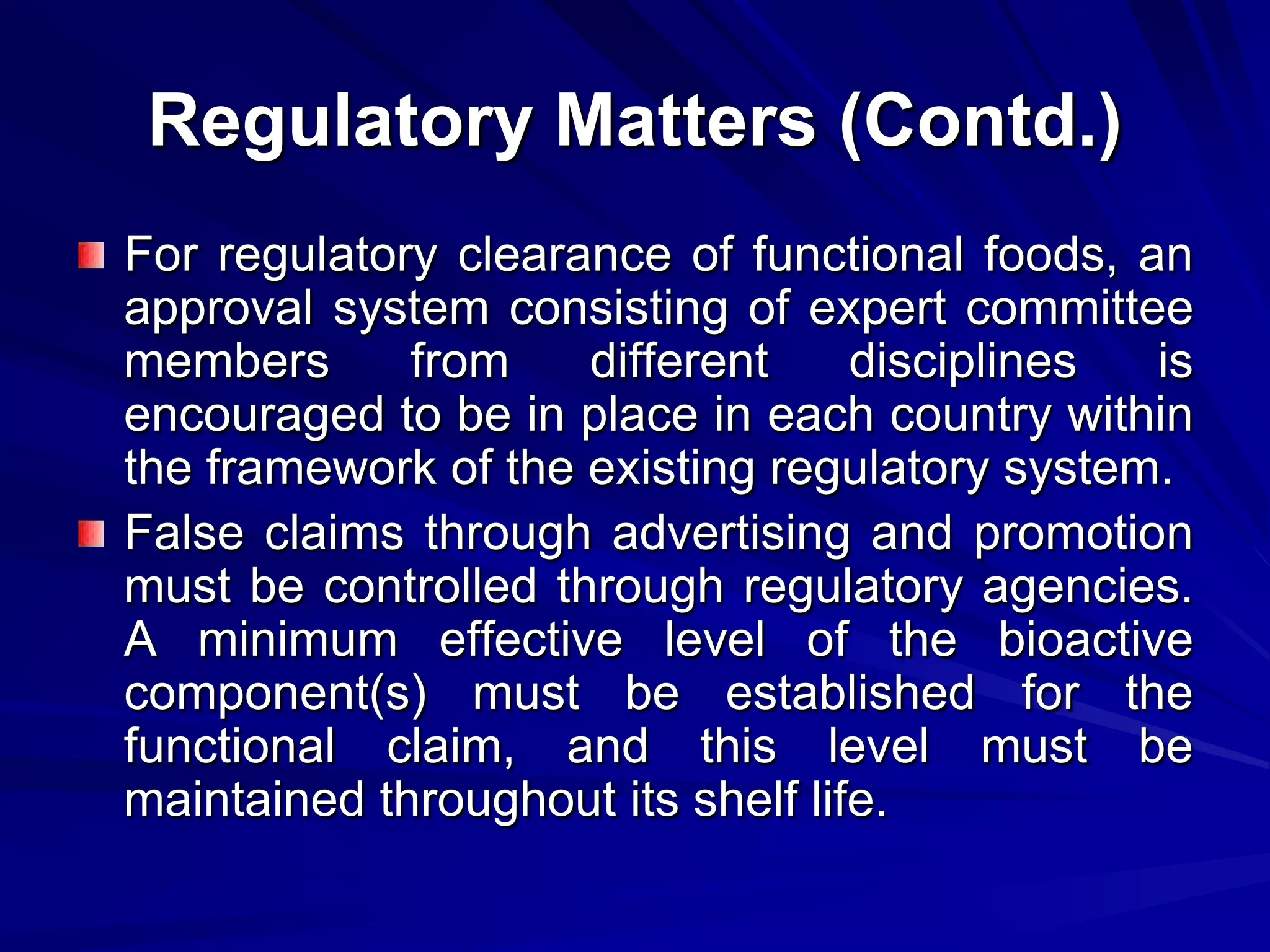
Regulatory Matters (Contd.)
For regulatory clearance of functional foods, an
approval system consisting of expert committee
members      from    different     disciplines is
encouraged to be in place in each country within
the framework of the existing regulatory system.
False claims through advertising and promotion
must be controlled through regulatory agencies.
A minimum effective level of the bioactive
component(s) must be established for the
functional claim, and this level must be
maintained throughout its shelf life.
Regulatory Matters (Contd.)

The safety level of the claimed bioactive
component(s) must be stipulated.
Approved analytical methods must be available
for testing the food, preferably carried out by
accredited laboratories.
Regulatory activities on functional foods should
be established within the existing regulatory
system and should also regularly keep abreast
with Codex guidelines. Effective monitoring and
evaluation of such activities should be central to
such a regulatory system.
Codex and Functional Foods

Recognizing the need for an enhanced
coordinated approach to the global development
of functional foods, the FAO/WHO Regional
Coordinating Committee for Asia (CCAsia), at its
13th session in Kuala Lumpur held in September
2002, first commenced discussions on this
subject.
The Coordinating Committee recommended that
FAO and WHO organize an expert consultation
to discuss various aspects of functional foods.
Codex and Functional Foods
         (Contd.)
Following on that initial development, at
the 14th session of CCAsia meeting held in
2004 in South Korea, a pre-Codex
workshop on functional foods was
organized. A wide variety of topics were
discussed, including safety evaluation,
scientific substantiation as well as
consumer perceptions, concerns, and
behaviours.
Remarks
Codex and Functional Foods

It may be noted that so far there was no
consideration of functional foods as such
in Codex, and no definition.
However, there are Guidelines on Use of
Nutrition and Health Claims that define the
conditions for health claims including
nutrient function claims
Remarks (Contd.)
At present there is no work in Codex on
“Functional Foods”, Codex work was
completed with the finalization of the
scientific criteria for health claims
included in Guidelines on Use of
Nutrition and Health Claims, and there
was no proposal in the CCNFSDu or
CCFL to discuss " Functional Foods"
Functional Foods and Codex-
       Nutrition Claims
Nutrition claims should be consistent with
national nutrition policy and support that
policy. Only nutrition claims that support
national nutrition policy should be allowed.
Health claims should be consistent with
national health policy, including nutrition
policy, and support such policies where
applicable.
Nutrition Claims (Contd.)
Nutrition and Health Claims (CAC/GL 23-1997)
Example:
“Nutrient A (naming a physiological role of
nutrient A in the body in the maintenance of
health and promotion of normal growth and
development).
Food X is a source of/ high in nutrient A.”
Nutrition Claims (Contd.)
Other function claims – These claims concern specific
beneficial effects of the consumption of foods or their
constituents, in the context of the total diet on normal
functions or biological activities of the body. Such claims
relate to a positive contribution to health or to the
improvement of a function or to modifying or preserving
health.
Examples:
“Substance A (naming the effect of substance A on
improving or modifying a physiological function or
biological activity associated with health). Food Y contains
x grams of substance A.”
Nutrition Claims (Contd.)
Reduction of disease risk claims – Claims relating the consumption of a food
    or food constituent, in the context of the total diet, to the reduced risk of
                   developing a disease or health related condition.
Risk reduction means significantly altering a major risk factor(s) for a disease or
                              health-related condition.
Diseases have multiple risk factors and altering one of these risk factors may or
may not have a beneficial effect. The presentation of risk reduction claims must
    ensure, for example, by use of appropriate language and reference to other
      risk factors, that consumers do not interpret them as prevention claims.

                                      Examples:
 “A healthful diet low in nutrient or substance A may reduce the risk of disease
                    D. Food X is low in nutrient or substance A.”
 “A healthful diet rich in nutrient or substance B may reduce the risk of disease
                   F. Food Y is high in nutrient or substance B.”
Nutrition Claims (Contd.)
NUTRITION LABELLING
  Any food for which a nutrition or health claim is made
  should be labelled with a nutrient declaration in
  accordance with Section 3 of the Codex Guidelines on
  Nutrition Labelling.

NUTRITION CLAIMS
   The only nutrition claims permitted shall be those
   relating to energy, protein, carbohydrate, and fat and
   components thereof, fibre, sodium and vitamins and
   minerals for which Nutrient Reference Values (NRVs)
   have been laid down in the Codex Guidelines for
   Nutrition Labelling.
Nutrition Claims (Contd.)
   .

NUTRIENT CONTENT CLAIMS
When a nutrient content claim that is listed in the Table to these
Guidelines or a synonymous claim is made, the conditions
specified in the Table for that claim should apply.

Where a food is by its nature low in or free of the nutrient that is
the subject of the claim, the term describing the level of the
nutrient should not immediately precede the name of the food but
should be in the form “a low (naming the nutrient) food” or “a
(naming the nutrient)-free food”; say, Low-sodium or Sodium-free.
Concluding Remarks
As such there is no work in Codex on
“Functional Foods”
Codex work was completed with the
finalization of the scientific criteria for
health claims included in Guidelines on
Use of Nutrition and Health Claims
National Authority therefore, is the key
for regulating Functional Foods in the
market
Thank You
        for
Your Kind Attention
    nandi.biplab@gmail.com

Codex & Functional Foods

  • 1.
    Codex in relationto Functional Foods Dr. Biplab K. Nandi Senior Food and Nutrition Officer (Retd.) Food and Agriculture Organization of the United Nations President Society for Nutrition, Education and Health Advancement (SNEHA), Kolkata
  • 2.
    Outline of Presentation Introduction FunctionalFoods and Health Benefits Regulatory Matters Codex and Functional Foods Concluding Remarks
  • 3.
    Introduction Research anddevelopment over the years have shown that in addition to nutrients, there are various other components in foods that may be beneficial to health. These bioactive or functional ingredients are believed to be able to serve physiological roles beyond provisions of simple nutrient requirements, for example ability to promote general well being or even reduce the risk of chronic diseases.
  • 4.
    Introduction (Contd.) Foods containingsuch functional ingredients are termed ‘functional foods’. These foods are similar in appearance to conventional foods and are intended to be consumed as part of a normal diet. Functional foods should be in conventional food form and possess inherent or added bioactive/biologically active components that have characteristics of promoting health benefits beyond basic nutrition that can be substantiated scientifically.
  • 5.
    Commonly consumed foodswith potential functional properties and health benefits Foods Probable bioactive Possible health component(s) benefits responsible for health benefits Grain Dietary Fiber Reduce risk to Products, cancer Fruits and Vegetables Grain Fiber, particularly Lower risk of Products, Soluble Fiber coronary heart Fruits and disease Vegetables Contd.
  • 6.
    Soya bean Phytosterols, Anticarcinogens, isoflavones, saponins, lower blood phenolic acids, phytic cholesterol acid Broccoli and Glucosinolates are Reduce risk to Other converted to indoles, cancer Cruciferous isothiacyanates vegetables Contd.
  • 7.
    Tomato, Lycopene Reduce risk to Papaya cancer watermelon Hawthorn Flavonoids Reduce risk to Fruit coronary heart disease Mushroom Eritadenine Lower blood cholesterol Marine fish Omega 3 fatty acids Reduce risk to coronary heart disease
  • 8.
    Tea (green flavonoids, especially Reduce risk to and black) catechins coronary heart disease Yoghurt Bifido bacteria Improve gut health and reduce risk to colon cancers Turmeric Curcumin Carminative, astringent and antiseptic; reduce risk to cancer Contd.
  • 9.
    Ginger Gingerol Relieves flatulence, anti Inflammatory action Garlic Allyl sulphur Lower blood compounds cholesterol, inhibit cancer process Rice bran oil Phytosterols, oryzanol, Lower blood tocotrienol cholesterol
  • 10.
    Functional Foods It canbe stated that: All foods are Functional But Functional Foods are MORE Functional
  • 11.
    Regulatory Matters Functional foodsmust comply with national regulations on nutrition. All functional foods must meet the necessary requirements for food safety, labelling and claims as determined by national regulations or such guidelines as provided by Codex Alimentarius.
  • 12.
    Regulatory Matters (Contd.) Forregulatory clearance of functional foods, an approval system consisting of expert committee members from different disciplines is encouraged to be in place in each country within the framework of the existing regulatory system. False claims through advertising and promotion must be controlled through regulatory agencies. A minimum effective level of the bioactive component(s) must be established for the functional claim, and this level must be maintained throughout its shelf life.
  • 13.
    Regulatory Matters (Contd.) Thesafety level of the claimed bioactive component(s) must be stipulated. Approved analytical methods must be available for testing the food, preferably carried out by accredited laboratories. Regulatory activities on functional foods should be established within the existing regulatory system and should also regularly keep abreast with Codex guidelines. Effective monitoring and evaluation of such activities should be central to such a regulatory system.
  • 14.
    Codex and FunctionalFoods Recognizing the need for an enhanced coordinated approach to the global development of functional foods, the FAO/WHO Regional Coordinating Committee for Asia (CCAsia), at its 13th session in Kuala Lumpur held in September 2002, first commenced discussions on this subject. The Coordinating Committee recommended that FAO and WHO organize an expert consultation to discuss various aspects of functional foods.
  • 15.
    Codex and FunctionalFoods (Contd.) Following on that initial development, at the 14th session of CCAsia meeting held in 2004 in South Korea, a pre-Codex workshop on functional foods was organized. A wide variety of topics were discussed, including safety evaluation, scientific substantiation as well as consumer perceptions, concerns, and behaviours.
  • 16.
    Remarks Codex and FunctionalFoods It may be noted that so far there was no consideration of functional foods as such in Codex, and no definition. However, there are Guidelines on Use of Nutrition and Health Claims that define the conditions for health claims including nutrient function claims
  • 17.
    Remarks (Contd.) At presentthere is no work in Codex on “Functional Foods”, Codex work was completed with the finalization of the scientific criteria for health claims included in Guidelines on Use of Nutrition and Health Claims, and there was no proposal in the CCNFSDu or CCFL to discuss " Functional Foods"
  • 18.
    Functional Foods andCodex- Nutrition Claims Nutrition claims should be consistent with national nutrition policy and support that policy. Only nutrition claims that support national nutrition policy should be allowed. Health claims should be consistent with national health policy, including nutrition policy, and support such policies where applicable.
  • 19.
    Nutrition Claims (Contd.) Nutritionand Health Claims (CAC/GL 23-1997) Example: “Nutrient A (naming a physiological role of nutrient A in the body in the maintenance of health and promotion of normal growth and development). Food X is a source of/ high in nutrient A.”
  • 20.
    Nutrition Claims (Contd.) Otherfunction claims – These claims concern specific beneficial effects of the consumption of foods or their constituents, in the context of the total diet on normal functions or biological activities of the body. Such claims relate to a positive contribution to health or to the improvement of a function or to modifying or preserving health. Examples: “Substance A (naming the effect of substance A on improving or modifying a physiological function or biological activity associated with health). Food Y contains x grams of substance A.”
  • 21.
    Nutrition Claims (Contd.) Reductionof disease risk claims – Claims relating the consumption of a food or food constituent, in the context of the total diet, to the reduced risk of developing a disease or health related condition. Risk reduction means significantly altering a major risk factor(s) for a disease or health-related condition. Diseases have multiple risk factors and altering one of these risk factors may or may not have a beneficial effect. The presentation of risk reduction claims must ensure, for example, by use of appropriate language and reference to other risk factors, that consumers do not interpret them as prevention claims. Examples: “A healthful diet low in nutrient or substance A may reduce the risk of disease D. Food X is low in nutrient or substance A.” “A healthful diet rich in nutrient or substance B may reduce the risk of disease F. Food Y is high in nutrient or substance B.”
  • 22.
    Nutrition Claims (Contd.) NUTRITIONLABELLING Any food for which a nutrition or health claim is made should be labelled with a nutrient declaration in accordance with Section 3 of the Codex Guidelines on Nutrition Labelling. NUTRITION CLAIMS The only nutrition claims permitted shall be those relating to energy, protein, carbohydrate, and fat and components thereof, fibre, sodium and vitamins and minerals for which Nutrient Reference Values (NRVs) have been laid down in the Codex Guidelines for Nutrition Labelling.
  • 23.
    Nutrition Claims (Contd.) . NUTRIENT CONTENT CLAIMS When a nutrient content claim that is listed in the Table to these Guidelines or a synonymous claim is made, the conditions specified in the Table for that claim should apply. Where a food is by its nature low in or free of the nutrient that is the subject of the claim, the term describing the level of the nutrient should not immediately precede the name of the food but should be in the form “a low (naming the nutrient) food” or “a (naming the nutrient)-free food”; say, Low-sodium or Sodium-free.
  • 24.
    Concluding Remarks As suchthere is no work in Codex on “Functional Foods” Codex work was completed with the finalization of the scientific criteria for health claims included in Guidelines on Use of Nutrition and Health Claims National Authority therefore, is the key for regulating Functional Foods in the market
  • 25.
    Thank You for Your Kind Attention nandi.biplab@gmail.com