
IndianAgriculturalResearchInstitute
The need for nutrient
efficient rice varieties
Status and prospects
K K Vinod
IndianAgriculturalResearchInstitute
A rendezvous with the impasse
An impasse that is inevitable
It is irreversible
It is imminent
It is relevant to the existence of mankind
IndianAgriculturalResearchInstitute
Heading for a ‘stalemate’ in agriculture
Modern agriculture is taxing the nature
Demand for food is ever-increasing
Land area is shrinking, thus productivity to go high
Varieties are to be nutrient hungry
Soil health is diminishing
Fertilizer use is rising high
Fertilizer sources are going to be exhausted!
Where will we go tomorrow?
IndianAgriculturalResearchInstitute
In pursuit of nutrient efficient varieties
 Why nutrient efficiency, why not nutrient use efficiency?
 The surplus-deficit scenario of plant breeding
 Why rice is important?
 Where to look for nutrient efficiency?
 What to look for nutrient efficiency?
 Where we are now?
 Is the future bleak or bright?
IndianAgriculturalResearchInstitute
In pursuit of nutrient efficient varieties
Why nutrient efficiency, why not nutrient use efficiency?
The surplus-deficit scenario of plant breeding
Why rice is important?
Where to look for nutrient efficiency?
What to look for nutrient efficiency?
Where we are now?
Is the future bleak or bright?
IndianAgriculturalResearchInstitute
NE vs NUE
• Nutrient use efficiency (NUE) is the crop response
to applied nutrients
• Nutrient efficiency (NE) is the crop response to
total nutrients – applied and native
• NUE is a function of increased nutrient input
• NE is relevant to decrement in nutrient input
• NE is associated to nutrient deficiency
• NUE is associated to nutrient sufficiency
• Both NUE and NE are genetic, NE is more complex
than NUE
IndianAgriculturalResearchInstitute
Concerns of overdependence
Overdependence of mineral fertilizers
(a) soil nutrient deficiency
(b) non-recyclable nutrient loss
(c) loss of nutrients by soil processes
(d) Terrestrial nutrient pollution
(e) atmospheric pollution
(f) depletion of natural resources
(g) geographic resource confinement
(h) booming fertilizer costs
(i) constrained fertilizer affordability to farmers
(j) no alternative to fertilizer resources
Uncertainty of looming threat of climate change
IndianAgriculturalResearchInstitute
In pursuit of nutrient efficient varieties
Why nutrient efficiency, why not nutrient use efficiency?
The surplus-deficit scenario of plant breeding
Why rice is important?
Where to look for nutrient efficiency?
What to look for nutrient efficiency?
Where we are now?
Is the future bleak or bright?
IndianAgriculturalResearchInstitute
Nutrient sufficiency
• Modern agriculture is nutrient rich
• Technology eased natural resource conversion
• Fertilizers were made cheaper - subsidized
• Supply is huge – More addition, more exhaustion
• No regulation on fertilizer use
• Intensive agriculture receives intensive fertilization
• Poor farmlands go poorer and rich goes richer
• Nutrients are sufficient enough for polluting
• Modern varieties are nutrient hungry
• No nutrient recycling – high harvest loss
IndianAgriculturalResearchInstitute
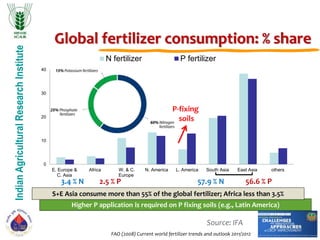
FAO (2008) Current world fertilizer trends and outlook 2011/2012
0
10
20
30
40
E. Europe &
C. Asia
Africa W. & C.
Europe
N. America L. America South Asia East Asia others
N fertilizer P fertilizer
56.6 % P57.9 % N2.5 % P3.4 % N
Higher P application is required on P fixing soils (e.g., Latin America)
P-fixing
soils
S+E Asia consume more than 55% of the global fertilizer; Africa less than 3.5%
Global fertilizer consumption: % share
Source: IFA
IndianAgriculturalResearchInstitute
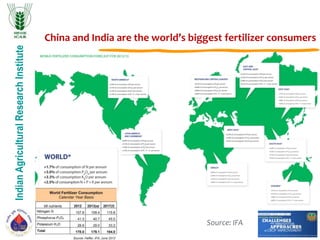
China and India are the world’s biggest fertilizer consumers
Source: IFA
IndianAgriculturalResearchInstitute
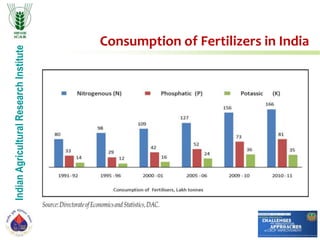
Consumption of Fertilizers in India
IndianAgriculturalResearchInstitute
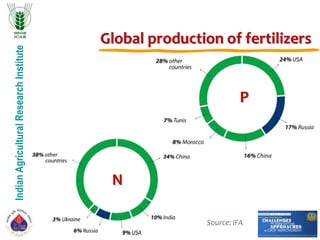
Global production of fertilizers
N
P
Source: IFA
IndianAgriculturalResearchInstitute
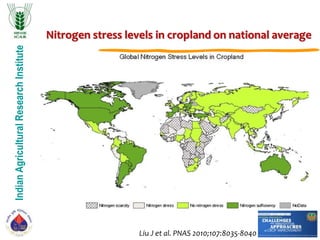
Liu J et al. PNAS 2010;107:8035-8040
Nitrogen stress levels in cropland on national average
IndianAgriculturalResearchInstitute
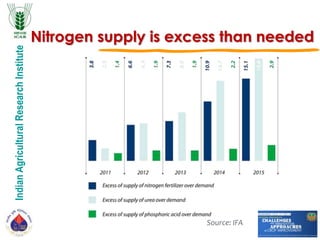
Nitrogen supply is excess than needed
Source: IFA
IndianAgriculturalResearchInstitute
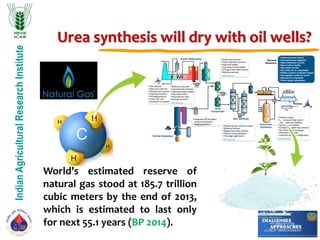
Urea synthesis will dry with oil wells?
World’s estimated reserve of
natural gas stood at 185.7 trillion
cubic meters by the end of 2013,
which is estimated to last only
for next 55.1 years (BP 2014).
IndianAgriculturalResearchInstitute
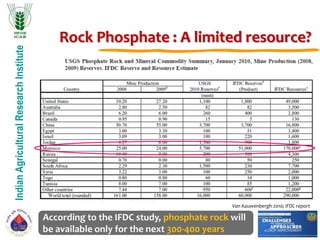
Van Kauwenbergh 2010; IFDC report
According to the IFDC study, phosphate rock will
be available only for the next 300-400 years
Rock Phosphate : A limited resource?
IndianAgriculturalResearchInstitute
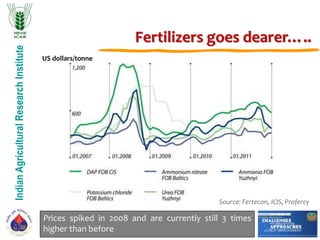
Prices spiked in 2008 and are currently still 3 times
higher than before
Fertilizers goes dearer…..
Source: Fertecon, ICIS, Profercy
US dollars/tonne
IndianAgriculturalResearchInstitute
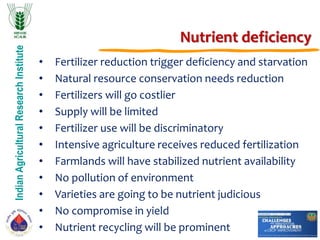
Nutrient deficiency
• Fertilizer reduction trigger deficiency and starvation
• Natural resource conservation needs reduction
• Fertilizers will go costlier
• Supply will be limited
• Fertilizer use will be discriminatory
• Intensive agriculture receives reduced fertilization
• Farmlands will have stabilized nutrient availability
• No pollution of environment
• Varieties are going to be nutrient judicious
• No compromise in yield
• Nutrient recycling will be prominent
IndianAgriculturalResearchInstitute
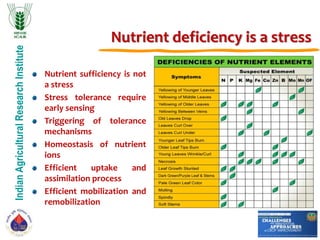
Nutrient deficiency is a stress
Nutrient sufficiency is not
a stress
Stress tolerance require
early sensing
Triggering of tolerance
mechanisms
Homeostasis of nutrient
ions
Efficient uptake and
assimilation process
Efficient mobilization and
remobilization
IndianAgriculturalResearchInstitute
The genetic risk of over-dependence
Negative selection for deficiency tolerance
Erosion of nutrient efficient genes
Internal driving mechanisms of deficiency sensing
ignored
Pathways leading to secondary uptake processes
ignored
Symbiotic genes untargeted
Uptake efficiency has little meaning under sufficiency
than deficiency
Over reliance on utilization efficiency in modern varieties
IndianAgriculturalResearchInstitute
In pursuit of nutrient efficient varieties
Why nutrient efficiency, why not nutrient use efficiency?
The surplus-deficit scenario of plant breeding
Why rice is important?
Where to look for nutrient efficiency?
What to look for nutrient efficiency?
Where we are now?
Is the future bleak or bright?
IndianAgriculturalResearchInstitute
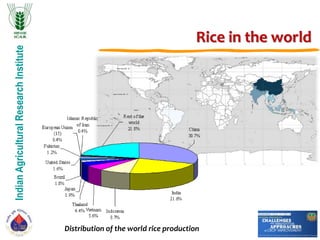
Distribution of the world rice production
Rice in the world
IndianAgriculturalResearchInstitute
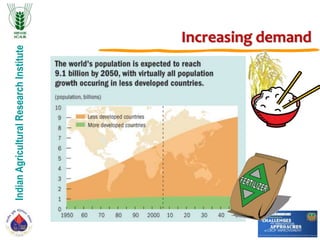
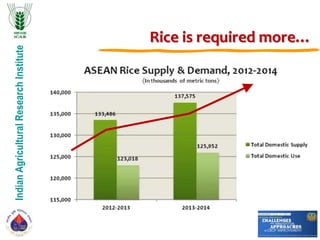
Increasing demand
IndianAgriculturalResearchInstitute
Rice is required more…
IndianAgriculturalResearchInstitute
In pursuit of nutrient efficient varieties
Why nutrient efficiency, why not nutrient use efficiency?
The surplus-deficit scenario of plant breeding
Why rice is important?
Where to look for nutrient efficiency?
What to look for nutrient efficiency?
Where we are now?
Is the future bleak or bright?
IndianAgriculturalResearchInstitute
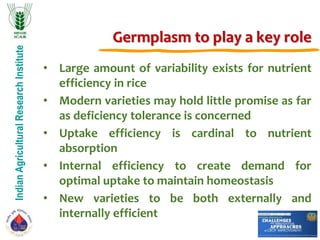
Germplasm to play a key role
• Large amount of variability exists for nutrient
efficiency in rice
• Modern varieties may hold little promise as far
as deficiency tolerance is concerned
• Uptake efficiency is cardinal to nutrient
absorption
• Internal efficiency to create demand for
optimal uptake to maintain homeostasis
• New varieties to be both externally and
internally efficient
IndianAgriculturalResearchInstitute
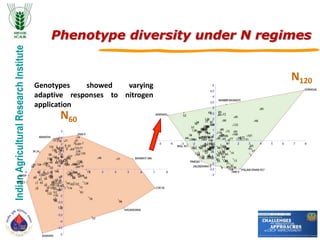
Phenotype diversity under N regimes
N60
N120
Genotypes showed varying
adaptive responses to nitrogen
application
IndianAgriculturalResearchInstitute
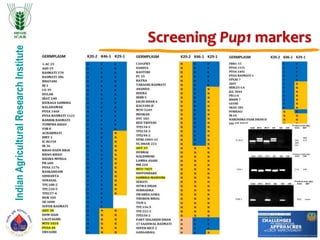
Screening Pup1 markers
IndianAgriculturalResearchInstitute
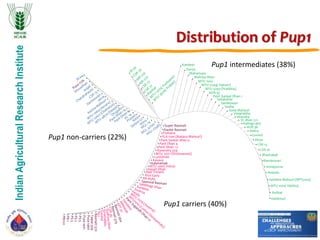
Distribution of Pup1
Super Basmati
Basmati370
N22
PB-1
PB1121
PS-2
PS-3
PS-5
Pusa1401
Pusa1460
Taipai309
Kalanamak
MTU 1061( Indra)
Govind
Hazari Dhan
Kesava
Lunishree
MTU 2077 (Krishnaveni)
Narendra 359
Pant Dhan 12
Pant Dhan 4
Pant Sankar dhan-3
PLA 1100 (Badava Mahsuri)
Pothana
Ranbir Basmati
Red Trinaini
Haldimuri
Jhulhat
MTU 1001( Vijetha)
Sambha Mahsuri (BPT5204)
Ananda
Annapurna
Bamleswari
Bhadrakali
CSR 10
CSR 13
Divya
Govind
Heera
HUR 36
Kalinga 463
Kamlesh
Kavya
Mahamaya
Malviya Dhan
MTU 1010
MTU 5249( Vajram)
MTU 5293 (Pratibha)
NDR 97
Pant Sankar Dhan 1
Sadabahar
Samleswari
Sneha
Sona Mahsuri
Vanprabha
Virendra
VL dhan 221
Pup1 non-carriers (22%)
Pup1 carriers (40%)
Pup1 intermediates (38%)
IndianAgriculturalResearchInstitute
Landraces and traditional varieties
• Experience from other crops and
from rice
• They remain unselected for NE
genes
• They still conserve NE genes
• Wild germplasm to contribute to NE
IndianAgriculturalResearchInstitute
In pursuit of nutrient efficient varieties
Why nutrient efficiency, why not nutrient use efficiency?
The surplus-deficit scenario of plant breeding
Why rice is important?
Where to look for nutrient efficiency?
What to look for nutrient efficiency?
Where we are now?
Is the future bleak or bright?
IndianAgriculturalResearchInstitute
Key factors for breeding
• Heritability of the NE will be low
• Little use of primary and secondary assimilation
genes
• Deficiency sensing and response to play a major
role
• Redefining physiological basis of NE
• Molecular breeding may be more fruitful than
conventional methods
IndianAgriculturalResearchInstitute
NE varieties would be….
• High uptake efficient
• Early in sensing starvation signals
• Efficient in morpho-physiological adaptations
• With better assimilation and remobilization
• Nutrient use efficient
• With better symbiotic machinery
IndianAgriculturalResearchInstitute
In pursuit of nutrient efficient varieties
Why nutrient efficiency, why not nutrient use efficiency?
The surplus-deficit scenario of plant breeding
Why rice is important?
Where to look for nutrient efficiency?
What to look for nutrient efficiency?
Where we are now?
Is the future bleak or bright?
IndianAgriculturalResearchInstitute
Back to square one ……
 Most of the attempts to map for the genes
ended up in identifying NUE genes than NE
 Redefining of traits to look for gains importance
here
 No sense in identifying genes under no fertilizer
input
 No sense in identifying genes using HYVs
 Field screening may give better results than
artificial screens
IndianAgriculturalResearchInstitute
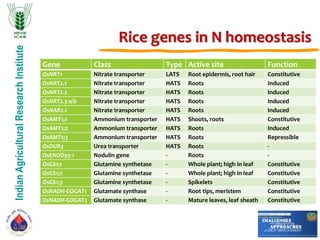
Rice genes in N homeostasis
Gene Class Type Active site Function
OsNRT1 Nitrate transporter LATS Root epidermis, root hair Constitutive
OsNRT2.1 Nitrate transporter HATS Roots Induced
OsNRT2.2 Nitrate transporter HATS Roots Induced
OsNRT2.3 a/b Nitrate transporter HATS Roots Induced
OsNAR2.1 Nitrate transporter HATS Roots Induced
OsAMT1;1 Ammonium transporter HATS Shoots, roots Constitutive
OsAMT1;2 Ammonium transporter HATS Roots Induced
OsAMT1;3 Ammonium transporter HATS Roots Repressible
OsDUR3 Urea transporter HATS Roots -
OsENOD93-1 Nodulin gene - Roots -
OsGS1;1 Glutamine synthetase - Whole plant; high in leaf Constitutive
OsGS1;2 Glutamine synthetase - Whole plant; high in leaf Constitutive
OsGS1;3 Glutamine synthetase - Spikelets Constitutive
OsNADH-GOGAT1 Glutamate synthase - Root tips, meristem Constitutive
OsNADH-GOGAT2 Glutamate synthase - Mature leaves, leaf sheath Constitutive
IndianAgriculturalResearchInstitute
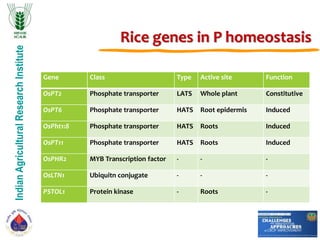
Rice genes in P homeostasis
Gene Class Type Active site Function
OsPT2 Phosphate transporter LATS Whole plant Constitutive
OsPT6 Phosphate transporter HATS Root epidermis Induced
OsPht1:8 Phosphate transporter HATS Roots Induced
OsPT11 Phosphate transporter HATS Roots Induced
OsPHR2 MYB Transcription factor - - -
OsLTN1 Ubiquitn conjugate - - -
PSTOL1 Protein kinase - Roots -
IndianAgriculturalResearchInstitute
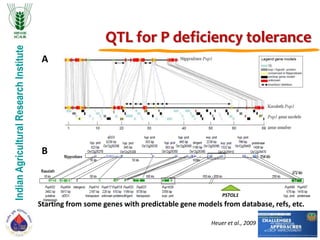
QTL for P deficiency tolerance
Heuer et al., 2009
A
B
Starting from some genes with predictable gene models from database, refs, etc.
PSTOL1
IndianAgriculturalResearchInstitute
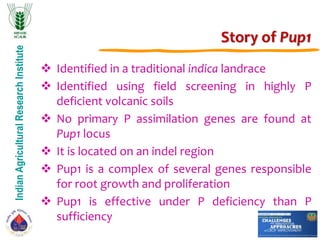
Story of Pup1
 Identified in a traditional indica landrace
 Identified using field screening in highly P
deficient volcanic soils
 No primary P assimilation genes are found at
Pup1 locus
 It is located on an indel region
 Pup1 is a complex of several genes responsible
for root growth and proliferation
 Pup1 is effective under P deficiency than P
sufficiency
IndianAgriculturalResearchInstitute
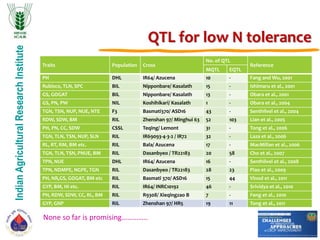
QTL for low N tolerance
Traits Population Cross
No. of QTL
Reference
MQTL EQTL
PH DHL IR64/ Azucena 10 - Fang and Wu, 2001
Rubisco, TLN, SPC BIL Nipponbare/ Kasalath 15 - Ishimaru et al., 2001
GS, GOGAT BIL Nipponbare/ Kasalath 13 - Obara et al., 2001
GS, PN, PW NIL Koshihikari/ Kasalath 1 - Obara et al., 2004
TGN, TSN, NUP, NUE, NTE F3 Basmati370/ ASD16 43 - Senthilvel et al., 2004
RDW, SDW, BM RIL Zhenshan 97/ Minghui 63 52 103 Lian et al., 2005
PH, PN, CC, SDW CSSL Teqing/ Lemont 31 - Tong et al., 2006
TGN, TLN, TSN, NUP, SLN RIL IR69093-4-3-2 / IR72 32 - Laza et al., 2006
RL, RT, RM, BM etc. RIL Bala/ Azucena 17 - MacMillan et al., 2006
TGN, TLN, TSN, PNUE, BM RIL Dasanbyeo / TR22183 20 58 Cho et al., 2007
TPN, NUE DHL IR64/ Azucena 16 - Senthilvel et al., 2008
TPN, NDMPE, NGPE, TGN RIL Dasanbyeo / TR22183 28 23 Piao et al., 2009
PH, NR,GS, GOGAT, BM etc RIL Basmati 370/ ASD16 15 44 Vinod et al., 2011
GYP, BM, HI etc. RIL IR64/ INRC10192 46 - Srividya et al., 2010
PH, RDW, SDW, CC, RL, BM RIL R9308/ Xieqingzao B 7 - Feng et al., 2010
GYP, GNP RIL Zhenshan 97/ HR5 19 11 Tong et al., 2011
None so far is promising…………..
IndianAgriculturalResearchInstitute
In pursuit of nutrient efficient varieties
Why nutrient efficiency, why not nutrient use efficiency?
The surplus-deficit scenario of plant breeding
Why rice is important?
Where to look for nutrient efficiency?
What to look for nutrient efficiency?
Where we are now?
Is the future bleak or bright?
IndianAgriculturalResearchInstitute
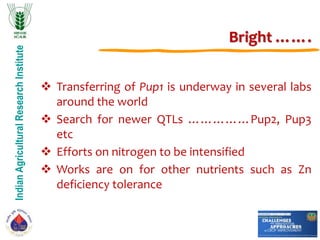
Bright …….
 Transferring of Pup1 is underway in several labs
around the world
 Search for newer QTLs ……………Pup2, Pup3
etc
 Efforts on nitrogen to be intensified
 Works are on for other nutrients such as Zn
deficiency tolerance
IndianAgriculturalResearchInstitute
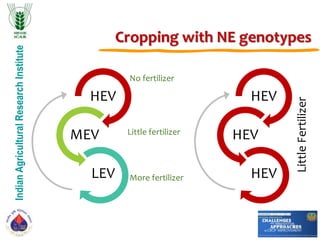
Cropping with NE genotypes
HEV
MEV
LEV
No fertilizer
Little fertilizer
More fertilizer
HEV
HEV
HEV
LittleFertilizer
IndianAgriculturalResearchInstitute
The bottom line….
With the current Nitrogen Use Efficiency of 40% under irrigated
rice grown in 18 Million ha in India/ Year
With 120 Kg/ha of N applied, a whopping 1.3 Million tonnes of N
is lost to the environment
This loss is equivalent to urea worth 1500o Million Rupees
A mere saving of 10% loss will translate to a saving of 2500 Million
rupees under irrigated rice alone
Similar is the case with P, where P use efficiency is just around
20%
The loss is estimated to 4.8 Million tonnes of super phosphate
worth Rupees 24500 Million
10% improvement P equals more then 3000 Million
IndianAgriculturalResearchInstitute
THANK YOU FOR YOUR
KIND ATTENTION
Besides we can have fertilizers for a
longer future!!!!

The need for nutrient efficient rice varieties Status and prospects

  • 1.
    IndianAgriculturalResearchInstitute The need fornutrient efficient rice varieties Status and prospects K K Vinod
  • 2.
    IndianAgriculturalResearchInstitute A rendezvous withthe impasse An impasse that is inevitable It is irreversible It is imminent It is relevant to the existence of mankind
  • 3.
    IndianAgriculturalResearchInstitute Heading for a‘stalemate’ in agriculture Modern agriculture is taxing the nature Demand for food is ever-increasing Land area is shrinking, thus productivity to go high Varieties are to be nutrient hungry Soil health is diminishing Fertilizer use is rising high Fertilizer sources are going to be exhausted! Where will we go tomorrow?
  • 4.
    IndianAgriculturalResearchInstitute In pursuit ofnutrient efficient varieties  Why nutrient efficiency, why not nutrient use efficiency?  The surplus-deficit scenario of plant breeding  Why rice is important?  Where to look for nutrient efficiency?  What to look for nutrient efficiency?  Where we are now?  Is the future bleak or bright?
  • 5.
    IndianAgriculturalResearchInstitute In pursuit ofnutrient efficient varieties Why nutrient efficiency, why not nutrient use efficiency? The surplus-deficit scenario of plant breeding Why rice is important? Where to look for nutrient efficiency? What to look for nutrient efficiency? Where we are now? Is the future bleak or bright?
  • 6.
    IndianAgriculturalResearchInstitute NE vs NUE •Nutrient use efficiency (NUE) is the crop response to applied nutrients • Nutrient efficiency (NE) is the crop response to total nutrients – applied and native • NUE is a function of increased nutrient input • NE is relevant to decrement in nutrient input • NE is associated to nutrient deficiency • NUE is associated to nutrient sufficiency • Both NUE and NE are genetic, NE is more complex than NUE
  • 7.
    IndianAgriculturalResearchInstitute Concerns of overdependence Overdependenceof mineral fertilizers (a) soil nutrient deficiency (b) non-recyclable nutrient loss (c) loss of nutrients by soil processes (d) Terrestrial nutrient pollution (e) atmospheric pollution (f) depletion of natural resources (g) geographic resource confinement (h) booming fertilizer costs (i) constrained fertilizer affordability to farmers (j) no alternative to fertilizer resources Uncertainty of looming threat of climate change
  • 8.
    IndianAgriculturalResearchInstitute In pursuit ofnutrient efficient varieties Why nutrient efficiency, why not nutrient use efficiency? The surplus-deficit scenario of plant breeding Why rice is important? Where to look for nutrient efficiency? What to look for nutrient efficiency? Where we are now? Is the future bleak or bright?
  • 9.
    IndianAgriculturalResearchInstitute Nutrient sufficiency • Modernagriculture is nutrient rich • Technology eased natural resource conversion • Fertilizers were made cheaper - subsidized • Supply is huge – More addition, more exhaustion • No regulation on fertilizer use • Intensive agriculture receives intensive fertilization • Poor farmlands go poorer and rich goes richer • Nutrients are sufficient enough for polluting • Modern varieties are nutrient hungry • No nutrient recycling – high harvest loss
  • 10.
    IndianAgriculturalResearchInstitute FAO (2008) Currentworld fertilizer trends and outlook 2011/2012 0 10 20 30 40 E. Europe & C. Asia Africa W. & C. Europe N. America L. America South Asia East Asia others N fertilizer P fertilizer 56.6 % P57.9 % N2.5 % P3.4 % N Higher P application is required on P fixing soils (e.g., Latin America) P-fixing soils S+E Asia consume more than 55% of the global fertilizer; Africa less than 3.5% Global fertilizer consumption: % share Source: IFA
  • 11.
    IndianAgriculturalResearchInstitute China and Indiaare the world’s biggest fertilizer consumers Source: IFA
  • 12.
  • 13.
  • 14.
    IndianAgriculturalResearchInstitute Liu J etal. PNAS 2010;107:8035-8040 Nitrogen stress levels in cropland on national average
  • 15.
  • 16.
    IndianAgriculturalResearchInstitute Urea synthesis willdry with oil wells? World’s estimated reserve of natural gas stood at 185.7 trillion cubic meters by the end of 2013, which is estimated to last only for next 55.1 years (BP 2014).
  • 17.
    IndianAgriculturalResearchInstitute Van Kauwenbergh 2010;IFDC report According to the IFDC study, phosphate rock will be available only for the next 300-400 years Rock Phosphate : A limited resource?
  • 18.
    IndianAgriculturalResearchInstitute Prices spiked in2008 and are currently still 3 times higher than before Fertilizers goes dearer….. Source: Fertecon, ICIS, Profercy US dollars/tonne
  • 19.
    IndianAgriculturalResearchInstitute Nutrient deficiency • Fertilizerreduction trigger deficiency and starvation • Natural resource conservation needs reduction • Fertilizers will go costlier • Supply will be limited • Fertilizer use will be discriminatory • Intensive agriculture receives reduced fertilization • Farmlands will have stabilized nutrient availability • No pollution of environment • Varieties are going to be nutrient judicious • No compromise in yield • Nutrient recycling will be prominent
  • 20.
    IndianAgriculturalResearchInstitute Nutrient deficiency isa stress Nutrient sufficiency is not a stress Stress tolerance require early sensing Triggering of tolerance mechanisms Homeostasis of nutrient ions Efficient uptake and assimilation process Efficient mobilization and remobilization
  • 21.
    IndianAgriculturalResearchInstitute The genetic riskof over-dependence Negative selection for deficiency tolerance Erosion of nutrient efficient genes Internal driving mechanisms of deficiency sensing ignored Pathways leading to secondary uptake processes ignored Symbiotic genes untargeted Uptake efficiency has little meaning under sufficiency than deficiency Over reliance on utilization efficiency in modern varieties
  • 22.
    IndianAgriculturalResearchInstitute In pursuit ofnutrient efficient varieties Why nutrient efficiency, why not nutrient use efficiency? The surplus-deficit scenario of plant breeding Why rice is important? Where to look for nutrient efficiency? What to look for nutrient efficiency? Where we are now? Is the future bleak or bright?
  • 23.
    IndianAgriculturalResearchInstitute Distribution of theworld rice production Rice in the world
  • 24.
  • 25.
  • 26.
    IndianAgriculturalResearchInstitute In pursuit ofnutrient efficient varieties Why nutrient efficiency, why not nutrient use efficiency? The surplus-deficit scenario of plant breeding Why rice is important? Where to look for nutrient efficiency? What to look for nutrient efficiency? Where we are now? Is the future bleak or bright?
  • 27.
    IndianAgriculturalResearchInstitute Germplasm to playa key role • Large amount of variability exists for nutrient efficiency in rice • Modern varieties may hold little promise as far as deficiency tolerance is concerned • Uptake efficiency is cardinal to nutrient absorption • Internal efficiency to create demand for optimal uptake to maintain homeostasis • New varieties to be both externally and internally efficient
  • 28.
    IndianAgriculturalResearchInstitute Phenotype diversity underN regimes N60 N120 Genotypes showed varying adaptive responses to nitrogen application
  • 29.
  • 30.
    IndianAgriculturalResearchInstitute Distribution of Pup1 SuperBasmati Basmati370 N22 PB-1 PB1121 PS-2 PS-3 PS-5 Pusa1401 Pusa1460 Taipai309 Kalanamak MTU 1061( Indra) Govind Hazari Dhan Kesava Lunishree MTU 2077 (Krishnaveni) Narendra 359 Pant Dhan 12 Pant Dhan 4 Pant Sankar dhan-3 PLA 1100 (Badava Mahsuri) Pothana Ranbir Basmati Red Trinaini Haldimuri Jhulhat MTU 1001( Vijetha) Sambha Mahsuri (BPT5204) Ananda Annapurna Bamleswari Bhadrakali CSR 10 CSR 13 Divya Govind Heera HUR 36 Kalinga 463 Kamlesh Kavya Mahamaya Malviya Dhan MTU 1010 MTU 5249( Vajram) MTU 5293 (Pratibha) NDR 97 Pant Sankar Dhan 1 Sadabahar Samleswari Sneha Sona Mahsuri Vanprabha Virendra VL dhan 221 Pup1 non-carriers (22%) Pup1 carriers (40%) Pup1 intermediates (38%)
  • 31.
    IndianAgriculturalResearchInstitute Landraces and traditionalvarieties • Experience from other crops and from rice • They remain unselected for NE genes • They still conserve NE genes • Wild germplasm to contribute to NE
  • 32.
    IndianAgriculturalResearchInstitute In pursuit ofnutrient efficient varieties Why nutrient efficiency, why not nutrient use efficiency? The surplus-deficit scenario of plant breeding Why rice is important? Where to look for nutrient efficiency? What to look for nutrient efficiency? Where we are now? Is the future bleak or bright?
  • 33.
    IndianAgriculturalResearchInstitute Key factors forbreeding • Heritability of the NE will be low • Little use of primary and secondary assimilation genes • Deficiency sensing and response to play a major role • Redefining physiological basis of NE • Molecular breeding may be more fruitful than conventional methods
  • 34.
    IndianAgriculturalResearchInstitute NE varieties wouldbe…. • High uptake efficient • Early in sensing starvation signals • Efficient in morpho-physiological adaptations • With better assimilation and remobilization • Nutrient use efficient • With better symbiotic machinery
  • 35.
    IndianAgriculturalResearchInstitute In pursuit ofnutrient efficient varieties Why nutrient efficiency, why not nutrient use efficiency? The surplus-deficit scenario of plant breeding Why rice is important? Where to look for nutrient efficiency? What to look for nutrient efficiency? Where we are now? Is the future bleak or bright?
  • 36.
    IndianAgriculturalResearchInstitute Back to squareone ……  Most of the attempts to map for the genes ended up in identifying NUE genes than NE  Redefining of traits to look for gains importance here  No sense in identifying genes under no fertilizer input  No sense in identifying genes using HYVs  Field screening may give better results than artificial screens
  • 37.
    IndianAgriculturalResearchInstitute Rice genes inN homeostasis Gene Class Type Active site Function OsNRT1 Nitrate transporter LATS Root epidermis, root hair Constitutive OsNRT2.1 Nitrate transporter HATS Roots Induced OsNRT2.2 Nitrate transporter HATS Roots Induced OsNRT2.3 a/b Nitrate transporter HATS Roots Induced OsNAR2.1 Nitrate transporter HATS Roots Induced OsAMT1;1 Ammonium transporter HATS Shoots, roots Constitutive OsAMT1;2 Ammonium transporter HATS Roots Induced OsAMT1;3 Ammonium transporter HATS Roots Repressible OsDUR3 Urea transporter HATS Roots - OsENOD93-1 Nodulin gene - Roots - OsGS1;1 Glutamine synthetase - Whole plant; high in leaf Constitutive OsGS1;2 Glutamine synthetase - Whole plant; high in leaf Constitutive OsGS1;3 Glutamine synthetase - Spikelets Constitutive OsNADH-GOGAT1 Glutamate synthase - Root tips, meristem Constitutive OsNADH-GOGAT2 Glutamate synthase - Mature leaves, leaf sheath Constitutive
  • 38.
    IndianAgriculturalResearchInstitute Rice genes inP homeostasis Gene Class Type Active site Function OsPT2 Phosphate transporter LATS Whole plant Constitutive OsPT6 Phosphate transporter HATS Root epidermis Induced OsPht1:8 Phosphate transporter HATS Roots Induced OsPT11 Phosphate transporter HATS Roots Induced OsPHR2 MYB Transcription factor - - - OsLTN1 Ubiquitn conjugate - - - PSTOL1 Protein kinase - Roots -
  • 39.
    IndianAgriculturalResearchInstitute QTL for Pdeficiency tolerance Heuer et al., 2009 A B Starting from some genes with predictable gene models from database, refs, etc. PSTOL1
  • 40.
    IndianAgriculturalResearchInstitute Story of Pup1 Identified in a traditional indica landrace  Identified using field screening in highly P deficient volcanic soils  No primary P assimilation genes are found at Pup1 locus  It is located on an indel region  Pup1 is a complex of several genes responsible for root growth and proliferation  Pup1 is effective under P deficiency than P sufficiency
  • 41.
    IndianAgriculturalResearchInstitute QTL for lowN tolerance Traits Population Cross No. of QTL Reference MQTL EQTL PH DHL IR64/ Azucena 10 - Fang and Wu, 2001 Rubisco, TLN, SPC BIL Nipponbare/ Kasalath 15 - Ishimaru et al., 2001 GS, GOGAT BIL Nipponbare/ Kasalath 13 - Obara et al., 2001 GS, PN, PW NIL Koshihikari/ Kasalath 1 - Obara et al., 2004 TGN, TSN, NUP, NUE, NTE F3 Basmati370/ ASD16 43 - Senthilvel et al., 2004 RDW, SDW, BM RIL Zhenshan 97/ Minghui 63 52 103 Lian et al., 2005 PH, PN, CC, SDW CSSL Teqing/ Lemont 31 - Tong et al., 2006 TGN, TLN, TSN, NUP, SLN RIL IR69093-4-3-2 / IR72 32 - Laza et al., 2006 RL, RT, RM, BM etc. RIL Bala/ Azucena 17 - MacMillan et al., 2006 TGN, TLN, TSN, PNUE, BM RIL Dasanbyeo / TR22183 20 58 Cho et al., 2007 TPN, NUE DHL IR64/ Azucena 16 - Senthilvel et al., 2008 TPN, NDMPE, NGPE, TGN RIL Dasanbyeo / TR22183 28 23 Piao et al., 2009 PH, NR,GS, GOGAT, BM etc RIL Basmati 370/ ASD16 15 44 Vinod et al., 2011 GYP, BM, HI etc. RIL IR64/ INRC10192 46 - Srividya et al., 2010 PH, RDW, SDW, CC, RL, BM RIL R9308/ Xieqingzao B 7 - Feng et al., 2010 GYP, GNP RIL Zhenshan 97/ HR5 19 11 Tong et al., 2011 None so far is promising…………..
  • 42.
    IndianAgriculturalResearchInstitute In pursuit ofnutrient efficient varieties Why nutrient efficiency, why not nutrient use efficiency? The surplus-deficit scenario of plant breeding Why rice is important? Where to look for nutrient efficiency? What to look for nutrient efficiency? Where we are now? Is the future bleak or bright?
  • 43.
    IndianAgriculturalResearchInstitute Bright …….  Transferringof Pup1 is underway in several labs around the world  Search for newer QTLs ……………Pup2, Pup3 etc  Efforts on nitrogen to be intensified  Works are on for other nutrients such as Zn deficiency tolerance
  • 44.
    IndianAgriculturalResearchInstitute Cropping with NEgenotypes HEV MEV LEV No fertilizer Little fertilizer More fertilizer HEV HEV HEV LittleFertilizer
  • 45.
    IndianAgriculturalResearchInstitute The bottom line…. Withthe current Nitrogen Use Efficiency of 40% under irrigated rice grown in 18 Million ha in India/ Year With 120 Kg/ha of N applied, a whopping 1.3 Million tonnes of N is lost to the environment This loss is equivalent to urea worth 1500o Million Rupees A mere saving of 10% loss will translate to a saving of 2500 Million rupees under irrigated rice alone Similar is the case with P, where P use efficiency is just around 20% The loss is estimated to 4.8 Million tonnes of super phosphate worth Rupees 24500 Million 10% improvement P equals more then 3000 Million
  • 46.
    IndianAgriculturalResearchInstitute THANK YOU FORYOUR KIND ATTENTION Besides we can have fertilizers for a longer future!!!!