NUMERICAL METHOD
Introduction
Numerical methods can be used to find roots of a function
→We find roots of a function by;
1. Direct method
2. Iterative method
ERROR
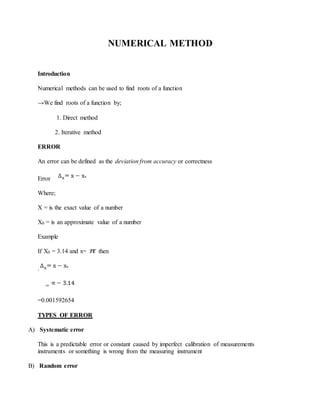
An error can be defined as the deviation from accuracy or correctness
Error
Where;
X = is the exact value of a number
X0 = is an approximate value of a number
Example
If X0 = 3.14 and x= then
.
=
=0.001592654
TYPES OF ERROR
A) Systematic error
This is a predictable error or constant caused by imperfect calibration of measurements
instruments or something is wrong from the measuring instrument
B) Random error
Unpredictable error caused either by weather or anything else.
Sources of errors
1. Experimentation error/modeling error
2. Truncation error/terminating error
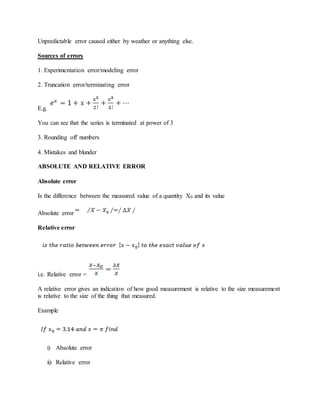
E.g.
You can see that the series is terminated at power of 3
3. Rounding off numbers
4. Mistakes and blunder
ABSOLUTE AND RELATIVE ERROR
Absolute error
Is the difference between the measured value of a quantity X0 and its value
Absolute error
Relative error
i.e. Relative error =
A relative error gives an indication of how good measurement is relative to the size measurement
is relative to the size of the thing that measured.
Example
i) Absolute error
ii) Relative error
iii)Percentage error
Solution
i. Absolute error = /X – X0/
= X – X0
∆x = 0.001592654
ii. Relative error
=
= 0.000050696(9dp)
iii. Percentage error
= 0.000050696 x 100%
= 5.0696 x 10⁻²%
Roots by iterative methods
Iterative method is used to find a root of function by approximations repeatedly.
If f(x1), f(x2) < 0 the root lies between X1and X2
Newton’s Raphson formula
The formula is based on the tangent lines drawn to the curves through x-axis
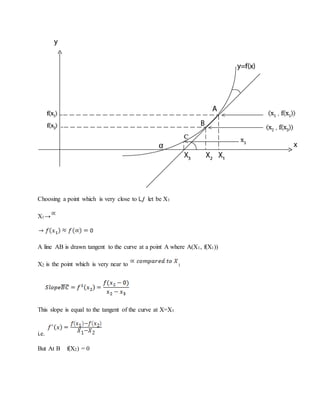
Consider the graph below
Suppose f(x) = 0 has a root that x is an approximation for
Choosing a point which is very close to  let be X1
X1→
A line AB is drawn tangent to the curve at a point A where A(X1, f(X1))
X2 is the point which is very near to 1
This slope is equal to the tangent of the curve at X=X1
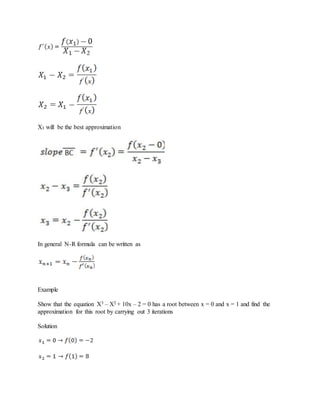
i.e.
But At B f(X2) = 0
X3 will be the best approximation
In general N-R formula can be written as
Example
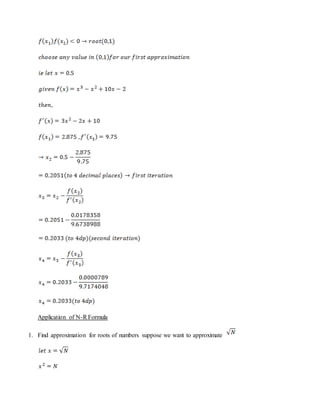
Show that the equation X3 – X2 + 10x – 2 = 0 has a root between x = 0 and x = 1 and find the
approximation for this root by carrying out 3 iterations
Solution
Application of N-RFormula
1. Find approximation for roots of numbers suppose we want to approximate
Example
B y using 2 iteration only and starting with an initial value 2, find the square root of 5 correct to
four decimal place
Solution
Let x=
X2=5
X2 – 5 = 0
Let f(x) = x2 – 5 by N.R formula
f’(x)= 2x
Given X1=2
Then
First iteration
Example
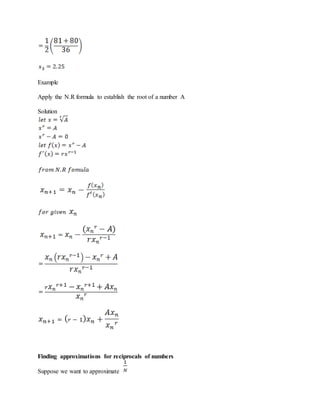
Apply the N.R formula to establish the root of a number A
Solution
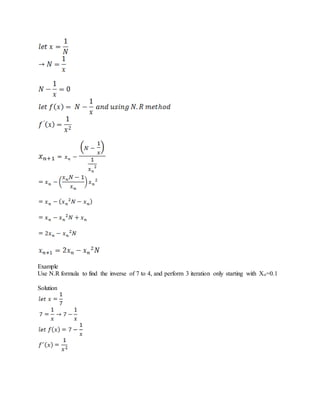
Finding approximations for reciprocals of numbers
Suppose we want to approximate
Example
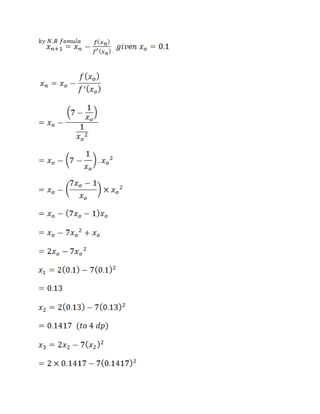
Use N.R formula to find the inverse of 7 to 4, and perform 3 iteration only starting with Xo=0.1
Solution
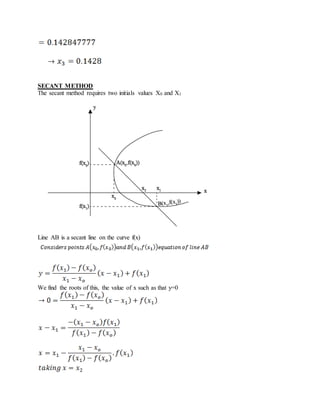
SECANT METHOD
The secant method requires two initials values X0 and X1
Line AB is a secant line on the curve f(x)
We find the roots of this, the value of x such as that y=0
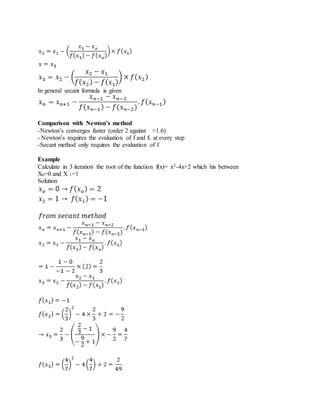
In general secant formula is given
Comparison with Newton’s method
-Newton’s converges faster (order 2 against ≈1.6)
- Newton’s requires the evaluation of f and f1 at every step
-Secant method only requires the evaluation of f
Example
Calculate in 3 iteration the root of the function f(x)= x2-4x+2 which his between
X0=0 and X 1=1
Solution
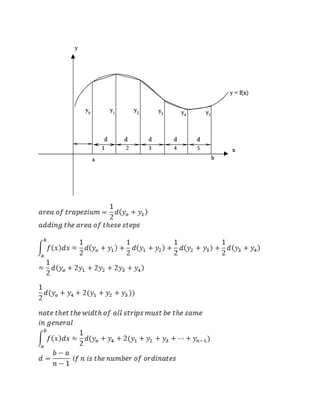
NUMERICAL INTEGRATION
Definite integral is used to determine the area between y= f(x), the x -axis and the
ordinates x = a and x = b
An approximate value for the integral can be found by estimating this area by another two
methods
A. Trapezium rule
Example
Estimate to 4 decimal places
Using five ordinates by the trapezium rule
Solution
Taking five ordinates from X = 0 to X = 1
5 – 1 = 4 number of strips
X 0 0.25 0.5 0.75 1
Y 1 0.9412 0.8 0.64 0.5
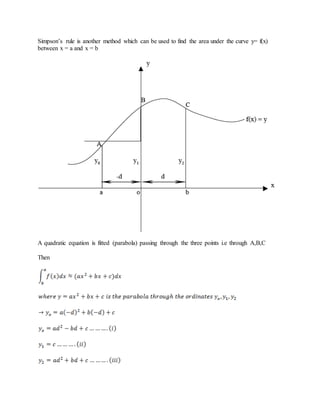
Simpson’s rule
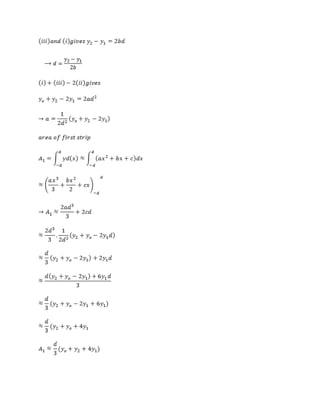
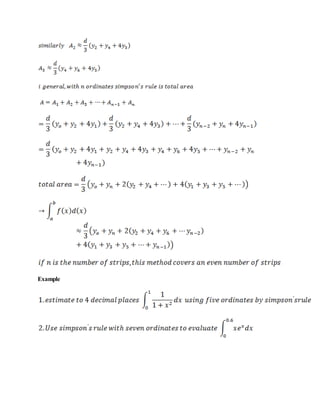
Simpson’s rule is another method which can be used to find the area under the curve y= f(x)
between x = a and x = b
A quadratic equation is fitted (parabola) passing through the three points i.e through A,B,C
Then
Example

NUMERICAL METHOD

  • 1.
    NUMERICAL METHOD Introduction Numerical methodscan be used to find roots of a function →We find roots of a function by; 1. Direct method 2. Iterative method ERROR An error can be defined as the deviation from accuracy or correctness Error Where; X = is the exact value of a number X0 = is an approximate value of a number Example If X0 = 3.14 and x= then . = =0.001592654 TYPES OF ERROR A) Systematic error This is a predictable error or constant caused by imperfect calibration of measurements instruments or something is wrong from the measuring instrument B) Random error
  • 2.
    Unpredictable error causedeither by weather or anything else. Sources of errors 1. Experimentation error/modeling error 2. Truncation error/terminating error E.g. You can see that the series is terminated at power of 3 3. Rounding off numbers 4. Mistakes and blunder ABSOLUTE AND RELATIVE ERROR Absolute error Is the difference between the measured value of a quantity X0 and its value Absolute error Relative error i.e. Relative error = A relative error gives an indication of how good measurement is relative to the size measurement is relative to the size of the thing that measured. Example i) Absolute error ii) Relative error
  • 3.
    iii)Percentage error Solution i. Absoluteerror = /X – X0/ = X – X0 ∆x = 0.001592654 ii. Relative error = = 0.000050696(9dp) iii. Percentage error = 0.000050696 x 100% = 5.0696 x 10⁻²% Roots by iterative methods Iterative method is used to find a root of function by approximations repeatedly. If f(x1), f(x2) < 0 the root lies between X1and X2 Newton’s Raphson formula The formula is based on the tangent lines drawn to the curves through x-axis Consider the graph below Suppose f(x) = 0 has a root that x is an approximation for
  • 4.
    Choosing a pointwhich is very close to  let be X1 X1→ A line AB is drawn tangent to the curve at a point A where A(X1, f(X1)) X2 is the point which is very near to 1 This slope is equal to the tangent of the curve at X=X1 i.e. But At B f(X2) = 0
  • 5.
    X3 will bethe best approximation In general N-R formula can be written as Example Show that the equation X3 – X2 + 10x – 2 = 0 has a root between x = 0 and x = 1 and find the approximation for this root by carrying out 3 iterations Solution
  • 6.
    Application of N-RFormula 1.Find approximation for roots of numbers suppose we want to approximate
  • 7.
    Example B y using2 iteration only and starting with an initial value 2, find the square root of 5 correct to four decimal place Solution Let x= X2=5 X2 – 5 = 0 Let f(x) = x2 – 5 by N.R formula
  • 8.
  • 9.
    Example Apply the N.Rformula to establish the root of a number A Solution Finding approximations for reciprocals of numbers Suppose we want to approximate
  • 10.
    Example Use N.R formulato find the inverse of 7 to 4, and perform 3 iteration only starting with Xo=0.1 Solution
  • 12.
    SECANT METHOD The secantmethod requires two initials values X0 and X1 Line AB is a secant line on the curve f(x) We find the roots of this, the value of x such as that y=0
  • 13.
    In general secantformula is given Comparison with Newton’s method -Newton’s converges faster (order 2 against ≈1.6) - Newton’s requires the evaluation of f and f1 at every step -Secant method only requires the evaluation of f Example Calculate in 3 iteration the root of the function f(x)= x2-4x+2 which his between X0=0 and X 1=1 Solution
  • 14.
    NUMERICAL INTEGRATION Definite integralis used to determine the area between y= f(x), the x -axis and the ordinates x = a and x = b An approximate value for the integral can be found by estimating this area by another two methods A. Trapezium rule
  • 16.
    Example Estimate to 4decimal places Using five ordinates by the trapezium rule Solution Taking five ordinates from X = 0 to X = 1 5 – 1 = 4 number of strips X 0 0.25 0.5 0.75 1 Y 1 0.9412 0.8 0.64 0.5 Simpson’s rule
  • 17.
    Simpson’s rule isanother method which can be used to find the area under the curve y= f(x) between x = a and x = b A quadratic equation is fitted (parabola) passing through the three points i.e through A,B,C Then
  • 19.