Section 2 : Calculus
Topic 1 : Functions of Single Variable Limit,
Continuity and Differentiability
Functions
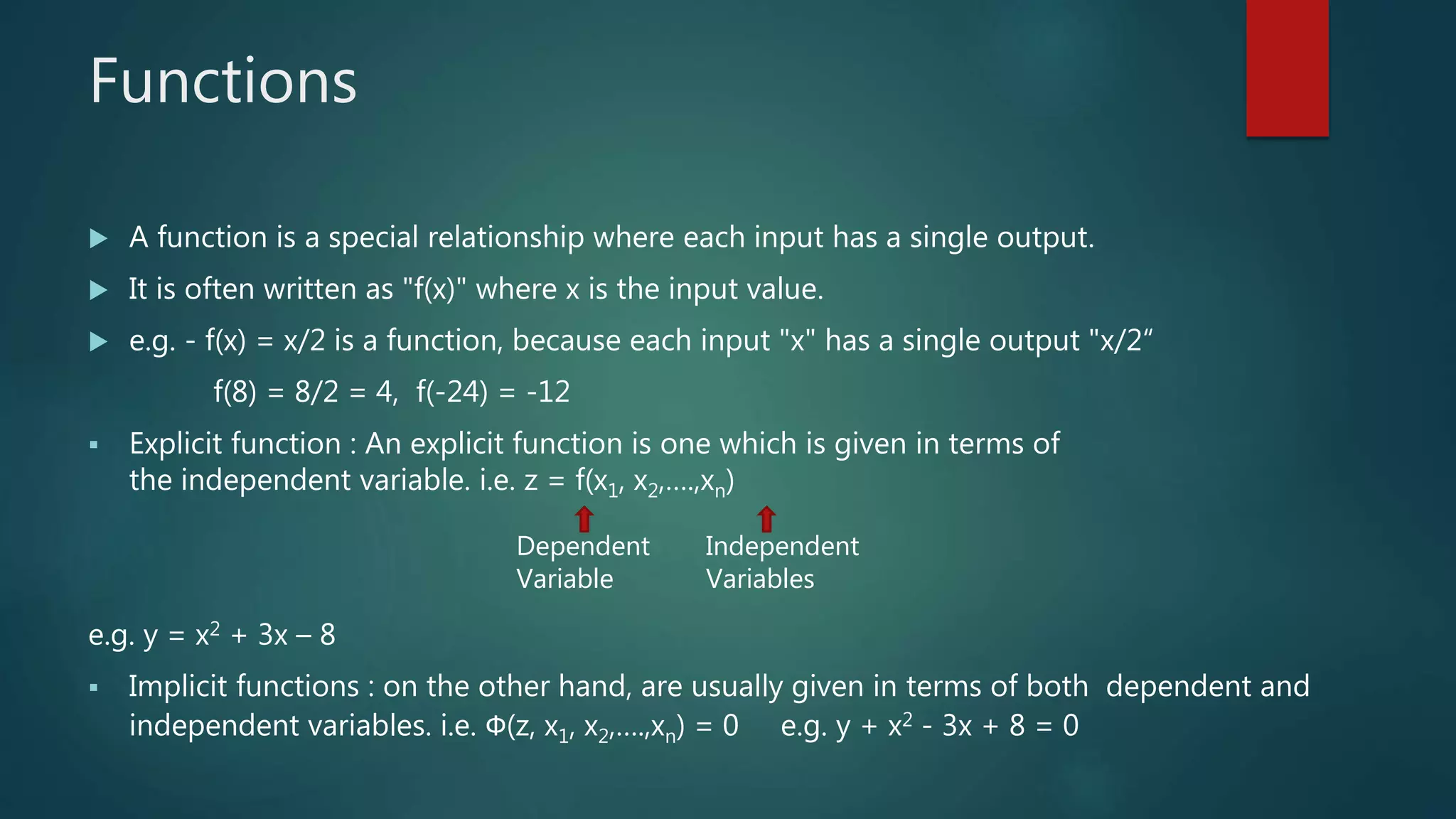
 A function is a special relationship where each input has a single output.
 It is often written as "f(x)" where x is the input value.
 e.g. - f(x) = x/2 is a function, because each input "x" has a single output "x/2“
f(8) = 8/2 = 4, f(-24) = -12
 Explicit function : An explicit function is one which is given in terms of
the independent variable. i.e. z = f(x1, x2,….,xn)
e.g. y = x2 + 3x – 8
 Implicit functions : on the other hand, are usually given in terms of both dependent and
independent variables. i.e. Ф(z, x1, x2,….,xn) = 0 e.g. y + x2 - 3x + 8 = 0
Dependent
Variable
Independent
Variables
Functions
 Composite function : z = f(x, y) where, x = Ф(t) and y = ψ(t)
Some special functions
 Even function : f(-x) = f(x) e.g. – cos x, x2
 Odd function : f(-x) = - f(x)
 Modulus function : f(x) = |x|= x ; x > 0
= -x ; x < 0
= 0 ; x = 0
 Greatest integer function : For all real numbers, x, the greatest integer function returns the
largest integer less than or equal to x. f(x) = [x] = n є z |where n ≤ x < n+1.
e.g. [7.2] = 7
Functions
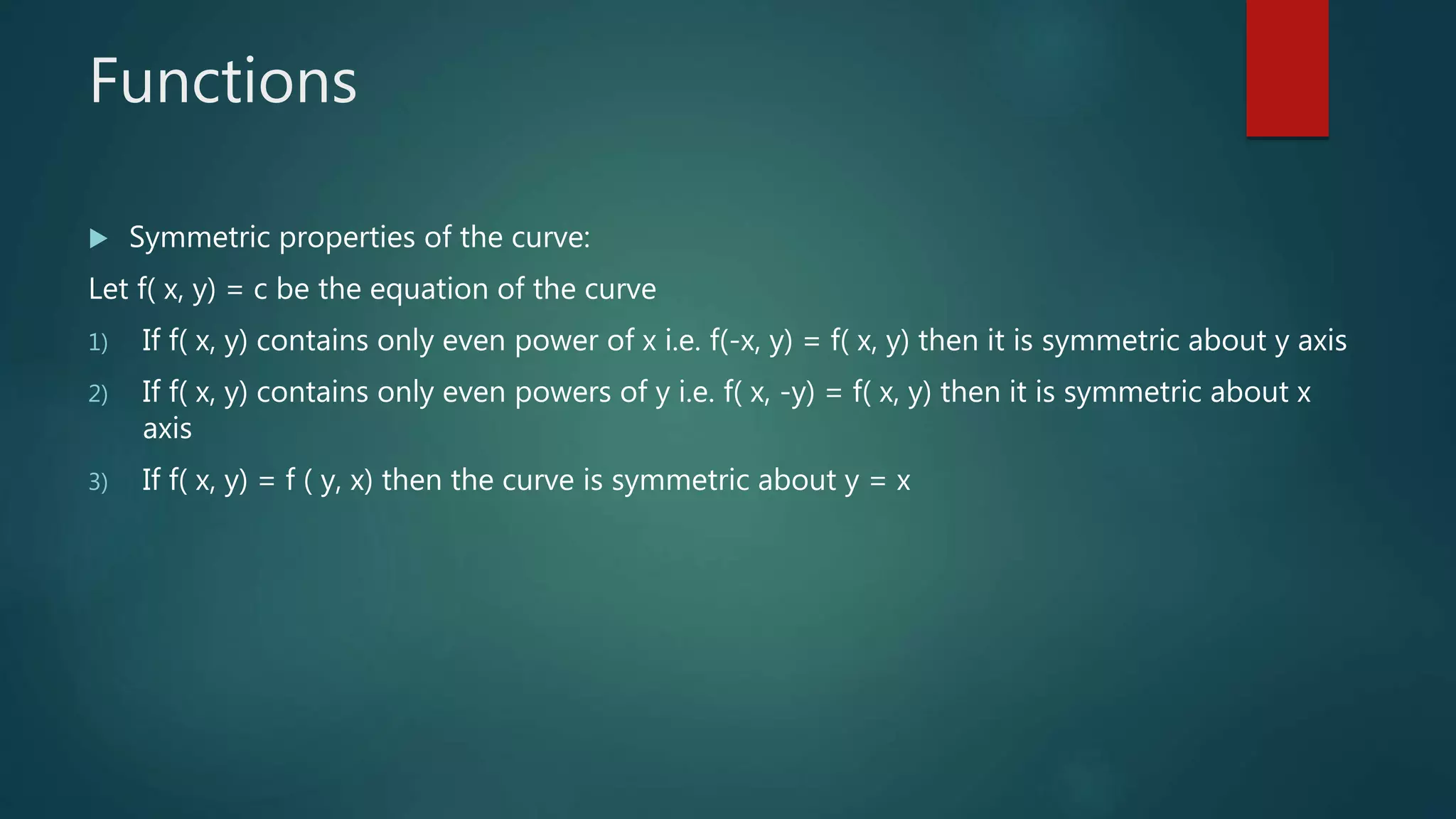
 Symmetric properties of the curve:
Let f( x, y) = c be the equation of the curve
1) If f( x, y) contains only even power of x i.e. f(-x, y) = f( x, y) then it is symmetric about y axis
2) If f( x, y) contains only even powers of y i.e. f( x, -y) = f( x, y) then it is symmetric about x
axis
3) If f( x, y) = f ( y, x) then the curve is symmetric about y = x
Limits
 Limit of a function: let f(x) be defined in neighbourhood of a є R, then l є R is said to be limit
f(x) as x approaches a if for given є > 0 & δ > 0 such that |f(x) – l|< є whenever |x – a|< δ.
 lim
𝑥→𝑎
𝑓(𝑥) = l
 Left limit : when x < a, lim
𝑥→𝑎−
𝑓(𝑥) = lim
ℎ→0
𝑓(𝑎 − ℎ) where h = a - x
 Right limit : when x < a, lim
𝑥→𝑎+
𝑓(𝑥) = lim
ℎ→0
𝑓(𝑎 + ℎ) where h = x – a
 Limit exists only if lim
𝑥→𝑎−
𝑓(𝑥) = lim
𝑥→𝑎+
𝑓(𝑥)
 L’ Hospital’s rule : lim
𝑥→𝑎
𝑓(𝑥)
𝑔(𝑥)
= lim
𝑥→𝑎
𝑓′(𝑥)
𝑔′(𝑥)
[ as
0
0
or
∞
∞
]
Limits
 Example : Applying L’ Hospitals' rule
lim
𝑥→0
1−cos 3𝑥
𝑥 sin 2𝑥
[
0
0
]
lim
𝑥→0
3 sin 3𝑥
sin 2𝑥+2𝑥 cos 2𝑥
lim
𝑥→0
9 cos 3𝑥
2 𝑐𝑜𝑠2𝑥+2 cos 2𝑥−4𝑥 sin 2𝑥
=
9
4
IMP
Limits
 If we have 1∞ form, lim
𝑥→𝑎
𝑓(𝑥)g(x) = 𝑒
lim
𝑥→𝑎
𝑔 𝑥 [𝑓 𝑥 −1]
 e.g. lim
𝑥→0
1 − sin 𝑥 ^ (
1
sin x
)
 𝑒
lim
𝑥→0
1−sin 𝑥 −1
sin 𝑥
 𝑒
lim
𝑥→0
−1

1
𝑒
Continuity
 Continuity at a point : A function is said to be continuous at a point x = a, if lim
𝑥→𝑎
𝑓(𝑥) = 𝑓(𝑎)
 Continuity in an interval : A function f(x) is said to be continuous in [a, b] if it satisfies following
three conditions
1. f(x) is continuous ∀ 𝑥 ∈ (𝑎, 𝑏)
2. lim
𝑥→𝑎+
𝑓(𝑥) = 𝑓(𝑎)
3. lim
𝑥→𝑏−
𝑓(𝑥) = 𝑓(𝑏)
e.g. f(x) = 0 ; x = 0
=
1
2
- x ; 0 < x <
1
2
=
1
2
; x =
1
2
=
3
2
- x ;
1
2
< x < 1 = 1 ; x ≥ 1
Continuity
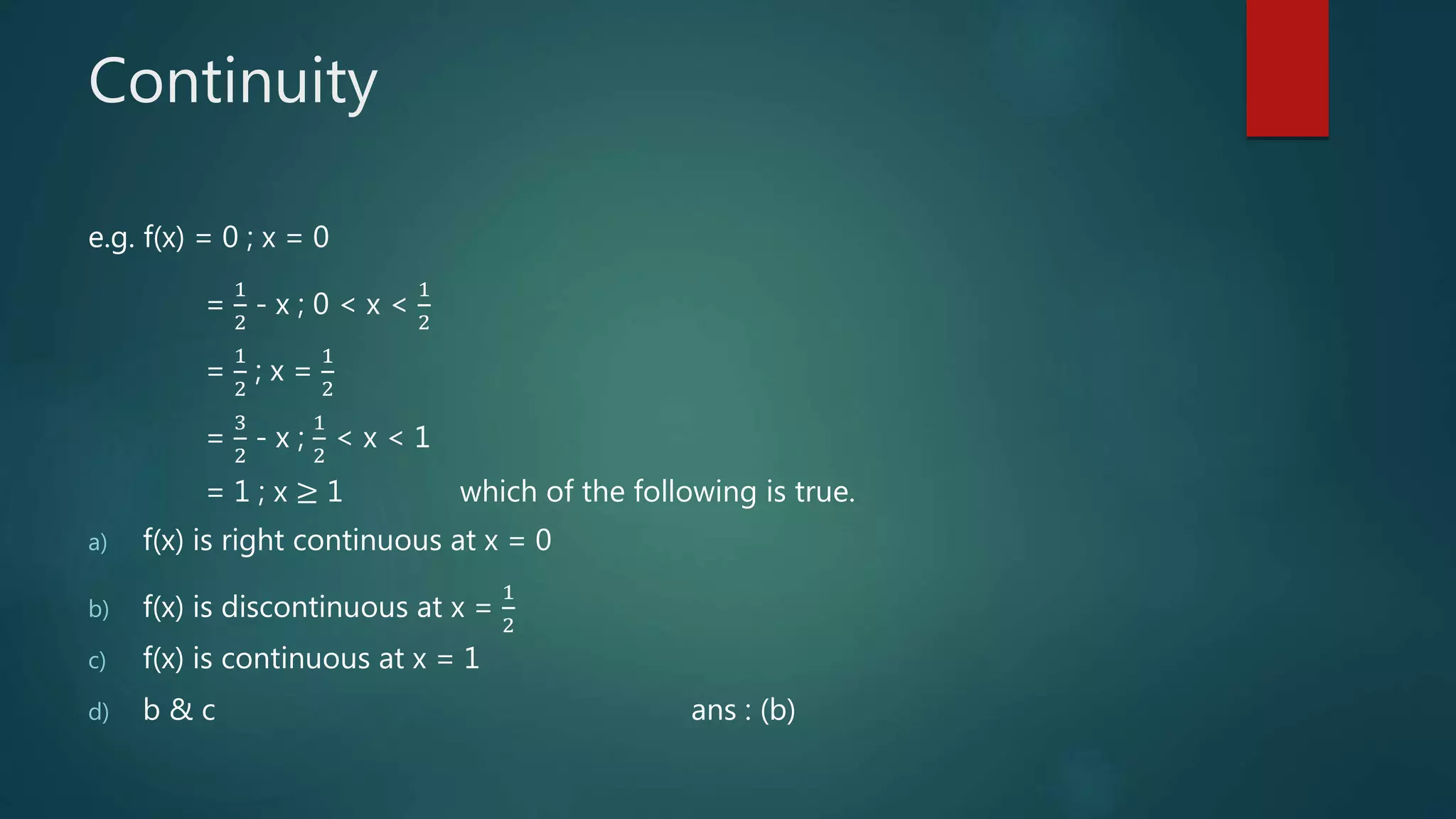
e.g. f(x) = 0 ; x = 0
=
1
2
- x ; 0 < x <
1
2
=
1
2
; x =
1
2
=
3
2
- x ;
1
2
< x < 1
= 1 ; x ≥ 1 which of the following is true.
a) f(x) is right continuous at x = 0
b) f(x) is discontinuous at x =
1
2
c) f(x) is continuous at x = 1
d) b & c ans : (b)
Differentiation
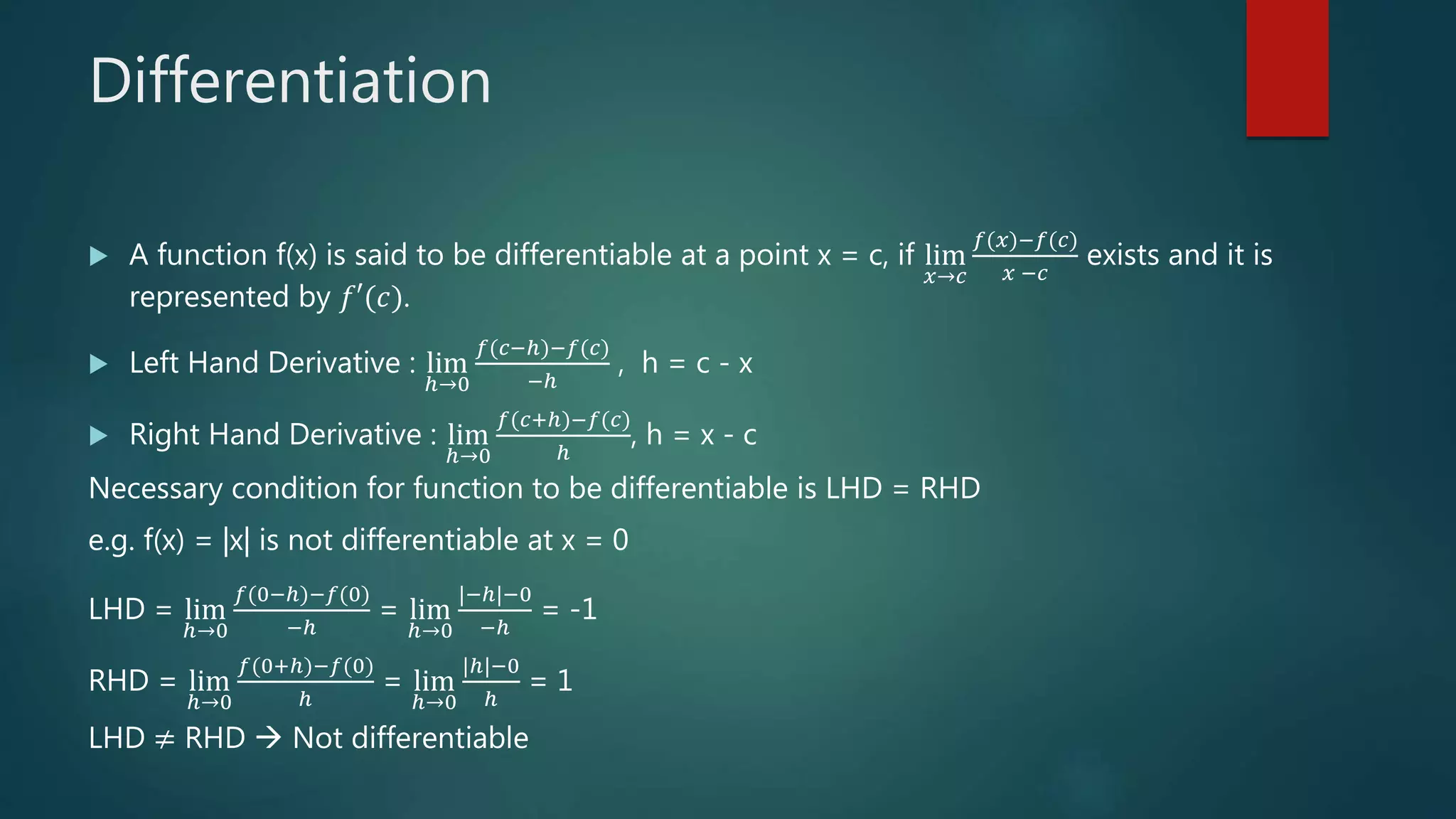
 A function f(x) is said to be differentiable at a point x = c, if lim
𝑥→𝑐
𝑓(𝑥)−𝑓(𝑐)
𝑥 −𝑐
exists and it is
represented by 𝑓′(𝑐).
 Left Hand Derivative : lim
ℎ→0
𝑓(𝑐−ℎ)−𝑓(𝑐)
−ℎ
, h = c - x
 Right Hand Derivative : lim
ℎ→0
𝑓(𝑐+ℎ)−𝑓(𝑐)
ℎ
, h = x - c
Necessary condition for function to be differentiable is LHD = RHD
e.g. f(x) = |x| is not differentiable at x = 0
LHD = lim
ℎ→0
𝑓(0−ℎ)−𝑓(0)
−ℎ
= lim
ℎ→0
|−ℎ|−0
−ℎ
= -1
RHD = lim
ℎ→0
𝑓(0+ℎ)−𝑓(0)
ℎ
= lim
ℎ→0
|ℎ|−0
ℎ
= 1
LHD ≠ RHD  Not differentiable
Differentiation
 Note:
 Every differentiable function is a continuous function
 But every continuous function is not differentiable

GATE Engineering Maths : Limit, Continuity and Differentiability

  • 1.
    Section 2 :Calculus Topic 1 : Functions of Single Variable Limit, Continuity and Differentiability
  • 2.
    Functions  A functionis a special relationship where each input has a single output.  It is often written as "f(x)" where x is the input value.  e.g. - f(x) = x/2 is a function, because each input "x" has a single output "x/2“ f(8) = 8/2 = 4, f(-24) = -12  Explicit function : An explicit function is one which is given in terms of the independent variable. i.e. z = f(x1, x2,….,xn) e.g. y = x2 + 3x – 8  Implicit functions : on the other hand, are usually given in terms of both dependent and independent variables. i.e. Ф(z, x1, x2,….,xn) = 0 e.g. y + x2 - 3x + 8 = 0 Dependent Variable Independent Variables
  • 3.
    Functions  Composite function: z = f(x, y) where, x = Ф(t) and y = ψ(t) Some special functions  Even function : f(-x) = f(x) e.g. – cos x, x2  Odd function : f(-x) = - f(x)  Modulus function : f(x) = |x|= x ; x > 0 = -x ; x < 0 = 0 ; x = 0  Greatest integer function : For all real numbers, x, the greatest integer function returns the largest integer less than or equal to x. f(x) = [x] = n є z |where n ≤ x < n+1. e.g. [7.2] = 7
  • 4.
    Functions  Symmetric propertiesof the curve: Let f( x, y) = c be the equation of the curve 1) If f( x, y) contains only even power of x i.e. f(-x, y) = f( x, y) then it is symmetric about y axis 2) If f( x, y) contains only even powers of y i.e. f( x, -y) = f( x, y) then it is symmetric about x axis 3) If f( x, y) = f ( y, x) then the curve is symmetric about y = x
  • 5.
    Limits  Limit ofa function: let f(x) be defined in neighbourhood of a є R, then l є R is said to be limit f(x) as x approaches a if for given є > 0 & δ > 0 such that |f(x) – l|< є whenever |x – a|< δ.  lim 𝑥→𝑎 𝑓(𝑥) = l  Left limit : when x < a, lim 𝑥→𝑎− 𝑓(𝑥) = lim ℎ→0 𝑓(𝑎 − ℎ) where h = a - x  Right limit : when x < a, lim 𝑥→𝑎+ 𝑓(𝑥) = lim ℎ→0 𝑓(𝑎 + ℎ) where h = x – a  Limit exists only if lim 𝑥→𝑎− 𝑓(𝑥) = lim 𝑥→𝑎+ 𝑓(𝑥)  L’ Hospital’s rule : lim 𝑥→𝑎 𝑓(𝑥) 𝑔(𝑥) = lim 𝑥→𝑎 𝑓′(𝑥) 𝑔′(𝑥) [ as 0 0 or ∞ ∞ ]
  • 6.
    Limits  Example :Applying L’ Hospitals' rule lim 𝑥→0 1−cos 3𝑥 𝑥 sin 2𝑥 [ 0 0 ] lim 𝑥→0 3 sin 3𝑥 sin 2𝑥+2𝑥 cos 2𝑥 lim 𝑥→0 9 cos 3𝑥 2 𝑐𝑜𝑠2𝑥+2 cos 2𝑥−4𝑥 sin 2𝑥 = 9 4 IMP
  • 7.
    Limits  If wehave 1∞ form, lim 𝑥→𝑎 𝑓(𝑥)g(x) = 𝑒 lim 𝑥→𝑎 𝑔 𝑥 [𝑓 𝑥 −1]  e.g. lim 𝑥→0 1 − sin 𝑥 ^ ( 1 sin x )  𝑒 lim 𝑥→0 1−sin 𝑥 −1 sin 𝑥  𝑒 lim 𝑥→0 −1  1 𝑒
  • 8.
    Continuity  Continuity ata point : A function is said to be continuous at a point x = a, if lim 𝑥→𝑎 𝑓(𝑥) = 𝑓(𝑎)  Continuity in an interval : A function f(x) is said to be continuous in [a, b] if it satisfies following three conditions 1. f(x) is continuous ∀ 𝑥 ∈ (𝑎, 𝑏) 2. lim 𝑥→𝑎+ 𝑓(𝑥) = 𝑓(𝑎) 3. lim 𝑥→𝑏− 𝑓(𝑥) = 𝑓(𝑏) e.g. f(x) = 0 ; x = 0 = 1 2 - x ; 0 < x < 1 2 = 1 2 ; x = 1 2 = 3 2 - x ; 1 2 < x < 1 = 1 ; x ≥ 1
  • 9.
    Continuity e.g. f(x) =0 ; x = 0 = 1 2 - x ; 0 < x < 1 2 = 1 2 ; x = 1 2 = 3 2 - x ; 1 2 < x < 1 = 1 ; x ≥ 1 which of the following is true. a) f(x) is right continuous at x = 0 b) f(x) is discontinuous at x = 1 2 c) f(x) is continuous at x = 1 d) b & c ans : (b)
  • 10.
    Differentiation  A functionf(x) is said to be differentiable at a point x = c, if lim 𝑥→𝑐 𝑓(𝑥)−𝑓(𝑐) 𝑥 −𝑐 exists and it is represented by 𝑓′(𝑐).  Left Hand Derivative : lim ℎ→0 𝑓(𝑐−ℎ)−𝑓(𝑐) −ℎ , h = c - x  Right Hand Derivative : lim ℎ→0 𝑓(𝑐+ℎ)−𝑓(𝑐) ℎ , h = x - c Necessary condition for function to be differentiable is LHD = RHD e.g. f(x) = |x| is not differentiable at x = 0 LHD = lim ℎ→0 𝑓(0−ℎ)−𝑓(0) −ℎ = lim ℎ→0 |−ℎ|−0 −ℎ = -1 RHD = lim ℎ→0 𝑓(0+ℎ)−𝑓(0) ℎ = lim ℎ→0 |ℎ|−0 ℎ = 1 LHD ≠ RHD  Not differentiable
  • 11.
    Differentiation  Note:  Everydifferentiable function is a continuous function  But every continuous function is not differentiable