12 
VVEECCTTOORRSS AANNDD 
TTHHEE GGEEOOMMEETTRRYY OOFF SSPPAACCEE
VECTORS AND THE GEOMETRY OF SPACE 
In this chapter, we introduce 
vectors and coordinate systems 
for three-dimensional space.
VECTORS AND THE GEOMETRY OF SPACE 
This will be the setting for our study of 
the calculus of functions of two variables 
in Chapter 14. 
 This is because the graph of such a function 
is a surface in space.
VECTORS AND THE GEOMETRY OF SPACE 
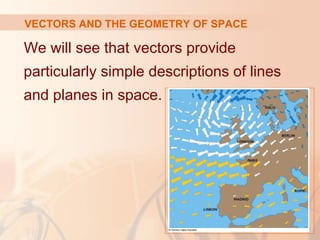
We will see that vectors provide 
particularly simple descriptions of lines 
and planes in space.
VECTORS AND THE GEOMETRY OF SPACE 
12.1 
Three-Dimensional 
Coordinate Systems 
In this section, we will learn about: 
Aspects of three-dimensional coordinate systems.
TWO-DIMENSIONAL (2-D) COORDINATE SYSTEMS 
To locate a point in a plane, two numbers 
are necessary. 
 We know that any point in the plane can be represented 
as an ordered pair (a, b) of real numbers—where a is 
the x-coordinate and b is the y-coordinate. 
 For this reason, a plane is called two-dimensional.
THREE-DIMENSIONAL (3-D) COORDINATE SYSTEMS 
To locate a point in space, three 
numbers are required. 
 We represent any point in space by 
an ordered triple (a, b, c) of real numbers.
3-D COORDINATE SYSTEMS 
In order to represent points in space, 
we first choose: 
 A fixed point O (the origin) 
 Three directed lines through O that are 
perpendicular to each other
COORDINATE AXES 
The three lines are called the coordinate 
axes. 
They are labeled: 
 x-axis 
 y-axis 
 z-axis
COORDINATE AXES 
Usually, we think of: 
 The x- and y-axes as being horizontal 
 The z-axis as being vertical
COORDINATE AXES 
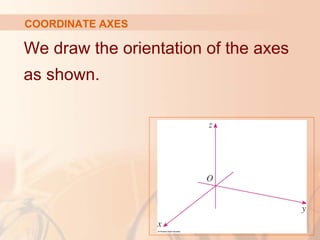
We draw the orientation of the axes 
as shown.
COORDINATE AXES 
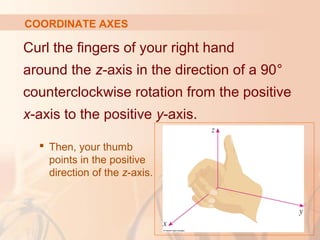
The direction of the z-axis is 
determined by the right-hand rule, 
illustrated as follows.
COORDINATE AXES 
Curl the fingers of your right hand 
around the z-axis in the direction of a 90° 
counterclockwise rotation from the positive 
x-axis to the positive y-axis. 
 Then, your thumb 
points in the positive 
direction of the z-axis.
COORDINATE PLANES 
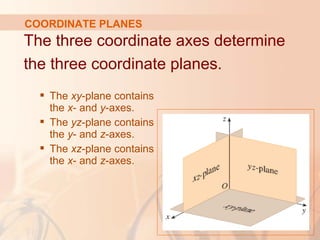
The three coordinate axes determine 
the three coordinate planes. 
 The xy-plane contains 
the x- and y-axes. 
 The yz-plane contains 
the y- and z-axes. 
 The xz-plane contains 
the x- and z-axes.
OCTANTS 
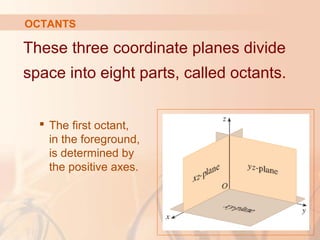
These three coordinate planes divide 
space into eight parts, called octants. 
 The first octant, 
in the foreground, 
is determined by 
the positive axes.
3-D COORDINATE SYSTEMS 
Many people have some difficulty 
visualizing diagrams of 3-D figures. 
Thus, you may find it helpful to do 
the following.
3-D COORDINATE SYSTEMS 
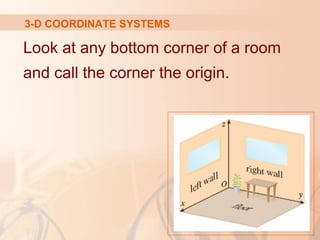
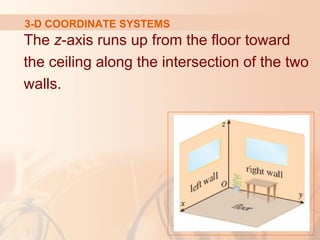
Look at any bottom corner of a room 
and call the corner the origin.
3-D COORDINATE SYSTEMS 
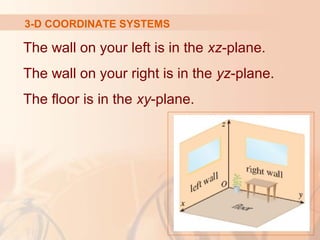
The wall on your left is in the xz-plane. 
The wall on your right is in the yz-plane. 
The floor is in the xy-plane.
3-D COORDINATE SYSTEMS 
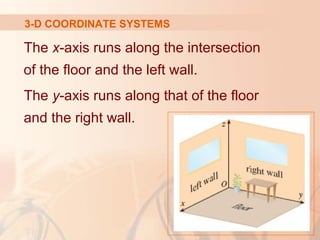
The x-axis runs along the intersection 
of the floor and the left wall. 
The y-axis runs along that of the floor 
and the right wall.
3-D COORDINATE SYSTEMS 
The z-axis runs up from the floor toward 
the ceiling along the intersection of the two 
walls.
3-D COORDINATE SYSTEMS 
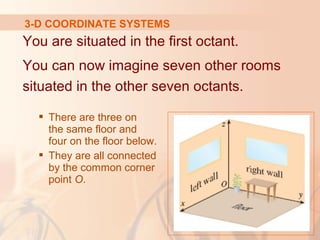
You are situated in the first octant. 
You can now imagine seven other rooms 
situated in the other seven octants. 
 There are three on 
the same floor and 
four on the floor below. 
 They are all connected 
by the common corner 
point O.
3-D COORDINATE SYSTEMS 
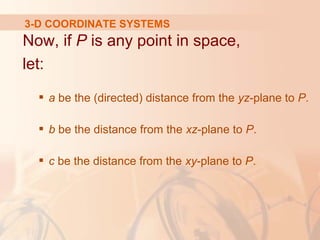
Now, if P is any point in space, 
let: 
 a be the (directed) distance from the yz-plane to P. 
 b be the distance from the xz-plane to P. 
 c be the distance from the xy-plane to P.
3-D COORDINATE SYSTEMS 
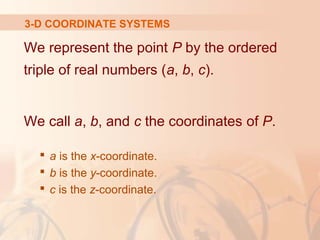
We represent the point P by the ordered 
triple of real numbers (a, b, c). 
We call a, b, and c the coordinates of P. 
 a is the x-coordinate. 
 b is the y-coordinate. 
 c is the z-coordinate.
3-D COORDINATE SYSTEMS 
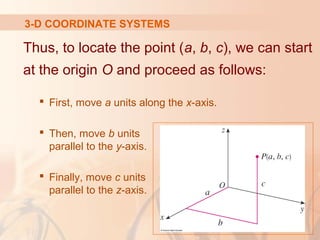
Thus, to locate the point (a, b, c), we can start 
at the origin O and proceed as follows: 
 First, move a units along the x-axis. 
 Then, move b units 
parallel to the y-axis. 
 Finally, move c units 
parallel to the z-axis.
3-D COORDINATE SYSTEMS 
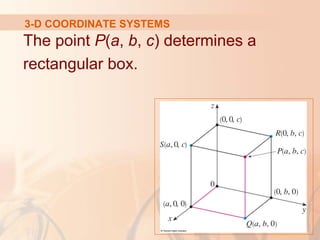
The point P(a, b, c) determines a 
rectangular box.
PROJECTIONS 
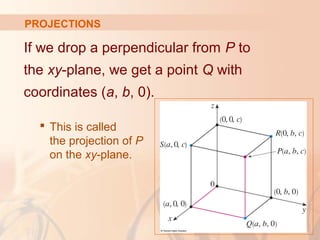
If we drop a perpendicular from P to 
the xy-plane, we get a point Q with 
coordinates (a, b, 0). 
 This is called 
the projection of P 
on the xy-plane.
PROJECTIONS 
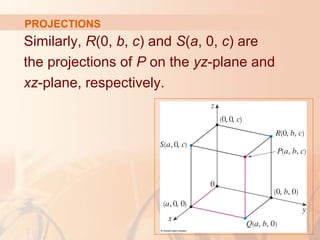
Similarly, R(0, b, c) and S(a, 0, c) are 
the projections of P on the yz-plane and 
xz-plane, respectively.
3-D COORDINATE SYSTEMS 
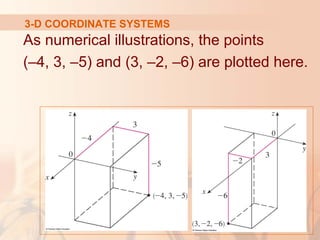
As numerical illustrations, the points 
(–4, 3, –5) and (3, –2, –6) are plotted here.
3-D COORDINATE SYSTEMS 
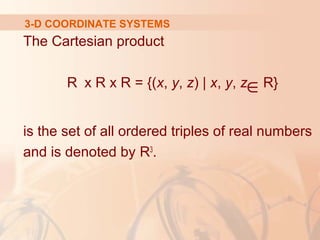
The Cartesian product 
Î 
R x R x R = {(x, y, z) | x, y, z R} 
is the set of all ordered triples of real numbers 
and is denoted by R3.
3-D RECTANGULAR COORDINATE SYSTEM 
We have given a one-to-one correspondence 
between points P in space and ordered triples 
(a, b, c) in R3. 
 It is called a 3-D rectangular coordinate 
system.
3-D RECTANGULAR COORDINATE SYSTEM 
Notice that, in terms of coordinates, 
the first octant can be described as 
the set of points whose coordinates are 
all positive.
2-D VS. 3-D ANALYTIC GEOMETRY 
In 2-D analytic geometry, the graph of an 
equation involving x and y is a curve in R2. 
In 3-D analytic geometry, an equation in 
x, y, and z represents a surface in R3.
3-D COORDINATE SYSTEMS Example 1 
What surfaces in R3 are represented by 
the following equations? 
a. z = 3 
b. y = 5
3-D COORDINATE SYSTEMS Example 1 a 
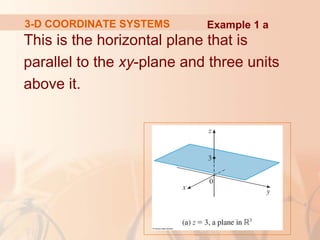
The equation z = 3 represents the set 
{(x, y, z) | z = 3}. 
 This is the set of all points in R3 whose 
z-coordinate is 3.
3-D COORDINATE SYSTEMS Example 1 a 
This is the horizontal plane that is 
parallel to the xy-plane and three units 
above it.
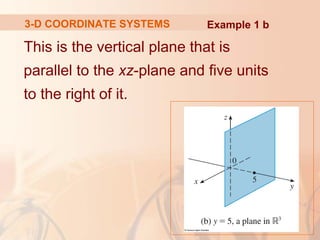
3-D COORDINATE SYSTEMS Example 1 b 
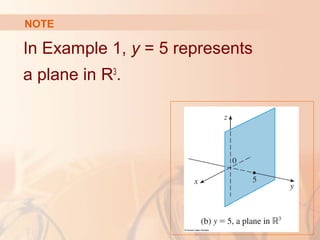
The equation y = 5 represents 
the set of all points in R3 whose 
y-coordinate is 5.
3-D COORDINATE SYSTEMS Example 1 b 
This is the vertical plane that is 
parallel to the xz-plane and five units 
to the right of it.
NOTE Note 
When an equation is given, we must 
understand from the context whether it 
represents either: 
 A curve in R2 
 A surface in R3
NOTE 
In Example 1, y = 5 represents 
a plane in R3.
NOTE 
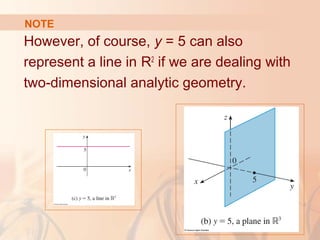
However, of course, y = 5 can also 
represent a line in R2 if we are dealing with 
two-dimensional analytic geometry.
NOTE 
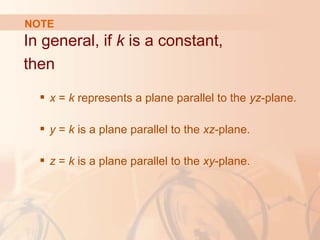
In general, if k is a constant, 
then 
 x = k represents a plane parallel to the yz-plane. 
 y = k is a plane parallel to the xz-plane. 
 z = k is a plane parallel to the xy-plane.
NOTE 
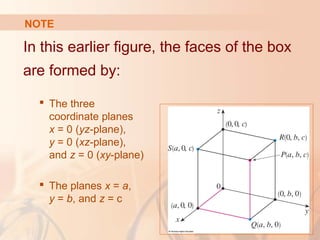
In this earlier figure, the faces of the box 
are formed by: 
 The three 
coordinate planes 
x = 0 (yz-plane), 
y = 0 (xz-plane), 
and z = 0 (xy-plane) 
 The planes x = a, 
y = b, and z = c
3-D COORDINATE SYSTEMS Example 2 
Describe and sketch the surface in R3 
represented by the equation 
y = x
3-D COORDINATE SYSTEMS Example 2 
The equation represents the set of all points 
in R3 whose x- and y-coordinates are equal, 
that is, {(x, x, z) | x Î R, z Î 
R}. 
 This is a vertical plane that intersects 
the xy-plane in the line y = x, z = 0.
3-D COORDINATE SYSTEMS Example 2 
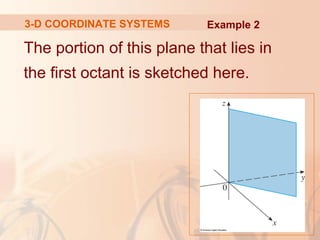
The portion of this plane that lies in 
the first octant is sketched here.
3-D COORDINATE SYSTEMS 
The familiar formula for the distance 
between two points in a plane is easily 
extended to the following 3-D formula.
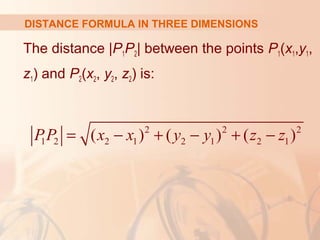
DISTANCE FORMULA IN THREE DIMENSIONS 
The distance |P1P2| between the points P1(x1,y1, 
z1) and P2(x2, y2, z2) is: 
2 2 2 
P1P2 = (x2 - x1) + ( y2 - y1) + (z2 - z1)
3-D COORDINATE SYSTEMS 
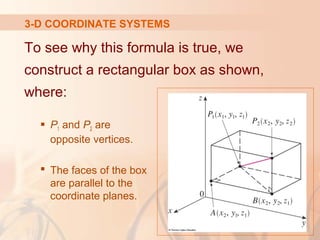
To see why this formula is true, we 
construct a rectangular box as shown, 
where: 
 P1 and P2 are 
opposite vertices. 
 The faces of the box 
are parallel to the 
coordinate planes.
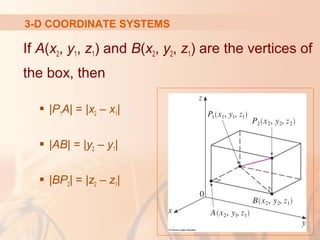
3-D COORDINATE SYSTEMS 
If A(x2, y1, z1) and B(x2, y2, z1) are the vertices of 
the box, then 
 |P1A| = |x2 – x1| 
 |AB| = |y2 – y1| 
 |BP2| = |z2 – z1|
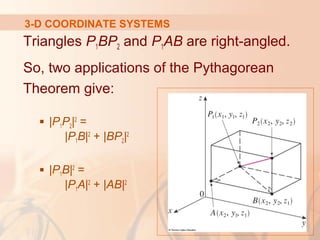
3-D COORDINATE SYSTEMS 
Triangles P1BP2 and P1AB are right-angled. 
So, two applications of the Pythagorean 
Theorem give: 
 |P1P2|2 = 
|P1B|2 + |BP2|2 
 |P1B|2 = 
|P1A|2 + |AB|2
3-D COORDINATE SYSTEMS 
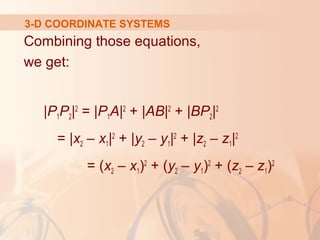
Combining those equations, 
we get: 
|P1P2|2 = |P1A|2 + |AB|2 + |BP2|2 
= |x2 – x1|2 + |y2 – y1|2 + |z2 – z1|2 
= (x2 – x1)2 + (y2 – y1)2 + (z2 – z1)2
3-D COORDINATE SYSTEMS 
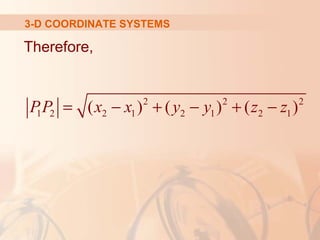
Therefore, 
2 2 2 
P1P2 = (x2 - x1) + ( y2 - y1) + (z2 - z1)
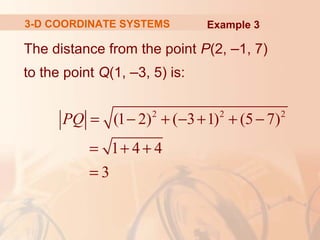
3-D COORDINATE SYSTEMS Example 3 
The distance from the point P(2, –1, 7) 
to the point Q(1, –3, 5) is: 
(1 2)2 ( 3 1)2 (5 7)2 
1 4 4 
3 
PQ = - + - + + - 
= + + 
=
3-D COORDINATE SYSTEMS Example 4 
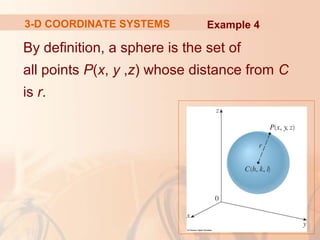
Find an equation of a sphere 
with radius r and center C(h, k, l).
3-D COORDINATE SYSTEMS Example 4 
By definition, a sphere is the set of 
all points P(x, y ,z) whose distance from C 
is r.
3-D COORDINATE SYSTEMS Example 4 
Thus, P is on the sphere if and only 
if |PC| = r 
 Squaring both sides, we have |PC|2 = r2 
or 
(x – h)2 + (y – k)2 + (z – l)2 = r2
3-D COORDINATE SYSTEMS 
The result of Example 4 is worth 
remembering. 
 We write it as follows.
EQUATION OF A SPHERE 
An equation of a sphere with center C(h, k, l) 
and radius r is: 
(x – h)2 + (y – k)2 + (z – l)2 = r2 
 In particular, if the center is the origin O, 
then an equation of the sphere is: 
x2 + y2 + z2 = r2
3-D COORDINATE SYSTEMS Example 5 
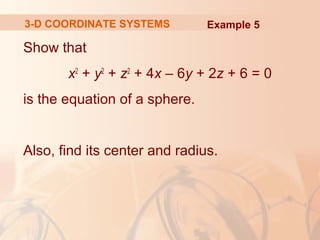
Show that 
x2 + y2 + z2 + 4x – 6y + 2z + 6 = 0 
is the equation of a sphere. 
Also, find its center and radius.
3-D COORDINATE SYSTEMS Example 5 
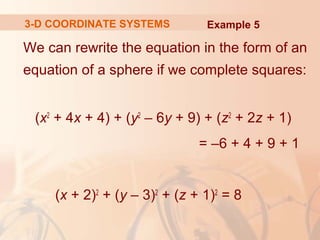
We can rewrite the equation in the form of an 
equation of a sphere if we complete squares: 
(x2 + 4x + 4) + (y2 – 6y + 9) + (z2 + 2z + 1) 
= –6 + 4 + 9 + 1 
(x + 2)2 + (y – 3)2 + (z + 1)2 = 8
3-D COORDINATE SYSTEMS Example 5 
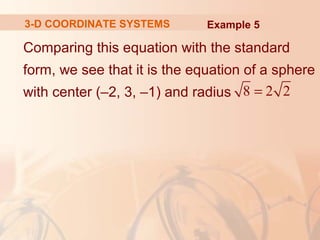
Comparing this equation with the standard 
form, we see that it is the equation of a sphere 
with center (–2, 3, –1) and radius 8 = 2 2
3-D COORDINATE SYSTEMS Example 6 
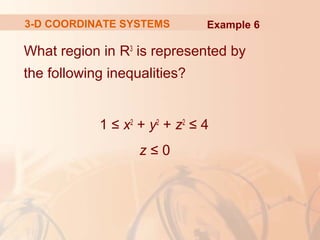
What region in R3 is represented by 
the following inequalities? 
1 ≤ x2 + y2 + z2 ≤ 4 
z ≤ 0
3-D COORDINATE SYSTEMS Example 6 
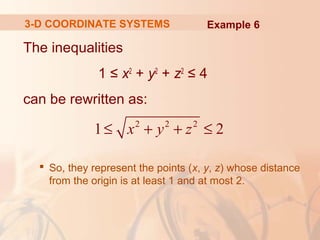
The inequalities 
1 ≤ x2 + y2 + z2 ≤ 4 
can be rewritten as: 
1£ x2 + y2 + z2 £ 2 
 So, they represent the points (x, y, z) whose distance 
from the origin is at least 1 and at most 2.
3-D COORDINATE SYSTEMS Example 6 
However, we are also given that 
z ≤ 0. 
 So, the points lie on or below the xy-plane.
3-D COORDINATE SYSTEMS Example 6 
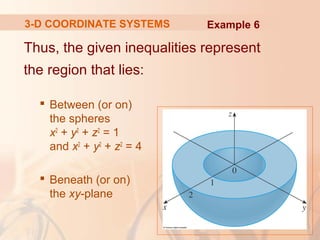
Thus, the given inequalities represent 
the region that lies: 
 Between (or on) 
the spheres 
x2 + y2 + z2 = 1 
and x2 + y2 + z2 = 4 
 Beneath (or on) 
the xy-plane

3D Coordinate Geometry

  • 1.
    12 VVEECCTTOORRSS AANNDD TTHHEE GGEEOOMMEETTRRYY OOFF SSPPAACCEE
  • 2.
    VECTORS AND THEGEOMETRY OF SPACE In this chapter, we introduce vectors and coordinate systems for three-dimensional space.
  • 3.
    VECTORS AND THEGEOMETRY OF SPACE This will be the setting for our study of the calculus of functions of two variables in Chapter 14.  This is because the graph of such a function is a surface in space.
  • 4.
    VECTORS AND THEGEOMETRY OF SPACE We will see that vectors provide particularly simple descriptions of lines and planes in space.
  • 5.
    VECTORS AND THEGEOMETRY OF SPACE 12.1 Three-Dimensional Coordinate Systems In this section, we will learn about: Aspects of three-dimensional coordinate systems.
  • 6.
    TWO-DIMENSIONAL (2-D) COORDINATESYSTEMS To locate a point in a plane, two numbers are necessary.  We know that any point in the plane can be represented as an ordered pair (a, b) of real numbers—where a is the x-coordinate and b is the y-coordinate.  For this reason, a plane is called two-dimensional.
  • 7.
    THREE-DIMENSIONAL (3-D) COORDINATESYSTEMS To locate a point in space, three numbers are required.  We represent any point in space by an ordered triple (a, b, c) of real numbers.
  • 8.
    3-D COORDINATE SYSTEMS In order to represent points in space, we first choose:  A fixed point O (the origin)  Three directed lines through O that are perpendicular to each other
  • 9.
    COORDINATE AXES Thethree lines are called the coordinate axes. They are labeled:  x-axis  y-axis  z-axis
  • 10.
    COORDINATE AXES Usually,we think of:  The x- and y-axes as being horizontal  The z-axis as being vertical
  • 11.
    COORDINATE AXES Wedraw the orientation of the axes as shown.
  • 12.
    COORDINATE AXES Thedirection of the z-axis is determined by the right-hand rule, illustrated as follows.
  • 13.
    COORDINATE AXES Curlthe fingers of your right hand around the z-axis in the direction of a 90° counterclockwise rotation from the positive x-axis to the positive y-axis.  Then, your thumb points in the positive direction of the z-axis.
  • 14.
    COORDINATE PLANES Thethree coordinate axes determine the three coordinate planes.  The xy-plane contains the x- and y-axes.  The yz-plane contains the y- and z-axes.  The xz-plane contains the x- and z-axes.
  • 15.
    OCTANTS These threecoordinate planes divide space into eight parts, called octants.  The first octant, in the foreground, is determined by the positive axes.
  • 16.
    3-D COORDINATE SYSTEMS Many people have some difficulty visualizing diagrams of 3-D figures. Thus, you may find it helpful to do the following.
  • 17.
    3-D COORDINATE SYSTEMS Look at any bottom corner of a room and call the corner the origin.
  • 18.
    3-D COORDINATE SYSTEMS The wall on your left is in the xz-plane. The wall on your right is in the yz-plane. The floor is in the xy-plane.
  • 19.
    3-D COORDINATE SYSTEMS The x-axis runs along the intersection of the floor and the left wall. The y-axis runs along that of the floor and the right wall.
  • 20.
    3-D COORDINATE SYSTEMS The z-axis runs up from the floor toward the ceiling along the intersection of the two walls.
  • 21.
    3-D COORDINATE SYSTEMS You are situated in the first octant. You can now imagine seven other rooms situated in the other seven octants.  There are three on the same floor and four on the floor below.  They are all connected by the common corner point O.
  • 22.
    3-D COORDINATE SYSTEMS Now, if P is any point in space, let:  a be the (directed) distance from the yz-plane to P.  b be the distance from the xz-plane to P.  c be the distance from the xy-plane to P.
  • 23.
    3-D COORDINATE SYSTEMS We represent the point P by the ordered triple of real numbers (a, b, c). We call a, b, and c the coordinates of P.  a is the x-coordinate.  b is the y-coordinate.  c is the z-coordinate.
  • 24.
    3-D COORDINATE SYSTEMS Thus, to locate the point (a, b, c), we can start at the origin O and proceed as follows:  First, move a units along the x-axis.  Then, move b units parallel to the y-axis.  Finally, move c units parallel to the z-axis.
  • 25.
    3-D COORDINATE SYSTEMS The point P(a, b, c) determines a rectangular box.
  • 26.
    PROJECTIONS If wedrop a perpendicular from P to the xy-plane, we get a point Q with coordinates (a, b, 0).  This is called the projection of P on the xy-plane.
  • 27.
    PROJECTIONS Similarly, R(0,b, c) and S(a, 0, c) are the projections of P on the yz-plane and xz-plane, respectively.
  • 28.
    3-D COORDINATE SYSTEMS As numerical illustrations, the points (–4, 3, –5) and (3, –2, –6) are plotted here.
  • 29.
    3-D COORDINATE SYSTEMS The Cartesian product Î R x R x R = {(x, y, z) | x, y, z R} is the set of all ordered triples of real numbers and is denoted by R3.
  • 30.
    3-D RECTANGULAR COORDINATESYSTEM We have given a one-to-one correspondence between points P in space and ordered triples (a, b, c) in R3.  It is called a 3-D rectangular coordinate system.
  • 31.
    3-D RECTANGULAR COORDINATESYSTEM Notice that, in terms of coordinates, the first octant can be described as the set of points whose coordinates are all positive.
  • 32.
    2-D VS. 3-DANALYTIC GEOMETRY In 2-D analytic geometry, the graph of an equation involving x and y is a curve in R2. In 3-D analytic geometry, an equation in x, y, and z represents a surface in R3.
  • 33.
    3-D COORDINATE SYSTEMSExample 1 What surfaces in R3 are represented by the following equations? a. z = 3 b. y = 5
  • 34.
    3-D COORDINATE SYSTEMSExample 1 a The equation z = 3 represents the set {(x, y, z) | z = 3}.  This is the set of all points in R3 whose z-coordinate is 3.
  • 35.
    3-D COORDINATE SYSTEMSExample 1 a This is the horizontal plane that is parallel to the xy-plane and three units above it.
  • 36.
    3-D COORDINATE SYSTEMSExample 1 b The equation y = 5 represents the set of all points in R3 whose y-coordinate is 5.
  • 37.
    3-D COORDINATE SYSTEMSExample 1 b This is the vertical plane that is parallel to the xz-plane and five units to the right of it.
  • 38.
    NOTE Note Whenan equation is given, we must understand from the context whether it represents either:  A curve in R2  A surface in R3
  • 39.
    NOTE In Example1, y = 5 represents a plane in R3.
  • 40.
    NOTE However, ofcourse, y = 5 can also represent a line in R2 if we are dealing with two-dimensional analytic geometry.
  • 41.
    NOTE In general,if k is a constant, then  x = k represents a plane parallel to the yz-plane.  y = k is a plane parallel to the xz-plane.  z = k is a plane parallel to the xy-plane.
  • 42.
    NOTE In thisearlier figure, the faces of the box are formed by:  The three coordinate planes x = 0 (yz-plane), y = 0 (xz-plane), and z = 0 (xy-plane)  The planes x = a, y = b, and z = c
  • 43.
    3-D COORDINATE SYSTEMSExample 2 Describe and sketch the surface in R3 represented by the equation y = x
  • 44.
    3-D COORDINATE SYSTEMSExample 2 The equation represents the set of all points in R3 whose x- and y-coordinates are equal, that is, {(x, x, z) | x Î R, z Î R}.  This is a vertical plane that intersects the xy-plane in the line y = x, z = 0.
  • 45.
    3-D COORDINATE SYSTEMSExample 2 The portion of this plane that lies in the first octant is sketched here.
  • 46.
    3-D COORDINATE SYSTEMS The familiar formula for the distance between two points in a plane is easily extended to the following 3-D formula.
  • 47.
    DISTANCE FORMULA INTHREE DIMENSIONS The distance |P1P2| between the points P1(x1,y1, z1) and P2(x2, y2, z2) is: 2 2 2 P1P2 = (x2 - x1) + ( y2 - y1) + (z2 - z1)
  • 48.
    3-D COORDINATE SYSTEMS To see why this formula is true, we construct a rectangular box as shown, where:  P1 and P2 are opposite vertices.  The faces of the box are parallel to the coordinate planes.
  • 49.
    3-D COORDINATE SYSTEMS If A(x2, y1, z1) and B(x2, y2, z1) are the vertices of the box, then  |P1A| = |x2 – x1|  |AB| = |y2 – y1|  |BP2| = |z2 – z1|
  • 50.
    3-D COORDINATE SYSTEMS Triangles P1BP2 and P1AB are right-angled. So, two applications of the Pythagorean Theorem give:  |P1P2|2 = |P1B|2 + |BP2|2  |P1B|2 = |P1A|2 + |AB|2
  • 51.
    3-D COORDINATE SYSTEMS Combining those equations, we get: |P1P2|2 = |P1A|2 + |AB|2 + |BP2|2 = |x2 – x1|2 + |y2 – y1|2 + |z2 – z1|2 = (x2 – x1)2 + (y2 – y1)2 + (z2 – z1)2
  • 52.
    3-D COORDINATE SYSTEMS Therefore, 2 2 2 P1P2 = (x2 - x1) + ( y2 - y1) + (z2 - z1)
  • 53.
    3-D COORDINATE SYSTEMSExample 3 The distance from the point P(2, –1, 7) to the point Q(1, –3, 5) is: (1 2)2 ( 3 1)2 (5 7)2 1 4 4 3 PQ = - + - + + - = + + =
  • 54.
    3-D COORDINATE SYSTEMSExample 4 Find an equation of a sphere with radius r and center C(h, k, l).
  • 55.
    3-D COORDINATE SYSTEMSExample 4 By definition, a sphere is the set of all points P(x, y ,z) whose distance from C is r.
  • 56.
    3-D COORDINATE SYSTEMSExample 4 Thus, P is on the sphere if and only if |PC| = r  Squaring both sides, we have |PC|2 = r2 or (x – h)2 + (y – k)2 + (z – l)2 = r2
  • 57.
    3-D COORDINATE SYSTEMS The result of Example 4 is worth remembering.  We write it as follows.
  • 58.
    EQUATION OF ASPHERE An equation of a sphere with center C(h, k, l) and radius r is: (x – h)2 + (y – k)2 + (z – l)2 = r2  In particular, if the center is the origin O, then an equation of the sphere is: x2 + y2 + z2 = r2
  • 59.
    3-D COORDINATE SYSTEMSExample 5 Show that x2 + y2 + z2 + 4x – 6y + 2z + 6 = 0 is the equation of a sphere. Also, find its center and radius.
  • 60.
    3-D COORDINATE SYSTEMSExample 5 We can rewrite the equation in the form of an equation of a sphere if we complete squares: (x2 + 4x + 4) + (y2 – 6y + 9) + (z2 + 2z + 1) = –6 + 4 + 9 + 1 (x + 2)2 + (y – 3)2 + (z + 1)2 = 8
  • 61.
    3-D COORDINATE SYSTEMSExample 5 Comparing this equation with the standard form, we see that it is the equation of a sphere with center (–2, 3, –1) and radius 8 = 2 2
  • 62.
    3-D COORDINATE SYSTEMSExample 6 What region in R3 is represented by the following inequalities? 1 ≤ x2 + y2 + z2 ≤ 4 z ≤ 0
  • 63.
    3-D COORDINATE SYSTEMSExample 6 The inequalities 1 ≤ x2 + y2 + z2 ≤ 4 can be rewritten as: 1£ x2 + y2 + z2 £ 2  So, they represent the points (x, y, z) whose distance from the origin is at least 1 and at most 2.
  • 64.
    3-D COORDINATE SYSTEMSExample 6 However, we are also given that z ≤ 0.  So, the points lie on or below the xy-plane.
  • 65.
    3-D COORDINATE SYSTEMSExample 6 Thus, the given inequalities represent the region that lies:  Between (or on) the spheres x2 + y2 + z2 = 1 and x2 + y2 + z2 = 4  Beneath (or on) the xy-plane