DIGITAL ELECTRONICS
DR. R. M. THOMBRE
HEAD OF DEPT OF PHYSICS
M.G. COLLEGE ARMORI
NUMBER SYSTEMS
• Decimal
• Binary
• Octal
• Hexadecimal
• A digital system can understand
positional number system only
where there are a few symbols called
digits and these symbols represent
different values depending on the
position they occupy in the number.
• A value of each digit in a number can
be determined using
• The digit
• The position of the digit in the
number
• The base of the number system
(where base is defined as the total
number of digits available in the
number system).
NUMBER SYSTEMS
DECIMAL SYSTEM
• The number system that we use in our day-to-day life is
the decimal number system. Decimal number system has
base 10 as it uses 10 digits from 0 to 9. In decimal
number system, the successive positions to the left of the
decimal point represents units, tens, hundreds, thousands
and so on.
• Each position represents a specific power of the base (10).
For example, the decimal number 1234 consists of the
digit 4 in the units position, 3 in the tens position, 2 in the
hundreds position, and 1 in the thousands position, and
its value can be written as
(1×1000) + (2×100) + (3×10) + (4×l)
(1×10³) + (2×10²) + (3×101) + (4×l00)
1000 + 200 + 30 + 1 1234
BINARY NUMBER SYSTEM
• Characteristics
• Uses two digits, 0 and 1.
• Also called base 2 number system
• Each position in a binary number represents a 0 power
of the base (2). Example: 20
• Last position in a binary number represents an x power
of the base (2). Example: 2x where x represents the last
position - 1.
BINARY SYSTEM
• In mathematics and digital electronics, a binary
number is a number expressed in the base-2numeral
system or binary numeral system, which uses only
two symbols: typically 0 (zero) and 1 (one).
• The base-2 numeral system is a positional notation
with a radix of 2.
• Each digit is referred to as a bit.
I will teach about it briefly.
Step Binary Number Decimal Number
Step 1 101012 ((1 × 2
4
) + (0 × 2
3
) + (1 × 2
2
) + (0 × 2
1
)
+ (1 × 2
0
))10
Step 2 101012 (16 + 0 + 4 + 0 + 1)10
Step 3 101012 2110
Example
Binary Number: 101012
Calculating Decimal Equivalent −
.
Note: 101012 is normally written as 10101
OCTAL NUMBER SYSTEM
• Characteristics
• Uses eight digits, 0,1,2,3,4,5,6,7.
• Also called base 8 number system
• Each position in an octal number represents a 0 power
of the base (8). Example: 80
• Last position in an octal number represents an x power
of the base (8). Example: 8x where x represents the last
position - 1.
Step Octal Number Decimal Number
Step 1 125708 ((1 × 8
4
) + (2 × 8
3
) + (5 × 8
2
) + (7 × 8
1
)
+ (0 × 8
0
))10
Step 2 125708 (4096 + 1024 + 320 + 56 + 0)10
Step 3 125708 549610
Example
Octal Number − 125708
Calculating Decimal Equivalent −
Note: 125708 is normally written as 12570.
HEXADECIMAL NUMBER SYSTEM
• Characteristics
• Uses 10 digits and 6 letters, 0,1,2,3,4,5,6,7,8,9,A,B,C,D,E,F.
• Letters represents numbers starting from 10. A = 10, B = 11, C =
12, D = 13, E = 14, F = 15.
• Also called base 16 number system.
• Each position in a hexadecimal number represents a 0 power of
the base (16). Example 160.
• Last position in a hexadecimal number represents an x power of
the base (16). Example 16x where x represents the last position -
1.
Step Hexadecimal Number Decimal Number
Step 1 19FDE16 ((1 × 16
4
) + (9 × 16
3
) + (F × 16
2
) + (D ×
16
1
) + (E × 16
0
))10
Step 2 19FDE16 ((1 × 16
4
) + (9 × 16
3
) + (15 × 16
2
) + (13
× 16
1
) + (14 × 16
0
))10
Step 3 19FDE16 (65536 + 36864 + 3840 + 208 + 14)10
Step 4 19FDE16 10646210
Example −
Hexadecimal Number: 19FDE16
Calculating Decimal Equivalent −
.
Note − 19FDE16 is normally written as 19FDE
DECIMAL FRACTION
• To the right of the
decimal point, the
digit 1 has a weight
0.1 (1/10), the digit
2 has a weight of
0.01 (1/100) and
the digit 5 has a
weight of
0.001(1/1000)
BINARY FRACTION
• The binary numbering system is a base-2 numbering system which
contains only two digits, a “0” or a “1”. Thus each digit of a binary
number can take the “0” or the “1” value with the position of the 0 or 1
indicating its value or weighting.
• Similar to decimal fractions, binary numbers can also be represented as
unsigned fractional numbers by placing the binary digits to the right of
the decimal point or in this case, binary point. Thus all the fractional
digits to the right of the binary point have respective weightings which
are negative powers of two, creating a binary fraction. In other words,
the powers of 2 are negative.
• So for the fractional binary numbers to the right of the binary point, the
weight of each digit becomes more negative giving: 2-1, 2-2, 2-3, 2-4, and
so on as shown.
BINARY FRACTIONS
Now lets suppose we have the following binary number of:
1101.01112, what will be its decimal number equivalent.
1101.0111 = (1×23) + (1×22) + (0×21) + (1×20) + (0×2-1) +
(1×2-2) + (1×2-3) + (1×2-4)
= 8 + 4 + 0 + 1 + 0 + 1/4 + 1/8 + 1/16
= 8 + 4 + 0 + 1 + 0 + 0.25 + 0.125 + 0.0625 = 13.437510
DECIMAL TO BINARY
CONVERSION
• A decimal like 19 can be converted into binary by repeatedly
dividing the number by 2 and collecting the remainders (double
dabble method)
• 2 19
2 9 – 1 LSB
2 4 – 1
2 2 – 0
2 1 -0
0 -1 MSB
• For decimal fractions, the fractional part has to be
multiplied by 2 successively and collecting the carries
from top to bottom. The multiplication can be
repeated till the fractional part becomes zero. If the
fractional part is not zero after four or five steps the
process can be stopped and we have to be satisfied
with the nearest value.
• For example the decimal fraction .625 is converted into
binary as
• 0.625 × 2 = 1.250; carry is 1 (MSB)
• 0.250 × 2 = 0.500; carry is 0
• 0.500 × 2 = 1.000; carry is 1 (LSB)
• Therefore (0.625)10 = (0.101)2
PROBLEMS- DECIMAL TO BINARY
• Convert (107.6875)
• Convert (52.4)
2 107
2 53 -1
2 26-1
2 13 -0
2 6 -1
2 3 -0
2 1 -1
0 -1
• 0.6875 = 0.10112
• 52.4 = 110100.01102
HEXADECIMAL TO DECIMAL
• Convert D5H to decimal
• (D5)H = (13×161 + 5×160)
= (13 ×16 + 5× 1)
= (208+5)
= 21310
• (E9)H = (233)H
• (3FC.8)H = (1020.5)H
• (FFFF)H = (65535)H
DECIMAL TO HEXADECIMAL
• Convert 213 to Hex
• 16 213
• 13 -5
• 0 -13 (D)
• (213)10 = D5H
HEXADECIMAL TO BINARY
• Convert (25)H to Binary
• 25H = (0010 0101)2
• Convert (3A.7) to Binary
• (3A.7)H = (0011 1010. 0111)2
• Convert (CD.E8) to Binary
• (CD.E8) = (1100 1101. 1110 1000)2
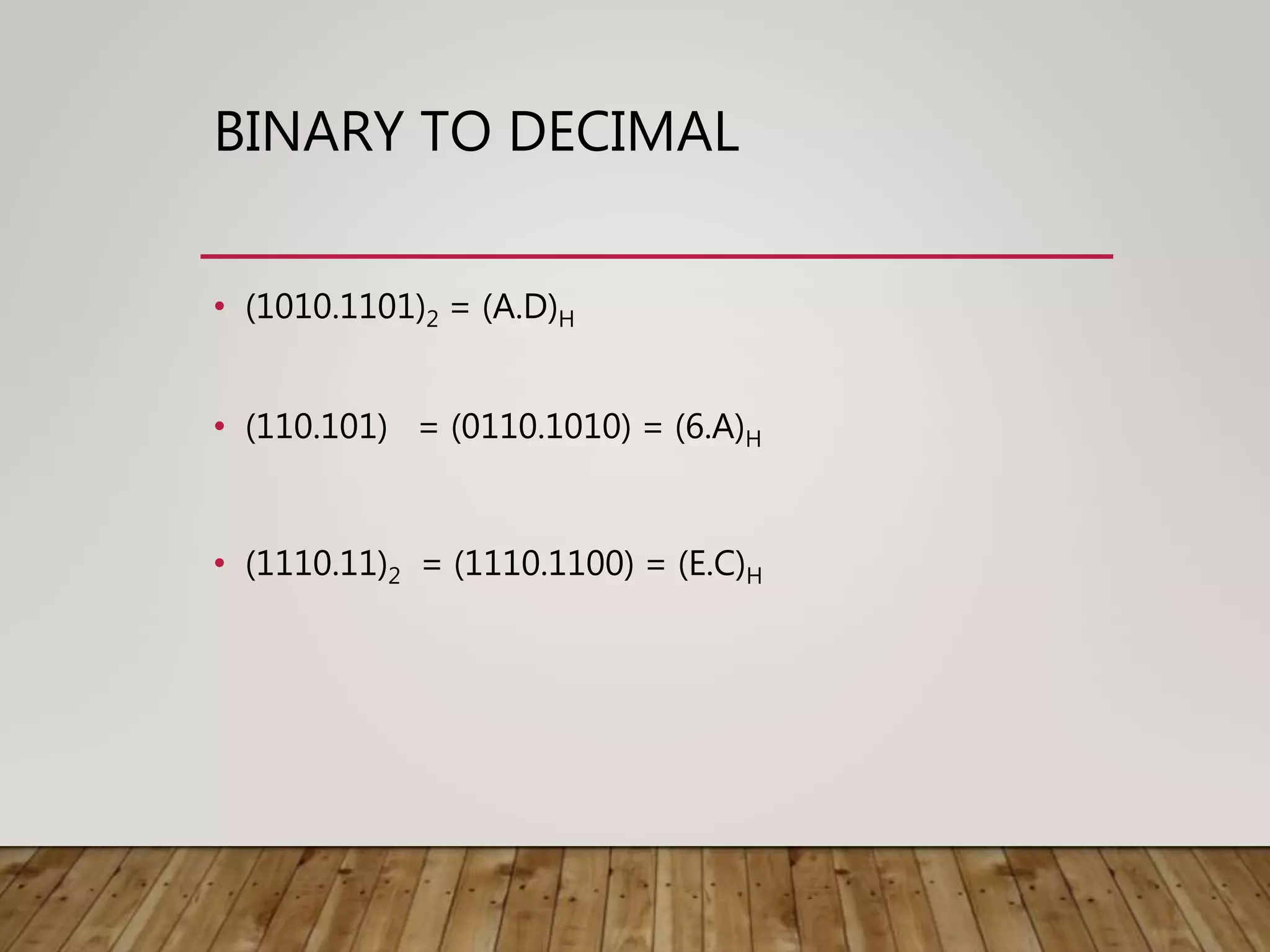
BINARY TO DECIMAL
• (1010.1101)2 = (A.D)H
• (110.101) = (0110.1010) = (6.A)H
• (1110.11)2 = (1110.1100) = (E.C)H
OCTAL TO DECIMAL
Decimal Octal Binary
0 0 000
1 1 001
2 2 010
3 3 011
4 4 100
5 5 101
6 6 110
7 7 111
OCTAL TO DECIMAL
• Convert (75)8 to decimal
• (75)8 = (7×81 + 5×80)
= (7×8 + 5× 1)
= (56+5)
= 6110
DECIMAL TO OCTAL
• Convert 6810 to octal
• 8 68
• 8 8 - 4
• 8 1 – 0
• 0 – 1
• (68)10 = (104)8
OCTAL TO BINARY
Octal Binary Decimal
27 010 111 2 3
135 001 011 101 93
45.5 100 101.101 37.625
BINARY TO OCTAL
• (10 101)2 = (010 101)2 = (25)8
• (10111.1) = (010 111 . 100) = (2 7 . 4)8
• Binary to decimal
• (11101)
• (111.11)
• Hex to decimal
• (50)H
• (3EF)H
• Decimal to Hex
• (48)10
• (1024)10
• Hex to binary (99)H , (FF.E6)H

Number system

  • 1.
    DIGITAL ELECTRONICS DR. R.M. THOMBRE HEAD OF DEPT OF PHYSICS M.G. COLLEGE ARMORI
  • 2.
    NUMBER SYSTEMS • Decimal •Binary • Octal • Hexadecimal
  • 3.
    • A digitalsystem can understand positional number system only where there are a few symbols called digits and these symbols represent different values depending on the position they occupy in the number. • A value of each digit in a number can be determined using • The digit • The position of the digit in the number • The base of the number system (where base is defined as the total number of digits available in the number system).
  • 4.
  • 5.
    DECIMAL SYSTEM • Thenumber system that we use in our day-to-day life is the decimal number system. Decimal number system has base 10 as it uses 10 digits from 0 to 9. In decimal number system, the successive positions to the left of the decimal point represents units, tens, hundreds, thousands and so on. • Each position represents a specific power of the base (10). For example, the decimal number 1234 consists of the digit 4 in the units position, 3 in the tens position, 2 in the hundreds position, and 1 in the thousands position, and its value can be written as
  • 6.
    (1×1000) + (2×100)+ (3×10) + (4×l) (1×10³) + (2×10²) + (3×101) + (4×l00) 1000 + 200 + 30 + 1 1234
  • 8.
    BINARY NUMBER SYSTEM •Characteristics • Uses two digits, 0 and 1. • Also called base 2 number system • Each position in a binary number represents a 0 power of the base (2). Example: 20 • Last position in a binary number represents an x power of the base (2). Example: 2x where x represents the last position - 1.
  • 9.
    BINARY SYSTEM • Inmathematics and digital electronics, a binary number is a number expressed in the base-2numeral system or binary numeral system, which uses only two symbols: typically 0 (zero) and 1 (one). • The base-2 numeral system is a positional notation with a radix of 2. • Each digit is referred to as a bit. I will teach about it briefly.
  • 10.
    Step Binary NumberDecimal Number Step 1 101012 ((1 × 2 4 ) + (0 × 2 3 ) + (1 × 2 2 ) + (0 × 2 1 ) + (1 × 2 0 ))10 Step 2 101012 (16 + 0 + 4 + 0 + 1)10 Step 3 101012 2110 Example Binary Number: 101012 Calculating Decimal Equivalent − . Note: 101012 is normally written as 10101
  • 11.
    OCTAL NUMBER SYSTEM •Characteristics • Uses eight digits, 0,1,2,3,4,5,6,7. • Also called base 8 number system • Each position in an octal number represents a 0 power of the base (8). Example: 80 • Last position in an octal number represents an x power of the base (8). Example: 8x where x represents the last position - 1.
  • 12.
    Step Octal NumberDecimal Number Step 1 125708 ((1 × 8 4 ) + (2 × 8 3 ) + (5 × 8 2 ) + (7 × 8 1 ) + (0 × 8 0 ))10 Step 2 125708 (4096 + 1024 + 320 + 56 + 0)10 Step 3 125708 549610 Example Octal Number − 125708 Calculating Decimal Equivalent − Note: 125708 is normally written as 12570.
  • 13.
    HEXADECIMAL NUMBER SYSTEM •Characteristics • Uses 10 digits and 6 letters, 0,1,2,3,4,5,6,7,8,9,A,B,C,D,E,F. • Letters represents numbers starting from 10. A = 10, B = 11, C = 12, D = 13, E = 14, F = 15. • Also called base 16 number system. • Each position in a hexadecimal number represents a 0 power of the base (16). Example 160. • Last position in a hexadecimal number represents an x power of the base (16). Example 16x where x represents the last position - 1.
  • 15.
    Step Hexadecimal NumberDecimal Number Step 1 19FDE16 ((1 × 16 4 ) + (9 × 16 3 ) + (F × 16 2 ) + (D × 16 1 ) + (E × 16 0 ))10 Step 2 19FDE16 ((1 × 16 4 ) + (9 × 16 3 ) + (15 × 16 2 ) + (13 × 16 1 ) + (14 × 16 0 ))10 Step 3 19FDE16 (65536 + 36864 + 3840 + 208 + 14)10 Step 4 19FDE16 10646210 Example − Hexadecimal Number: 19FDE16 Calculating Decimal Equivalent − . Note − 19FDE16 is normally written as 19FDE
  • 16.
    DECIMAL FRACTION • Tothe right of the decimal point, the digit 1 has a weight 0.1 (1/10), the digit 2 has a weight of 0.01 (1/100) and the digit 5 has a weight of 0.001(1/1000)
  • 18.
    BINARY FRACTION • Thebinary numbering system is a base-2 numbering system which contains only two digits, a “0” or a “1”. Thus each digit of a binary number can take the “0” or the “1” value with the position of the 0 or 1 indicating its value or weighting. • Similar to decimal fractions, binary numbers can also be represented as unsigned fractional numbers by placing the binary digits to the right of the decimal point or in this case, binary point. Thus all the fractional digits to the right of the binary point have respective weightings which are negative powers of two, creating a binary fraction. In other words, the powers of 2 are negative. • So for the fractional binary numbers to the right of the binary point, the weight of each digit becomes more negative giving: 2-1, 2-2, 2-3, 2-4, and so on as shown.
  • 19.
  • 21.
    Now lets supposewe have the following binary number of: 1101.01112, what will be its decimal number equivalent. 1101.0111 = (1×23) + (1×22) + (0×21) + (1×20) + (0×2-1) + (1×2-2) + (1×2-3) + (1×2-4) = 8 + 4 + 0 + 1 + 0 + 1/4 + 1/8 + 1/16 = 8 + 4 + 0 + 1 + 0 + 0.25 + 0.125 + 0.0625 = 13.437510
  • 22.
    DECIMAL TO BINARY CONVERSION •A decimal like 19 can be converted into binary by repeatedly dividing the number by 2 and collecting the remainders (double dabble method) • 2 19 2 9 – 1 LSB 2 4 – 1 2 2 – 0 2 1 -0 0 -1 MSB
  • 23.
    • For decimalfractions, the fractional part has to be multiplied by 2 successively and collecting the carries from top to bottom. The multiplication can be repeated till the fractional part becomes zero. If the fractional part is not zero after four or five steps the process can be stopped and we have to be satisfied with the nearest value. • For example the decimal fraction .625 is converted into binary as
  • 24.
    • 0.625 ×2 = 1.250; carry is 1 (MSB) • 0.250 × 2 = 0.500; carry is 0 • 0.500 × 2 = 1.000; carry is 1 (LSB) • Therefore (0.625)10 = (0.101)2
  • 25.
    PROBLEMS- DECIMAL TOBINARY • Convert (107.6875) • Convert (52.4) 2 107 2 53 -1 2 26-1 2 13 -0 2 6 -1 2 3 -0 2 1 -1 0 -1
  • 26.
    • 0.6875 =0.10112 • 52.4 = 110100.01102
  • 27.
    HEXADECIMAL TO DECIMAL •Convert D5H to decimal • (D5)H = (13×161 + 5×160) = (13 ×16 + 5× 1) = (208+5) = 21310
  • 28.
    • (E9)H =(233)H • (3FC.8)H = (1020.5)H • (FFFF)H = (65535)H
  • 29.
    DECIMAL TO HEXADECIMAL •Convert 213 to Hex • 16 213 • 13 -5 • 0 -13 (D) • (213)10 = D5H
  • 30.
    HEXADECIMAL TO BINARY •Convert (25)H to Binary • 25H = (0010 0101)2 • Convert (3A.7) to Binary • (3A.7)H = (0011 1010. 0111)2 • Convert (CD.E8) to Binary • (CD.E8) = (1100 1101. 1110 1000)2
  • 31.
    BINARY TO DECIMAL •(1010.1101)2 = (A.D)H • (110.101) = (0110.1010) = (6.A)H • (1110.11)2 = (1110.1100) = (E.C)H
  • 32.
    OCTAL TO DECIMAL DecimalOctal Binary 0 0 000 1 1 001 2 2 010 3 3 011 4 4 100 5 5 101 6 6 110 7 7 111
  • 33.
    OCTAL TO DECIMAL •Convert (75)8 to decimal • (75)8 = (7×81 + 5×80) = (7×8 + 5× 1) = (56+5) = 6110
  • 34.
    DECIMAL TO OCTAL •Convert 6810 to octal • 8 68 • 8 8 - 4 • 8 1 – 0 • 0 – 1 • (68)10 = (104)8
  • 35.
    OCTAL TO BINARY OctalBinary Decimal 27 010 111 2 3 135 001 011 101 93 45.5 100 101.101 37.625
  • 36.
    BINARY TO OCTAL •(10 101)2 = (010 101)2 = (25)8 • (10111.1) = (010 111 . 100) = (2 7 . 4)8
  • 37.
    • Binary todecimal • (11101) • (111.11) • Hex to decimal • (50)H • (3EF)H • Decimal to Hex • (48)10 • (1024)10 • Hex to binary (99)H , (FF.E6)H