Group
velocity and
phase
velocity
Dr. R. M. Thombre
HOD Dept. of Physics
M. G. College Armori
Waves: Phase and group velocities of a
wave packet
The velocity of a wave can be defined in many different ways,
partly because there are different kinds of waves, and partly
because we can focus on different aspects or components of any
given wave.
The wave function depends on both time, t, and position, x, i.e.:
where A is the amplitude.

A A(x,t) ,
Waves: Phase and group velocities of a
wave packet
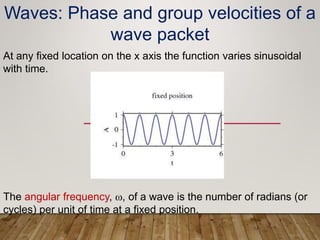
At any fixed location on the x axis the function varies sinusoidal
with time.
The angular frequency, , of a wave is the number of radians (or
cycles) per unit of time at a fixed position.
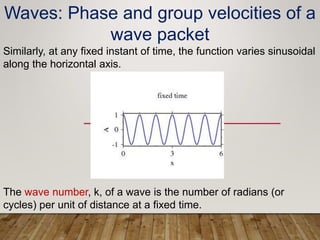
Similarly, at any fixed instant of time, the function varies sinusoidal
along the horizontal axis.
The wave number, k, of a wave is the number of radians (or
cycles) per unit of distance at a fixed time.
Waves: Phase and group velocities of a
wave packet
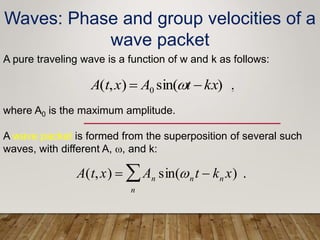
A pure traveling wave is a function of w and k as follows:
where A0 is the maximum amplitude.
A wave packet is formed from the superposition of several such
waves, with different A, , and k:

A(t,x)  A0 sin(t  kx) ,
A(t,x)  An sin(nt  kn x)
n
 .
Waves: Phase and group velocities of a
wave packet
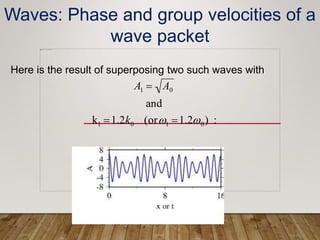
Here is the result of superposing two such waves with

A1  A0
and
k1 1.2k0 (or1 1.20) :
Waves: Phase and group velocities of a
wave packet
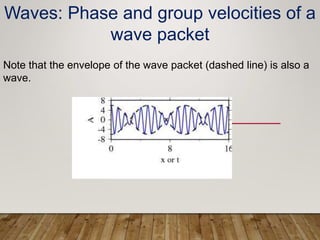
Note that the envelope of the wave packet (dashed line) is also a
wave.
Waves: Phase and group velocities of a
wave packet
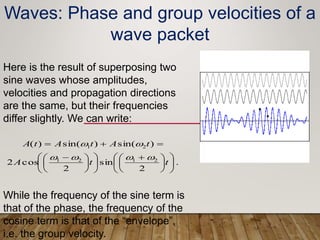
Here is the result of superposing two
sine waves whose amplitudes,
velocities and propagation directions
are the same, but their frequencies
differ slightly. We can write:
While the frequency of the sine term is
that of the phase, the frequency of the
cosine term is that of the “envelope”,
i.e. the group velocity.
.
2
sin
2
cos
2
)
sin(
)
sin(
)
(
2
1
2
1
2
1











 











 



t
t
A
t
A
t
A
t
A






Waves: Phase and group velocities of a
wave packet
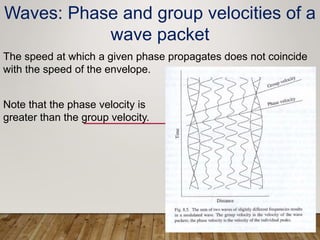
The speed at which a given phase propagates does not coincide
with the speed of the envelope.
Note that the phase velocity is
greater than the group velocity.
Waves: Phase and group velocities of a
wave packet
The group velocity is the velocity with which the envelope of the
wave packet, propagates through space.
The phase velocity is the velocity at which the phase of any one
frequency component of the wave will propagate. You could pick
one particular phase of the wave (for example the crest) and it
would appear to travel at the phase velocity.
Waves: Phase and group velocities of a
wave packet

Group velocity and phase velocity

  • 1.
    Group velocity and phase velocity Dr. R.M. Thombre HOD Dept. of Physics M. G. College Armori
  • 2.
    Waves: Phase andgroup velocities of a wave packet The velocity of a wave can be defined in many different ways, partly because there are different kinds of waves, and partly because we can focus on different aspects or components of any given wave. The wave function depends on both time, t, and position, x, i.e.: where A is the amplitude.  A A(x,t) ,
  • 3.
    Waves: Phase andgroup velocities of a wave packet At any fixed location on the x axis the function varies sinusoidal with time. The angular frequency, , of a wave is the number of radians (or cycles) per unit of time at a fixed position.
  • 4.
    Similarly, at anyfixed instant of time, the function varies sinusoidal along the horizontal axis. The wave number, k, of a wave is the number of radians (or cycles) per unit of distance at a fixed time. Waves: Phase and group velocities of a wave packet
  • 5.
    A pure travelingwave is a function of w and k as follows: where A0 is the maximum amplitude. A wave packet is formed from the superposition of several such waves, with different A, , and k:  A(t,x)  A0 sin(t  kx) , A(t,x)  An sin(nt  kn x) n  . Waves: Phase and group velocities of a wave packet
  • 6.
    Here is theresult of superposing two such waves with  A1  A0 and k1 1.2k0 (or1 1.20) : Waves: Phase and group velocities of a wave packet
  • 7.
    Note that theenvelope of the wave packet (dashed line) is also a wave. Waves: Phase and group velocities of a wave packet
  • 8.
    Here is theresult of superposing two sine waves whose amplitudes, velocities and propagation directions are the same, but their frequencies differ slightly. We can write: While the frequency of the sine term is that of the phase, the frequency of the cosine term is that of the “envelope”, i.e. the group velocity. . 2 sin 2 cos 2 ) sin( ) sin( ) ( 2 1 2 1 2 1                              t t A t A t A t A       Waves: Phase and group velocities of a wave packet
  • 9.
    The speed atwhich a given phase propagates does not coincide with the speed of the envelope. Note that the phase velocity is greater than the group velocity. Waves: Phase and group velocities of a wave packet
  • 10.
    The group velocityis the velocity with which the envelope of the wave packet, propagates through space. The phase velocity is the velocity at which the phase of any one frequency component of the wave will propagate. You could pick one particular phase of the wave (for example the crest) and it would appear to travel at the phase velocity. Waves: Phase and group velocities of a wave packet