Positional Number Systems
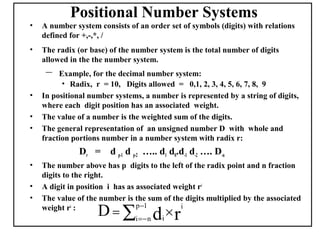
•   A number system consists of an order set of symbols (digits) with relations
    defined for +,-,*, /
•   The radix (or base) of the number system is the total number of digits
    allowed in the the number system.
     –   Example, for the decimal number system:
          • Radix, r = 10, Digits allowed = 0,1, 2, 3, 4, 5, 6, 7, 8, 9
•   In positional number systems, a number is represented by a string of digits,
    where each digit position has an associated weight.
•   The value of a number is the weighted sum of the digits.
•   The general representation of an unsigned number D with whole and
    fraction portions number in a number system with radix r:
               Dr = d p-1 d p-2 ….. d1 d0.d-1 d-2 …. D-n
•   The number above has p digits to the left of the radix point and n fraction
    digits to the right.
•   A digit in position i has as associated weight ri
•   The value of the number is the sum of the digits multiplied by the associated
    weight ri :
                    D = ∑i =− n di × r
                                 p −1         i
Positional Number Systems
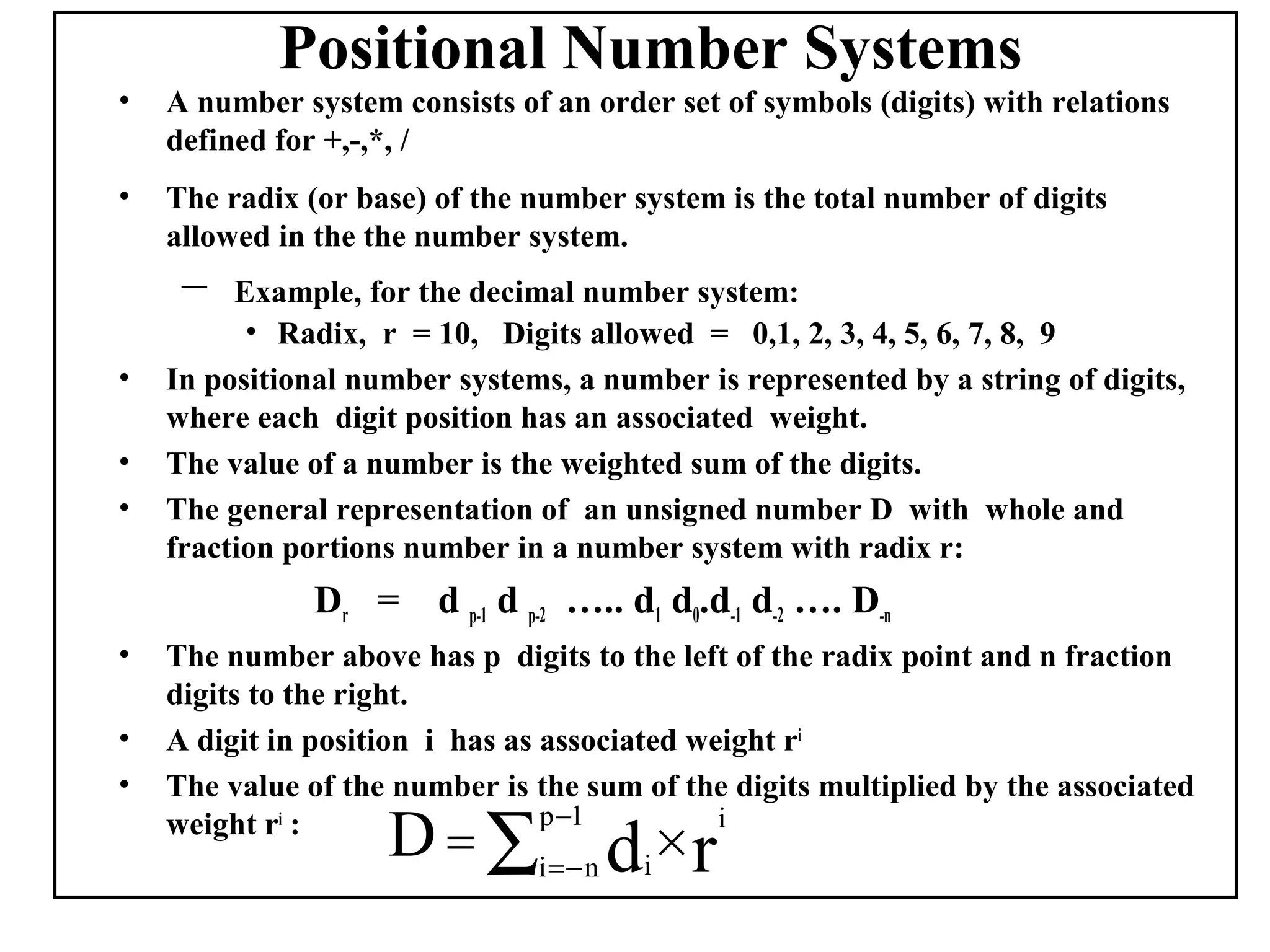
                           Number:              Dr =      d p-1 d p-2 ….. d1 d0.d-1 d-2 …. D-n
                           Value:             D = ∑i =− n di × ri
                                                       p −1


•       For example in the decimal number system:
                    5185.6810 = 5x10³ + 1x10² + 8x101 + 5x100 + 6 x 10⁻¹ + 8 x 10⁻²

                                       = 5x1000 + 1x100 + 8x10 + 5 x 1 + 6x.1           + 8x.01
•       For the binary number system with radix = 2, digits 0, 1
                         D2 = dp-1 × 2p-1 ….. d1 × 21 + d0 . 20 + d-1 × 2-1 + d-2 × 2-2 …..
• For Example:
                100112 = 1 × 16 + 0 × 8 + 0 × 4 + 1 × 2 + 1 × 1 = 1910
        |       |

    MSB         LSB (least significant bit)

(most significant bit)
             Binary Point
             101.0012 = 1x4 + 0x2 + 1x1 + 0x.5 + 0x.25 + 1x.125 = 5.12510
Number Systems Used in Computers
  Name
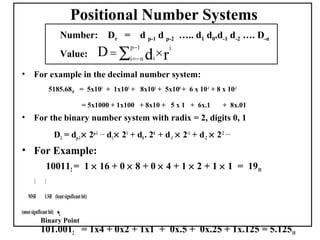
                   Radix                   Set of Digits                  Example
  of Radix

   Decimal           r=10           {0,1,2,3,4,5,6,7,8,9}                     25510

    Binary           r=2            {0,1}                                    11111111 2


    Octal            r= 8           {0,1,2,3,4,5,6,7}                          377 8


 Hexadecimal         r=16           {0,1,2,3,4,5,6,7,8,9,A, B, C, D, E, F}       FF16


Decimal 0      1     2      3   4      5     6    7     8   9   10   11   12 13 14 15
 Hex      0    1    2      3    4      5     6   7      8   9   A    B    C    D      E   F
Binary   0000 0001 0010   0011 0100 0101 0110 0111 1000 1001 1010 1011 1100 1101 1110 1111
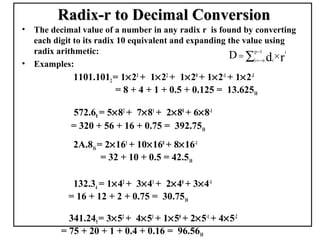
Radix-r to Decimal Conversion
•   The decimal value of a number in any radix r is found by converting
    each digit to its radix 10 equivalent and expanding the value using
    radix arithmetic:
                                                        D = ∑ip=−−1n di × ri
•   Examples:
              1101.1012 = 1×23 + 1×22 + 1×20 + 1×2-1 + 1×2-3
                        = 8 + 4 + 1 + 0.5 + 0.125 = 13.62510

              572.68 = 5×82 + 7×81 + 2×80 + 6×8-1
              = 320 + 56 + 16 + 0.75 = 392.7510
              2A.816 = 2×161 + 10×160 + 8×16-1
                      = 32 + 10 + 0.5 = 42.510

              132.34 = 1×42 + 3×41 + 2×40 + 3×4-1
             = 16 + 12 + 2 + 0.75 = 30.7510

             341.245 = 3×52 + 4×51 + 1×50 + 2×5-1 + 4×5-2
           = 75 + 20 + 1 + 0.4 + 0.16 = 96.5610
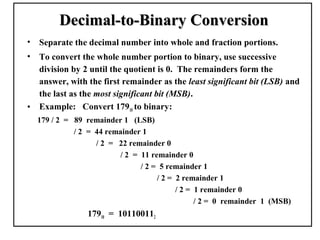
Decimal-to-Binary Conversion
•   Separate the decimal number into whole and fraction portions.
•   To convert the whole number portion to binary, use successive
    division by 2 until the quotient is 0. The remainders form the
    answer, with the first remainder as the least significant bit (LSB) and
    the last as the most significant bit (MSB).
•   Example: Convert 17910 to binary:
    179 / 2 = 89 remainder 1 (LSB)
              / 2 = 44 remainder 1
                    / 2 = 22 remainder 0
                           / 2 = 11 remainder 0
                                 / 2 = 5 remainder 1
                                      / 2 = 2 remainder 1
                                            / 2 = 1 remainder 0
                                                  / 2 = 0 remainder 1 (MSB)
                  17910 = 101100112
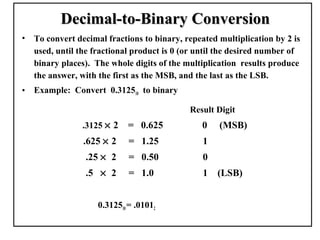
Decimal-to-Binary Conversion
•   To convert decimal fractions to binary, repeated multiplication by 2 is
    used, until the fractional product is 0 (or until the desired number of
    binary places). The whole digits of the multiplication results produce
    the answer, with the first as the MSB, and the last as the LSB.
•   Example: Convert 0.312510 to binary

                                             Result Digit
                .3125 × 2    = 0.625            0    (MSB)
                 .625 × 2     = 1.25             1
                 .25 × 2      = 0.50             0
                 .5 × 2       = 1.0              1   (LSB)


                     0.312510 = .01012
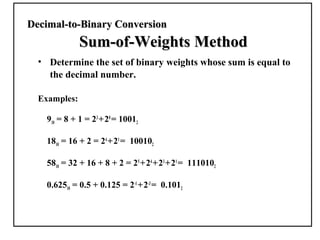
Decimal-to-Binary Conversion
              Sum-of-Weights Method
  • Determine the set of binary weights whose sum is equal to
    the decimal number.

  Examples:

    910 = 8 + 1 = 23 + 20 = 10012

    1810 = 16 + 2 = 24 + 21 = 100102

    5810 = 32 + 16 + 8 + 2 = 25 + 24 + 23 + 21 = 1110102

    0.62510 = 0.5 + 0.125 = 2-1 + 2-3 = 0.1012
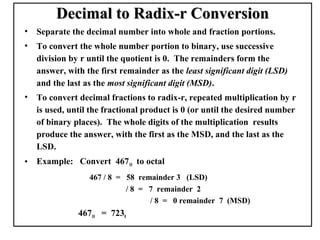
Decimal to Radix-r Conversion
•   Separate the decimal number into whole and fraction portions.
•   To convert the whole number portion to binary, use successive
    division by r until the quotient is 0. The remainders form the
    answer, with the first remainder as the least significant digit (LSD)
    and the last as the most significant digit (MSD).
•   To convert decimal fractions to radix-r, repeated multiplication by r
    is used, until the fractional product is 0 (or until the desired number
    of binary places). The whole digits of the multiplication results
    produce the answer, with the first as the MSD, and the last as the
    LSD.
•   Example: Convert 46710 to octal
                  467 / 8 = 58 remainder 3 (LSD)
                            / 8 = 7 remainder 2
                                  / 8 = 0 remainder 7 (MSD)
               46710 = 7238
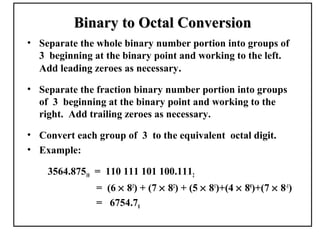
Binary to Octal Conversion
• Separate the whole binary number portion into groups of
  3 beginning at the binary point and working to the left.
  Add leading zeroes as necessary .

• Separate the fraction binary number portion into groups
  of 3 beginning at the binary point and working to the
  right. Add trailing zeroes as necessary.

• Convert each group of 3 to the equivalent octal digit.
• Example:

    3564.87510 = 110 111 101 100.1112
               = (6 × 83) + (7 × 82) + (5 × 81)+(4 × 80)+(7 × 8-1)
               = 6754.78
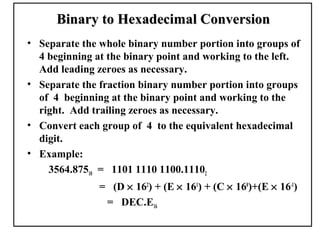
Binary to Hexadecimal Conversion
• Separate the whole binary number portion into groups of
  4 beginning at the binary point and working to the left.
  Add leading zeroes as necessary.
• Separate the fraction binary number portion into groups
  of 4 beginning at the binary point and working to the
  right. Add trailing zeroes as necessary.
• Convert each group of 4 to the equivalent hexadecimal
  digit.
• Example:
    3564.87510 = 1101 1110 1100.11102
               = (D × 162) + (E × 161) + (C × 160)+(E × 16-1)
                = DEC.E16
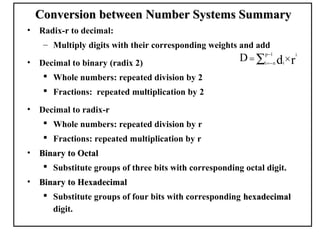
Conversion between Number Systems Summary
•   Radix-r to decimal:
     – Multiply digits with their corresponding weights and add

•   Decimal to binary (radix 2)
                                                         D = ∑ip=−−1n di × ri
      Whole numbers: repeated division by 2
      Fractions: repeated multiplication by 2

•   Decimal to radix-r
      Whole numbers: repeated division by r
      Fractions: repeated multiplication by r
•   Binary to Octal
      Substitute groups of three bits with corresponding octal digit.
•   Binary to Hexadecimal
      Substitute groups of four bits with corresponding hexadecimal
       digit.
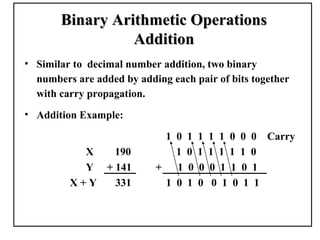
Binary Arithmetic Operations
                 Addition
• Similar to decimal number addition, two binary
  numbers are added by adding each pair of bits together
  with carry propagation.
• Addition Example:

                            1 0   1   1   1 1 0 0 0 Carry
           X   190            1   0   1   1 1 1 1 0
           Y + 141         + 1    0   0   0 1 1 0 1
         X+Y   331          1 0   1   0    0 1 0 1 1
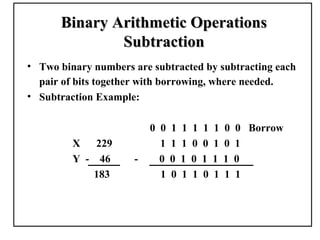
Binary Arithmetic Operations
              Subtraction
• Two binary numbers are subtracted by subtracting each
  pair of bits together with borrowing, where needed.
• Subtraction Example:

                         0 0   1   1   1   1   1   0   0 Borrow
         X   229           1   1   1   0   0   1   0   1
         Y - 46      -     0   0   1   0   1   1   1   0
            183            1   0   1   1   0   1   1   1
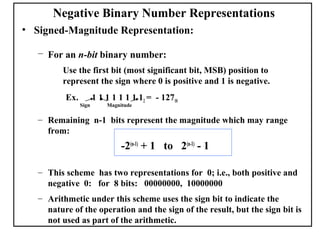
Negative Binary Number Representations
• Signed-Magnitude Representation:

   – For an n-bit binary number:
         Use the first bit (most significant bit, MSB) position to
         represent the sign where 0 is positive and 1 is negative.
          Ex.          1 1 1 1 1 1 1 12 = - 12710
                Sign       Magnitude

   – Remaining n-1 bits represent the magnitude which may range
     from:
                                -2(n-1) + 1 to 2(n-1) - 1

   – This scheme has two representations for 0; i.e., both positive and
     negative 0: for 8 bits: 00000000, 10000000
   – Arithmetic under this scheme uses the sign bit to indicate the
     nature of the operation and the sign of the result, but the sign bit is
     not used as part of the arithmetic.
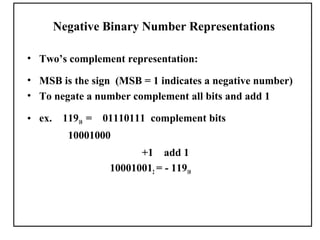
Negative Binary Number Representations

• Two’s complement representation:

• MSB is the sign (MSB = 1 indicates a negative number)
• To negate a number complement all bits and add 1

• ex. 11910 =   01110111 complement bits
        10001000
                       +1 add 1
                 100010012 = - 11910
Properties of Two's Complement Numbers
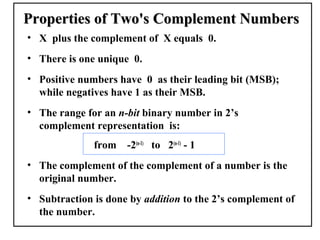
• X plus the complement of X equals 0.
• There is one unique 0.
• Positive numbers have 0 as their leading bit (MSB);
  while negatives have 1 as their MSB.
• The range for an n-bit binary number in 2’s
  complement representation is:
              from   -2(n-1) to 2(n-1) - 1
• The complement of the complement of a number is the
  original number.
• Subtraction is done by addition to the 2’s complement of
  the number.
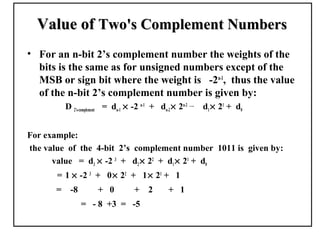
Value of Two's Complement Numbers
• For an n-bit 2’s complement number the weights of the
  bits is the same as for unsigned numbers except of the
  MSB or sign bit where the weight is -2n-1, thus the value
  of the n-bit 2’s complement number is given by:
           D 2’s-complement = dn-1 × -2 n-1 + dn-2 × 2n-2 …..   d 1 × 2 1 + d0


For example:
the value of the 4-bit 2’s complement number 1011 is given by:
      value = d3 × -2 3 + d2 × 22 + d1 × 21 + d0
       = 1 × -2 3 + 0 × 22 + 1 × 21 + 1
       =    -8         + 0           +     2       + 1
                 = - 8 +3 = -5
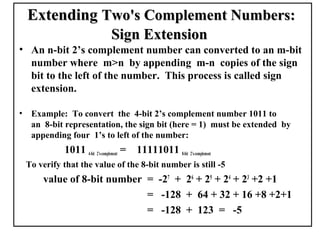
Extending Two's Complement Numbers:
                                  Sign Extension
• An n-bit 2’s complement number can converted to an m-bit
  number where m>n by appending m-n copies of the sign
  bit to the left of the number. This process is called sign
  extension.

•    Example: To convert the 4-bit 2’s complement number 1011 to
     an 8-bit representation, the sign bit (here = 1) must be extended by
     appending four 1’s to left of the number:
              1011 4-bit 2’s-complement =   11111011 8-bit 2’s-complement
    To verify that the value of the 8-bit number is still -5
        value of 8-bit number = -27 + 26 + 25 + 24 + 23 +2 +1
                              = -128 + 64 + 32 + 16 +8 +2+1
                              = -128 + 123 = -5
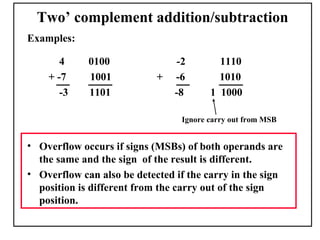
Two’ complement addition/subtraction
Examples:

       4     0100               -2        1110
    + -7     1001           +   -6        1010
       -3    1101               -8      1 1000

                                 Ignore carry out from MSB


• Overflow occurs if signs (MSBs) of both operands are
  the same and the sign of the result is different.
• Overflow can also be detected if the carry in the sign
  position is different from the carry out of the sign
  position.
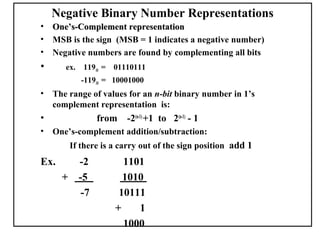
Negative Binary Number Representations
•   One’s-Complement representation
•   MSB is the sign (MSB = 1 indicates a negative number)
•   Negative numbers are found by complementing all bits
•      ex.    11910 =   01110111
             -11910 = 10001000
•   The range of values for an n-bit binary number in 1’s
    complement representation is:
•                  from    -2(n-1) +1 to 2(n-1) - 1
•   One’s-complement addition/subtraction:
          If there is a carry out of the sign position add 1
Ex.          -2           1101
      +      -5           1010
              -7         10111
                        +    1
                          1000
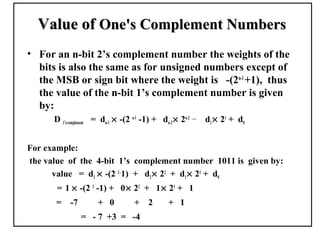
Value of One's Complement Numbers
• For an n-bit 2’s complement number the weights of the
  bits is also the same as for unsigned numbers except of
  the MSB or sign bit where the weight is -(2n-1 +1), thus
  the value of the n-bit 1’s complement number is given
  by:
      D 1’s-complement = dn-1 × -(2 n-1 -1) + dn-2 × 2n-2 …..   d1 × 21 + d 0


For example:
the value of the 4-bit 1’s complement number 1011 is given by:
      value = d3 × -(2 3 -1) + d2 × 22 + d1 × 21 + d0
       = 1 × -(2 3 -1) + 0 × 22 + 1 × 21 + 1
       =    -7        + 0            +    2       + 1
                 = - 7 +3 = -4
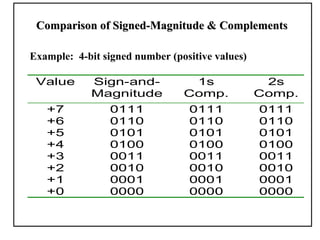
Comparison of Signed-Magnitude & Complements

Example: 4-bit signed number (positive values)

 Value       Sign-and-           1s               2s
             Magnitude          Comp.            Comp.
   +7            0111            0111            0111
   +6            0110            0110            0110
   +5            0101            0101            0101
   +4            0100            0100            0100
   +3            0011            0011            0011
   +2            0010            0010            0010
   +1            0001            0001            0001
   +0            0000            0000            0000
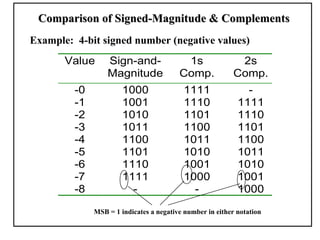
Comparison of Signed-Magnitude & Complements
Example: 4-bit signed number (negative values)
       Value      Sign-and-               1s                2s
                  Magnitude              Comp.             Comp.
         -0            1000                1111               -
         -1            1001                1110             1111
         -2            1010                1101             1110
         -3            1011                1100             1101
         -4            1100                1011             1100
         -5            1101                1010             1011
         -6            1110                1001             1010
         -7            1111                1000             1001
         -8              -                   -              1000

              MSB = 1 indicates a negative number in either notation

L 2.10

  • 1.
    Positional Number Systems • A number system consists of an order set of symbols (digits) with relations defined for +,-,*, / • The radix (or base) of the number system is the total number of digits allowed in the the number system. – Example, for the decimal number system: • Radix, r = 10, Digits allowed = 0,1, 2, 3, 4, 5, 6, 7, 8, 9 • In positional number systems, a number is represented by a string of digits, where each digit position has an associated weight. • The value of a number is the weighted sum of the digits. • The general representation of an unsigned number D with whole and fraction portions number in a number system with radix r: Dr = d p-1 d p-2 ….. d1 d0.d-1 d-2 …. D-n • The number above has p digits to the left of the radix point and n fraction digits to the right. • A digit in position i has as associated weight ri • The value of the number is the sum of the digits multiplied by the associated weight ri : D = ∑i =− n di × r p −1 i
  • 2.
    Positional Number Systems Number: Dr = d p-1 d p-2 ….. d1 d0.d-1 d-2 …. D-n Value: D = ∑i =− n di × ri p −1 • For example in the decimal number system: 5185.6810 = 5x10³ + 1x10² + 8x101 + 5x100 + 6 x 10⁻¹ + 8 x 10-2 = 5x1000 + 1x100 + 8x10 + 5 x 1 + 6x.1 + 8x.01 • For the binary number system with radix = 2, digits 0, 1 D2 = dp-1 × 2p-1 ….. d1 × 21 + d0 . 20 + d-1 × 2-1 + d-2 × 2-2 ….. • For Example: 100112 = 1 × 16 + 0 × 8 + 0 × 4 + 1 × 2 + 1 × 1 = 1910 | | MSB LSB (least significant bit) (most significant bit) Binary Point 101.0012 = 1x4 + 0x2 + 1x1 + 0x.5 + 0x.25 + 1x.125 = 5.12510
  • 3.
    Number Systems Usedin Computers Name Radix Set of Digits Example of Radix Decimal r=10 {0,1,2,3,4,5,6,7,8,9} 25510 Binary r=2 {0,1} 11111111 2 Octal r= 8 {0,1,2,3,4,5,6,7} 377 8 Hexadecimal r=16 {0,1,2,3,4,5,6,7,8,9,A, B, C, D, E, F} FF16 Decimal 0 1 2 3 4 5 6 7 8 9 10 11 12 13 14 15 Hex 0 1 2 3 4 5 6 7 8 9 A B C D E F Binary 0000 0001 0010 0011 0100 0101 0110 0111 1000 1001 1010 1011 1100 1101 1110 1111
  • 4.
    Radix-r to DecimalConversion • The decimal value of a number in any radix r is found by converting each digit to its radix 10 equivalent and expanding the value using radix arithmetic: D = ∑ip=−−1n di × ri • Examples: 1101.1012 = 1×23 + 1×22 + 1×20 + 1×2-1 + 1×2-3 = 8 + 4 + 1 + 0.5 + 0.125 = 13.62510 572.68 = 5×82 + 7×81 + 2×80 + 6×8-1 = 320 + 56 + 16 + 0.75 = 392.7510 2A.816 = 2×161 + 10×160 + 8×16-1 = 32 + 10 + 0.5 = 42.510 132.34 = 1×42 + 3×41 + 2×40 + 3×4-1 = 16 + 12 + 2 + 0.75 = 30.7510 341.245 = 3×52 + 4×51 + 1×50 + 2×5-1 + 4×5-2 = 75 + 20 + 1 + 0.4 + 0.16 = 96.5610
  • 5.
    Decimal-to-Binary Conversion • Separate the decimal number into whole and fraction portions. • To convert the whole number portion to binary, use successive division by 2 until the quotient is 0. The remainders form the answer, with the first remainder as the least significant bit (LSB) and the last as the most significant bit (MSB). • Example: Convert 17910 to binary: 179 / 2 = 89 remainder 1 (LSB) / 2 = 44 remainder 1 / 2 = 22 remainder 0 / 2 = 11 remainder 0 / 2 = 5 remainder 1 / 2 = 2 remainder 1 / 2 = 1 remainder 0 / 2 = 0 remainder 1 (MSB) 17910 = 101100112
  • 6.
    Decimal-to-Binary Conversion • To convert decimal fractions to binary, repeated multiplication by 2 is used, until the fractional product is 0 (or until the desired number of binary places). The whole digits of the multiplication results produce the answer, with the first as the MSB, and the last as the LSB. • Example: Convert 0.312510 to binary Result Digit .3125 × 2 = 0.625 0 (MSB) .625 × 2 = 1.25 1 .25 × 2 = 0.50 0 .5 × 2 = 1.0 1 (LSB) 0.312510 = .01012
  • 7.
    Decimal-to-Binary Conversion Sum-of-Weights Method • Determine the set of binary weights whose sum is equal to the decimal number. Examples: 910 = 8 + 1 = 23 + 20 = 10012 1810 = 16 + 2 = 24 + 21 = 100102 5810 = 32 + 16 + 8 + 2 = 25 + 24 + 23 + 21 = 1110102 0.62510 = 0.5 + 0.125 = 2-1 + 2-3 = 0.1012
  • 8.
    Decimal to Radix-rConversion • Separate the decimal number into whole and fraction portions. • To convert the whole number portion to binary, use successive division by r until the quotient is 0. The remainders form the answer, with the first remainder as the least significant digit (LSD) and the last as the most significant digit (MSD). • To convert decimal fractions to radix-r, repeated multiplication by r is used, until the fractional product is 0 (or until the desired number of binary places). The whole digits of the multiplication results produce the answer, with the first as the MSD, and the last as the LSD. • Example: Convert 46710 to octal 467 / 8 = 58 remainder 3 (LSD) / 8 = 7 remainder 2 / 8 = 0 remainder 7 (MSD) 46710 = 7238
  • 9.
    Binary to OctalConversion • Separate the whole binary number portion into groups of 3 beginning at the binary point and working to the left. Add leading zeroes as necessary . • Separate the fraction binary number portion into groups of 3 beginning at the binary point and working to the right. Add trailing zeroes as necessary. • Convert each group of 3 to the equivalent octal digit. • Example: 3564.87510 = 110 111 101 100.1112 = (6 × 83) + (7 × 82) + (5 × 81)+(4 × 80)+(7 × 8-1) = 6754.78
  • 10.
    Binary to HexadecimalConversion • Separate the whole binary number portion into groups of 4 beginning at the binary point and working to the left. Add leading zeroes as necessary. • Separate the fraction binary number portion into groups of 4 beginning at the binary point and working to the right. Add trailing zeroes as necessary. • Convert each group of 4 to the equivalent hexadecimal digit. • Example: 3564.87510 = 1101 1110 1100.11102 = (D × 162) + (E × 161) + (C × 160)+(E × 16-1) = DEC.E16
  • 11.
    Conversion between NumberSystems Summary • Radix-r to decimal: – Multiply digits with their corresponding weights and add • Decimal to binary (radix 2) D = ∑ip=−−1n di × ri  Whole numbers: repeated division by 2  Fractions: repeated multiplication by 2 • Decimal to radix-r  Whole numbers: repeated division by r  Fractions: repeated multiplication by r • Binary to Octal  Substitute groups of three bits with corresponding octal digit. • Binary to Hexadecimal  Substitute groups of four bits with corresponding hexadecimal digit.
  • 12.
    Binary Arithmetic Operations Addition • Similar to decimal number addition, two binary numbers are added by adding each pair of bits together with carry propagation. • Addition Example: 1 0 1 1 1 1 0 0 0 Carry X 190 1 0 1 1 1 1 1 0 Y + 141 + 1 0 0 0 1 1 0 1 X+Y 331 1 0 1 0 0 1 0 1 1
  • 13.
    Binary Arithmetic Operations Subtraction • Two binary numbers are subtracted by subtracting each pair of bits together with borrowing, where needed. • Subtraction Example: 0 0 1 1 1 1 1 0 0 Borrow X 229 1 1 1 0 0 1 0 1 Y - 46 - 0 0 1 0 1 1 1 0 183 1 0 1 1 0 1 1 1
  • 14.
    Negative Binary NumberRepresentations • Signed-Magnitude Representation: – For an n-bit binary number: Use the first bit (most significant bit, MSB) position to represent the sign where 0 is positive and 1 is negative. Ex. 1 1 1 1 1 1 1 12 = - 12710 Sign Magnitude – Remaining n-1 bits represent the magnitude which may range from: -2(n-1) + 1 to 2(n-1) - 1 – This scheme has two representations for 0; i.e., both positive and negative 0: for 8 bits: 00000000, 10000000 – Arithmetic under this scheme uses the sign bit to indicate the nature of the operation and the sign of the result, but the sign bit is not used as part of the arithmetic.
  • 15.
    Negative Binary NumberRepresentations • Two’s complement representation: • MSB is the sign (MSB = 1 indicates a negative number) • To negate a number complement all bits and add 1 • ex. 11910 = 01110111 complement bits 10001000 +1 add 1 100010012 = - 11910
  • 16.
    Properties of Two'sComplement Numbers • X plus the complement of X equals 0. • There is one unique 0. • Positive numbers have 0 as their leading bit (MSB); while negatives have 1 as their MSB. • The range for an n-bit binary number in 2’s complement representation is: from -2(n-1) to 2(n-1) - 1 • The complement of the complement of a number is the original number. • Subtraction is done by addition to the 2’s complement of the number.
  • 17.
    Value of Two'sComplement Numbers • For an n-bit 2’s complement number the weights of the bits is the same as for unsigned numbers except of the MSB or sign bit where the weight is -2n-1, thus the value of the n-bit 2’s complement number is given by: D 2’s-complement = dn-1 × -2 n-1 + dn-2 × 2n-2 ….. d 1 × 2 1 + d0 For example: the value of the 4-bit 2’s complement number 1011 is given by: value = d3 × -2 3 + d2 × 22 + d1 × 21 + d0 = 1 × -2 3 + 0 × 22 + 1 × 21 + 1 = -8 + 0 + 2 + 1 = - 8 +3 = -5
  • 18.
    Extending Two's ComplementNumbers: Sign Extension • An n-bit 2’s complement number can converted to an m-bit number where m>n by appending m-n copies of the sign bit to the left of the number. This process is called sign extension. • Example: To convert the 4-bit 2’s complement number 1011 to an 8-bit representation, the sign bit (here = 1) must be extended by appending four 1’s to left of the number: 1011 4-bit 2’s-complement = 11111011 8-bit 2’s-complement To verify that the value of the 8-bit number is still -5 value of 8-bit number = -27 + 26 + 25 + 24 + 23 +2 +1 = -128 + 64 + 32 + 16 +8 +2+1 = -128 + 123 = -5
  • 19.
    Two’ complement addition/subtraction Examples: 4 0100 -2 1110 + -7 1001 + -6 1010 -3 1101 -8 1 1000 Ignore carry out from MSB • Overflow occurs if signs (MSBs) of both operands are the same and the sign of the result is different. • Overflow can also be detected if the carry in the sign position is different from the carry out of the sign position.
  • 20.
    Negative Binary NumberRepresentations • One’s-Complement representation • MSB is the sign (MSB = 1 indicates a negative number) • Negative numbers are found by complementing all bits • ex. 11910 = 01110111 -11910 = 10001000 • The range of values for an n-bit binary number in 1’s complement representation is: • from -2(n-1) +1 to 2(n-1) - 1 • One’s-complement addition/subtraction: If there is a carry out of the sign position add 1 Ex. -2 1101 + -5 1010 -7 10111 + 1 1000
  • 21.
    Value of One'sComplement Numbers • For an n-bit 2’s complement number the weights of the bits is also the same as for unsigned numbers except of the MSB or sign bit where the weight is -(2n-1 +1), thus the value of the n-bit 1’s complement number is given by: D 1’s-complement = dn-1 × -(2 n-1 -1) + dn-2 × 2n-2 ….. d1 × 21 + d 0 For example: the value of the 4-bit 1’s complement number 1011 is given by: value = d3 × -(2 3 -1) + d2 × 22 + d1 × 21 + d0 = 1 × -(2 3 -1) + 0 × 22 + 1 × 21 + 1 = -7 + 0 + 2 + 1 = - 7 +3 = -4
  • 22.
    Comparison of Signed-Magnitude& Complements Example: 4-bit signed number (positive values) Value Sign-and- 1s 2s Magnitude Comp. Comp. +7 0111 0111 0111 +6 0110 0110 0110 +5 0101 0101 0101 +4 0100 0100 0100 +3 0011 0011 0011 +2 0010 0010 0010 +1 0001 0001 0001 +0 0000 0000 0000
  • 23.
    Comparison of Signed-Magnitude& Complements Example: 4-bit signed number (negative values) Value Sign-and- 1s 2s Magnitude Comp. Comp. -0 1000 1111 - -1 1001 1110 1111 -2 1010 1101 1110 -3 1011 1100 1101 -4 1100 1011 1100 -5 1101 1010 1011 -6 1110 1001 1010 -7 1111 1000 1001 -8 - - 1000 MSB = 1 indicates a negative number in either notation