Computer & Network Technology

Chamila Fernando
02/03/14

Information Representation

BSc(Eng) Hons,MBA,MIEEE
1
Negative Numbers Representation
 Till now, we have only considered how unsigned (non-

negative) numbers can be represented. There are three
common ways of representing signed numbers (positive
and negative numbers) for binary numbers:
 Sign-and-Magnitude
 1s Complement
 2s Complement

02/03/14

Information Representation

2
Negative Numbers:
Sign-and-Magnitude
 Negative numbers are usually written by writing a minus
sign in front.
 Example:

- (12)10 , - (1100)2

• In computer memory of fixed width, this sign is usually
represented by a bit:
0 for +
1 for -

02/03/14

Information Representation

3
Negative Numbers:
Sign-and-Magnitude
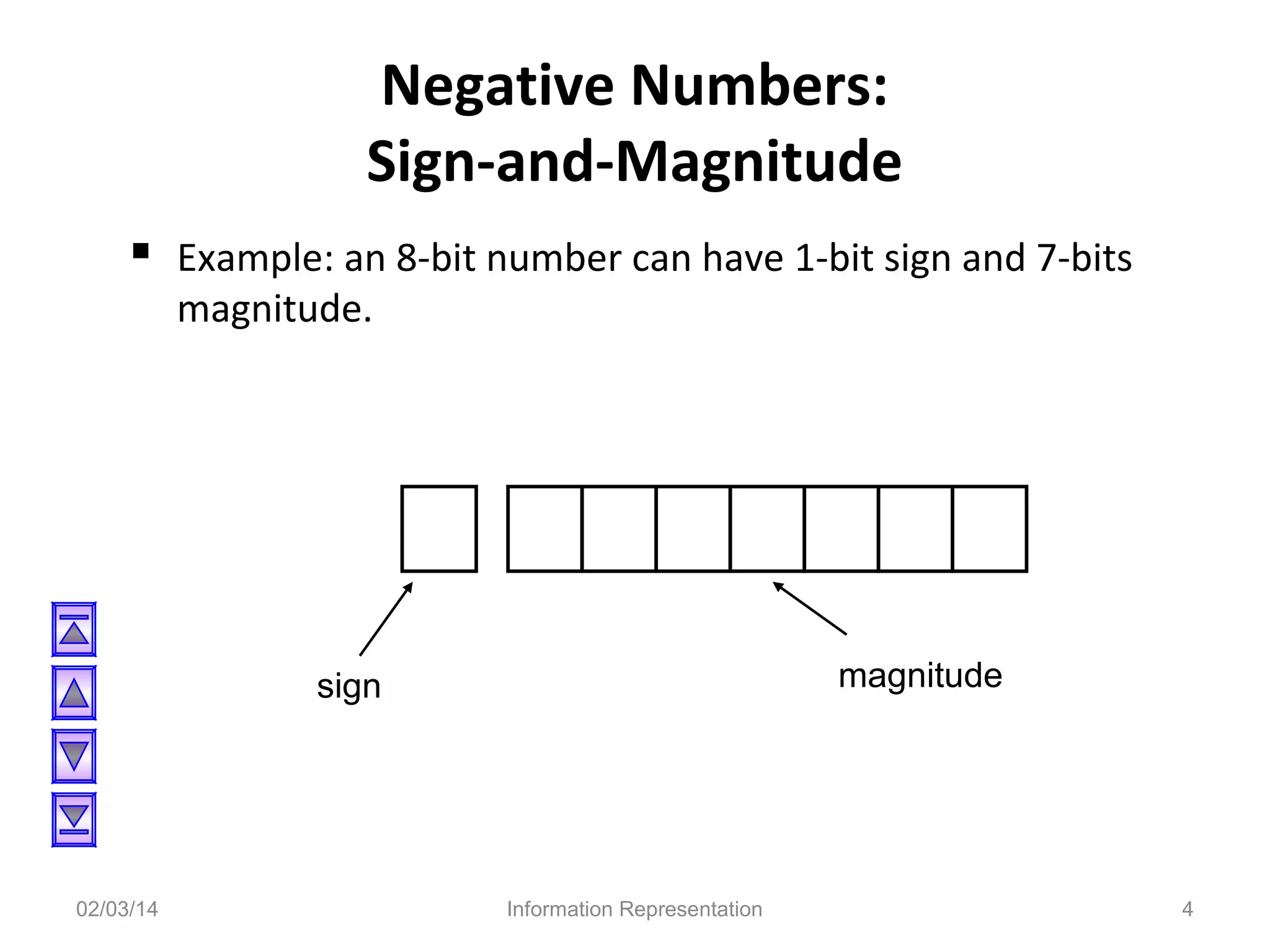
 Example: an 8-bit number can have 1-bit sign and 7-bits
magnitude.

magnitude

sign

02/03/14

Information Representation

4
Negative Numbers:
Sign-and-Magnitude
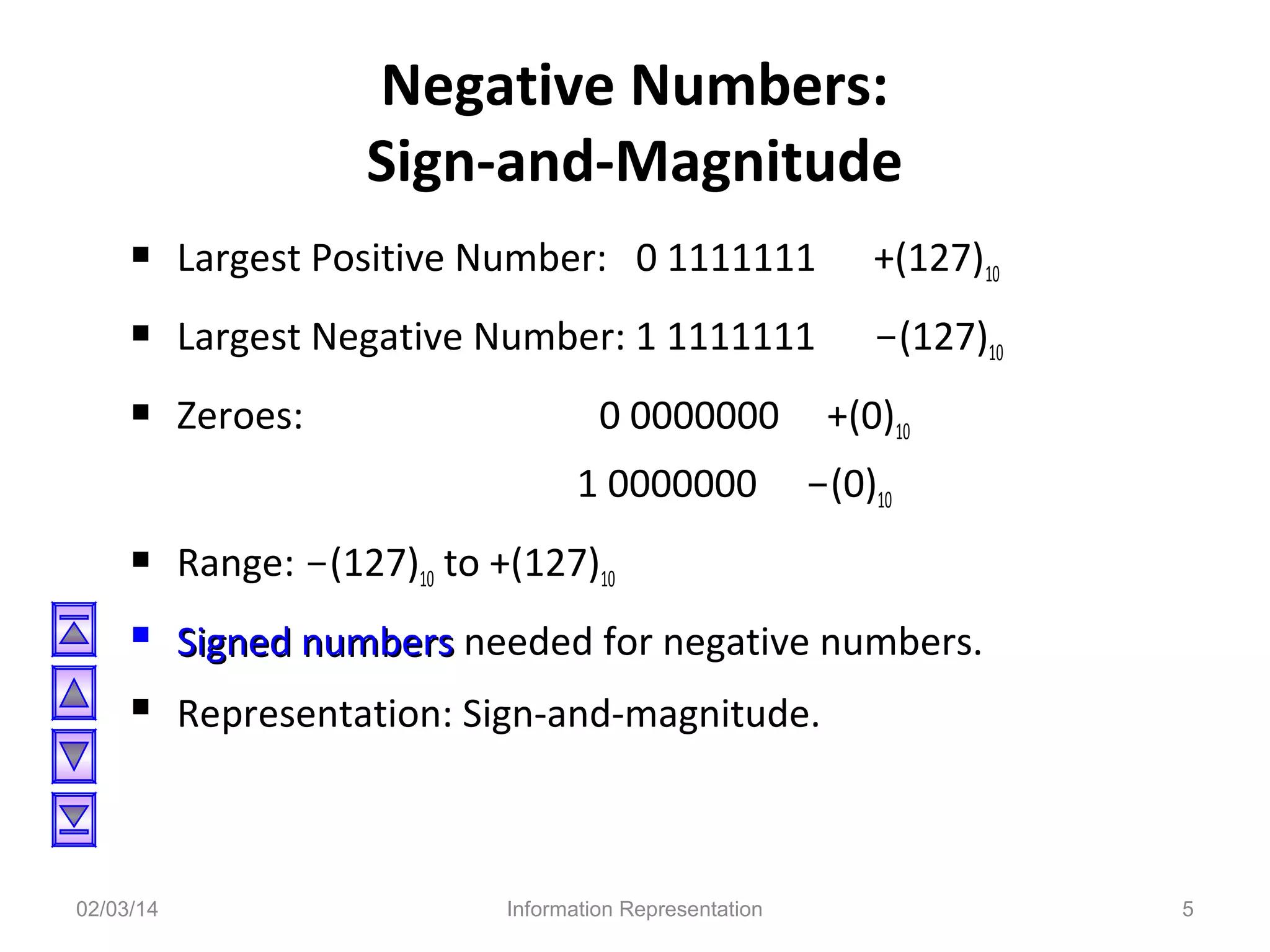
 Largest Positive Number: 0 1111111

+(127)10

 Largest Negative Number: 1 1111111

-(127)10

 Zeroes:

0 0000000
1 0000000





02/03/14

+(0)10
-(0)10

Range: -(127)10 to +(127)10
Signed numbers needed for negative numbers.
Representation: Sign-and-magnitude.

Information Representation

5
Negative Numbers:
Sign-and-Magnitude
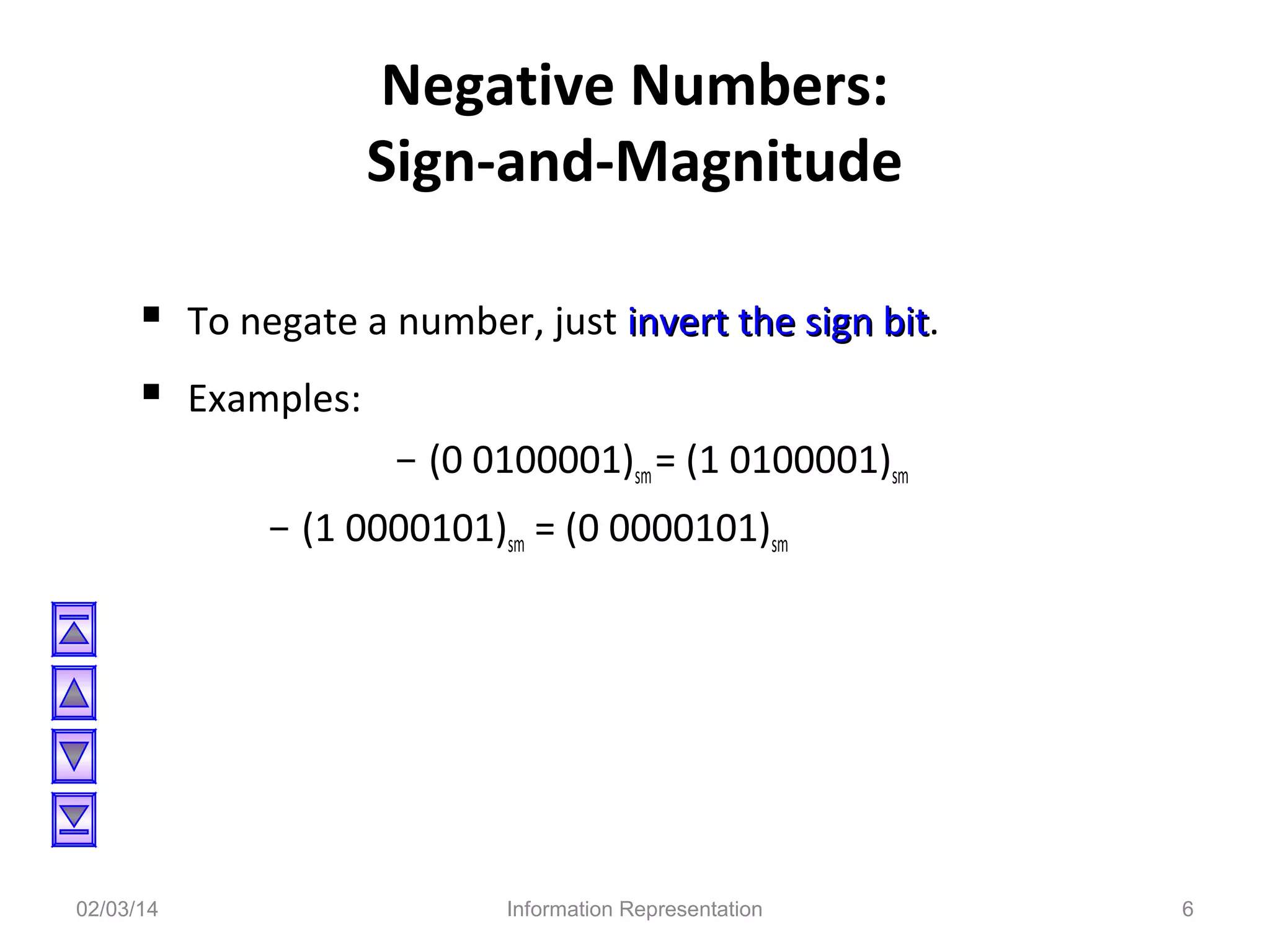
 To negate a number, just invert the sign bit.
bit
 Examples:
- (0 0100001)sm = (1 0100001)sm
- (1 0000101)sm = (0 0000101)sm

02/03/14

Information Representation

6
1s and 2s Complement
 Two other ways of representing signed numbers for binary
numbers are:

 1s-complement
 2s-complement

02/03/14

Information Representation

7
1s Complement
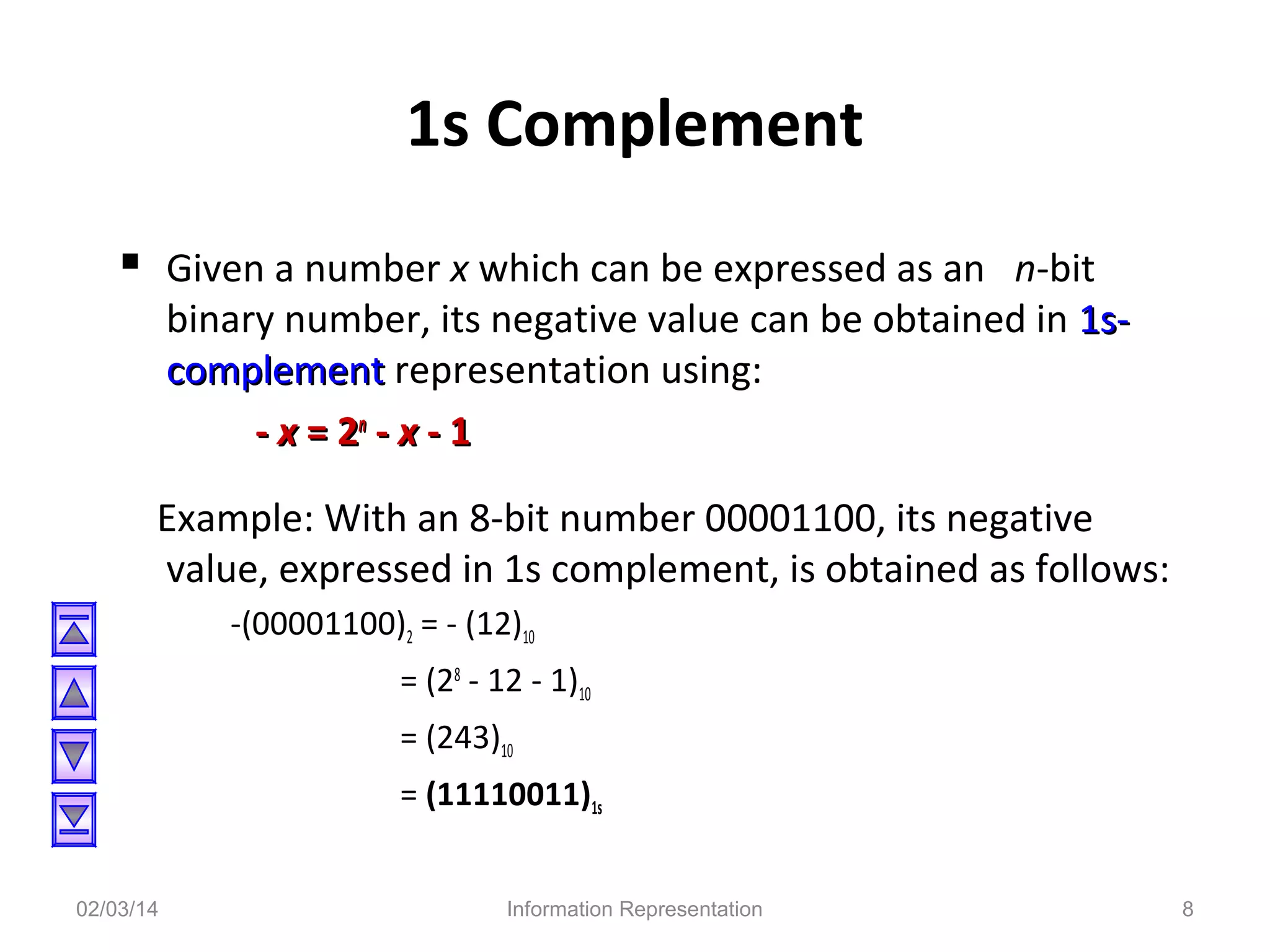
 Given a number x which can be expressed as an n-bit

binary number, its negative value can be obtained in 1scomplement representation using:
- x = 2n - x - 1

Example: With an 8-bit number 00001100, its negative
value, expressed in 1s complement, is obtained as follows:
-(00001100)2 = - (12)10
= (28 - 12 - 1)10
= (243)10
= (11110011)1s
02/03/14

Information Representation

8
1s Complement
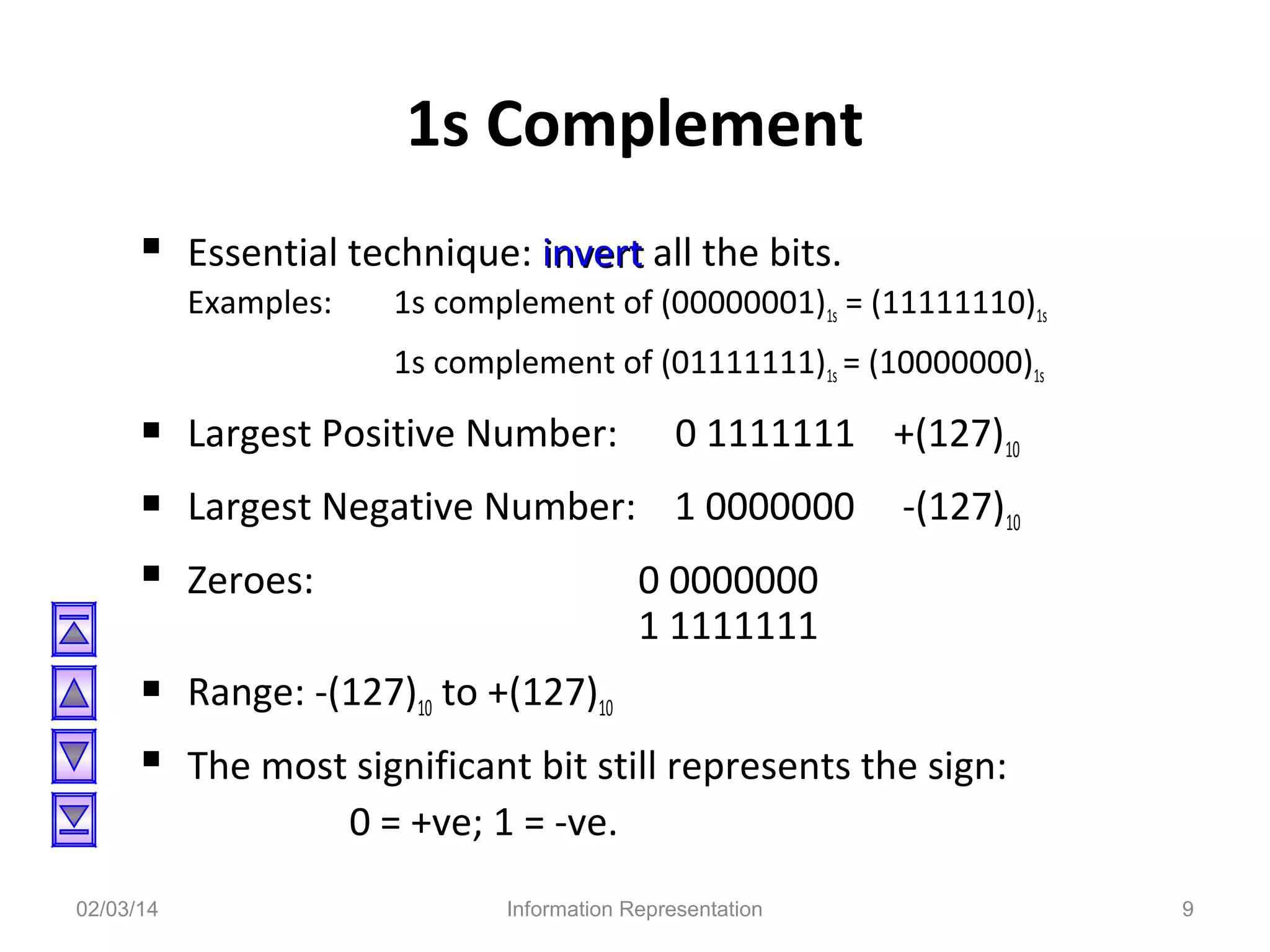
 Essential technique: invert all the bits.
Examples:

1s complement of (00000001)1s = (11111110)1s
1s complement of (01111111)1s = (10000000)1s

 Largest Positive Number: 0 1111111 +(127)10
 Largest Negative Number: 1 0000000 -(127)10
 Zeroes:
0 0000000
1 1111111

 Range: -(127)10 to +(127)10
 The most significant bit still represents the sign:
0 = +ve; 1 = -ve.
02/03/14

Information Representation

9
1s Complement
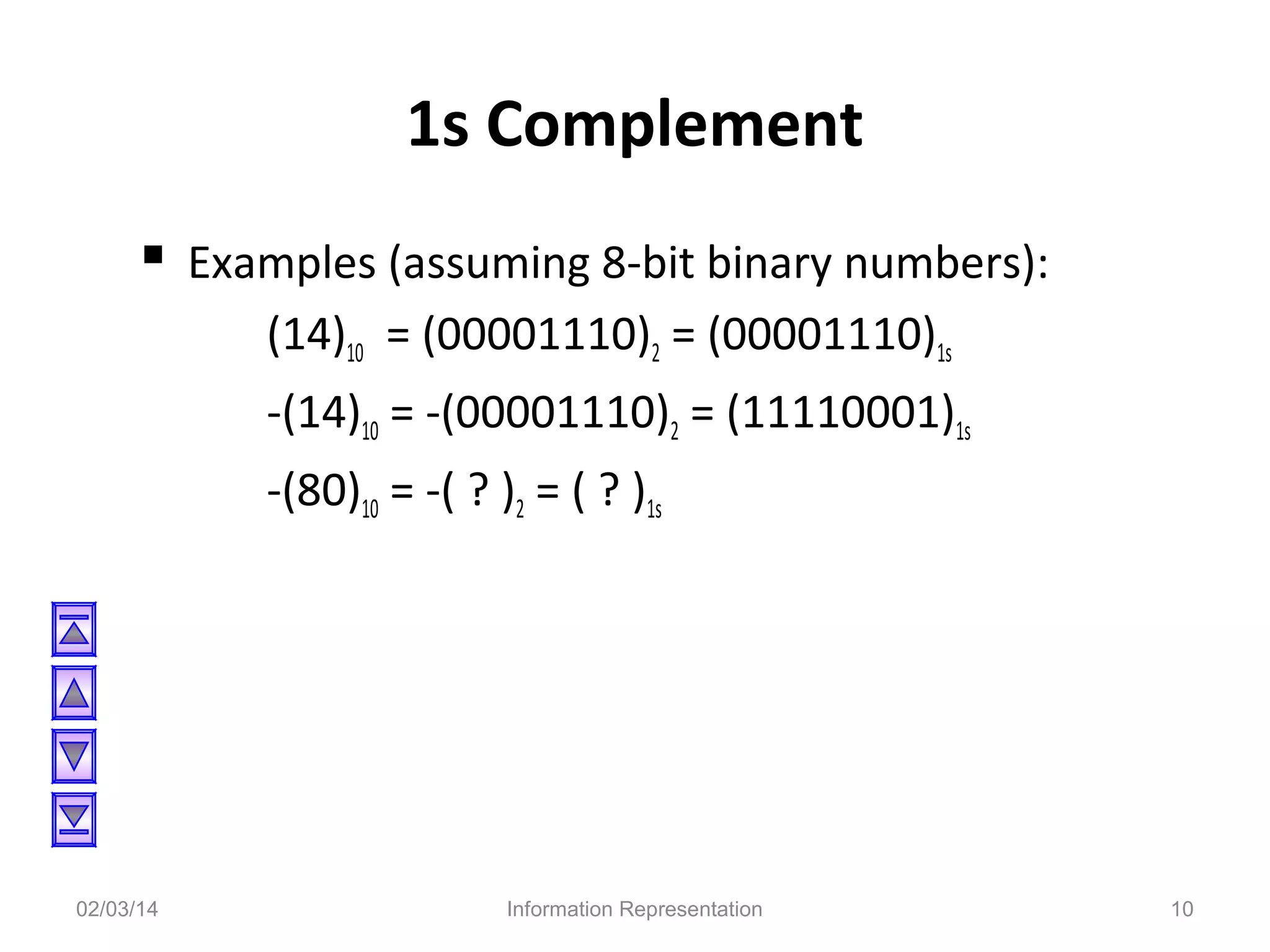
 Examples (assuming 8-bit binary numbers):
(14)10 = (00001110)2 = (00001110)1s
-(14)10 = -(00001110)2 = (11110001)1s
-(80)10 = -( ? )2 = ( ? )1s

02/03/14

Information Representation

10
2s Complement
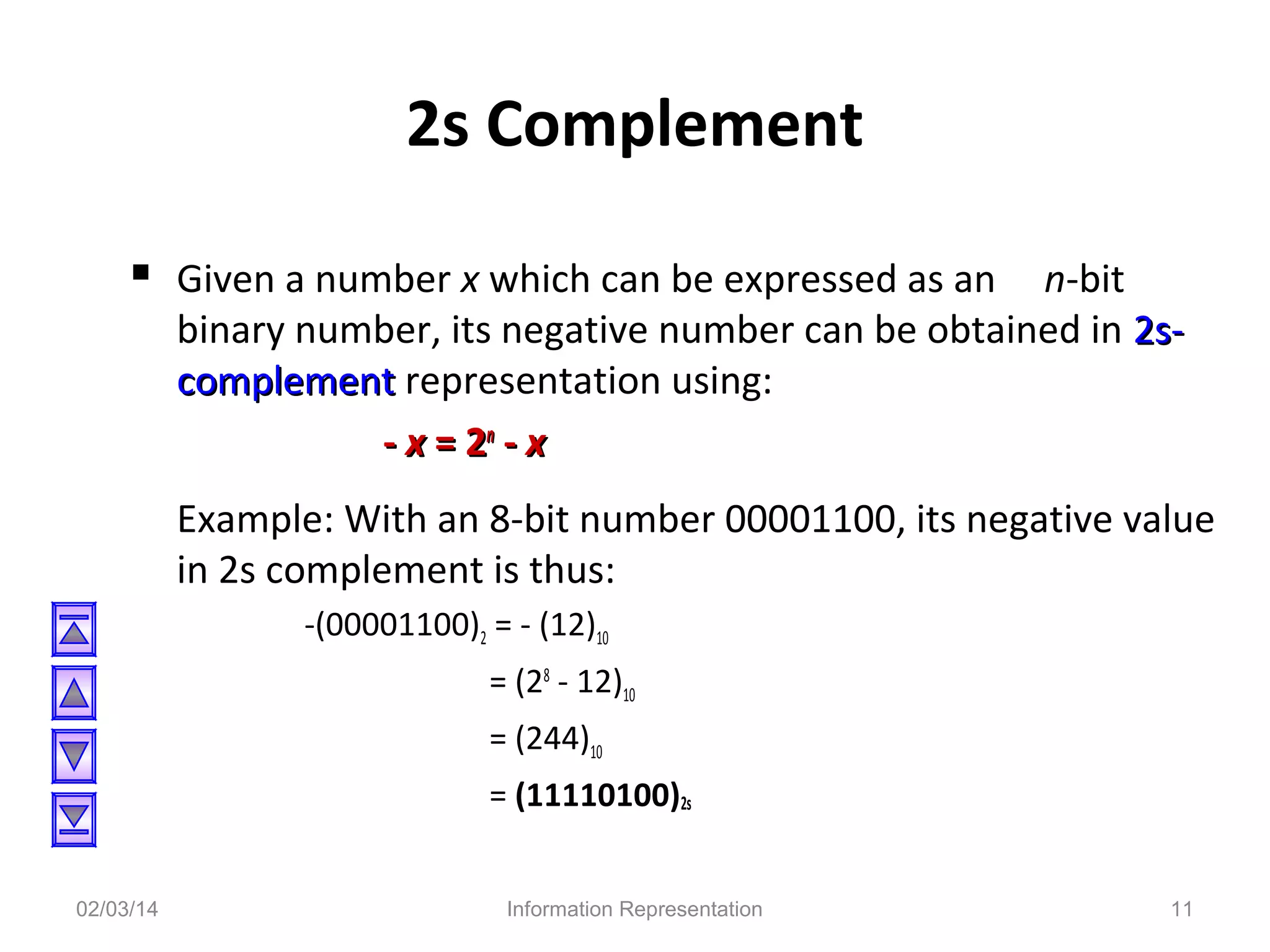
 Given a number x which can be expressed as an n-bit

binary number, its negative number can be obtained in 2scomplement representation using:
- x = 2n - x
Example: With an 8-bit number 00001100, its negative value
in 2s complement is thus:
-(00001100)2 = - (12)10
= (28 - 12)10
= (244)10
= (11110100)2s

02/03/14

Information Representation

11
2s Complement
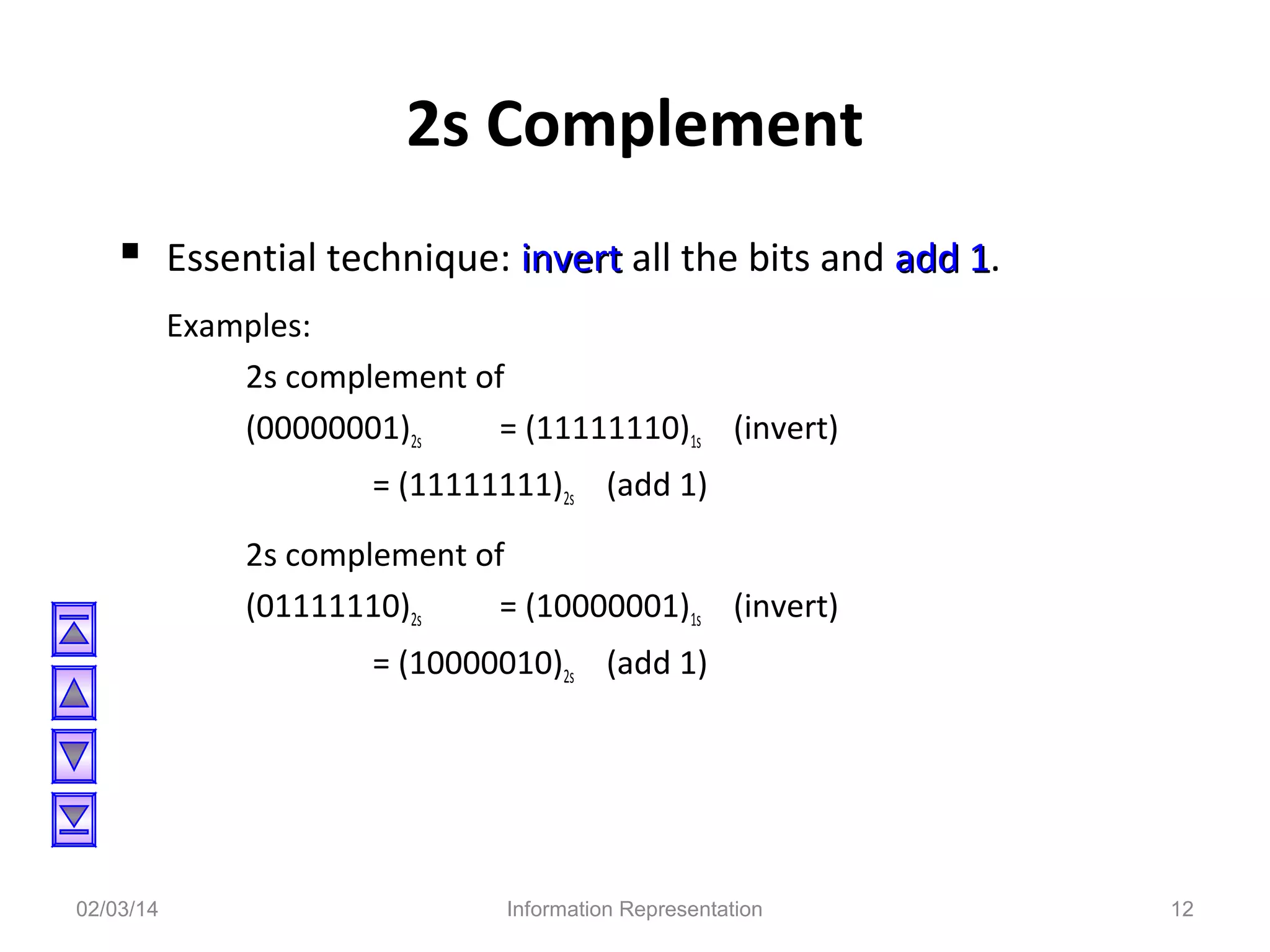
 Essential technique: invert all the bits and add 1.
1
Examples:
2s complement of
(00000001)2s
= (11111110)1s (invert)
= (11111111)2s (add 1)
2s complement of
(01111110)2s
= (10000001)1s (invert)
= (10000010)2s (add 1)

02/03/14

Information Representation

12
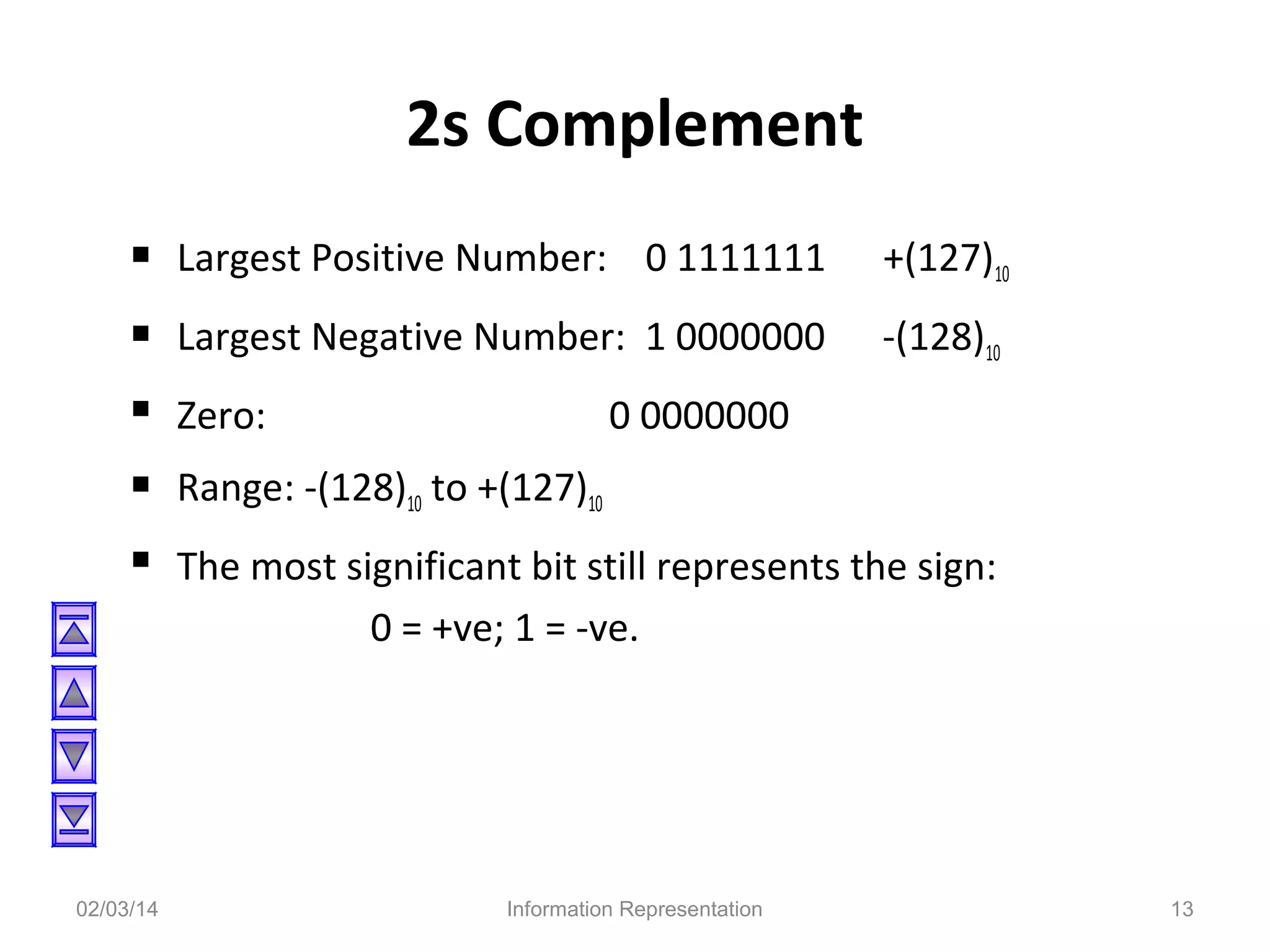
2s Complement
 Largest Positive Number: 0 1111111

+(127)10

Largest Negative Number: 1 0000000

-(128)10






02/03/14

Zero:

0 0000000

Range: -(128)10 to +(127)10
The most significant bit still represents the sign:
0 = +ve; 1 = -ve.

Information Representation

13
2s Complement
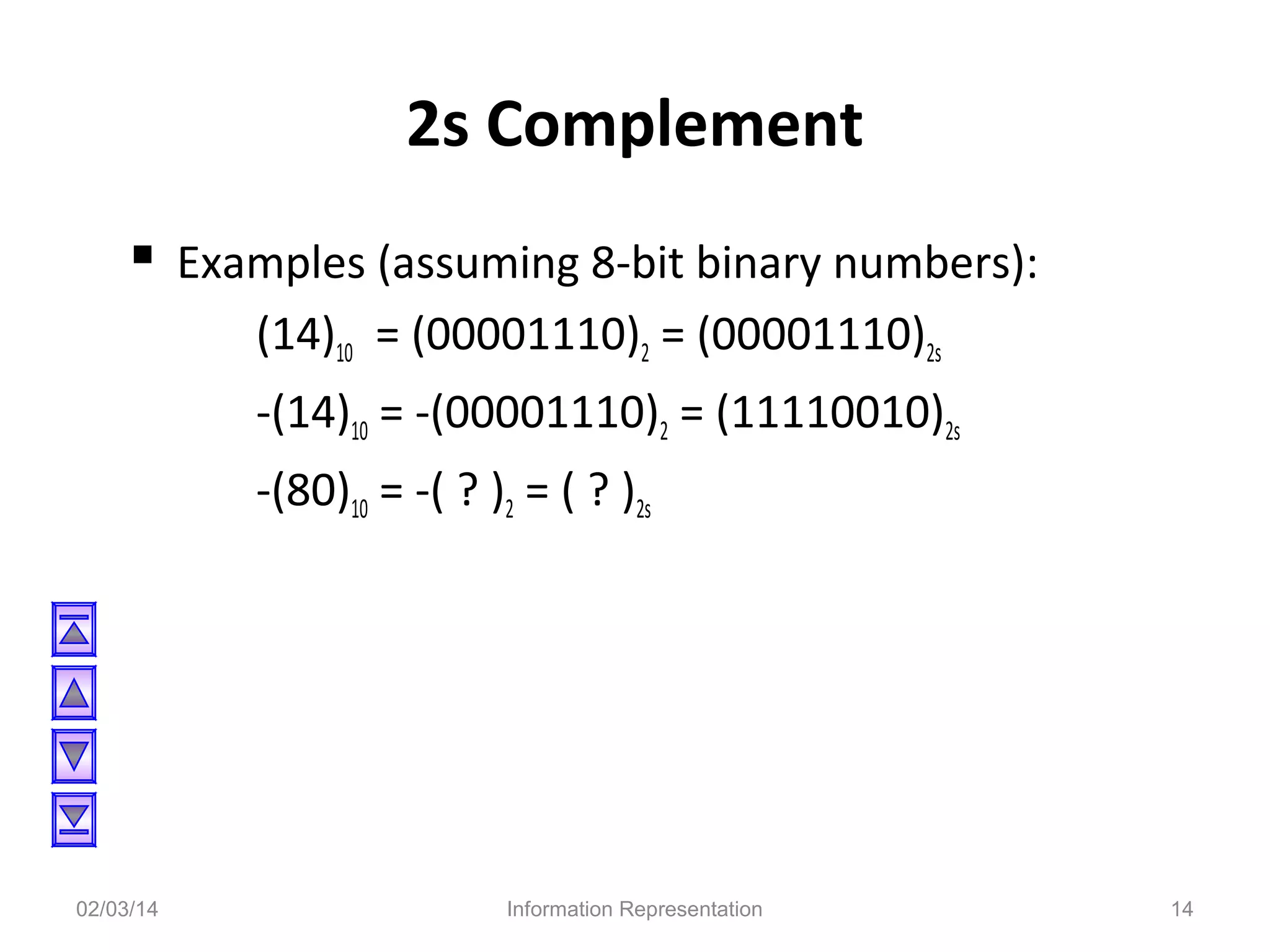
 Examples (assuming 8-bit binary numbers):
(14)10 = (00001110)2 = (00001110)2s
-(14)10 = -(00001110)2 = (11110010)2s
-(80)10 = -( ? )2 = ( ? )2s

02/03/14

Information Representation

14
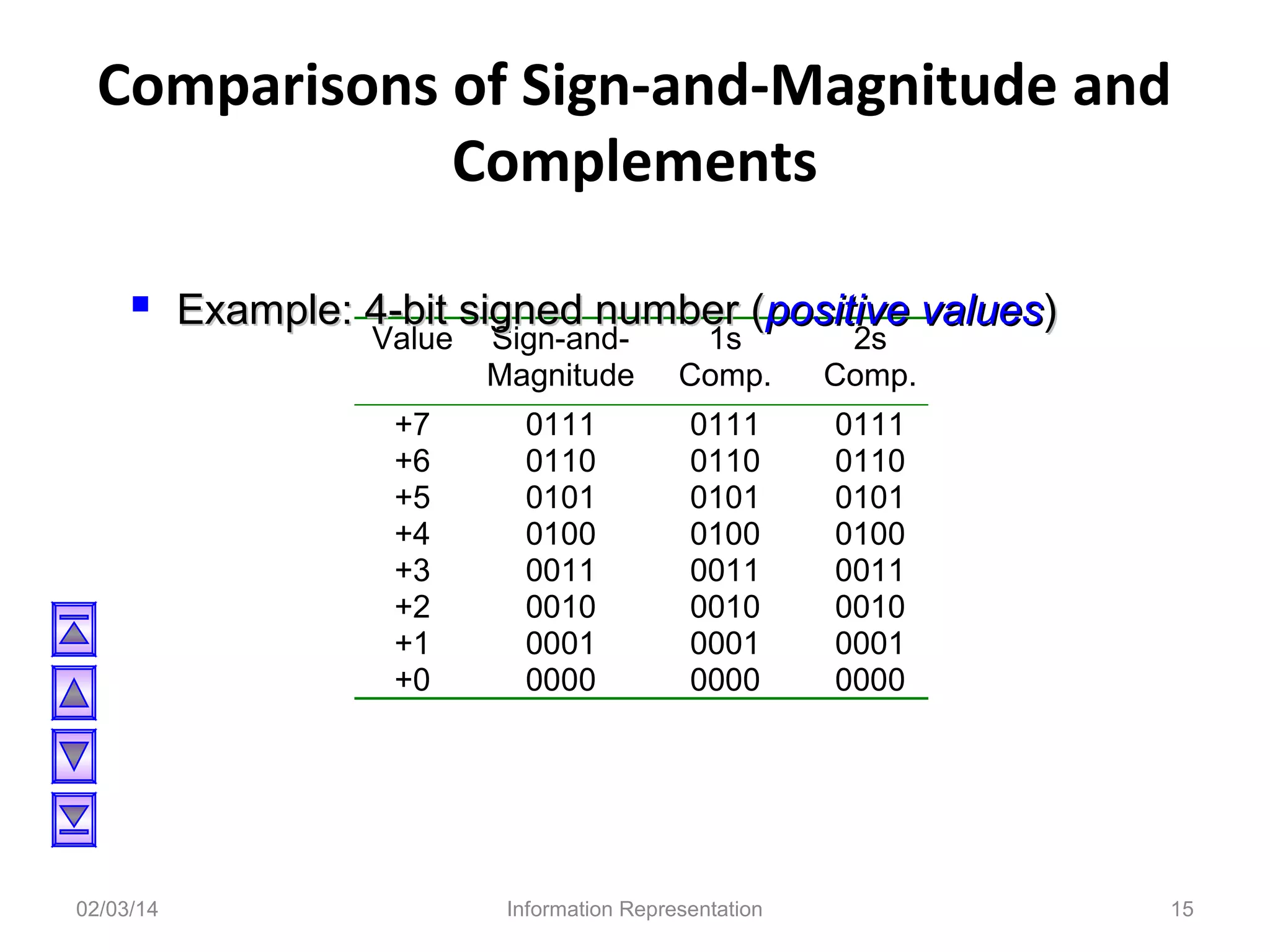
Comparisons of Sign-and-Magnitude and
Complements
 Example: 4-bit signed number (positive values)
Value Sign-and1s
2s
Magnitude
+7
+6
+5
+4
+3
+2
+1
+0

02/03/14

Comp.

Comp.

0111
0110
0101
0100
0011
0010
0001
0000

0111
0110
0101
0100
0011
0010
0001
0000

0111
0110
0101
0100
0011
0010
0001
0000

Information Representation

15
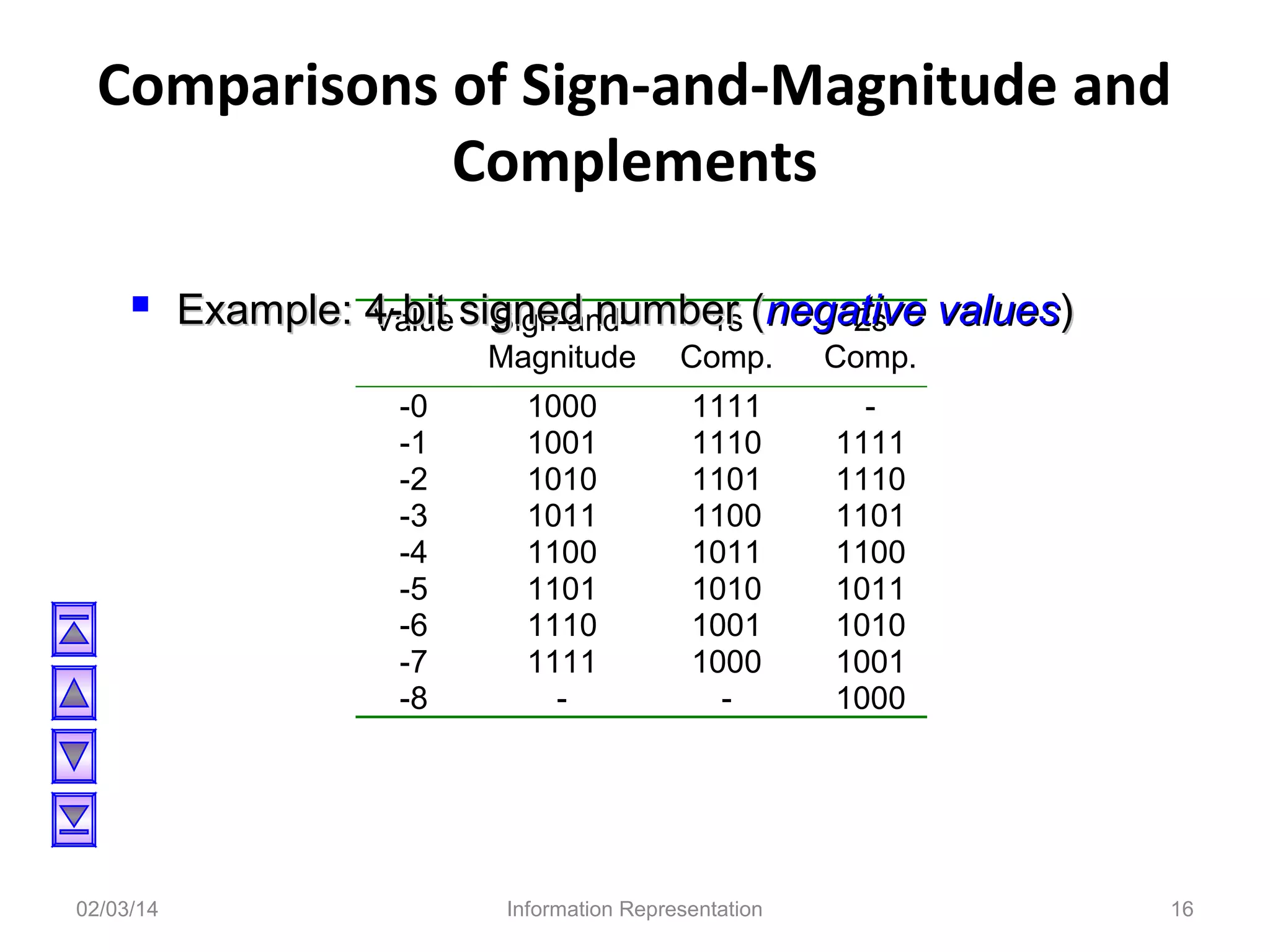
Comparisons of Sign-and-Magnitude and
Complements
 Example: 4-bit signed number (negative values)
Value Sign-and1s
2s
Magnitude
-0
-1
-2
-3
-4
-5
-6
-7
-8

02/03/14

Comp.

Comp.

1000
1001
1010
1011
1100
1101
1110
1111
-

1111
1110
1101
1100
1011
1010
1001
1000
-

1111
1110
1101
1100
1011
1010
1001
1000

Information Representation

16
Complements (General)
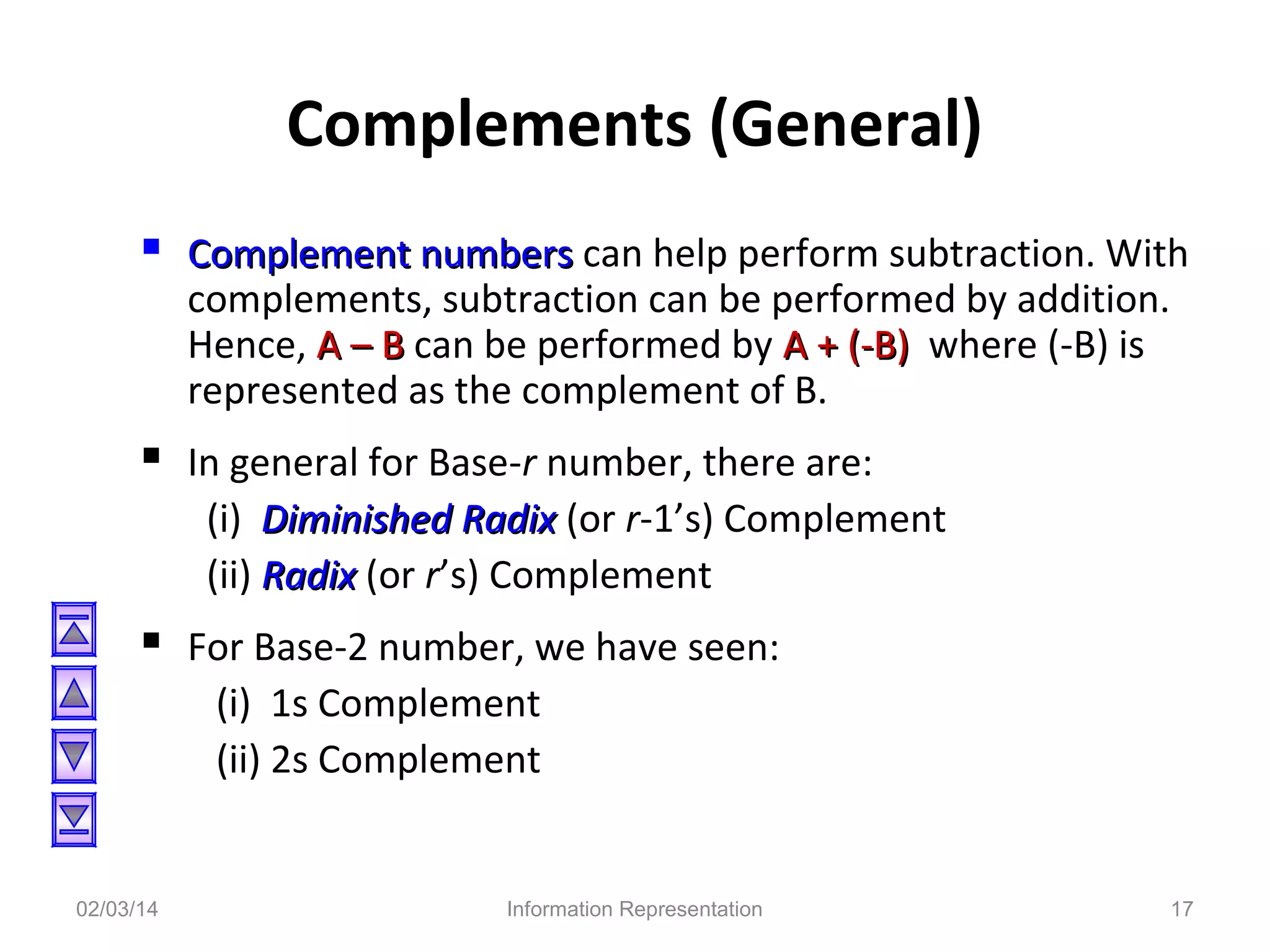
 Complement numbers can help perform subtraction. With
complements, subtraction can be performed by addition.
Hence, A – B can be performed by A + (-B) where (-B) is
represented as the complement of B.

 In general for Base-r number, there are:
(i) Diminished Radix (or r-1’s) Complement
(ii) Radix (or r’s) Complement

 For Base-2 number, we have seen:
(i) 1s Complement
(ii) 2s Complement

02/03/14

Information Representation

17
Diminished-Radix Complements
 Given an n-digit number, xr, its (r-1)’s complement is:
(rn - 1) - x
E.g.: (r-1)’s complement, or 9s complement, of (22)10 is:
(102 - 1) - 22 = (77)9s [This means –(22)10 is (77)9s]
(r-1)’s complement, or 1s complement, of (0101)2 is:
(24- 1) - 0101 = (1010)1s [This means –(0101)2 is (1010)1s]
Same as inverting all digits:
(102 - 1) - 22 = 99 - 22 = (77)9s
(24 - 1) - 0101 = 1111 - 0101 = (1010)1s

02/03/14

Information Representation

18
Radix Complements
 Given an n-digit number, xr, its r’s-complement is:
rn - x
E.g.: r’s-complement, or 10s complement, of (22)10 is:
102 - 22 = (78)10s [This means –(22)10 is (78)10s]
r’s-complement, or 2s complement, of (0101)2 is:
24 - 0101 = (1011)2s [This means –(0101)2 is (1011)2s]
Same as inverting all digits and adding 1:
(102) - 22 = (99+1) - 22
= 77 + 1 = (78)10s
(24) - 0101 = (1111+1) - 0101 = 1010 +1 = (1011)2s

02/03/14

Information Representation

19
2s Complement Addition/Subtraction
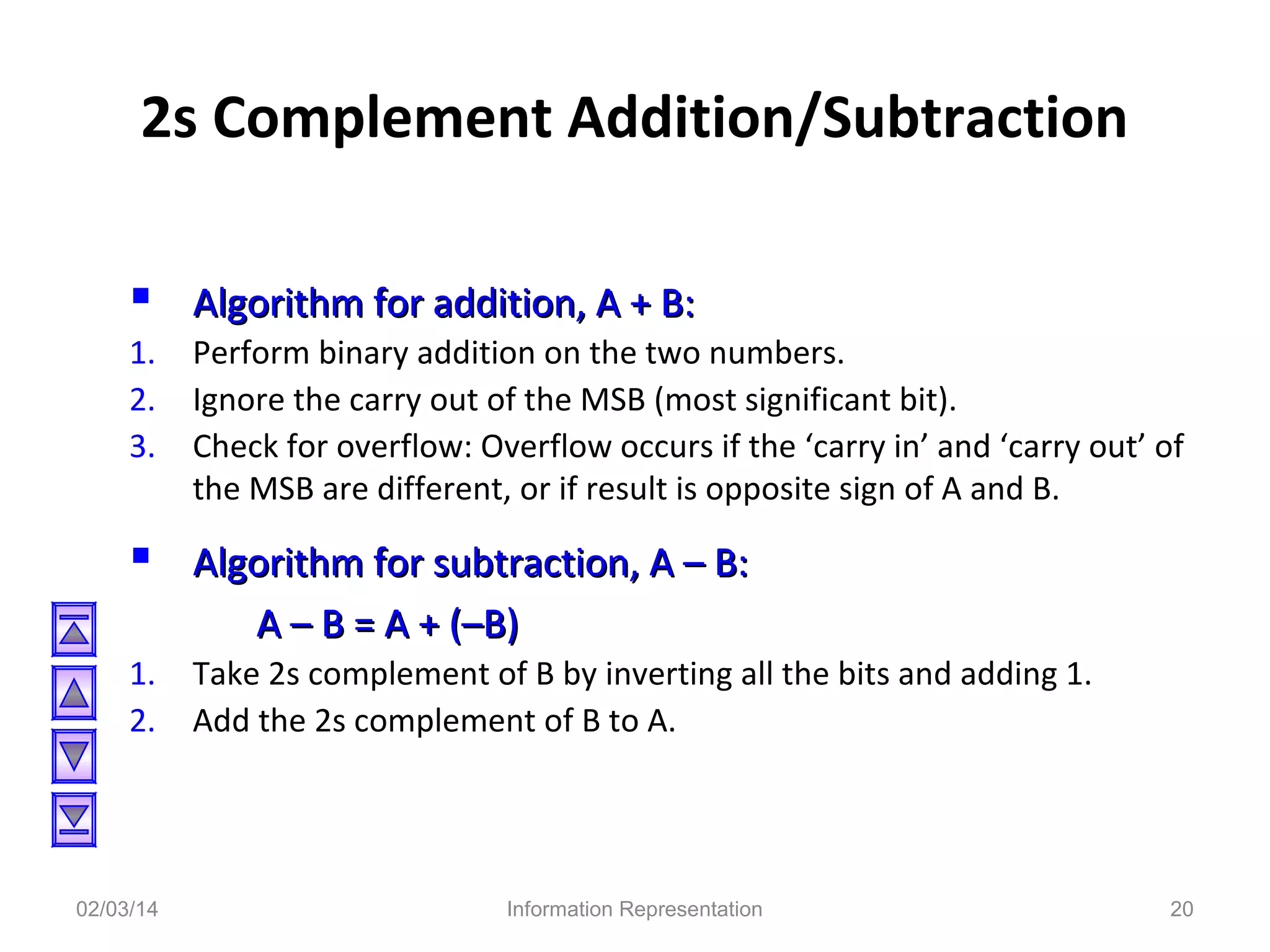
 Algorithm for addition, A + B:
1.
2.
3.

Perform binary addition on the two numbers.
Ignore the carry out of the MSB (most significant bit).
Check for overflow: Overflow occurs if the ‘carry in’ and ‘carry out’ of
the MSB are different, or if result is opposite sign of A and B.

 Algorithm for subtraction, A – B:
A – B = A + (–B)
1.
2.

02/03/14

Take 2s complement of B by inverting all the bits and adding 1.
Add the 2s complement of B to A.

Information Representation

20
2s Complement Addition/Subtraction
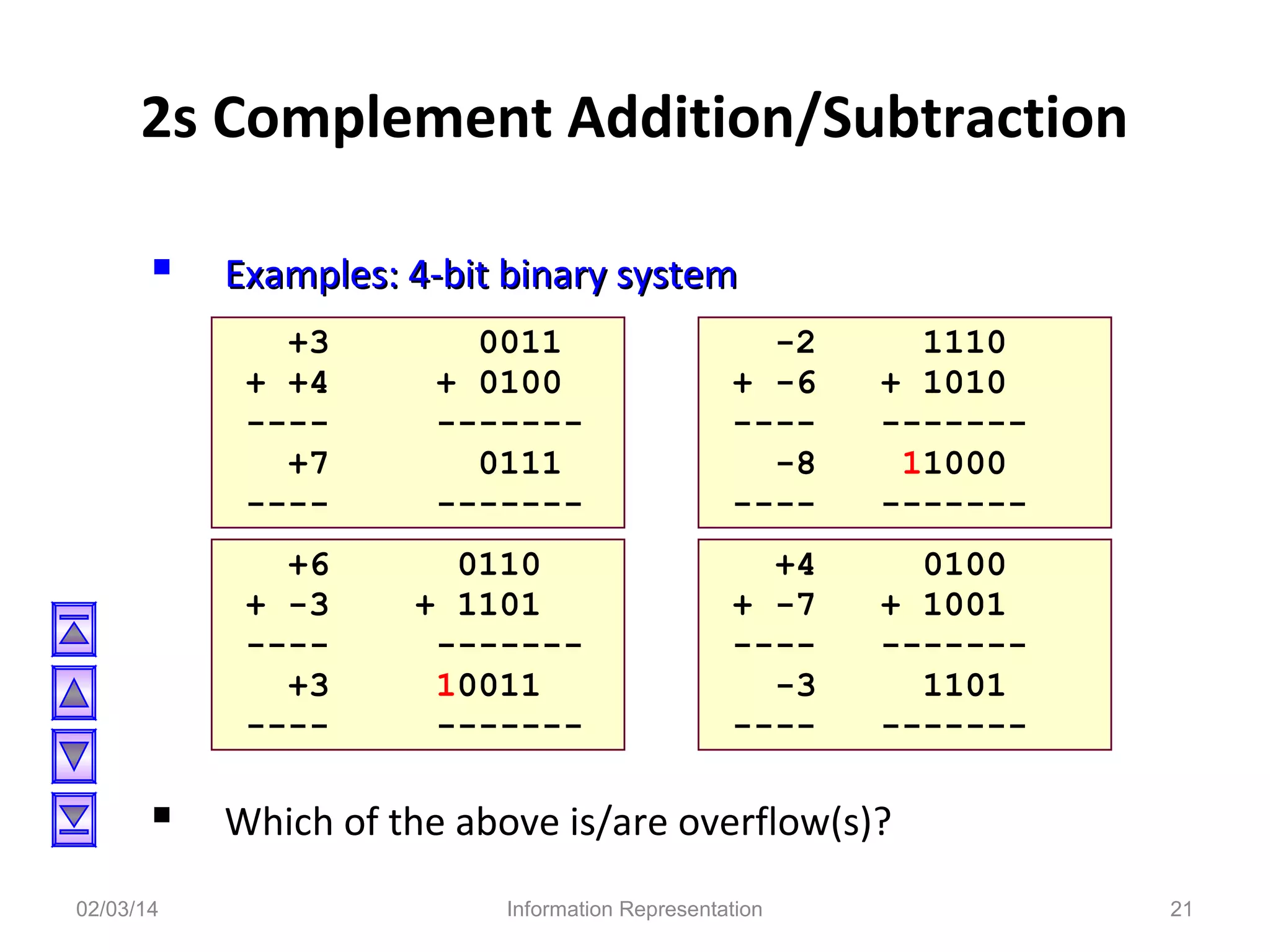
 Examples: 4-bit binary system
+3
+ +4
---+7
----

0011
+ 0100
------0111
-------

-2
+ -6
----8
----

1110
+ 1010
------11000
-------

+6
+ -3
---+3
----

0110
+ 1101
------10011
-------

+4
+ -7
----3
----

0100
+ 1001
------1101
-------

 Which of the above is/are overflow(s)?
02/03/14

Information Representation

21
2s Complement Addition/Subtraction
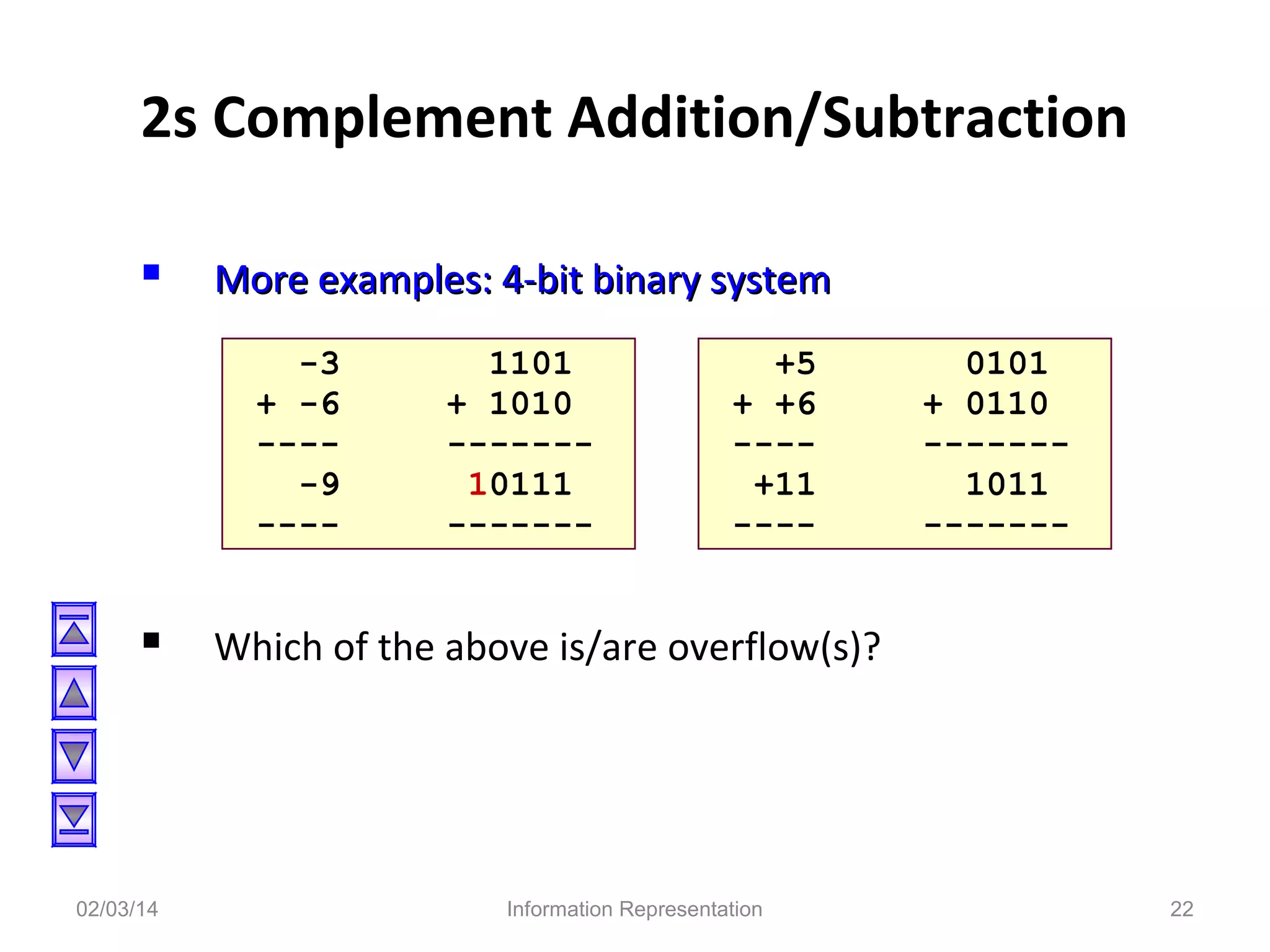
 More examples: 4-bit binary system
-3
+ -6
----9
----

1101
+ 1010
------10111
-------

+5
+ +6
---+11
----

0101
+ 0110
------1011
-------

 Which of the above is/are overflow(s)?

02/03/14

Information Representation

22
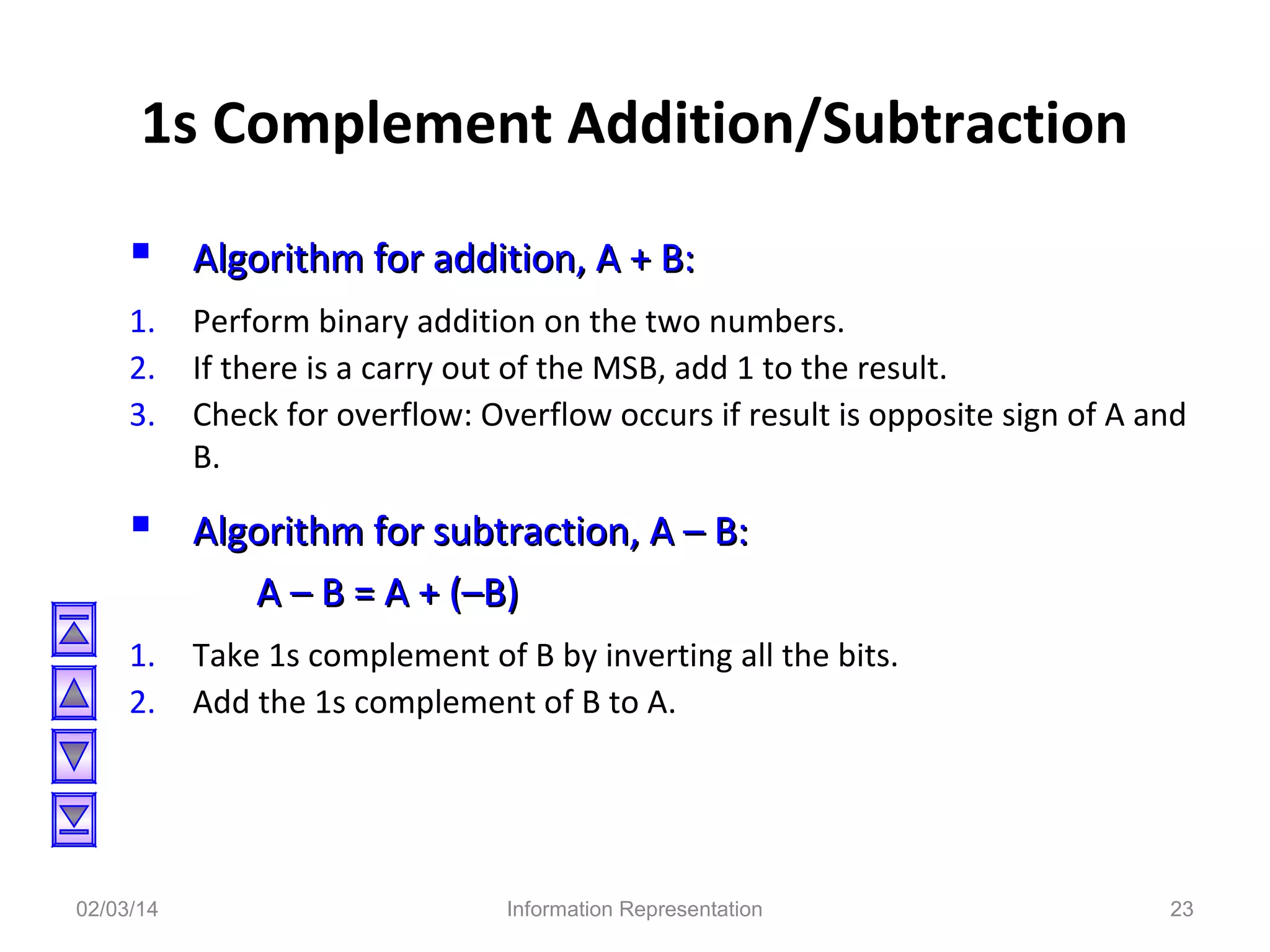
1s Complement Addition/Subtraction
 Algorithm for addition, A + B:
1.
2.
3.

Perform binary addition on the two numbers.
If there is a carry out of the MSB, add 1 to the result.
Check for overflow: Overflow occurs if result is opposite sign of A and
B.

 Algorithm for subtraction, A – B:
A – B = A + (–B)
1.
2.

02/03/14

Take 1s complement of B by inverting all the bits.
Add the 1s complement of B to A.

Information Representation

23
1s Complement Addition/Subtraction
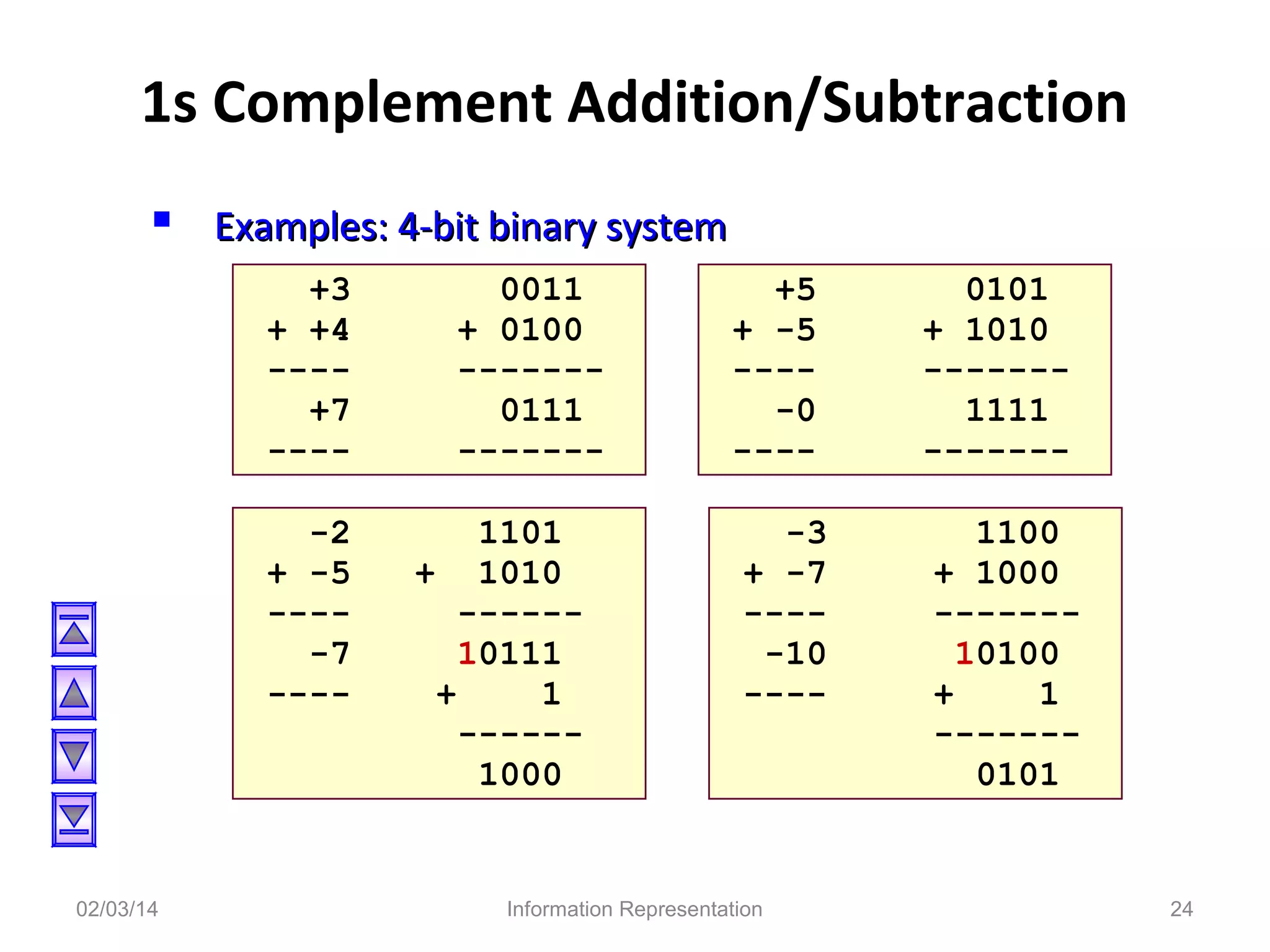
 Examples: 4-bit binary system
+3
+ +4
---+7
----2
+ -5
----7
----

02/03/14

0011
+ 0100
------0111
------1101
+ 1010
-----10111
+
1
-----1000

+5
+ -5
----0
----3
+ -7
----10
----

Information Representation

0101
+ 1010
------1111
------1100
+ 1000
------10100
+
1
------0101

24
Overflow
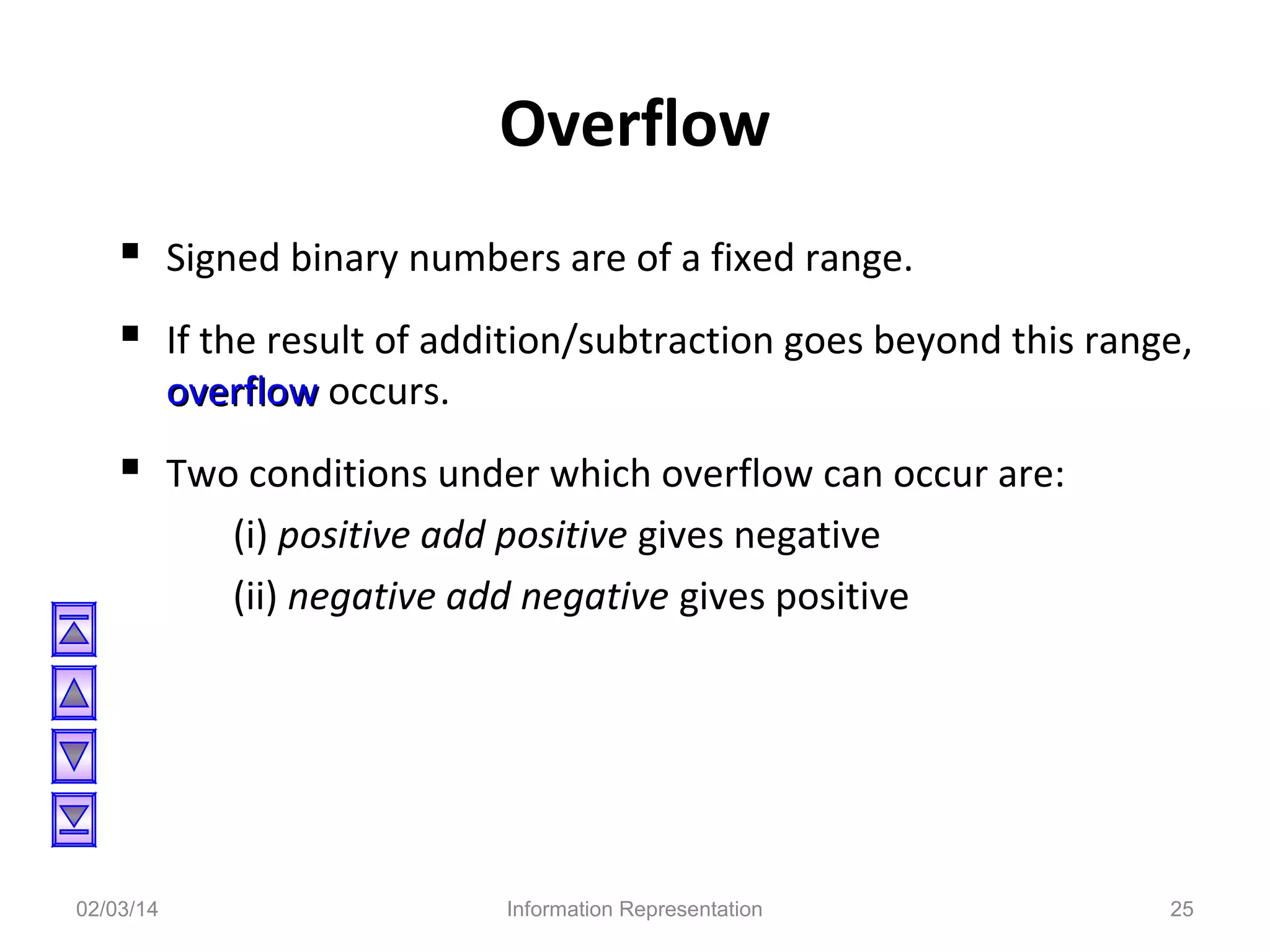
 Signed binary numbers are of a fixed range.
 If the result of addition/subtraction goes beyond this range,
overflow occurs.

 Two conditions under which overflow can occur are:
(i) positive add positive gives negative
(ii) negative add negative gives positive

02/03/14

Information Representation

25
Overflow
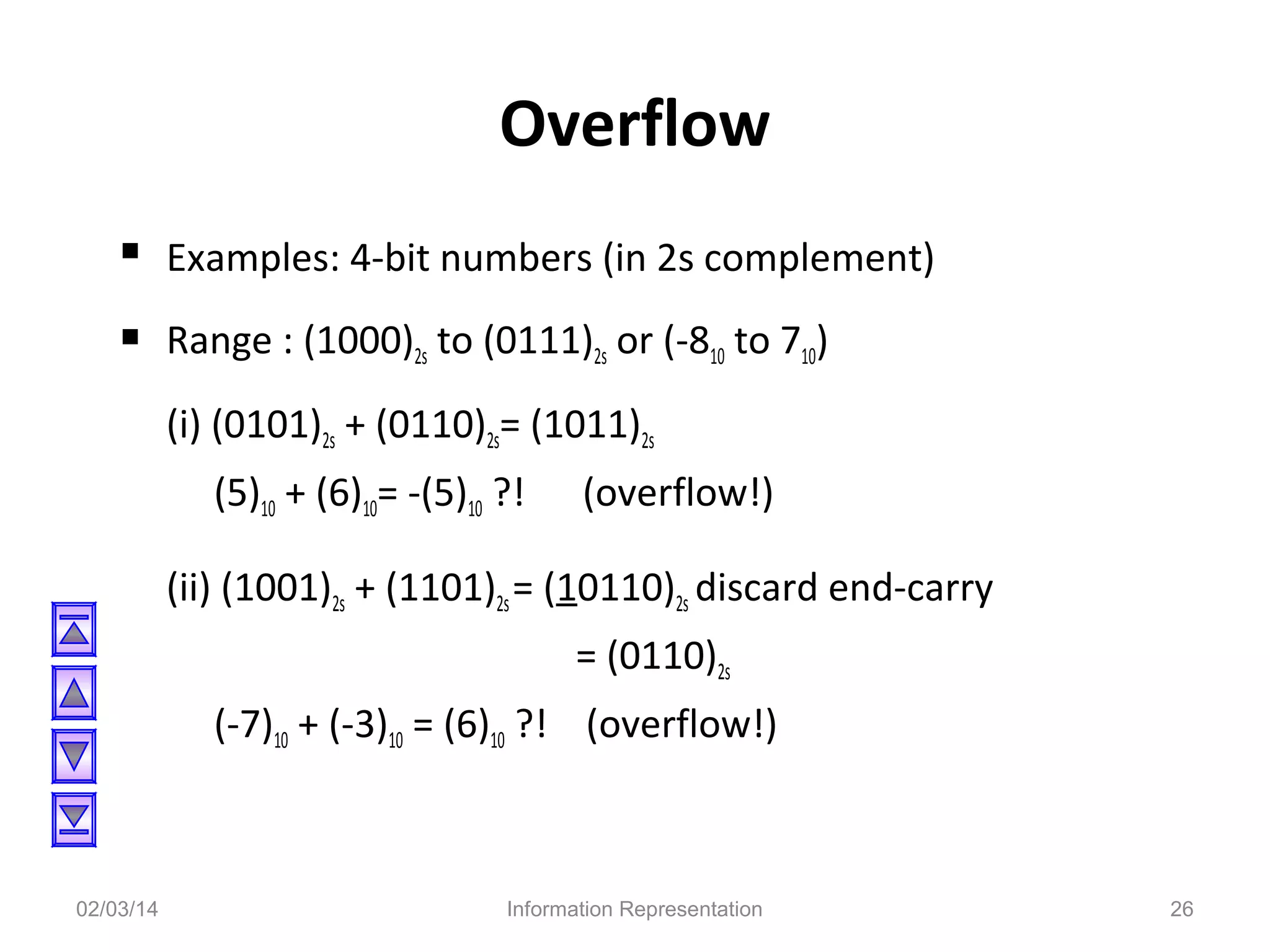
 Examples: 4-bit numbers (in 2s complement)
 Range : (1000)2s to (0111)2s or (-810 to 710)
(i) (0101)2s + (0110)2s= (1011)2s
(5)10 + (6)10= -(5)10 ?!

(overflow!)

(ii) (1001)2s + (1101)2s = (10110)2s discard end-carry
= (0110)2s
(-7)10 + (-3)10 = (6)10 ?! (overflow!)

02/03/14

Information Representation

26
Fixed Point Numbers
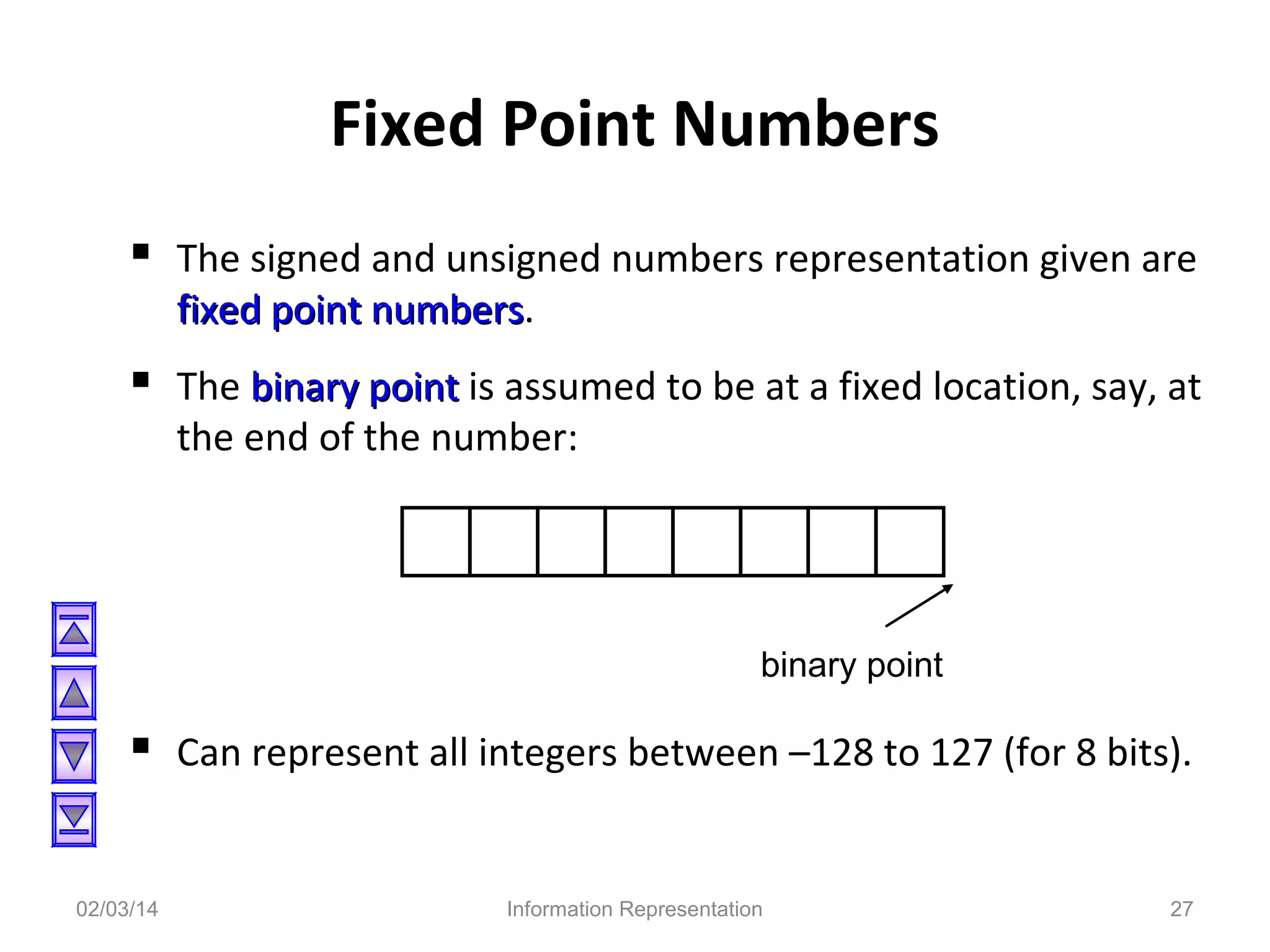
 The signed and unsigned numbers representation given are
fixed point numbers.
numbers

 The binary point is assumed to be at a fixed location, say, at
the end of the number:

binary point

 Can represent all integers between –128 to 127 (for 8 bits).
02/03/14

Information Representation

27
Fixed Point Numbers
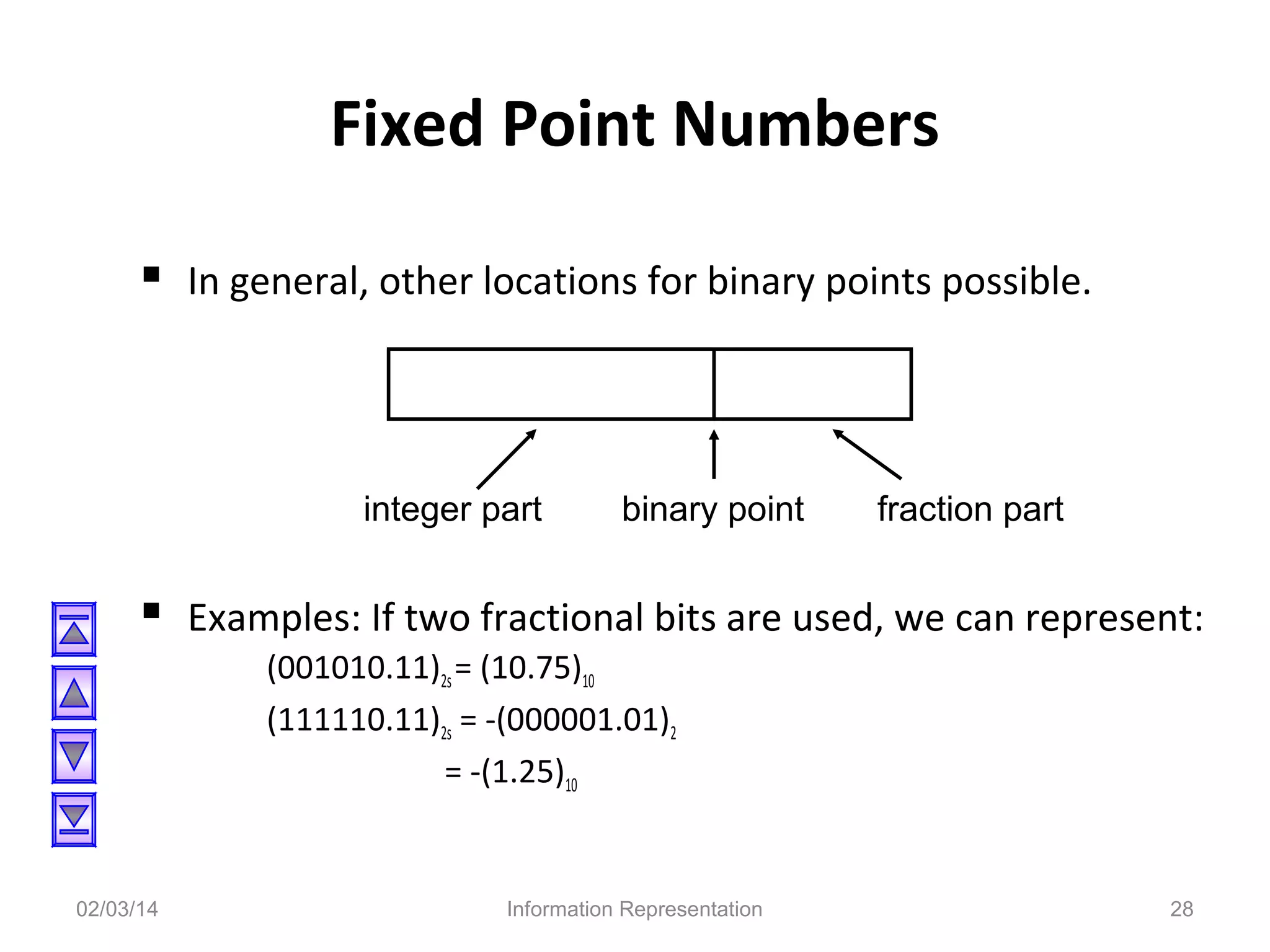
 In general, other locations for binary points possible.

integer part

binary point

fraction part

 Examples: If two fractional bits are used, we can represent:
(001010.11)2s = (10.75)10
(111110.11)2s = -(000001.01)2
= -(1.25)10

02/03/14

Information Representation

28
Floating Point Numbers
 Fixed point numbers have limited range.
 To represent very large or very small numbers, we use

floating point numbers (cf. scientific numbers). Examples:
0.23 x 10²³ (very large positive number)
0.5 x 10⁻³² (very small positive number)
-0.1239 x 10⁻¹⁸ (very small negative number)

02/03/14

Information Representation

29
Floating Point Numbers
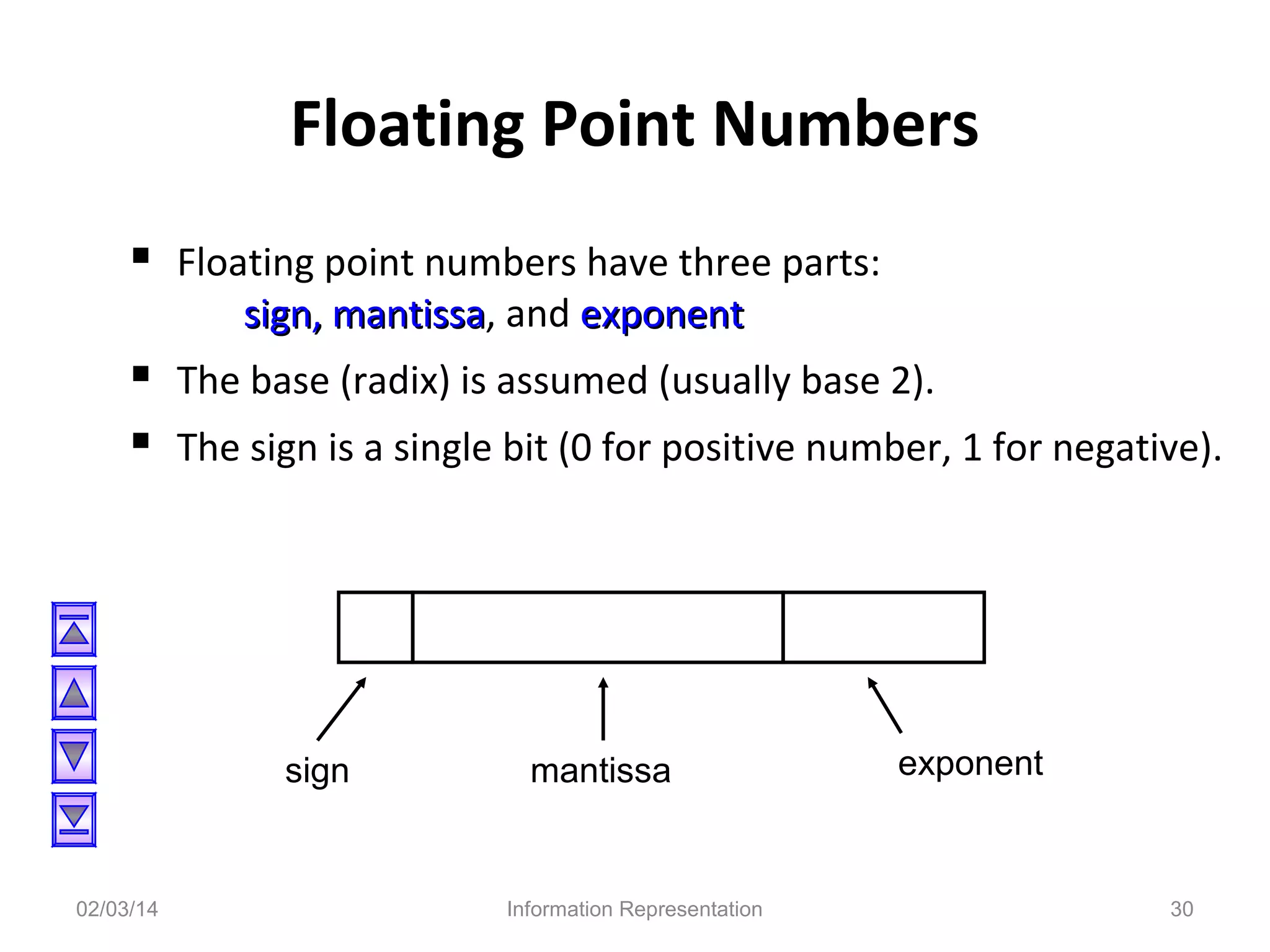
 Floating point numbers have three parts:
sign, mantissa, and exponent
mantissa

 The base (radix) is assumed (usually base 2).
 The sign is a single bit (0 for positive number, 1 for negative).

sign

02/03/14

mantissa

Information Representation

exponent

30
Floating Point Numbers
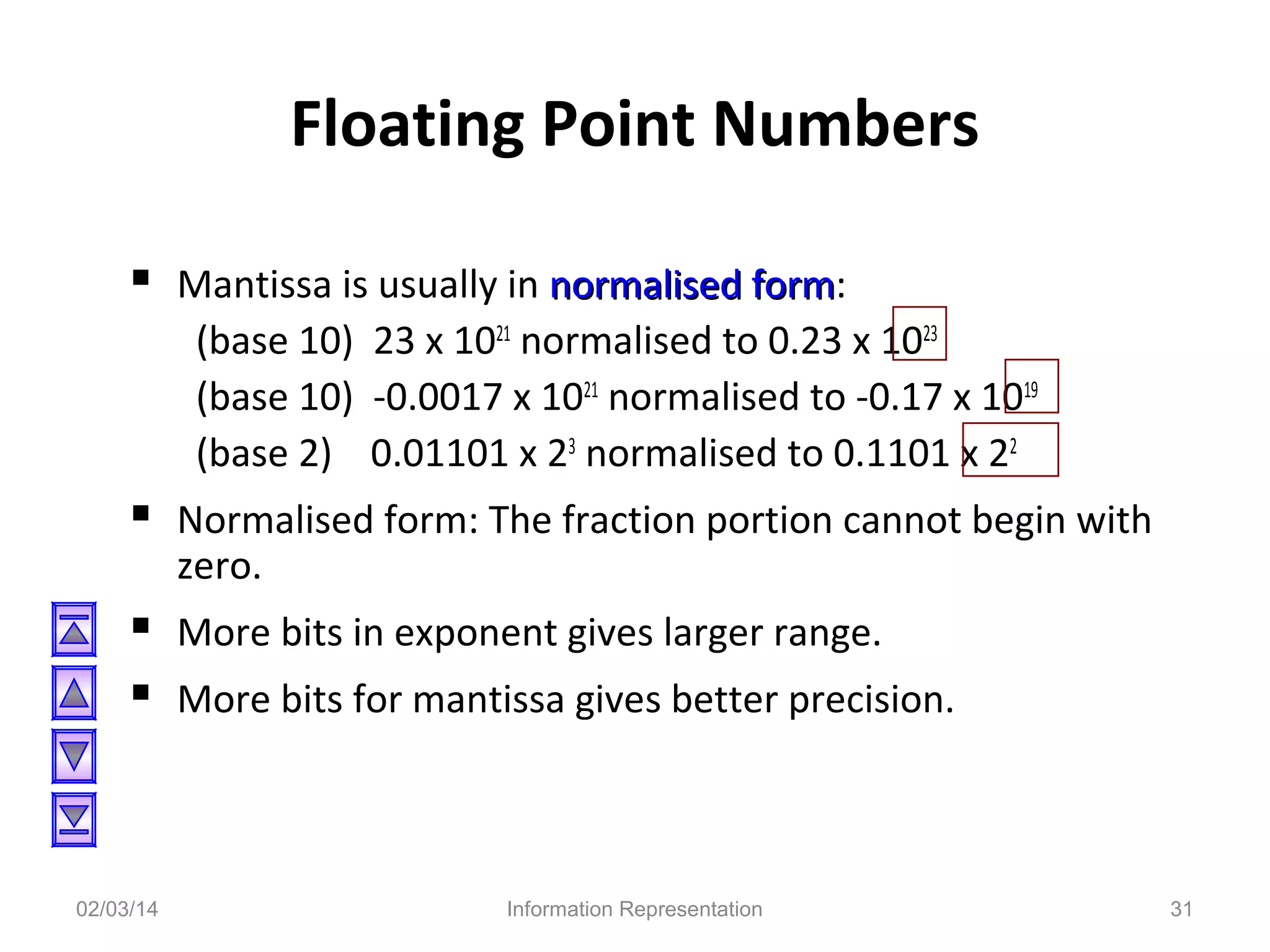
 Mantissa is usually in normalised form:
form
(base 10) 23 x 1021 normalised to 0.23 x 10²³
(base 10) -0.0017 x 10²¹ normalised to -0.17 x 10¹⁹
(base 2) 0.01101 x 23 normalised to 0.1101 x 22

 Normalised form: The fraction portion cannot begin with
zero.

 More bits in exponent gives larger range.
 More bits for mantissa gives better precision.

02/03/14

Information Representation

31
Floating Point Numbers
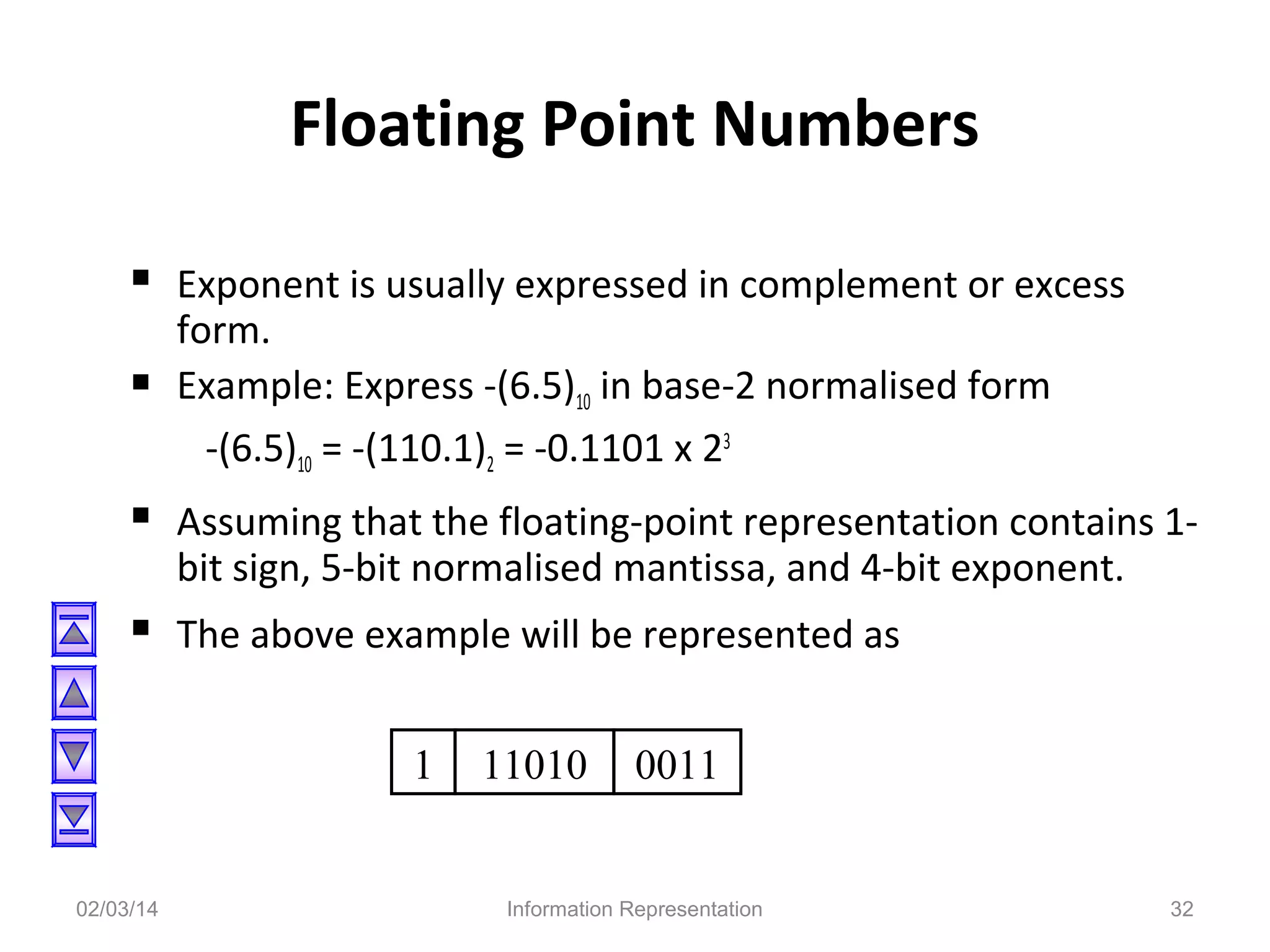
 Exponent is usually expressed in complement or excess


form.
Example: Express -(6.5)10 in base-2 normalised form
-(6.5)10 = -(110.1)2 = -0.1101 x 23

 Assuming that the floating-point representation contains 1bit sign, 5-bit normalised mantissa, and 4-bit exponent.

 The above example will be represented as
1

02/03/14

11010

0011

Information Representation

32
Floating Point Numbers
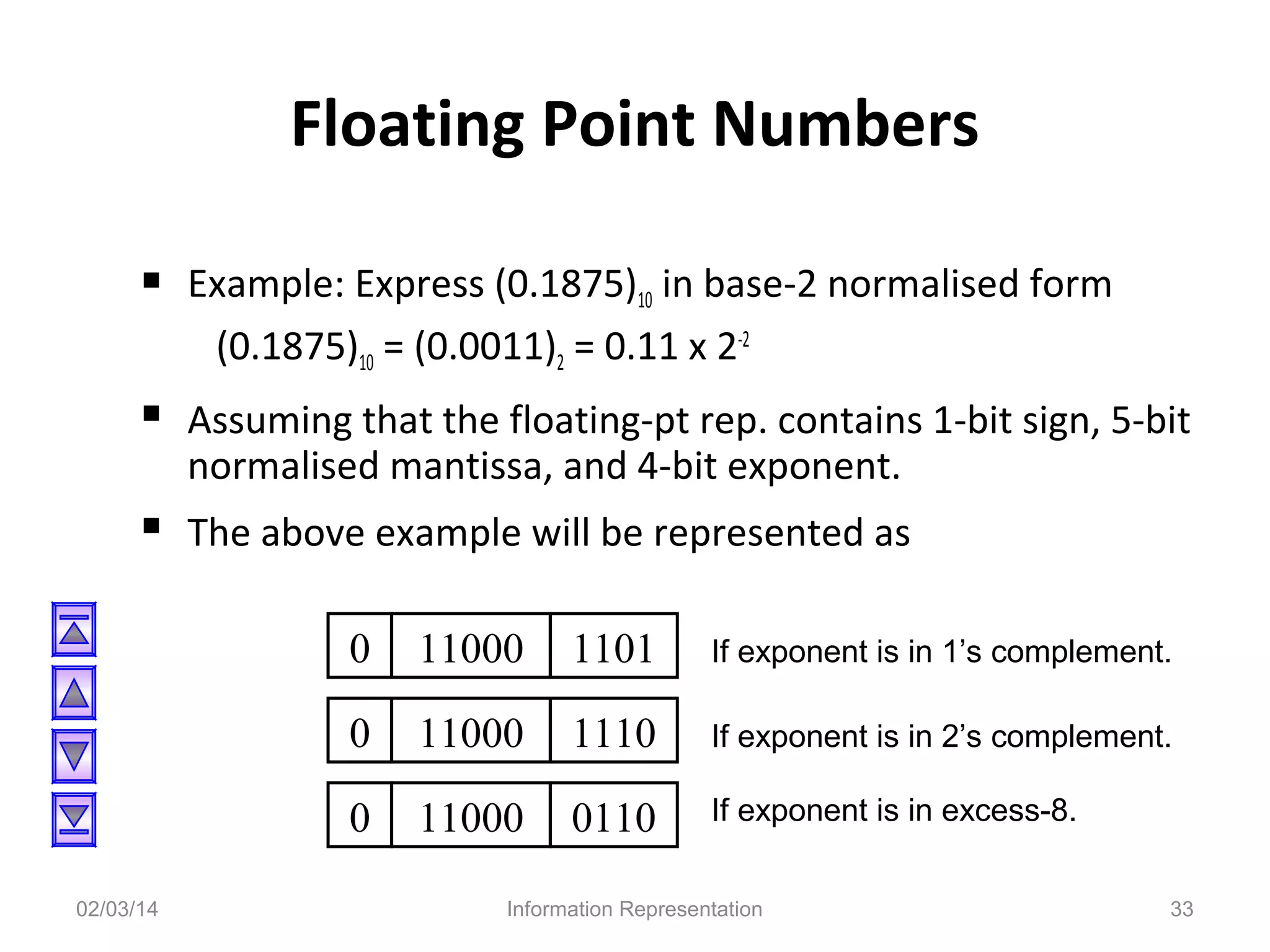
 Example: Express (0.1875)10 in base-2 normalised form
(0.1875)10 = (0.0011)2 = 0.11 x 2-2

 Assuming that the floating-pt rep. contains 1-bit sign, 5-bit
normalised mantissa, and 4-bit exponent.

 The above example will be represented as
0

1101

If exponent is in 1’s complement.

0

11000

1110

If exponent is in 2’s complement.

0
02/03/14

11000

11000

0110

If exponent is in excess-8.

Information Representation

33
Excess Representation
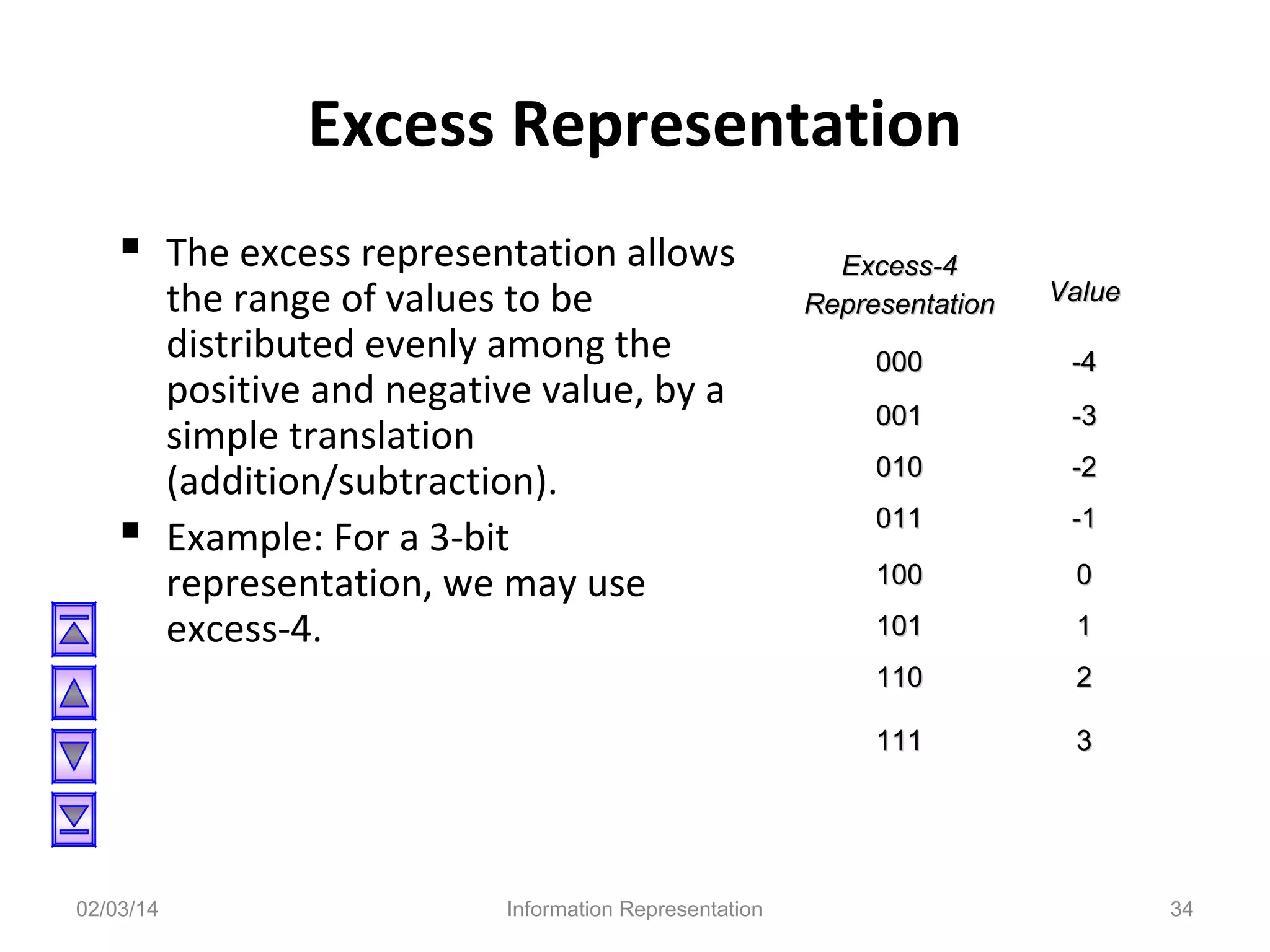
 The excess representation allows

Information Representation

000

-4

001

-3

010

-2

011

-1

100

0

101

1
2

111

02/03/14

Value

110



the range of values to be
distributed evenly among the
positive and negative value, by a
simple translation
(addition/subtraction).
Example: For a 3-bit
representation, we may use
excess-4.

Excess-4
Representation

3

34
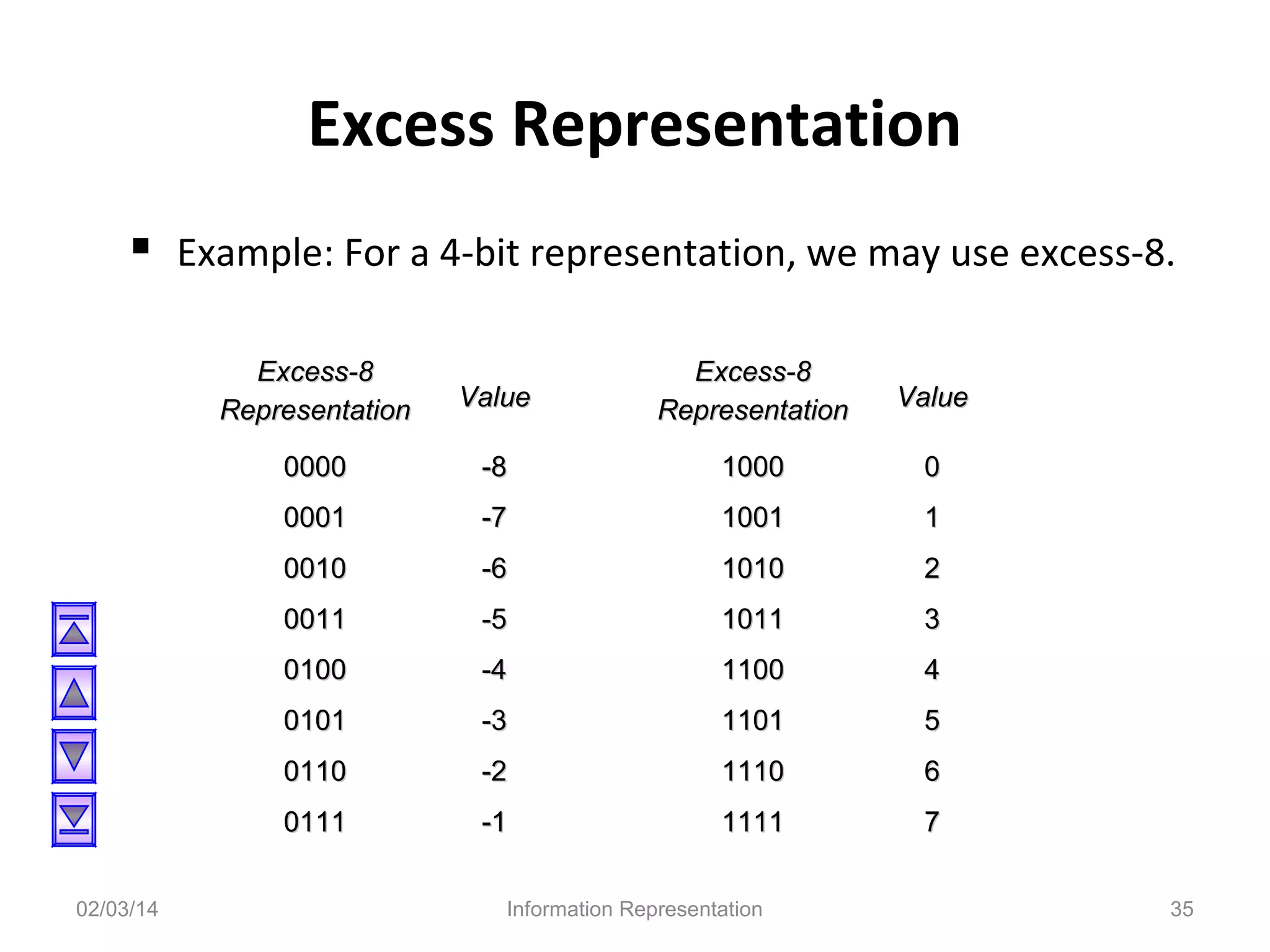
Excess Representation
 Example: For a 4-bit representation, we may use excess-8.
Excess-8
Representation

Excess-8
Representation

Value

0000

-8

1000

0

0001

-7

1001

1

0010

-6

1010

2

0011

-5

1011

3

0100

-4

1100

4

0101

-3

1101

5

0110

-2

1110

6

0111
02/03/14

Value

-1

1111

7

Information Representation

35
Arithmetics with Floating Point Numbers
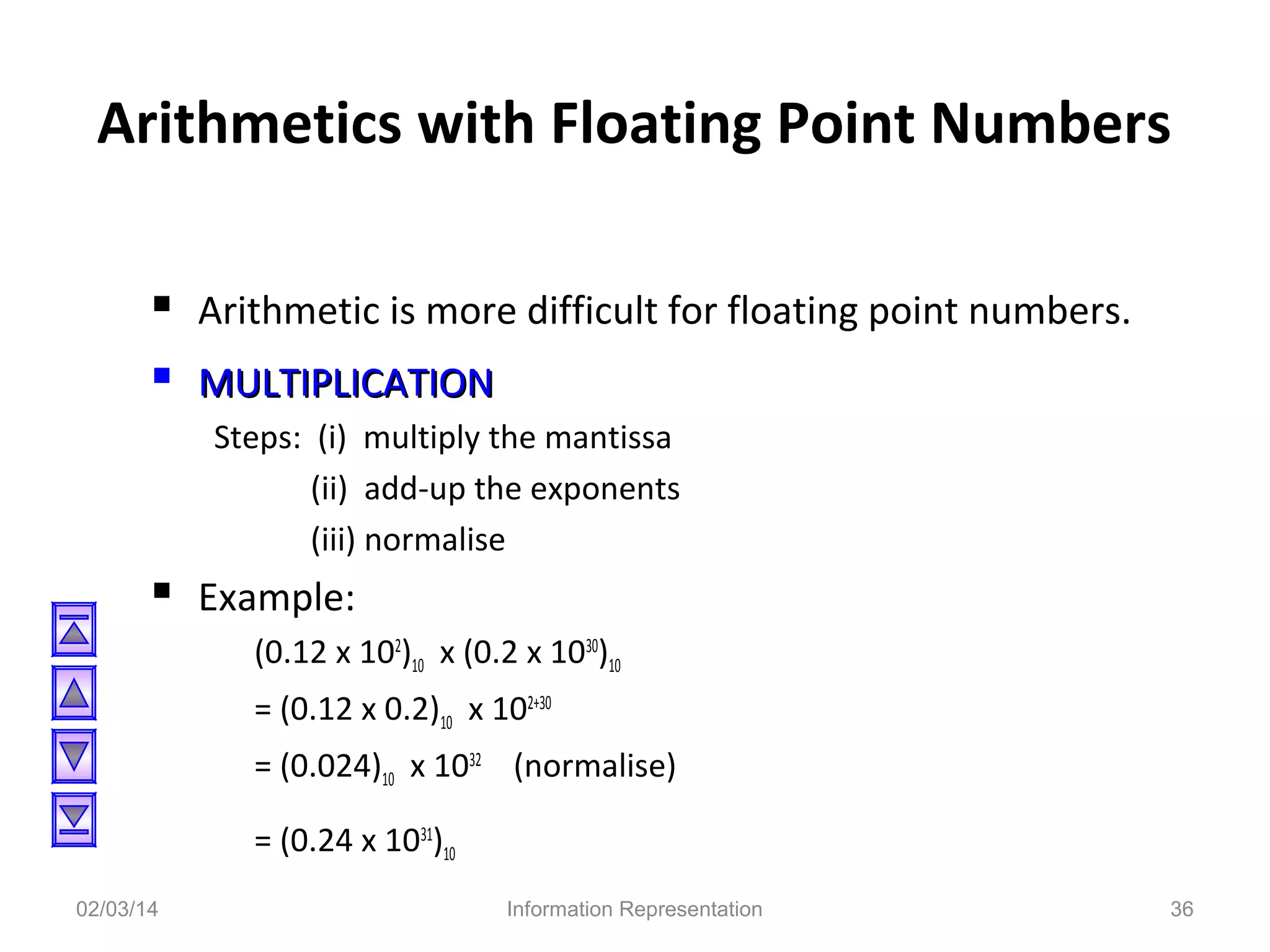
 Arithmetic is more difficult for floating point numbers.
 MULTIPLICATION
Steps: (i) multiply the mantissa
(ii) add-up the exponents
(iii) normalise

 Example:
(0.12 x 10²)10 x (0.2 x 1030)10
= (0.12 x 0.2)10 x 102+30
= (0.024)10 x 1032 (normalise)
= (0.24 x 1031)10
02/03/14

Information Representation

36
Arithmetics with Floating Point Numbers
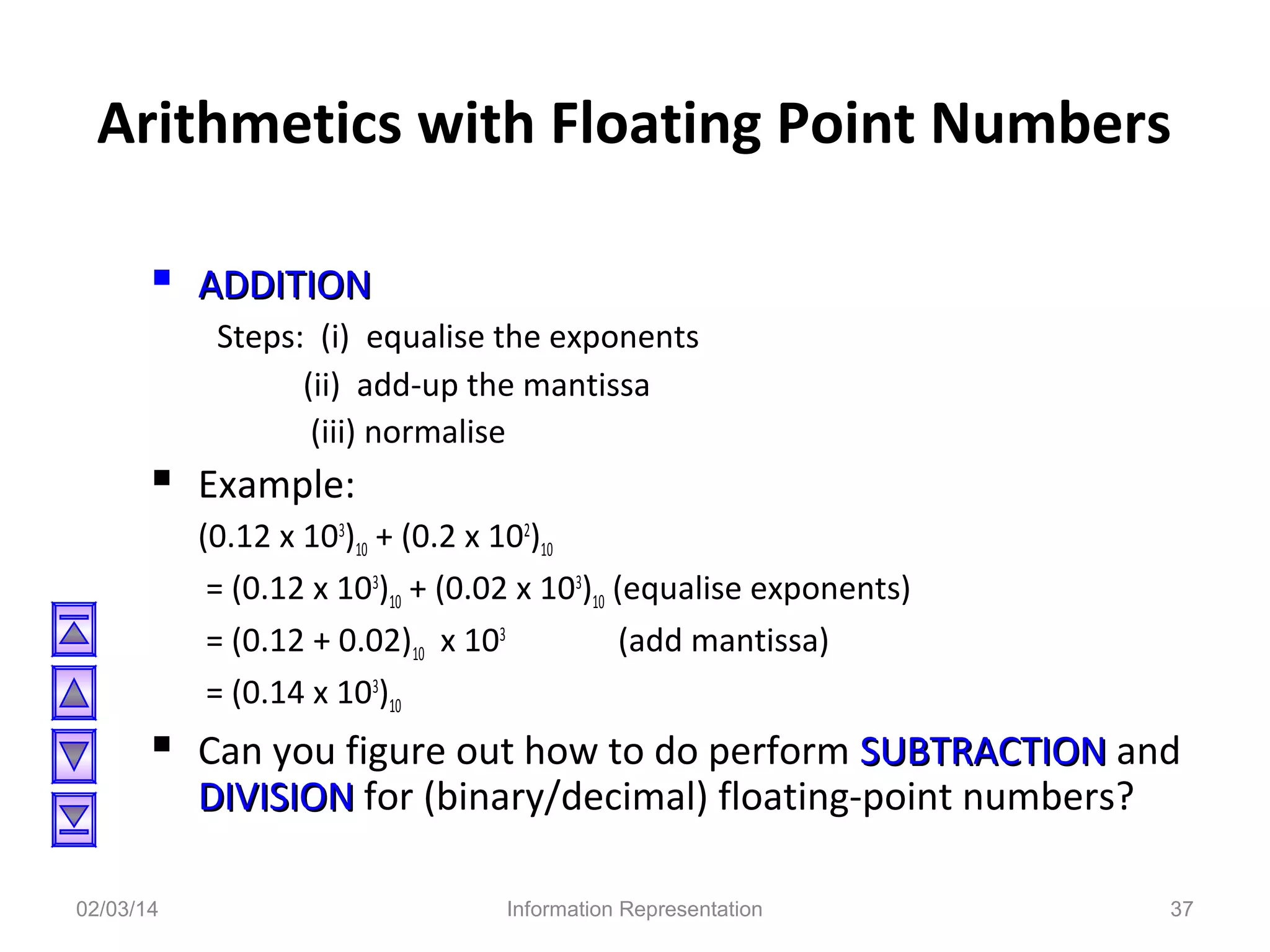
 ADDITION
Steps: (i) equalise the exponents
(ii) add-up the mantissa
(iii) normalise

 Example:
(0.12 x 10³)10 + (0.2 x 10²)10
= (0.12 x 10³)10 + (0.02 x 10³)10 (equalise exponents)
= (0.12 + 0.02)10 x 103
(add mantissa)
= (0.14 x 10³)10

 Can you figure out how to do perform SUBTRACTION and
DIVISION for (binary/decimal) floating-point numbers?

02/03/14

Information Representation

37
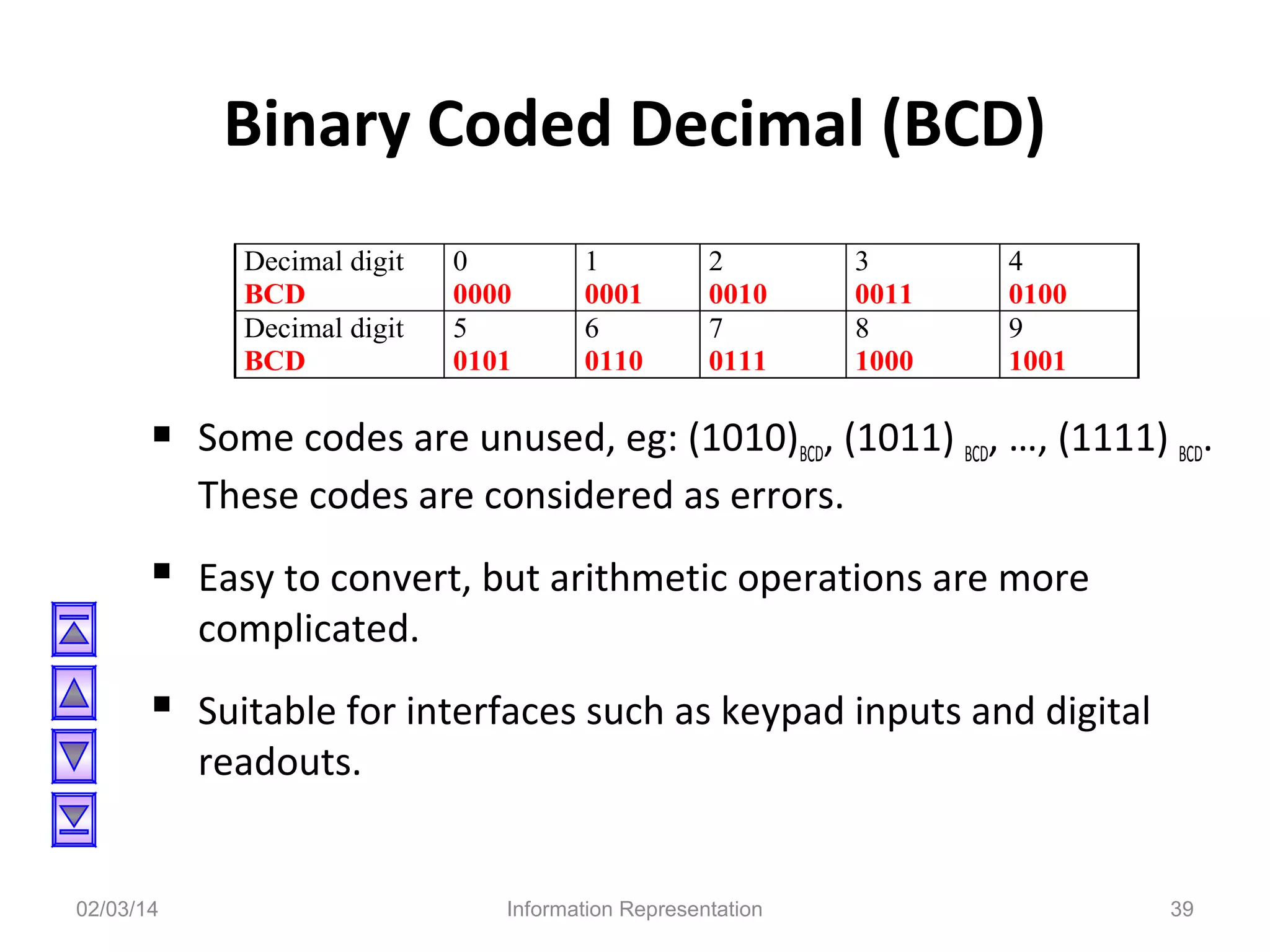
Binary Coded Decimal (BCD)
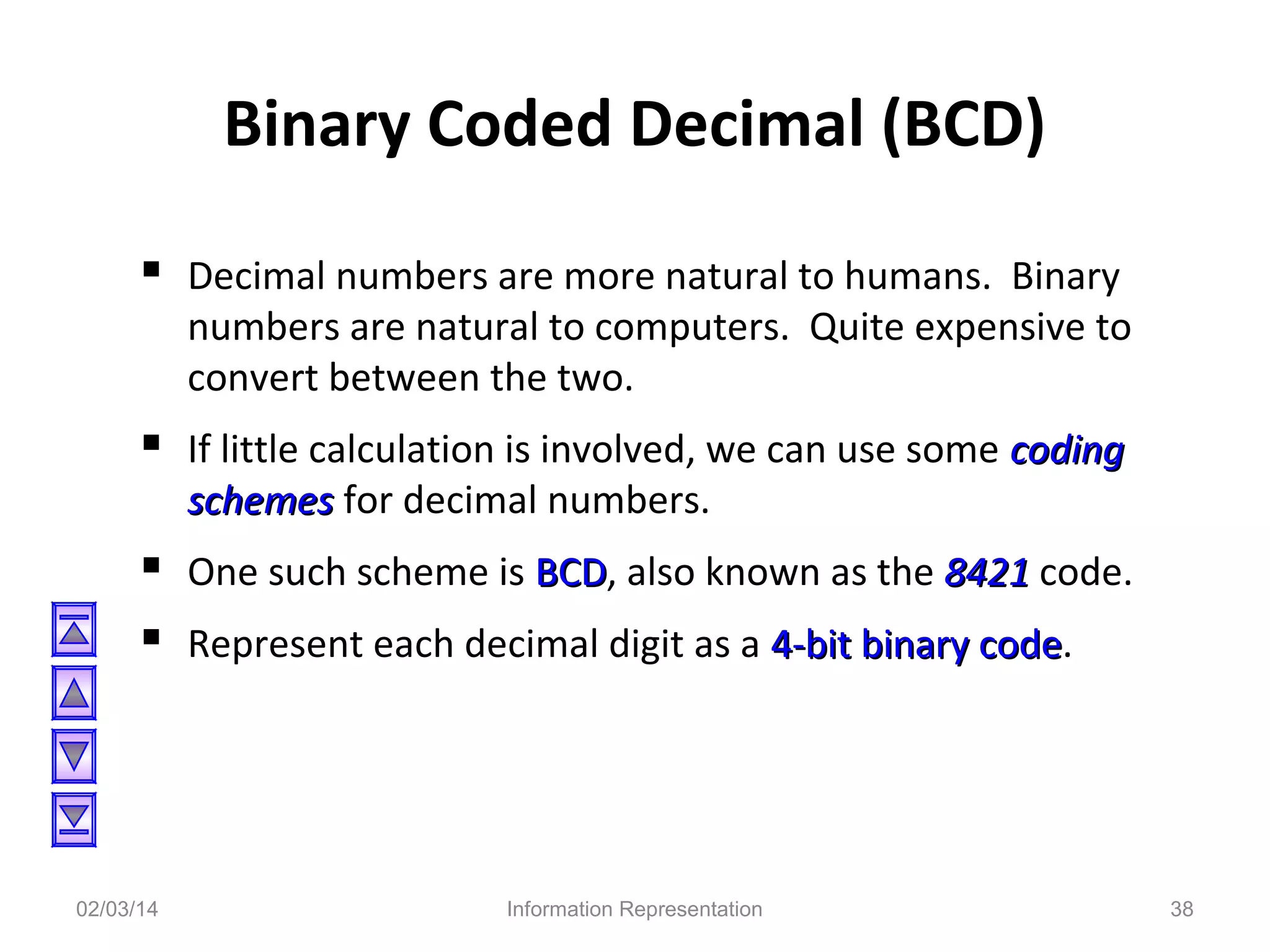
 Decimal numbers are more natural to humans. Binary

numbers are natural to computers. Quite expensive to
convert between the two.

 If little calculation is involved, we can use some coding
schemes for decimal numbers.

 One such scheme is BCD, also known as the 8421 code.
BCD
 Represent each decimal digit as a 4-bit binary code.
code

02/03/14

Information Representation

38
Binary Coded Decimal (BCD)
Decimal digit
BCD
Decimal digit
BCD

0
0000
5
0101

1
0001
6
0110

2
0010
7
0111

3
0011
8
1000

4
0100
9
1001

 Some codes are unused, eg: (1010)BCD, (1011) BCD, …, (1111) BCD.
These codes are considered as errors.

 Easy to convert, but arithmetic operations are more
complicated.

 Suitable for interfaces such as keypad inputs and digital
readouts.

02/03/14

Information Representation

39
Binary Coded Decimal (BCD)
Decimal digit
BCD
Decimal digit
BCD

0
0000
5
0101

1
0001
6
0110

2
0010
7
0111

3
0011
8
1000

4
0100
9
1001

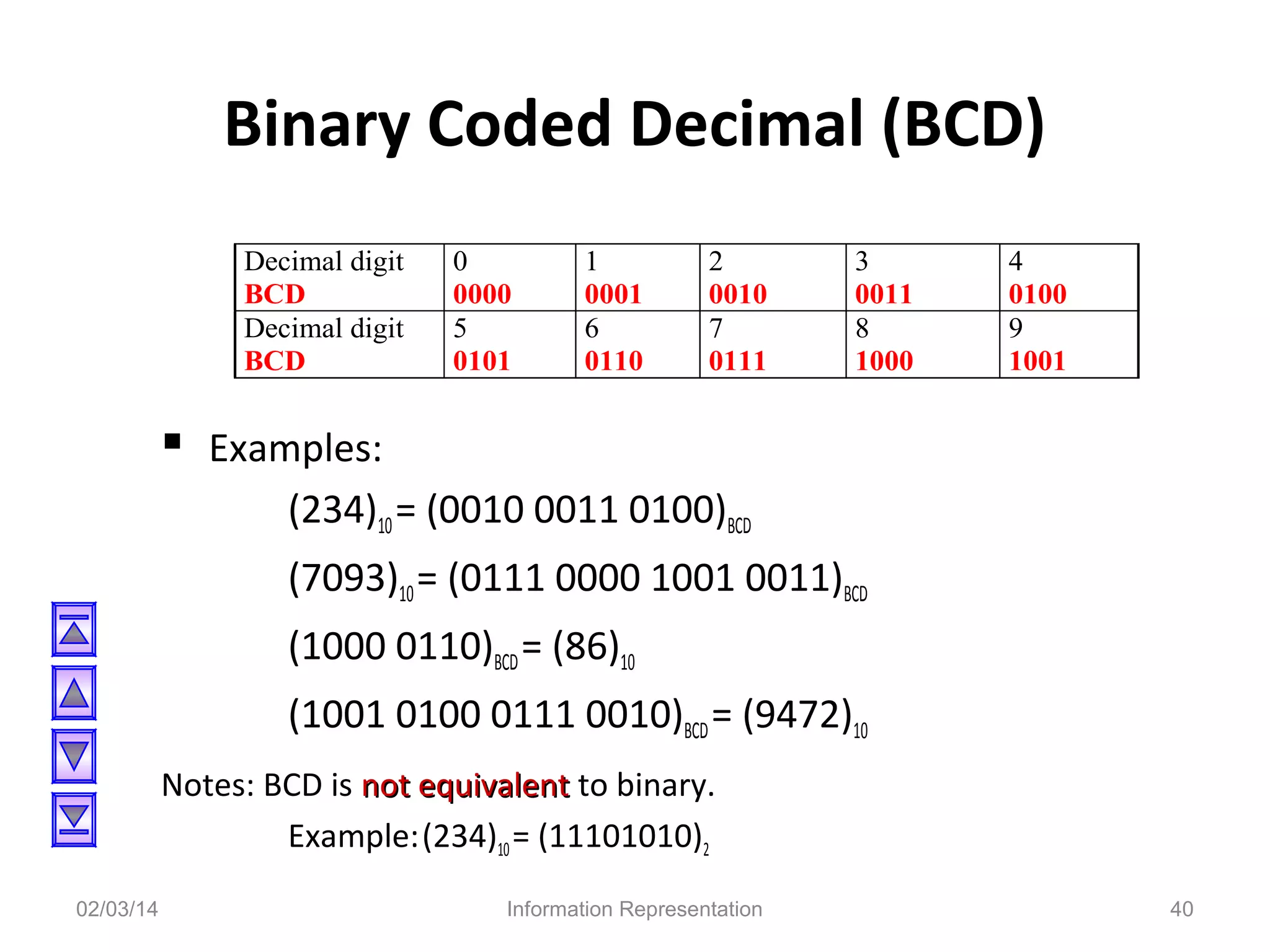
 Examples:
(234)10 = (0010 0011 0100)BCD
(7093)10 = (0111 0000 1001 0011)BCD
(1000 0110)BCD = (86)10
(1001 0100 0111 0010)BCD = (9472)10
Notes: BCD is not equivalent to binary.
Example: (234)10 = (11101010)2
02/03/14

Information Representation

40
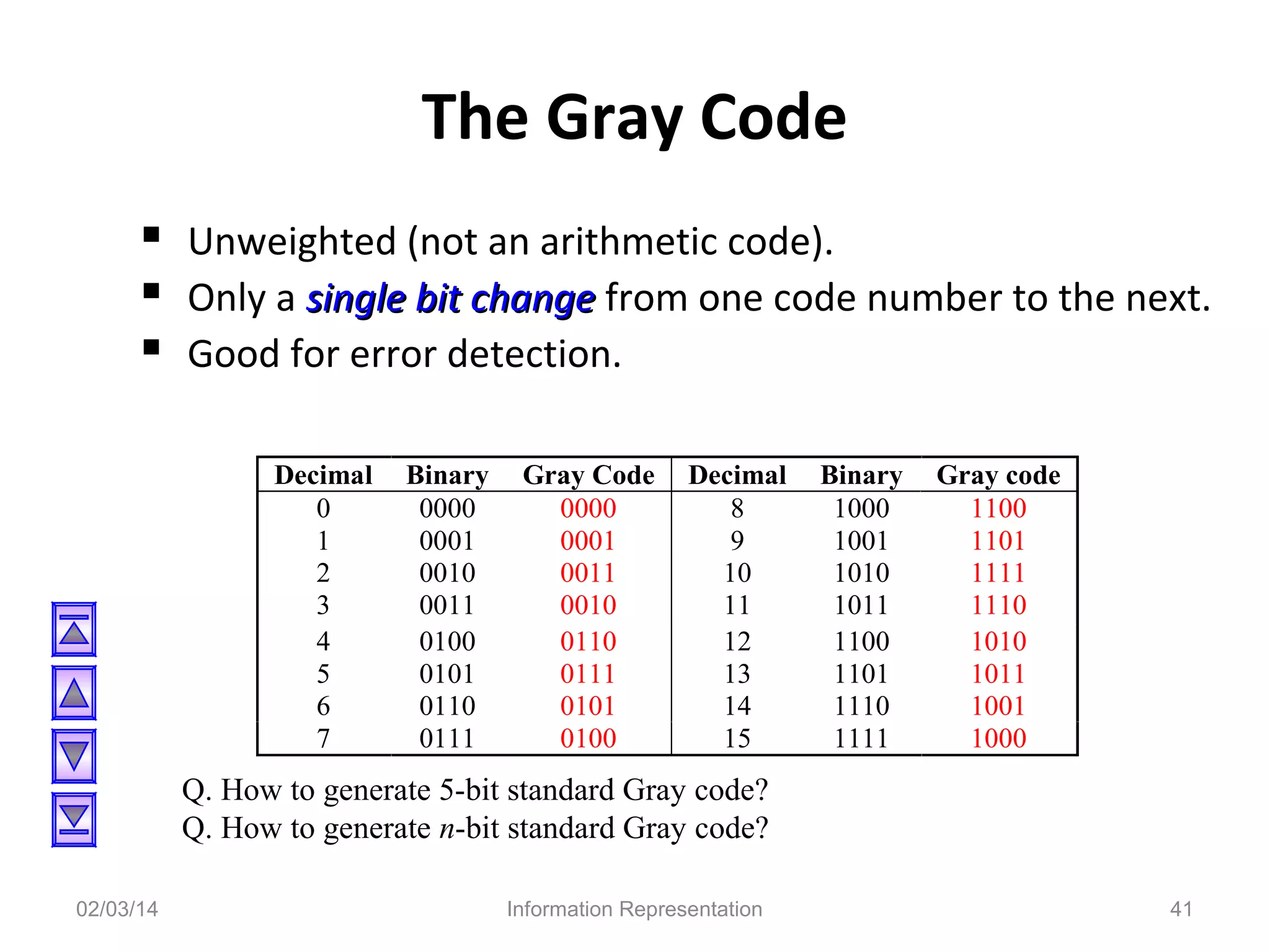
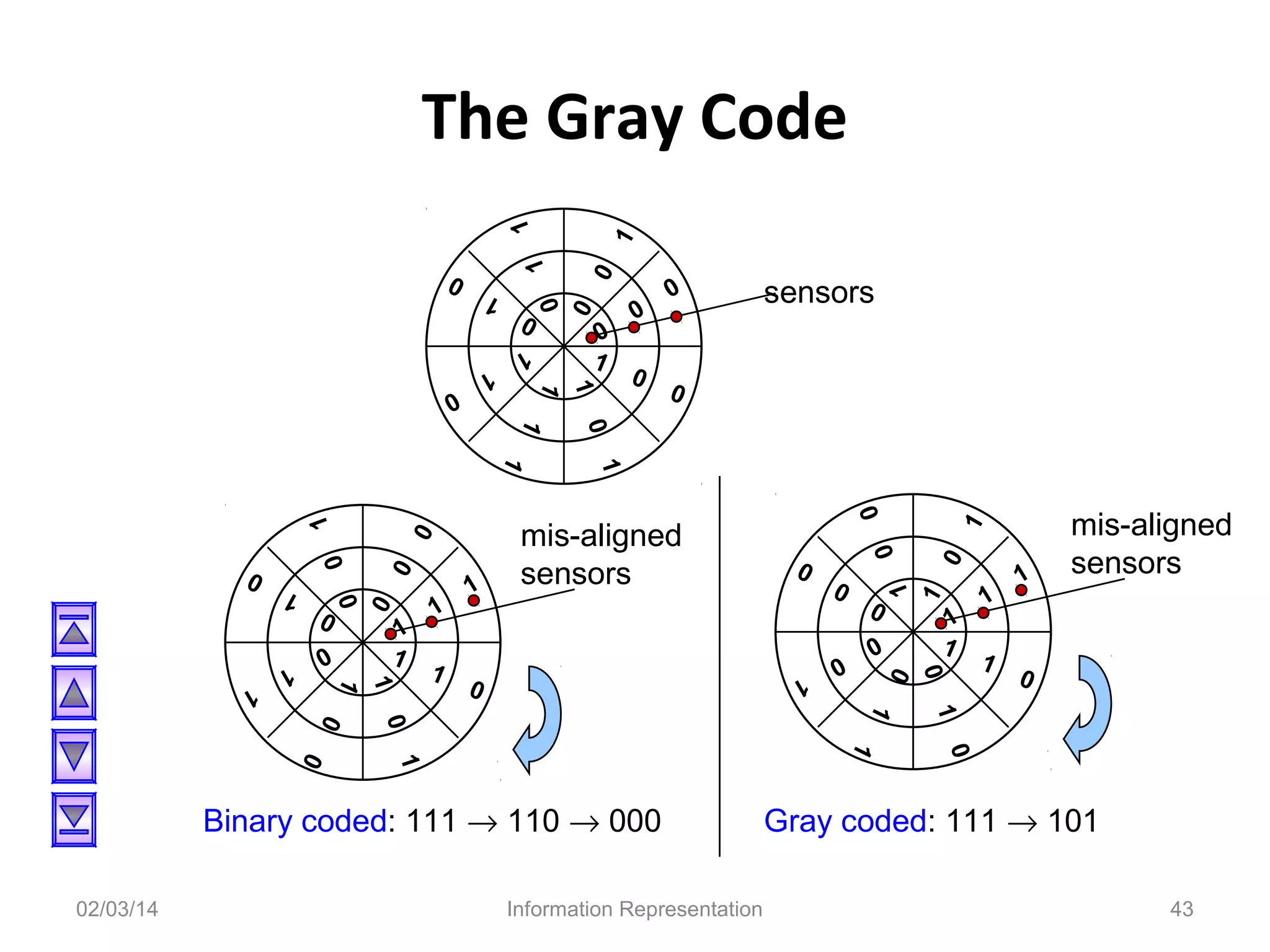
The Gray Code
 Unweighted (not an arithmetic code).
 Only a single bit change from one code number to the next.
 Good for error detection.
Decimal
0
1
2
3
4
5
6
7

Binary
0000
0001
0010
0011
0100
0101
0110
0111

Gray Code
0000
0001
0011
0010
0110
0111
0101
0100

Decimal
8
9
10
11
12
13
14
15

Binary
1000
1001
1010
1011
1100
1101
1110
1111

Gray code
1100
1101
1111
1110
1010
1011
1001
1000

Q. How to generate 5-bit standard Gray code?
Q. How to generate n-bit standard Gray code?
02/03/14

Information Representation

41
The Gray Code
0000
0001
0001
0011
0000
0010
0010
0110
0011
0111
0001
0101
0000
0100

1100
0100
1101
0101
1111
0111
1110
0110
1010
0010
1011
0011
1001
0001
1000
0000

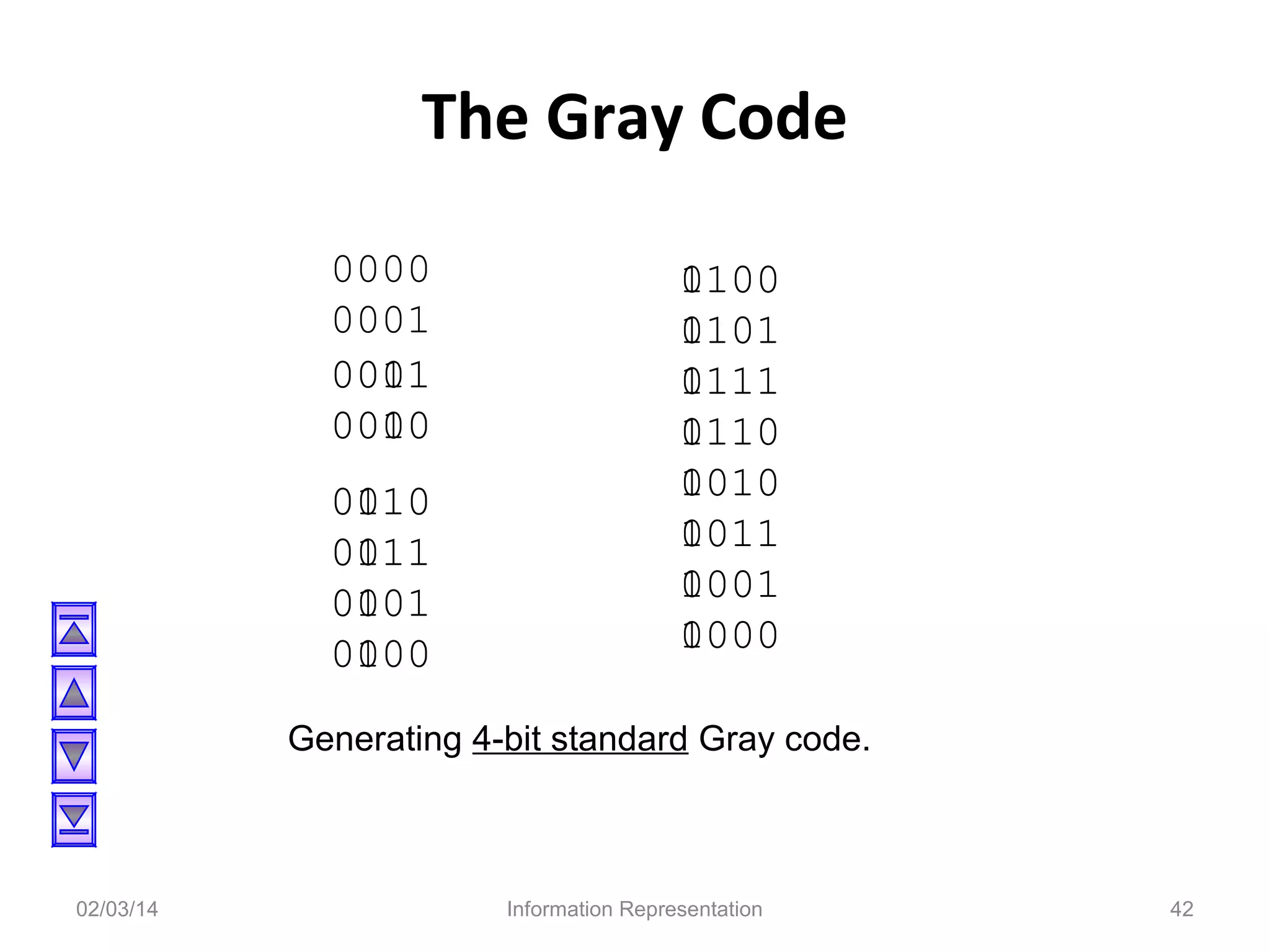
Generating 4-bit standard Gray code.

02/03/14

Information Representation

42
0
0

0

1

1

1

The Gray Code
0

1

0

0
1

0

1

1
1

0

0

0

0

1

0

1

1
1

0

1
1

0

0
0

0

0
0

0
0

0

0

1
1
0
0

0

1

0
0

1
1

1

0

1

0

1

0

1

1

1
1

1

mis-aligned
sensors

1

1

0

0

1

1

1

1

0

Information Representation

1

mis-aligned
sensors

1

1

0

0

Binary coded: 111 → 110 → 000
02/03/14

sensors

Gray coded: 111 → 101
43
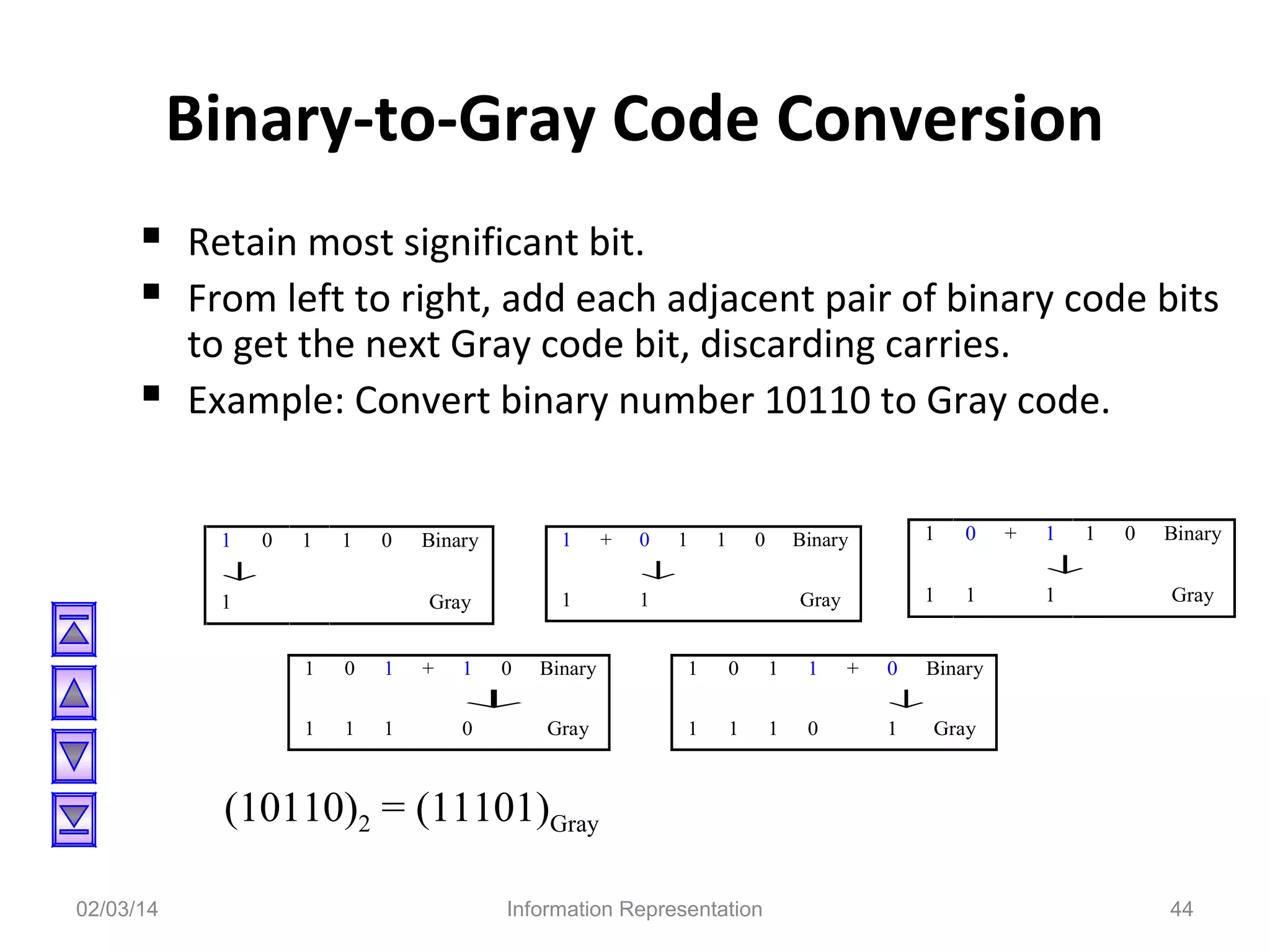
Binary-to-Gray Code Conversion
 Retain most significant bit.
 From left to right, add each adjacent pair of binary code bits


to get the next Gray code bit, discarding carries.
Example: Convert binary number 10110 to Gray code.
1

0

1

1

0

↓
1

1

Binary

1

Gray
1
1

0
1

1
1

+

1

0

↓
0

Binary
Gray

+

0

1

1

0

1

Binary

↓
1

1

Gray
1
1

0
1

1
1

1
0

+

0

0
1

+

1

1

↓
1

0

Binary
Gray

Binary

↓
1
Gray

(10110)2 = (11101)Gray
02/03/14

Information Representation

44
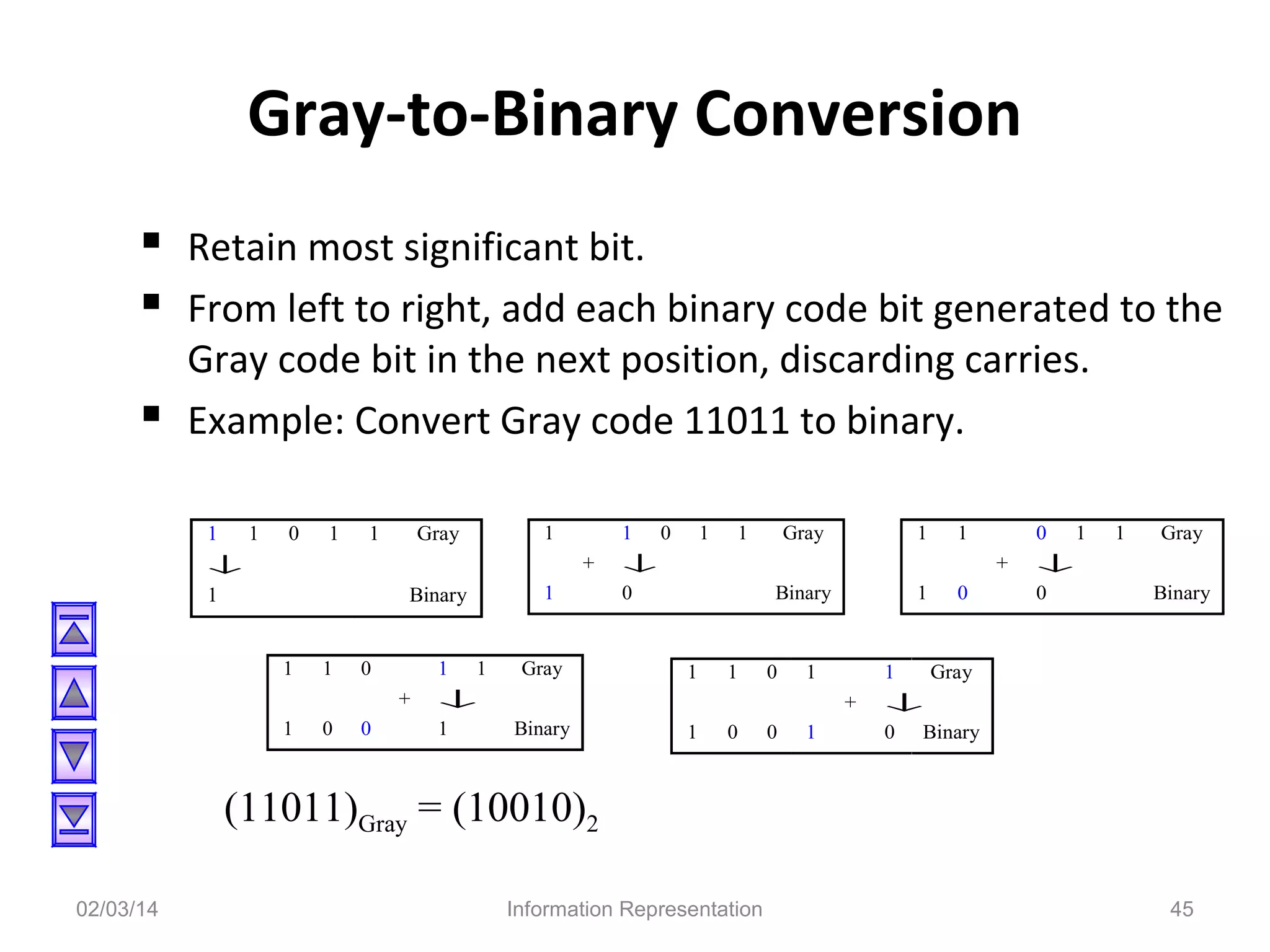
Gray-to-Binary Conversion
 Retain most significant bit.
 From left to right, add each binary code bit generated to the


Gray code bit in the next position, discarding carries.
Example: Convert Gray code 11011 to binary.
1

1

0

1

1

1

Gray

1
+

↓
1

1

Binary
1

1

0

1
+

1

0

0

1

↓
1

Gray

0

1

1

Gray

1

0
+

↓
0

Binary

1

1

0

1

1

1
+

Binary

1

1

0

0

1

0

↓
0

1

1

Gray
Binary

Gray

↓
0 Binary

(11011)Gray = (10010)2
02/03/14

Information Representation

45
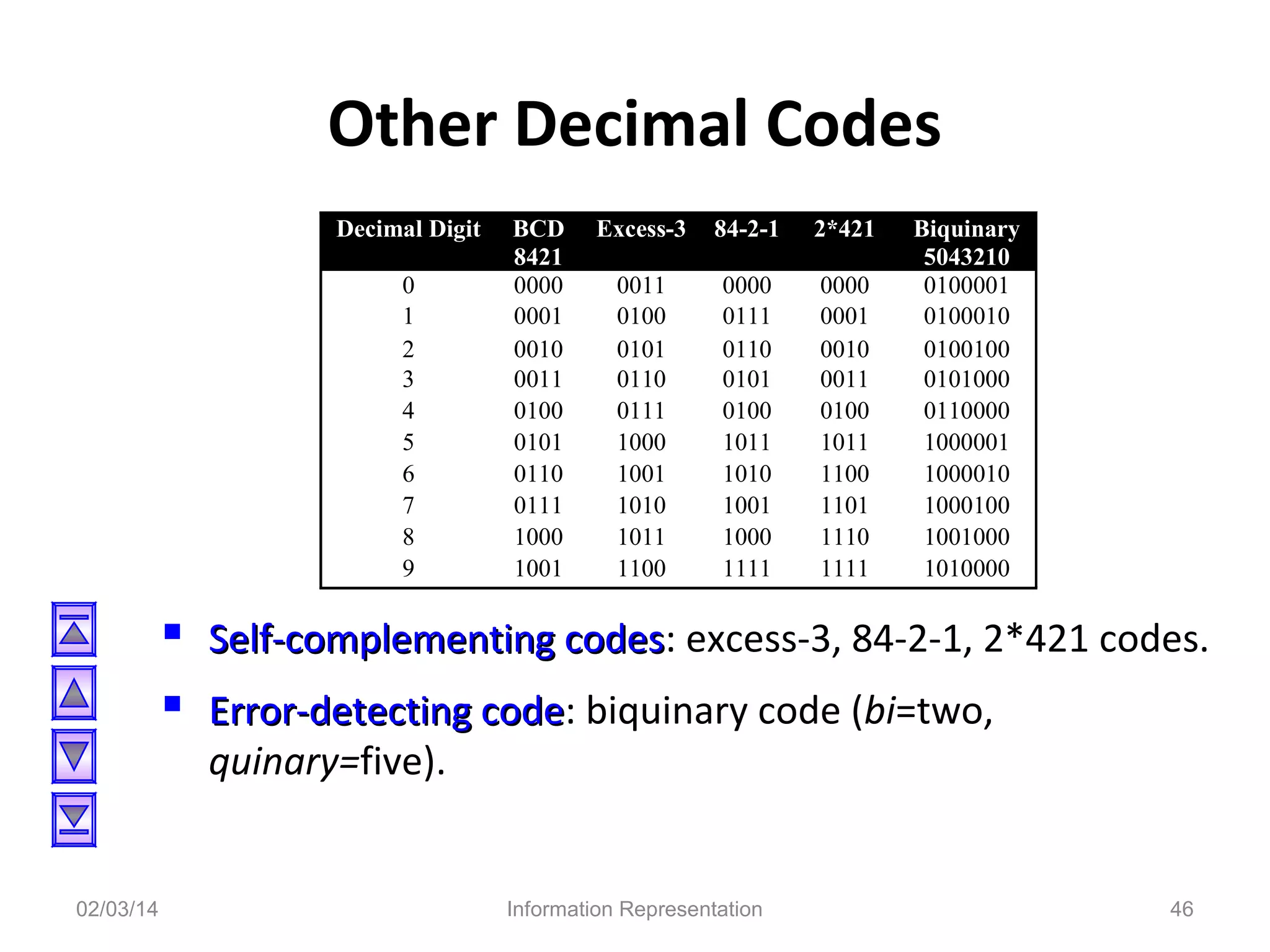
Other Decimal Codes
Decimal Digit
0
1
2
3
4
5
6
7
8
9

BCD
8421
0000
0001
0010
0011
0100
0101
0110
0111
1000
1001

Excess-3

84-2-1

2*421

0011
0100
0101
0110
0111
1000
1001
1010
1011
1100

0000
0111
0110
0101
0100
1011
1010
1001
1000
1111

0000
0001
0010
0011
0100
1011
1100
1101
1110
1111

Biquinary
5043210
0100001
0100010
0100100
0101000
0110000
1000001
1000010
1000100
1001000
1010000

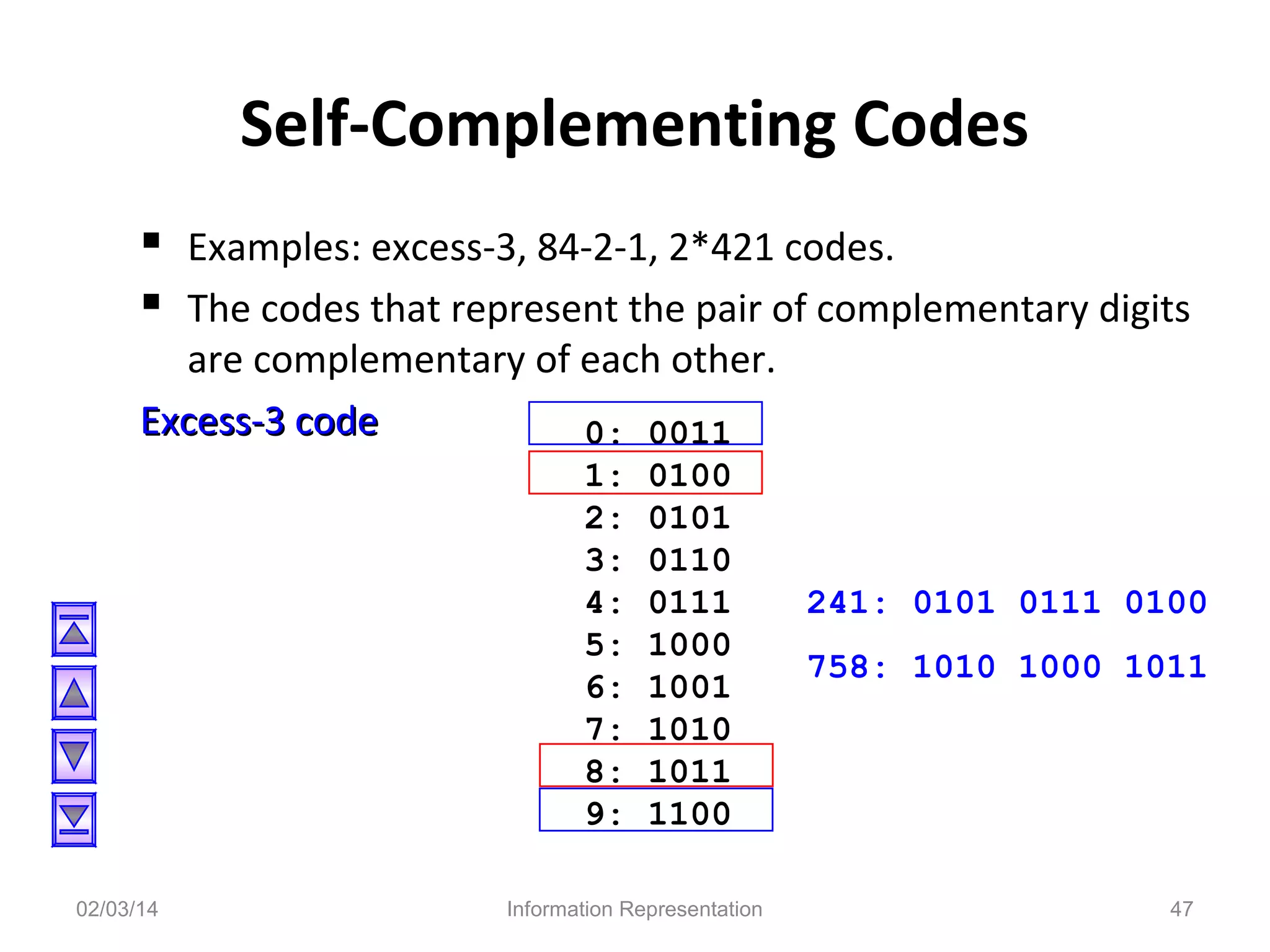
 Self-complementing codes: excess-3, 84-2-1, 2*421 codes.
codes
 Error-detecting code: biquinary code (bi=two,
code
quinary=five).

02/03/14

Information Representation

46
Self-Complementing Codes
 Examples: excess-3, 84-2-1, 2*421 codes.
 The codes that represent the pair of complementary digits
are complementary of each other.
Excess-3 code
0: 0011
1:
2:
3:
4:
5:
6:
7:
8:
9:
02/03/14

0100
0101
0110
0111
1000
1001
1010
1011
1100

Information Representation

241: 0101 0111 0100
758: 1010 1000 1011

47
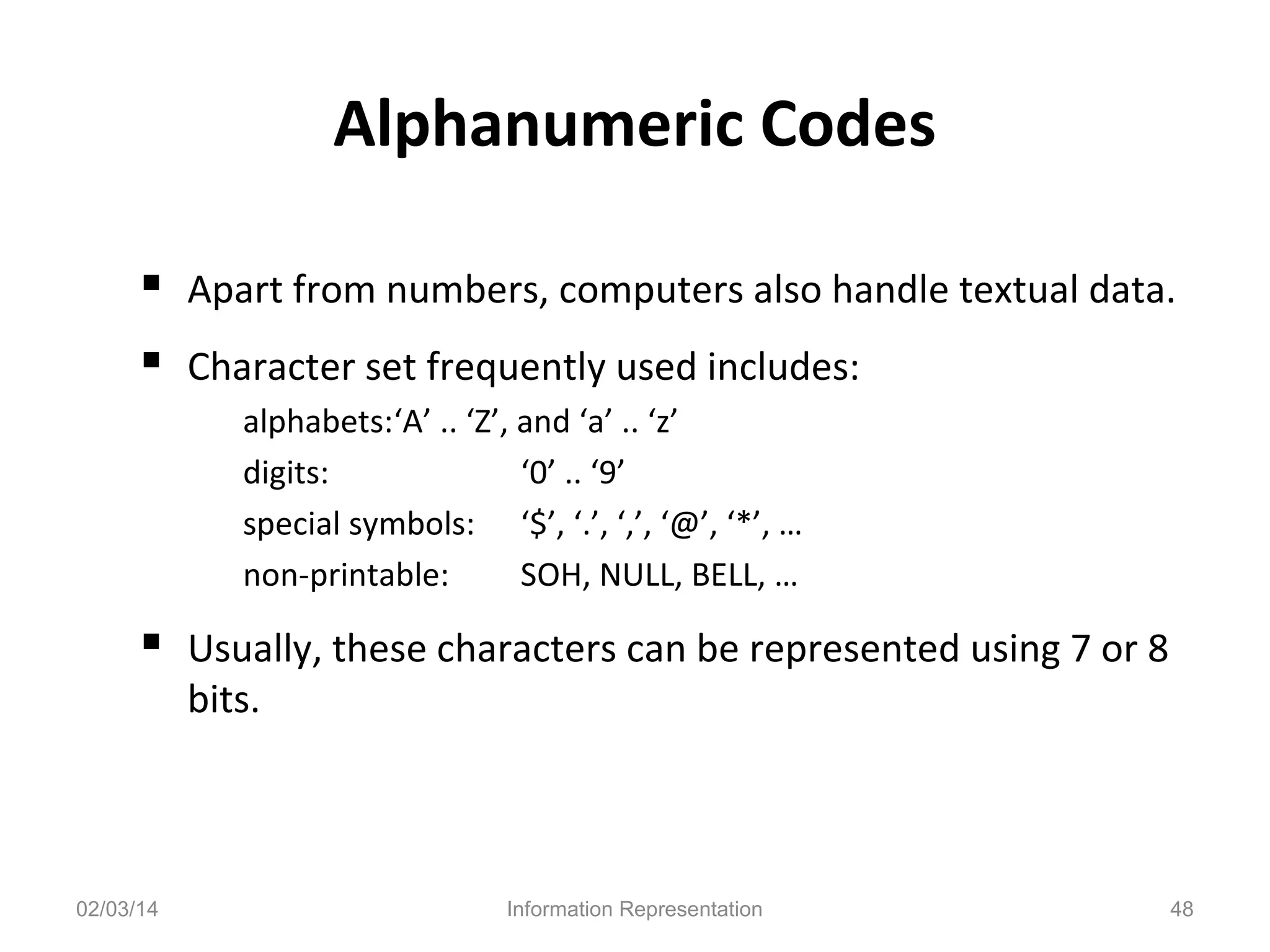
Alphanumeric Codes
 Apart from numbers, computers also handle textual data.
 Character set frequently used includes:
alphabets:‘A’ .. ‘Z’, and ‘a’ .. ‘z’
digits:
‘0’ .. ‘9’
special symbols: ‘$’, ‘.’, ‘,’, ‘@’, ‘*’, …
non-printable:
SOH, NULL, BELL, …

 Usually, these characters can be represented using 7 or 8
bits.

02/03/14

Information Representation

48
Alphanumeric Codes
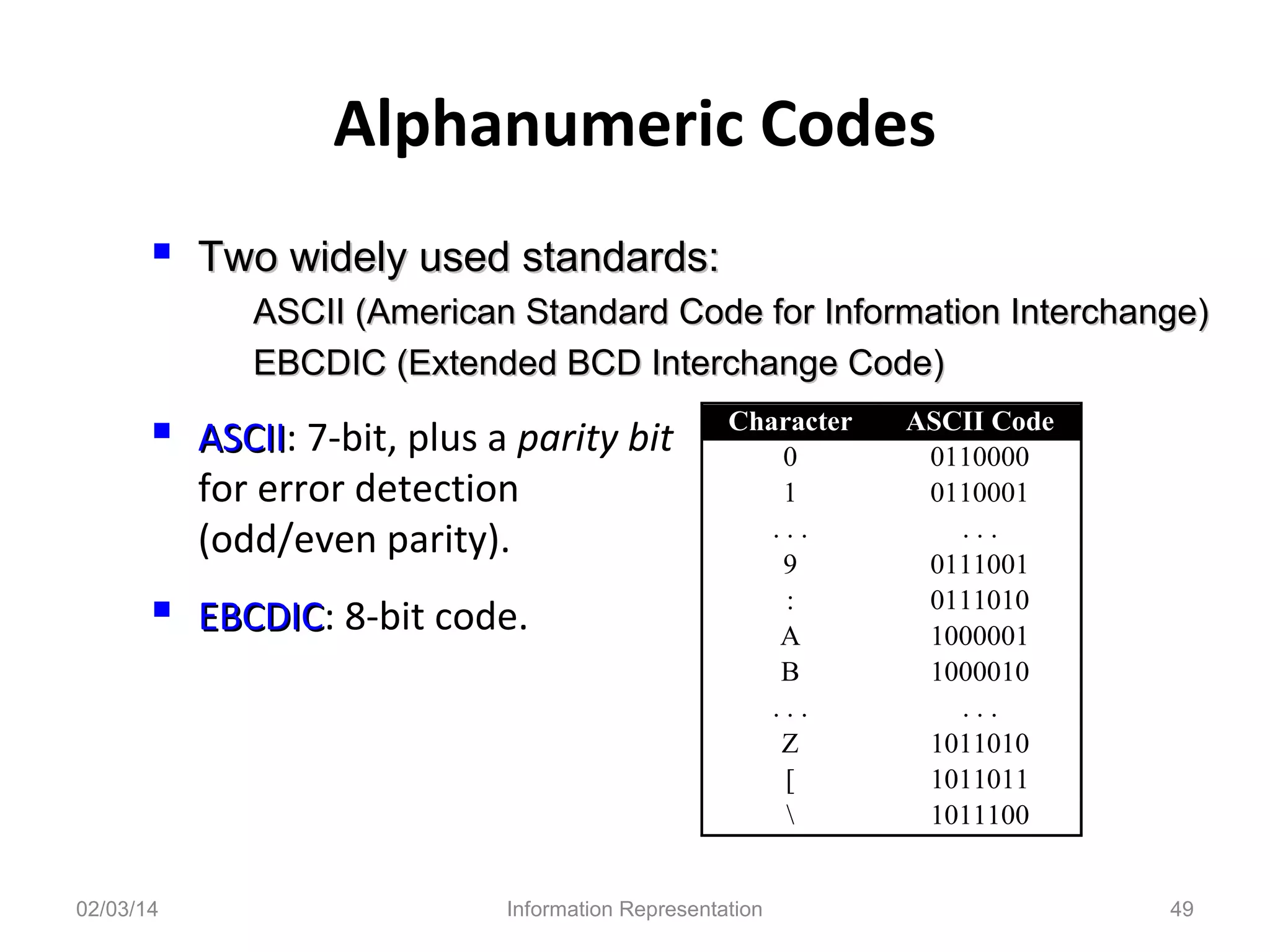
 Two widely used standards:
ASCII (American Standard Code for Information Interchange)
EBCDIC (Extended BCD Interchange Code)

 ASCII: 7-bit, plus a parity bit
ASCII
for error detection
(odd/even parity).

 EBCDIC: 8-bit code.
EBCDIC

02/03/14

Character
0
1
...
9
:
A
B
...
Z
[


Information Representation

ASCII Code
0110000
0110001
...
0111001
0111010
1000001
1000010
...
1011010
1011011
1011100
49
Alphanumeric Codes
 ASCII table:
LSBs
0000
0001
0010
0011
0100
0101
0110
0111
1000
1001
1010
1011
1100
1101
1110
1111
02/03/14

000
NUL
SOH
STX
ETX
EOT
ENQ
ACK
BEL
BS
HT
LF
VT
FF
CR
O
SI

001
DLE
DC1
DC2
DC3
DC4
NAK
SYN
ETB
CAN
EM
SUB
ESC
FS
GS
RS
US

010
SP
!
“
#
$
%
&
‘
(
)
*
+
,
.
/

MSBs
011 100
0
@
1
A
2
B
3
C
4
D
5
E
6
F
7
G
8
H
9
I
:
J
;
K
<
L
=
M
>
N
?
O

Information Representation

101
P
Q
R
S
T
U
V
W
X
Y
Z
[

]
^
_

110
`
a
b
c
d
e
f
g
h
i
j
k
l
m
n
o

111
p
q
r
s
t
u
v
w
x
y
z
{
|
}
~
DEL
50
Error Detection Codes
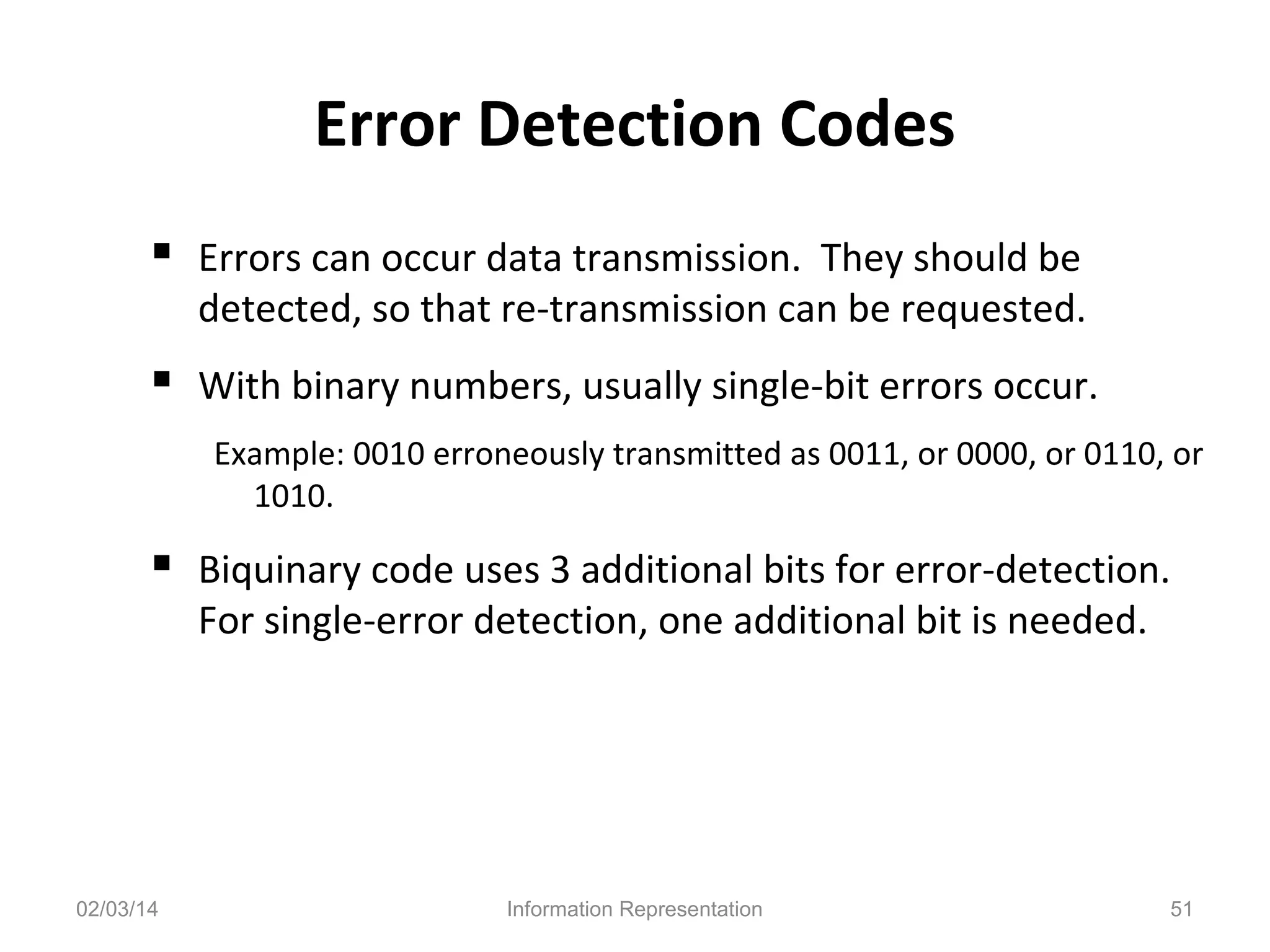
 Errors can occur data transmission. They should be

detected, so that re-transmission can be requested.

 With binary numbers, usually single-bit errors occur.
Example: 0010 erroneously transmitted as 0011, or 0000, or 0110, or
1010.

 Biquinary code uses 3 additional bits for error-detection.
For single-error detection, one additional bit is needed.

02/03/14

Information Representation

51
Error Detection Codes
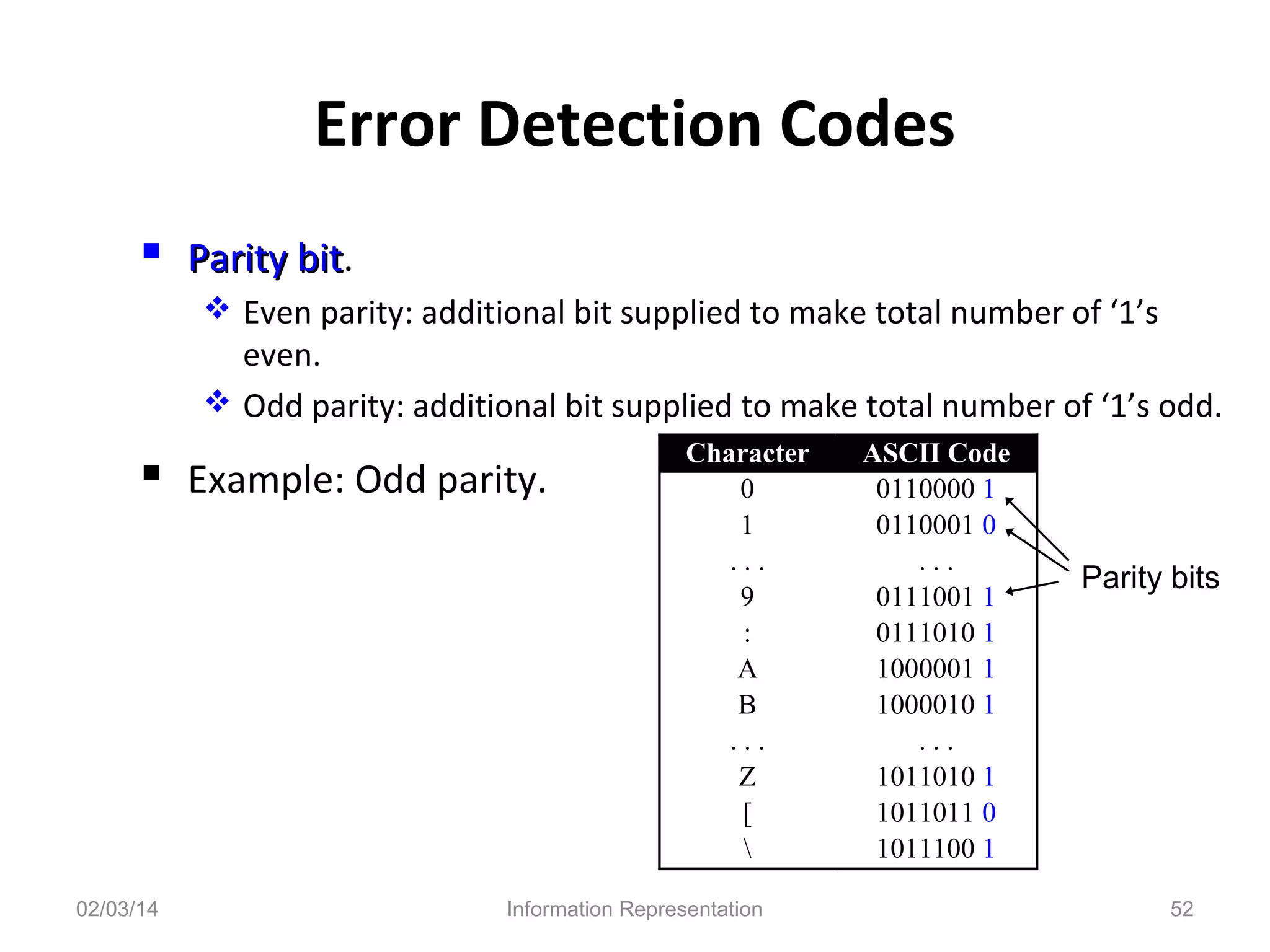
 Parity bit.
bit
 Even parity: additional bit supplied to make total number of ‘1’s

even.
 Odd parity: additional bit supplied to make total number of ‘1’s odd.

 Example: Odd parity.

02/03/14

Character
0
1
...
9
:
A
B
...
Z
[


Information Representation

ASCII Code
0110000 1
0110001 0
...
0111001 1
0111010 1
1000001 1
1000010 1
...
1011010 1
1011011 0
1011100 1

Parity bits

52
Error Detection Codes
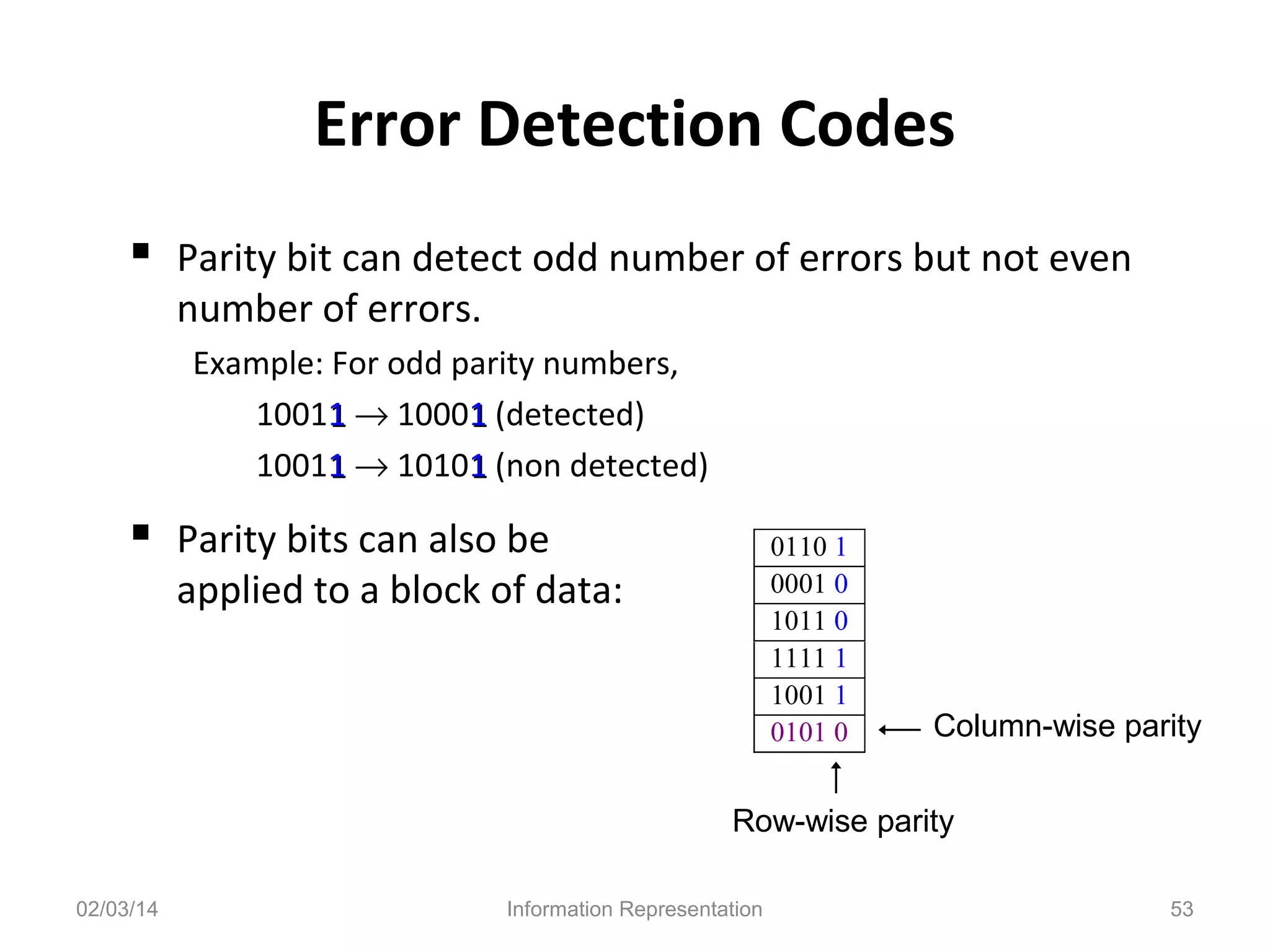
 Parity bit can detect odd number of errors but not even
number of errors.

Example: For odd parity numbers,
10011 → 10001 (detected)
10011 → 10101 (non detected)

 Parity bits can also be

0110 1
0001 0
1011 0
1111 1
1001 1
0101 0

applied to a block of data:

Column-wise parity

Row-wise parity
02/03/14

Information Representation

53
Error Detection Codes
 Sometimes, it is not enough to do error detection. We may
want to do error correction.

 Error correction is expensive. In practice, we may use only
single-bit error correction.

 Popular technique: Hamming Code (not covered).

02/03/14

Information Representation

54

Lecture 3

  • 1.
    Computer & NetworkTechnology Chamila Fernando 02/03/14 Information Representation BSc(Eng) Hons,MBA,MIEEE 1
  • 2.
    Negative Numbers Representation Till now, we have only considered how unsigned (non- negative) numbers can be represented. There are three common ways of representing signed numbers (positive and negative numbers) for binary numbers:  Sign-and-Magnitude  1s Complement  2s Complement 02/03/14 Information Representation 2
  • 3.
    Negative Numbers: Sign-and-Magnitude  Negativenumbers are usually written by writing a minus sign in front.  Example: - (12)10 , - (1100)2 • In computer memory of fixed width, this sign is usually represented by a bit: 0 for + 1 for - 02/03/14 Information Representation 3
  • 4.
    Negative Numbers: Sign-and-Magnitude  Example:an 8-bit number can have 1-bit sign and 7-bits magnitude. magnitude sign 02/03/14 Information Representation 4
  • 5.
    Negative Numbers: Sign-and-Magnitude  LargestPositive Number: 0 1111111 +(127)10  Largest Negative Number: 1 1111111 -(127)10  Zeroes: 0 0000000 1 0000000    02/03/14 +(0)10 -(0)10 Range: -(127)10 to +(127)10 Signed numbers needed for negative numbers. Representation: Sign-and-magnitude. Information Representation 5
  • 6.
    Negative Numbers: Sign-and-Magnitude  Tonegate a number, just invert the sign bit. bit  Examples: - (0 0100001)sm = (1 0100001)sm - (1 0000101)sm = (0 0000101)sm 02/03/14 Information Representation 6
  • 7.
    1s and 2sComplement  Two other ways of representing signed numbers for binary numbers are:  1s-complement  2s-complement 02/03/14 Information Representation 7
  • 8.
    1s Complement  Givena number x which can be expressed as an n-bit binary number, its negative value can be obtained in 1scomplement representation using: - x = 2n - x - 1 Example: With an 8-bit number 00001100, its negative value, expressed in 1s complement, is obtained as follows: -(00001100)2 = - (12)10 = (28 - 12 - 1)10 = (243)10 = (11110011)1s 02/03/14 Information Representation 8
  • 9.
    1s Complement  Essentialtechnique: invert all the bits. Examples: 1s complement of (00000001)1s = (11111110)1s 1s complement of (01111111)1s = (10000000)1s  Largest Positive Number: 0 1111111 +(127)10  Largest Negative Number: 1 0000000 -(127)10  Zeroes: 0 0000000 1 1111111  Range: -(127)10 to +(127)10  The most significant bit still represents the sign: 0 = +ve; 1 = -ve. 02/03/14 Information Representation 9
  • 10.
    1s Complement  Examples(assuming 8-bit binary numbers): (14)10 = (00001110)2 = (00001110)1s -(14)10 = -(00001110)2 = (11110001)1s -(80)10 = -( ? )2 = ( ? )1s 02/03/14 Information Representation 10
  • 11.
    2s Complement  Givena number x which can be expressed as an n-bit binary number, its negative number can be obtained in 2scomplement representation using: - x = 2n - x Example: With an 8-bit number 00001100, its negative value in 2s complement is thus: -(00001100)2 = - (12)10 = (28 - 12)10 = (244)10 = (11110100)2s 02/03/14 Information Representation 11
  • 12.
    2s Complement  Essentialtechnique: invert all the bits and add 1. 1 Examples: 2s complement of (00000001)2s = (11111110)1s (invert) = (11111111)2s (add 1) 2s complement of (01111110)2s = (10000001)1s (invert) = (10000010)2s (add 1) 02/03/14 Information Representation 12
  • 13.
    2s Complement  LargestPositive Number: 0 1111111 +(127)10 Largest Negative Number: 1 0000000 -(128)10     02/03/14 Zero: 0 0000000 Range: -(128)10 to +(127)10 The most significant bit still represents the sign: 0 = +ve; 1 = -ve. Information Representation 13
  • 14.
    2s Complement  Examples(assuming 8-bit binary numbers): (14)10 = (00001110)2 = (00001110)2s -(14)10 = -(00001110)2 = (11110010)2s -(80)10 = -( ? )2 = ( ? )2s 02/03/14 Information Representation 14
  • 15.
    Comparisons of Sign-and-Magnitudeand Complements  Example: 4-bit signed number (positive values) Value Sign-and1s 2s Magnitude +7 +6 +5 +4 +3 +2 +1 +0 02/03/14 Comp. Comp. 0111 0110 0101 0100 0011 0010 0001 0000 0111 0110 0101 0100 0011 0010 0001 0000 0111 0110 0101 0100 0011 0010 0001 0000 Information Representation 15
  • 16.
    Comparisons of Sign-and-Magnitudeand Complements  Example: 4-bit signed number (negative values) Value Sign-and1s 2s Magnitude -0 -1 -2 -3 -4 -5 -6 -7 -8 02/03/14 Comp. Comp. 1000 1001 1010 1011 1100 1101 1110 1111 - 1111 1110 1101 1100 1011 1010 1001 1000 - 1111 1110 1101 1100 1011 1010 1001 1000 Information Representation 16
  • 17.
    Complements (General)  Complementnumbers can help perform subtraction. With complements, subtraction can be performed by addition. Hence, A – B can be performed by A + (-B) where (-B) is represented as the complement of B.  In general for Base-r number, there are: (i) Diminished Radix (or r-1’s) Complement (ii) Radix (or r’s) Complement  For Base-2 number, we have seen: (i) 1s Complement (ii) 2s Complement 02/03/14 Information Representation 17
  • 18.
    Diminished-Radix Complements  Givenan n-digit number, xr, its (r-1)’s complement is: (rn - 1) - x E.g.: (r-1)’s complement, or 9s complement, of (22)10 is: (102 - 1) - 22 = (77)9s [This means –(22)10 is (77)9s] (r-1)’s complement, or 1s complement, of (0101)2 is: (24- 1) - 0101 = (1010)1s [This means –(0101)2 is (1010)1s] Same as inverting all digits: (102 - 1) - 22 = 99 - 22 = (77)9s (24 - 1) - 0101 = 1111 - 0101 = (1010)1s 02/03/14 Information Representation 18
  • 19.
    Radix Complements  Givenan n-digit number, xr, its r’s-complement is: rn - x E.g.: r’s-complement, or 10s complement, of (22)10 is: 102 - 22 = (78)10s [This means –(22)10 is (78)10s] r’s-complement, or 2s complement, of (0101)2 is: 24 - 0101 = (1011)2s [This means –(0101)2 is (1011)2s] Same as inverting all digits and adding 1: (102) - 22 = (99+1) - 22 = 77 + 1 = (78)10s (24) - 0101 = (1111+1) - 0101 = 1010 +1 = (1011)2s 02/03/14 Information Representation 19
  • 20.
    2s Complement Addition/Subtraction Algorithm for addition, A + B: 1. 2. 3. Perform binary addition on the two numbers. Ignore the carry out of the MSB (most significant bit). Check for overflow: Overflow occurs if the ‘carry in’ and ‘carry out’ of the MSB are different, or if result is opposite sign of A and B.  Algorithm for subtraction, A – B: A – B = A + (–B) 1. 2. 02/03/14 Take 2s complement of B by inverting all the bits and adding 1. Add the 2s complement of B to A. Information Representation 20
  • 21.
    2s Complement Addition/Subtraction Examples: 4-bit binary system +3 + +4 ---+7 ---- 0011 + 0100 ------0111 ------- -2 + -6 ----8 ---- 1110 + 1010 ------11000 ------- +6 + -3 ---+3 ---- 0110 + 1101 ------10011 ------- +4 + -7 ----3 ---- 0100 + 1001 ------1101 -------  Which of the above is/are overflow(s)? 02/03/14 Information Representation 21
  • 22.
    2s Complement Addition/Subtraction More examples: 4-bit binary system -3 + -6 ----9 ---- 1101 + 1010 ------10111 ------- +5 + +6 ---+11 ---- 0101 + 0110 ------1011 -------  Which of the above is/are overflow(s)? 02/03/14 Information Representation 22
  • 23.
    1s Complement Addition/Subtraction Algorithm for addition, A + B: 1. 2. 3. Perform binary addition on the two numbers. If there is a carry out of the MSB, add 1 to the result. Check for overflow: Overflow occurs if result is opposite sign of A and B.  Algorithm for subtraction, A – B: A – B = A + (–B) 1. 2. 02/03/14 Take 1s complement of B by inverting all the bits. Add the 1s complement of B to A. Information Representation 23
  • 24.
    1s Complement Addition/Subtraction Examples: 4-bit binary system +3 + +4 ---+7 ----2 + -5 ----7 ---- 02/03/14 0011 + 0100 ------0111 ------1101 + 1010 -----10111 + 1 -----1000 +5 + -5 ----0 ----3 + -7 ----10 ---- Information Representation 0101 + 1010 ------1111 ------1100 + 1000 ------10100 + 1 ------0101 24
  • 25.
    Overflow  Signed binarynumbers are of a fixed range.  If the result of addition/subtraction goes beyond this range, overflow occurs.  Two conditions under which overflow can occur are: (i) positive add positive gives negative (ii) negative add negative gives positive 02/03/14 Information Representation 25
  • 26.
    Overflow  Examples: 4-bitnumbers (in 2s complement)  Range : (1000)2s to (0111)2s or (-810 to 710) (i) (0101)2s + (0110)2s= (1011)2s (5)10 + (6)10= -(5)10 ?! (overflow!) (ii) (1001)2s + (1101)2s = (10110)2s discard end-carry = (0110)2s (-7)10 + (-3)10 = (6)10 ?! (overflow!) 02/03/14 Information Representation 26
  • 27.
    Fixed Point Numbers The signed and unsigned numbers representation given are fixed point numbers. numbers  The binary point is assumed to be at a fixed location, say, at the end of the number: binary point  Can represent all integers between –128 to 127 (for 8 bits). 02/03/14 Information Representation 27
  • 28.
    Fixed Point Numbers In general, other locations for binary points possible. integer part binary point fraction part  Examples: If two fractional bits are used, we can represent: (001010.11)2s = (10.75)10 (111110.11)2s = -(000001.01)2 = -(1.25)10 02/03/14 Information Representation 28
  • 29.
    Floating Point Numbers Fixed point numbers have limited range.  To represent very large or very small numbers, we use floating point numbers (cf. scientific numbers). Examples: 0.23 x 10²³ (very large positive number) 0.5 x 10⁻³² (very small positive number) -0.1239 x 10⁻¹⁸ (very small negative number) 02/03/14 Information Representation 29
  • 30.
    Floating Point Numbers Floating point numbers have three parts: sign, mantissa, and exponent mantissa  The base (radix) is assumed (usually base 2).  The sign is a single bit (0 for positive number, 1 for negative). sign 02/03/14 mantissa Information Representation exponent 30
  • 31.
    Floating Point Numbers Mantissa is usually in normalised form: form (base 10) 23 x 1021 normalised to 0.23 x 10²³ (base 10) -0.0017 x 10²¹ normalised to -0.17 x 10¹⁹ (base 2) 0.01101 x 23 normalised to 0.1101 x 22  Normalised form: The fraction portion cannot begin with zero.  More bits in exponent gives larger range.  More bits for mantissa gives better precision. 02/03/14 Information Representation 31
  • 32.
    Floating Point Numbers Exponent is usually expressed in complement or excess  form. Example: Express -(6.5)10 in base-2 normalised form -(6.5)10 = -(110.1)2 = -0.1101 x 23  Assuming that the floating-point representation contains 1bit sign, 5-bit normalised mantissa, and 4-bit exponent.  The above example will be represented as 1 02/03/14 11010 0011 Information Representation 32
  • 33.
    Floating Point Numbers Example: Express (0.1875)10 in base-2 normalised form (0.1875)10 = (0.0011)2 = 0.11 x 2-2  Assuming that the floating-pt rep. contains 1-bit sign, 5-bit normalised mantissa, and 4-bit exponent.  The above example will be represented as 0 1101 If exponent is in 1’s complement. 0 11000 1110 If exponent is in 2’s complement. 0 02/03/14 11000 11000 0110 If exponent is in excess-8. Information Representation 33
  • 34.
    Excess Representation  Theexcess representation allows Information Representation 000 -4 001 -3 010 -2 011 -1 100 0 101 1 2 111 02/03/14 Value 110  the range of values to be distributed evenly among the positive and negative value, by a simple translation (addition/subtraction). Example: For a 3-bit representation, we may use excess-4. Excess-4 Representation 3 34
  • 35.
    Excess Representation  Example:For a 4-bit representation, we may use excess-8. Excess-8 Representation Excess-8 Representation Value 0000 -8 1000 0 0001 -7 1001 1 0010 -6 1010 2 0011 -5 1011 3 0100 -4 1100 4 0101 -3 1101 5 0110 -2 1110 6 0111 02/03/14 Value -1 1111 7 Information Representation 35
  • 36.
    Arithmetics with FloatingPoint Numbers  Arithmetic is more difficult for floating point numbers.  MULTIPLICATION Steps: (i) multiply the mantissa (ii) add-up the exponents (iii) normalise  Example: (0.12 x 10²)10 x (0.2 x 1030)10 = (0.12 x 0.2)10 x 102+30 = (0.024)10 x 1032 (normalise) = (0.24 x 1031)10 02/03/14 Information Representation 36
  • 37.
    Arithmetics with FloatingPoint Numbers  ADDITION Steps: (i) equalise the exponents (ii) add-up the mantissa (iii) normalise  Example: (0.12 x 10³)10 + (0.2 x 10²)10 = (0.12 x 10³)10 + (0.02 x 10³)10 (equalise exponents) = (0.12 + 0.02)10 x 103 (add mantissa) = (0.14 x 10³)10  Can you figure out how to do perform SUBTRACTION and DIVISION for (binary/decimal) floating-point numbers? 02/03/14 Information Representation 37
  • 38.
    Binary Coded Decimal(BCD)  Decimal numbers are more natural to humans. Binary numbers are natural to computers. Quite expensive to convert between the two.  If little calculation is involved, we can use some coding schemes for decimal numbers.  One such scheme is BCD, also known as the 8421 code. BCD  Represent each decimal digit as a 4-bit binary code. code 02/03/14 Information Representation 38
  • 39.
    Binary Coded Decimal(BCD) Decimal digit BCD Decimal digit BCD 0 0000 5 0101 1 0001 6 0110 2 0010 7 0111 3 0011 8 1000 4 0100 9 1001  Some codes are unused, eg: (1010)BCD, (1011) BCD, …, (1111) BCD. These codes are considered as errors.  Easy to convert, but arithmetic operations are more complicated.  Suitable for interfaces such as keypad inputs and digital readouts. 02/03/14 Information Representation 39
  • 40.
    Binary Coded Decimal(BCD) Decimal digit BCD Decimal digit BCD 0 0000 5 0101 1 0001 6 0110 2 0010 7 0111 3 0011 8 1000 4 0100 9 1001  Examples: (234)10 = (0010 0011 0100)BCD (7093)10 = (0111 0000 1001 0011)BCD (1000 0110)BCD = (86)10 (1001 0100 0111 0010)BCD = (9472)10 Notes: BCD is not equivalent to binary. Example: (234)10 = (11101010)2 02/03/14 Information Representation 40
  • 41.
    The Gray Code Unweighted (not an arithmetic code).  Only a single bit change from one code number to the next.  Good for error detection. Decimal 0 1 2 3 4 5 6 7 Binary 0000 0001 0010 0011 0100 0101 0110 0111 Gray Code 0000 0001 0011 0010 0110 0111 0101 0100 Decimal 8 9 10 11 12 13 14 15 Binary 1000 1001 1010 1011 1100 1101 1110 1111 Gray code 1100 1101 1111 1110 1010 1011 1001 1000 Q. How to generate 5-bit standard Gray code? Q. How to generate n-bit standard Gray code? 02/03/14 Information Representation 41
  • 42.
  • 43.
    0 0 0 1 1 1 The Gray Code 0 1 0 0 1 0 1 1 1 0 0 0 0 1 0 1 1 1 0 1 1 0 0 0 0 0 0 0 0 0 0 1 1 0 0 0 1 0 0 1 1 1 0 1 0 1 0 1 1 1 1 1 mis-aligned sensors 1 1 0 0 1 1 1 1 0 InformationRepresentation 1 mis-aligned sensors 1 1 0 0 Binary coded: 111 → 110 → 000 02/03/14 sensors Gray coded: 111 → 101 43
  • 44.
    Binary-to-Gray Code Conversion Retain most significant bit.  From left to right, add each adjacent pair of binary code bits  to get the next Gray code bit, discarding carries. Example: Convert binary number 10110 to Gray code. 1 0 1 1 0 ↓ 1 1 Binary 1 Gray 1 1 0 1 1 1 + 1 0 ↓ 0 Binary Gray + 0 1 1 0 1 Binary ↓ 1 1 Gray 1 1 0 1 1 1 1 0 + 0 0 1 + 1 1 ↓ 1 0 Binary Gray Binary ↓ 1 Gray (10110)2 = (11101)Gray 02/03/14 Information Representation 44
  • 45.
    Gray-to-Binary Conversion  Retainmost significant bit.  From left to right, add each binary code bit generated to the  Gray code bit in the next position, discarding carries. Example: Convert Gray code 11011 to binary. 1 1 0 1 1 1 Gray 1 + ↓ 1 1 Binary 1 1 0 1 + 1 0 0 1 ↓ 1 Gray 0 1 1 Gray 1 0 + ↓ 0 Binary 1 1 0 1 1 1 + Binary 1 1 0 0 1 0 ↓ 0 1 1 Gray Binary Gray ↓ 0 Binary (11011)Gray = (10010)2 02/03/14 Information Representation 45
  • 46.
    Other Decimal Codes DecimalDigit 0 1 2 3 4 5 6 7 8 9 BCD 8421 0000 0001 0010 0011 0100 0101 0110 0111 1000 1001 Excess-3 84-2-1 2*421 0011 0100 0101 0110 0111 1000 1001 1010 1011 1100 0000 0111 0110 0101 0100 1011 1010 1001 1000 1111 0000 0001 0010 0011 0100 1011 1100 1101 1110 1111 Biquinary 5043210 0100001 0100010 0100100 0101000 0110000 1000001 1000010 1000100 1001000 1010000  Self-complementing codes: excess-3, 84-2-1, 2*421 codes. codes  Error-detecting code: biquinary code (bi=two, code quinary=five). 02/03/14 Information Representation 46
  • 47.
    Self-Complementing Codes  Examples:excess-3, 84-2-1, 2*421 codes.  The codes that represent the pair of complementary digits are complementary of each other. Excess-3 code 0: 0011 1: 2: 3: 4: 5: 6: 7: 8: 9: 02/03/14 0100 0101 0110 0111 1000 1001 1010 1011 1100 Information Representation 241: 0101 0111 0100 758: 1010 1000 1011 47
  • 48.
    Alphanumeric Codes  Apartfrom numbers, computers also handle textual data.  Character set frequently used includes: alphabets:‘A’ .. ‘Z’, and ‘a’ .. ‘z’ digits: ‘0’ .. ‘9’ special symbols: ‘$’, ‘.’, ‘,’, ‘@’, ‘*’, … non-printable: SOH, NULL, BELL, …  Usually, these characters can be represented using 7 or 8 bits. 02/03/14 Information Representation 48
  • 49.
    Alphanumeric Codes  Twowidely used standards: ASCII (American Standard Code for Information Interchange) EBCDIC (Extended BCD Interchange Code)  ASCII: 7-bit, plus a parity bit ASCII for error detection (odd/even parity).  EBCDIC: 8-bit code. EBCDIC 02/03/14 Character 0 1 ... 9 : A B ... Z [ Information Representation ASCII Code 0110000 0110001 ... 0111001 0111010 1000001 1000010 ... 1011010 1011011 1011100 49
  • 50.
    Alphanumeric Codes  ASCIItable: LSBs 0000 0001 0010 0011 0100 0101 0110 0111 1000 1001 1010 1011 1100 1101 1110 1111 02/03/14 000 NUL SOH STX ETX EOT ENQ ACK BEL BS HT LF VT FF CR O SI 001 DLE DC1 DC2 DC3 DC4 NAK SYN ETB CAN EM SUB ESC FS GS RS US 010 SP ! “ # $ % & ‘ ( ) * + , . / MSBs 011 100 0 @ 1 A 2 B 3 C 4 D 5 E 6 F 7 G 8 H 9 I : J ; K < L = M > N ? O Information Representation 101 P Q R S T U V W X Y Z [ ] ^ _ 110 ` a b c d e f g h i j k l m n o 111 p q r s t u v w x y z { | } ~ DEL 50
  • 51.
    Error Detection Codes Errors can occur data transmission. They should be detected, so that re-transmission can be requested.  With binary numbers, usually single-bit errors occur. Example: 0010 erroneously transmitted as 0011, or 0000, or 0110, or 1010.  Biquinary code uses 3 additional bits for error-detection. For single-error detection, one additional bit is needed. 02/03/14 Information Representation 51
  • 52.
    Error Detection Codes Parity bit. bit  Even parity: additional bit supplied to make total number of ‘1’s even.  Odd parity: additional bit supplied to make total number of ‘1’s odd.  Example: Odd parity. 02/03/14 Character 0 1 ... 9 : A B ... Z [ Information Representation ASCII Code 0110000 1 0110001 0 ... 0111001 1 0111010 1 1000001 1 1000010 1 ... 1011010 1 1011011 0 1011100 1 Parity bits 52
  • 53.
    Error Detection Codes Parity bit can detect odd number of errors but not even number of errors. Example: For odd parity numbers, 10011 → 10001 (detected) 10011 → 10101 (non detected)  Parity bits can also be 0110 1 0001 0 1011 0 1111 1 1001 1 0101 0 applied to a block of data: Column-wise parity Row-wise parity 02/03/14 Information Representation 53
  • 54.
    Error Detection Codes Sometimes, it is not enough to do error detection. We may want to do error correction.  Error correction is expensive. In practice, we may use only single-bit error correction.  Popular technique: Hamming Code (not covered). 02/03/14 Information Representation 54