Digital Logic and Design
Karnaugh Map
Recap: Boolean Algebra
 Simplification of Boolean expressions are
done through Boolean algebra.
 The method wasn’t effective.
 Solving a problem through Boolean
algebra was a bit tricky
 Need skill of applying rules and law.
 Doesn’t guarantee simplest form of expression
Karnaugh Map
 K-map provides a systematic method
 For simplifying Boolean expressions and minimizing
expressions.
 If properly used, will produce the simplest SOP and
POS.
 Similar to truth table, presents all possible values of
input variables and resulting output for each value.
Karnaugh Map
 Karnaugh map is an array of cells in which each cell
represents a binary value of input variables.
 The cells are managed in a way so that simplification of
a given expression is simply a matter of properly
grouping the cells.
 Karnaugh maps can be used for expression with two,
three, four and five variables, but we will discuss only 3-
variable and 4-varable situations to illustrate the
principles.
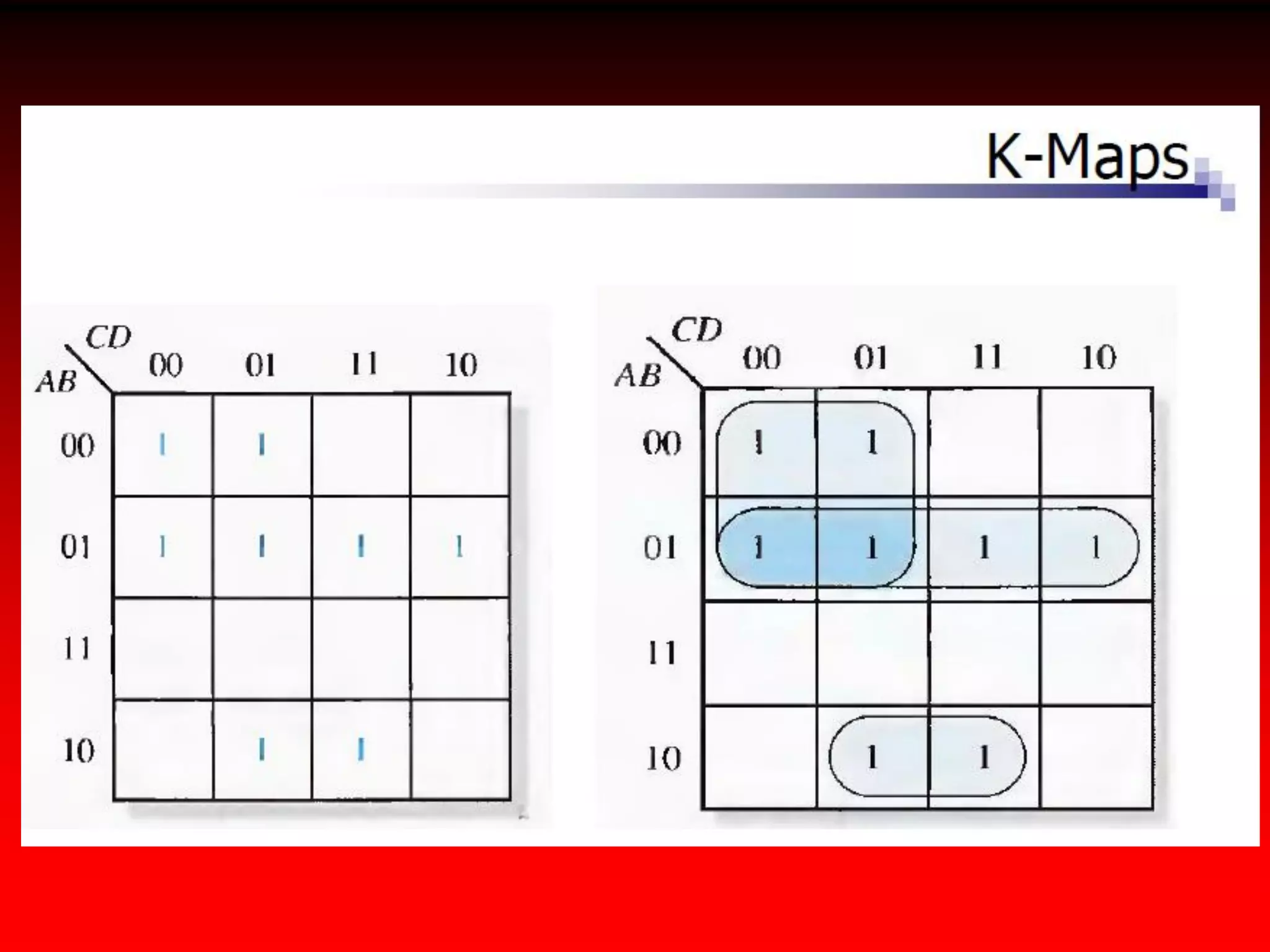
Karnaugh Map
2-variable K-map
3-variable karnaugh map
 The 3-variable karnaugh map is an array
of eight cells.
 In this case A, B and C are used for the
variables although other letters could be
used.
 Binary values of A is along the left side
and the value of B and C is across the top.
The 3-variable Karnaugh map
 The value of a given cell is the binary
values of A at the left in the same row
combined with the value of B and C at
the top in the same column.
 For example: the cell in the upper left
corner has a binary value of 000 and the
cell in the lower right corner has a binary
value of 110.
3-Variable K-map
ABC 0 1
00 0 1
01 2 3
11 6 7
10 4 5
ABC 00 01 11 10
0 0 1 3 2
1 4 5 7 6
The 4-variable karnaugh map
 The 4-variable karnaugh map is an array
of sixteen cells
 Binary values of A and B are along the left
side and the values of C and D are across
the top.
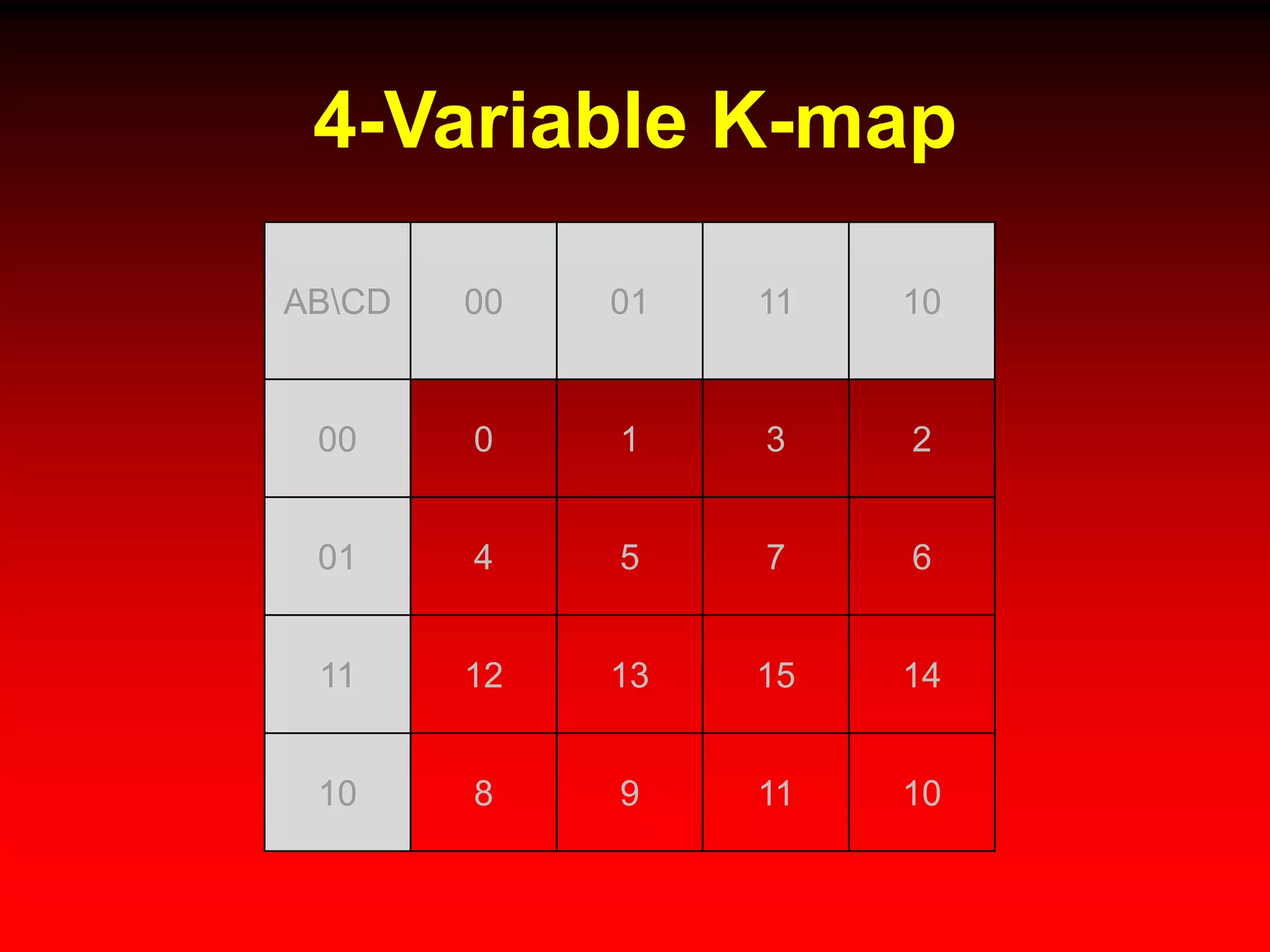
 The value of a given cell is the binary
value of A and B at the left in the same row
combined with the binary values of C and
D at the top of the same column.
4-Variable K-map
ABCD 00 01 11 10
00 0 1 3 2
01 4 5 7 6
11 12 13 15 14
10 8 9 11 10
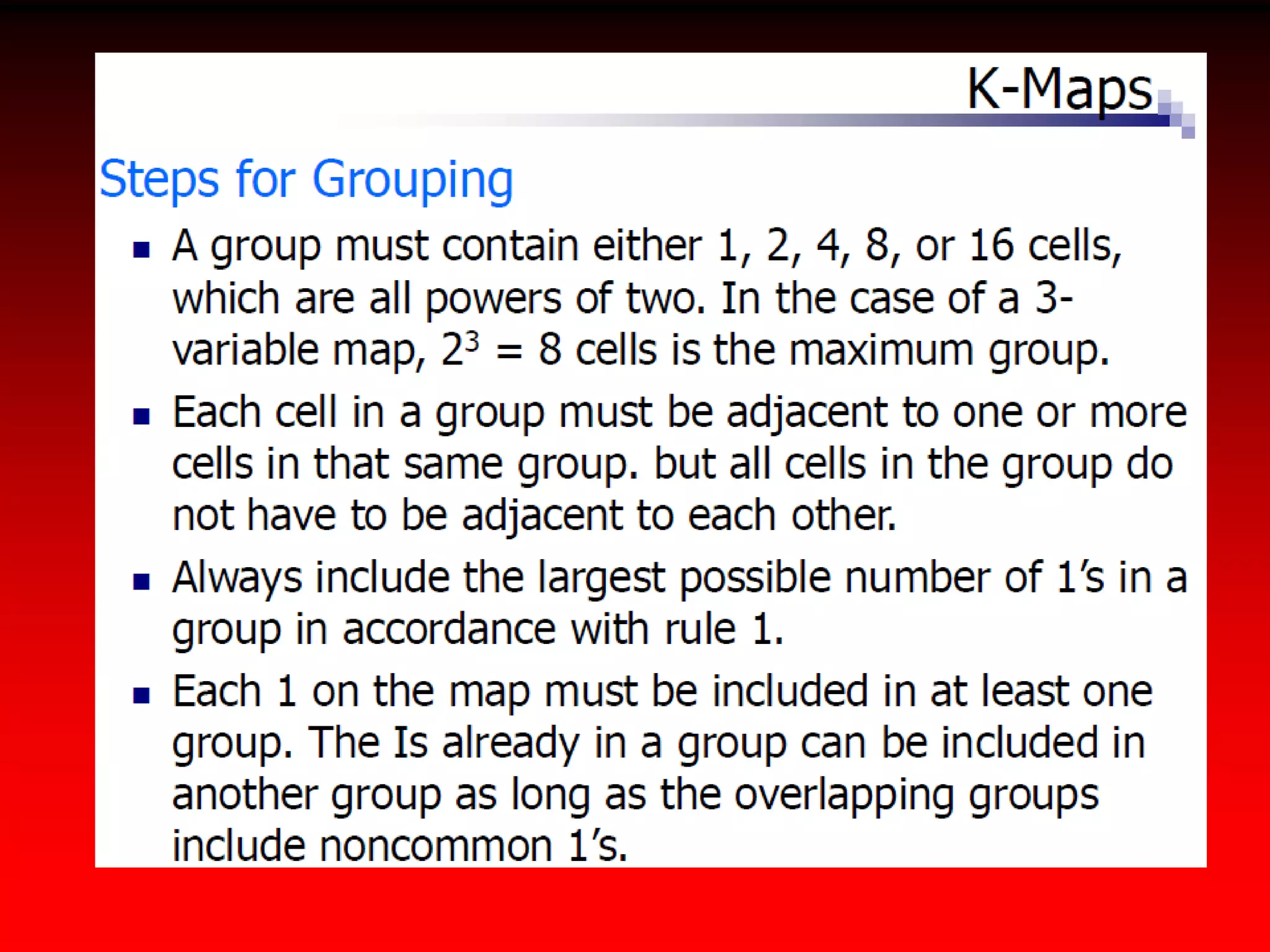
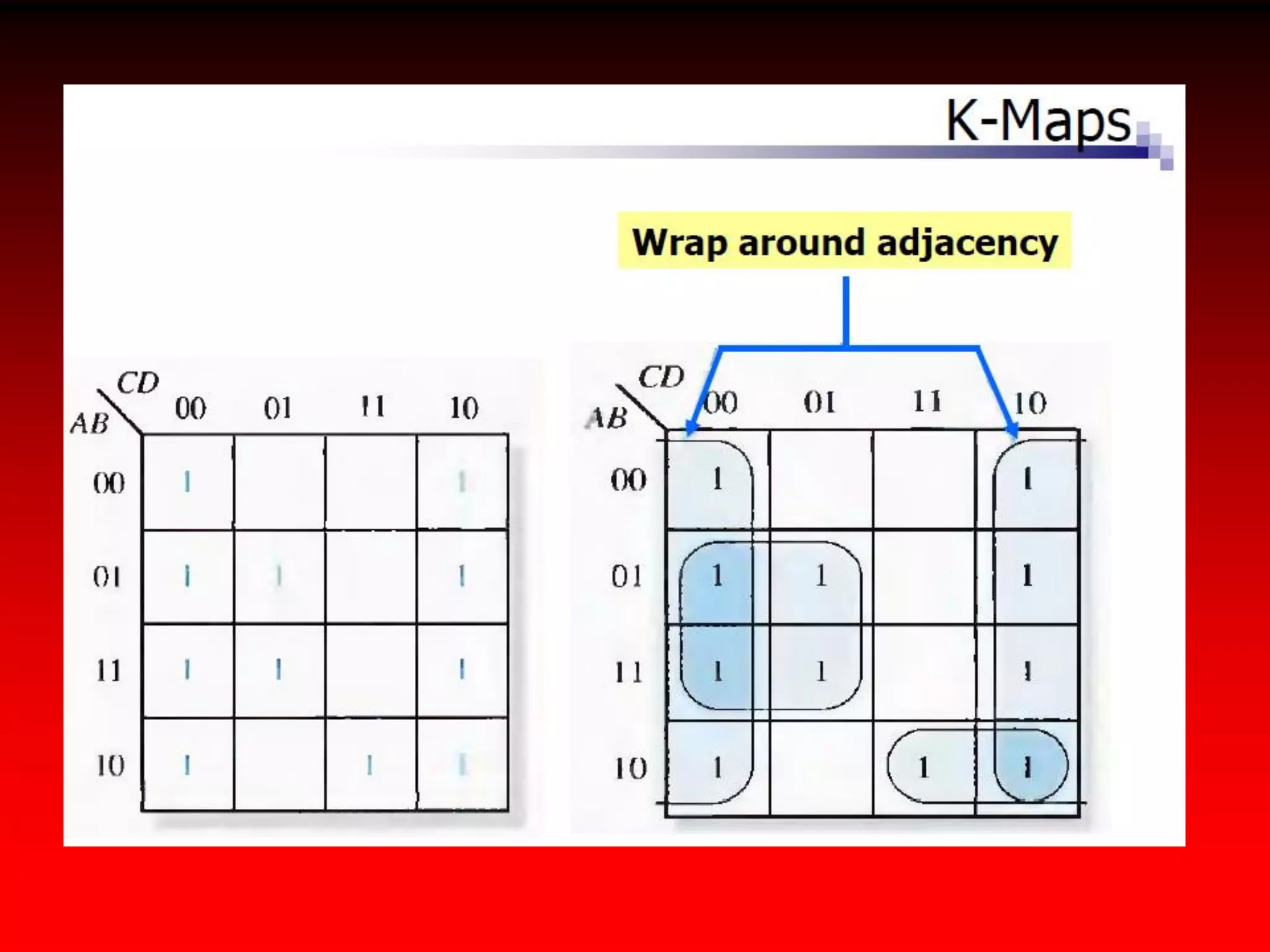
Grouping & Adjacent Cells
 K-map is considered to be wrapped around
 All sides are adjacent to each other
 Adjacent cells which has 1’s in SOP can be grouped
together in 2’s power.
 2 adjacent cells can be grouped (pair)
 4 adjacent cells can be grouped (Quads)
 8 adjacent cells can be grouped (octets)
 Groups can be row, column, square or rectangular.
 Groups of diagonal cells are not allowed
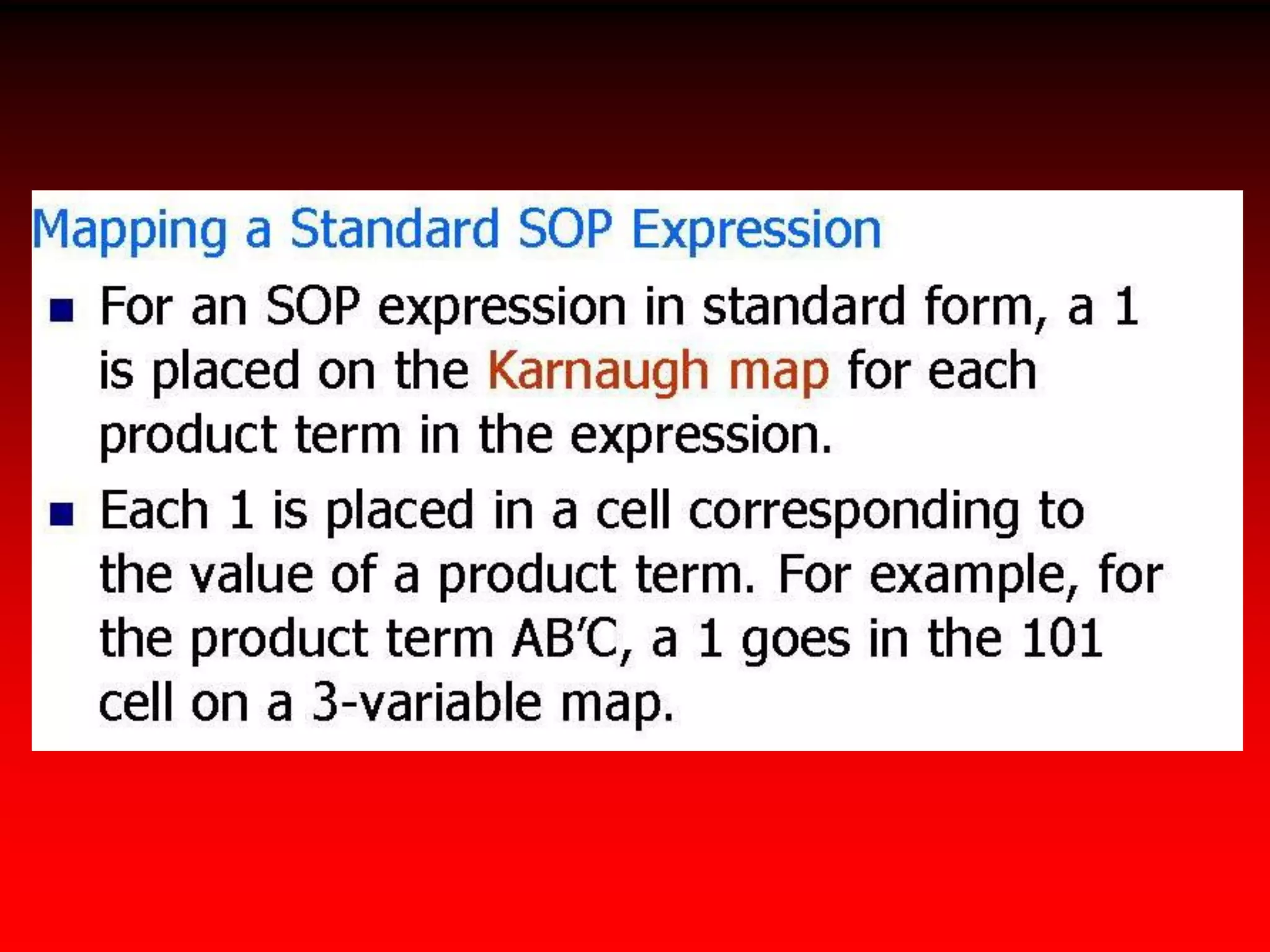
Mapping of Standard SOP
expression
 Selecting n-variable K-map
 1 marked in cell for each minterm
Mapping of Standard SOP
expression
 SOP expression CBACBACAB 
ABC 00 01 11 10
0 0 0 0 1
1 1 0 0 1
Cell Adjacency
 The cells in a karnaugh map are arranged
so that there is only a single-variable
change between adjacent cells.
 Adjacency is defined by a single variable
change.
 Cells with values that differ by more than
one variable are not adjacent.
Cell Adjacency
Continued ( simplification
through K maps)
 Karnaugh map is used for simplifying
Boolean expressions to their minimum
form.
 A minimized SOP expression contains the
fewest possible terms with the fewest
possible variables per term.
 Generally a minimum SOP expression can
be implemented with fewer logic gates
than a standard expression.
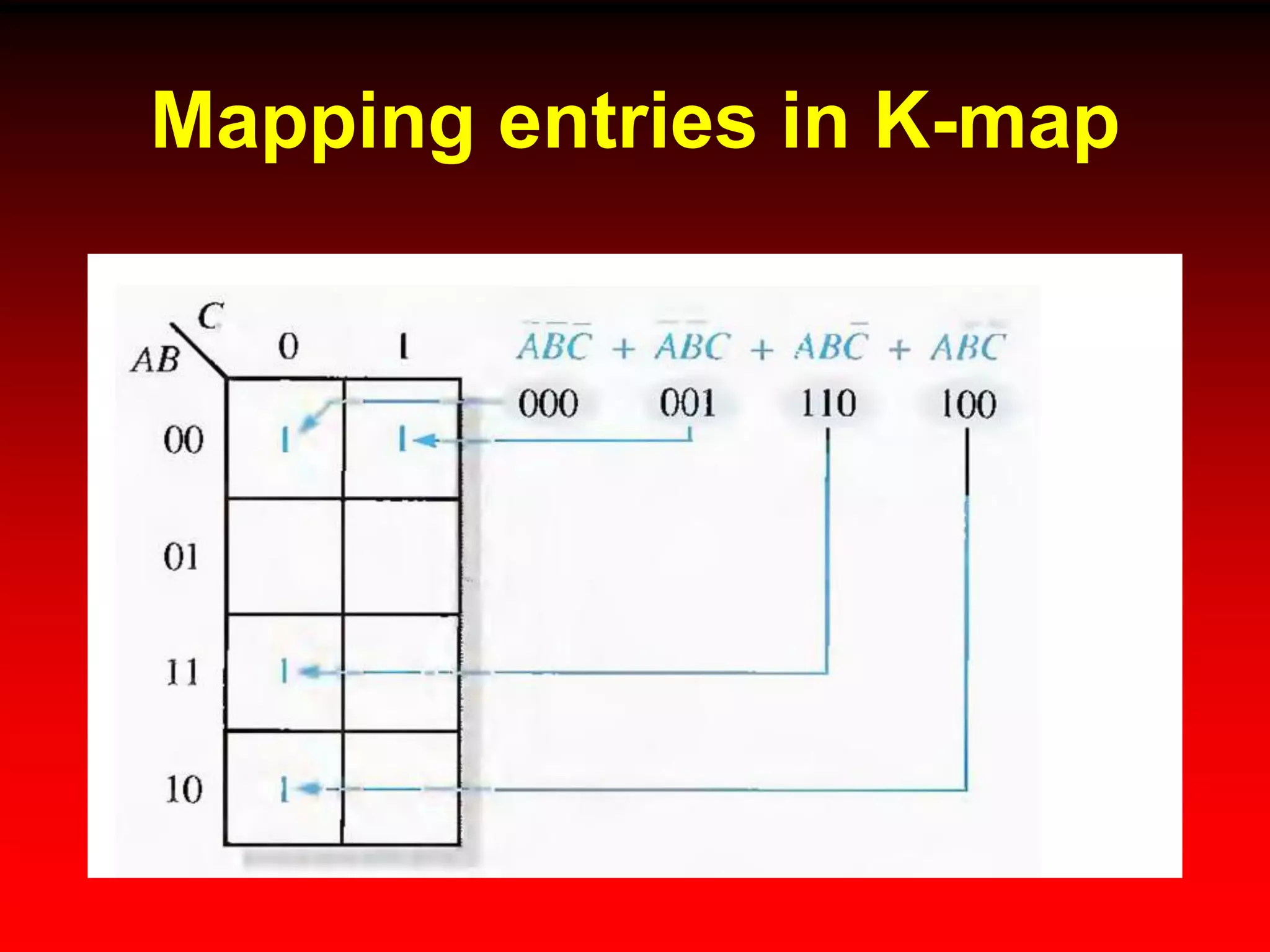
Mapping SOP expression
Mapping entries in K-map
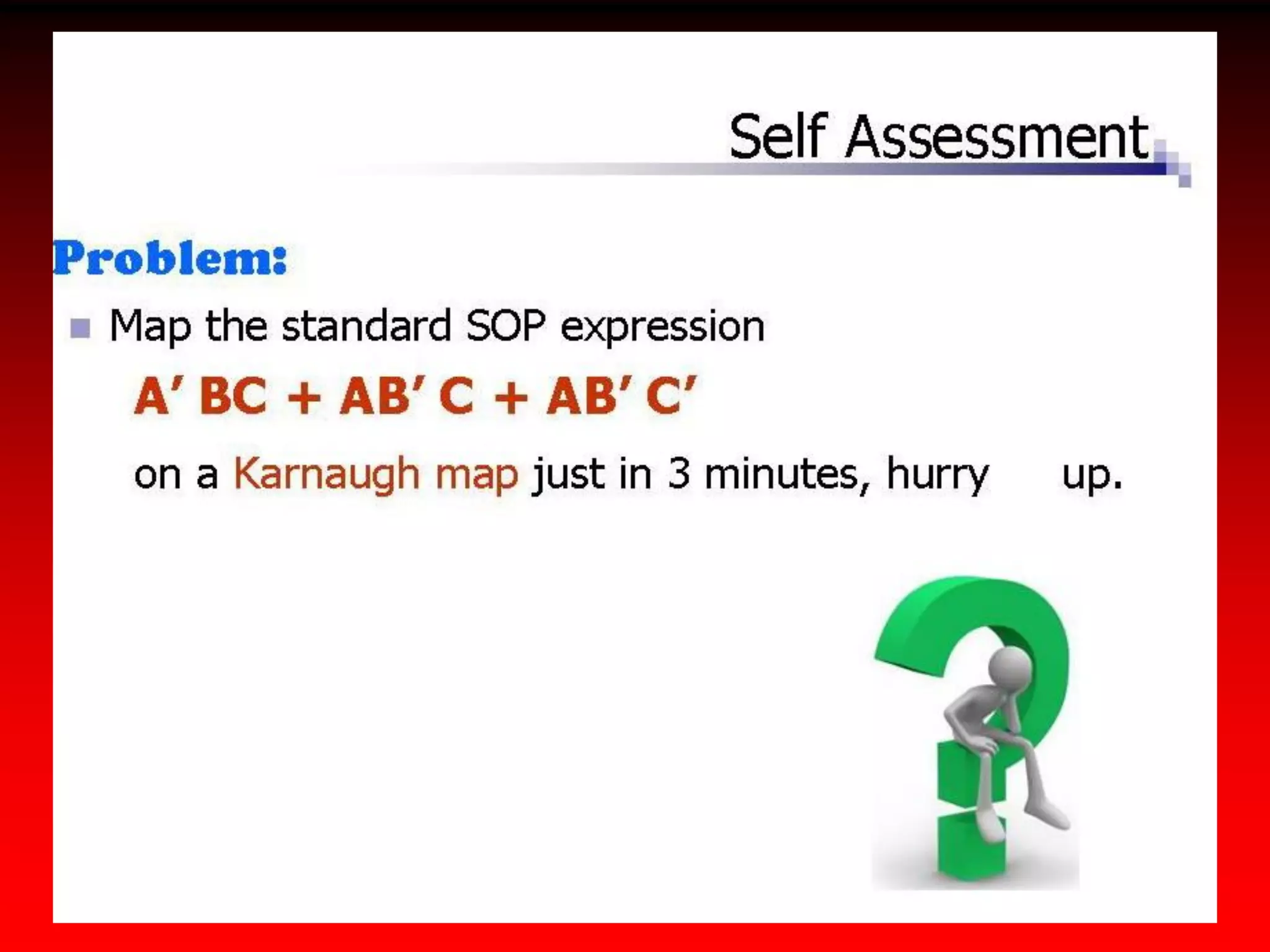
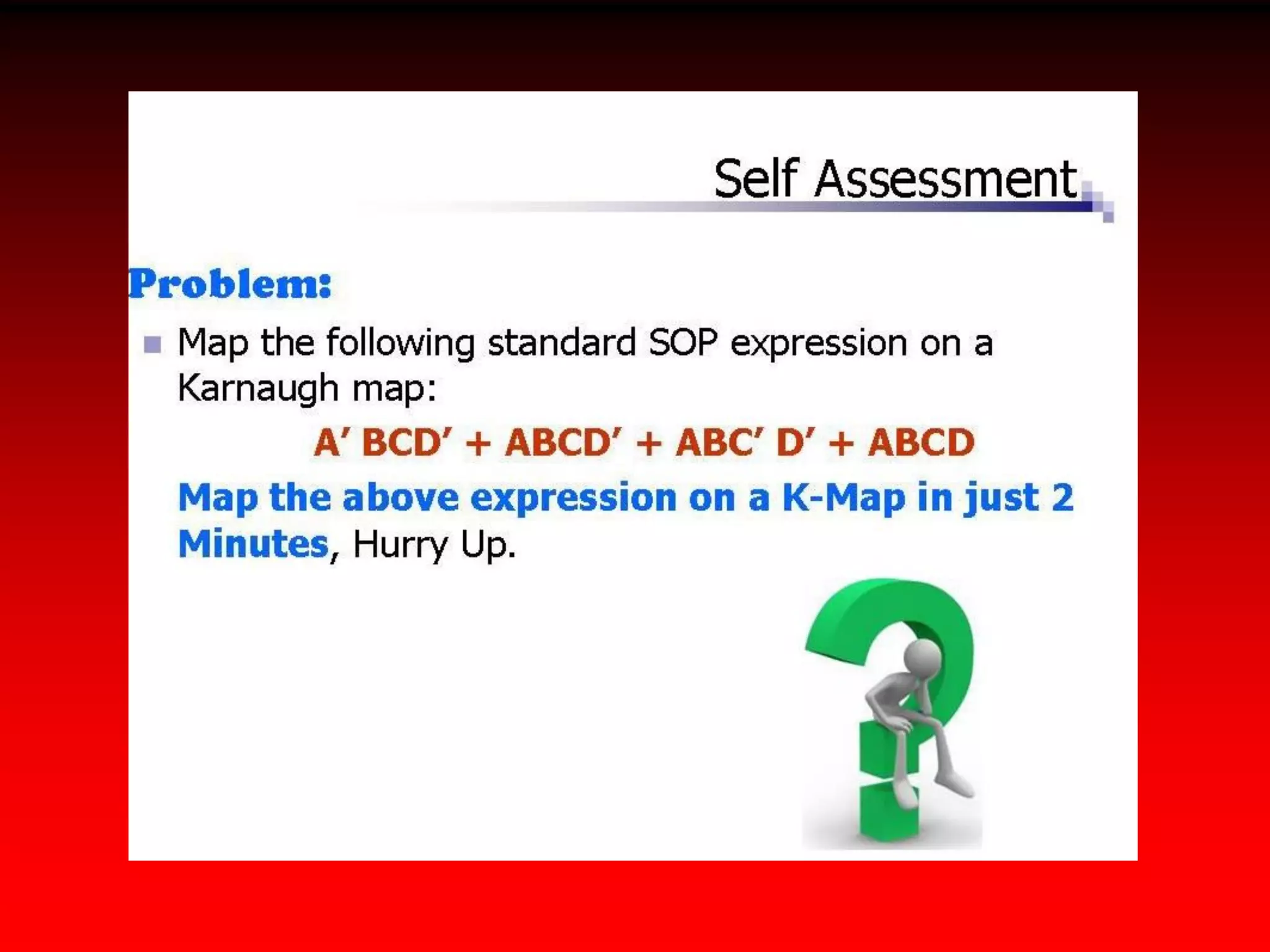
Class activity
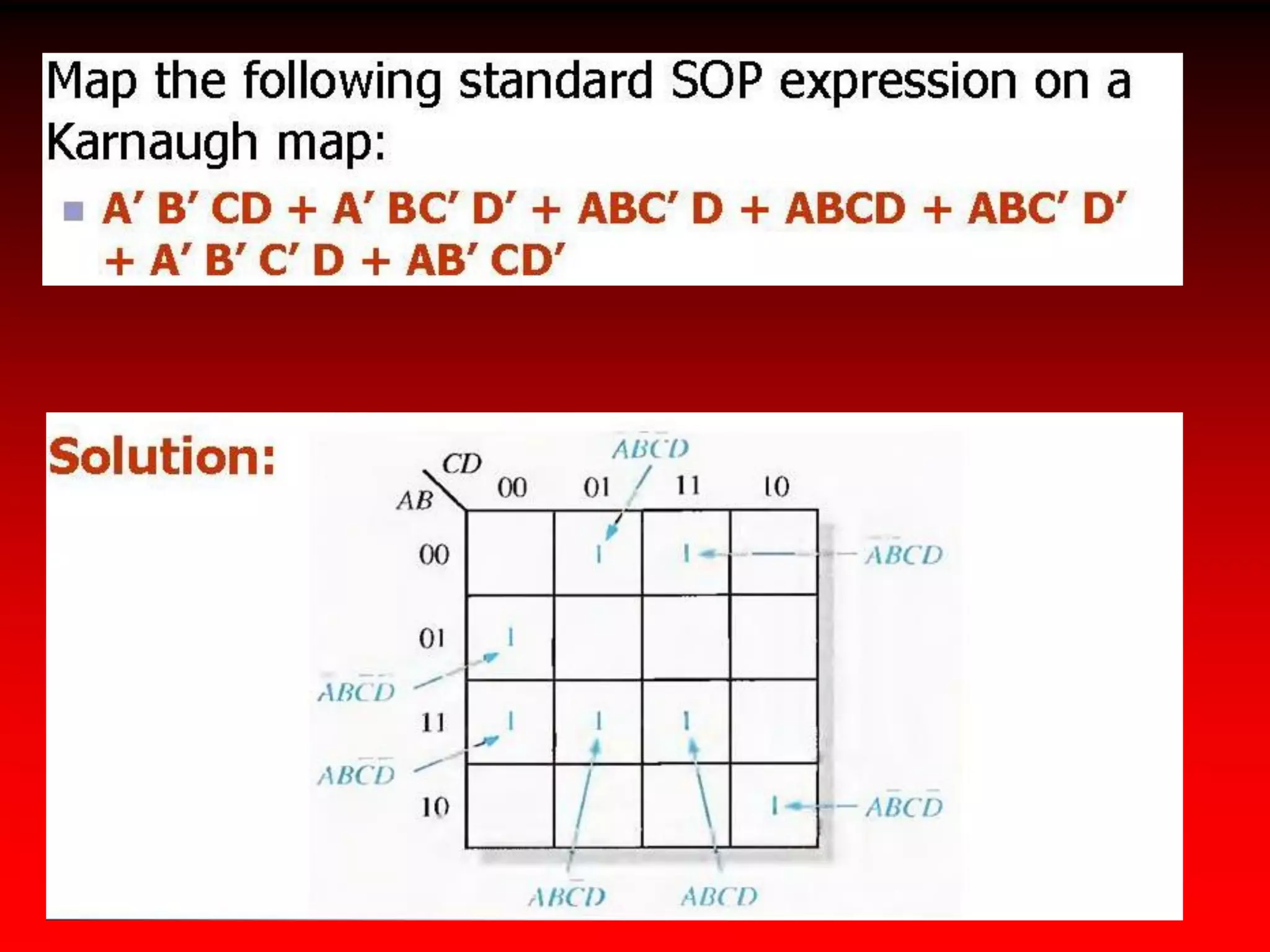
Solution
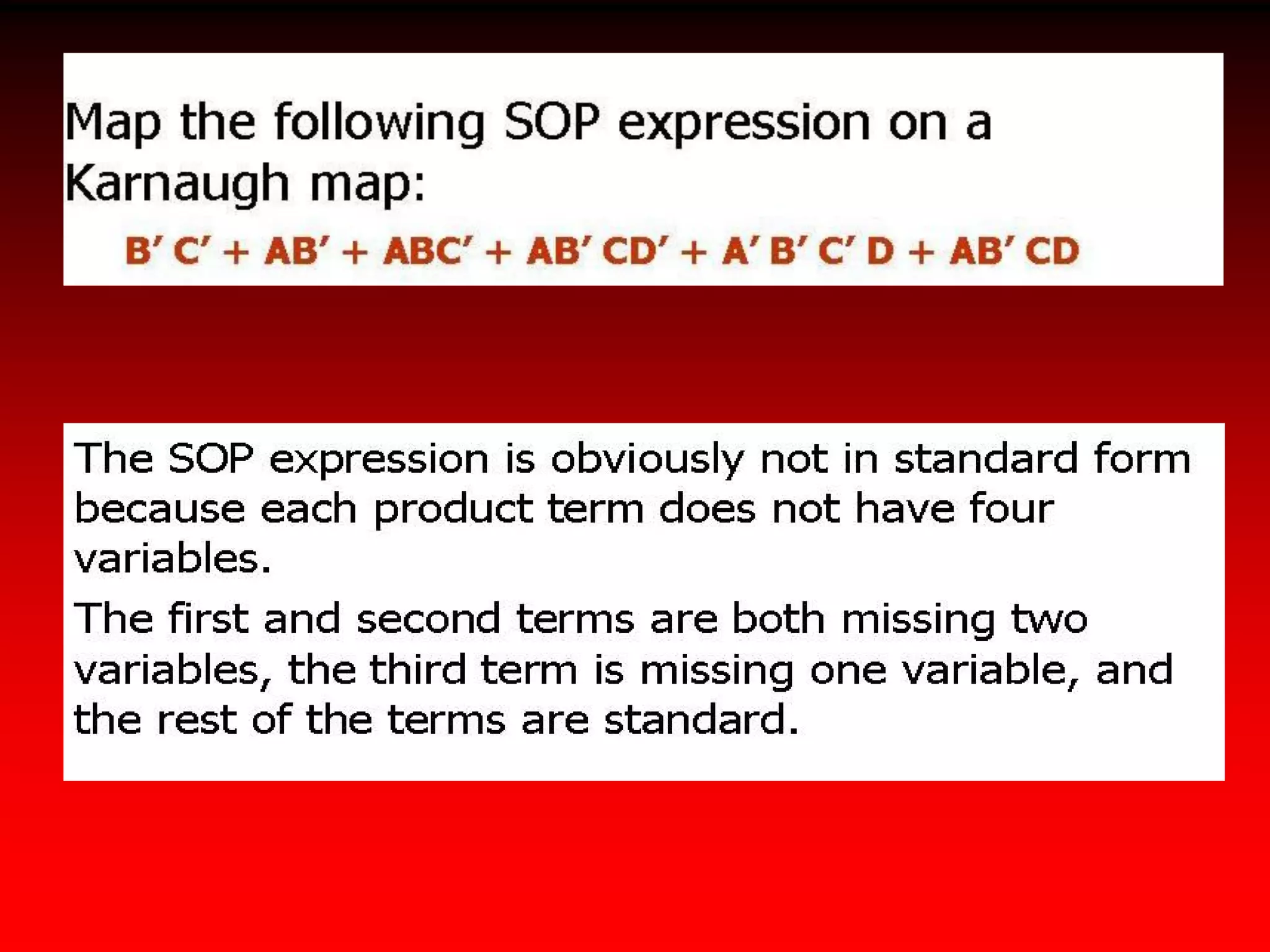
Mapping a non standard SOP
expression
Mapping a non standard SOP
expression
Numerical expansion of the given
expression can be done as follows
Mapping non standard SOP into K-map
Continued…
Continued…
0 1
00
01
11
10
AB
C
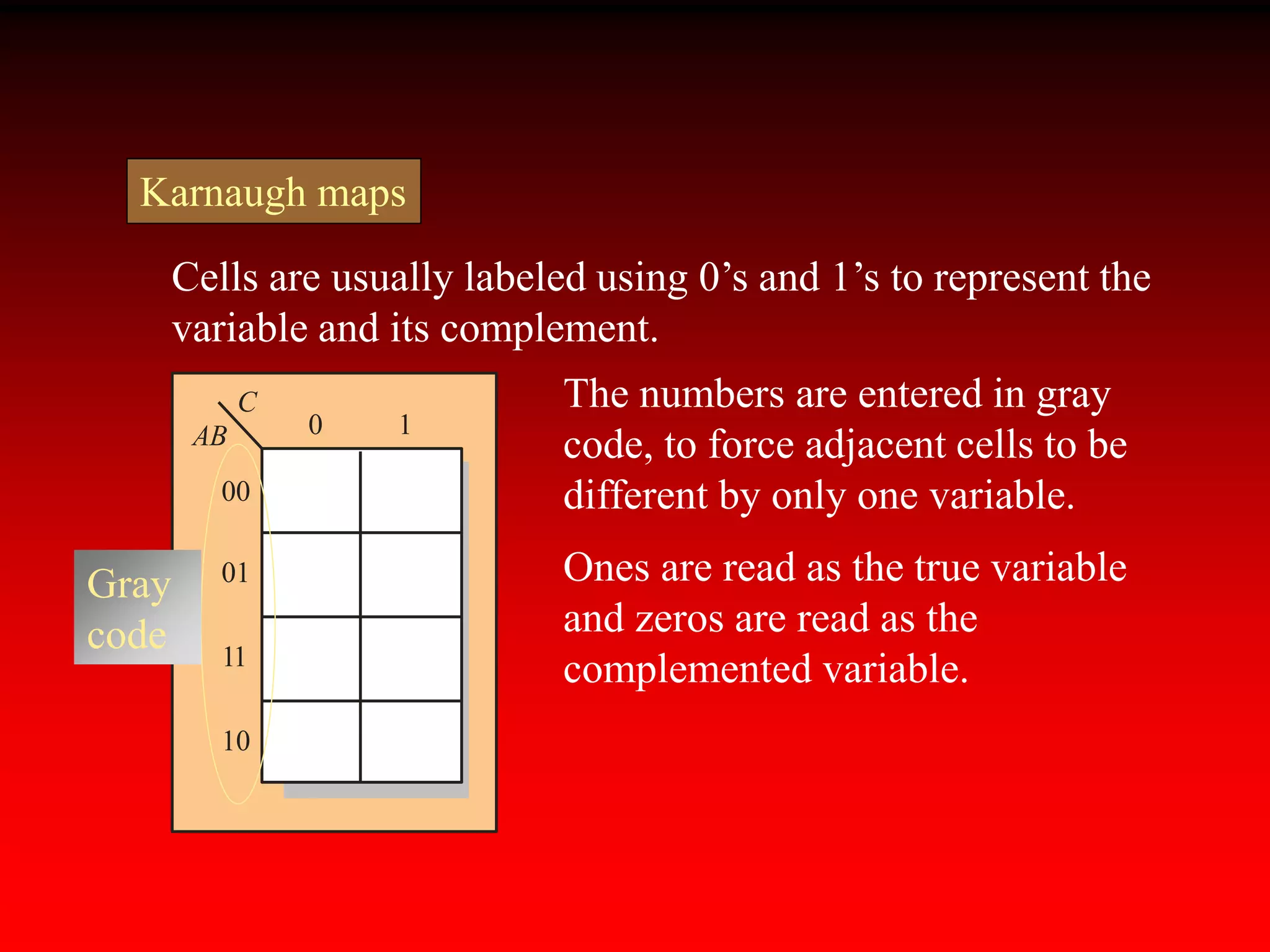
Cells are usually labeled using 0’s and 1’s to represent the
variable and its complement.
Gray
code
Karnaugh maps
Ones are read as the true variable
and zeros are read as the
complemented variable.
The numbers are entered in gray
code, to force adjacent cells to be
different by only one variable.
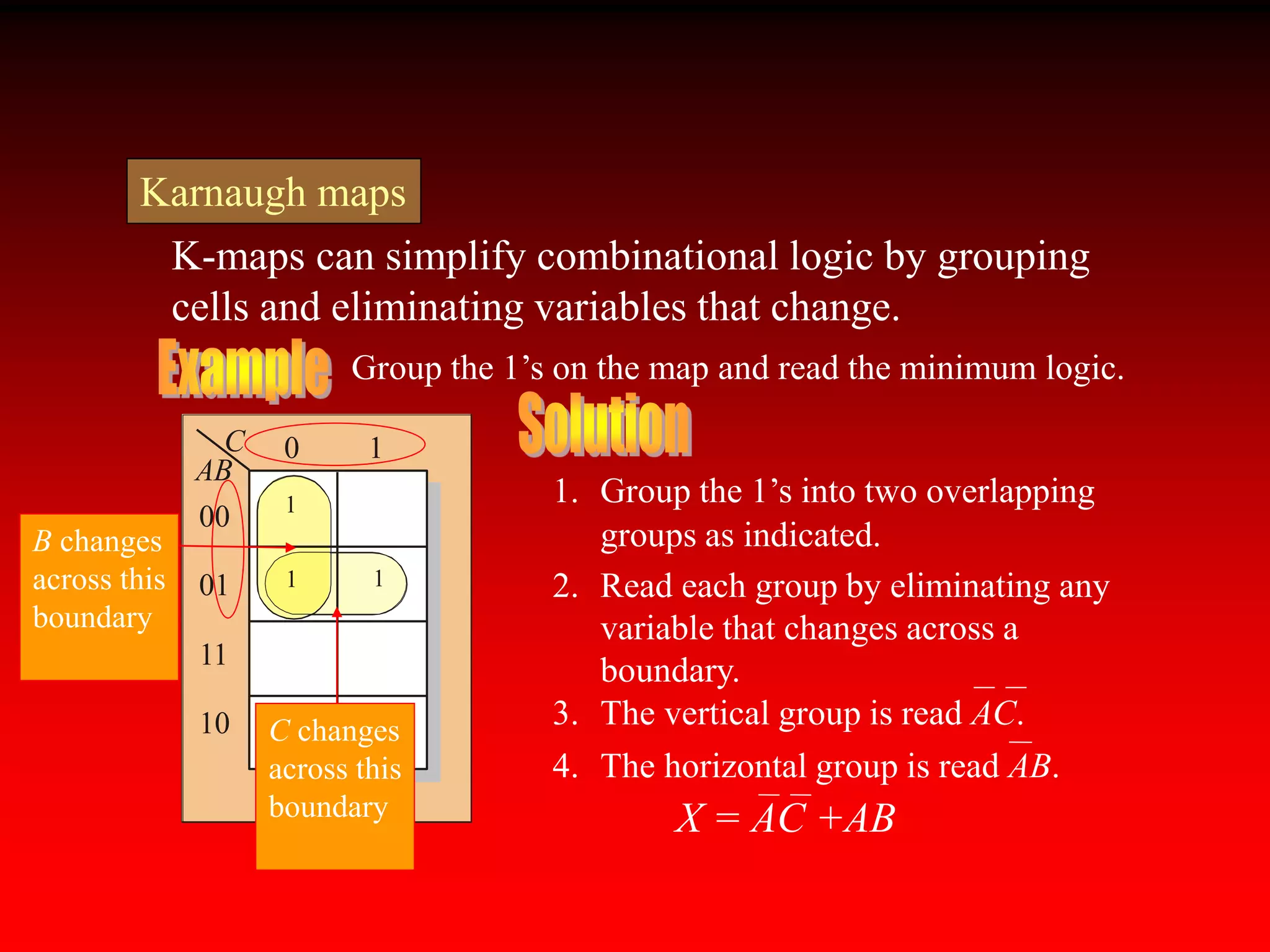
1. Group the 1’s into two overlapping
groups as indicated.
2. Read each group by eliminating any
variable that changes across a
boundary.
3. The vertical group is read AC.
K-maps can simplify combinational logic by grouping
cells and eliminating variables that change.
Karnaugh maps
1
1 1
AB
C
00
01
11
10
0 1
1
1 1
AB
C
00
01
11
10
0 1
Group the 1’s on the map and read the minimum logic.
B changes
across this
boundary
C changes
across this
boundary
4. The horizontal group is read AB.
X = AC +AB
X
Karnaugh maps
Group the 1’s on the map and read the minimum logic.
1. Group the 1’s into two separate
groups as indicated.
2. Read each group by eliminating
any variable that changes across a
boundary.
3. The upper (yellow) group is read as
AD.
4. The lower (green) group is read as
AD.
AB
CD
00
01
11
10
00 01 11 10
1 1
1 1
1
1
1
1
AB
CD
00
01
11
10
00 01 11 10
1 1
1 1
1
1
1
1
X = AD +AD
B changes
C changes
B changes
C changes across
outer boundary
Related Example
 Minimize the following SOP expression,
 F(x, y, z) = Σ(0,2,6,7)
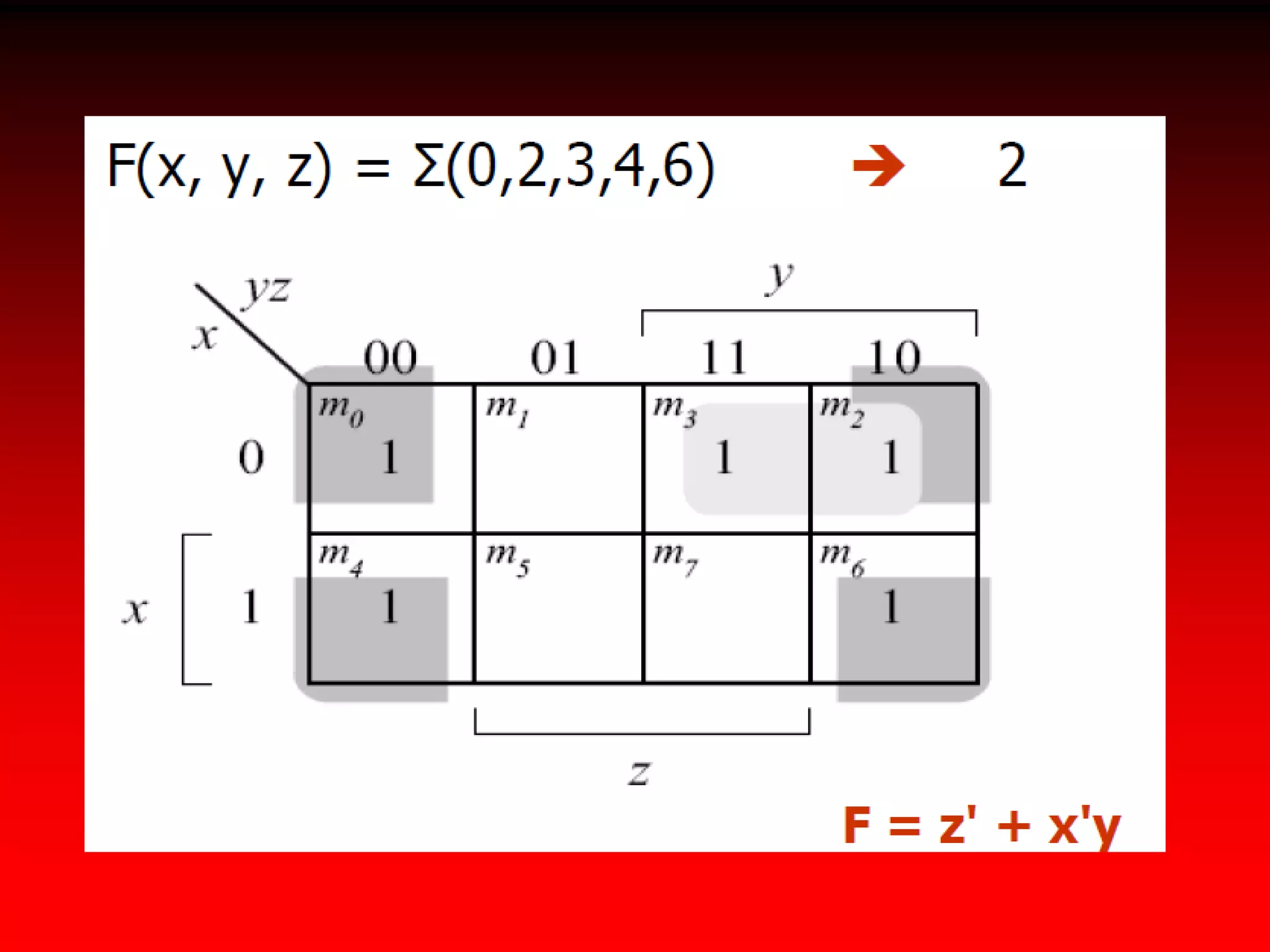
 F(x, y, z) = Σ(0,2,3,4,6)
 F(x, y, z) = Σ(0,1,2,3,7)
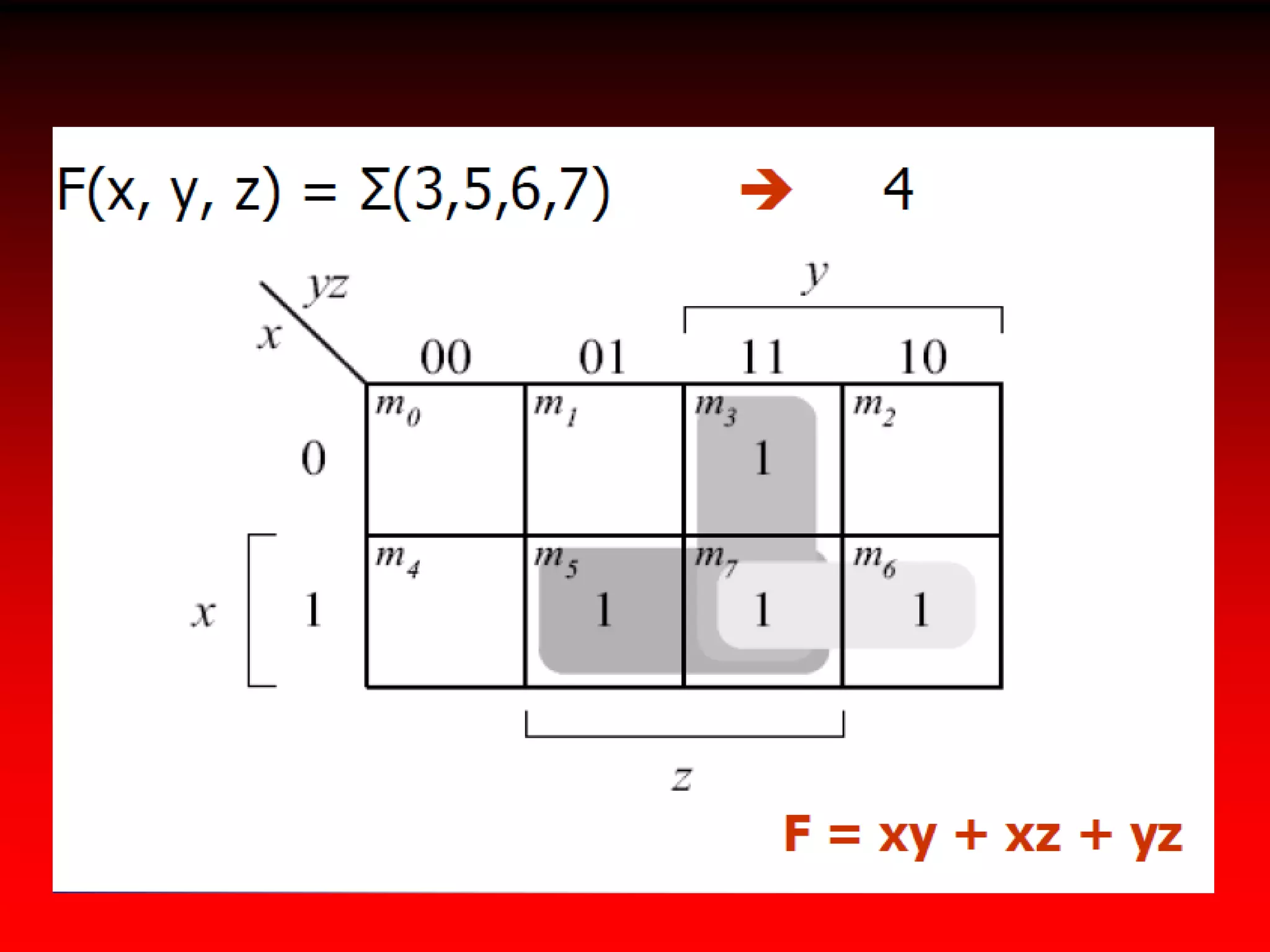
 F(x, y, z) = Σ(3,5,6,7)
 F(x, y, z) = Σ(0,1,5,7)
 F(x, y, z) = Σ(0,1,6,7)
 F(x, y, z) = Σ(1,2,3,6,7)
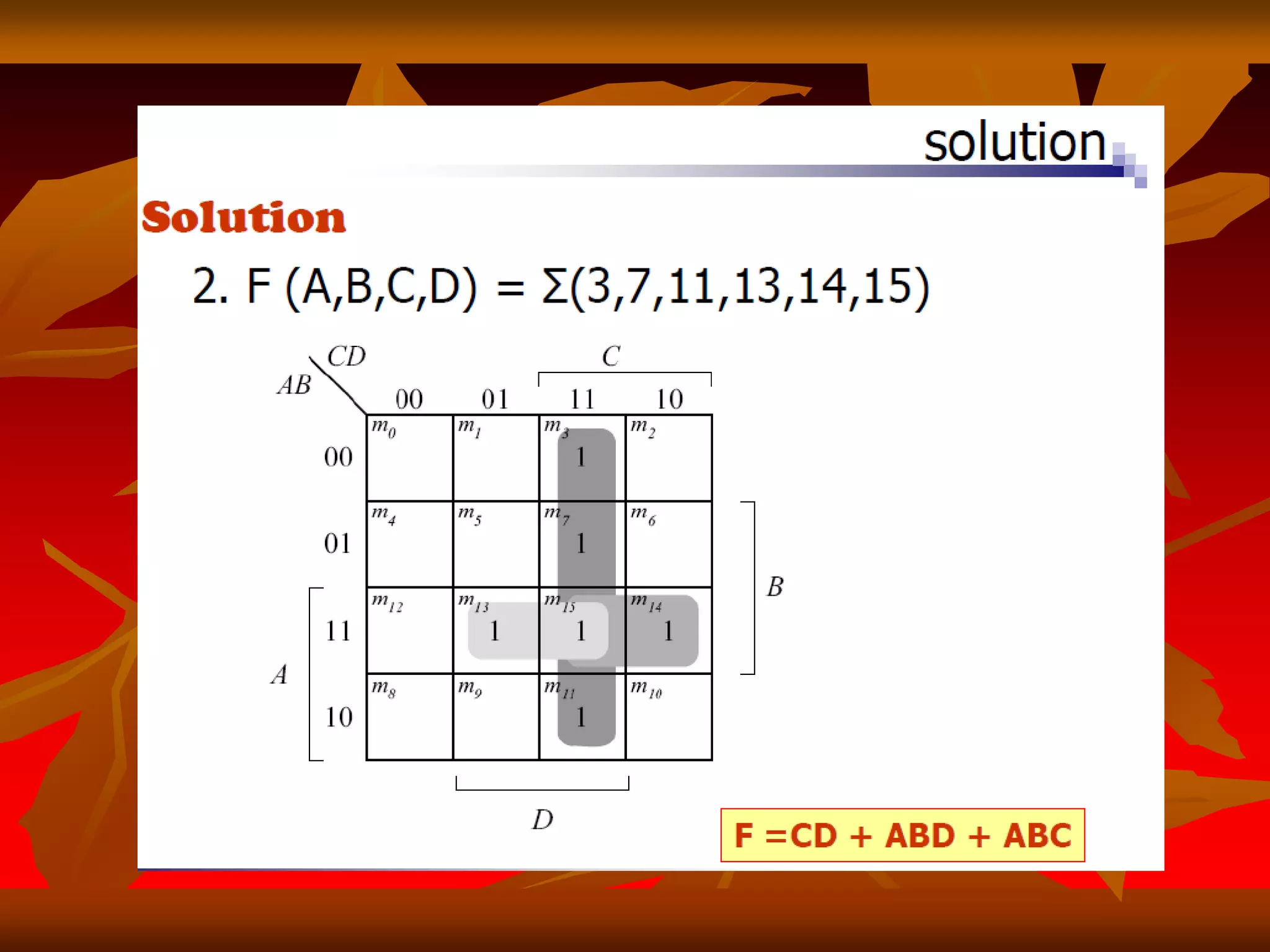
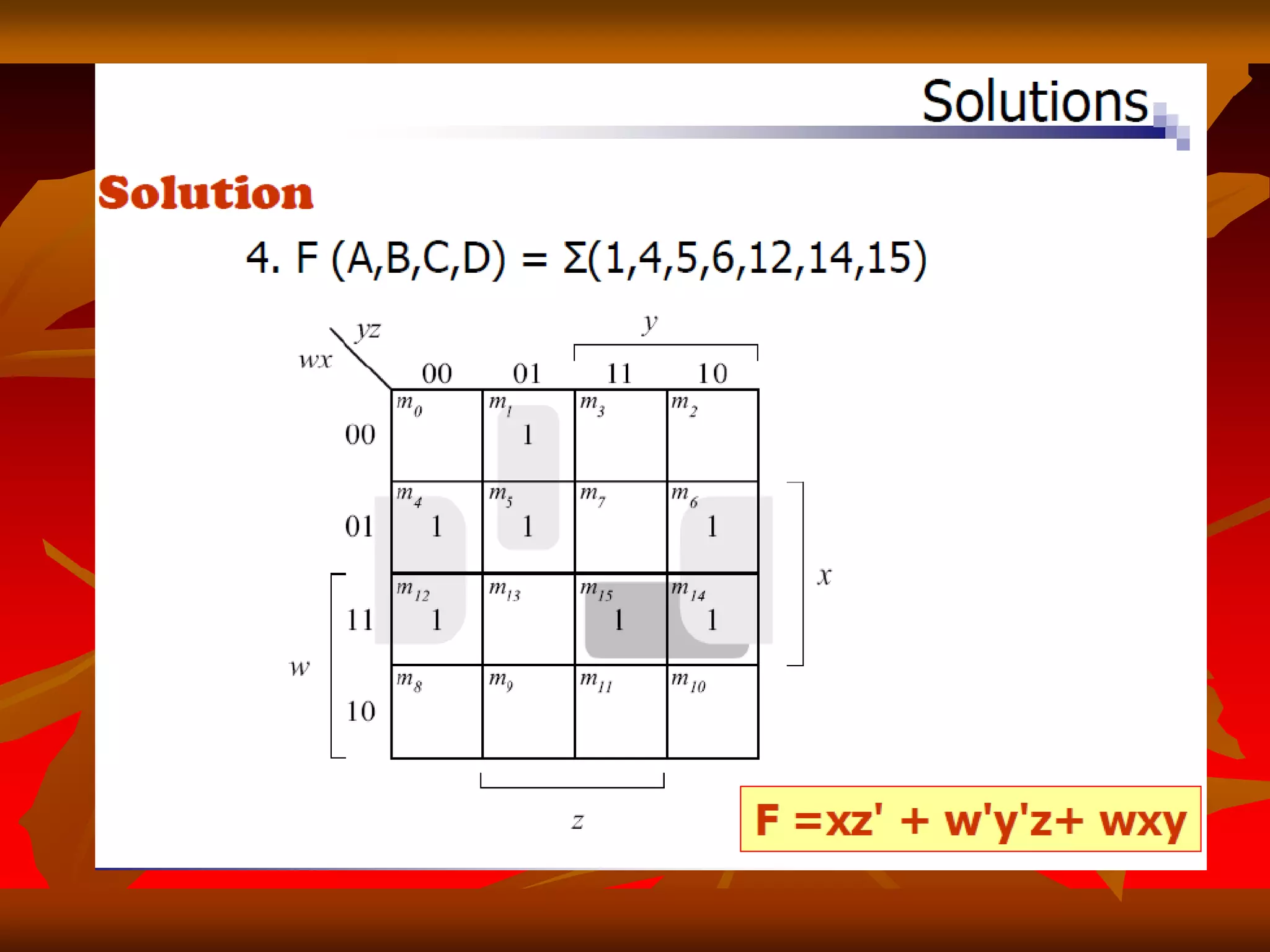
SOLUTION(1-7)
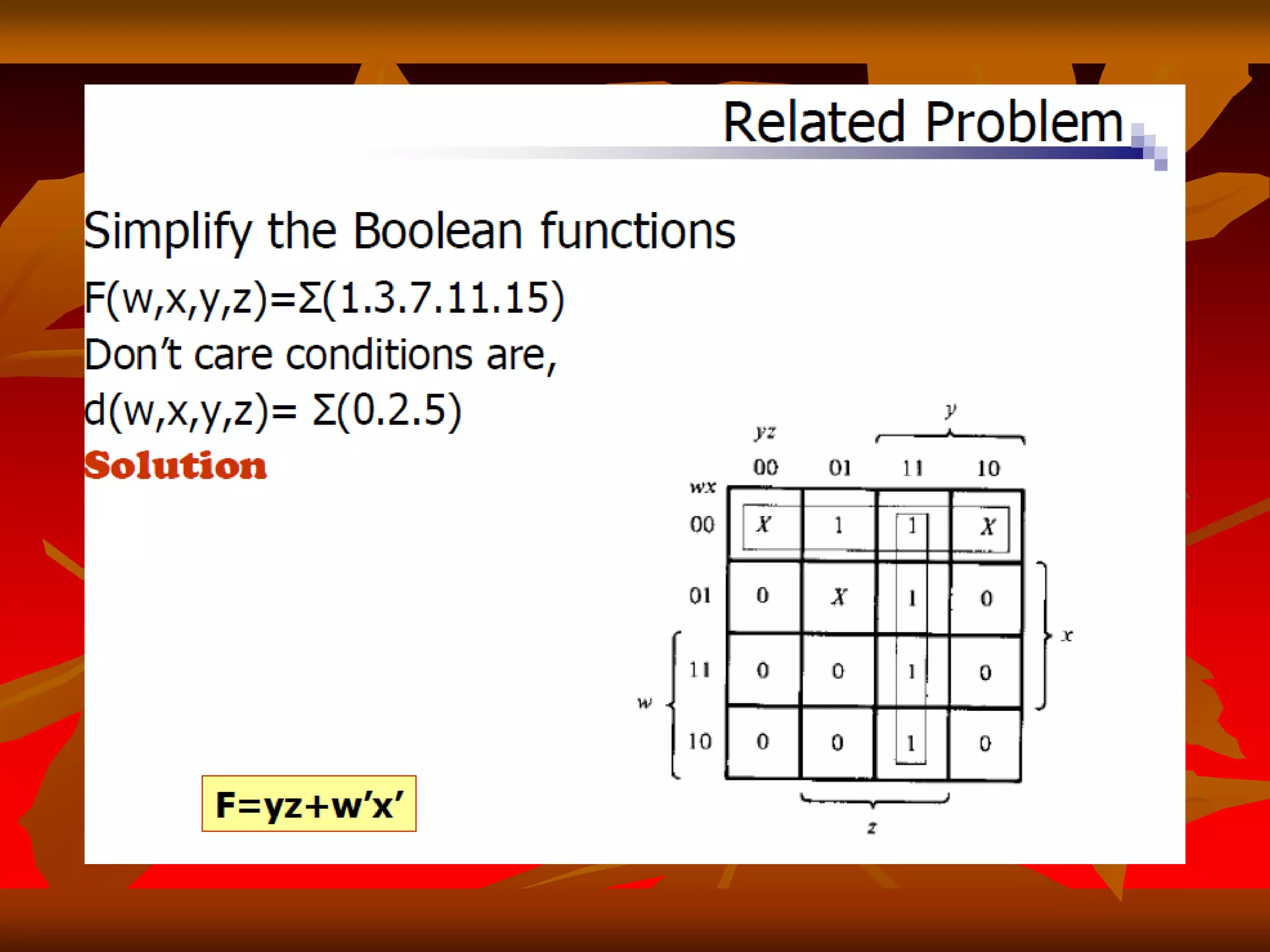
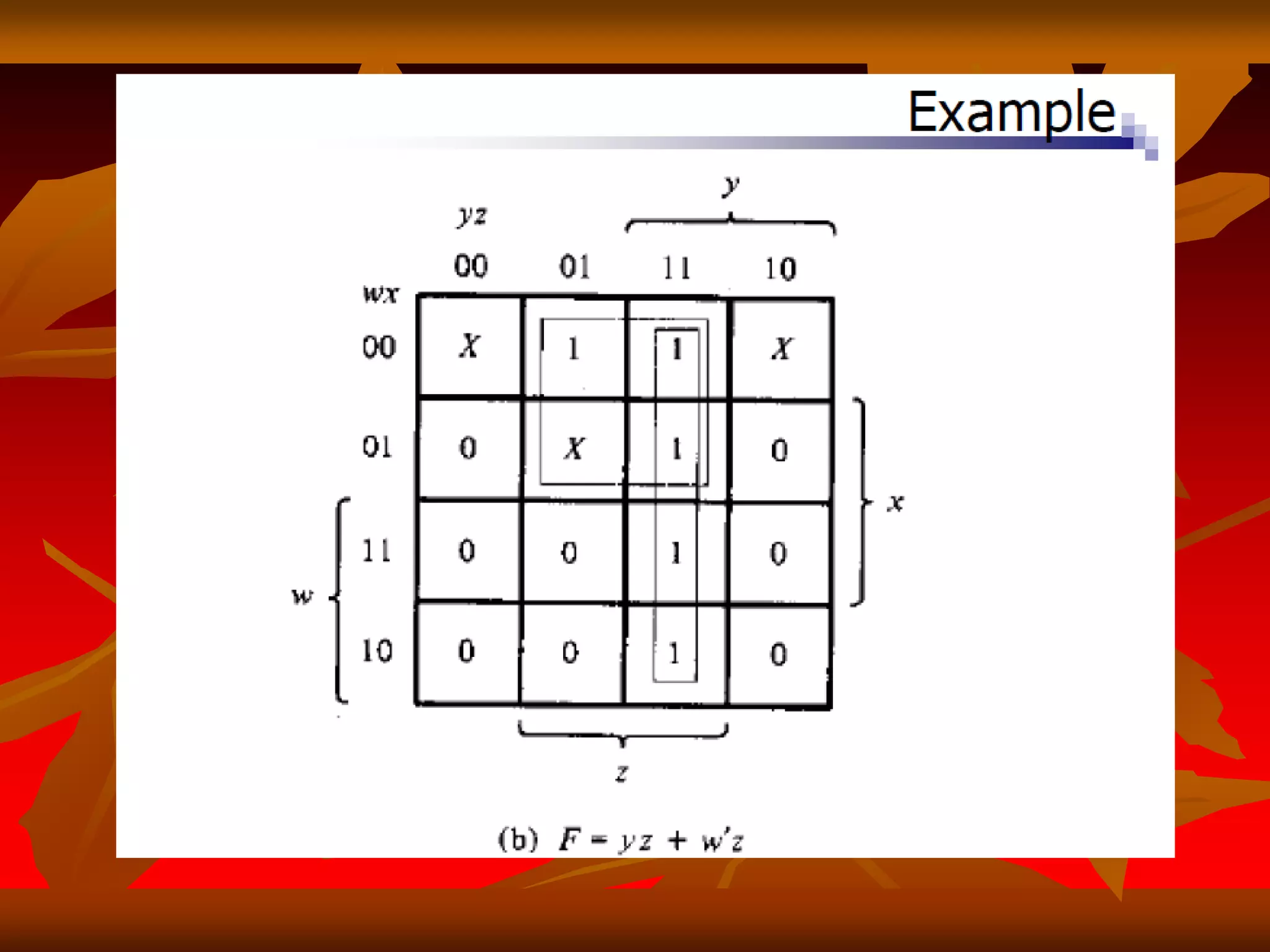
Don’t care conditions
END OF LECTURE

Kmap..(karnaugh map)

  • 1.
    Digital Logic andDesign Karnaugh Map
  • 2.
    Recap: Boolean Algebra Simplification of Boolean expressions are done through Boolean algebra.  The method wasn’t effective.  Solving a problem through Boolean algebra was a bit tricky  Need skill of applying rules and law.  Doesn’t guarantee simplest form of expression
  • 3.
    Karnaugh Map  K-mapprovides a systematic method  For simplifying Boolean expressions and minimizing expressions.  If properly used, will produce the simplest SOP and POS.  Similar to truth table, presents all possible values of input variables and resulting output for each value.
  • 4.
    Karnaugh Map  Karnaughmap is an array of cells in which each cell represents a binary value of input variables.  The cells are managed in a way so that simplification of a given expression is simply a matter of properly grouping the cells.  Karnaugh maps can be used for expression with two, three, four and five variables, but we will discuss only 3- variable and 4-varable situations to illustrate the principles.
  • 5.
  • 6.
  • 7.
    3-variable karnaugh map The 3-variable karnaugh map is an array of eight cells.  In this case A, B and C are used for the variables although other letters could be used.  Binary values of A is along the left side and the value of B and C is across the top.
  • 8.
    The 3-variable Karnaughmap  The value of a given cell is the binary values of A at the left in the same row combined with the value of B and C at the top in the same column.  For example: the cell in the upper left corner has a binary value of 000 and the cell in the lower right corner has a binary value of 110.
  • 9.
    3-Variable K-map ABC 01 00 0 1 01 2 3 11 6 7 10 4 5 ABC 00 01 11 10 0 0 1 3 2 1 4 5 7 6
  • 10.
    The 4-variable karnaughmap  The 4-variable karnaugh map is an array of sixteen cells  Binary values of A and B are along the left side and the values of C and D are across the top.  The value of a given cell is the binary value of A and B at the left in the same row combined with the binary values of C and D at the top of the same column.
  • 11.
    4-Variable K-map ABCD 0001 11 10 00 0 1 3 2 01 4 5 7 6 11 12 13 15 14 10 8 9 11 10
  • 12.
    Grouping & AdjacentCells  K-map is considered to be wrapped around  All sides are adjacent to each other  Adjacent cells which has 1’s in SOP can be grouped together in 2’s power.  2 adjacent cells can be grouped (pair)  4 adjacent cells can be grouped (Quads)  8 adjacent cells can be grouped (octets)  Groups can be row, column, square or rectangular.  Groups of diagonal cells are not allowed
  • 13.
    Mapping of StandardSOP expression  Selecting n-variable K-map  1 marked in cell for each minterm
  • 14.
    Mapping of StandardSOP expression  SOP expression CBACBACAB  ABC 00 01 11 10 0 0 0 0 1 1 1 0 0 1
  • 15.
    Cell Adjacency  Thecells in a karnaugh map are arranged so that there is only a single-variable change between adjacent cells.  Adjacency is defined by a single variable change.  Cells with values that differ by more than one variable are not adjacent.
  • 16.
  • 17.
    Continued ( simplification throughK maps)  Karnaugh map is used for simplifying Boolean expressions to their minimum form.  A minimized SOP expression contains the fewest possible terms with the fewest possible variables per term.  Generally a minimum SOP expression can be implemented with fewer logic gates than a standard expression.
  • 19.
  • 21.
  • 22.
  • 23.
  • 27.
    Mapping a nonstandard SOP expression
  • 29.
    Mapping a nonstandard SOP expression
  • 30.
    Numerical expansion ofthe given expression can be done as follows
  • 31.
    Mapping non standardSOP into K-map
  • 33.
  • 34.
  • 41.
    0 1 00 01 11 10 AB C Cells areusually labeled using 0’s and 1’s to represent the variable and its complement. Gray code Karnaugh maps Ones are read as the true variable and zeros are read as the complemented variable. The numbers are entered in gray code, to force adjacent cells to be different by only one variable.
  • 43.
    1. Group the1’s into two overlapping groups as indicated. 2. Read each group by eliminating any variable that changes across a boundary. 3. The vertical group is read AC. K-maps can simplify combinational logic by grouping cells and eliminating variables that change. Karnaugh maps 1 1 1 AB C 00 01 11 10 0 1 1 1 1 AB C 00 01 11 10 0 1 Group the 1’s on the map and read the minimum logic. B changes across this boundary C changes across this boundary 4. The horizontal group is read AB. X = AC +AB
  • 44.
    X Karnaugh maps Group the1’s on the map and read the minimum logic. 1. Group the 1’s into two separate groups as indicated. 2. Read each group by eliminating any variable that changes across a boundary. 3. The upper (yellow) group is read as AD. 4. The lower (green) group is read as AD. AB CD 00 01 11 10 00 01 11 10 1 1 1 1 1 1 1 1 AB CD 00 01 11 10 00 01 11 10 1 1 1 1 1 1 1 1 X = AD +AD B changes C changes B changes C changes across outer boundary
  • 45.
    Related Example  Minimizethe following SOP expression,  F(x, y, z) = Σ(0,2,6,7)  F(x, y, z) = Σ(0,2,3,4,6)  F(x, y, z) = Σ(0,1,2,3,7)  F(x, y, z) = Σ(3,5,6,7)  F(x, y, z) = Σ(0,1,5,7)  F(x, y, z) = Σ(0,1,6,7)  F(x, y, z) = Σ(1,2,3,6,7)
  • 46.
  • 63.
  • 68.