Dr.M.Pyingkodi
AP/MCA
Kongu Engineering College
Erode, Tamilnadu
Signed Binary Numbers
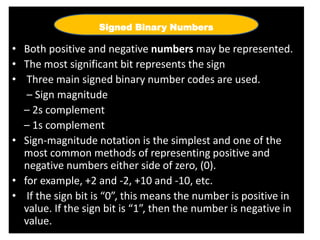
• Both positive and negative numbers may be represented.
• The most significant bit represents the sign
• Three main signed binary number codes are used.
– Sign magnitude
– 2s complement
– 1s complement
• Sign-magnitude notation is the simplest and one of the
most common methods of representing positive and
negative numbers either side of zero, (0).
• for example, +2 and -2, +10 and -10, etc.
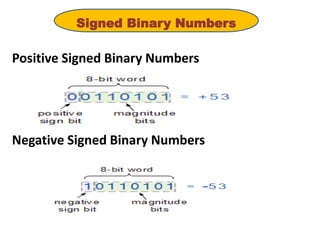
• If the sign bit is “0”, this means the number is positive in
value. If the sign bit is “1”, then the number is negative in
value.
Signed Binary Numbers
Positive Signed Binary Numbers
Negative Signed Binary Numbers
Signed Binary Numbers
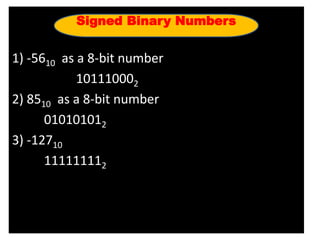
1) -5610 as a 8-bit number
101110002
2) 8510 as a 8-bit number
010101012
3) -12710
111111112
Signed Binary Numbers
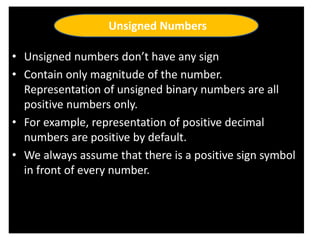
• Unsigned numbers don’t have any sign
• Contain only magnitude of the number.
Representation of unsigned binary numbers are all
positive numbers only.
• For example, representation of positive decimal
numbers are positive by default.
• We always assume that there is a positive sign symbol
in front of every number.
Unsigned Numbers
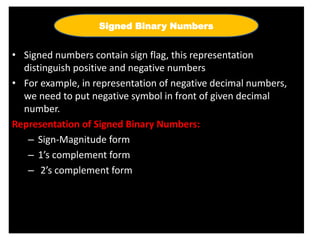
• Signed numbers contain sign flag, this representation
distinguish positive and negative numbers
• For example, in representation of negative decimal numbers,
we need to put negative symbol in front of given decimal
number.
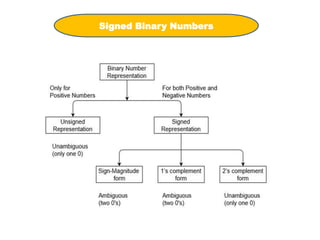
Representation of Signed Binary Numbers:
– Sign-Magnitude form
– 1’s complement form
– 2’s complement form
Signed Binary Numbers
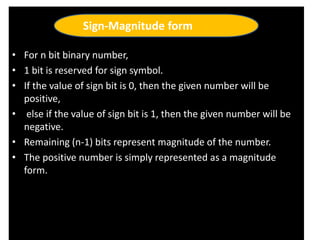
• For n bit binary number,
• 1 bit is reserved for sign symbol.
• If the value of sign bit is 0, then the given number will be
positive,
• else if the value of sign bit is 1, then the given number will be
negative.
• Remaining (n-1) bits represent magnitude of the number.
• The positive number is simply represented as a magnitude
form.
Sign-Magnitude form
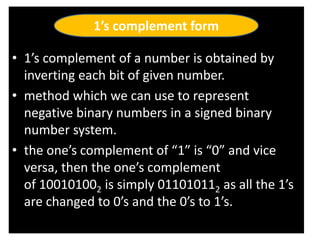
• 1’s complement of a number is obtained by
inverting each bit of given number.
• method which we can use to represent
negative binary numbers in a signed binary
number system.
• the one’s complement of “1” is “0” and vice
versa, then the one’s complement
of 100101002 is simply 011010112 as all the 1’s
are changed to 0’s and the 0’s to 1’s.
1’s complement form
Signed Binary Numbers
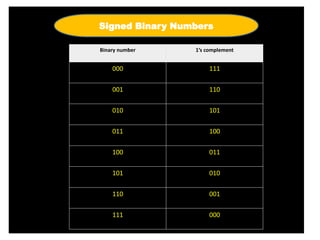
Binary number 1’s complement
000 111
001 110
010 101
011 100
100 011
101 010
110 001
111 000
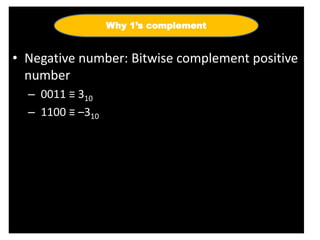
• Negative number: Bitwise complement positive
number
– 0011 ≡ 310
– 1100 ≡ –310
Why 1’s complement
Ones-complement
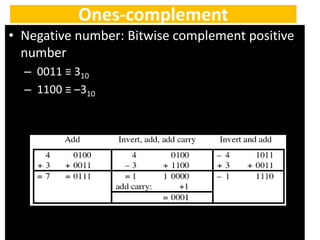
• Negative number: Bitwise complement positive
number
– 0011 ≡ 310
– 1100 ≡ –310
• Solves th arithmetic problem
• Binary subtraction is very much difficult as
compare to addition.
• To do subtraction
• first the binary number subtracted from
another number is represented in 1s
complemented form and then add with the
another number.
Why 1’s complement
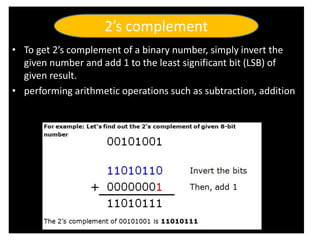
• To get 2’s complement of a binary number, simply invert the
given number and add 1 to the least significant bit (LSB) of
given result.
• performing arithmetic operations such as subtraction, addition
2’s complement
Signed Binary Numbers

Signed Binary Numbers

  • 1.
  • 2.
    • Both positiveand negative numbers may be represented. • The most significant bit represents the sign • Three main signed binary number codes are used. – Sign magnitude – 2s complement – 1s complement • Sign-magnitude notation is the simplest and one of the most common methods of representing positive and negative numbers either side of zero, (0). • for example, +2 and -2, +10 and -10, etc. • If the sign bit is “0”, this means the number is positive in value. If the sign bit is “1”, then the number is negative in value. Signed Binary Numbers
  • 3.
  • 4.
    Positive Signed BinaryNumbers Negative Signed Binary Numbers Signed Binary Numbers
  • 5.
    1) -5610 asa 8-bit number 101110002 2) 8510 as a 8-bit number 010101012 3) -12710 111111112 Signed Binary Numbers
  • 6.
    • Unsigned numbersdon’t have any sign • Contain only magnitude of the number. Representation of unsigned binary numbers are all positive numbers only. • For example, representation of positive decimal numbers are positive by default. • We always assume that there is a positive sign symbol in front of every number. Unsigned Numbers
  • 7.
    • Signed numberscontain sign flag, this representation distinguish positive and negative numbers • For example, in representation of negative decimal numbers, we need to put negative symbol in front of given decimal number. Representation of Signed Binary Numbers: – Sign-Magnitude form – 1’s complement form – 2’s complement form Signed Binary Numbers
  • 8.
    • For nbit binary number, • 1 bit is reserved for sign symbol. • If the value of sign bit is 0, then the given number will be positive, • else if the value of sign bit is 1, then the given number will be negative. • Remaining (n-1) bits represent magnitude of the number. • The positive number is simply represented as a magnitude form. Sign-Magnitude form
  • 9.
    • 1’s complementof a number is obtained by inverting each bit of given number. • method which we can use to represent negative binary numbers in a signed binary number system. • the one’s complement of “1” is “0” and vice versa, then the one’s complement of 100101002 is simply 011010112 as all the 1’s are changed to 0’s and the 0’s to 1’s. 1’s complement form
  • 10.
    Signed Binary Numbers Binarynumber 1’s complement 000 111 001 110 010 101 011 100 100 011 101 010 110 001 111 000
  • 11.
    • Negative number:Bitwise complement positive number – 0011 ≡ 310 – 1100 ≡ –310 Why 1’s complement
  • 12.
    Ones-complement • Negative number:Bitwise complement positive number – 0011 ≡ 310 – 1100 ≡ –310 • Solves th arithmetic problem
  • 13.
    • Binary subtractionis very much difficult as compare to addition. • To do subtraction • first the binary number subtracted from another number is represented in 1s complemented form and then add with the another number. Why 1’s complement
  • 14.
    • To get2’s complement of a binary number, simply invert the given number and add 1 to the least significant bit (LSB) of given result. • performing arithmetic operations such as subtraction, addition 2’s complement