Name: ID:
Md. Ilias Bappi 131-15-2266
Md.Kawsar Hamid 131-15-2223
Introducing my group members
PRESENTATION
ON
NUMBER SYSTEM
&
CONVERSION
WHAT IS NUMBER SYSTEM…?
The number system that we use in our day-to-day life
is the decimal number system. Decimal number
system has base 10 as it uses 10 digits from 0 to 9. In
decimal number system, the successive positions to
the left of the decimal point represent units, tens,
hundreds, thousands and so on.
COMPLEMENT OF NUMBER
One's complement: In binary system, if each 1 is replaced by 0
and each 0 by 1, then resulting number is called as one's
complement of the that number.
• If first number is positive then resulting will be negative with the
same magnitude and vice versa.
• In binary arithmetic 1’s complement of a binary number
N is obtained by the formula = (2^n – 1) – N
Where n is the no of bits in binary number N.
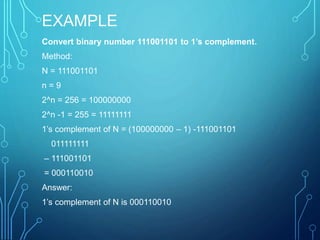
EXAMPLE
Convert binary number 111001101 to 1’s complement.
Method:
N = 111001101
n = 9
2^n = 256 = 100000000
2^n -1 = 255 = 11111111
1’s complement of N = (100000000 – 1) -111001101
011111111
– 111001101
= 000110010
Answer:
1’s complement of N is 000110010
TWO'S COMPLEMENT
Two's complement: If 1 is added to the complement of a
number then resulting number is known as two's
complement.
• If MSB is 0 then the number is positive else if MSB is 1
then the number is negative.
• 2’s complement of a binary number N is obtained by the
formula (2^n) – N ,Where n is the no of bits in number N
EXAMPLE
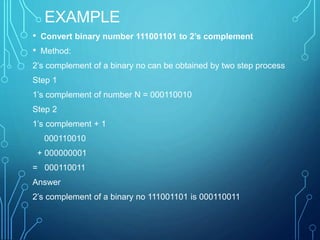
• Convert binary number 111001101 to 2’s complement
• Method:
2’s complement of a binary no can be obtained by two step process
Step 1
1’s complement of number N = 000110010
Step 2
1’s complement + 1
000110010
+ 000000001
= 000110011
Answer
2’s complement of a binary no 111001101 is 000110011
CONVERSION
CONVERSION AMONG BASES
• The possibilities:
Hexadecimal
Decimal Octal
Binary
EXAMPLE
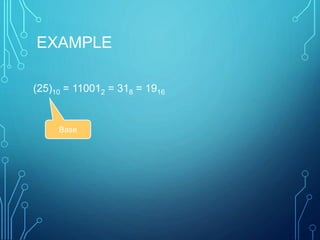
(25)10 = 110012 = 318 = 1916
Base
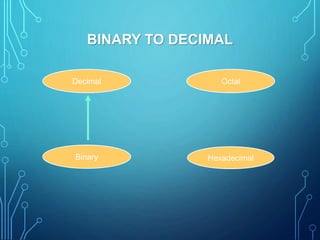
BINARY TO DECIMAL
Hexadecimal
Decimal Octal
Binary
BINARY TO DECIMAL
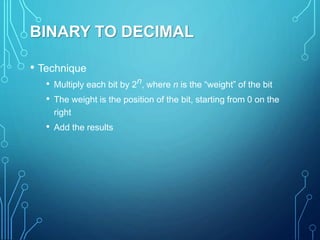
• Technique
• Multiply each bit by 2n, where n is the “weight” of the bit
• The weight is the position of the bit, starting from 0 on the
right
• Add the results
EXAMPLE
1010112 => 1 x 20 = 1
1 x 21 = 2
0 x 22 = 0
1 x 23 = 8
0 x 24 = 0
1 x 25 = 32
4310
Bit “0”
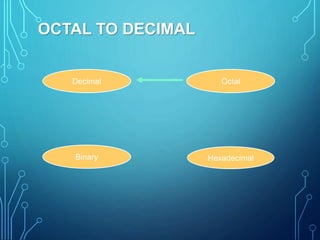
OCTAL TO DECIMAL
Hexadecimal
Decimal Octal
Binary
OCTAL TO DECIMAL
• Technique
• Multiply each bit by 8n, where n is the “weight” of the bit
• The weight is the position of the bit, starting from 0 on the
right
• Add the results
EXAMPLE
7248 => 4 x 80 = 4
2 x 81 = 16
7 x 82 = 448
46810
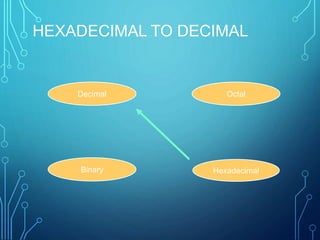
HEXADECIMAL TO DECIMAL
Hexadecimal
Decimal Octal
Binary
HEXADECIMAL TO DECIMAL
• Technique
• Multiply each bit by 16n, where n is the “weight” of the bit
• The weight is the position of the bit, starting from 0 on the
right
• Add the results
EXAMPLE
ABC16 => C x 160 = 12 x 1 = 12
B x 161 = 11 x 16 = 176
A x 162 = 10 x 256 = 2560
274810
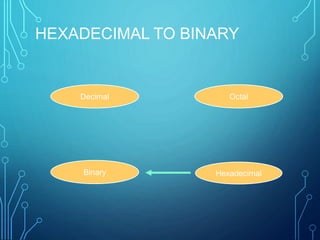
HEXADECIMAL TO BINARY
Hexadecimal
Decimal Octal
Binary
HEXADECIMAL TO BINARY
• Technique
• Convert each hexadecimal digit to a 4-bit equivalent binary
representation
EXAMPLE
10AF16 = ?2
1 0 A F
0001 0000 1010 1111
10AF16 = 00010000101011112
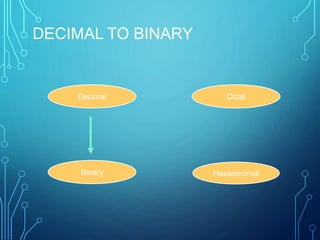
DECIMAL TO BINARY
Hexadecimal
Decimal Octal
Binary
DECIMAL TO BINARY
• Technique
• Divide by two, keep track of the remainder
• First remainder is bit 0 (LSB, least-significant bit)
• Second remainder is bit 1
• Etc.
EXAMPLE
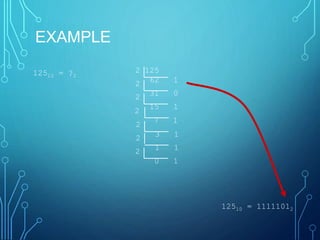
12510 = ?2
2 125
62 12
31 02
15 1
2
7 1
2
3 12
1 12
0 1
12510 = 11111012
OCTAL TO BINARY
Hexadecimal
Decimal Octal
Binary
OCTAL TO BINARY
• Technique
• Convert each octal digit to a 3-bit equivalent binary
representation
EXAMPLE
7058 = ?2
7 0 5
111 000 101
7058 = 1110001012
OCTAL TO HEXADECIMAL
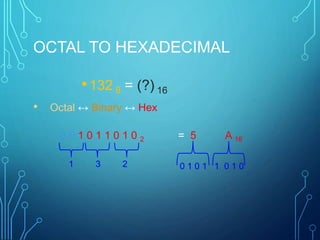
•132 8 = (?) 16
• Octal ↔ Binary ↔ Hex
0 0 1 0 1 1 0 1 0 2
1 3 2
= 5 A 16
0 1 0 1 1 0 1 0
FRACTIONS
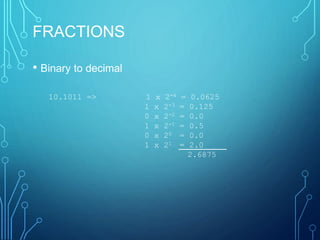
• Binary to decimal
10.1011 => 1 x 2-4 = 0.0625
1 x 2-3 = 0.125
0 x 2-2 = 0.0
1 x 2-1 = 0.5
0 x 20 = 0.0
1 x 21 = 2.0
2.6875
Thank You
all

Number system conversion

  • 1.
    Name: ID: Md. IliasBappi 131-15-2266 Md.Kawsar Hamid 131-15-2223 Introducing my group members
  • 2.
  • 3.
    WHAT IS NUMBERSYSTEM…? The number system that we use in our day-to-day life is the decimal number system. Decimal number system has base 10 as it uses 10 digits from 0 to 9. In decimal number system, the successive positions to the left of the decimal point represent units, tens, hundreds, thousands and so on.
  • 4.
    COMPLEMENT OF NUMBER One'scomplement: In binary system, if each 1 is replaced by 0 and each 0 by 1, then resulting number is called as one's complement of the that number. • If first number is positive then resulting will be negative with the same magnitude and vice versa. • In binary arithmetic 1’s complement of a binary number N is obtained by the formula = (2^n – 1) – N Where n is the no of bits in binary number N.
  • 5.
    EXAMPLE Convert binary number111001101 to 1’s complement. Method: N = 111001101 n = 9 2^n = 256 = 100000000 2^n -1 = 255 = 11111111 1’s complement of N = (100000000 – 1) -111001101 011111111 – 111001101 = 000110010 Answer: 1’s complement of N is 000110010
  • 6.
    TWO'S COMPLEMENT Two's complement:If 1 is added to the complement of a number then resulting number is known as two's complement. • If MSB is 0 then the number is positive else if MSB is 1 then the number is negative. • 2’s complement of a binary number N is obtained by the formula (2^n) – N ,Where n is the no of bits in number N
  • 7.
    EXAMPLE • Convert binarynumber 111001101 to 2’s complement • Method: 2’s complement of a binary no can be obtained by two step process Step 1 1’s complement of number N = 000110010 Step 2 1’s complement + 1 000110010 + 000000001 = 000110011 Answer 2’s complement of a binary no 111001101 is 000110011
  • 8.
  • 9.
    CONVERSION AMONG BASES •The possibilities: Hexadecimal Decimal Octal Binary
  • 10.
    EXAMPLE (25)10 = 110012= 318 = 1916 Base
  • 11.
  • 12.
    BINARY TO DECIMAL •Technique • Multiply each bit by 2n, where n is the “weight” of the bit • The weight is the position of the bit, starting from 0 on the right • Add the results
  • 13.
    EXAMPLE 1010112 => 1x 20 = 1 1 x 21 = 2 0 x 22 = 0 1 x 23 = 8 0 x 24 = 0 1 x 25 = 32 4310 Bit “0”
  • 14.
  • 15.
    OCTAL TO DECIMAL •Technique • Multiply each bit by 8n, where n is the “weight” of the bit • The weight is the position of the bit, starting from 0 on the right • Add the results
  • 16.
    EXAMPLE 7248 => 4x 80 = 4 2 x 81 = 16 7 x 82 = 448 46810
  • 17.
  • 18.
    HEXADECIMAL TO DECIMAL •Technique • Multiply each bit by 16n, where n is the “weight” of the bit • The weight is the position of the bit, starting from 0 on the right • Add the results
  • 19.
    EXAMPLE ABC16 => Cx 160 = 12 x 1 = 12 B x 161 = 11 x 16 = 176 A x 162 = 10 x 256 = 2560 274810
  • 20.
  • 21.
    HEXADECIMAL TO BINARY •Technique • Convert each hexadecimal digit to a 4-bit equivalent binary representation
  • 22.
    EXAMPLE 10AF16 = ?2 10 A F 0001 0000 1010 1111 10AF16 = 00010000101011112
  • 23.
  • 24.
    DECIMAL TO BINARY •Technique • Divide by two, keep track of the remainder • First remainder is bit 0 (LSB, least-significant bit) • Second remainder is bit 1 • Etc.
  • 25.
    EXAMPLE 12510 = ?2 2125 62 12 31 02 15 1 2 7 1 2 3 12 1 12 0 1 12510 = 11111012
  • 26.
  • 27.
    OCTAL TO BINARY •Technique • Convert each octal digit to a 3-bit equivalent binary representation
  • 28.
    EXAMPLE 7058 = ?2 70 5 111 000 101 7058 = 1110001012
  • 29.
    OCTAL TO HEXADECIMAL •1328 = (?) 16 • Octal ↔ Binary ↔ Hex 0 0 1 0 1 1 0 1 0 2 1 3 2 = 5 A 16 0 1 0 1 1 0 1 0
  • 30.
    FRACTIONS • Binary todecimal 10.1011 => 1 x 2-4 = 0.0625 1 x 2-3 = 0.125 0 x 2-2 = 0.0 1 x 2-1 = 0.5 0 x 20 = 0.0 1 x 21 = 2.0 2.6875
  • 31.