
Chapter 2
Data Representation
• Data Representation
• Compliments
• Subtraction of Unsigned Numbers
using r’s complement
• How To Represent Signed Numbers
• Floating-Point Representation
Data Types
• The data types stored in digital computers
may be classified as being one of the
following categories:
1. numbers used in arithmetic computations,
2. letters of the alphabet used in data
processing, and
3. other discrete symbols used for specific
purposes.
All types of data are represented in computers in
binary-coded form.
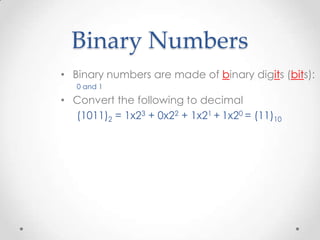
Binary Numbers
• Binary numbers are made of binary digits (bits):
0 and 1
• Convert the following to decimal
(1011)2 = 1x23 + 0x22 + 1x21 + 1x20 = (11)10
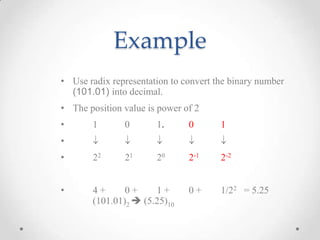
Example
• Use radix representation to convert the binary number
(101.01) into decimal.
• The position value is power of 2
• 1 0 1. 0 1
•
• 22 21 20 2-1 2-2
• 4 + 0 + 1 + 0 + 1/22 = 5.25
(101.01)2  (5.25)10
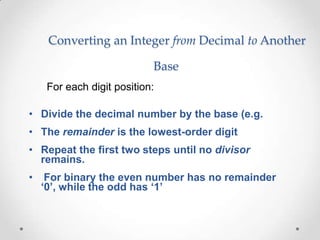
Converting an Integer from Decimal to Another
Base
• Divide the decimal number by the base (e.g.
• The remainder is the lowest-order digit
• Repeat the first two steps until no divisor
remains.
• For binary the even number has no remainder
‘0’, while the odd has ‘1’
For each digit position:
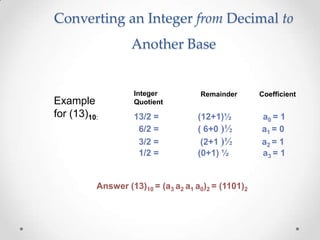
Converting an Integer from Decimal to
Another Base
Example
for (13)10:
Integer
Quotient
13/2 = (12+1)½ a0 = 1
6/2 = ( 6+0 )½ a1 = 0
3/2 = (2+1 )½ a2 = 1
1/2 = (0+1) ½ a3 = 1
Remainder Coefficient
Answer (13)10 = (a3 a2 a1 a0)2 = (1101)2
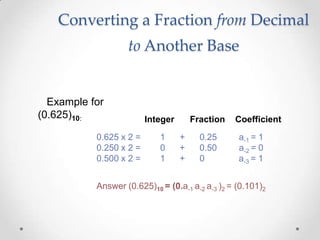
Converting a Fraction from Decimal
to Another Base
Example for
(0.625)10: Integer
0.625 x 2 = 1 + 0.25 a-1 = 1
0.250 x 2 = 0 + 0.50 a-2 = 0
0.500 x 2 = 1 + 0 a-3 = 1
Fraction Coefficient
Answer (0.625)10 = (0.a-1 a-2 a-3 )2 = (0.101)2
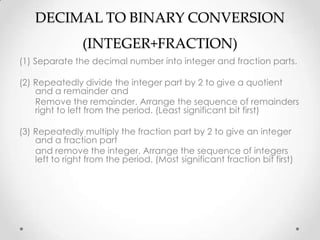
DECIMAL TO BINARY CONVERSION
(INTEGER+FRACTION)
(1) Separate the decimal number into integer and fraction parts.
(2) Repeatedly divide the integer part by 2 to give a quotient
and a remainder and
Remove the remainder. Arrange the sequence of remainders
right to left from the period. (Least significant bit first)
(3) Repeatedly multiply the fraction part by 2 to give an integer
and a fraction part
and remove the integer. Arrange the sequence of integers
left to right from the period. (Most significant fraction bit first)
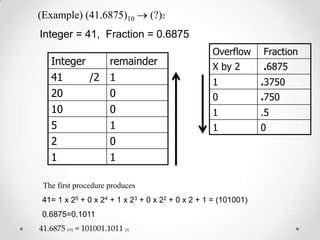
(Example) (41.6875)10 (?)2
Integer = 41, Fraction = 0.6875
The first procedure produces
41= 1 x 25 + 0 x 24 + 1 x 23 + 0 x 22 + 0 x 2 + 1 = (101001)
0.6875=0.1011
41.6875 (10) = 101001.1011 (2)
Integer remainder
41 /2 1
20 0
10 0
5 1
2 0
1 1
Overflow Fraction
X by 2 .6875
1 .3750
0 .750
1 .5
1 0
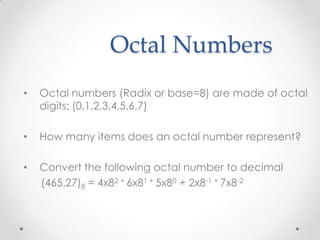
Octal Numbers
• Octal numbers (Radix or base=8) are made of octal
digits: (0,1,2,3,4,5,6,7)
• How many items does an octal number represent?
• Convert the following octal number to decimal
(465.27)8 = 4x82 + 6x81 + 5x80 + 2x8-1 + 7x8-2
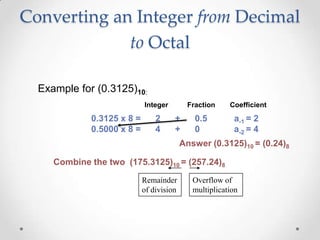
Converting an Integer from Decimal
to Octal
Example for (0.3125)10:
Integer
0.3125 x 8 = 2 + 0.5 a-1 = 2
0.5000 x 8 = 4 + 0 a-2 = 4
Fraction Coefficient
Answer (0.3125)10 = (0.24)8
Combine the two (175.3125)10 = (257.24)8
Remainder
of division
Overflow of
multiplication
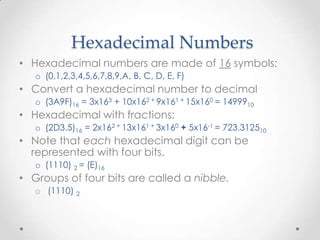
Hexadecimal Numbers
• Hexadecimal numbers are made of 16 symbols:
o (0,1,2,3,4,5,6,7,8,9,A, B, C, D, E, F)
• Convert a hexadecimal number to decimal
o (3A9F)16 = 3x163 + 10x162 + 9x161 + 15x160 = 1499910
• Hexadecimal with fractions:
o (2D3.5)16 = 2x162 + 13x161 + 3x160 + 5x16-1 = 723.312510
• Note that each hexadecimal digit can be
represented with four bits.
o (1110) 2 = (E)16
• Groups of four bits are called a nibble.
o (1110) 2
Example
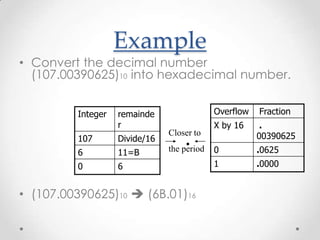
• Convert the decimal number
(107.00390625)10 into hexadecimal number.
• (107.00390625)10  (6B.01)16
Integer remainde
r
107 Divide/16
6 11=B
0 6
Overflow Fraction
X by 16 .
00390625
0 .0625
1 .0000
.
Closer to
the period
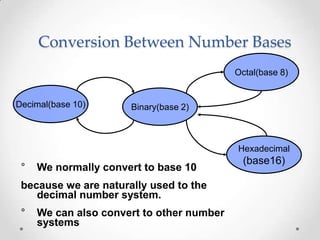
Conversion Between Number Bases
Decimal(base 10)
Octal(base 8)
Binary(base 2)
Hexadecimal
(base16)
° We normally convert to base 10
because we are naturally used to the
decimal number system.
° We can also convert to other number
systems
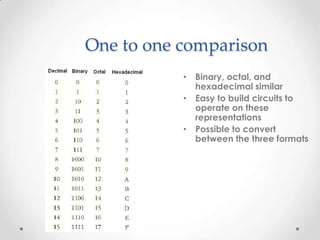
One to one comparison
• Binary, octal, and
hexadecimal similar
• Easy to build circuits to
operate on these
representations
• Possible to convert
between the three formats
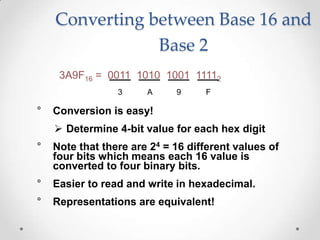
Converting between Base 16 and
Base 2
° Conversion is easy!
 Determine 4-bit value for each hex digit
° Note that there are 24 = 16 different values of
four bits which means each 16 value is
converted to four binary bits.
° Easier to read and write in hexadecimal.
° Representations are equivalent!
3A9F16 = 0011 1010 1001 11112
3 A 9 F
Converting between Base 16 and
Base 8
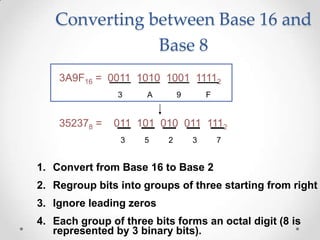
1. Convert from Base 16 to Base 2
2. Regroup bits into groups of three starting from right
3. Ignore leading zeros
4. Each group of three bits forms an octal digit (8 is
represented by 3 binary bits).
352378 = 011 101 010 011 1112
5 2 3 73
3A9F16 = 0011 1010 1001 11112
3 A 9 F
Example
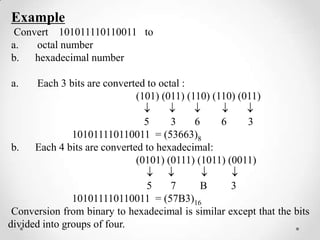
Convert 101011110110011 to
a. octal number
b. hexadecimal number
a. Each 3 bits are converted to octal :
(101) (011) (110) (110) (011)
5 3 6 6 3
101011110110011 = (53663)8
b. Each 4 bits are converted to hexadecimal:
(0101) (0111) (1011) (0011)
5 7 B 3
101011110110011 = (57B3)16
Conversion from binary to hexadecimal is similar except that the bits
divided into groups of four.
Compliments
Complements Of Numbers
Subtraction using
addition
• Conventional addition (using carry) is easily
• implemented in digital computers.
• However; subtraction by borrowing is
difficult and inefficient for digital computers.
• Much more efficient to implement
subtraction using ADDITION OF the
COMPLEMENTS of numbers.
Binary Addition
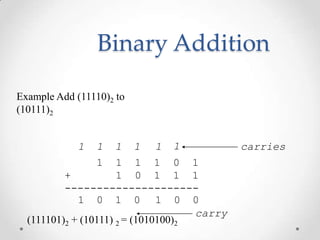
1 1 1 1 0 1
+ 1 0 1 1 1
---------------------
0
1
0
1
1
1111
1 1 00
carries
Example Add (11110)2 to
(10111)2
(111101)2 + (10111) 2 = (1010100)2
carry
Binary Subtraction
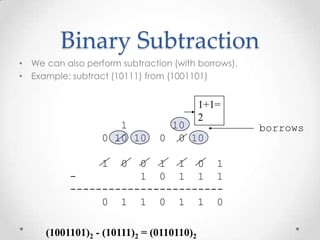
• We can also perform subtraction (with borrows).
• Example: subtract (10111) from (1001101)
1 10
0 10 10 0 0 10
1 0 0 1 1 0 1
- 1 0 1 1 1
------------------------
0 1 1 0 1 1 0
borrows
1+1=
2
(1001101)2 - (10111)2 = (0110110)2
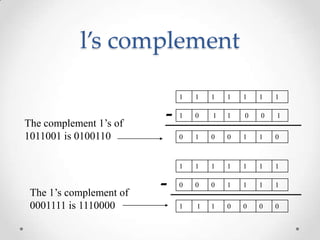
The complement 1’s of
1011001 is 0100110
0 1 1 0 0- 1
1 1 1 1 1 1
1 0 0 1 1 0
0 0 1 1 1- 1
1 1 1 1 1 1
1 1 0 0 0 0
1
1
0
The 1’s complement of
0001111 is 1110000
0
1
1
l’s complement
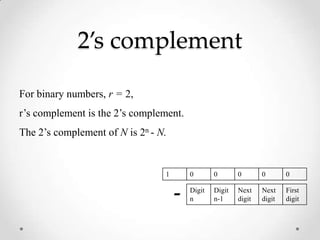
For binary numbers, r = 2,
r’s complement is the 2’s complement.
The 2’s complement of N is 2n - N.
2’s complement
Digit
n
Digit
n-1
Next
digit
Next
digit
First
digit
0 0 0 0 0
-
1
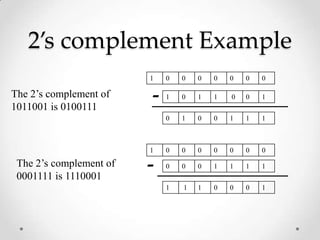
2’s complement Example
The 2’s complement of
1011001 is 0100111
The 2’s complement of
0001111 is 1110001
0 1 1 0 0- 1
0 0 0 0 0 0
1 0 0 1 1 1
0 0 1 1 1- 1
1 1 0 0 0 1
1
0
0
0
1
1
0 0 0 0 0 001
Fast Methods for 2’s
Complement
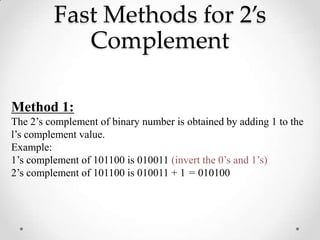
Method 1:
The 2’s complement of binary number is obtained by adding 1 to the
l’s complement value.
Example:
1’s complement of 101100 is 010011 (invert the 0’s and 1’s)
2’s complement of 101100 is 010011 + 1 = 010100
Fast Methods for 2’s
Complement
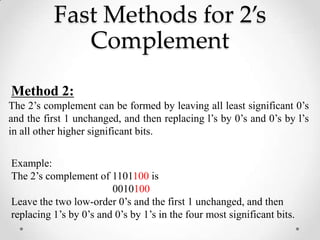
Method 2:
The 2’s complement can be formed by leaving all least significant 0’s
and the first 1 unchanged, and then replacing l’s by 0’s and 0’s by l’s
in all other higher significant bits.
Example:
The 2’s complement of 1101100 is
0010100
Leave the two low-order 0’s and the first 1 unchanged, and then
replacing 1’s by 0’s and 0’s by 1’s in the four most significant bits.
Examples
o Finding the 2’s complement of (01100101)2
• Method 1 – Simply complement each bit and
then add 1 to the result.
(01100101)2
[N] = 2’s complement = 1’s complement (10011010)2
+1
=(10011011)2
• Method 2 – Starting with the least significant
bit, copy all the bits up to and including the
first 1 bit and then complement the remaining
bits.
N = 0 1 1 0 0 1 0 1
[N] = 1 0 0 1 1 0 1 1
Video Reference
• http://www.youtube.com/watch?v=SXAr35BiqK8

Data representation

  • 1.
    Chapter 2 Data Representation •Data Representation • Compliments • Subtraction of Unsigned Numbers using r’s complement • How To Represent Signed Numbers • Floating-Point Representation
  • 2.
    Data Types • Thedata types stored in digital computers may be classified as being one of the following categories: 1. numbers used in arithmetic computations, 2. letters of the alphabet used in data processing, and 3. other discrete symbols used for specific purposes. All types of data are represented in computers in binary-coded form.
  • 3.
    Binary Numbers • Binarynumbers are made of binary digits (bits): 0 and 1 • Convert the following to decimal (1011)2 = 1x23 + 0x22 + 1x21 + 1x20 = (11)10
  • 4.
    Example • Use radixrepresentation to convert the binary number (101.01) into decimal. • The position value is power of 2 • 1 0 1. 0 1 • • 22 21 20 2-1 2-2 • 4 + 0 + 1 + 0 + 1/22 = 5.25 (101.01)2  (5.25)10
  • 5.
    Converting an Integerfrom Decimal to Another Base • Divide the decimal number by the base (e.g. • The remainder is the lowest-order digit • Repeat the first two steps until no divisor remains. • For binary the even number has no remainder ‘0’, while the odd has ‘1’ For each digit position:
  • 6.
    Converting an Integerfrom Decimal to Another Base Example for (13)10: Integer Quotient 13/2 = (12+1)½ a0 = 1 6/2 = ( 6+0 )½ a1 = 0 3/2 = (2+1 )½ a2 = 1 1/2 = (0+1) ½ a3 = 1 Remainder Coefficient Answer (13)10 = (a3 a2 a1 a0)2 = (1101)2
  • 7.
    Converting a Fractionfrom Decimal to Another Base Example for (0.625)10: Integer 0.625 x 2 = 1 + 0.25 a-1 = 1 0.250 x 2 = 0 + 0.50 a-2 = 0 0.500 x 2 = 1 + 0 a-3 = 1 Fraction Coefficient Answer (0.625)10 = (0.a-1 a-2 a-3 )2 = (0.101)2
  • 8.
    DECIMAL TO BINARYCONVERSION (INTEGER+FRACTION) (1) Separate the decimal number into integer and fraction parts. (2) Repeatedly divide the integer part by 2 to give a quotient and a remainder and Remove the remainder. Arrange the sequence of remainders right to left from the period. (Least significant bit first) (3) Repeatedly multiply the fraction part by 2 to give an integer and a fraction part and remove the integer. Arrange the sequence of integers left to right from the period. (Most significant fraction bit first)
  • 9.
    (Example) (41.6875)10 (?)2 Integer= 41, Fraction = 0.6875 The first procedure produces 41= 1 x 25 + 0 x 24 + 1 x 23 + 0 x 22 + 0 x 2 + 1 = (101001) 0.6875=0.1011 41.6875 (10) = 101001.1011 (2) Integer remainder 41 /2 1 20 0 10 0 5 1 2 0 1 1 Overflow Fraction X by 2 .6875 1 .3750 0 .750 1 .5 1 0
  • 10.
    Octal Numbers • Octalnumbers (Radix or base=8) are made of octal digits: (0,1,2,3,4,5,6,7) • How many items does an octal number represent? • Convert the following octal number to decimal (465.27)8 = 4x82 + 6x81 + 5x80 + 2x8-1 + 7x8-2
  • 11.
    Converting an Integerfrom Decimal to Octal Example for (0.3125)10: Integer 0.3125 x 8 = 2 + 0.5 a-1 = 2 0.5000 x 8 = 4 + 0 a-2 = 4 Fraction Coefficient Answer (0.3125)10 = (0.24)8 Combine the two (175.3125)10 = (257.24)8 Remainder of division Overflow of multiplication
  • 12.
    Hexadecimal Numbers • Hexadecimalnumbers are made of 16 symbols: o (0,1,2,3,4,5,6,7,8,9,A, B, C, D, E, F) • Convert a hexadecimal number to decimal o (3A9F)16 = 3x163 + 10x162 + 9x161 + 15x160 = 1499910 • Hexadecimal with fractions: o (2D3.5)16 = 2x162 + 13x161 + 3x160 + 5x16-1 = 723.312510 • Note that each hexadecimal digit can be represented with four bits. o (1110) 2 = (E)16 • Groups of four bits are called a nibble. o (1110) 2
  • 13.
    Example • Convert thedecimal number (107.00390625)10 into hexadecimal number. • (107.00390625)10  (6B.01)16 Integer remainde r 107 Divide/16 6 11=B 0 6 Overflow Fraction X by 16 . 00390625 0 .0625 1 .0000 . Closer to the period
  • 14.
    Conversion Between NumberBases Decimal(base 10) Octal(base 8) Binary(base 2) Hexadecimal (base16) ° We normally convert to base 10 because we are naturally used to the decimal number system. ° We can also convert to other number systems
  • 15.
    One to onecomparison • Binary, octal, and hexadecimal similar • Easy to build circuits to operate on these representations • Possible to convert between the three formats
  • 16.
    Converting between Base16 and Base 2 ° Conversion is easy!  Determine 4-bit value for each hex digit ° Note that there are 24 = 16 different values of four bits which means each 16 value is converted to four binary bits. ° Easier to read and write in hexadecimal. ° Representations are equivalent! 3A9F16 = 0011 1010 1001 11112 3 A 9 F
  • 17.
    Converting between Base16 and Base 8 1. Convert from Base 16 to Base 2 2. Regroup bits into groups of three starting from right 3. Ignore leading zeros 4. Each group of three bits forms an octal digit (8 is represented by 3 binary bits). 352378 = 011 101 010 011 1112 5 2 3 73 3A9F16 = 0011 1010 1001 11112 3 A 9 F
  • 18.
    Example Convert 101011110110011 to a.octal number b. hexadecimal number a. Each 3 bits are converted to octal : (101) (011) (110) (110) (011) 5 3 6 6 3 101011110110011 = (53663)8 b. Each 4 bits are converted to hexadecimal: (0101) (0111) (1011) (0011) 5 7 B 3 101011110110011 = (57B3)16 Conversion from binary to hexadecimal is similar except that the bits divided into groups of four.
  • 19.
  • 20.
    Subtraction using addition • Conventionaladdition (using carry) is easily • implemented in digital computers. • However; subtraction by borrowing is difficult and inefficient for digital computers. • Much more efficient to implement subtraction using ADDITION OF the COMPLEMENTS of numbers.
  • 21.
    Binary Addition 1 11 1 0 1 + 1 0 1 1 1 --------------------- 0 1 0 1 1 1111 1 1 00 carries Example Add (11110)2 to (10111)2 (111101)2 + (10111) 2 = (1010100)2 carry
  • 22.
    Binary Subtraction • Wecan also perform subtraction (with borrows). • Example: subtract (10111) from (1001101) 1 10 0 10 10 0 0 10 1 0 0 1 1 0 1 - 1 0 1 1 1 ------------------------ 0 1 1 0 1 1 0 borrows 1+1= 2 (1001101)2 - (10111)2 = (0110110)2
  • 23.
    The complement 1’sof 1011001 is 0100110 0 1 1 0 0- 1 1 1 1 1 1 1 1 0 0 1 1 0 0 0 1 1 1- 1 1 1 1 1 1 1 1 1 0 0 0 0 1 1 0 The 1’s complement of 0001111 is 1110000 0 1 1 l’s complement
  • 24.
    For binary numbers,r = 2, r’s complement is the 2’s complement. The 2’s complement of N is 2n - N. 2’s complement Digit n Digit n-1 Next digit Next digit First digit 0 0 0 0 0 - 1
  • 25.
    2’s complement Example The2’s complement of 1011001 is 0100111 The 2’s complement of 0001111 is 1110001 0 1 1 0 0- 1 0 0 0 0 0 0 1 0 0 1 1 1 0 0 1 1 1- 1 1 1 0 0 0 1 1 0 0 0 1 1 0 0 0 0 0 001
  • 26.
    Fast Methods for2’s Complement Method 1: The 2’s complement of binary number is obtained by adding 1 to the l’s complement value. Example: 1’s complement of 101100 is 010011 (invert the 0’s and 1’s) 2’s complement of 101100 is 010011 + 1 = 010100
  • 27.
    Fast Methods for2’s Complement Method 2: The 2’s complement can be formed by leaving all least significant 0’s and the first 1 unchanged, and then replacing l’s by 0’s and 0’s by l’s in all other higher significant bits. Example: The 2’s complement of 1101100 is 0010100 Leave the two low-order 0’s and the first 1 unchanged, and then replacing 1’s by 0’s and 0’s by 1’s in the four most significant bits.
  • 28.
    Examples o Finding the2’s complement of (01100101)2 • Method 1 – Simply complement each bit and then add 1 to the result. (01100101)2 [N] = 2’s complement = 1’s complement (10011010)2 +1 =(10011011)2 • Method 2 – Starting with the least significant bit, copy all the bits up to and including the first 1 bit and then complement the remaining bits. N = 0 1 1 0 0 1 0 1 [N] = 1 0 0 1 1 0 1 1
  • 29.