2.0 FERROUS MATERIAL STRUCTURE AND BINARY ALLOY SYSTEM

2.1   Understand the metal production

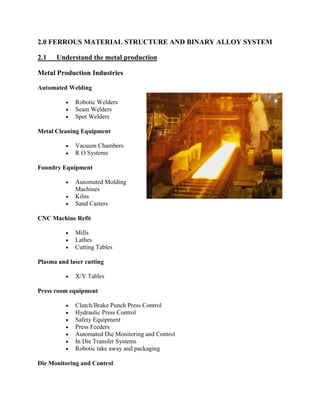
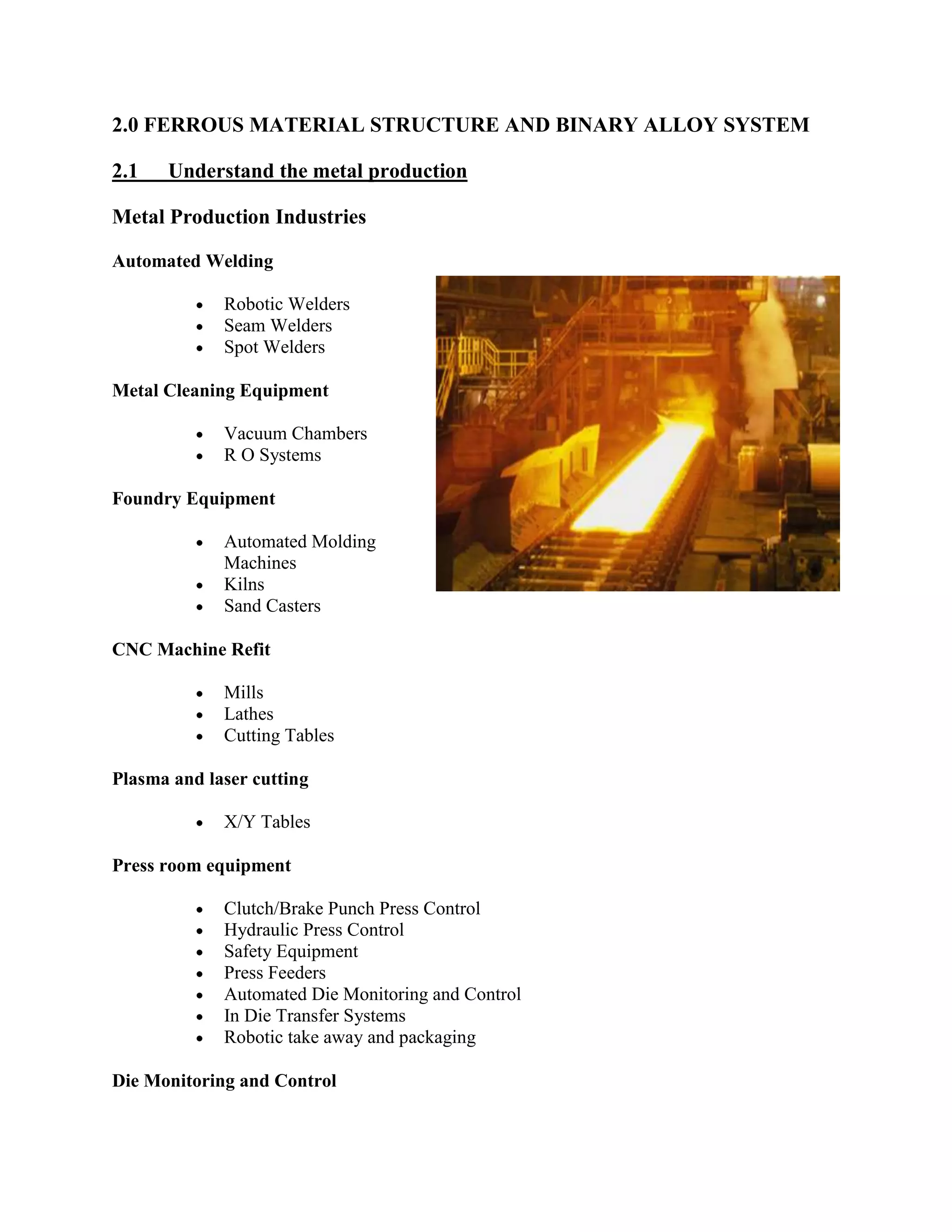
Metal Production Industries

Automated Welding

             Robotic Welders
             Seam Welders
             Spot Welders

Metal Cleaning Equipment

             Vacuum Chambers
             R O Systems

Foundry Equipment

             Automated Molding
             Machines
             Kilns
             Sand Casters

CNC Machine Refit

             Mills
             Lathes
             Cutting Tables

Plasma and laser cutting

             X/Y Tables

Press room equipment

             Clutch/Brake Punch Press Control
             Hydraulic Press Control
             Safety Equipment
             Press Feeders
             Automated Die Monitoring and Control
             In Die Transfer Systems
             Robotic take away and packaging

Die Monitoring and Control
Spin forming

Precision winding

Remote Control Systems

               Radio Control Systems
               Web Systems

Kilns


2.2     State the content of iron ore

Iron ores are rocks and minerals from which metallic iron can be economically extracted. The
ores are usually rich in iron oxides and vary in color from dark grey, bright yellow, deep purple,
to rusty red. The iron itself is usually found in the form of magnetite (Fe3O4), hematite (Fe2O3),
goethite (FeO(OH)), limonite (FeO(OH).n(H2O)) or siderite (FeCO3). Ores carrying very high
quantities of hematite or magnetite (greater than ~60% iron) are known as "natural ore" or
"direct shipping ore", meaning they can be fed directly into iron-making blast furnaces. Most
reserves of such ore have now been depleted. Iron ore is the raw material used to make pig iron
(Pig iron is the intermediate product of smelting iron ore with a high-carbon fuel such as coke,
usually with limestone as a flux.), which is one of the main raw materials to make steel. 98% of
the mined iron ore is used to make steel. Indeed, it has been argued that iron ore is "more integral
to the global economy than any other commodity, except perhaps oil".

The types of iron ore

a)Magnetite
Magnetite iron - iron of high quality mineral
 - Almost 70% of the metal / black metal

b)Iron carbonate
Iron carbonate - a low-grade material.
- Containing 20% iron


c)Hematite
Hematite iron - iron of high quality mineral
 - Contains 40-60% iron red

d)Limonite
Limonite iron - containing 20-55% iron
 - Brown
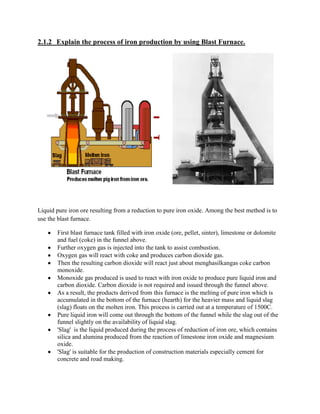
2.1.2 Explain the process of iron production by using Blast Furnace.


Liquid pure iron ore resulting from a reduction to pure iron oxide. Among the best method is to
use the blast furnace.

       First blast furnace tank filled with iron oxide (ore, pellet, sinter), limestone or dolomite
       and fuel (coke) in the funnel above.
       Further oxygen gas is injected into the tank to assist combustion.
       Oxygen gas will react with coke and produces carbon dioxide gas.
       Then the resulting carbon dioxide will react just about menghasilkangas coke carbon
       monoxide.
       Monoxide gas produced is used to react with iron oxide to produce pure liquid iron and
       carbon dioxide. Carbon dioxide is not required and issued through the funnel above.
       As a result, the products derived from this furnace is the melting of pure iron which is
       accumulated in the bottom of the furnace (hearth) for the heavier mass and liquid slag
       (slag) floats on the molten iron. This process is carried out at a temperature of 1500C.
       Pure liquid iron will come out through the bottom of the funnel while the slag out of the
       funnel slightly on the availability of liquid slag.
       'Slag' is the liquid produced during the process of reduction of iron ore, which contains
       silica and alumina produced from the reaction of limestone iron oxide and magnesium
       oxide.
       'Slag' is suitable for the production of construction materials especially cement for
       concrete and road making.
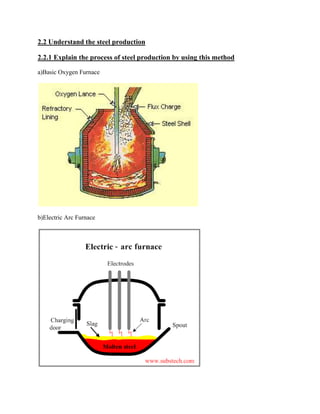
2.2 Understand the steel production

2.2.1 Explain the process of steel production by using this method

a)Basic Oxygen Furnace


b)Electric Arc Furnace

Nota bi teknologi bahan

  • 1.
    2.0 FERROUS MATERIALSTRUCTURE AND BINARY ALLOY SYSTEM 2.1 Understand the metal production Metal Production Industries Automated Welding Robotic Welders Seam Welders Spot Welders Metal Cleaning Equipment Vacuum Chambers R O Systems Foundry Equipment Automated Molding Machines Kilns Sand Casters CNC Machine Refit Mills Lathes Cutting Tables Plasma and laser cutting X/Y Tables Press room equipment Clutch/Brake Punch Press Control Hydraulic Press Control Safety Equipment Press Feeders Automated Die Monitoring and Control In Die Transfer Systems Robotic take away and packaging Die Monitoring and Control
  • 2.
    Spin forming Precision winding RemoteControl Systems Radio Control Systems Web Systems Kilns 2.2 State the content of iron ore Iron ores are rocks and minerals from which metallic iron can be economically extracted. The ores are usually rich in iron oxides and vary in color from dark grey, bright yellow, deep purple, to rusty red. The iron itself is usually found in the form of magnetite (Fe3O4), hematite (Fe2O3), goethite (FeO(OH)), limonite (FeO(OH).n(H2O)) or siderite (FeCO3). Ores carrying very high quantities of hematite or magnetite (greater than ~60% iron) are known as "natural ore" or "direct shipping ore", meaning they can be fed directly into iron-making blast furnaces. Most reserves of such ore have now been depleted. Iron ore is the raw material used to make pig iron (Pig iron is the intermediate product of smelting iron ore with a high-carbon fuel such as coke, usually with limestone as a flux.), which is one of the main raw materials to make steel. 98% of the mined iron ore is used to make steel. Indeed, it has been argued that iron ore is "more integral to the global economy than any other commodity, except perhaps oil". The types of iron ore a)Magnetite Magnetite iron - iron of high quality mineral - Almost 70% of the metal / black metal b)Iron carbonate Iron carbonate - a low-grade material. - Containing 20% iron c)Hematite Hematite iron - iron of high quality mineral - Contains 40-60% iron red d)Limonite Limonite iron - containing 20-55% iron - Brown
  • 3.
    2.1.2 Explain theprocess of iron production by using Blast Furnace. Liquid pure iron ore resulting from a reduction to pure iron oxide. Among the best method is to use the blast furnace. First blast furnace tank filled with iron oxide (ore, pellet, sinter), limestone or dolomite and fuel (coke) in the funnel above. Further oxygen gas is injected into the tank to assist combustion. Oxygen gas will react with coke and produces carbon dioxide gas. Then the resulting carbon dioxide will react just about menghasilkangas coke carbon monoxide. Monoxide gas produced is used to react with iron oxide to produce pure liquid iron and carbon dioxide. Carbon dioxide is not required and issued through the funnel above. As a result, the products derived from this furnace is the melting of pure iron which is accumulated in the bottom of the furnace (hearth) for the heavier mass and liquid slag (slag) floats on the molten iron. This process is carried out at a temperature of 1500C. Pure liquid iron will come out through the bottom of the funnel while the slag out of the funnel slightly on the availability of liquid slag. 'Slag' is the liquid produced during the process of reduction of iron ore, which contains silica and alumina produced from the reaction of limestone iron oxide and magnesium oxide. 'Slag' is suitable for the production of construction materials especially cement for concrete and road making.
  • 4.
    2.2 Understand thesteel production 2.2.1 Explain the process of steel production by using this method a)Basic Oxygen Furnace b)Electric Arc Furnace