Production of iron and steel
By Asegid Tadesse
Wollega University, Ethiopia
Objectives
This chapter aims in understanding of:
Part 1:
 Classification of ferrous metals
 Steel and alloy steels
 Cast iron
 Wrought iron
Part 2:
 Heat treatment of plain carbon steels
Part 3:
 Production of iron and steel
2
Department of Mechanical Engineering
Iron and Steel
What is Iron?
 Iron is a strong, hard, heavy gray metal.
 Iron is produced by melting iron ore (mineral compounds in the
earth's crust – 5% of the Earth's crust is iron ) and removing
impurities.
• Pig iron
• Wrought iron
What is steel?
 Steel is simply a purified form of iron with lower carbon
content.
 It can be produced from molten iron ore with blast of air (BOF),
Electric arc furnace, Bessemer converter.
Production of iron and steel
3
Department of Mechanical Engineering
Iron and Steel
 Applications?
 Cutting tools, pressure vessels, bolts, hammers, gears, cutlery, jet engine
parts, car bodies, screws, concrete reinforcement, ‘tin’ cans, bridges…
 Why?
 Ore is cheap and abundant.
 Economical processing techniques (extraction, refining, alloying,
fabrication) are economical.
 High strength.
 Very versatile metallurgy – a wide range of mechanical and physical
properties can be achieved, and these can be tailored to the application.
 Disadvantage?
 Low corrosion resistance (instead use titanium, brass).
 High density: 7.9 g/cm3 (instead use Al, Mg).
 High temperature strength could be better (instead use Ni).
Production of iron and steel
4
Department of Mechanical Engineering
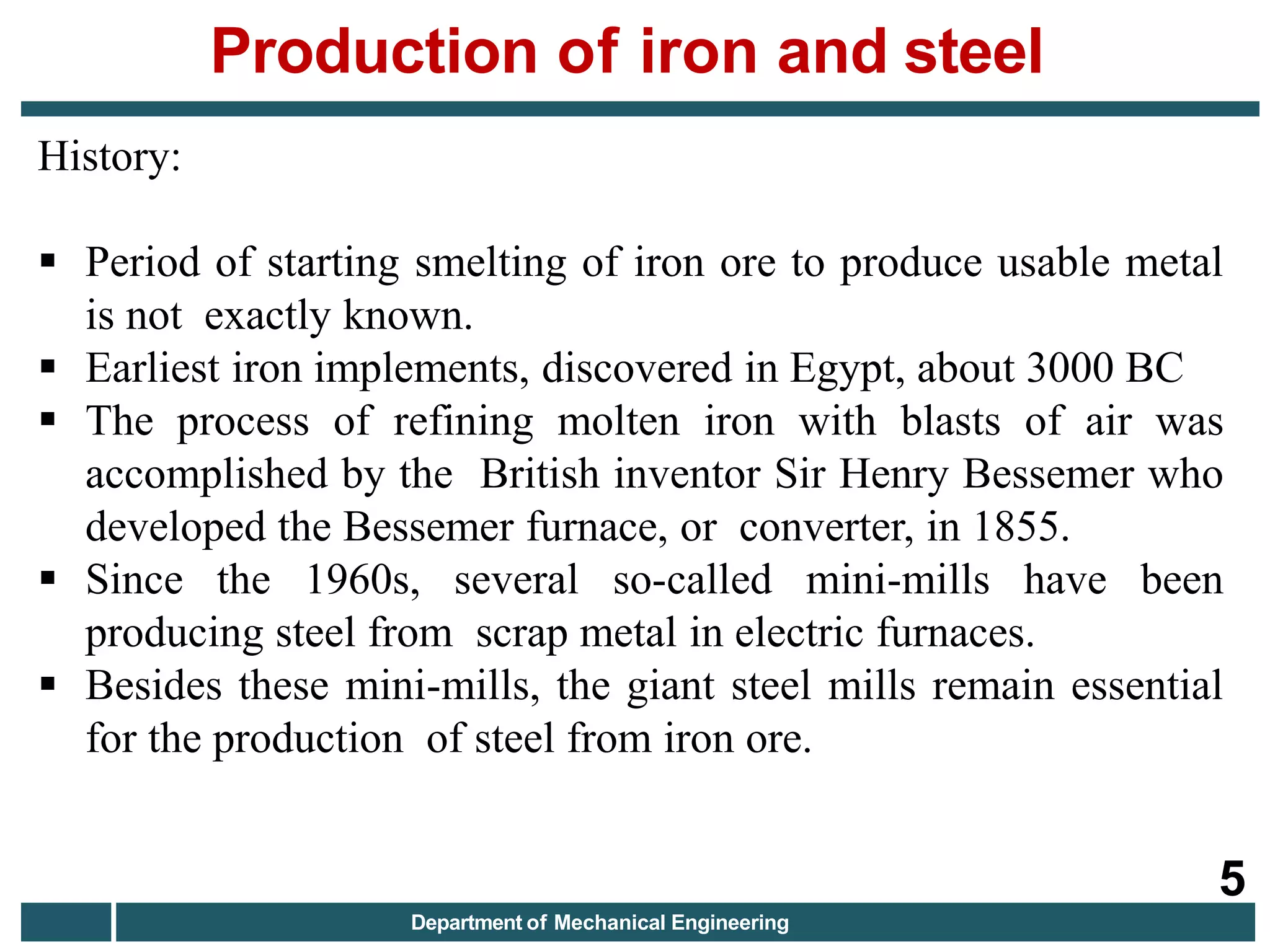
History:
 Period of starting smelting of iron ore to produce usable metal
is not exactly known.
 Earliest iron implements, discovered in Egypt, about 3000 BC
 The process of refining molten iron with blasts of air was
accomplished by the British inventor Sir Henry Bessemer who
developed the Bessemer furnace, or converter, in 1855.
 Since the 1960s, several so-called mini-mills have been
producing steel from scrap metal in electric furnaces.
 Besides these mini-mills, the giant steel mills remain essential
for the production of steel from iron ore.
Production of iron and steel
5
Department of Mechanical Engineering
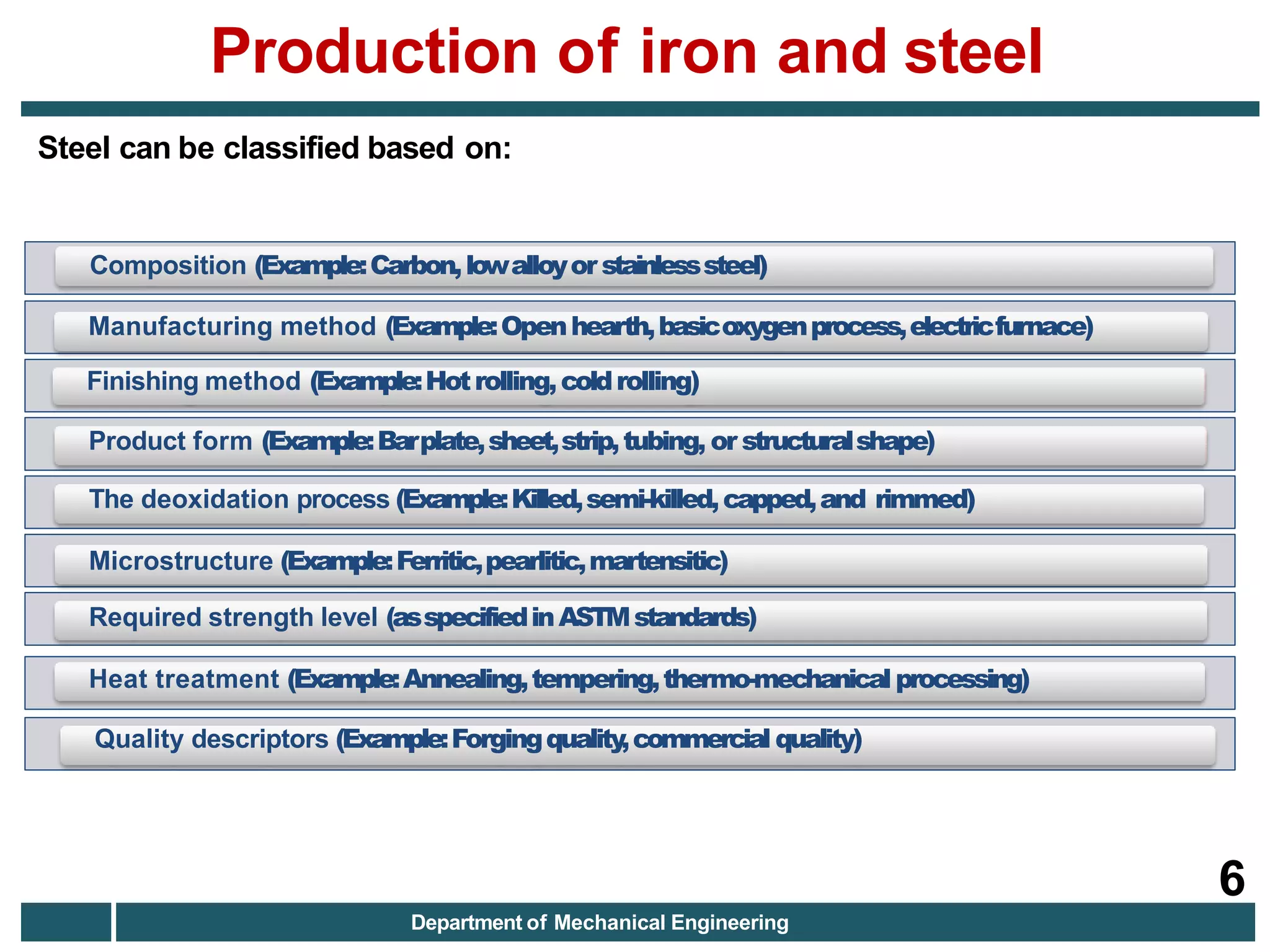
Composition (Example:Carbon,lowalloyorstainlesssteel)
Manufacturing method (Example:Openhearth,basicoxygenprocess,electricfurnace)
Finishing method (Example:Hotrolling,coldrolling)
Product form (Example:Barplate,sheet,strip,tubing, or structuralshape)
The deoxidation process (Example:Killed,semi-killed,capped,and rimmed)
Microstructure (Example:Ferritic,pearlitic,martensitic)
Required strength level (asspecifiedinASTMstandards)
Heat treatment (Example:Annealing,tempering,thermo-mechanicalprocessing)
Quality descriptors (Example:Forgingquality
,commercial quality)
Steel can be classified based on:
Production of iron and steel
6
Department of Mechanical Engineering
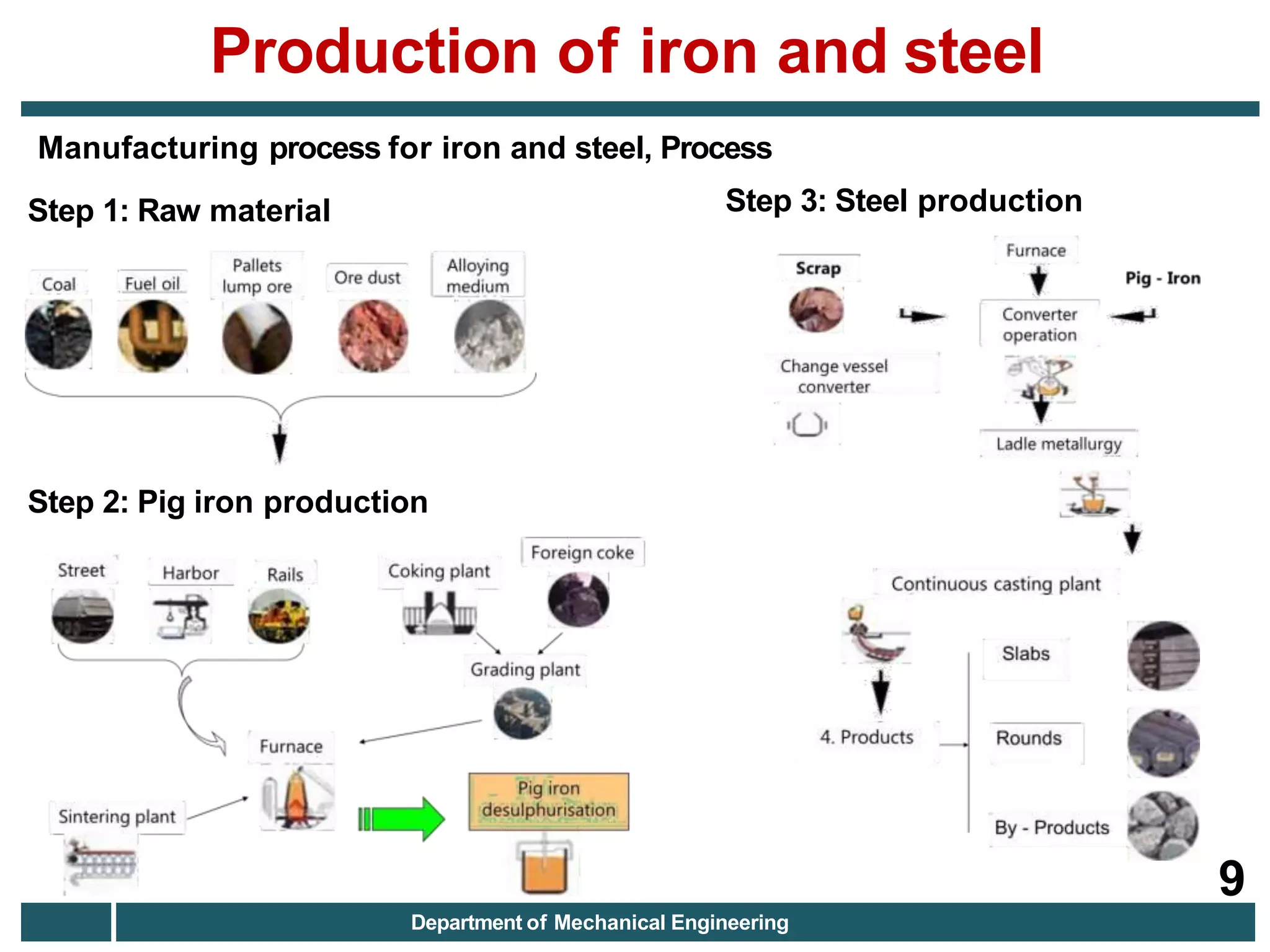
Manufacturing process for iron and steel
Production of iron and steel
7
Department of Mechanical Engineering
Steel
production
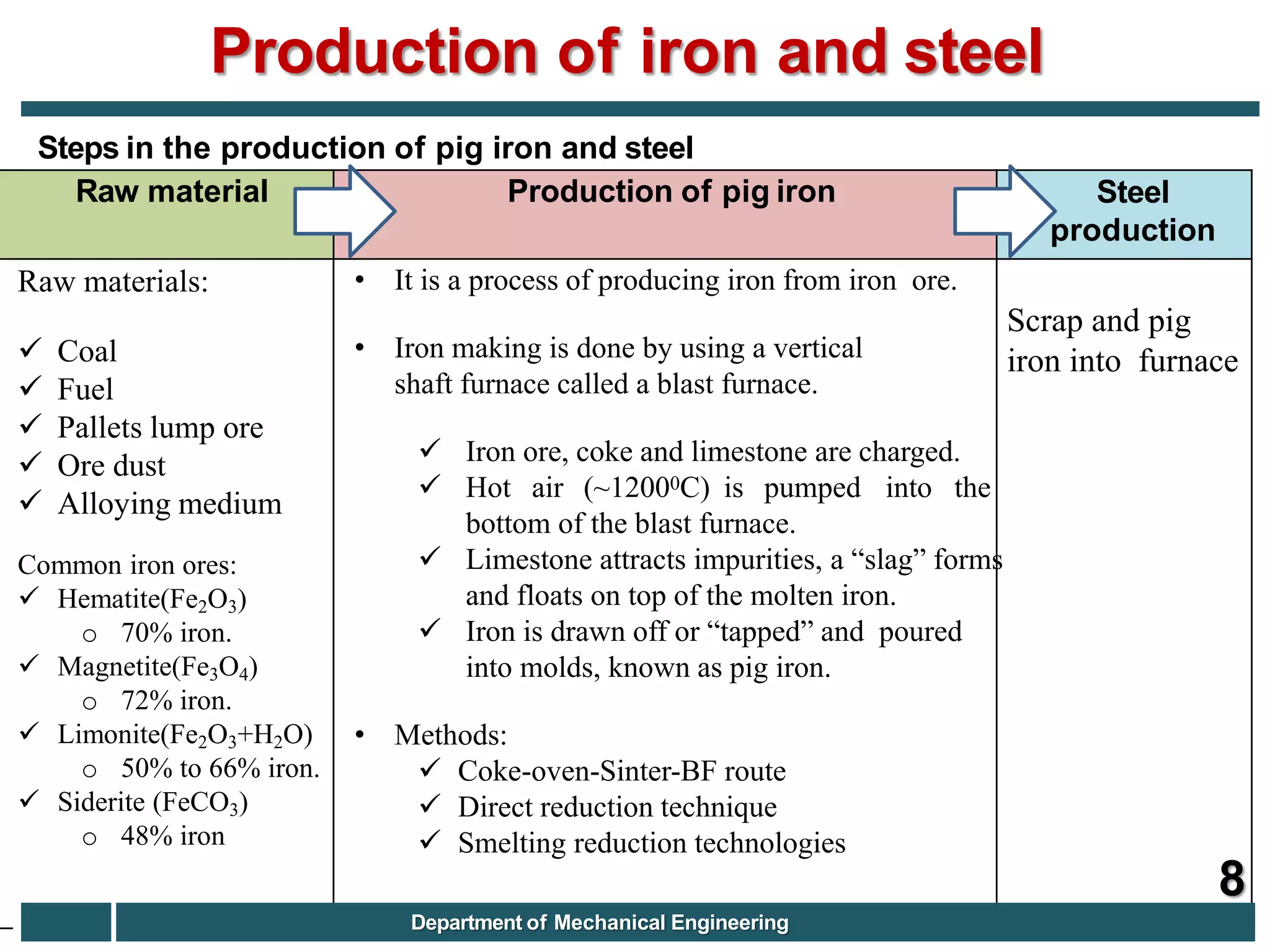
Raw materials:
 Coal
 Fuel
 Pallets lump ore
 Ore dust
 Alloying medium
Common iron ores:
 Hematite(Fe2O3)
o 70% iron.
 Magnetite(Fe3O4)
o 72% iron.
 Limonite(Fe2O3+H2O)
o 50% to 66% iron.
 Siderite (FeCO3)
o 48% iron
• It is a process of producing iron from iron ore.
• Iron making is done by using a vertical
shaft furnace called a blast furnace.
 Iron ore, coke and limestone are charged.
 Hot air (~12000C) is pumped into the
bottom of the blast furnace.
 Limestone attracts impurities, a “slag” forms
and floats on top of the molten iron.
 Iron is drawn off or “tapped” and poured
into molds, known as pig iron.
• Methods:
 Coke-oven-Sinter-BF route
 Direct reduction technique
 Smelting reduction technologies
Scrap and pig
iron into furnace
Steps in the production of pig iron and steel
Raw material Production of pig iron
Production of iron and steel
8
Department of Mechanical Engineering
Step 1: Raw material Step 3: Steel production
Step 2: Pig iron production
Manufacturing process for iron and steel, Process
Production of iron and steel
9
Department of Mechanical Engineering
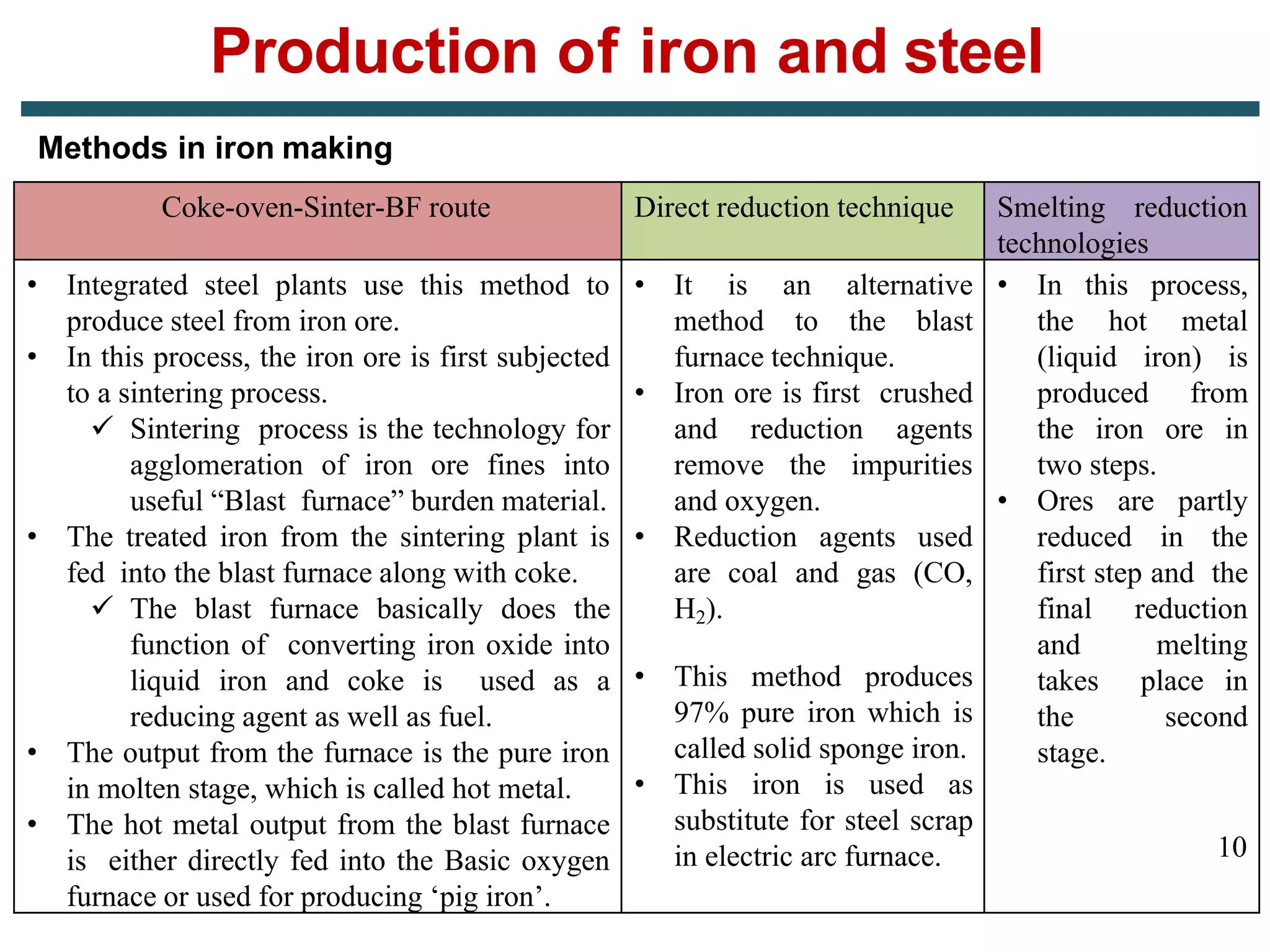
Coke-oven-Sinter-BF route Direct reduction technique Smelting reduction
technologies
• Integrated steel plants use this method to
produce steel from iron ore.
• In this process, the iron ore is first subjected
to a sintering process.
 Sintering process is the technology for
agglomeration of iron ore fines into
useful “Blast furnace” burden material.
• The treated iron from the sintering plant is
fed into the blast furnace along with coke.
 The blast furnace basically does the
function of converting iron oxide into
liquid iron and coke is used as a
reducing agent as well as fuel.
• The output from the furnace is the pure iron
in molten stage, which is called hot metal.
• The hot metal output from the blast furnace
is either directly fed into the Basic oxygen
furnace or used for producing ‘pig iron’.
• It is an alternative
method to the blast
furnace technique.
• Iron ore is first crushed
and reduction agents
remove the impurities
and oxygen.
• Reduction agents used
are coal and gas (CO,
H2).
• This method produces
97% pure iron which is
called solid sponge iron.
• This iron is used as
substitute for steel scrap
in electric arc furnace.
• In this process,
the hot metal
(liquid iron) is
produced from
the iron ore in
two steps.
• Ores are partly
reduced in the
first step and the
final reduction
and melting
takes place in
the second
stage.
10
Methods in iron making
Production of iron and steel
Processes used for smelting
Corex technique: More…
In this technique, coal is directly used in a
melter gesifier as an energy carrier and
reducing agent, thereby eliminating the
need for a blast furnace, sinter plant and
coke ovens.
• Hismelt
• Ausmelt
• Romelt
• Plasmasmelt
• Iron Smelting Reduction
(DIOS)
Methods used in iron making
Production of iron and steel
11
Department of Mechanical Engineering
Basics:
 The blast furnace is used to reduce
and convert iron oxides into liquid
iron called hot metal.
 The blast furnace is a steel stack lined
with fireproof bricks.
 Iron ore, coke and lime stone are put
into the top and preheated air is
blasted through the bottom.
 The combined mixture of the three
substances which are needed to
extract iron from its ore is called
charge.
 Iron ore or hematite: often
contains sand with iron ore, Fe2O3.
 Limestone: CaCO3.
 Coke: mainly carbon.
(Coke, limestone, iron ore)
Blast furnace: The iron making furnace
Production of iron and steel
12
Department of Mechanical Engineering
Blast furnace: The iron making furnace
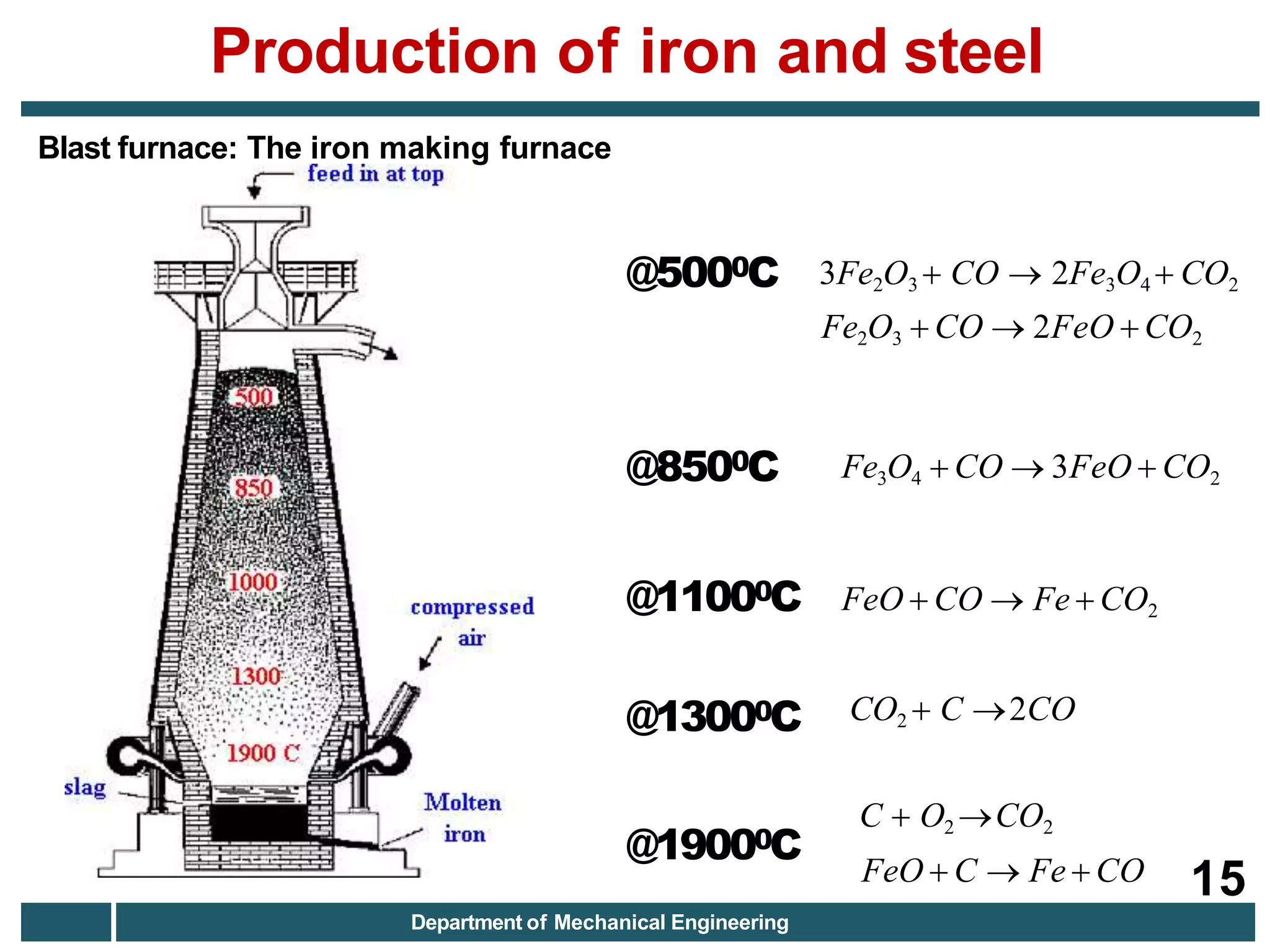
Reactions:
 Oxygen in the air reacts with coke to give
carbon dioxide. This is a heat generation stage.
 The limestone breaks down to form carbon
dioxide.
 Carbon dioxide produced in the two stages react
with more coke to produce carbon monoxide.
 The carbon monoxide reduces the iron in the ore
to give molten iron. this is a process of
reduction of iron ore into metal.
 The lime stone reacts with the sand to form slag
(calcium silicate). This is a purification stage.
 In this stage, Al2O3 could be added (sinter) for
stability of the blast furnace slag.
CaCO3  CaO CO2
C  O2  CO2
CO2  C 2CO
3CO  Fe2O3  2Fe  3CO2
CaO  SiO2  CaSi3(Slag)
CaO  SiO2  Al2O3 Slag
Production of iron and steel
13
Department of Mechanical Engineering
 The slag and iron are
drained from the bottom.
 Slag is used to build
roads.
 Molten iron is poured into
molds to solidify, which
is called cast iron.
 The rest of the molten
iron is used to make steel.
(Coke, limestone, iron ore)
Blast furnace: The iron making furnace
Production of iron and steel
14
Department of Mechanical Engineering
3Fe2O3  CO  2Fe3O4  CO2
Fe2O3  CO  2FeO  CO2
Fe3O4  CO  3FeO  CO2
FeO  CO  Fe  CO2
CO2  C 2CO
@19000C
C  O2 CO2
@5000C
@8500C
@11000C
@13000C
Blast furnace: The iron making furnace
Production of iron and steel
15
FeO  C  Fe  CO
Department of Mechanical Engineering
Iron making: Liquid iron flow into channel, pig iron
Production of iron and steel
16
Department of Mechanical Engineering
Steel making process
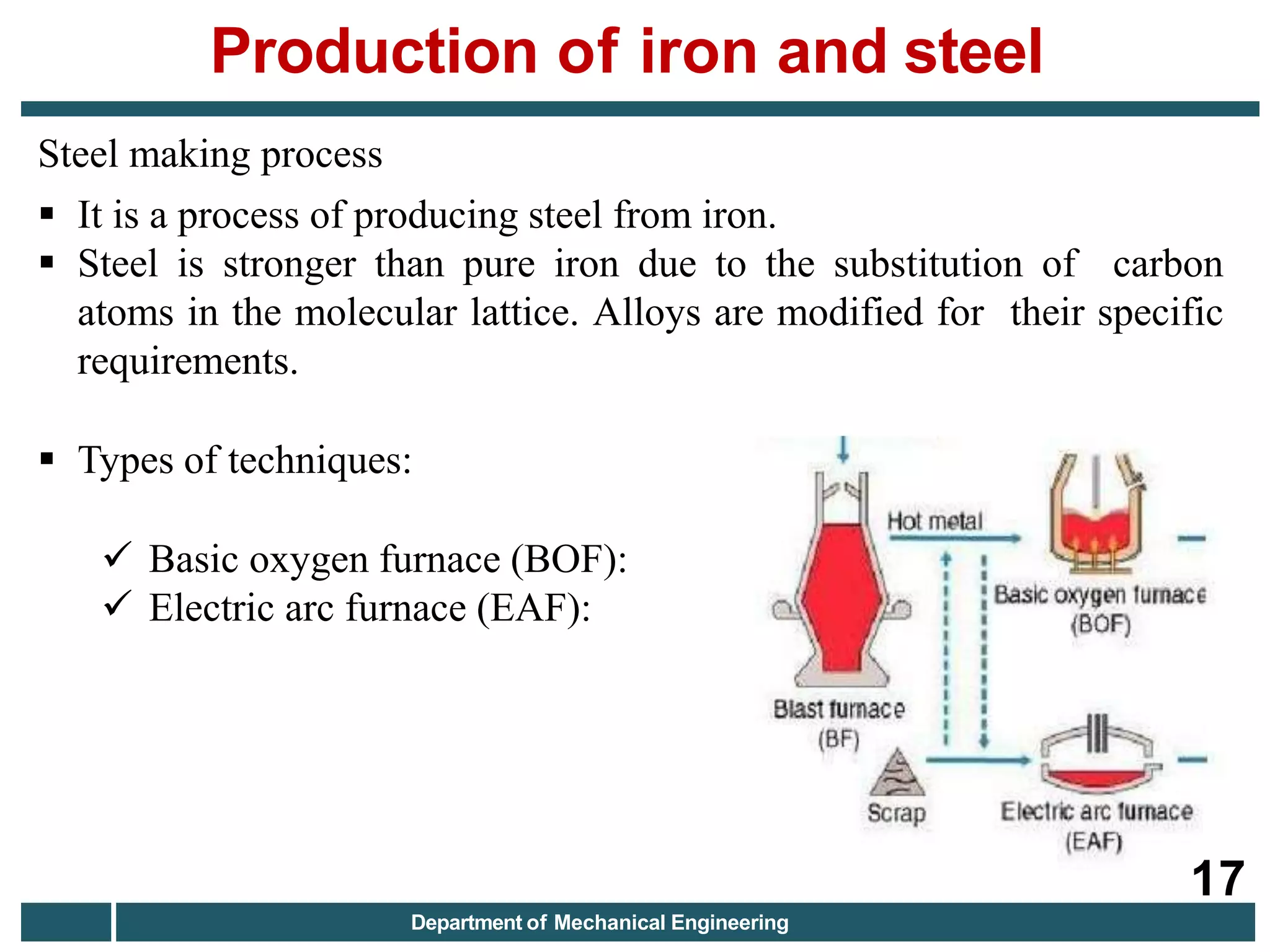
 It is a process of producing steel from iron.
 Steel is stronger than pure iron due to the substitution of carbon
atoms in the molecular lattice. Alloys are modified for their specific
requirements.
 Types of techniques:
 Basic oxygen furnace (BOF):
 Electric arc furnace (EAF):
Production of iron and steel
17
Department of Mechanical Engineering
Steel making process
Production of iron and steel
18
Department of Mechanical Engineering
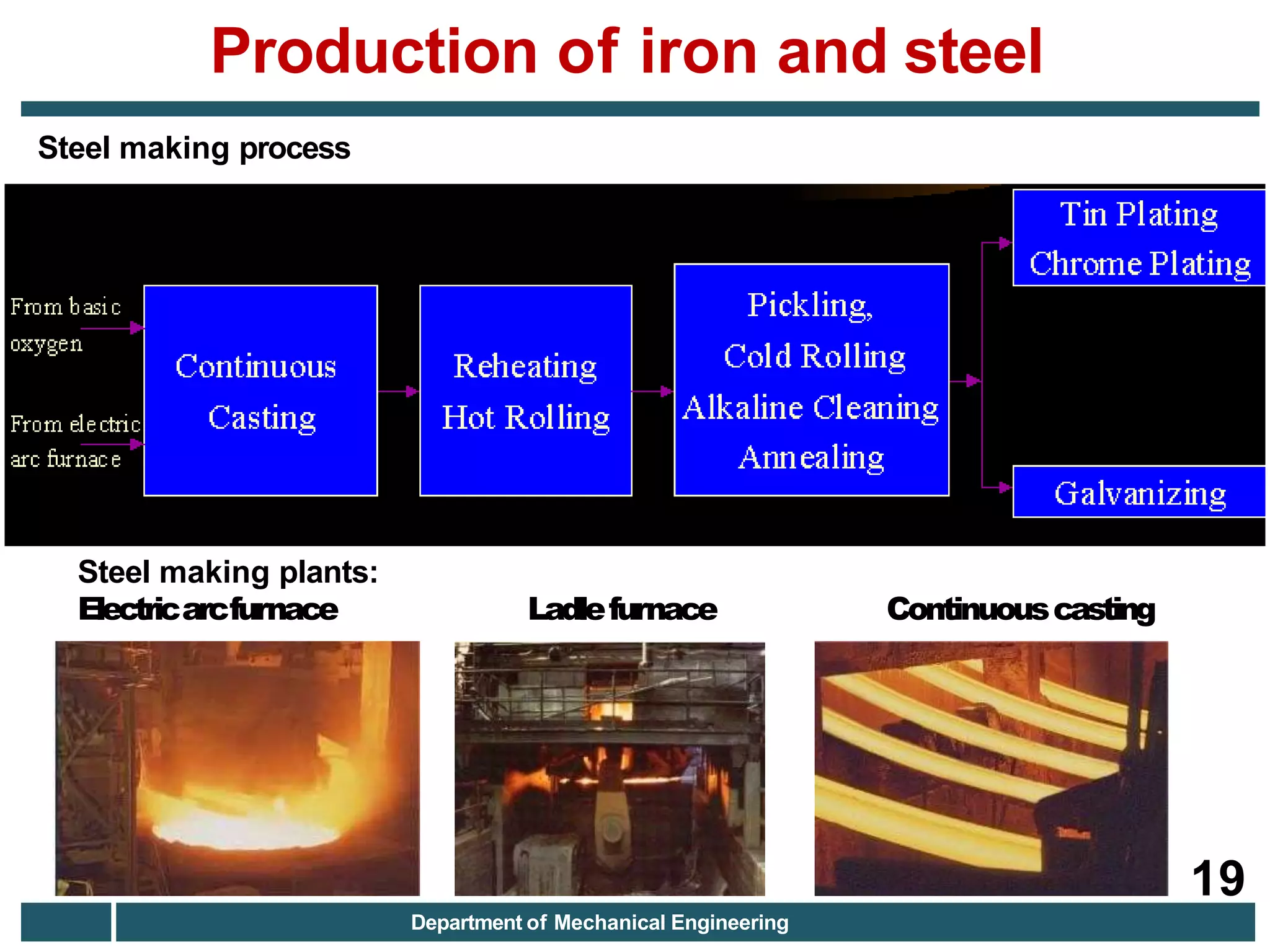
Steel making plants:
Electricarcfurnace Ladlefurnace Continuouscasting
Steel making process
Production of iron and steel
19
Department of Mechanical Engineering
Steel making process
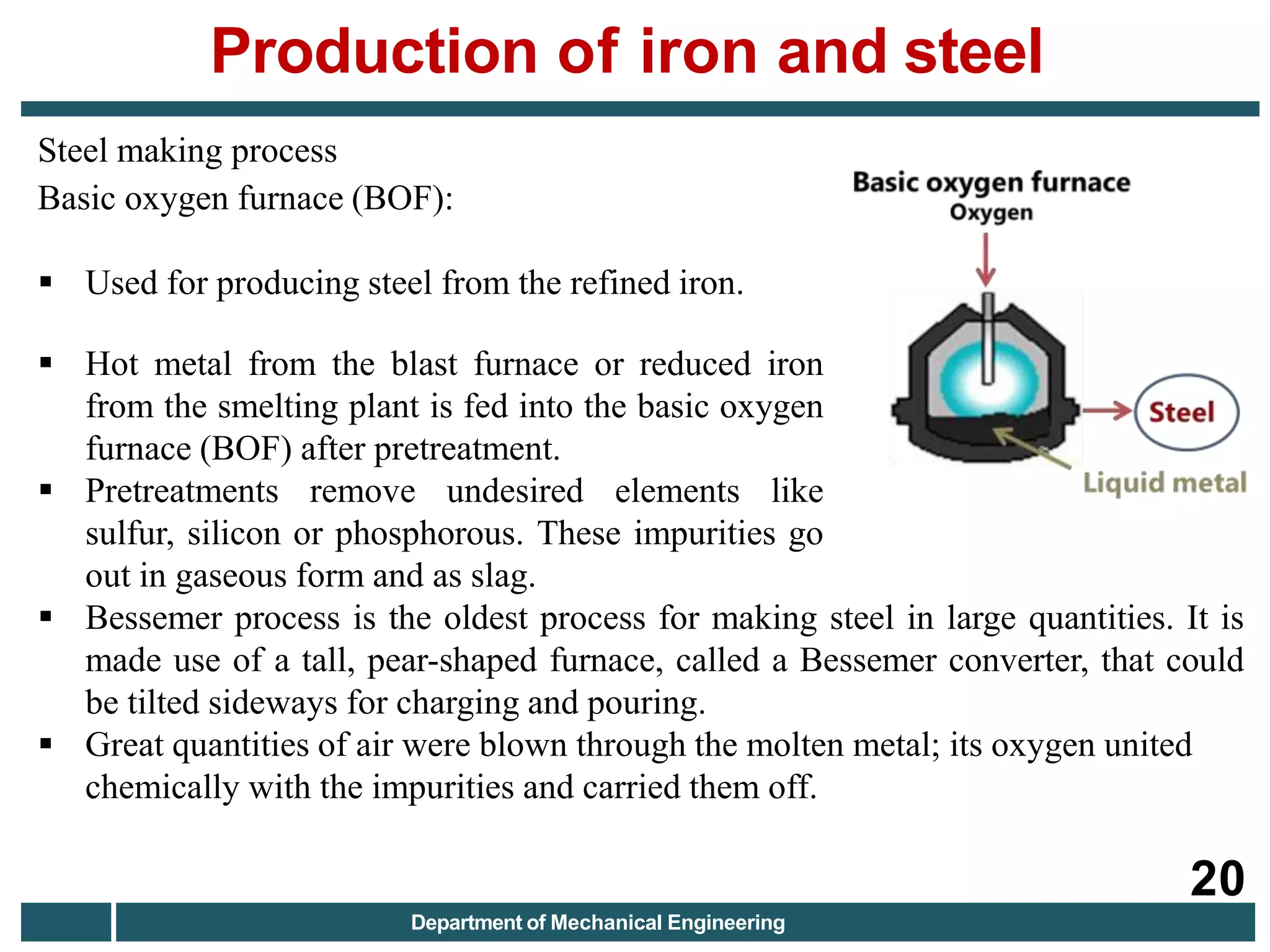
Basic oxygen furnace (BOF):
 Used for producing steel from the refined iron.
 Hot metal from the blast furnace or reduced iron
from the smelting plant is fed into the basic oxygen
furnace (BOF) after pretreatment.
 Pretreatments remove undesired elements like
sulfur, silicon or phosphorous. These impurities go
out in gaseous form and as slag.
 Bessemer process is the oldest process for making steel in large quantities. It is
made use of a tall, pear-shaped furnace, called a Bessemer converter, that could
be tilted sideways for charging and pouring.
 Great quantities of air were blown through the molten metal; its oxygen united
chemically with the impurities and carried them off.
Production of iron and steel
20
Department of Mechanical Engineering
Steel making process
Basic oxygen furnace (BOF):
Production of iron and steel
21
Department of Mechanical Engineering
Steel making process
Basic oxygen furnace (BOF):
Steps:
 The furnace is tilted sideways for charging.
 Air is replaced by a high-pressure stream of nearly pure oxygen and thousands
of cubic meters of oxygen are blown into the furnace at supersonic speed.
 After the furnace has been charged and turned upright, an oxygen lance is
lowered into it. The water-cooled tip of the lance is usually about 2m above the
charge although this distance can be varied according to requirements.
 The oxygen combines with carbon and other unwanted elements and starts a
high-temperature churning (mixing) reaction that rapidly burns out impurities
from the pig iron and converts it into steel.
 The refining process takes 50 min or less; approximately 275 metric tons of steel
can be made in an hour.
Production of iron and steel
22
Department of Mechanical Engineering
Steel making process
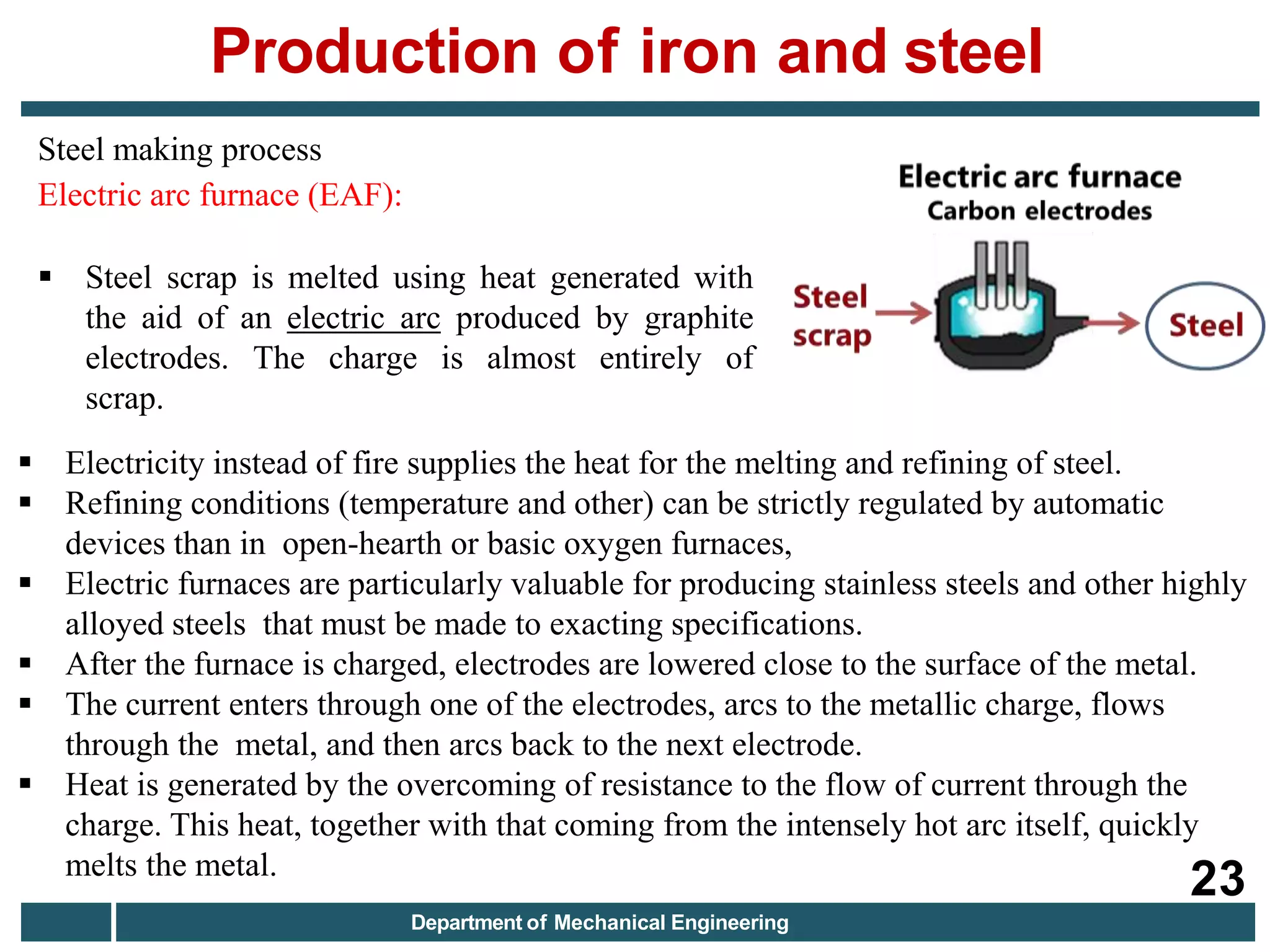
Electric arc furnace (EAF):
 Steel scrap is melted using heat generated with
the aid of an electric arc produced by graphite
electrodes. The charge is almost entirely of
scrap.
 Electricity instead of fire supplies the heat for the melting and refining of steel.
 Refining conditions (temperature and other) can be strictly regulated by automatic
devices than in open-hearth or basic oxygen furnaces,
 Electric furnaces are particularly valuable for producing stainless steels and other highly
alloyed steels that must be made to exacting specifications.
 After the furnace is charged, electrodes are lowered close to the surface of the metal.
 The current enters through one of the electrodes, arcs to the metallic charge, flows
through the metal, and then arcs back to the next electrode.
 Heat is generated by the overcoming of resistance to the flow of current through the
charge. This heat, together with that coming from the intensely hot arc itself, quickly
melts the metal.
Production of iron and steel
23
Department of Mechanical Engineering
Steel making process
Electric arc furnace (EAF):
Production of iron and steel
24
Department of Mechanical Engineering
Steel making process
 In this technique (EAF), the output is crude steel which is used in either ingots or
fed in the continuous casting process cycle.
Ingot:
• In 1950s, steel was poured into stationary molds to form "ingots".
• Molten steel cast in vertical cast iron molds intended for rolling after heating in
two stages (That is, in a primary mill and then in a finishing mill).
Continuous steel casting:
• It is the process of solidifying molten steel into a "semi-finished" billet, bloom,
or slab for subsequent rolling in the finishing mills.
• It eliminates the need for primary rolling of ingots.
• It results in an improved yield, quality, productivity and cost efficiency.
Production of iron and steel
25
Departrment of Mechanical Engineering
Steel making process
Process:
 The crude steel or liquid steel is
poured into a reciprocating
refractory-lined receptacle, called a
Tundish.
 Below the Tundish are water-
cooled copper molds of desired
size.
 The steel solidified in the molds is
slowly pulled out to produced an
“endless” strand, which is gas-cut
to desired length.
 This steel is called semi-finished
steel. The semi-finished steel is fed
into re-rolling mills to get finished
steel products.
Production of iron and steel
26
Department of Mechanical Engineering
Steel products
Finished carbon steel:
 Steel that has properties made up mostly of the element
carbon, and which relies on the carbon content for
structure.
 Finished carbon steel is classified as:
 Long products: used in the construction and engineering
industry and in the manufacturing sector. Examples:
rods, channels, angles and other structural material.
 Flat products: may be hot-rolled, cold-rolled or
galvanized and find use mainly in automobile,
shipbuilding and the white goods/consumer durable
sector.
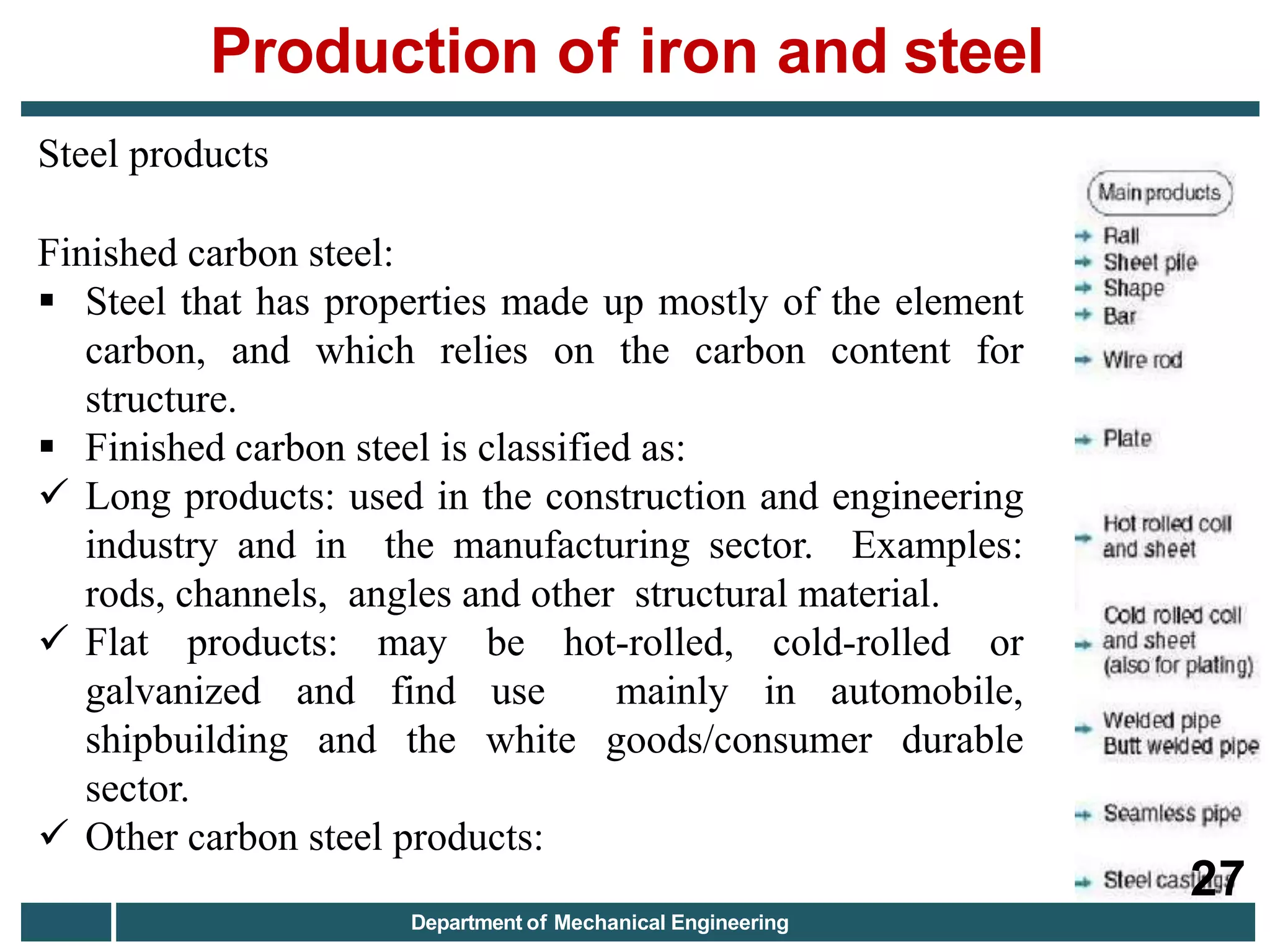
 Other carbon steel products:
Production of iron and steel
27
Department of Mechanical Engineering
Steel products
Finished alloy steel:
 Alloy steel is defined as a material containing iron, carbon (<2%), Si,
Mn plus alloy elements like Cr, V, Mo, W, N, Pb, Nb, Cu, etc.
 Stainless steel is alloy steel that contains more than 10% Cr with or
without other alloying elements.
 Stainless steel has special properties like high level of corrosion.
resistance and the ability to maintain its strength at high temperatures.
Production of iron and steel
28
Department of Mechanical Engineering
Steel Slabs Hot rolled plate
Hot rolled coil
Cold rolled coil
Steel products
Production of iron and steel
29
Department of Mechanical Engineering
Hot Dipped GalvanizedCoil Electro Galvanized Coil
Tin Plate coil Blooms (>= 0.25% of carbon bymass)
Steel products
Production of iron and steel
30
Department of Mechanical Engineering
Billets Reinforcing bar in coils
Wire-rod in coils Equal Angles (L-
sections)
Steel products
Production of iron and steel
31
Department of Mechanical Engineering
Sections (I-Beams) Channels
Rounds (Round bar) Flat Bar
Steel products
Production of iron and steel
32
Department of Mechanical Engineering
Rails Seamless Pipe
Welded Galvanized Steel Pipe
Steel products
Production of iron and steel
33
Department of Mechanical Engineering
References
1. William D. Callister, “Material Science and Engineering” An introduction,
7th edition, John Wiley & Sons
2. Brain S. Mitchell, “An introduction to materials engineering and science for
chemical and materials engineers”, Wiley Interscience.
3. Micheal F Ashby, “Material selection in mechanical design”, 2nd edition,
4. Veron John, “Introduction to Engineering Materials,” 3rd edition,
Macmillan
5. Micheal F Ashby, David R. H. Jones, “Engineering Materials 1, 2”, 2nd
edition,
6. Butterworth Michael Ashby, Hugh Shercliff, and David Cebon, Materials:
“Engineering, Science, Processing and Design”, Mar 30, 2007
7. Flinn and Paul K. Trojan, “Engineering Materials and their applications”,
Dec 12, 1994
35
Department of Mechanical Engineering
THANK YOU!

Mat ii chapter 2.1

  • 1.
    Production of ironand steel By Asegid Tadesse Wollega University, Ethiopia
  • 2.
    Objectives This chapter aimsin understanding of: Part 1:  Classification of ferrous metals  Steel and alloy steels  Cast iron  Wrought iron Part 2:  Heat treatment of plain carbon steels Part 3:  Production of iron and steel 2 Department of Mechanical Engineering
  • 3.
    Iron and Steel Whatis Iron?  Iron is a strong, hard, heavy gray metal.  Iron is produced by melting iron ore (mineral compounds in the earth's crust – 5% of the Earth's crust is iron ) and removing impurities. • Pig iron • Wrought iron What is steel?  Steel is simply a purified form of iron with lower carbon content.  It can be produced from molten iron ore with blast of air (BOF), Electric arc furnace, Bessemer converter. Production of iron and steel 3 Department of Mechanical Engineering
  • 4.
    Iron and Steel Applications?  Cutting tools, pressure vessels, bolts, hammers, gears, cutlery, jet engine parts, car bodies, screws, concrete reinforcement, ‘tin’ cans, bridges…  Why?  Ore is cheap and abundant.  Economical processing techniques (extraction, refining, alloying, fabrication) are economical.  High strength.  Very versatile metallurgy – a wide range of mechanical and physical properties can be achieved, and these can be tailored to the application.  Disadvantage?  Low corrosion resistance (instead use titanium, brass).  High density: 7.9 g/cm3 (instead use Al, Mg).  High temperature strength could be better (instead use Ni). Production of iron and steel 4 Department of Mechanical Engineering
  • 5.
    History:  Period ofstarting smelting of iron ore to produce usable metal is not exactly known.  Earliest iron implements, discovered in Egypt, about 3000 BC  The process of refining molten iron with blasts of air was accomplished by the British inventor Sir Henry Bessemer who developed the Bessemer furnace, or converter, in 1855.  Since the 1960s, several so-called mini-mills have been producing steel from scrap metal in electric furnaces.  Besides these mini-mills, the giant steel mills remain essential for the production of steel from iron ore. Production of iron and steel 5 Department of Mechanical Engineering
  • 6.
    Composition (Example:Carbon,lowalloyorstainlesssteel) Manufacturing method(Example:Openhearth,basicoxygenprocess,electricfurnace) Finishing method (Example:Hotrolling,coldrolling) Product form (Example:Barplate,sheet,strip,tubing, or structuralshape) The deoxidation process (Example:Killed,semi-killed,capped,and rimmed) Microstructure (Example:Ferritic,pearlitic,martensitic) Required strength level (asspecifiedinASTMstandards) Heat treatment (Example:Annealing,tempering,thermo-mechanicalprocessing) Quality descriptors (Example:Forgingquality ,commercial quality) Steel can be classified based on: Production of iron and steel 6 Department of Mechanical Engineering
  • 7.
    Manufacturing process foriron and steel Production of iron and steel 7 Department of Mechanical Engineering
  • 8.
    Steel production Raw materials:  Coal Fuel  Pallets lump ore  Ore dust  Alloying medium Common iron ores:  Hematite(Fe2O3) o 70% iron.  Magnetite(Fe3O4) o 72% iron.  Limonite(Fe2O3+H2O) o 50% to 66% iron.  Siderite (FeCO3) o 48% iron • It is a process of producing iron from iron ore. • Iron making is done by using a vertical shaft furnace called a blast furnace.  Iron ore, coke and limestone are charged.  Hot air (~12000C) is pumped into the bottom of the blast furnace.  Limestone attracts impurities, a “slag” forms and floats on top of the molten iron.  Iron is drawn off or “tapped” and poured into molds, known as pig iron. • Methods:  Coke-oven-Sinter-BF route  Direct reduction technique  Smelting reduction technologies Scrap and pig iron into furnace Steps in the production of pig iron and steel Raw material Production of pig iron Production of iron and steel 8 Department of Mechanical Engineering
  • 9.
    Step 1: Rawmaterial Step 3: Steel production Step 2: Pig iron production Manufacturing process for iron and steel, Process Production of iron and steel 9 Department of Mechanical Engineering
  • 10.
    Coke-oven-Sinter-BF route Directreduction technique Smelting reduction technologies • Integrated steel plants use this method to produce steel from iron ore. • In this process, the iron ore is first subjected to a sintering process.  Sintering process is the technology for agglomeration of iron ore fines into useful “Blast furnace” burden material. • The treated iron from the sintering plant is fed into the blast furnace along with coke.  The blast furnace basically does the function of converting iron oxide into liquid iron and coke is used as a reducing agent as well as fuel. • The output from the furnace is the pure iron in molten stage, which is called hot metal. • The hot metal output from the blast furnace is either directly fed into the Basic oxygen furnace or used for producing ‘pig iron’. • It is an alternative method to the blast furnace technique. • Iron ore is first crushed and reduction agents remove the impurities and oxygen. • Reduction agents used are coal and gas (CO, H2). • This method produces 97% pure iron which is called solid sponge iron. • This iron is used as substitute for steel scrap in electric arc furnace. • In this process, the hot metal (liquid iron) is produced from the iron ore in two steps. • Ores are partly reduced in the first step and the final reduction and melting takes place in the second stage. 10 Methods in iron making Production of iron and steel
  • 11.
    Processes used forsmelting Corex technique: More… In this technique, coal is directly used in a melter gesifier as an energy carrier and reducing agent, thereby eliminating the need for a blast furnace, sinter plant and coke ovens. • Hismelt • Ausmelt • Romelt • Plasmasmelt • Iron Smelting Reduction (DIOS) Methods used in iron making Production of iron and steel 11 Department of Mechanical Engineering
  • 12.
    Basics:  The blastfurnace is used to reduce and convert iron oxides into liquid iron called hot metal.  The blast furnace is a steel stack lined with fireproof bricks.  Iron ore, coke and lime stone are put into the top and preheated air is blasted through the bottom.  The combined mixture of the three substances which are needed to extract iron from its ore is called charge.  Iron ore or hematite: often contains sand with iron ore, Fe2O3.  Limestone: CaCO3.  Coke: mainly carbon. (Coke, limestone, iron ore) Blast furnace: The iron making furnace Production of iron and steel 12 Department of Mechanical Engineering
  • 13.
    Blast furnace: Theiron making furnace Reactions:  Oxygen in the air reacts with coke to give carbon dioxide. This is a heat generation stage.  The limestone breaks down to form carbon dioxide.  Carbon dioxide produced in the two stages react with more coke to produce carbon monoxide.  The carbon monoxide reduces the iron in the ore to give molten iron. this is a process of reduction of iron ore into metal.  The lime stone reacts with the sand to form slag (calcium silicate). This is a purification stage.  In this stage, Al2O3 could be added (sinter) for stability of the blast furnace slag. CaCO3  CaO CO2 C  O2  CO2 CO2  C 2CO 3CO  Fe2O3  2Fe  3CO2 CaO  SiO2  CaSi3(Slag) CaO  SiO2  Al2O3 Slag Production of iron and steel 13 Department of Mechanical Engineering
  • 14.
     The slagand iron are drained from the bottom.  Slag is used to build roads.  Molten iron is poured into molds to solidify, which is called cast iron.  The rest of the molten iron is used to make steel. (Coke, limestone, iron ore) Blast furnace: The iron making furnace Production of iron and steel 14 Department of Mechanical Engineering
  • 15.
    3Fe2O3  CO 2Fe3O4  CO2 Fe2O3  CO  2FeO  CO2 Fe3O4  CO  3FeO  CO2 FeO  CO  Fe  CO2 CO2  C 2CO @19000C C  O2 CO2 @5000C @8500C @11000C @13000C Blast furnace: The iron making furnace Production of iron and steel 15 FeO  C  Fe  CO Department of Mechanical Engineering
  • 16.
    Iron making: Liquidiron flow into channel, pig iron Production of iron and steel 16 Department of Mechanical Engineering
  • 17.
    Steel making process It is a process of producing steel from iron.  Steel is stronger than pure iron due to the substitution of carbon atoms in the molecular lattice. Alloys are modified for their specific requirements.  Types of techniques:  Basic oxygen furnace (BOF):  Electric arc furnace (EAF): Production of iron and steel 17 Department of Mechanical Engineering
  • 18.
    Steel making process Productionof iron and steel 18 Department of Mechanical Engineering
  • 19.
    Steel making plants: ElectricarcfurnaceLadlefurnace Continuouscasting Steel making process Production of iron and steel 19 Department of Mechanical Engineering
  • 20.
    Steel making process Basicoxygen furnace (BOF):  Used for producing steel from the refined iron.  Hot metal from the blast furnace or reduced iron from the smelting plant is fed into the basic oxygen furnace (BOF) after pretreatment.  Pretreatments remove undesired elements like sulfur, silicon or phosphorous. These impurities go out in gaseous form and as slag.  Bessemer process is the oldest process for making steel in large quantities. It is made use of a tall, pear-shaped furnace, called a Bessemer converter, that could be tilted sideways for charging and pouring.  Great quantities of air were blown through the molten metal; its oxygen united chemically with the impurities and carried them off. Production of iron and steel 20 Department of Mechanical Engineering
  • 21.
    Steel making process Basicoxygen furnace (BOF): Production of iron and steel 21 Department of Mechanical Engineering
  • 22.
    Steel making process Basicoxygen furnace (BOF): Steps:  The furnace is tilted sideways for charging.  Air is replaced by a high-pressure stream of nearly pure oxygen and thousands of cubic meters of oxygen are blown into the furnace at supersonic speed.  After the furnace has been charged and turned upright, an oxygen lance is lowered into it. The water-cooled tip of the lance is usually about 2m above the charge although this distance can be varied according to requirements.  The oxygen combines with carbon and other unwanted elements and starts a high-temperature churning (mixing) reaction that rapidly burns out impurities from the pig iron and converts it into steel.  The refining process takes 50 min or less; approximately 275 metric tons of steel can be made in an hour. Production of iron and steel 22 Department of Mechanical Engineering
  • 23.
    Steel making process Electricarc furnace (EAF):  Steel scrap is melted using heat generated with the aid of an electric arc produced by graphite electrodes. The charge is almost entirely of scrap.  Electricity instead of fire supplies the heat for the melting and refining of steel.  Refining conditions (temperature and other) can be strictly regulated by automatic devices than in open-hearth or basic oxygen furnaces,  Electric furnaces are particularly valuable for producing stainless steels and other highly alloyed steels that must be made to exacting specifications.  After the furnace is charged, electrodes are lowered close to the surface of the metal.  The current enters through one of the electrodes, arcs to the metallic charge, flows through the metal, and then arcs back to the next electrode.  Heat is generated by the overcoming of resistance to the flow of current through the charge. This heat, together with that coming from the intensely hot arc itself, quickly melts the metal. Production of iron and steel 23 Department of Mechanical Engineering
  • 24.
    Steel making process Electricarc furnace (EAF): Production of iron and steel 24 Department of Mechanical Engineering
  • 25.
    Steel making process In this technique (EAF), the output is crude steel which is used in either ingots or fed in the continuous casting process cycle. Ingot: • In 1950s, steel was poured into stationary molds to form "ingots". • Molten steel cast in vertical cast iron molds intended for rolling after heating in two stages (That is, in a primary mill and then in a finishing mill). Continuous steel casting: • It is the process of solidifying molten steel into a "semi-finished" billet, bloom, or slab for subsequent rolling in the finishing mills. • It eliminates the need for primary rolling of ingots. • It results in an improved yield, quality, productivity and cost efficiency. Production of iron and steel 25 Departrment of Mechanical Engineering
  • 26.
    Steel making process Process: The crude steel or liquid steel is poured into a reciprocating refractory-lined receptacle, called a Tundish.  Below the Tundish are water- cooled copper molds of desired size.  The steel solidified in the molds is slowly pulled out to produced an “endless” strand, which is gas-cut to desired length.  This steel is called semi-finished steel. The semi-finished steel is fed into re-rolling mills to get finished steel products. Production of iron and steel 26 Department of Mechanical Engineering
  • 27.
    Steel products Finished carbonsteel:  Steel that has properties made up mostly of the element carbon, and which relies on the carbon content for structure.  Finished carbon steel is classified as:  Long products: used in the construction and engineering industry and in the manufacturing sector. Examples: rods, channels, angles and other structural material.  Flat products: may be hot-rolled, cold-rolled or galvanized and find use mainly in automobile, shipbuilding and the white goods/consumer durable sector.  Other carbon steel products: Production of iron and steel 27 Department of Mechanical Engineering
  • 28.
    Steel products Finished alloysteel:  Alloy steel is defined as a material containing iron, carbon (<2%), Si, Mn plus alloy elements like Cr, V, Mo, W, N, Pb, Nb, Cu, etc.  Stainless steel is alloy steel that contains more than 10% Cr with or without other alloying elements.  Stainless steel has special properties like high level of corrosion. resistance and the ability to maintain its strength at high temperatures. Production of iron and steel 28 Department of Mechanical Engineering
  • 29.
    Steel Slabs Hotrolled plate Hot rolled coil Cold rolled coil Steel products Production of iron and steel 29 Department of Mechanical Engineering
  • 30.
    Hot Dipped GalvanizedCoilElectro Galvanized Coil Tin Plate coil Blooms (>= 0.25% of carbon bymass) Steel products Production of iron and steel 30 Department of Mechanical Engineering
  • 31.
    Billets Reinforcing barin coils Wire-rod in coils Equal Angles (L- sections) Steel products Production of iron and steel 31 Department of Mechanical Engineering
  • 32.
    Sections (I-Beams) Channels Rounds(Round bar) Flat Bar Steel products Production of iron and steel 32 Department of Mechanical Engineering
  • 33.
    Rails Seamless Pipe WeldedGalvanized Steel Pipe Steel products Production of iron and steel 33 Department of Mechanical Engineering
  • 34.
    References 1. William D.Callister, “Material Science and Engineering” An introduction, 7th edition, John Wiley & Sons 2. Brain S. Mitchell, “An introduction to materials engineering and science for chemical and materials engineers”, Wiley Interscience. 3. Micheal F Ashby, “Material selection in mechanical design”, 2nd edition, 4. Veron John, “Introduction to Engineering Materials,” 3rd edition, Macmillan 5. Micheal F Ashby, David R. H. Jones, “Engineering Materials 1, 2”, 2nd edition, 6. Butterworth Michael Ashby, Hugh Shercliff, and David Cebon, Materials: “Engineering, Science, Processing and Design”, Mar 30, 2007 7. Flinn and Paul K. Trojan, “Engineering Materials and their applications”, Dec 12, 1994 35 Department of Mechanical Engineering
  • 35.