Metallurgical
Engineering
(MT2006D)
Course Evaluation Policy
Mid Exam: 30 Marks
Quiz/Assignment: 30 Marks
End Exam: 40 Marks
Relative grading
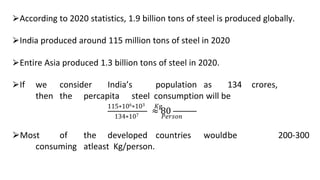
⮚According to 2020 statistics, 1.9 billion tons of steel is produced globally.
⮚India produced around 115 million tons of steel in 2020
⮚Entire Asia produced 1.3 billion tons of steel in 2020.
⮚If we consider India’s population as 134 crores,
then the percapita steel consumption will be
≈ 80
115∗106∗103 𝐾g
134∗107 𝑃𝑒𝑟𝑠𝑜𝑛
⮚Most of the developed countries wouldbe
consuming atleast Kg/person.
200-300
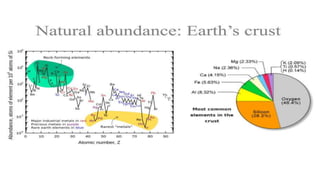
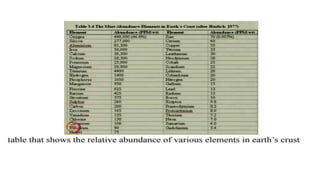
⮚Iron is available in abundance in the earth’s crust relative to copper, zinc
etc.
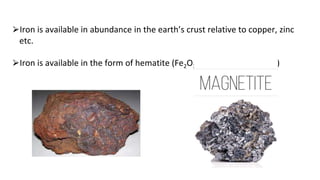
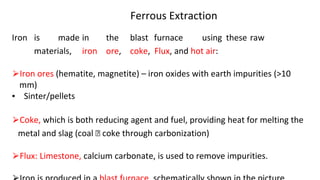
⮚Iron is available in the form of hematite (Fe2O3) or Magnetite (Fe3O4)
Ferrous Extraction
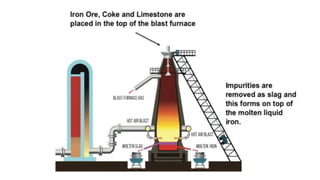
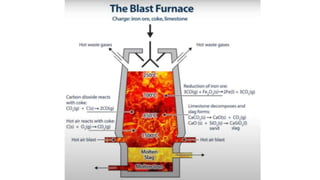
Iron is made in the blast furnace using these raw
materials, iron ore, coke, Flux, and hot air:
⮚Iron ores (hematite, magnetite) – iron oxides with earth impurities (>10
mm)
▪ Sinter/pellets
⮚Coke, which is both reducing agent and fuel, providing heat for melting the
metal and slag (coal 🡪 coke through carbonization)
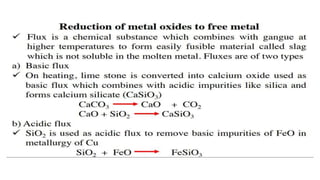
⮚Flux: Limestone, calcium carbonate, is used to remove impurities.
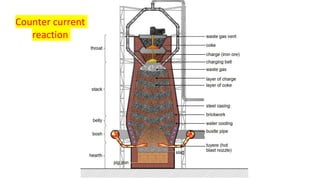
Counter current
reaction
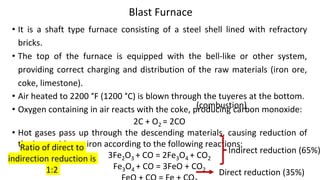
Blast Furnace
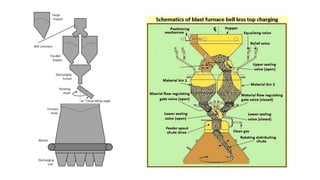
• It is a shaft type furnace consisting of a steel shell lined with refractory
bricks.
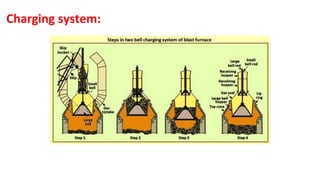
• The top of the furnace is equipped with the bell-like or other system,
providing correct charging and distribution of the raw materials (iron ore,
coke, limestone).
• Air heated to 2200 °F (1200 °C) is blown through the tuyeres at the bottom.
• Oxygen containing in air reacts with the coke, producing carbon monoxide:
2C + O2 = 2CO
• Hot gases pass up through the descending materials, causing reduction of
the iron oxides to iron according to the following reactions:
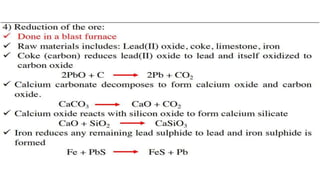
3Fe2O3 + CO = 2Fe3O4 + CO2
Fe3O4 + CO = 3FeO + CO2
Indirect reduction (65%)
Direct reduction (35%)
Ratio of direct to
indirection reduction is
1:2
(combustion)
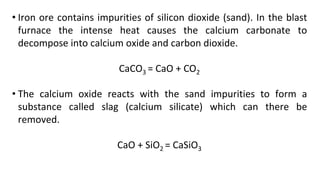
• Iron ore contains impurities of silicon dioxide (sand). In the blast
furnace the intense heat causes the calcium carbonate to
decompose into calcium oxide and carbon dioxide.
CaCO3 = CaO + CO2
• The calcium oxide reacts with the sand impurities to form a
substance called slag (calcium silicate) which can there be
removed.
CaO + SiO2 = CaSiO3
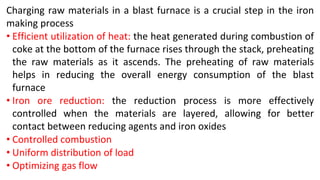
Charging system:
Charging raw materials in a blast furnace is a crucial step in the iron
making process
• Efficient utilization of heat: the heat generated during combustion of
coke at the bottom of the furnace rises through the stack, preheating
the raw materials as it ascends. The preheating of raw materials
helps in reducing the overall energy consumption of the blast
furnace
• Iron ore reduction: the reduction process is more effectively
controlled when the materials are layered, allowing for better
contact between reducing agents and iron oxides
• Controlled combustion
• Uniform distribution of load
• Optimizing gas flow
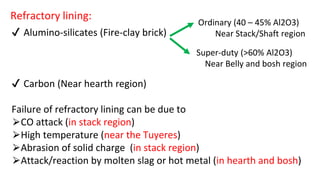
Refractory lining:
✔ Alumino-silicates (Fire-clay brick)
✔ Carbon (Near hearth region)
Failure of refractory lining can be due to
⮚CO attack (in stack region)
⮚High temperature (near the Tuyeres)
⮚Abrasion of solid charge (in stack region)
⮚Attack/reaction by molten slag or hot metal (in hearth and bosh)
Ordinary (40 – 45% Al2O3)
Near Stack/Shaft region
Super-duty (>60% Al2O3)
Near Belly and bosh region
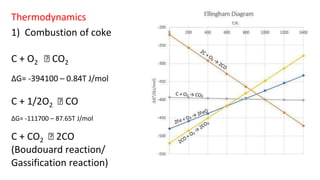
1) Combustion of coke
C + O2 🡪 CO2
ΔG= -394100 – 0.84T J/mol
C + 1/2O2 🡪 CO
ΔG= -111700 – 87.65T J/mol
C + CO2 🡪 2CO
(Boudouard reaction/
Gassification reaction)
Thermodynamics
Output from Blast Furnace
⮚Molten iron
⮚Molten slag
⮚Top gases (N2 + CO+ CO2)
• Iron in the form of a spongy mass moves down and its
temperature reaches the melting point at the bottom regions of
the furnace where it melts and accumulates.
• The gangue, ash and other fractions of ore and coke are mixed by
fluxes, forming slag which is capable to absorb Sulphur and other
impurities.
• The furnace is periodically tapped and the melt (pig iron) is
poured into ladles, which are transferred to cast iron and steel
making furnaces.
• Pig iron usually contains 3-4% of carbon, 2-4% of silicon, 1-2% of
manganese and 1-1.2% of phosphorous.
Major constituents of slag
• SiO2 (30-35%), Al2O3 (1.8-2.5%)
• CaO (28-25%), MgO (1-6%)
• MnO, P2O5
• The viscosity of the slag should be less for easy removal
Major
Minor
Major impurities in pig iron
1) Silicon
This element comes from the sand or other minerals mixed with the iron ore. It
can make the iron brittle and hard to work with. In the blast furnace, silicon
reacts with limestone (CaCO3) to form calcium silicate (CaSiO3), which floats on
top of the molten iron as slag
2) Carbon
3) Sulfur
This element can come from iron ore or the coke. It makes the steel hot-short
(high temperature). In the blast furnace, sulfur reacts with calcium oxide (CaO)
from the limestone to form calcium sulfide (CaS), which goes into slag
4) Phosphorous
this element can make the steel cold-short (low temperature). It is usually
removed by adding manganese to the molten iron, which forms manganese
phosphate that goes into the slag
5) Manganese
SiO2 + C 🡪 SiO + CO
SiO2 + 3C 🡪 SiC + 2CO
SiO+ 2C
SiO + [C] 🡪 [Si] +CO
2SiO 🡪 SiO2 + [Si]
FeO + SiO 🡪 [Fe] +SiO2
How to decrease the Si in the hot metal?
High blast pressure
Silicon
(Si)
CO
[] 🡪 dissolved state
Le Chatelier’s principle
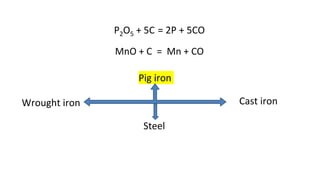
P2O5 + 5C = 2P + 5CO
MnO + C = Mn + CO
Pig iron
Wrought iron
Steel
Cast iron
Cast iron manufacturing process
• Cast iron is manufactured by re-melting pig iron
with coke and limestone
• This is done in a furnace known as cupola furnace
• Cupola furnace was first built in china in the warring states period
(403-221 BC)
• Generally cupolas are not worked continuously like blast furnaces
but are run only when required.
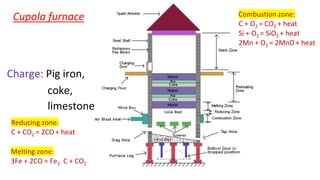
Cupola furnace
Charge: Pig iron,
coke,
limestone
Combustion zone:
C + O2 = CO2 + heat
Si + O2 = SiO2 + heat
2Mn + O2 = 2MnO+ heat
Reducing zone:
C + CO2 = 2CO + heat
Melting zone:
3Fe + 2CO = Fe3 C + CO2
• Cupola shell is made of steel and has a lining of refractory brick
• The bottom of the shell is lined with clay and sand mixture and it
is a temporary lining.
Parts of cupola furnace
1) Cylindrical shell: It is the outermost part of the furnace. It is
made up of steel and other parts of this furnace are present
inside this shell
1) Legs: Legs are provided at the bottom of the furnace to support
the furnace
3) Sand bed: It is in tapered form so that the melted iron can flow
easily
3) Slag hole: it is present at the opposite side of the hole from
which cast iron comes out. It is present near the elevated part of
the sand bed. It is used to remove slag formed on melted iron
due to impurities.
3) Air pipe and Tuyers: Air pipe is provided to allow the air to reach
inside the furnace through the tuyers.
3) Spark arrestor or cap of furnace: it is present at the top of the
furnace. It is used to capture the burning particles and only
allow the gas to pass to the environment.
7) Charging door: it is present near the top of the furnace. The
charge in this furnace are pig iron, coke and limestone. Coke is
used for combustion and limestone is used as flux
7) Well: the part of the furnace from sand bed to lower part of
tuyers is known as well. Molten iron is stored in well and comes
out from the tapping hole.
7) Combustion zone: Combustion takes place in this zone. The air
from tuyers reacts with carbon to form carbon di oxide. It is also
known as oxidizing zone.
7) Reducing zone: it is above the combustion zone. In this zone
carbon reacts with carbon dioxide to form carbon monoxide.
7) Melting zone: in this zone iron melts and the molten iron comes
out of the tap hole. The temperature of this zone is very high
nearly 1600 ℃.
7) Preheating zone: the metal to be melted is preheated in this
zone. The temperature in this zone is around 1090 ℃
7) Stack zone: In this zone the charge is staked in layer form.
Advantages of cupola
furnace
✔Simple in construction
✔Wide rage of materials can be melted
✔Less floor space is required
✔Very skilled operators are not required
✔Low cost of operation
✔Low cost of maintenance
Disadvantages of cupola furnace
✔Very hard to control the temperature in the furnace
✔Some metals are converted to their oxide which are not suitable
for casting
• Conventional routefor making steel consists of
sintering or pelletization plants, coke ovens, blast furnaces.
• Coking coke is needed to make coke strong enough to support the
burden in the blast furnace.
• This requires high capital expenses and raw materials of stringent
specifications.
• Thecoke ovens and sintering plants in an
integrated steel plant are polluting and expensive units.
• Over years, the hot metal production from the blast furnace has
decreased due to the unavailability of high grade coke.
• Alternative iron production is feasible in the places where high
grade coal (coking coal) is not available but low grade coal (non-
coking coal) or natural gas is available
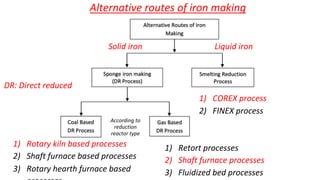
Alternative routes of iron making
Solid iron Liquid iron
DR: Direct reduced
1) Retort processes
2) Shaft furnace processes
3) Fluidized bed processes
1) COREX process
2) FINEX process
According to
reduction
reactor type
1) Rotary kiln based processes
2) Shaft furnace based processes
3) Rotary hearth furnace based
• From DRI, iron is produced from direct reduction of iron ore
(in the form of lumps, pellets or fines) by a reducing gas (H2, CO)
produced from natural gas or coal.
• DR process convert iron ore into sponge iron at temperature
below the melting point of iron.
• DR process differ from conventional blast furnace in two ways
1) Solid metallized product is produced
2) A wide variety of reductantscan be used in the
placeof high grade coke
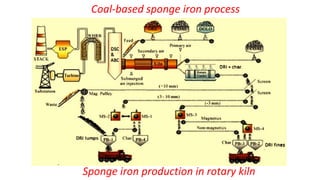
Sponge iron production in rotary kiln
Coal-based sponge iron process
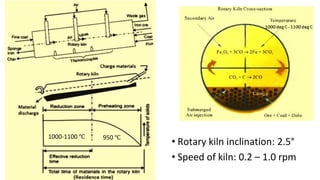
• Rotary kiln inclination: 2.5°
• Speed of kiln: 0.2 – 1.0 rpm
1000-1100 ℃ 950 ℃
• Coal based direct reduction rotary kiln process was developed for
converting iron ore directly into metallic iron without melting.
Hence the produced iron has highly porous structure and gives a
sponge appearance.
• As iron ore is in direct contact with the reducing agent throughout
the reduction process, it is called direct reduced iron.
• Raw material mix consisting of iron ore, dolomite and non-coking
coal is fed at one end of the rotary kiln and is heated by coal
burner to produce DRI.
• The produced DRI along with char is taken out from the other end
of the kiln.
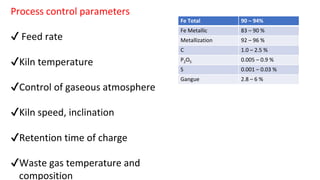
Process control parameters
✔ Feed rate
✔Kiln temperature
✔Control of gaseous atmosphere
✔Kiln speed, inclination
✔Retention time of charge
✔Waste gas temperature and
composition
Fe Total 90 – 94%
Fe Metallic 83 – 90 %
Metallization 92 – 96 %
C 1.0 – 2.5 %
P2O5 0.005 – 0.9 %
S 0.001 – 0.03 %
Gangue 2.8 – 6 %
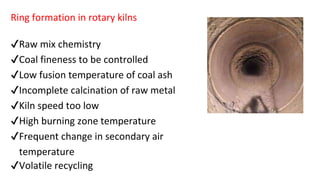
Ring formation in rotary kilns
✔Raw mix chemistry
✔Coal fineness to be controlled
✔Low fusion temperature of coal ash
✔Incomplete calcination of raw metal
✔Kiln speed too low
✔High burning zone temperature
✔Frequent change in secondary air
temperature
✔Volatile recycling
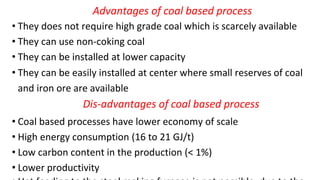
Advantages of coal based process
• They does not require high grade coal which is scarcely available
• They can use non-coking coal
• They can be installed at lower capacity
• They can be easily installed at center where small reserves of coal
and iron ore are available
Dis-advantages of coal based process
• Coal based processes have lower economy of scale
• High energy consumption (16 to 21 GJ/t)
• Low carbon content in the production (< 1%)
• Lower productivity
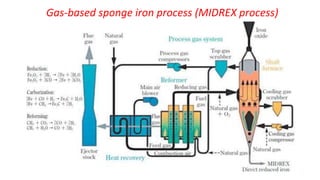
Gas-based sponge iron process (MIDREX process)
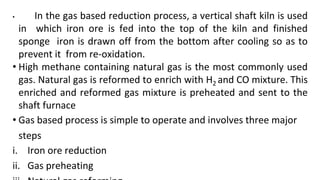
• In the gas based reduction process, a vertical shaft kiln is used
in which iron ore is fed into the top of the kiln and finished
sponge iron is drawn off from the bottom after cooling so as to
prevent it from re-oxidation.
• High methane containing natural gas is the most commonly used
gas. Natural gas is reformed to enrich with H2 and CO mixture. This
enriched and reformed gas mixture is preheated and sent to the
shaft furnace
• Gas based process is simple to operate and involves three major
steps
i. Iron ore reduction
ii. Gas preheating
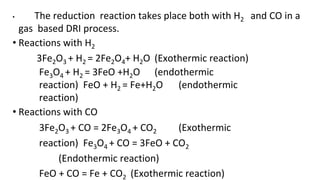
• The reduction reaction takes place both with H2 and CO in a
gas based DRI process.
• Reactions with H2
3Fe2O3 + H2 = 2Fe2O4+ H2O (Exothermic reaction)
Fe3O4 + H2 = 3FeO +H2O (endothermic
reaction) FeO + H2 = Fe+H2O (endothermic
reaction)
• Reactions with CO
3Fe2O3 + CO = 2Fe3O4 + CO2 (Exothermic
reaction) Fe3O4 + CO = 3FeO + CO2
(Endothermic reaction)
FeO + CO = Fe + CO2 (Exothermic reaction)
Advantages of gas based process over coal based process
• Less capital cost
• High productivity
• Better quality
• Energy efficiency
• Better plant availability
• Environmental
pollution
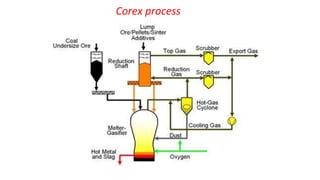
Corex process
• COREX consists of two reactors, the reduction
shaft and the melter-gasifier.
• Thereduction shaft is placed above the melter-
gasifier and reduced iron material descends by gravity.
• Thevolume of the reduction shaft is 600 m3 and
the melter- gasifier is 2000 m3.
• Iron ore, pellets and additives (limestone and
dolomite) are charged into the reduction shaft from the top
of the shaft.
• Some amount of coke is also added to the shaft to avoid clustering
inside the shaft due to sticking of the ore/pellets and to maintain
• The gas moves in the counter current direction to the top of
the shaft and exists at around 250 ℃ from the shaft.
• The iron bearing material gets reduced to over 95% metallization
in the shaft.
• The hot DRI at around 600 – 800 ℃ is discharged from reduction
shaft into the melter-gasifier
• Oxygen plays a vital role in COREX process for generation of heat
and reduction gases.
• Oxygen gasifies the coal char and generates CO. The sensible heat
of the gasesis transferred to the char bed which
is utilized for melting iron and slag.
• The hot metal and slag are collected in the hearth.
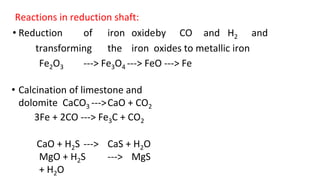
Reactions in reduction shaft:
• Reduction of iron oxideby CO and H2 and
transforming the iron oxides to metallic iron
Fe2O3 ---> Fe3O4 ---> FeO ---> Fe
• Calcination of limestone and
dolomite CaCO3 --->CaO + CO2
3Fe + 2CO ---> Fe3C + CO2
CaO + H2S ---> CaS + H2O
MgO + H2S ---> MgS
+ H2O
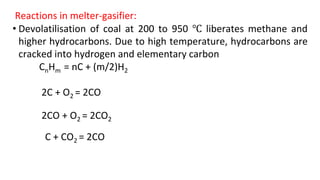
Reactions in melter-gasifier:
• Devolatilisation of coal at 200 to 950 ℃ liberates methane and
higher hydrocarbons. Due to high temperature, hydrocarbons are
cracked into hydrogen and elementary carbon
CnHm = nC + (m/2)H2
2C + O2 = 2CO
2CO + O2 = 2CO2
C + CO2 = 2CO
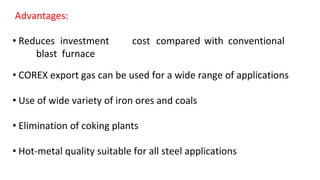
Advantages:
• Reduces investment cost compared with conventional
blast furnace
• COREX export gas can be used for a wide range of applications
• Use of wide variety of iron ores and coals
• Elimination of coking plants
• Hot-metal quality suitable for all steel applications
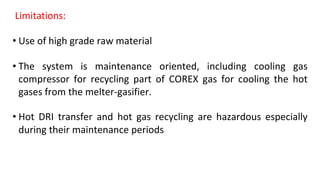
Limitations:
• Use of high grade raw material
• The system is maintenance oriented, including cooling gas
compressor for recycling part of COREX gas for cooling the hot
gases from the melter-gasifier.
• Hot DRI transfer and hot gas recycling are hazardous especially
during their maintenance periods
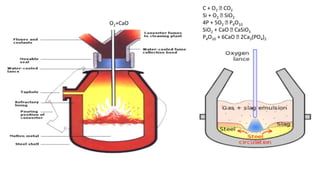
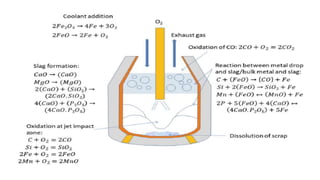
O2+CaO
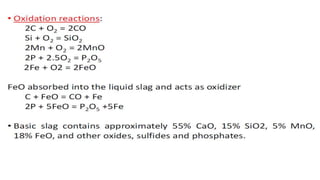
C + O2 🡪 CO2
Si + O2 🡪 SiO2
4P + 5O2 🡪 P4O10
SiO2 + CaO 🡪 CaSiO3
P4O10 + 6CaO 🡪 2Ca3(PO4)2
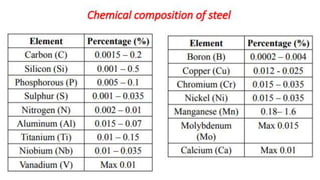
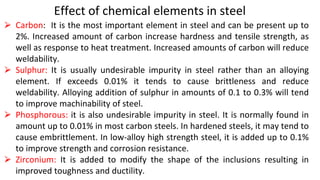
Effect of chemical elements in steel
⮚ Carbon: It is the most important element in steel and can be present up to
2%. Increased amount of carbon increase hardness and tensile strength, as
well as response to heat treatment. Increased amounts of carbon will reduce
weldability.
⮚ Sulphur: It is usually undesirable impurity in steel rather than an alloying
element. If exceeds 0.01% it tends to cause brittleness and reduce
weldability. Alloying addition of sulphur in amounts of 0.1 to 0.3% will tend
to improve machinability of steel.
⮚ Phosphorous: it is also undesirable impurity in steel. It is normally found in
amount up to 0.01% in most carbon steels. In hardened steels, it may tend to
cause embrittlement. In low-alloy high strength steel, it is added up to 0.1%
to improve strength and corrosion resistance.
⮚ Zirconium: It is added to modify the shape of the inclusions resulting in
improved toughness and ductility.
Effect of chemical elements in steel
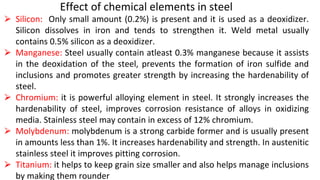
⮚ Silicon: Only small amount (0.2%) is present and it is used as a deoxidizer.
Silicon dissolves in iron and tends to strengthen it. Weld metal usually
contains 0.5% silicon as a deoxidizer.
⮚ Manganese: Steel usually contain atleast 0.3% manganese because it assists
in the deoxidation of the steel, prevents the formation of iron sulfide and
inclusions and promotes greater strength by increasing the hardenability of
steel.
⮚ Chromium: it is powerful alloying element in steel. It strongly increases the
hardenability of steel, improves corrosion resistance of alloys in oxidizing
media. Stainless steel may contain in excess of 12% chromium.
⮚ Molybdenum: molybdenum is a strong carbide former and is usually present
in amounts less than 1%. It increases hardenability and strength. In austenitic
stainless steel it improves pitting corrosion.
⮚ Titanium: it helps to keep grain size smaller and also helps manage inclusions
by making them rounder
Effect of chemical elements in steel
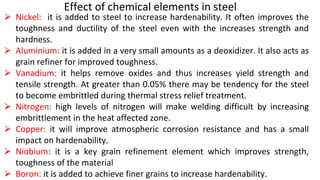
⮚ Nickel: it is added to steel to increase hardenability. It often improves the
toughness and ductility of the steel even with the increases strength and
hardness.
⮚ Aluminium: it is added in a very small amounts as a deoxidizer. It also acts as
grain refiner for improved toughness.
⮚ Vanadium: it helps remove oxides and thus increases yield strength and
tensile strength. At greater than 0.05% there may be tendency for the steel
to become embrittled during thermal stress relief treatment.
⮚ Nitrogen: high levels of nitrogen will make welding difficult by increasing
embrittlement in the heat affected zone.
⮚ Copper: it will improve atmospheric corrosion resistance and has a small
impact on hardenability.
⮚ Niobium: it is a key grain refinement element which improves strength,
toughness of the material
⮚ Boron: it is added to achieve finer grains to increase hardenability.
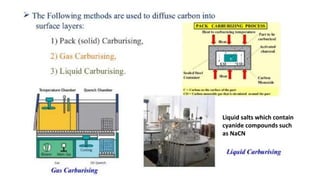
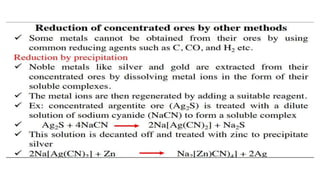
Liquid salts which contain
cyanide compounds such
as NaCN
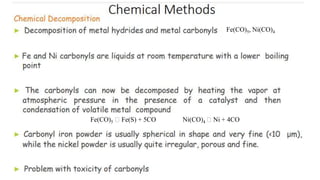
Fe(CO)5, Ni(CO)4
Fe(CO)5 🡪 Fe(S) + 5CO Ni(CO)4 🡪 Ni + 4CO
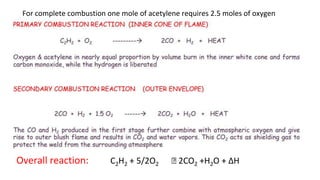
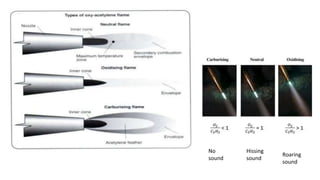
For complete combustion one mole of acetylene requires 2.5 moles of oxygen
Overall reaction: C2H2 + 5/2O2 🡪 2CO2 +H2O + ΔH
No
sound
Hissing
sound
Roaring
sound
Assignment
⮚ Tensile test
⮚ Compression test
⮚ Hardness test
⮚ Impact test
⮚ Fatigue test
⮚ Creep test
ppt on Metallurgical Engineering PPT.pptx

ppt on Metallurgical Engineering PPT.pptx

  • 1.
  • 3.
    Course Evaluation Policy MidExam: 30 Marks Quiz/Assignment: 30 Marks End Exam: 40 Marks Relative grading
  • 4.
    ⮚According to 2020statistics, 1.9 billion tons of steel is produced globally. ⮚India produced around 115 million tons of steel in 2020 ⮚Entire Asia produced 1.3 billion tons of steel in 2020. ⮚If we consider India’s population as 134 crores, then the percapita steel consumption will be ≈ 80 115∗106∗103 𝐾g 134∗107 𝑃𝑒𝑟𝑠𝑜𝑛 ⮚Most of the developed countries wouldbe consuming atleast Kg/person. 200-300
  • 6.
    ⮚Iron is availablein abundance in the earth’s crust relative to copper, zinc etc. ⮚Iron is available in the form of hematite (Fe2O3) or Magnetite (Fe3O4)
  • 7.
    Ferrous Extraction Iron ismade in the blast furnace using these raw materials, iron ore, coke, Flux, and hot air: ⮚Iron ores (hematite, magnetite) – iron oxides with earth impurities (>10 mm) ▪ Sinter/pellets ⮚Coke, which is both reducing agent and fuel, providing heat for melting the metal and slag (coal 🡪 coke through carbonization) ⮚Flux: Limestone, calcium carbonate, is used to remove impurities.
  • 9.
  • 11.
    Blast Furnace • Itis a shaft type furnace consisting of a steel shell lined with refractory bricks. • The top of the furnace is equipped with the bell-like or other system, providing correct charging and distribution of the raw materials (iron ore, coke, limestone). • Air heated to 2200 °F (1200 °C) is blown through the tuyeres at the bottom. • Oxygen containing in air reacts with the coke, producing carbon monoxide: 2C + O2 = 2CO • Hot gases pass up through the descending materials, causing reduction of the iron oxides to iron according to the following reactions: 3Fe2O3 + CO = 2Fe3O4 + CO2 Fe3O4 + CO = 3FeO + CO2 Indirect reduction (65%) Direct reduction (35%) Ratio of direct to indirection reduction is 1:2 (combustion)
  • 12.
    • Iron orecontains impurities of silicon dioxide (sand). In the blast furnace the intense heat causes the calcium carbonate to decompose into calcium oxide and carbon dioxide. CaCO3 = CaO + CO2 • The calcium oxide reacts with the sand impurities to form a substance called slag (calcium silicate) which can there be removed. CaO + SiO2 = CaSiO3
  • 13.
  • 15.
    Charging raw materialsin a blast furnace is a crucial step in the iron making process • Efficient utilization of heat: the heat generated during combustion of coke at the bottom of the furnace rises through the stack, preheating the raw materials as it ascends. The preheating of raw materials helps in reducing the overall energy consumption of the blast furnace • Iron ore reduction: the reduction process is more effectively controlled when the materials are layered, allowing for better contact between reducing agents and iron oxides • Controlled combustion • Uniform distribution of load • Optimizing gas flow
  • 16.
    Refractory lining: ✔ Alumino-silicates(Fire-clay brick) ✔ Carbon (Near hearth region) Failure of refractory lining can be due to ⮚CO attack (in stack region) ⮚High temperature (near the Tuyeres) ⮚Abrasion of solid charge (in stack region) ⮚Attack/reaction by molten slag or hot metal (in hearth and bosh) Ordinary (40 – 45% Al2O3) Near Stack/Shaft region Super-duty (>60% Al2O3) Near Belly and bosh region
  • 17.
    1) Combustion ofcoke C + O2 🡪 CO2 ΔG= -394100 – 0.84T J/mol C + 1/2O2 🡪 CO ΔG= -111700 – 87.65T J/mol C + CO2 🡪 2CO (Boudouard reaction/ Gassification reaction) Thermodynamics
  • 18.
    Output from BlastFurnace ⮚Molten iron ⮚Molten slag ⮚Top gases (N2 + CO+ CO2)
  • 19.
    • Iron inthe form of a spongy mass moves down and its temperature reaches the melting point at the bottom regions of the furnace where it melts and accumulates. • The gangue, ash and other fractions of ore and coke are mixed by fluxes, forming slag which is capable to absorb Sulphur and other impurities. • The furnace is periodically tapped and the melt (pig iron) is poured into ladles, which are transferred to cast iron and steel making furnaces. • Pig iron usually contains 3-4% of carbon, 2-4% of silicon, 1-2% of manganese and 1-1.2% of phosphorous.
  • 20.
    Major constituents ofslag • SiO2 (30-35%), Al2O3 (1.8-2.5%) • CaO (28-25%), MgO (1-6%) • MnO, P2O5 • The viscosity of the slag should be less for easy removal Major Minor
  • 21.
    Major impurities inpig iron 1) Silicon This element comes from the sand or other minerals mixed with the iron ore. It can make the iron brittle and hard to work with. In the blast furnace, silicon reacts with limestone (CaCO3) to form calcium silicate (CaSiO3), which floats on top of the molten iron as slag 2) Carbon 3) Sulfur This element can come from iron ore or the coke. It makes the steel hot-short (high temperature). In the blast furnace, sulfur reacts with calcium oxide (CaO) from the limestone to form calcium sulfide (CaS), which goes into slag 4) Phosphorous this element can make the steel cold-short (low temperature). It is usually removed by adding manganese to the molten iron, which forms manganese phosphate that goes into the slag 5) Manganese
  • 22.
    SiO2 + C🡪 SiO + CO SiO2 + 3C 🡪 SiC + 2CO SiO+ 2C SiO + [C] 🡪 [Si] +CO 2SiO 🡪 SiO2 + [Si] FeO + SiO 🡪 [Fe] +SiO2 How to decrease the Si in the hot metal? High blast pressure Silicon (Si) CO [] 🡪 dissolved state Le Chatelier’s principle
  • 23.
    P2O5 + 5C= 2P + 5CO MnO + C = Mn + CO Pig iron Wrought iron Steel Cast iron
  • 24.
    Cast iron manufacturingprocess • Cast iron is manufactured by re-melting pig iron with coke and limestone • This is done in a furnace known as cupola furnace • Cupola furnace was first built in china in the warring states period (403-221 BC) • Generally cupolas are not worked continuously like blast furnaces but are run only when required.
  • 25.
    Cupola furnace Charge: Pigiron, coke, limestone Combustion zone: C + O2 = CO2 + heat Si + O2 = SiO2 + heat 2Mn + O2 = 2MnO+ heat Reducing zone: C + CO2 = 2CO + heat Melting zone: 3Fe + 2CO = Fe3 C + CO2
  • 26.
    • Cupola shellis made of steel and has a lining of refractory brick • The bottom of the shell is lined with clay and sand mixture and it is a temporary lining. Parts of cupola furnace 1) Cylindrical shell: It is the outermost part of the furnace. It is made up of steel and other parts of this furnace are present inside this shell 1) Legs: Legs are provided at the bottom of the furnace to support the furnace
  • 27.
    3) Sand bed:It is in tapered form so that the melted iron can flow easily 3) Slag hole: it is present at the opposite side of the hole from which cast iron comes out. It is present near the elevated part of the sand bed. It is used to remove slag formed on melted iron due to impurities. 3) Air pipe and Tuyers: Air pipe is provided to allow the air to reach inside the furnace through the tuyers. 3) Spark arrestor or cap of furnace: it is present at the top of the furnace. It is used to capture the burning particles and only allow the gas to pass to the environment.
  • 28.
    7) Charging door:it is present near the top of the furnace. The charge in this furnace are pig iron, coke and limestone. Coke is used for combustion and limestone is used as flux 7) Well: the part of the furnace from sand bed to lower part of tuyers is known as well. Molten iron is stored in well and comes out from the tapping hole. 7) Combustion zone: Combustion takes place in this zone. The air from tuyers reacts with carbon to form carbon di oxide. It is also known as oxidizing zone. 7) Reducing zone: it is above the combustion zone. In this zone carbon reacts with carbon dioxide to form carbon monoxide.
  • 29.
    7) Melting zone:in this zone iron melts and the molten iron comes out of the tap hole. The temperature of this zone is very high nearly 1600 ℃. 7) Preheating zone: the metal to be melted is preheated in this zone. The temperature in this zone is around 1090 ℃ 7) Stack zone: In this zone the charge is staked in layer form.
  • 30.
    Advantages of cupola furnace ✔Simplein construction ✔Wide rage of materials can be melted ✔Less floor space is required ✔Very skilled operators are not required ✔Low cost of operation ✔Low cost of maintenance
  • 31.
    Disadvantages of cupolafurnace ✔Very hard to control the temperature in the furnace ✔Some metals are converted to their oxide which are not suitable for casting
  • 32.
    • Conventional routeformaking steel consists of sintering or pelletization plants, coke ovens, blast furnaces. • Coking coke is needed to make coke strong enough to support the burden in the blast furnace. • This requires high capital expenses and raw materials of stringent specifications. • Thecoke ovens and sintering plants in an integrated steel plant are polluting and expensive units.
  • 33.
    • Over years,the hot metal production from the blast furnace has decreased due to the unavailability of high grade coke. • Alternative iron production is feasible in the places where high grade coal (coking coal) is not available but low grade coal (non- coking coal) or natural gas is available
  • 34.
    Alternative routes ofiron making Solid iron Liquid iron DR: Direct reduced 1) Retort processes 2) Shaft furnace processes 3) Fluidized bed processes 1) COREX process 2) FINEX process According to reduction reactor type 1) Rotary kiln based processes 2) Shaft furnace based processes 3) Rotary hearth furnace based
  • 35.
    • From DRI,iron is produced from direct reduction of iron ore (in the form of lumps, pellets or fines) by a reducing gas (H2, CO) produced from natural gas or coal. • DR process convert iron ore into sponge iron at temperature below the melting point of iron. • DR process differ from conventional blast furnace in two ways 1) Solid metallized product is produced 2) A wide variety of reductantscan be used in the placeof high grade coke
  • 36.
    Sponge iron productionin rotary kiln Coal-based sponge iron process
  • 37.
    • Rotary kilninclination: 2.5° • Speed of kiln: 0.2 – 1.0 rpm 1000-1100 ℃ 950 ℃
  • 38.
    • Coal baseddirect reduction rotary kiln process was developed for converting iron ore directly into metallic iron without melting. Hence the produced iron has highly porous structure and gives a sponge appearance. • As iron ore is in direct contact with the reducing agent throughout the reduction process, it is called direct reduced iron. • Raw material mix consisting of iron ore, dolomite and non-coking coal is fed at one end of the rotary kiln and is heated by coal burner to produce DRI. • The produced DRI along with char is taken out from the other end of the kiln.
  • 39.
    Process control parameters ✔Feed rate ✔Kiln temperature ✔Control of gaseous atmosphere ✔Kiln speed, inclination ✔Retention time of charge ✔Waste gas temperature and composition Fe Total 90 – 94% Fe Metallic 83 – 90 % Metallization 92 – 96 % C 1.0 – 2.5 % P2O5 0.005 – 0.9 % S 0.001 – 0.03 % Gangue 2.8 – 6 %
  • 40.
    Ring formation inrotary kilns ✔Raw mix chemistry ✔Coal fineness to be controlled ✔Low fusion temperature of coal ash ✔Incomplete calcination of raw metal ✔Kiln speed too low ✔High burning zone temperature ✔Frequent change in secondary air temperature ✔Volatile recycling
  • 41.
    Advantages of coalbased process • They does not require high grade coal which is scarcely available • They can use non-coking coal • They can be installed at lower capacity • They can be easily installed at center where small reserves of coal and iron ore are available Dis-advantages of coal based process • Coal based processes have lower economy of scale • High energy consumption (16 to 21 GJ/t) • Low carbon content in the production (< 1%) • Lower productivity
  • 42.
    Gas-based sponge ironprocess (MIDREX process)
  • 43.
    • In thegas based reduction process, a vertical shaft kiln is used in which iron ore is fed into the top of the kiln and finished sponge iron is drawn off from the bottom after cooling so as to prevent it from re-oxidation. • High methane containing natural gas is the most commonly used gas. Natural gas is reformed to enrich with H2 and CO mixture. This enriched and reformed gas mixture is preheated and sent to the shaft furnace • Gas based process is simple to operate and involves three major steps i. Iron ore reduction ii. Gas preheating
  • 44.
    • The reductionreaction takes place both with H2 and CO in a gas based DRI process. • Reactions with H2 3Fe2O3 + H2 = 2Fe2O4+ H2O (Exothermic reaction) Fe3O4 + H2 = 3FeO +H2O (endothermic reaction) FeO + H2 = Fe+H2O (endothermic reaction) • Reactions with CO 3Fe2O3 + CO = 2Fe3O4 + CO2 (Exothermic reaction) Fe3O4 + CO = 3FeO + CO2 (Endothermic reaction) FeO + CO = Fe + CO2 (Exothermic reaction)
  • 47.
    Advantages of gasbased process over coal based process • Less capital cost • High productivity • Better quality • Energy efficiency • Better plant availability • Environmental pollution
  • 48.
  • 49.
    • COREX consistsof two reactors, the reduction shaft and the melter-gasifier. • Thereduction shaft is placed above the melter- gasifier and reduced iron material descends by gravity. • Thevolume of the reduction shaft is 600 m3 and the melter- gasifier is 2000 m3. • Iron ore, pellets and additives (limestone and dolomite) are charged into the reduction shaft from the top of the shaft. • Some amount of coke is also added to the shaft to avoid clustering inside the shaft due to sticking of the ore/pellets and to maintain
  • 50.
    • The gasmoves in the counter current direction to the top of the shaft and exists at around 250 ℃ from the shaft. • The iron bearing material gets reduced to over 95% metallization in the shaft. • The hot DRI at around 600 – 800 ℃ is discharged from reduction shaft into the melter-gasifier • Oxygen plays a vital role in COREX process for generation of heat and reduction gases. • Oxygen gasifies the coal char and generates CO. The sensible heat of the gasesis transferred to the char bed which is utilized for melting iron and slag. • The hot metal and slag are collected in the hearth.
  • 51.
    Reactions in reductionshaft: • Reduction of iron oxideby CO and H2 and transforming the iron oxides to metallic iron Fe2O3 ---> Fe3O4 ---> FeO ---> Fe • Calcination of limestone and dolomite CaCO3 --->CaO + CO2 3Fe + 2CO ---> Fe3C + CO2 CaO + H2S ---> CaS + H2O MgO + H2S ---> MgS + H2O
  • 52.
    Reactions in melter-gasifier: •Devolatilisation of coal at 200 to 950 ℃ liberates methane and higher hydrocarbons. Due to high temperature, hydrocarbons are cracked into hydrogen and elementary carbon CnHm = nC + (m/2)H2 2C + O2 = 2CO 2CO + O2 = 2CO2 C + CO2 = 2CO
  • 53.
    Advantages: • Reduces investmentcost compared with conventional blast furnace • COREX export gas can be used for a wide range of applications • Use of wide variety of iron ores and coals • Elimination of coking plants • Hot-metal quality suitable for all steel applications
  • 54.
    Limitations: • Use ofhigh grade raw material • The system is maintenance oriented, including cooling gas compressor for recycling part of COREX gas for cooling the hot gases from the melter-gasifier. • Hot DRI transfer and hot gas recycling are hazardous especially during their maintenance periods
  • 58.
    O2+CaO C + O2🡪 CO2 Si + O2 🡪 SiO2 4P + 5O2 🡪 P4O10 SiO2 + CaO 🡪 CaSiO3 P4O10 + 6CaO 🡪 2Ca3(PO4)2
  • 71.
    Effect of chemicalelements in steel ⮚ Carbon: It is the most important element in steel and can be present up to 2%. Increased amount of carbon increase hardness and tensile strength, as well as response to heat treatment. Increased amounts of carbon will reduce weldability. ⮚ Sulphur: It is usually undesirable impurity in steel rather than an alloying element. If exceeds 0.01% it tends to cause brittleness and reduce weldability. Alloying addition of sulphur in amounts of 0.1 to 0.3% will tend to improve machinability of steel. ⮚ Phosphorous: it is also undesirable impurity in steel. It is normally found in amount up to 0.01% in most carbon steels. In hardened steels, it may tend to cause embrittlement. In low-alloy high strength steel, it is added up to 0.1% to improve strength and corrosion resistance. ⮚ Zirconium: It is added to modify the shape of the inclusions resulting in improved toughness and ductility.
  • 72.
    Effect of chemicalelements in steel ⮚ Silicon: Only small amount (0.2%) is present and it is used as a deoxidizer. Silicon dissolves in iron and tends to strengthen it. Weld metal usually contains 0.5% silicon as a deoxidizer. ⮚ Manganese: Steel usually contain atleast 0.3% manganese because it assists in the deoxidation of the steel, prevents the formation of iron sulfide and inclusions and promotes greater strength by increasing the hardenability of steel. ⮚ Chromium: it is powerful alloying element in steel. It strongly increases the hardenability of steel, improves corrosion resistance of alloys in oxidizing media. Stainless steel may contain in excess of 12% chromium. ⮚ Molybdenum: molybdenum is a strong carbide former and is usually present in amounts less than 1%. It increases hardenability and strength. In austenitic stainless steel it improves pitting corrosion. ⮚ Titanium: it helps to keep grain size smaller and also helps manage inclusions by making them rounder
  • 73.
    Effect of chemicalelements in steel ⮚ Nickel: it is added to steel to increase hardenability. It often improves the toughness and ductility of the steel even with the increases strength and hardness. ⮚ Aluminium: it is added in a very small amounts as a deoxidizer. It also acts as grain refiner for improved toughness. ⮚ Vanadium: it helps remove oxides and thus increases yield strength and tensile strength. At greater than 0.05% there may be tendency for the steel to become embrittled during thermal stress relief treatment. ⮚ Nitrogen: high levels of nitrogen will make welding difficult by increasing embrittlement in the heat affected zone. ⮚ Copper: it will improve atmospheric corrosion resistance and has a small impact on hardenability. ⮚ Niobium: it is a key grain refinement element which improves strength, toughness of the material ⮚ Boron: it is added to achieve finer grains to increase hardenability.
  • 122.
    Liquid salts whichcontain cyanide compounds such as NaCN
  • 142.
    Fe(CO)5, Ni(CO)4 Fe(CO)5 🡪Fe(S) + 5CO Ni(CO)4 🡪 Ni + 4CO
  • 234.
    For complete combustionone mole of acetylene requires 2.5 moles of oxygen Overall reaction: C2H2 + 5/2O2 🡪 2CO2 +H2O + ΔH
  • 235.
  • 248.
    Assignment ⮚ Tensile test ⮚Compression test ⮚ Hardness test ⮚ Impact test ⮚ Fatigue test ⮚ Creep test