CAST IRON & ITS STRUCTURE
 MUHAMMAD ABSAR SALEEMI
(MM-025)
 IBRAHIM KHAN
(MM-032)
 SYED SAAD UL HAQUE
(MM-014)
 KASHIF SOHAIL QURESHI
(MM-006)
DEPARTMENT OF MATERIAL ENGINEERING
INTRODUCTION
 Cast iron is the name given to those ferrous
metals containing more than 1.7% carbon.
 Cast irons like steels, are basically alloys of
iron and carbon.
 Cast irons contain more than 2 percent
carbon.
 Most commercially manufactured types are
in the range of 2.5 to 4 percent carbon.
CAST IRON SKILLET
ASTM-888 CAST IRON PIP
COMPOSITION
 All cast irons contain more than 2% C.
 Cast iron is the alloy of carbon with 1.7 to 4.5%
carbon and 0.5 to 3% silicon.
 But in some alloy it has Manganese 0.5 to
1.0%, Phosphorous 0.1 to 0.9 %, & Sulphur
0.07 to 0.10%.
STRUCTURE
 It have a matrix structure which may be
established either during cooling from
the molten state ( as cast condition) or as
a result of heat treatment. The main
component of cast iron are Iron, carbon,
silicon.
TYPES OF CAST IRON
 The best method of classifying cast iron is
according to metallographic structure.
 There are four variables to be considered
which lead to the different types of cast iron.
 Some variables may control the condition of
the carbon and also its physical form.
 The types of cast iron are as follows:
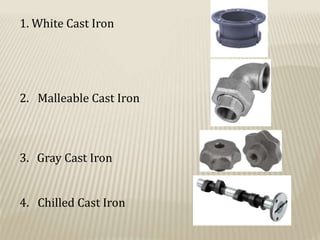
1. White Cast Iron
2. Malleable Cast Iron
3. Gray Cast Iron
4. Chilled Cast Iron
5. Nodular Cast Iron
6. Alloy Cast Iron
1. WHITE CAST IRON
 It is the cast iron in which all the cast iron in
the combined form as cementite.
 All white cast iron are hypoeutectic.
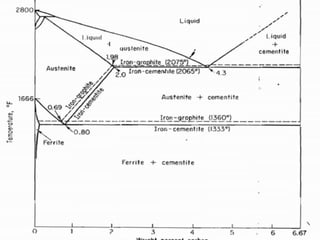
 In the figure the alloy at “x” exists as a uniform
liquid solution of carbon dissolved in liquid
iron.
 Solidification now begins by the formation of
austenite crystals containing about 1 percent
carbon.
1. WHITE CAST IRON
STRUCTURE:
 The typical microstructure of white cast iron,
consisting of dendrites of transformed
austenite (pearlite) in a white interdendritic
network of cementite, Higher magnification of
the same sample reveals that the dark areas
are pearlite.
1. WHITE CAST IRON
PROPERTIES:
 It is hard, brittle & interstitial compound.
 Due to large amount of cementite it is hard & brittle but
extremely brittle & difficult to machine
 The range mechanical properties for unalloyed white irons is
as follows: hardness Brinell 375 to 600, tensile strength
20,000 to 70,000 psi, compressive strength 200,000 lo
250,000 psi and modulus of elasticity 24 to 28 million psi.
1. WHITE CAST IRON
APPLICATION:
It can be used as liners of cement mixers, ball
mills, drawing dies and extrusion nozzles.
NOZZLE
BALL MILLS CEMENT MIXERS
2. MALLEABLE CAST IRON
INTRODUCTION:
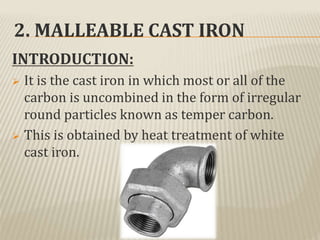
 It is the cast iron in which most or all of the
carbon is uncombined in the form of irregular
round particles known as temper carbon.
 This is obtained by heat treatment of white
cast iron.
2. MALLEABLE CAST IRON
MANUFACTURING:
 White irons suitable for conversion to
malleable iron are of the following range of
composition:
 Carbon  2.00-2.65%
 Silicon  0.90-1.40%
 Manganese  0.25-0.55%
 Phosphorous  Less than 0.18%
 Sulphur  0.05%
2. MALLEABLE CAST IRON
 Commercially, It can be prepared by two steps:
(1) First stage annealing.
(2) Second stage annealing.
 In the first-stage annealing, the white-iron
casting is slowly reheated to a temperature
between 1650 ˚F and 1750 ˚F.
 This graphitization starts at the malleableizing
temperature.
2. MALLEABLE CAST IRON
 The initial precipitation of a graphite nucleus
depletes the austenite of carbon, and so more
is dissolved from the adjacent cementite.
 The graphite nuclei grow at approximately
equal rates in all directions and ultimately
appear as irregular nodules or spheroids
usually called temper carbon. As shown in
figure.
MALLEABLE IRON, UNETCHED. IRREGULAR
NODULES OF GRAPHITE CALLED TEMPER
CARBON. (1OOX)
2. MALLEABLE CAST IRON
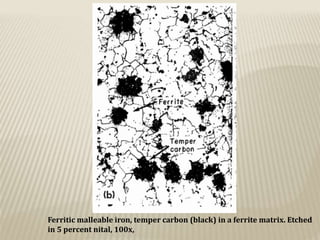
• After first-stage annealing, the castings are cooled
as rapidly as practical to about 1400oF in
preparation for the second stage of the annealing
treatment.
• During the slow cooling, the carbon dissolved in
the austenite is converted to graphite on the
existing temper-carbon particles, and the
remaining austenite transforms into ferrite. After
cooling to room temperature the structure is
known as standard malleable cast iron.
Ferritic malleable iron, temper carbon (black) in a ferrite matrix. Etched
in 5 percent nital, 100x,
2. MALLEABLE CAST IRON
 The changes in microstructure during the
malleableizing cycle are shown schematically
in Figure.
The changes in microstructure as a function of
the malleableizing cycle-resulting in temper carbon in a
ferrite matrix'
2. MALLEABLE CAST IRON
PROPERTIES:
 When copper is added it increase its tensile strength,
corrosion resistance e.t.c.
 The properties of malleable cast iron are:
1. Tensile Strength  58000-65000 (psi)
2. Yield point  40000-450000 (psi)
3. Elongation % in 2 in 15-20
4. BHN  135-155.
2. MALLEABLE CAST IRON:
APPLICATION:
It can be widely used as:
 Pipe fittings.
 Chain-hoist assemblies.
 Railroad equipment.
 Also as industrial casters e.t.c.
3. PEARLITIC MALLEABLE CAST IRON
 If a controlled quantity of carbon, in the order of 0.3 to 0.9
percent, is retained as finely distributed iron carbide, an
entirely different set of mechanical properties results.
 If manganese is added, the regular  cycle can be
maintained to retain combined carbon throughout the
matrix.
 The second-stage annealing of the normal process may be
replaced by, a quench, usually air, which cools the casting
through the eutectoid range; fast enough to retain
combined carbon throughout the matrix.
 The matrix is completely pearlitic shown in figure.
MATRIX OF PEARLITIC MALLEABLE IRON
3. PEARLITIC MALLEABLE CAST IRON
If the cooling rate through the critical range is
not quite fast enough to retain all the combined
carbon, the areas surrounding the temper-
carbon nodules will be completely graphitized,
while those at greater distance from the nodules
will be pearlitic .
Because of its general appearance, this is
referred to as a bull’s-eye structure. As shown
in figure.
BULL’S EYE STRUCTURE
3. PEARLITIC MALLEABLE CAST IRON
PROPERTIES:
 We can also add some alloying element like
Manganese, sulphur & copper. Copper may be
added to increase corrosion resistance &
graphite distribution.
 If it is heated at 1200F to 1300F it improves its
machineability, toughness & lower the
hardness. The spheroidize the pearlite as
shown in figure.
Microstructure of a pearlitic malleable iron tempered to
obtain a spheroldite matrix. Nital etch, 500x
3.PEARLITIC MALLEABLE CAST IRON
APPLICATION:
 It can widely used in industries application
like:
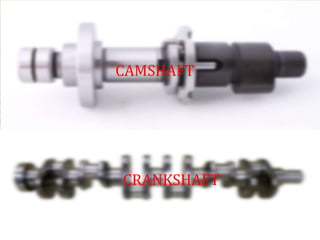
 Camshafts and crankshafts in automobiles
 Rolls, pumps, nozzles, cams, and rocker arms
as machine parts.
 For a variety of small tools such as wrenches,
hammers, clamps, and shears.
CAMSHAFT
CAMSHAFT
CAMSHAFT
CRANKSHAFT
4. GRAY CAST IRON
 It is the cast iron in which most or all of the carbon is
uncombined in the form of graphite flakes.
 Most gray cast irons are hypoeutectic alloys containing
between 2.5 and 4 percent carbon.
 The initial appearance of combined carbon is in the
cementite resulting from the eutectic reaction at
2065F<.
 There is experimental evidence that, with proper
control of the alloying element, the alloy will follow the
stable iron-graphite equilibrium diagram, ), forming
austenite and graphite at the eutectic temperature of
2075F.
4. GRAY CAST IRON
 At any rate, any cementite which is formed will
graphitize rapidly. The graphite appears as
many irregular, generally elongated and curved
plates which give gray cast iron its
characteristic grayish or blackish fracture.
As shown in figure.
Graphite flakes in gray cast iron.
Unetched, I0Ox
4. GRAY CAST IRON
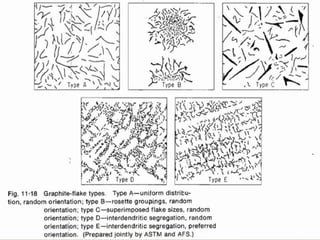
Gray iron have a different size of flakes.
4. GRAY CAST IRON
REDUCING FALKE SIZE:
The best method of reducing the size and improving the
distribution of the graphite flakes seems to be by the addition of
a small amount of material known as an inoculant. Inoculating
agents that have been used successfully are metallic calcium,
aluminum, titanium, zirconium, silicon carbide, calcium silicide ,
or combinations of these. They probably promote the nucleation
of primary austenite, resulting in small grains, which reduces the
size and improves the distribution of the graphite flakes.
3. GRAY CAST IRON
SOME EXAMPLES:
The AFS & ASTM prepared 5 flakes size which
are shown in figure.
4. GRAY CAST IRON
MECHAINICAL PROPERTIES:
(1) TENSILE STRENGTH:
Tensile strength is important in selecting a gray iron for parts that are
subjected to static loads in indirect tension or bending. Such parts
include pressure vessels, housings, valves, fittings, and levers, irons
above 40,000 psi in tensile strength are usually considered high-
strength irons and are somewhat more expensive to produce and more
difficult to machine.
4. GRAY CAST IRON
(2) YIELDING:
Gray irons do not exhibit a well-defined yield point as do most mild steels. The
stress-strain curve does not show a straight-line portion; thus a definite
modulus of elasticity cannot be determined. The percent elongation is small for
all cast irons, rarely exceeding 3 to 4 percent, and the reduction of area is too
slight to be appreciable.
(3) COMPRESSIVE STRENGHT:
Compressive strength is important when the gray iron is used for Machinery
foundations or supports. Like all brittle materials, the compressive strength of
gray iron is much greater than its tensile strength and is largely a function of the
shearing strength. Failure in compression usually occurs along an oblique plane
unless the specimen is long enough to allow failure by buckling
3. GRAY CAST IRON
(4) TROSIONAL PROPERTIES:
Many grades of gray iron have higher torsional shear
strength than some grades of steel. This characteristic,
along with low notch sensitivity, makes gray iron a suitable
material for various types of shafting.
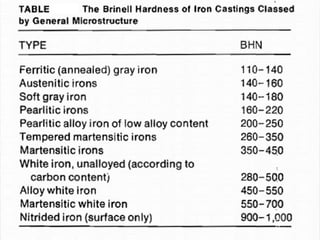
(5) HARDNESS:
The composition also exerts a considerable effect on the
hardness. Increasing carbon and silicon contents will result
in decreasing hardness, although the effect is not as
marked on hardness as it is on tensile strength. Some
hardness number are given in figure.
3. GRAY CAST IRON
APPLICATION:
 Some common application of gray cast iron:
 Elevators and industrial furnace door
 Guards and frames around hazardous machinery
 Many types of gear housings, enclosures for
electrical equipment, pump housings, and steam
turbine housings.
ELEVATORS DOORS
FURNACE DOOR
5. CHILLED CAST IRON
 Chilled-Iron castings are made by casting the molten
metal against a metal chiller, resulting in a surface of
white cast iron.
 This hard, abrasion-resistant white-iron surface or case is
backed up by a softer gray-iron core.
 This case-core structure is obtained by careful control of
the overall alloy composition and adjustment of the
cooling rate.
 A chilled-iron casting may be produced by adjusting the
composition of the iron so that the normal cooling rate at
the surface is just fast enough to produce white iron while
the slower cooling rate below the surface will produce
mottled or gray iron. As shown in figure.
Fracture of chilled iron
casting showing the
white, mottled & gray
portion.
5. CHILLED CAST IRON
INFLUENCE OF SOME ALLOY CONTENT:
The depth of the chilled zone decrease and hardness of
the chilled zone increases by:
 Carbon, silicon & manganese content.
 Phosphorus which can decreases the depth of chill.
With carbon and silicon constant, an increase of 0.1
percent phosphorus will decrease the depth of chill
about 0.1 in.
 Nickel which can reduces the chill depth, and its
influence is about one-fourth that of silicon.
 Copper, in additions of less than 4 percent, decreases
the depth of chill, but in excess of this amount the
chill depth and hardness increase.
5. CHILLED CAST IRON
 A constant chill depth may be obtained by using a
combination of alloying elements that have opposite
effects. Since nickel reduces chill depth, it is common
practice to add chromium produce the opposite effect.
The normal ratio employed in this purpose is 3 parts of
nickel to 1 of chromium.
4. CHILLED CAST IRON
APPLICATION:
Some common examples of chilled cast iron are
railway car wheels, crushing rolls, stamp shoes, dies,
sprockets, plowshares, and many other heavy-duty
machinery parts.
CRUSHING ROLLS
SPROCKETS
6. NODULAR CAST IRON
 Nodular cast iron, also known as ductile iron,
spheroidal, graphite iron, and spherulitic iron, is
cast iron in which the graphite is present as tiny
balls or spheroids.
 Nodular cast iron differs from malleable iron in
that it is usually obtained as a result of
solidification and does not require heat
treatment.
 The spheroids are more rounded than the
irregular aggregates of temper carbon found in
malleable iron. As shown in figure.
Nodular Iron unetched, showing graphite
sphrodize, 125x.
6. NODULAR CAST IRON
PROPERTIES:
The structure of nodular cast iron have
toughness, maximum ductility & machinability
which can widely used in some applications.
5. NODULAR CAST IRON
APPLICATION:
 Some typical application Nodular cast iron are
in the field of:
 Agricultural & tractor parts.
 Automotive & diesel crankshafts.
 Drive pulleys
 Fly pulleys.
 Elevator doors
 Furnace buckets e.t.c.
TRACTOR PART
CRANKSHAFTS
7. ALLOY CAST IRON:
 An alloy cast iron is one which contains a specially
added element or elements in sufficient amount to
produce a measurable modification in the physical or
mechanical properties.
 Alloying elements are added to cast iron for special
properties such as resistance to corrosion, heat, or
wear, and to improve mechanical properties and also
for accelerate or graphitization.
 The most common alloying elements are chromium,
copper, molybdenum, nickel and vanadium.
7. ALLOY CAST IRON:
MOLYBDEUM:
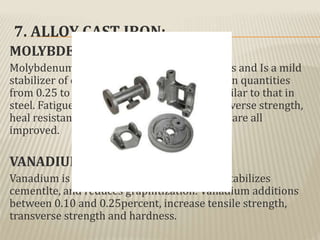
Molybdenum Improves mechanical properties and Is a mild
stabilizer of carbides. Molybdenum is added in quantities
from 0.25 to 1.25 percent and its effect is similar to that in
steel. Fatigue strength, tensile strength, transverse strength,
heal resistance, and hardness of the cast iron are all
improved.
VANADIUM:
Vanadium is very powerful carbide former, stabilizes
cementlte, and reduces graphitization. Vanadium additions
between 0.10 and 0.25percent, increase tensile strength,
transverse strength and hardness.
7. ALLOY CAST IRON:
NICKEL:
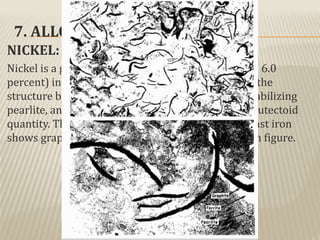
Nickel is a graphitizer. The purpose of nickel (0.5 to 6.0
percent) in the engineering gray irons is to control the
structure by retarding austenite transformation, stabilizing
pearlite, and maintaining combined carbon at the eutectoid
quantity. Thus the microstructure of a low-nickel cast iron
shows graphite, pearlite, and very little ferrite. As in figure.
7. ALLOY CAST IRON:
NICKEL:
Nickel is a graphitizer. The purpose of nickel (0.5 to 6.0
percent) in the engineering gray irons is to control the
structure by retarding austenite transformation, stabilizing
pearlite, and maintaining combined carbon at the eutectoid
quantity. Thus the microstructure of a low-nickel cast iron
shows graphite, pearlite, and very little ferrite. As in figure.
For excellent abrasion resistance, about 4 percent nickel in
combination with about 1.50 percent chromium is added to
white cast iron. As in figure.
PRODUCTION
Cast iron is made by re-melting pig iron, often along
with substantial quantities of scrap iron, scrap steel,
limestone, carbon (coke) and taking various steps to
remove undesirable contaminants. Depending on the
application, carbon and silicon content are adjusted to
the desired levels, which may be anywhere from 2–3.5%
and 1–3%, respectively. Other elements are then added
to the melt before the final form is produced by casting.
Iron is more often melted in electric induction
furnaces or electric arc furnaces. After melting is
complete, the molten iron is poured into a holding
furnace or ladle.
HEAT TREATMENT
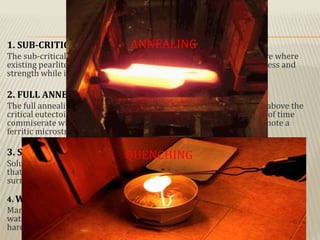
1. SUB-CRITICAL ANEALING:
The sub-critical annealing process typically produces a microstructure where
existing pearlite dissolves into the ferritic matrix which lowers hardness and
strength while improving machinability.
2. FULL ANNEALING:
The full annealing process involves taking a casting to a temperature above the
critical eutectoid temperature in the 1475F-1650F range for a length of time
commiserate with the cross section size and then slow cooled to promote a
ferritic microstructure.
3. SOLUTION ANNEALING HEAT TREATMENT PROCESS:
Solution Annealing stainless steel castings is a process which takes the carbides
that have precipitated in the grain boundaries and dissolves then into the
surrounding matrix.
4. WATER QUENCHING STEEL:
Many steel foundries cast low carbon or low alloy steels that require a severe
water quench to adequately achieve the proper martensitic microstructure and
hardness requirements.
ANNEALING
QUENCHING
HEAT TREATMENT
POLYMER QUENCH HARDNING:
Polymer quench hardening of steel castings like 4130, 15B41, 1045, and 5130 is the
proper way to balance the necessity for rapid quench rates while minimizing the risk of
quench cracking the castings.
OIL QUENCH HARDNING:
Steel castings made from alloys in excess of 0.40% carbon content can typically be oil
quench hardened to achieve their desired mechanical or hardness requirements.
NORMALIZED HEAT TREATMENT:
Gray iron and ductile iron castings are typically normalized to move the carbon from
being locked in carbides or graphite into more of a pearlitic microstructure.
AUSTEMPERED DUCTILE IRON:
In addition to austempering ductile iron , gray irons and several alloys of steel castings
can also be austempered.
CARBON RESTORATION:
To insure that the steel castings are capable of achieving full surface hardness during
subsequent hardening processing the castings may require a carbon restoration of their
surfaces which is done through several furnaces.
PROPERTIES
The ductility of cast iron is very low, and it cannot
be rolled, drawn, or worked at room temperature.
Most of the cast irons are not malleable at any
temperature. However, they melt readily and can be
cast into complicated shapes which are usually
machined to final dimensions. Since casting is the
only suitable process applied to these alloys, they
are known as cast irons.
APPLICATIONS
With its relatively low melting point, good
fluidity, castability, excellent machinability, resistance to
deformation and wear resistance, cast irons have
become an engineering material with a wide range of
applications.
 Pipes
 Machines
 Automotive parts such as cylinder heads , cylinder
blocks and gearbox cases.
MACHINE
PIPES
Cast iron its types , properties and its applications....

Cast iron its types , properties and its applications....

  • 1.
    CAST IRON &ITS STRUCTURE  MUHAMMAD ABSAR SALEEMI (MM-025)  IBRAHIM KHAN (MM-032)  SYED SAAD UL HAQUE (MM-014)  KASHIF SOHAIL QURESHI (MM-006) DEPARTMENT OF MATERIAL ENGINEERING
  • 2.
    INTRODUCTION  Cast ironis the name given to those ferrous metals containing more than 1.7% carbon.  Cast irons like steels, are basically alloys of iron and carbon.  Cast irons contain more than 2 percent carbon.  Most commercially manufactured types are in the range of 2.5 to 4 percent carbon.
  • 3.
  • 4.
  • 5.
    COMPOSITION  All castirons contain more than 2% C.  Cast iron is the alloy of carbon with 1.7 to 4.5% carbon and 0.5 to 3% silicon.  But in some alloy it has Manganese 0.5 to 1.0%, Phosphorous 0.1 to 0.9 %, & Sulphur 0.07 to 0.10%.
  • 6.
    STRUCTURE  It havea matrix structure which may be established either during cooling from the molten state ( as cast condition) or as a result of heat treatment. The main component of cast iron are Iron, carbon, silicon.
  • 7.
    TYPES OF CASTIRON  The best method of classifying cast iron is according to metallographic structure.  There are four variables to be considered which lead to the different types of cast iron.  Some variables may control the condition of the carbon and also its physical form.  The types of cast iron are as follows:
  • 8.
    1. White CastIron 2. Malleable Cast Iron 3. Gray Cast Iron 4. Chilled Cast Iron
  • 9.
    5. Nodular CastIron 6. Alloy Cast Iron
  • 10.
    1. WHITE CASTIRON  It is the cast iron in which all the cast iron in the combined form as cementite.  All white cast iron are hypoeutectic.  In the figure the alloy at “x” exists as a uniform liquid solution of carbon dissolved in liquid iron.  Solidification now begins by the formation of austenite crystals containing about 1 percent carbon.
  • 12.
    1. WHITE CASTIRON STRUCTURE:  The typical microstructure of white cast iron, consisting of dendrites of transformed austenite (pearlite) in a white interdendritic network of cementite, Higher magnification of the same sample reveals that the dark areas are pearlite.
  • 14.
    1. WHITE CASTIRON PROPERTIES:  It is hard, brittle & interstitial compound.  Due to large amount of cementite it is hard & brittle but extremely brittle & difficult to machine  The range mechanical properties for unalloyed white irons is as follows: hardness Brinell 375 to 600, tensile strength 20,000 to 70,000 psi, compressive strength 200,000 lo 250,000 psi and modulus of elasticity 24 to 28 million psi.
  • 15.
    1. WHITE CASTIRON APPLICATION: It can be used as liners of cement mixers, ball mills, drawing dies and extrusion nozzles. NOZZLE BALL MILLS CEMENT MIXERS
  • 16.
    2. MALLEABLE CASTIRON INTRODUCTION:  It is the cast iron in which most or all of the carbon is uncombined in the form of irregular round particles known as temper carbon.  This is obtained by heat treatment of white cast iron.
  • 17.
    2. MALLEABLE CASTIRON MANUFACTURING:  White irons suitable for conversion to malleable iron are of the following range of composition:  Carbon  2.00-2.65%  Silicon  0.90-1.40%  Manganese  0.25-0.55%  Phosphorous  Less than 0.18%  Sulphur  0.05%
  • 18.
    2. MALLEABLE CASTIRON  Commercially, It can be prepared by two steps: (1) First stage annealing. (2) Second stage annealing.  In the first-stage annealing, the white-iron casting is slowly reheated to a temperature between 1650 ˚F and 1750 ˚F.  This graphitization starts at the malleableizing temperature.
  • 19.
    2. MALLEABLE CASTIRON  The initial precipitation of a graphite nucleus depletes the austenite of carbon, and so more is dissolved from the adjacent cementite.  The graphite nuclei grow at approximately equal rates in all directions and ultimately appear as irregular nodules or spheroids usually called temper carbon. As shown in figure.
  • 20.
    MALLEABLE IRON, UNETCHED.IRREGULAR NODULES OF GRAPHITE CALLED TEMPER CARBON. (1OOX)
  • 21.
    2. MALLEABLE CASTIRON • After first-stage annealing, the castings are cooled as rapidly as practical to about 1400oF in preparation for the second stage of the annealing treatment. • During the slow cooling, the carbon dissolved in the austenite is converted to graphite on the existing temper-carbon particles, and the remaining austenite transforms into ferrite. After cooling to room temperature the structure is known as standard malleable cast iron.
  • 22.
    Ferritic malleable iron,temper carbon (black) in a ferrite matrix. Etched in 5 percent nital, 100x,
  • 23.
    2. MALLEABLE CASTIRON  The changes in microstructure during the malleableizing cycle are shown schematically in Figure.
  • 24.
    The changes inmicrostructure as a function of the malleableizing cycle-resulting in temper carbon in a ferrite matrix'
  • 25.
    2. MALLEABLE CASTIRON PROPERTIES:  When copper is added it increase its tensile strength, corrosion resistance e.t.c.  The properties of malleable cast iron are: 1. Tensile Strength  58000-65000 (psi) 2. Yield point  40000-450000 (psi) 3. Elongation % in 2 in 15-20 4. BHN  135-155.
  • 26.
    2. MALLEABLE CASTIRON: APPLICATION: It can be widely used as:  Pipe fittings.  Chain-hoist assemblies.  Railroad equipment.  Also as industrial casters e.t.c.
  • 27.
    3. PEARLITIC MALLEABLECAST IRON  If a controlled quantity of carbon, in the order of 0.3 to 0.9 percent, is retained as finely distributed iron carbide, an entirely different set of mechanical properties results.  If manganese is added, the regular cycle can be maintained to retain combined carbon throughout the matrix.  The second-stage annealing of the normal process may be replaced by, a quench, usually air, which cools the casting through the eutectoid range; fast enough to retain combined carbon throughout the matrix.  The matrix is completely pearlitic shown in figure.
  • 29.
    MATRIX OF PEARLITICMALLEABLE IRON
  • 30.
    3. PEARLITIC MALLEABLECAST IRON If the cooling rate through the critical range is not quite fast enough to retain all the combined carbon, the areas surrounding the temper- carbon nodules will be completely graphitized, while those at greater distance from the nodules will be pearlitic . Because of its general appearance, this is referred to as a bull’s-eye structure. As shown in figure.
  • 32.
  • 33.
    3. PEARLITIC MALLEABLECAST IRON PROPERTIES:  We can also add some alloying element like Manganese, sulphur & copper. Copper may be added to increase corrosion resistance & graphite distribution.  If it is heated at 1200F to 1300F it improves its machineability, toughness & lower the hardness. The spheroidize the pearlite as shown in figure.
  • 35.
    Microstructure of apearlitic malleable iron tempered to obtain a spheroldite matrix. Nital etch, 500x
  • 36.
    3.PEARLITIC MALLEABLE CASTIRON APPLICATION:  It can widely used in industries application like:  Camshafts and crankshafts in automobiles  Rolls, pumps, nozzles, cams, and rocker arms as machine parts.  For a variety of small tools such as wrenches, hammers, clamps, and shears.
  • 38.
  • 39.
  • 40.
  • 41.
    4. GRAY CASTIRON  It is the cast iron in which most or all of the carbon is uncombined in the form of graphite flakes.  Most gray cast irons are hypoeutectic alloys containing between 2.5 and 4 percent carbon.  The initial appearance of combined carbon is in the cementite resulting from the eutectic reaction at 2065F<.  There is experimental evidence that, with proper control of the alloying element, the alloy will follow the stable iron-graphite equilibrium diagram, ), forming austenite and graphite at the eutectic temperature of 2075F.
  • 43.
    4. GRAY CASTIRON  At any rate, any cementite which is formed will graphitize rapidly. The graphite appears as many irregular, generally elongated and curved plates which give gray cast iron its characteristic grayish or blackish fracture. As shown in figure.
  • 44.
    Graphite flakes ingray cast iron. Unetched, I0Ox
  • 45.
    4. GRAY CASTIRON Gray iron have a different size of flakes.
  • 47.
    4. GRAY CASTIRON REDUCING FALKE SIZE: The best method of reducing the size and improving the distribution of the graphite flakes seems to be by the addition of a small amount of material known as an inoculant. Inoculating agents that have been used successfully are metallic calcium, aluminum, titanium, zirconium, silicon carbide, calcium silicide , or combinations of these. They probably promote the nucleation of primary austenite, resulting in small grains, which reduces the size and improves the distribution of the graphite flakes.
  • 48.
    3. GRAY CASTIRON SOME EXAMPLES: The AFS & ASTM prepared 5 flakes size which are shown in figure.
  • 49.
    4. GRAY CASTIRON MECHAINICAL PROPERTIES: (1) TENSILE STRENGTH: Tensile strength is important in selecting a gray iron for parts that are subjected to static loads in indirect tension or bending. Such parts include pressure vessels, housings, valves, fittings, and levers, irons above 40,000 psi in tensile strength are usually considered high- strength irons and are somewhat more expensive to produce and more difficult to machine.
  • 50.
    4. GRAY CASTIRON (2) YIELDING: Gray irons do not exhibit a well-defined yield point as do most mild steels. The stress-strain curve does not show a straight-line portion; thus a definite modulus of elasticity cannot be determined. The percent elongation is small for all cast irons, rarely exceeding 3 to 4 percent, and the reduction of area is too slight to be appreciable. (3) COMPRESSIVE STRENGHT: Compressive strength is important when the gray iron is used for Machinery foundations or supports. Like all brittle materials, the compressive strength of gray iron is much greater than its tensile strength and is largely a function of the shearing strength. Failure in compression usually occurs along an oblique plane unless the specimen is long enough to allow failure by buckling
  • 51.
    3. GRAY CASTIRON (4) TROSIONAL PROPERTIES: Many grades of gray iron have higher torsional shear strength than some grades of steel. This characteristic, along with low notch sensitivity, makes gray iron a suitable material for various types of shafting. (5) HARDNESS: The composition also exerts a considerable effect on the hardness. Increasing carbon and silicon contents will result in decreasing hardness, although the effect is not as marked on hardness as it is on tensile strength. Some hardness number are given in figure.
  • 52.
    3. GRAY CASTIRON APPLICATION:  Some common application of gray cast iron:  Elevators and industrial furnace door  Guards and frames around hazardous machinery  Many types of gear housings, enclosures for electrical equipment, pump housings, and steam turbine housings. ELEVATORS DOORS FURNACE DOOR
  • 53.
    5. CHILLED CASTIRON  Chilled-Iron castings are made by casting the molten metal against a metal chiller, resulting in a surface of white cast iron.  This hard, abrasion-resistant white-iron surface or case is backed up by a softer gray-iron core.  This case-core structure is obtained by careful control of the overall alloy composition and adjustment of the cooling rate.  A chilled-iron casting may be produced by adjusting the composition of the iron so that the normal cooling rate at the surface is just fast enough to produce white iron while the slower cooling rate below the surface will produce mottled or gray iron. As shown in figure.
  • 54.
    Fracture of chillediron casting showing the white, mottled & gray portion.
  • 55.
    5. CHILLED CASTIRON INFLUENCE OF SOME ALLOY CONTENT: The depth of the chilled zone decrease and hardness of the chilled zone increases by:  Carbon, silicon & manganese content.  Phosphorus which can decreases the depth of chill. With carbon and silicon constant, an increase of 0.1 percent phosphorus will decrease the depth of chill about 0.1 in.  Nickel which can reduces the chill depth, and its influence is about one-fourth that of silicon.  Copper, in additions of less than 4 percent, decreases the depth of chill, but in excess of this amount the chill depth and hardness increase.
  • 56.
    5. CHILLED CASTIRON  A constant chill depth may be obtained by using a combination of alloying elements that have opposite effects. Since nickel reduces chill depth, it is common practice to add chromium produce the opposite effect. The normal ratio employed in this purpose is 3 parts of nickel to 1 of chromium.
  • 57.
    4. CHILLED CASTIRON APPLICATION: Some common examples of chilled cast iron are railway car wheels, crushing rolls, stamp shoes, dies, sprockets, plowshares, and many other heavy-duty machinery parts. CRUSHING ROLLS SPROCKETS
  • 58.
    6. NODULAR CASTIRON  Nodular cast iron, also known as ductile iron, spheroidal, graphite iron, and spherulitic iron, is cast iron in which the graphite is present as tiny balls or spheroids.  Nodular cast iron differs from malleable iron in that it is usually obtained as a result of solidification and does not require heat treatment.  The spheroids are more rounded than the irregular aggregates of temper carbon found in malleable iron. As shown in figure.
  • 59.
    Nodular Iron unetched,showing graphite sphrodize, 125x.
  • 60.
    6. NODULAR CASTIRON PROPERTIES: The structure of nodular cast iron have toughness, maximum ductility & machinability which can widely used in some applications.
  • 61.
    5. NODULAR CASTIRON APPLICATION:  Some typical application Nodular cast iron are in the field of:  Agricultural & tractor parts.  Automotive & diesel crankshafts.  Drive pulleys  Fly pulleys.  Elevator doors  Furnace buckets e.t.c. TRACTOR PART CRANKSHAFTS
  • 62.
    7. ALLOY CASTIRON:  An alloy cast iron is one which contains a specially added element or elements in sufficient amount to produce a measurable modification in the physical or mechanical properties.  Alloying elements are added to cast iron for special properties such as resistance to corrosion, heat, or wear, and to improve mechanical properties and also for accelerate or graphitization.  The most common alloying elements are chromium, copper, molybdenum, nickel and vanadium.
  • 63.
    7. ALLOY CASTIRON: MOLYBDEUM: Molybdenum Improves mechanical properties and Is a mild stabilizer of carbides. Molybdenum is added in quantities from 0.25 to 1.25 percent and its effect is similar to that in steel. Fatigue strength, tensile strength, transverse strength, heal resistance, and hardness of the cast iron are all improved. VANADIUM: Vanadium is very powerful carbide former, stabilizes cementlte, and reduces graphitization. Vanadium additions between 0.10 and 0.25percent, increase tensile strength, transverse strength and hardness.
  • 64.
    7. ALLOY CASTIRON: NICKEL: Nickel is a graphitizer. The purpose of nickel (0.5 to 6.0 percent) in the engineering gray irons is to control the structure by retarding austenite transformation, stabilizing pearlite, and maintaining combined carbon at the eutectoid quantity. Thus the microstructure of a low-nickel cast iron shows graphite, pearlite, and very little ferrite. As in figure.
  • 65.
    7. ALLOY CASTIRON: NICKEL: Nickel is a graphitizer. The purpose of nickel (0.5 to 6.0 percent) in the engineering gray irons is to control the structure by retarding austenite transformation, stabilizing pearlite, and maintaining combined carbon at the eutectoid quantity. Thus the microstructure of a low-nickel cast iron shows graphite, pearlite, and very little ferrite. As in figure. For excellent abrasion resistance, about 4 percent nickel in combination with about 1.50 percent chromium is added to white cast iron. As in figure.
  • 66.
    PRODUCTION Cast iron ismade by re-melting pig iron, often along with substantial quantities of scrap iron, scrap steel, limestone, carbon (coke) and taking various steps to remove undesirable contaminants. Depending on the application, carbon and silicon content are adjusted to the desired levels, which may be anywhere from 2–3.5% and 1–3%, respectively. Other elements are then added to the melt before the final form is produced by casting. Iron is more often melted in electric induction furnaces or electric arc furnaces. After melting is complete, the molten iron is poured into a holding furnace or ladle.
  • 67.
    HEAT TREATMENT 1. SUB-CRITICALANEALING: The sub-critical annealing process typically produces a microstructure where existing pearlite dissolves into the ferritic matrix which lowers hardness and strength while improving machinability. 2. FULL ANNEALING: The full annealing process involves taking a casting to a temperature above the critical eutectoid temperature in the 1475F-1650F range for a length of time commiserate with the cross section size and then slow cooled to promote a ferritic microstructure. 3. SOLUTION ANNEALING HEAT TREATMENT PROCESS: Solution Annealing stainless steel castings is a process which takes the carbides that have precipitated in the grain boundaries and dissolves then into the surrounding matrix. 4. WATER QUENCHING STEEL: Many steel foundries cast low carbon or low alloy steels that require a severe water quench to adequately achieve the proper martensitic microstructure and hardness requirements. ANNEALING QUENCHING
  • 68.
    HEAT TREATMENT POLYMER QUENCHHARDNING: Polymer quench hardening of steel castings like 4130, 15B41, 1045, and 5130 is the proper way to balance the necessity for rapid quench rates while minimizing the risk of quench cracking the castings. OIL QUENCH HARDNING: Steel castings made from alloys in excess of 0.40% carbon content can typically be oil quench hardened to achieve their desired mechanical or hardness requirements. NORMALIZED HEAT TREATMENT: Gray iron and ductile iron castings are typically normalized to move the carbon from being locked in carbides or graphite into more of a pearlitic microstructure. AUSTEMPERED DUCTILE IRON: In addition to austempering ductile iron , gray irons and several alloys of steel castings can also be austempered. CARBON RESTORATION: To insure that the steel castings are capable of achieving full surface hardness during subsequent hardening processing the castings may require a carbon restoration of their surfaces which is done through several furnaces.
  • 69.
    PROPERTIES The ductility ofcast iron is very low, and it cannot be rolled, drawn, or worked at room temperature. Most of the cast irons are not malleable at any temperature. However, they melt readily and can be cast into complicated shapes which are usually machined to final dimensions. Since casting is the only suitable process applied to these alloys, they are known as cast irons.
  • 70.
    APPLICATIONS With its relativelylow melting point, good fluidity, castability, excellent machinability, resistance to deformation and wear resistance, cast irons have become an engineering material with a wide range of applications.  Pipes  Machines  Automotive parts such as cylinder heads , cylinder blocks and gearbox cases. MACHINE PIPES