Construction and Material For
Food Science and Technology
Iron and Steel
Md. Abdul Alim
Iron and Steel
Iron: Iron is the most widely used engineering material in the world.
It’s a chemical element with symbol is ‘Fe’ having atomic number
26. Iron is also called ferrous metal (Ferrous metal are those which
have iron as their main constituent). Ferrous metals commonly
used in engineering practice are cast iron, wrought iron, steels and
alloy steels.
Uses: Applications of iron are almost beyond count:
– Skeletal frame work for large multistoried building,
– Hulls and superstructure of ships,
– Spans and trusses of bridges,
– Large/small engine, machine, tools and equipments,
– Ducts, flumes, overhead water tank, storage tank etc.
– Support for chemical/food processing equipments,
– Reinforcement in concretes and many others
Iron and Steel
Sources of Iron: Iron is obtained from iron ores in the
following sequence:
Iron ores
Pig Iron
Cast iron
Wrought Iron
Steel
Manufacturing of Iron
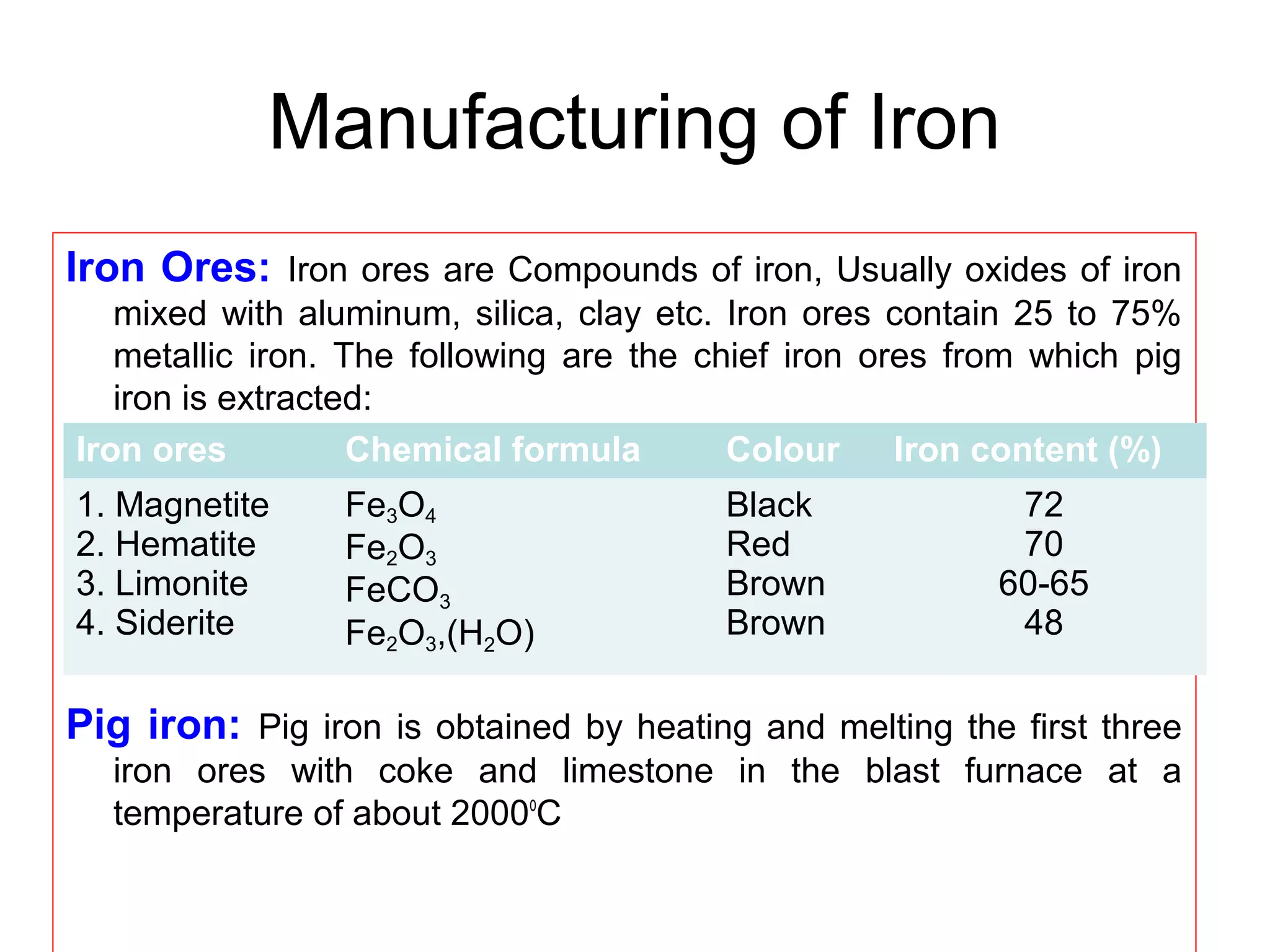
Iron Ores: Iron ores are Compounds of iron, Usually oxides of iron
mixed with aluminum, silica, clay etc. Iron ores contain 25 to 75%
metallic iron. The following are the chief iron ores from which pig
iron is extracted:
Pig iron: Pig iron is obtained by heating and melting the first three
iron ores with coke and limestone in the blast furnace at a
temperature of about 2000o
C
Iron ores Chemical formula Colour Iron content (%)
1. Magnetite
2. Hematite
3. Limonite
4. Siderite
Fe3O4
Fe2O3
FeCO3
Fe2O3,(H2O)
Black
Red
Brown
Brown
72
70
60-65
48
Manufacturing of Iron
Two processes take Place in the
blast furnace: 1. de-oxidations of
iron ores and 2. separation of iron
from impurities like silica, alumina,
clay, sand etc.
 In the first process(called reduction)
coke burns to carbon monoxide,
which releases the iron from the ore.
 In the second process, limestone
Becomes chemically active at high
temperature and forms silicates and
aluminates of calcium, called slag
which are lighter and floats on the top of the molten metallic iron.
The slag is allowed to flow out into a separate container and heavier
molten iron is collected into another container.
Manufacturing of Iron
Blast furnace processing (Chemical reaction):
• In the furnace, the coke reacts with oxygen in the air blast to
produce carbon monoxide:
– 2 C + O2 → 2 CO
• The carbon monoxide reduces the iron ore (in the chemical
equation below, hematite) to molten iron, becoming carbon
dioxide in the process:
– Fe2O3 + 3 CO → 2 Fe + 3 CO2
• Some iron in the high-temperature lower region of the furnace
reacts directly with the coke:
– 2 Fe2O3 + 3 C → 4 Fe + 3 CO2
• The flux present to melt impurities in the ore is principally
limestone (calcium carbonate) and dolomite (calcium-magnesium
carbonate). Other specialized fluxes are used depending on the
details of the ore. In the heat of the furnace the limestone flux
decomposes to calcium oxide (also known as quicklime):
– CaCO3 → CaO + CO2
Manufacturing of Iron
• Then calcium oxide combines with silicon dioxide to form a liquid
slag.
– CaO + SiO2 → CaSiO3
• The slag melts in the heat of the furnace. In the bottom of the
furnace, the molten slag floats on top of the denser molten iron, and
apertures in the side of the furnace are opened to run off the iron
and the slag separately. The iron, once cooled, is called pig iron,
while the slag can be used as a material in road construction or to
improve mineral-poor soils for agriculture.
Composition of Pig Iron
Composition of pig iron:
Classification of Pig iron:
1. Gray Pig Iron: Contains 3-4% free carbon (graphite), <1%
combined carbon. Silicon also 3-4%. Soft variety of pig iron.
2. White Pig Iron: Contains 3 or >3% combined carbon and <1% free
carbon. Silicon <1%. Hard and strong. Wrought iron is made from
it
3. Mottled Pig Iron: Contains equal amount of free & combined carbon
Constituent Percentage of composition
1. Iron
2. Carbon (both free and combined)
3. Silicon
4. Manganese
5. Sulphur and phosphorus
92-94
4-5
1-2
1-2
1-2
Manufacture of Cast Iron
Cast Iron: Cast iron is manufactured by remelting gray pig iron
(foundry pig iron) in a cupola furnace and running it into moulds of
shape required. Cast iron differs considerably from wrought iron in
chemical composition and physical characteristics. The most
important consideration affecting the character and properties of
cast iron is the carbon content. Cast iron is divided into 3 classes
based on the different state of carbon content:
1. Gray Cast Iron: In it carbon occurs chiefly in the graphite state (free
carbon).
2. White Cast Iron: In it carbon occurs chiefly as the carbide of iron
(carbon in chemical combination with iron).
3. Mottled Cast iron: It is a mixture of gray iron with particles of white
iron.
Cupola Furnace
Fig. Cupola furnace in simplified form
Fig. Cupola Furnace
With leveling
Properties and Uses of Cast Iron
Properties of Cast Iron:
1. Cast iron is strong in compression but weak in tension.
2. It is brittle and does not absorb shocks.
3. It does not posses the property of ductility and malleability.
4. Shrinkage of cast iron is high ranges from 0.5 to 3 percent.
Uses of Cast Iron:
1. It is used to make CI pipes (used for water mains and sewers)
2. Making manhole covers, columns with their caps and bases.
3. Carriage wheels, parts of machinery and their structure subject to
compression.
4. Gates, railings, window frames, gratings and other ornamental
works.
Malleable Cast Iron
Malleable Cast Iron: When cast iron is rendered malleable by a
process of annealing, it is called malleable cast iron. Annealing is
a process of heating metal above the critical temperature range,
holding at that temperature for a specific period of time and then
slowly cooling. Annealing makes the free carbon in combined
form and increases considerably the degree of toughness,
ductility and strength.
Uses of malleable cast iron: Malleable cast iron is used in
automobile construction for rear axle housing, brake supports,
steering-rear housing, hubs and pedals. Couplers, journal boxed,
brake fittings etc. use to make many parts of agricultural
machinery, pipes fittings, elbows, union sockets, valves, rings,
window and door fitings. Carpenters’ tool like hammers, saws,
chisels etc. are made from malleable cast iron.
Manufacture of Wrought Iron
Wrought Iron: Wrought iron is manufactured by melting the white pig
iron is a puddling furnace. Wrought iron is the purest form of iron
containing less than 0.12 percent of carbon.
Table. Constituents of typical high quality wrought iron
Constituents Composition (%)
1. Iron
2. Carbon
3. Silicon
4. Phosphorus
5. Sulphur
6. Manganese
7. Slag
96.00
0.10
0.20
0.25
0.05
0.10
3.25
Fig. Puddling Furnace
Properties and Uses of Wrought Iron
Properties of wrought iron: Principal properties of wrought iron are:
1. It becomes pasty and very plastic at red heat and could be forged
about 1650o
F. It melts at 2800o
F.
2. Wrought iron is very malleable and ductile.
3. Its tensile strength varies from 48,000 to 50,000 psi.
4. It is stronger in compression by 25 percent.
5. Shearing strength varies from 20,000 to 35,000 psi.
6. Wrought shows good resistance to fatique and corrosion.
7. Important property, it can be welded with ease.
Uses of wrought iron: Principal uses of wrought iron are:
For standard pipes, bars, rods, wires, plates, sheets, welding fittings,
rivets, etc. Wrought iron products are used for constructing
building, bridge, chemical industries, corrugated sheets (CI
Sheets) and ornamental works.
Steel
• Steel: Steel is an iron-carbon alloy having a carbon content less
than 2.0 percent and generally below 1.5 percent. It usually
contains a substantial quantities of manganese. It is usually
malleable having the properties of toughness as well as strength.
• There are four grades of steel depending on carbon content:
1. Low carbon steel or soft steel: contains from 0.05 to 0.15 percent of
carbon.
2. Medium carbon steel or medium hard steel: contains from 0.15 to
0.30 percent of carbon.
3. Medium high carbon steel or half hard steel: contains from 0.30 to
0.60 percent carbon.
4. High carbon steel or hard steel: contains from 0.60 to 1.50 percent
of carbon.
Manufacture of steel
• There are different varieties of steels that are manufactured under
different controlled condition. The following table shows different
steel making process with typical products:
Sl. No. Process Typical products
1 Basic Bassemer Pipes, tubes, wires, sheets etc.
2 Acid Bassemer Structural shapes, plates, sheets, wires,
rails castings etc.
3 Basic open hearth Structural shapes, sheets, wires, tubes etc.
4 Acid open hearth Large castings and forgings armour plates,
high strength wires
5 Acid Electric Special alloy steels, small castings of
carbon and alloy steel.
6 Basic Electric Special alloy steel, tool steels, high speed
steel, high grade carbon steels etc.
Physical Properties of Steels
Physical properties of steel like strength, ductility, malleability and
elastic properties are depended on:
1.Percent carbon content,
2.Percent content of silicon, sulphur, phosphorus, manganese and
other alloying elements, and
3.Heat treatment and mechanical working,
Effect of carbon: Carbon content influences the physical properties of
plain steel more than any other single factor. Carbon always acts as
a hardener and strengthener, but at the same time it reduces the
ductility.
Effect of silicon: The direct effect of silicon (usually not over 0.2%)
upon strength and ductility is very slight. Increasing the silicon
content to 0.3 or 0.4 percent has the effect of raising the elastic limit
and ultimate strength of the steel considerably without reducing the
ductility greatly.
Physical Properties of Steels
Effect of sulphur: Sulphur within reasonable limits (0.02 to 0.10 %) has no
appreciable effect upon the strength or ductility of steels. But if it is more
than 0.10%, it reduces both the strength and ductility.
Effect of phosphorus: Phosphorus is the most undesirable of all the elements
commonly found in steels. Its effect upon the properties of steel is very
capricious, but it is always detrimental to toughness, shock resistance and
often detrimental to ductility under static load.
Effect of manganese: Manganese has a tendency to improve the strength of
plain carbon steel. But with less than 0.3% manganese, the steel is likely to
be impregnated with oxides the harmful effect which outweights any
beneficial effect due to the manganese. Between 0.3 to 1.0 % beneficial
effects depend upon the amount of carbon present. Manganese content
above 1.5 or 2.0%, steel becomes so brittle.
Effect of heat treatment: Heat treatment improves strength, ductility and
elastic properties of steel depending upon the various composition.
Alloy steels
Alloy steel: An alloy steel may be defined as a steel to which
elements other than carbon are added in sufficient amount to
produce an improvement in properties. The alloying is done for
specific purposes to increase wearing resistance, corrosion
resistance and to improve electrical and magnetic properties, which
can not be obtained in plain carbon steel.
Alloying element: The chief alloying elements used in steel are nickel,
chromium, molybdenum, cobalt, vanadium, manganese, silicon and
tungsten. Following are the effects of alloying elements on steel:
1. Nickel (nickel steel): It increases the strength and toughness of the
steel. Steel containing 0.1 to 0.5% carbon when contains 2 to 5%
nickel contributes great strength and hardness with high elastic limit,
good ductility and good resistance to corrosion. Alloy containing
25% nickel posses maximum toughness and offers the greatest
resistance to rusting, corrosion and burning at high temperature.
Alloy Steels
Uses of nickel steel: Boiler tube, valves for use with superheated stream,
Valves of IC engines and spark plugs for petrol engines. A nickel steel alloy
containing 36% of nickel is known as invar which has nearly zero coefficient
of expansion and is used for measuring instrument and standard of lengths.
2. Chromium (chrome steel): It increases the hardness with high strength
and high elastic limit. It also imparts corrosion-resistance property to steel.
The most common chrome steel contains from 0.5 to 2% chromium and 0.1
to 1.5% carbon.
Uses of chrome steel: The chrome steel is used for balls, rollers and races
for bearings.
3. Nickel chrome steel: A nickel chrome steel containing 3.25% nickel,
1.5% chromium, and 0.25% carbon, and is much used for armour plates. It
is extensively used for motor car crankshafts, axles and gears requiring
great strength and hardness.
Other alloy steels are tungsten steel (cutting tools), Vanadium steel,
Manganese steel, Molybdenum steel, silicon steel, copper steel etc. used for
various purposes.
Stainless steel
Stainless steel: It is defined as that steel which when correctly heat treated and
finished, resists oxidation and corrosive attack from most corrosive media. The
different types (3 types) of stainless steels are discussed below:
1. Martensitic stainless steel: The chromium steels containing 12 to 14%
chromium and 0.12 to 0.35% carbon are first stainless steel developed. Since
these steels possess martensitic structure, therefore, they are called
martensitic stainless steel. They are used for cutlery, springs, surgical and
dental instruments.
2. Ferritic stainless steel: The steels containing greater amount of chromium
(16 to 18%) and about 0.12% carbon are called ferritic stainless steel. These
steel have better corrosion resistant property than martensitic stainless steels.
Used as sheet or strip for cold forming. They may be cold worked or hot
worked.
3. Austenitic stainless steel: The steel containing high content of both
chromium (18%) and nickel (8%) are called austenitic stainless steel. It is also
known as 18/8 steel. Used in the manufacturing of pump shaft, rail road, car
frames and sheathing, screws, nuts and bolts and small springs. Since 18/8
steel provide excellent resistance to attack by many chemicals, therefore it is
extensively used in chemical, food, paper making and dyeing industries.
Heat Treatment of Steel
Heat treatment: The term heat treatment may be defined as an
operation or a combination of operations, involving the heating and
cooling of a metal or an alloy in the solid state for the purpose of
obtaining certain desirable conditions or properties without change
in chemical composition.
The aim of heat treatment is to achieve one or more of the following
objectives:
1. To increase the hardness of metals,
2. To relieve the stresses set up in the material after hot or cold working,
3. To improve machinability,
4. To soften the metal,
5. To modify the structure of the material to improve its electrical and magnetic
properties.
6. To change the grain size,
7. To increase the qualities of a metal to provide better resistance to heat ,
corrosion and wear,
Heat Treatment of Steel
1. Normalizing: The process of normalizing consists of heating the steel above its
upper critical temperature. It is held at this temperature for about 15 minutes and
then allowed to cool down in air. It refines the grain structure, improve machinability,
tensile strength and structure of weld. It removes strains caused by cold working
process like hammering, rolling bending etc.
2. Annealing: The process consists of heating the steel above the upper critical
temperature. Holding it at this temperature for sometime (3-4 minutes for each mm of
thickness) to enable the internal changes to take place. Then cooling slowly in the
furnace. Full annealing heat treatment differs from normalizing heat treatment in that
the annealing temperature is typically 150-200F lower than the normalizing
temperature and the cooling rate is slower. This establishes a soft microstructure and
thus a soft product.
3. Hardening: Hardening is done to increase the hardness of the metal so that it can
resist wear and to make enable it to cut metals.
Process consists of heating metal to a temperature from 30 to 50o
C above the upper
critical point. Then keeping the metal at this temperature for a considerable time and
then cooling suddenly in a suitable cooling medium like water, oil or brine. It makes
metal hard and brittle.
4. Tempering: The tempering process consists of reheating the hardened steel to some
temperature below the lower critical temperature, followed by any desired rate of
cooling. It reduces brittleness of hard steel & increase ductility.
Iron-Carbon Phase Diagram
Iron-Carbon Diagram
Iron-carbon phase diagram describes the iron-carbon system of alloys containing up to 6.67% of carbon, discloses the phases compositions and their transformations occurring with the alloys during their cooling or heating.
•Carbon content 6.67% corresponds to the fixed composition of the iron carbide Fe3C.
•The diagram is presented in the picture:
•The following phases are involved in the transformation, occurring with iron-carbon alloys:
•L - Liquid solution of carbon in iron;
•δ-ferrite – Solid solution of carbon in iron.
•Maximum concentration of carbon in δ-ferrite is 0.09% at 2719 ºF (1493ºC) – temperature of the peritectic transformation.
•The crystal structure of δ-ferrite is BCC (cubic body centered).
•Austenite – interstitial solid solution of carbon in γ-iron.
•Austenite has FCC (cubic face centered) crystal structure, permitting high solubility of carbon – up to 2.06% at 2097 ºF (1147 ºC).
•Austenite does not exist below 1333 ºF (723ºC) and maximum carbon concentration at this temperature is 0.83%.
•α-ferrite – solid solution of carbon in α-iron.
•α-ferrite has BCC crystal structure and low solubility of carbon – up to 0.025% at 1333 ºF (723ºC).
•α-ferrite exists at room temperature.
•Cementite – iron carbide, intermetallic compound, having fixed composition Fe3C.
•Cementite is a hard and brittle substance, influencing on the properties of steels and cast irons.
•The following phase transformations occur with iron-carbon alloys:
•Alloys, containing up to 0.51% of carbon, start solidification with formation of crystals of δ-ferrite. Carbon content in δ-ferrite increases up to 0.09% in course solidification, and at 2719 ºF (1493ºC) remaining liquid phase and δ-ferrite
perform peritectic transformation, resulting in formation of austenite.
•Alloys, containing carbon more than 0.51%, but less than 2.06%, form primary austenite crystals in the beginning of solidification and when the temperature reaches the curve ACM primary cementite stars to form.
•Iron-carbon alloys, containing up to 2.06% of carbon, are called steels.
•Alloys, containing from 2.06 to 6.67% of carbon, experience eutectic transformation at 2097 ºF (1147 ºC). The eutectic concentration of carbon is 4.3%.
•In practice only hypoeutectic alloys are used. These alloys (carbon content from 2.06% to 4.3%) are called cast irons. When temperature of an alloy from this range reaches 2097 ºF (1147 ºC), it contains primary austenite crystals and
some amount of the liquid phase. The latter decomposes by eutectic mechanism to a fine mixture of austenite and cementite, called ledeburite.
•All iron-carbon alloys (steels and cast irons) experience eutectoid transformation at 1333 ºF (723ºC). The eutectoid concentration of carbon is 0.83%.
•When the temperature of an alloy reaches 1333 ºF (733ºC), austenite transforms to pearlite (fine ferrite-cementite structure, forming as a result of decomposition of austenite at slow cooling conditions).
•Critical temperatures
•Upper critical temperature (point) A3 is the temperature, below which ferrite starts to form as a result of ejection from austenite in the hypoeutectoid alloys.
•Upper critical temperature (point) ACM is the temperature, below which cementite starts to form as a result of ejection from austenite in the hypereutectoid alloys.
•Lower critical temperature (point) A1 is the temperature of the austenite-to-pearlite eutectoid transformation. Below this temperature austenite does not exist.
•Magnetic transformation temperature A2 is the temperature below which α-ferrite is ferromagnetic.
•Phase compositions of the iron-carbon alloys at room temperature
•Hypoeutectoid steels (carbon content from 0 to 0.83%) consist of primary (proeutectoid) ferrite (according to the curve A3) and pearlite.
•Eutectoid steel (carbon content 0.83%) entirely consists of pearlite.
•Hypereutectoid steels (carbon content from 0.83 to 2.06%) consist of primary (proeutectoid)cementite (according to the curve ACM) and pearlite.
•Cast irons (carbon content from 2.06% to 4.3%) consist of proeutectoid cementite C2 ejected from austenite according to the curve ACM , pearlite and transformed ledeburite (ledeburite in which austenite transformed to pearlite).
Acid Bassemer Process
Acid Bassemer process: Furnace is made of acid refractories (silica Bricks) steel is made from pig iron by
oxidizing the impurities.
In basic bassemer process: lining is done by basic refractories (dolomite)

iron and steel

  • 1.
    Construction and MaterialFor Food Science and Technology Iron and Steel Md. Abdul Alim
  • 2.
    Iron and Steel Iron:Iron is the most widely used engineering material in the world. It’s a chemical element with symbol is ‘Fe’ having atomic number 26. Iron is also called ferrous metal (Ferrous metal are those which have iron as their main constituent). Ferrous metals commonly used in engineering practice are cast iron, wrought iron, steels and alloy steels. Uses: Applications of iron are almost beyond count: – Skeletal frame work for large multistoried building, – Hulls and superstructure of ships, – Spans and trusses of bridges, – Large/small engine, machine, tools and equipments, – Ducts, flumes, overhead water tank, storage tank etc. – Support for chemical/food processing equipments, – Reinforcement in concretes and many others
  • 3.
    Iron and Steel Sourcesof Iron: Iron is obtained from iron ores in the following sequence: Iron ores Pig Iron Cast iron Wrought Iron Steel
  • 4.
    Manufacturing of Iron IronOres: Iron ores are Compounds of iron, Usually oxides of iron mixed with aluminum, silica, clay etc. Iron ores contain 25 to 75% metallic iron. The following are the chief iron ores from which pig iron is extracted: Pig iron: Pig iron is obtained by heating and melting the first three iron ores with coke and limestone in the blast furnace at a temperature of about 2000o C Iron ores Chemical formula Colour Iron content (%) 1. Magnetite 2. Hematite 3. Limonite 4. Siderite Fe3O4 Fe2O3 FeCO3 Fe2O3,(H2O) Black Red Brown Brown 72 70 60-65 48
  • 5.
    Manufacturing of Iron Twoprocesses take Place in the blast furnace: 1. de-oxidations of iron ores and 2. separation of iron from impurities like silica, alumina, clay, sand etc.  In the first process(called reduction) coke burns to carbon monoxide, which releases the iron from the ore.  In the second process, limestone Becomes chemically active at high temperature and forms silicates and aluminates of calcium, called slag which are lighter and floats on the top of the molten metallic iron. The slag is allowed to flow out into a separate container and heavier molten iron is collected into another container.
  • 6.
    Manufacturing of Iron Blastfurnace processing (Chemical reaction): • In the furnace, the coke reacts with oxygen in the air blast to produce carbon monoxide: – 2 C + O2 → 2 CO • The carbon monoxide reduces the iron ore (in the chemical equation below, hematite) to molten iron, becoming carbon dioxide in the process: – Fe2O3 + 3 CO → 2 Fe + 3 CO2 • Some iron in the high-temperature lower region of the furnace reacts directly with the coke: – 2 Fe2O3 + 3 C → 4 Fe + 3 CO2 • The flux present to melt impurities in the ore is principally limestone (calcium carbonate) and dolomite (calcium-magnesium carbonate). Other specialized fluxes are used depending on the details of the ore. In the heat of the furnace the limestone flux decomposes to calcium oxide (also known as quicklime): – CaCO3 → CaO + CO2
  • 7.
    Manufacturing of Iron •Then calcium oxide combines with silicon dioxide to form a liquid slag. – CaO + SiO2 → CaSiO3 • The slag melts in the heat of the furnace. In the bottom of the furnace, the molten slag floats on top of the denser molten iron, and apertures in the side of the furnace are opened to run off the iron and the slag separately. The iron, once cooled, is called pig iron, while the slag can be used as a material in road construction or to improve mineral-poor soils for agriculture.
  • 8.
    Composition of PigIron Composition of pig iron: Classification of Pig iron: 1. Gray Pig Iron: Contains 3-4% free carbon (graphite), <1% combined carbon. Silicon also 3-4%. Soft variety of pig iron. 2. White Pig Iron: Contains 3 or >3% combined carbon and <1% free carbon. Silicon <1%. Hard and strong. Wrought iron is made from it 3. Mottled Pig Iron: Contains equal amount of free & combined carbon Constituent Percentage of composition 1. Iron 2. Carbon (both free and combined) 3. Silicon 4. Manganese 5. Sulphur and phosphorus 92-94 4-5 1-2 1-2 1-2
  • 9.
    Manufacture of CastIron Cast Iron: Cast iron is manufactured by remelting gray pig iron (foundry pig iron) in a cupola furnace and running it into moulds of shape required. Cast iron differs considerably from wrought iron in chemical composition and physical characteristics. The most important consideration affecting the character and properties of cast iron is the carbon content. Cast iron is divided into 3 classes based on the different state of carbon content: 1. Gray Cast Iron: In it carbon occurs chiefly in the graphite state (free carbon). 2. White Cast Iron: In it carbon occurs chiefly as the carbide of iron (carbon in chemical combination with iron). 3. Mottled Cast iron: It is a mixture of gray iron with particles of white iron.
  • 10.
    Cupola Furnace Fig. Cupolafurnace in simplified form
  • 11.
  • 12.
    Properties and Usesof Cast Iron Properties of Cast Iron: 1. Cast iron is strong in compression but weak in tension. 2. It is brittle and does not absorb shocks. 3. It does not posses the property of ductility and malleability. 4. Shrinkage of cast iron is high ranges from 0.5 to 3 percent. Uses of Cast Iron: 1. It is used to make CI pipes (used for water mains and sewers) 2. Making manhole covers, columns with their caps and bases. 3. Carriage wheels, parts of machinery and their structure subject to compression. 4. Gates, railings, window frames, gratings and other ornamental works.
  • 13.
    Malleable Cast Iron MalleableCast Iron: When cast iron is rendered malleable by a process of annealing, it is called malleable cast iron. Annealing is a process of heating metal above the critical temperature range, holding at that temperature for a specific period of time and then slowly cooling. Annealing makes the free carbon in combined form and increases considerably the degree of toughness, ductility and strength. Uses of malleable cast iron: Malleable cast iron is used in automobile construction for rear axle housing, brake supports, steering-rear housing, hubs and pedals. Couplers, journal boxed, brake fittings etc. use to make many parts of agricultural machinery, pipes fittings, elbows, union sockets, valves, rings, window and door fitings. Carpenters’ tool like hammers, saws, chisels etc. are made from malleable cast iron.
  • 14.
    Manufacture of WroughtIron Wrought Iron: Wrought iron is manufactured by melting the white pig iron is a puddling furnace. Wrought iron is the purest form of iron containing less than 0.12 percent of carbon. Table. Constituents of typical high quality wrought iron Constituents Composition (%) 1. Iron 2. Carbon 3. Silicon 4. Phosphorus 5. Sulphur 6. Manganese 7. Slag 96.00 0.10 0.20 0.25 0.05 0.10 3.25
  • 15.
  • 16.
    Properties and Usesof Wrought Iron Properties of wrought iron: Principal properties of wrought iron are: 1. It becomes pasty and very plastic at red heat and could be forged about 1650o F. It melts at 2800o F. 2. Wrought iron is very malleable and ductile. 3. Its tensile strength varies from 48,000 to 50,000 psi. 4. It is stronger in compression by 25 percent. 5. Shearing strength varies from 20,000 to 35,000 psi. 6. Wrought shows good resistance to fatique and corrosion. 7. Important property, it can be welded with ease. Uses of wrought iron: Principal uses of wrought iron are: For standard pipes, bars, rods, wires, plates, sheets, welding fittings, rivets, etc. Wrought iron products are used for constructing building, bridge, chemical industries, corrugated sheets (CI Sheets) and ornamental works.
  • 17.
    Steel • Steel: Steelis an iron-carbon alloy having a carbon content less than 2.0 percent and generally below 1.5 percent. It usually contains a substantial quantities of manganese. It is usually malleable having the properties of toughness as well as strength. • There are four grades of steel depending on carbon content: 1. Low carbon steel or soft steel: contains from 0.05 to 0.15 percent of carbon. 2. Medium carbon steel or medium hard steel: contains from 0.15 to 0.30 percent of carbon. 3. Medium high carbon steel or half hard steel: contains from 0.30 to 0.60 percent carbon. 4. High carbon steel or hard steel: contains from 0.60 to 1.50 percent of carbon.
  • 18.
    Manufacture of steel •There are different varieties of steels that are manufactured under different controlled condition. The following table shows different steel making process with typical products: Sl. No. Process Typical products 1 Basic Bassemer Pipes, tubes, wires, sheets etc. 2 Acid Bassemer Structural shapes, plates, sheets, wires, rails castings etc. 3 Basic open hearth Structural shapes, sheets, wires, tubes etc. 4 Acid open hearth Large castings and forgings armour plates, high strength wires 5 Acid Electric Special alloy steels, small castings of carbon and alloy steel. 6 Basic Electric Special alloy steel, tool steels, high speed steel, high grade carbon steels etc.
  • 19.
    Physical Properties ofSteels Physical properties of steel like strength, ductility, malleability and elastic properties are depended on: 1.Percent carbon content, 2.Percent content of silicon, sulphur, phosphorus, manganese and other alloying elements, and 3.Heat treatment and mechanical working, Effect of carbon: Carbon content influences the physical properties of plain steel more than any other single factor. Carbon always acts as a hardener and strengthener, but at the same time it reduces the ductility. Effect of silicon: The direct effect of silicon (usually not over 0.2%) upon strength and ductility is very slight. Increasing the silicon content to 0.3 or 0.4 percent has the effect of raising the elastic limit and ultimate strength of the steel considerably without reducing the ductility greatly.
  • 20.
    Physical Properties ofSteels Effect of sulphur: Sulphur within reasonable limits (0.02 to 0.10 %) has no appreciable effect upon the strength or ductility of steels. But if it is more than 0.10%, it reduces both the strength and ductility. Effect of phosphorus: Phosphorus is the most undesirable of all the elements commonly found in steels. Its effect upon the properties of steel is very capricious, but it is always detrimental to toughness, shock resistance and often detrimental to ductility under static load. Effect of manganese: Manganese has a tendency to improve the strength of plain carbon steel. But with less than 0.3% manganese, the steel is likely to be impregnated with oxides the harmful effect which outweights any beneficial effect due to the manganese. Between 0.3 to 1.0 % beneficial effects depend upon the amount of carbon present. Manganese content above 1.5 or 2.0%, steel becomes so brittle. Effect of heat treatment: Heat treatment improves strength, ductility and elastic properties of steel depending upon the various composition.
  • 21.
    Alloy steels Alloy steel:An alloy steel may be defined as a steel to which elements other than carbon are added in sufficient amount to produce an improvement in properties. The alloying is done for specific purposes to increase wearing resistance, corrosion resistance and to improve electrical and magnetic properties, which can not be obtained in plain carbon steel. Alloying element: The chief alloying elements used in steel are nickel, chromium, molybdenum, cobalt, vanadium, manganese, silicon and tungsten. Following are the effects of alloying elements on steel: 1. Nickel (nickel steel): It increases the strength and toughness of the steel. Steel containing 0.1 to 0.5% carbon when contains 2 to 5% nickel contributes great strength and hardness with high elastic limit, good ductility and good resistance to corrosion. Alloy containing 25% nickel posses maximum toughness and offers the greatest resistance to rusting, corrosion and burning at high temperature.
  • 22.
    Alloy Steels Uses ofnickel steel: Boiler tube, valves for use with superheated stream, Valves of IC engines and spark plugs for petrol engines. A nickel steel alloy containing 36% of nickel is known as invar which has nearly zero coefficient of expansion and is used for measuring instrument and standard of lengths. 2. Chromium (chrome steel): It increases the hardness with high strength and high elastic limit. It also imparts corrosion-resistance property to steel. The most common chrome steel contains from 0.5 to 2% chromium and 0.1 to 1.5% carbon. Uses of chrome steel: The chrome steel is used for balls, rollers and races for bearings. 3. Nickel chrome steel: A nickel chrome steel containing 3.25% nickel, 1.5% chromium, and 0.25% carbon, and is much used for armour plates. It is extensively used for motor car crankshafts, axles and gears requiring great strength and hardness. Other alloy steels are tungsten steel (cutting tools), Vanadium steel, Manganese steel, Molybdenum steel, silicon steel, copper steel etc. used for various purposes.
  • 23.
    Stainless steel Stainless steel:It is defined as that steel which when correctly heat treated and finished, resists oxidation and corrosive attack from most corrosive media. The different types (3 types) of stainless steels are discussed below: 1. Martensitic stainless steel: The chromium steels containing 12 to 14% chromium and 0.12 to 0.35% carbon are first stainless steel developed. Since these steels possess martensitic structure, therefore, they are called martensitic stainless steel. They are used for cutlery, springs, surgical and dental instruments. 2. Ferritic stainless steel: The steels containing greater amount of chromium (16 to 18%) and about 0.12% carbon are called ferritic stainless steel. These steel have better corrosion resistant property than martensitic stainless steels. Used as sheet or strip for cold forming. They may be cold worked or hot worked. 3. Austenitic stainless steel: The steel containing high content of both chromium (18%) and nickel (8%) are called austenitic stainless steel. It is also known as 18/8 steel. Used in the manufacturing of pump shaft, rail road, car frames and sheathing, screws, nuts and bolts and small springs. Since 18/8 steel provide excellent resistance to attack by many chemicals, therefore it is extensively used in chemical, food, paper making and dyeing industries.
  • 24.
    Heat Treatment ofSteel Heat treatment: The term heat treatment may be defined as an operation or a combination of operations, involving the heating and cooling of a metal or an alloy in the solid state for the purpose of obtaining certain desirable conditions or properties without change in chemical composition. The aim of heat treatment is to achieve one or more of the following objectives: 1. To increase the hardness of metals, 2. To relieve the stresses set up in the material after hot or cold working, 3. To improve machinability, 4. To soften the metal, 5. To modify the structure of the material to improve its electrical and magnetic properties. 6. To change the grain size, 7. To increase the qualities of a metal to provide better resistance to heat , corrosion and wear,
  • 25.
    Heat Treatment ofSteel 1. Normalizing: The process of normalizing consists of heating the steel above its upper critical temperature. It is held at this temperature for about 15 minutes and then allowed to cool down in air. It refines the grain structure, improve machinability, tensile strength and structure of weld. It removes strains caused by cold working process like hammering, rolling bending etc. 2. Annealing: The process consists of heating the steel above the upper critical temperature. Holding it at this temperature for sometime (3-4 minutes for each mm of thickness) to enable the internal changes to take place. Then cooling slowly in the furnace. Full annealing heat treatment differs from normalizing heat treatment in that the annealing temperature is typically 150-200F lower than the normalizing temperature and the cooling rate is slower. This establishes a soft microstructure and thus a soft product. 3. Hardening: Hardening is done to increase the hardness of the metal so that it can resist wear and to make enable it to cut metals. Process consists of heating metal to a temperature from 30 to 50o C above the upper critical point. Then keeping the metal at this temperature for a considerable time and then cooling suddenly in a suitable cooling medium like water, oil or brine. It makes metal hard and brittle. 4. Tempering: The tempering process consists of reheating the hardened steel to some temperature below the lower critical temperature, followed by any desired rate of cooling. It reduces brittleness of hard steel & increase ductility.
  • 27.
  • 28.
    Iron-Carbon Diagram Iron-carbon phasediagram describes the iron-carbon system of alloys containing up to 6.67% of carbon, discloses the phases compositions and their transformations occurring with the alloys during their cooling or heating. •Carbon content 6.67% corresponds to the fixed composition of the iron carbide Fe3C. •The diagram is presented in the picture: •The following phases are involved in the transformation, occurring with iron-carbon alloys: •L - Liquid solution of carbon in iron; •δ-ferrite – Solid solution of carbon in iron. •Maximum concentration of carbon in δ-ferrite is 0.09% at 2719 ºF (1493ºC) – temperature of the peritectic transformation. •The crystal structure of δ-ferrite is BCC (cubic body centered). •Austenite – interstitial solid solution of carbon in γ-iron. •Austenite has FCC (cubic face centered) crystal structure, permitting high solubility of carbon – up to 2.06% at 2097 ºF (1147 ºC). •Austenite does not exist below 1333 ºF (723ºC) and maximum carbon concentration at this temperature is 0.83%. •α-ferrite – solid solution of carbon in α-iron. •α-ferrite has BCC crystal structure and low solubility of carbon – up to 0.025% at 1333 ºF (723ºC). •α-ferrite exists at room temperature. •Cementite – iron carbide, intermetallic compound, having fixed composition Fe3C. •Cementite is a hard and brittle substance, influencing on the properties of steels and cast irons. •The following phase transformations occur with iron-carbon alloys: •Alloys, containing up to 0.51% of carbon, start solidification with formation of crystals of δ-ferrite. Carbon content in δ-ferrite increases up to 0.09% in course solidification, and at 2719 ºF (1493ºC) remaining liquid phase and δ-ferrite perform peritectic transformation, resulting in formation of austenite. •Alloys, containing carbon more than 0.51%, but less than 2.06%, form primary austenite crystals in the beginning of solidification and when the temperature reaches the curve ACM primary cementite stars to form. •Iron-carbon alloys, containing up to 2.06% of carbon, are called steels. •Alloys, containing from 2.06 to 6.67% of carbon, experience eutectic transformation at 2097 ºF (1147 ºC). The eutectic concentration of carbon is 4.3%. •In practice only hypoeutectic alloys are used. These alloys (carbon content from 2.06% to 4.3%) are called cast irons. When temperature of an alloy from this range reaches 2097 ºF (1147 ºC), it contains primary austenite crystals and some amount of the liquid phase. The latter decomposes by eutectic mechanism to a fine mixture of austenite and cementite, called ledeburite. •All iron-carbon alloys (steels and cast irons) experience eutectoid transformation at 1333 ºF (723ºC). The eutectoid concentration of carbon is 0.83%. •When the temperature of an alloy reaches 1333 ºF (733ºC), austenite transforms to pearlite (fine ferrite-cementite structure, forming as a result of decomposition of austenite at slow cooling conditions). •Critical temperatures •Upper critical temperature (point) A3 is the temperature, below which ferrite starts to form as a result of ejection from austenite in the hypoeutectoid alloys. •Upper critical temperature (point) ACM is the temperature, below which cementite starts to form as a result of ejection from austenite in the hypereutectoid alloys. •Lower critical temperature (point) A1 is the temperature of the austenite-to-pearlite eutectoid transformation. Below this temperature austenite does not exist. •Magnetic transformation temperature A2 is the temperature below which α-ferrite is ferromagnetic. •Phase compositions of the iron-carbon alloys at room temperature •Hypoeutectoid steels (carbon content from 0 to 0.83%) consist of primary (proeutectoid) ferrite (according to the curve A3) and pearlite. •Eutectoid steel (carbon content 0.83%) entirely consists of pearlite. •Hypereutectoid steels (carbon content from 0.83 to 2.06%) consist of primary (proeutectoid)cementite (according to the curve ACM) and pearlite. •Cast irons (carbon content from 2.06% to 4.3%) consist of proeutectoid cementite C2 ejected from austenite according to the curve ACM , pearlite and transformed ledeburite (ledeburite in which austenite transformed to pearlite).
  • 29.
    Acid Bassemer Process AcidBassemer process: Furnace is made of acid refractories (silica Bricks) steel is made from pig iron by oxidizing the impurities. In basic bassemer process: lining is done by basic refractories (dolomite)