KNOWLEDGE BASED SYSTEMS
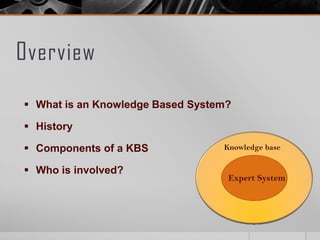
Overview
 What is an Knowledge Based System?
 History
 Components of a KBS
 Who is involved?
Knowledge base
Expert System
» A KBS is a computer program that uses artificial
intelligence to solve problems within a
specialized domain that ordinarily requires
human expertise.
» Typical tasks for expert systems involve
classification, diagnosis, monitoring, design,
scheduling, and planning for specialized tasks.
» Knowledge-based system is a more general than
the expert system.
 Problem-solving power does not lie with smart reasoning
techniques nor clever search algorithms but domain
dependent real-world knowledge.
 Real-world problems do not have well-defined solutions
 KBS allow this knowledge to be represented and creates
an explained solution.
 A KBS draws upon the knowledge of human experts
captured in a knowledge-base to solve problems that
normally require human expertise
 Uses Heuristic (cause-and-effect) rather than algorithms
KBS as real-world problem solvers
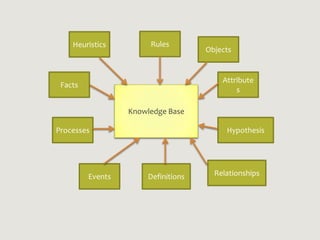
Knowledge Base
Heuristics Rules
Facts
Processes
Events Definitions
Objects
Attribute
s
Hypothesis
Relationships
KBS as diagnostic tool
• Diagnosis - Provides identification about a problem given
a set of symptoms or malfunctions.
• Interpretation – Provides an understanding of a situation
from available information.
• Design – Develops configurations that satisfy constraints
of the problem.
• Monitoring – Checks performance & flags
inconsistencies
• Control – Collects & evaluate evidence and from
opinions on that evidence.
• Debugging – Identifies and prescribes remedies for
malfunctions.
In the 1960s general purpose programs were developed
for solving the classes of problems but this strategy
produced no breakthroughs. In the next decade AI
scientists developed computer programs that could in
some sense think.
It was realized that the problem-solving power of
program comes from the knowledge it possesses.
i.e. To make a program intelligent, provide it with lots of high-quality,
specific knowledge about some problem area.
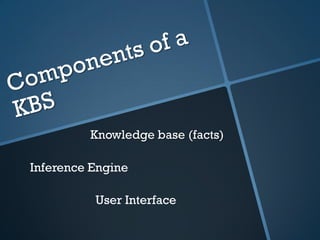
Knowledge base (facts)
Inference Engine
User Interface
Knowledge Base
The component of an expert system that contains the
system’s knowledge organized in collection of facts
about the system’s domain
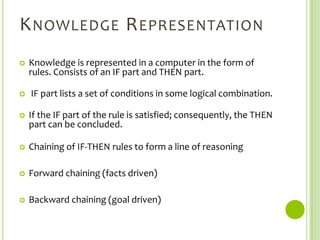
KNOWLEDGE REPRESENTATION
 Knowledge is represented in a computer in the form of
rules. Consists of an IF part and THEN part.
 IF part lists a set of conditions in some logical combination.
 If the IF part of the rule is satisfied; consequently, the THEN
part can be concluded.
 Chaining of IF-THEN rules to form a line of reasoning
 Forward chaining (facts driven)
 Backward chaining (goal driven)
 An inference engine tries to derive answers from a knowledge
base.
 It is the brain of the expert systems that provides a
methodology for reasoning about the information in the
knowledge base, and for formulating conclusions.
Inference Engine
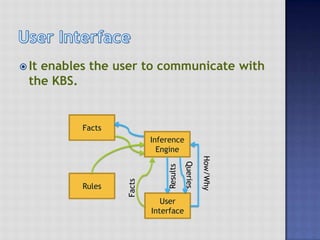
 It enables the user to communicate with
the KBS.
Inference
Engine
Facts
Rules
User
Interface
Results
Queries
How/Why
Facts
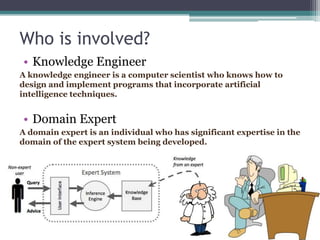
Who is involved?
• Knowledge Engineer
A knowledge engineer is a computer scientist who knows how to
design and implement programs that incorporate artificial
intelligence techniques.
• Domain Expert
A domain expert is an individual who has significant expertise in the
domain of the expert system being developed.
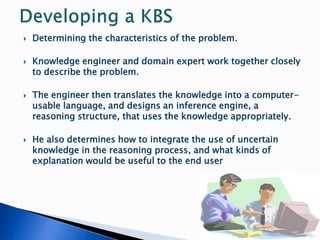
 Determining the characteristics of the problem.
 Knowledge engineer and domain expert work together closely
to describe the problem.
 The engineer then translates the knowledge into a computer-
usable language, and designs an inference engine, a
reasoning structure, that uses the knowledge appropriately.
 He also determines how to integrate the use of uncertain
knowledge in the reasoning process, and what kinds of
explanation would be useful to the end user
HUMAN EXPERTISE VS ARTIFICIAL EXPERTISE
1. Perishable
2. Difficult to transfer
3. Difficult to document
4. Unpredictable
5. Expensive
1. Permanent
2. Easy to transfer
3. Easy to document
4. Consistent
5. Affordable
 An expert system is judged to be successful when it
operates on the level of a human expert.
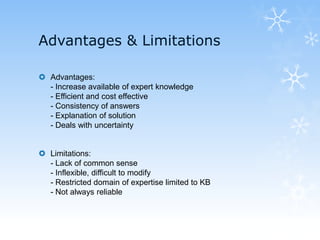
Advantages & Limitations
 Advantages:
- Increase available of expert knowledge
- Efficient and cost effective
- Consistency of answers
- Explanation of solution
- Deals with uncertainty
 Limitations:
- Lack of common sense
- Inflexible, difficult to modify
- Restricted domain of expertise limited to KB
- Not always reliable
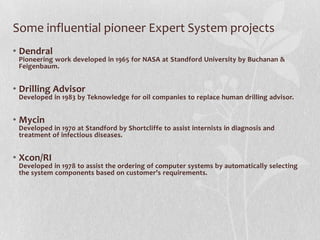
Some influential pioneer Expert System projects
• Dendral
Pioneering work developed in 1965 for NASA at Standford University by Buchanan &
Feigenbaum.
• Drilling Advisor
Developed in 1983 by Teknowledge for oil companies to replace human drilling advisor.
• Mycin
Developed in 1970 at Standford by Shortcliffe to assist internists in diagnosis and
treatment of infectious diseases.
• Xcon/RI
Developed in 1978 to assist the ordering of computer systems by automatically selecting
the system components based on customer’s requirements.

The End

Knowledge based systems

  • 1.
  • 2.
    Overview  What isan Knowledge Based System?  History  Components of a KBS  Who is involved? Knowledge base Expert System
  • 3.
    » A KBSis a computer program that uses artificial intelligence to solve problems within a specialized domain that ordinarily requires human expertise. » Typical tasks for expert systems involve classification, diagnosis, monitoring, design, scheduling, and planning for specialized tasks. » Knowledge-based system is a more general than the expert system.
  • 4.
     Problem-solving powerdoes not lie with smart reasoning techniques nor clever search algorithms but domain dependent real-world knowledge.  Real-world problems do not have well-defined solutions  KBS allow this knowledge to be represented and creates an explained solution.  A KBS draws upon the knowledge of human experts captured in a knowledge-base to solve problems that normally require human expertise  Uses Heuristic (cause-and-effect) rather than algorithms KBS as real-world problem solvers
  • 5.
    Knowledge Base Heuristics Rules Facts Processes EventsDefinitions Objects Attribute s Hypothesis Relationships
  • 6.
    KBS as diagnostictool • Diagnosis - Provides identification about a problem given a set of symptoms or malfunctions. • Interpretation – Provides an understanding of a situation from available information. • Design – Develops configurations that satisfy constraints of the problem. • Monitoring – Checks performance & flags inconsistencies • Control – Collects & evaluate evidence and from opinions on that evidence. • Debugging – Identifies and prescribes remedies for malfunctions.
  • 7.
    In the 1960sgeneral purpose programs were developed for solving the classes of problems but this strategy produced no breakthroughs. In the next decade AI scientists developed computer programs that could in some sense think. It was realized that the problem-solving power of program comes from the knowledge it possesses. i.e. To make a program intelligent, provide it with lots of high-quality, specific knowledge about some problem area.
  • 8.
    Knowledge base (facts) InferenceEngine User Interface
  • 9.
    Knowledge Base The componentof an expert system that contains the system’s knowledge organized in collection of facts about the system’s domain
  • 10.
    KNOWLEDGE REPRESENTATION  Knowledgeis represented in a computer in the form of rules. Consists of an IF part and THEN part.  IF part lists a set of conditions in some logical combination.  If the IF part of the rule is satisfied; consequently, the THEN part can be concluded.  Chaining of IF-THEN rules to form a line of reasoning  Forward chaining (facts driven)  Backward chaining (goal driven)
  • 11.
     An inferenceengine tries to derive answers from a knowledge base.  It is the brain of the expert systems that provides a methodology for reasoning about the information in the knowledge base, and for formulating conclusions. Inference Engine
  • 12.
     It enablesthe user to communicate with the KBS. Inference Engine Facts Rules User Interface Results Queries How/Why Facts
  • 13.
    Who is involved? •Knowledge Engineer A knowledge engineer is a computer scientist who knows how to design and implement programs that incorporate artificial intelligence techniques. • Domain Expert A domain expert is an individual who has significant expertise in the domain of the expert system being developed.
  • 14.
     Determining thecharacteristics of the problem.  Knowledge engineer and domain expert work together closely to describe the problem.  The engineer then translates the knowledge into a computer- usable language, and designs an inference engine, a reasoning structure, that uses the knowledge appropriately.  He also determines how to integrate the use of uncertain knowledge in the reasoning process, and what kinds of explanation would be useful to the end user
  • 15.
    HUMAN EXPERTISE VSARTIFICIAL EXPERTISE 1. Perishable 2. Difficult to transfer 3. Difficult to document 4. Unpredictable 5. Expensive 1. Permanent 2. Easy to transfer 3. Easy to document 4. Consistent 5. Affordable  An expert system is judged to be successful when it operates on the level of a human expert.
  • 16.
    Advantages & Limitations Advantages: - Increase available of expert knowledge - Efficient and cost effective - Consistency of answers - Explanation of solution - Deals with uncertainty  Limitations: - Lack of common sense - Inflexible, difficult to modify - Restricted domain of expertise limited to KB - Not always reliable
  • 17.
    Some influential pioneerExpert System projects • Dendral Pioneering work developed in 1965 for NASA at Standford University by Buchanan & Feigenbaum. • Drilling Advisor Developed in 1983 by Teknowledge for oil companies to replace human drilling advisor. • Mycin Developed in 1970 at Standford by Shortcliffe to assist internists in diagnosis and treatment of infectious diseases. • Xcon/RI Developed in 1978 to assist the ordering of computer systems by automatically selecting the system components based on customer’s requirements.
  • 18.