ADAMA SCIENCE AND
TECHNOLOGY UNIVERSITY
NO NAME ID NUMBER
1 Addisu Gebiru …………………………… UGR1952312
2 Amin Ahmed ……………..................... UGR2382513
3 Biruk Hussen …………………………… UGR2369613
4 Beshar Bashir …………………………… UGR2391013
5 Daniel Basaznew…………………………… UGR2296013
6 Jibril Jundi …………………………… UGR2279813
7 Mikiyas Getachew ………………………... UGR2310113
8 Million Teklehaymanot…………………….. UGR2283813
9 Natnael Demeke…………………………… UGR2268713
10 Tofik Kemal ……………………………….. UGR2395713
Engineering Material 2 ASSIGNMENT 1
Submitted to :- inst. Yeshialem Zewdie
Submission Date JUNE  15  2022
BLAST FURNACE AND PIG
IRON PRODUCTION
Iron ores
IRON ORES
• Iron is extracted from iron ores found in the earth crust.
• Iron ores are relatively concentrated deposits and the extracting process
is relatively cheap.
• The economic advantage of iron extraction together with excellent
combination of the products’ properties makes them the most widely
used metals.
• Iron and steel products account more than 60% of the metal use. Iron ores may
presents in forms of oxides, sulphide, or carbonate.
ORE PREPARATION
• Mechanically remove impurities, such as rock, sand and stone
• Crush into smaller sizes
• Separate by magnetic separator or flotation
• Chemically change non-oxide ores to a form of oxide ores
• After separated from impurities, oxide-typed ores are usually mixed with clay
and formed into pallets, which are then hardened by sintering. (Pallet must
be heavy and strong enough not to be blown away or break by blasting air).
• These processes together are sometimes called palletizing.
IRON SMELTING
• Iron is usually smelted (extraction of metal from ore) in a blast furnace,
which is a shaft-typed furnace with a height of 60 m or more.
• Production takes place on a continuous basis; once the furnace is running it
is usually not economical to shut down so frequently.
• Although, blast furnace is the mainstream method of extracting iron, it is
also possible to extract iron by other smelting methods such as Direct
reduction, Electric smelting and Reducing by hydrogen.
PIG IRON PRODUCTION
• Blast furnace iron may be made into castings either by melting it (grey
variety) in a cupola or by melting it (white pig iron) in an air furnace.
• These white castings may be further heated (annealing) to produce malleable
castings.
• Pig iron produced in the blast furnace may also be refined to wrought iron by
the paddling process.
• Wrought iron may be further treated to produce cast steel or made into
cemented bars to produce what is known as shear.
CONT…
Manufacture of pig iron: Pig iron is produced from the iron ore in the blast furnace.
• The iron ore, coke and lime stone mixture are fed into the furnace, through a
double bell and cone arrangement.
• The charge comes down slowly. It is melted on reaching the lower position of
the furnace.
• Molten iron is tapped through the tap hole and slag thro’ cinder notch from
time to time.
CONT…
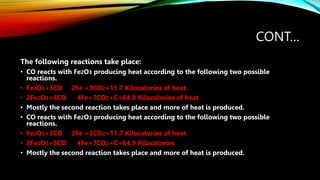
The following reactions take place:
• CO reacts with Fe2O3 producing heat according to the following two possible
reactions.
• Fe2O3+3CO 2Fe +3CO2+11.7 Kilocalories of heat.
• 2Fe2O3+8CO 4Fe+7CO2+C+64.9 Kilocalories of heat
• Mostly the second reaction takes place and more of heat is produced.
• CO reacts with Fe2O3 producing heat according to the following two possible
reactions.
• Fe2O3+3CO 2Fe +3CO2+11.7 Kilocalories of heat.
• 2Fe2O3+8CO 4Fe+7CO2+C+64.9 Kilocalories of heat
• Mostly the second reaction takes place and more of heat is produced.
BLAST FURNACE
• A blast furnace is a type of metallurgical furnace used for smelting to
produce metals, generally iron. In a blast furnace, fuel and ore are
continuously supplied through the top of the furnace, while air (sometimes with
oxygen enrichment) is blown into the bottom of the chamber, so that the
chemical reactions take place throughout the furnace as the material moves
downward. The end products are usually molten metal and slag phases
tapped from the bottom, and flue gases exiting from the top of the furnace.
CONT…
• Blast furnace description: The blast furnace is a hollow steel shaft,
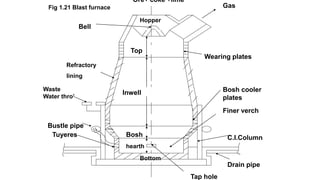
which is lined on the inside by means of refractory fire bricks (Fig 1.21).
• The furnace is full of charge of iron ore, coke and flux (usually lime
stone). Molten pig iron and slag are produced in the process.
• In the blast furnace, function of the flux is to convert the gangue into a
fusible form, so that it may be separated from molten iron.
• In order to make the slag fusible, there must be proper balance between
the acidic constituents, silica and secondarily alumina and basic
constituents, lime and secondarily magnesia.
• Slag roughly consists of 50% acidic and 50% basic constituents but it
varies in accordance with the ore used and the quality of iron to be
produced.
Gas
Ore+ coke +lime
Wearing plates
Bell
Top
Inwell
Bosh
Waste
Water thro’
Bustle pipe
Tuyeres
hearth
Bottom
Drain pipe
C.I.Column
Tap hole
Hopper
Finer verch
Bosh cooler
plates
Refractory
lining
Fig 1.21 Blast furnace
CONT…
• The main objective of blast furnace iron making is to produce hot metal with
consistent quality for the BOP (Basic Oxygen Process) steelmaking process. A
modern large blast furnace has a hearth diameter of 14–15 m, and a height of 35 m
with an internal volume of about 4500 m3. One such large blast furnace can
produce 10,000 tonnes hot metal per day. The hot metal and molten slag are then
discharged at fixed intervals (usually 2-5 hours) by opening the tap-holes and
cinder notches in the furnace wall.
• Hot metal is the main product of the blast furnace process. It is carbon saturated
iron with a number of impurities such as silicon, manganese, sulfur and
phosphorus. It is tapped from the blast furnace hearth at a temperature between
1480 °C and 1520 °C.
CHARACTERISTICS OF PIG IRON
• Pig iron is an impure form of iron containing excessive amounts impurities.
• It is weak and brittle.
• It is available in various compositions: typical composition is 3-4.5%C –
0.5-6%Mn – 0.3-2.5%Si – 0.01-0.12%S – 0.05-2.2%P
• Its quality depends mainly on the quality of raw materials, and process
control and efficiency.
• Carbon presents in forms of either cementite (Fe3C) or graphite.
• Microstructures are similar to those of ordinary grey and white cast irons.
THE PIG IRON IS CLASSIFIED INTO TWO
CLASSES:
• I. Grey pig irons: high in silicon content (2.5% or more), which favors the
formation of graphite. They are usually used for producing grey cast
irons.
• II. White pig irons: low in silicon content (~0.5%) and/or contain high
percentage of manganese, both of which favors the formation of
cementite. They are usually used in steelmaking and for producing
white cast irons.
blast furnace.pptx

blast furnace.pptx

  • 1.
    ADAMA SCIENCE AND TECHNOLOGYUNIVERSITY NO NAME ID NUMBER 1 Addisu Gebiru …………………………… UGR1952312 2 Amin Ahmed ……………..................... UGR2382513 3 Biruk Hussen …………………………… UGR2369613 4 Beshar Bashir …………………………… UGR2391013 5 Daniel Basaznew…………………………… UGR2296013 6 Jibril Jundi …………………………… UGR2279813 7 Mikiyas Getachew ………………………... UGR2310113 8 Million Teklehaymanot…………………….. UGR2283813 9 Natnael Demeke…………………………… UGR2268713 10 Tofik Kemal ……………………………….. UGR2395713 Engineering Material 2 ASSIGNMENT 1 Submitted to :- inst. Yeshialem Zewdie Submission Date JUNE 15 2022
  • 2.
    BLAST FURNACE ANDPIG IRON PRODUCTION Iron ores
  • 3.
    IRON ORES • Ironis extracted from iron ores found in the earth crust. • Iron ores are relatively concentrated deposits and the extracting process is relatively cheap. • The economic advantage of iron extraction together with excellent combination of the products’ properties makes them the most widely used metals. • Iron and steel products account more than 60% of the metal use. Iron ores may presents in forms of oxides, sulphide, or carbonate.
  • 4.
    ORE PREPARATION • Mechanicallyremove impurities, such as rock, sand and stone • Crush into smaller sizes • Separate by magnetic separator or flotation • Chemically change non-oxide ores to a form of oxide ores • After separated from impurities, oxide-typed ores are usually mixed with clay and formed into pallets, which are then hardened by sintering. (Pallet must be heavy and strong enough not to be blown away or break by blasting air). • These processes together are sometimes called palletizing.
  • 5.
    IRON SMELTING • Ironis usually smelted (extraction of metal from ore) in a blast furnace, which is a shaft-typed furnace with a height of 60 m or more. • Production takes place on a continuous basis; once the furnace is running it is usually not economical to shut down so frequently. • Although, blast furnace is the mainstream method of extracting iron, it is also possible to extract iron by other smelting methods such as Direct reduction, Electric smelting and Reducing by hydrogen.
  • 6.
    PIG IRON PRODUCTION •Blast furnace iron may be made into castings either by melting it (grey variety) in a cupola or by melting it (white pig iron) in an air furnace. • These white castings may be further heated (annealing) to produce malleable castings. • Pig iron produced in the blast furnace may also be refined to wrought iron by the paddling process. • Wrought iron may be further treated to produce cast steel or made into cemented bars to produce what is known as shear.
  • 7.
    CONT… Manufacture of pigiron: Pig iron is produced from the iron ore in the blast furnace. • The iron ore, coke and lime stone mixture are fed into the furnace, through a double bell and cone arrangement. • The charge comes down slowly. It is melted on reaching the lower position of the furnace. • Molten iron is tapped through the tap hole and slag thro’ cinder notch from time to time.
  • 8.
    CONT… The following reactionstake place: • CO reacts with Fe2O3 producing heat according to the following two possible reactions. • Fe2O3+3CO 2Fe +3CO2+11.7 Kilocalories of heat. • 2Fe2O3+8CO 4Fe+7CO2+C+64.9 Kilocalories of heat • Mostly the second reaction takes place and more of heat is produced. • CO reacts with Fe2O3 producing heat according to the following two possible reactions. • Fe2O3+3CO 2Fe +3CO2+11.7 Kilocalories of heat. • 2Fe2O3+8CO 4Fe+7CO2+C+64.9 Kilocalories of heat • Mostly the second reaction takes place and more of heat is produced.
  • 9.
    BLAST FURNACE • Ablast furnace is a type of metallurgical furnace used for smelting to produce metals, generally iron. In a blast furnace, fuel and ore are continuously supplied through the top of the furnace, while air (sometimes with oxygen enrichment) is blown into the bottom of the chamber, so that the chemical reactions take place throughout the furnace as the material moves downward. The end products are usually molten metal and slag phases tapped from the bottom, and flue gases exiting from the top of the furnace.
  • 10.
    CONT… • Blast furnacedescription: The blast furnace is a hollow steel shaft, which is lined on the inside by means of refractory fire bricks (Fig 1.21). • The furnace is full of charge of iron ore, coke and flux (usually lime stone). Molten pig iron and slag are produced in the process. • In the blast furnace, function of the flux is to convert the gangue into a fusible form, so that it may be separated from molten iron. • In order to make the slag fusible, there must be proper balance between the acidic constituents, silica and secondarily alumina and basic constituents, lime and secondarily magnesia. • Slag roughly consists of 50% acidic and 50% basic constituents but it varies in accordance with the ore used and the quality of iron to be produced.
  • 11.
    Gas Ore+ coke +lime Wearingplates Bell Top Inwell Bosh Waste Water thro’ Bustle pipe Tuyeres hearth Bottom Drain pipe C.I.Column Tap hole Hopper Finer verch Bosh cooler plates Refractory lining Fig 1.21 Blast furnace
  • 12.
    CONT… • The mainobjective of blast furnace iron making is to produce hot metal with consistent quality for the BOP (Basic Oxygen Process) steelmaking process. A modern large blast furnace has a hearth diameter of 14–15 m, and a height of 35 m with an internal volume of about 4500 m3. One such large blast furnace can produce 10,000 tonnes hot metal per day. The hot metal and molten slag are then discharged at fixed intervals (usually 2-5 hours) by opening the tap-holes and cinder notches in the furnace wall. • Hot metal is the main product of the blast furnace process. It is carbon saturated iron with a number of impurities such as silicon, manganese, sulfur and phosphorus. It is tapped from the blast furnace hearth at a temperature between 1480 °C and 1520 °C.
  • 13.
    CHARACTERISTICS OF PIGIRON • Pig iron is an impure form of iron containing excessive amounts impurities. • It is weak and brittle. • It is available in various compositions: typical composition is 3-4.5%C – 0.5-6%Mn – 0.3-2.5%Si – 0.01-0.12%S – 0.05-2.2%P • Its quality depends mainly on the quality of raw materials, and process control and efficiency. • Carbon presents in forms of either cementite (Fe3C) or graphite. • Microstructures are similar to those of ordinary grey and white cast irons.
  • 14.
    THE PIG IRONIS CLASSIFIED INTO TWO CLASSES: • I. Grey pig irons: high in silicon content (2.5% or more), which favors the formation of graphite. They are usually used for producing grey cast irons. • II. White pig irons: low in silicon content (~0.5%) and/or contain high percentage of manganese, both of which favors the formation of cementite. They are usually used in steelmaking and for producing white cast irons.